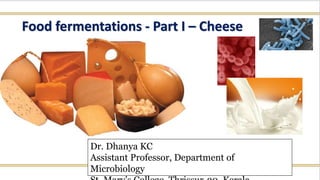
Food fermentations - Part I – Cheese
Dr. Dhanya KC
Assistant Professor, Department of
Microbiology
Cheese - obtained by coagulation of milk protein
Consolidated curd of milk solids - milk fat entrapped by coagulated casein
Yield of cheese from milk - 10%
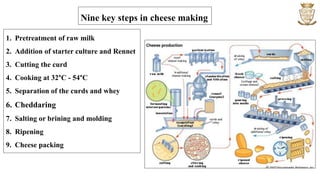
Nine key steps in cheese making
1. Pretreatment of raw milk
2. Addition of starter culture and Rennet
3. Cutting the curd
4. Cooking at 32°C - 54°C
5. Separation of the curds and whey
6. Cheddaring
7. Salting or brining and molding
8. Ripening
9. Cheese packing
Nine key steps in cheese-making
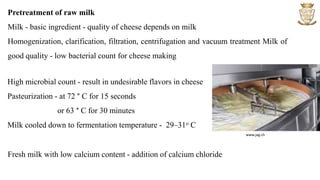
High microbial count - result in undesirable flavors in cheese
Pasteurization - at 72 ° C for 15 seconds
or 63 ° C for 30 minutes
Milk cooled down to fermentation temperature - 29–31o C
Pretreatment of raw milk
Milk - basic ingredient - quality of cheese depends on milk
Homogenization, clarification, filtration, centrifugation and vacuum treatment Milk of
good quality - low bacterial count for cheese making
Fresh milk with low calcium content - addition of calcium chloride
www.jag.ch
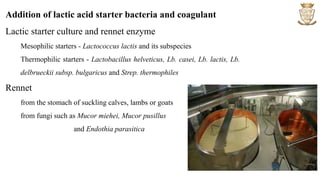
Addition of lactic acid starter bacteria and coagulant
Lactic starter culture and rennet enzyme
Mesophilic starters - Lactococcus lactis and its subspecies
Thermophilic starters - Lactobacillus helveticus, Lb. casei, Lb. lactis, Lb.
delbrueckii subsp. bulgaricus and Strep. thermophiles
Rennet
from the stomach of suckling calves, lambs or goats
from fungi such as Mucor miehei, Mucor pusillus
and Endothia parasitica
Curds - milk solids, fats and proteins
Whey - mostly water
Role of starter organisms - fermentation of milk lactose to
lactic acid to decrease the pH
 Increases the shelf-life and safety of the cheese
 Gives a sharp, fresh flavour
 Aids in moisture expulsion, curd shrinkage, cheese texture
Addition of lactic acid starter bacteria and coagulant
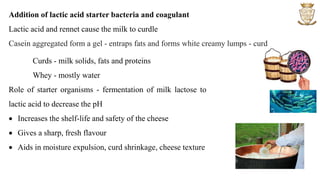
Lactic acid and rennet cause the milk to curdle
Casein aggregated form a gel - entraps fats and forms white creamy lumps - curd
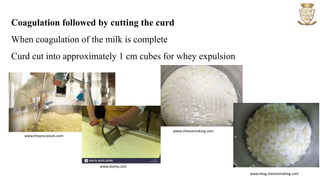
Coagulation followed by cutting the curd
When coagulation of the milk is complete
Curd cut into approximately 1 cm cubes for whey expulsion
www.blog.cheesemaking.com
www.cheesemaking.com
www.alamy.com
www.thepruceeats.com
Cooking to temperatures from 32°C to 54°C
Whey expulsion - by scalding - curd is heated to 32°C to 54°C
curd will shrink and become firm
www.blog.cheesemaking.com
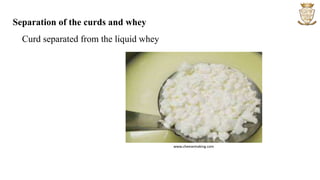
Separation of the curds and whey
Curd separated from the liquid whey
www.cheesemaking.com
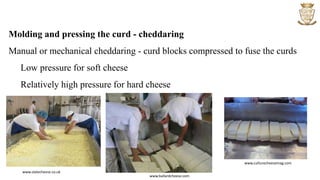
Molding and pressing the curd - cheddaring
Manual or mechanical cheddaring - curd blocks compressed to fuse the curds
Low pressure for soft cheese
Relatively high pressure for hard cheese
www.slatecheese.co.uk
www.culturecheesemag.com
www.ballardcheese.com
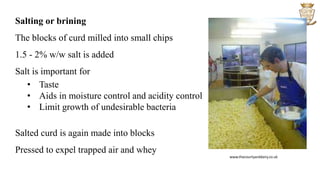
Salting or brining
The blocks of curd milled into small chips
1.5 - 2% w/w salt is added
Salt is important for
• Taste
• Aids in moisture control and acidity control
• Limit growth of undesirable bacteria
Salted curd is again made into blocks
Pressed to expel trapped air and whey
www.thecourtyarddairy.co.uk
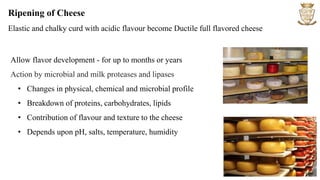
Allow flavor development - for up to months or years
Action by microbial and milk proteases and lipases
• Changes in physical, chemical and microbial profile
• Breakdown of proteins, carbohydrates, lipids
• Contribution of flavour and texture to the cheese
• Depends upon pH, salts, temperature, humidity
Ripening of Cheese
Elastic and chalky curd with acidic flavour become Ductile full flavored cheese
Ripening of Cheese
Lysozyme - hard-cooked Emmental, Gouda and Gruyere cheeses
Prevent growth of Clostridium tyrobutyricum
Propionibacterium freundenreichii ssp. shermanii - Swiss cheeses, e.g. Emmental and Gruyere
Modify the flavour and generate gas bubbles - holes or eyes within cheese
Penicillium roqueforti - Blue-veined cheeses, e.g. Danish Blue, Stilton, Roquefort
Ripened for up to a year
Develop the characteristic blue veins
Penicillium camemberti - Surface-ripened soft cheeses such as Camembert and Brie
Grows on the surface of the cheese
Produce the characteristic white crust or rind
Propionibacterium spp. Yeasts, micrococci, and Brevibacterium linens
Characteristic flavor of Limburger cheese
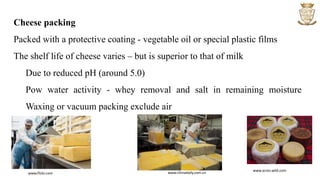
Cheese packing
Packed with a protective coating - vegetable oil or special plastic films
The shelf life of cheese varies – but is superior to that of milk
Due to reduced pH (around 5.0)
Pow water activity - whey removal and salt in remaining moisture
Waxing or vacuum packing exclude air
www.acres.wild.com
www.chinadaily.com.cnwww.flickr.com
Problems encountered in Cheese manufacture
Bacteriophage infections of starter cultures
Acidification slows or even stops - financial losses - pathogens might grow
To tackle the situation - use of
Phage inhibitory media
Rotation of strains
Phage- resistant bacterial strains
Types of cheese
Various types and flavors of cheese - a thousand types of cheese
Depending on Properties and treatment of milk and Method of production
Classification of cheeses difficult
Most successful approach - based on
Moisture content
Milk type
Role of microorganisms in ripening
• Soft cheese
• Semi soft cheese
• Hard cheese
• Very hard cheese
Moisture
Content
50–80%
Type Examples
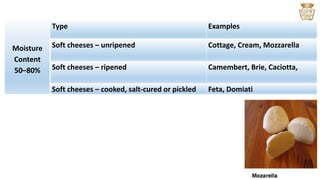
Soft cheeses – unripened Cottage, Cream, Mozzarella
Soft cheeses – ripened Camembert, Brie, Caciotta,
Soft cheeses – cooked, salt-cured or pickled Feta, Domiati
Moisture
Content
39–50%
Type Examples
Semi soft cheeses - ripened principally by
internal mould growth
Roquefort, Stilton, Danish Blue
Semi soft cheeses - ripened by bacteria and
surface micro-organisms
Limburger, Trappist
Semi soft cheeses - ripened primarily by bacteria Brick, Gouda, Edam
Roquefort
Moisture
Content <39%
Type Examples
Hard cheeses - without eyes, ripened by
bacteria
Cheddar, Caciocavallo
Hard cheeses - with eyes, ripened by
bacteria
Emmental, Gruyere
Moisture
Content <34%
Very hard cheeses Parmesan, Romano, Grana
References
1. Modern Industrial Microbiology and Biotechnology, Nduka Okafor, Science
Publishers
2. Dairy Microbiology – Handbook, Richard K. Robinson, Third Edition, Wiley
Interscience Publications
3. Industrial Microbiology: An Introduction, M J. Waites, N L. Morgan, J S. Rockey,
G Higton
4. Food Microbiology, Third Edition, Martin R. Adams and Maurice O. Moss
University of Surrey, Surrey, Guildford, UK.

Cheese fermentation

  • 1.
    Food fermentations -Part I – Cheese Dr. Dhanya KC Assistant Professor, Department of Microbiology
  • 2.
    Cheese - obtainedby coagulation of milk protein Consolidated curd of milk solids - milk fat entrapped by coagulated casein Yield of cheese from milk - 10%
  • 3.
    Nine key stepsin cheese making 1. Pretreatment of raw milk 2. Addition of starter culture and Rennet 3. Cutting the curd 4. Cooking at 32°C - 54°C 5. Separation of the curds and whey 6. Cheddaring 7. Salting or brining and molding 8. Ripening 9. Cheese packing
  • 4.
    Nine key stepsin cheese-making
  • 5.
    High microbial count- result in undesirable flavors in cheese Pasteurization - at 72 ° C for 15 seconds or 63 ° C for 30 minutes Milk cooled down to fermentation temperature - 29–31o C Pretreatment of raw milk Milk - basic ingredient - quality of cheese depends on milk Homogenization, clarification, filtration, centrifugation and vacuum treatment Milk of good quality - low bacterial count for cheese making Fresh milk with low calcium content - addition of calcium chloride www.jag.ch
  • 6.
    Addition of lacticacid starter bacteria and coagulant Lactic starter culture and rennet enzyme Mesophilic starters - Lactococcus lactis and its subspecies Thermophilic starters - Lactobacillus helveticus, Lb. casei, Lb. lactis, Lb. delbrueckii subsp. bulgaricus and Strep. thermophiles Rennet from the stomach of suckling calves, lambs or goats from fungi such as Mucor miehei, Mucor pusillus and Endothia parasitica
  • 7.
    Curds - milksolids, fats and proteins Whey - mostly water Role of starter organisms - fermentation of milk lactose to lactic acid to decrease the pH  Increases the shelf-life and safety of the cheese  Gives a sharp, fresh flavour  Aids in moisture expulsion, curd shrinkage, cheese texture Addition of lactic acid starter bacteria and coagulant Lactic acid and rennet cause the milk to curdle Casein aggregated form a gel - entraps fats and forms white creamy lumps - curd
  • 8.
    Coagulation followed bycutting the curd When coagulation of the milk is complete Curd cut into approximately 1 cm cubes for whey expulsion www.blog.cheesemaking.com www.cheesemaking.com www.alamy.com www.thepruceeats.com
  • 9.
    Cooking to temperaturesfrom 32°C to 54°C Whey expulsion - by scalding - curd is heated to 32°C to 54°C curd will shrink and become firm www.blog.cheesemaking.com
  • 10.
    Separation of thecurds and whey Curd separated from the liquid whey www.cheesemaking.com
  • 11.
    Molding and pressingthe curd - cheddaring Manual or mechanical cheddaring - curd blocks compressed to fuse the curds Low pressure for soft cheese Relatively high pressure for hard cheese www.slatecheese.co.uk www.culturecheesemag.com www.ballardcheese.com
  • 12.
    Salting or brining Theblocks of curd milled into small chips 1.5 - 2% w/w salt is added Salt is important for • Taste • Aids in moisture control and acidity control • Limit growth of undesirable bacteria Salted curd is again made into blocks Pressed to expel trapped air and whey www.thecourtyarddairy.co.uk
  • 13.
    Allow flavor development- for up to months or years Action by microbial and milk proteases and lipases • Changes in physical, chemical and microbial profile • Breakdown of proteins, carbohydrates, lipids • Contribution of flavour and texture to the cheese • Depends upon pH, salts, temperature, humidity Ripening of Cheese Elastic and chalky curd with acidic flavour become Ductile full flavored cheese
  • 14.
    Ripening of Cheese Lysozyme- hard-cooked Emmental, Gouda and Gruyere cheeses Prevent growth of Clostridium tyrobutyricum Propionibacterium freundenreichii ssp. shermanii - Swiss cheeses, e.g. Emmental and Gruyere Modify the flavour and generate gas bubbles - holes or eyes within cheese Penicillium roqueforti - Blue-veined cheeses, e.g. Danish Blue, Stilton, Roquefort Ripened for up to a year Develop the characteristic blue veins Penicillium camemberti - Surface-ripened soft cheeses such as Camembert and Brie Grows on the surface of the cheese Produce the characteristic white crust or rind Propionibacterium spp. Yeasts, micrococci, and Brevibacterium linens Characteristic flavor of Limburger cheese
  • 15.
    Cheese packing Packed witha protective coating - vegetable oil or special plastic films The shelf life of cheese varies – but is superior to that of milk Due to reduced pH (around 5.0) Pow water activity - whey removal and salt in remaining moisture Waxing or vacuum packing exclude air www.acres.wild.com www.chinadaily.com.cnwww.flickr.com
  • 16.
    Problems encountered inCheese manufacture Bacteriophage infections of starter cultures Acidification slows or even stops - financial losses - pathogens might grow To tackle the situation - use of Phage inhibitory media Rotation of strains Phage- resistant bacterial strains
  • 17.
    Types of cheese Varioustypes and flavors of cheese - a thousand types of cheese Depending on Properties and treatment of milk and Method of production Classification of cheeses difficult Most successful approach - based on Moisture content Milk type Role of microorganisms in ripening • Soft cheese • Semi soft cheese • Hard cheese • Very hard cheese
  • 18.
    Moisture Content 50–80% Type Examples Soft cheeses– unripened Cottage, Cream, Mozzarella Soft cheeses – ripened Camembert, Brie, Caciotta, Soft cheeses – cooked, salt-cured or pickled Feta, Domiati
  • 19.
    Moisture Content 39–50% Type Examples Semi softcheeses - ripened principally by internal mould growth Roquefort, Stilton, Danish Blue Semi soft cheeses - ripened by bacteria and surface micro-organisms Limburger, Trappist Semi soft cheeses - ripened primarily by bacteria Brick, Gouda, Edam Roquefort
  • 20.
    Moisture Content <39% Type Examples Hardcheeses - without eyes, ripened by bacteria Cheddar, Caciocavallo Hard cheeses - with eyes, ripened by bacteria Emmental, Gruyere Moisture Content <34% Very hard cheeses Parmesan, Romano, Grana
  • 21.
    References 1. Modern IndustrialMicrobiology and Biotechnology, Nduka Okafor, Science Publishers 2. Dairy Microbiology – Handbook, Richard K. Robinson, Third Edition, Wiley Interscience Publications 3. Industrial Microbiology: An Introduction, M J. Waites, N L. Morgan, J S. Rockey, G Higton 4. Food Microbiology, Third Edition, Martin R. Adams and Maurice O. Moss University of Surrey, Surrey, Guildford, UK.