Ella B. Dimaiwat
BSAETM (Bachelor of Science in Agri-Ecotourism Management)
Central Bicol State University of Agriculture
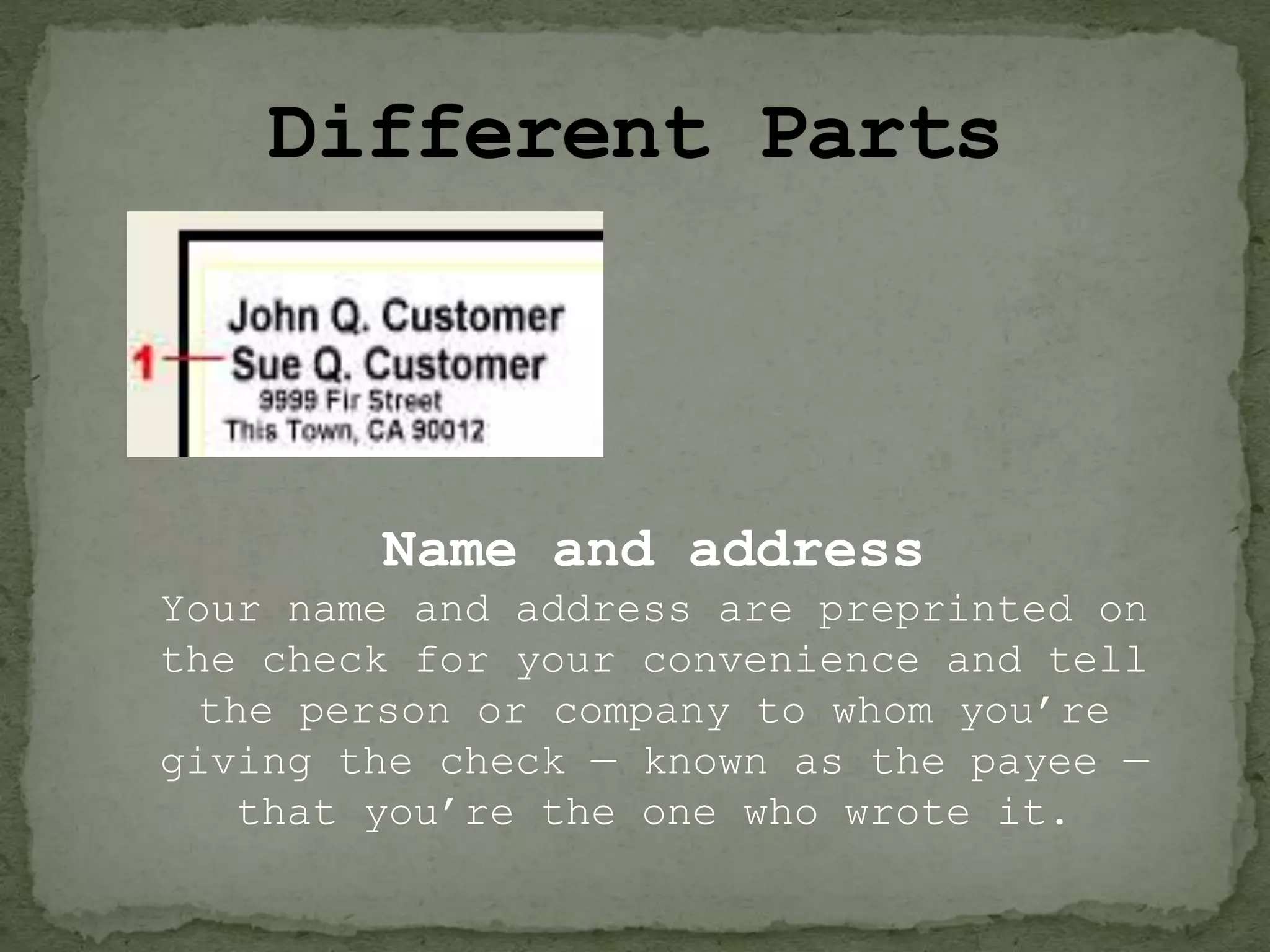
Name and address
Your name and address are preprinted on
the check for your convenience and tell
the person or company to whom you’re
giving the check — known as the payee —
that you’re the one who wrote it.
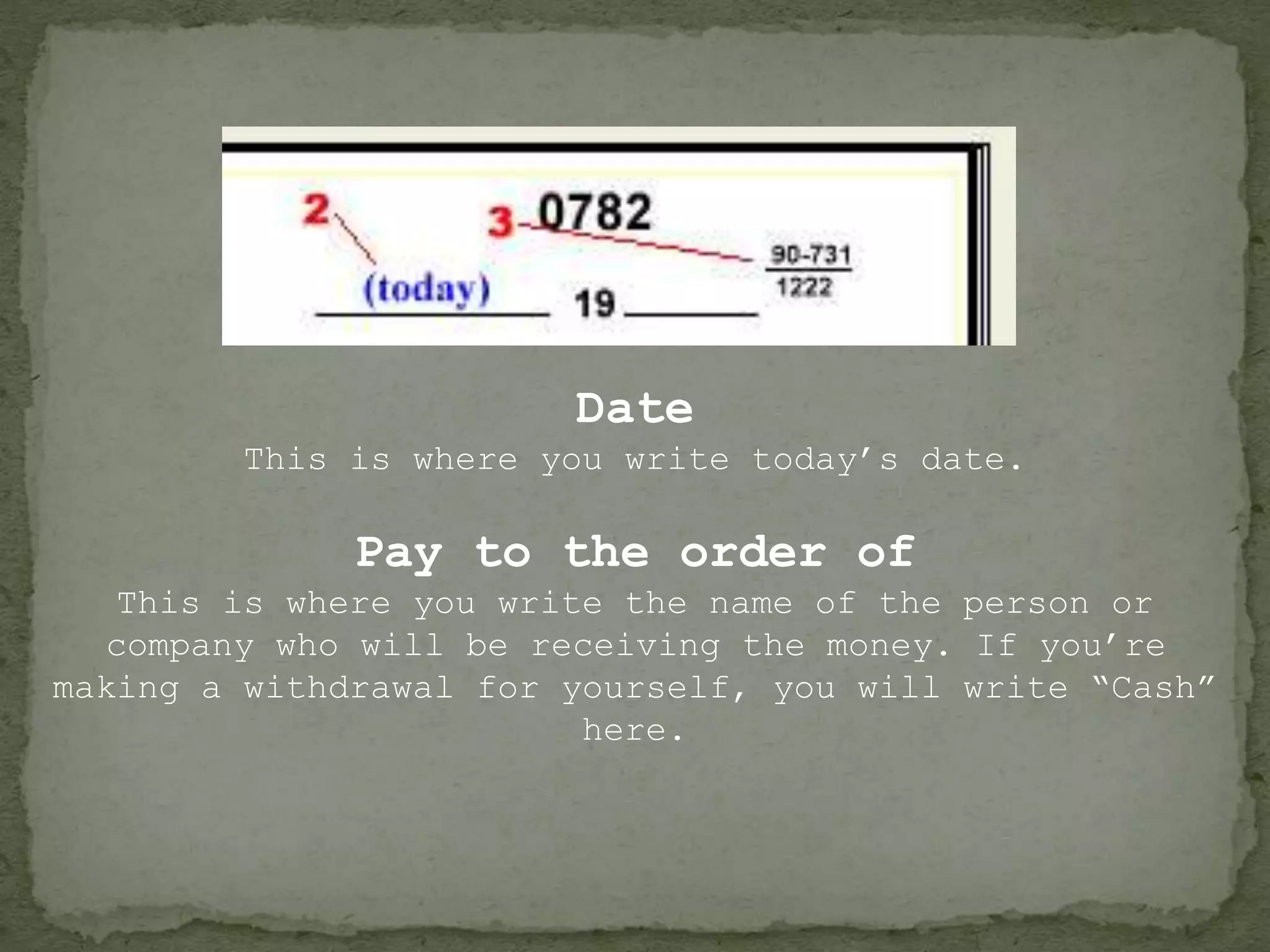
Date
This is where you write today’s date.
Pay to the order of
This is where you write the name of the person or
company who will be receiving the money. If you’re
making a withdrawal for yourself, you will write “Cash”
here.
Bank name
The name of the bank that holds your account
appears here.
Written amount
The amount in words is written on this line. You start at the
left edge of the line and when you’re finished, you will draw a
line through the remaining empty space as far as the word
“Dollars.”
Signature line
Your signature should be the last thing you
complete. It gives the bank permission, or
authorization, to release the money to the payee.
Check number
This is the check number. This reference number
will help you keep track of your payments by
check. Each time you write a check, you should
record the check number, date, payee, and amount
in your check register, and calculate your new
balance.
 Personal check - issued by individual w
ith checking or governments.
 Business check - issued by business.
 Cashier or Manager - purchased from the
bank.
 Certified check - personal or business
check.
 Money order - purchased from post offic
e and certain store.
 Maker - it has liability
 Drawee - the banks have the check
 Payee - individual / creditors
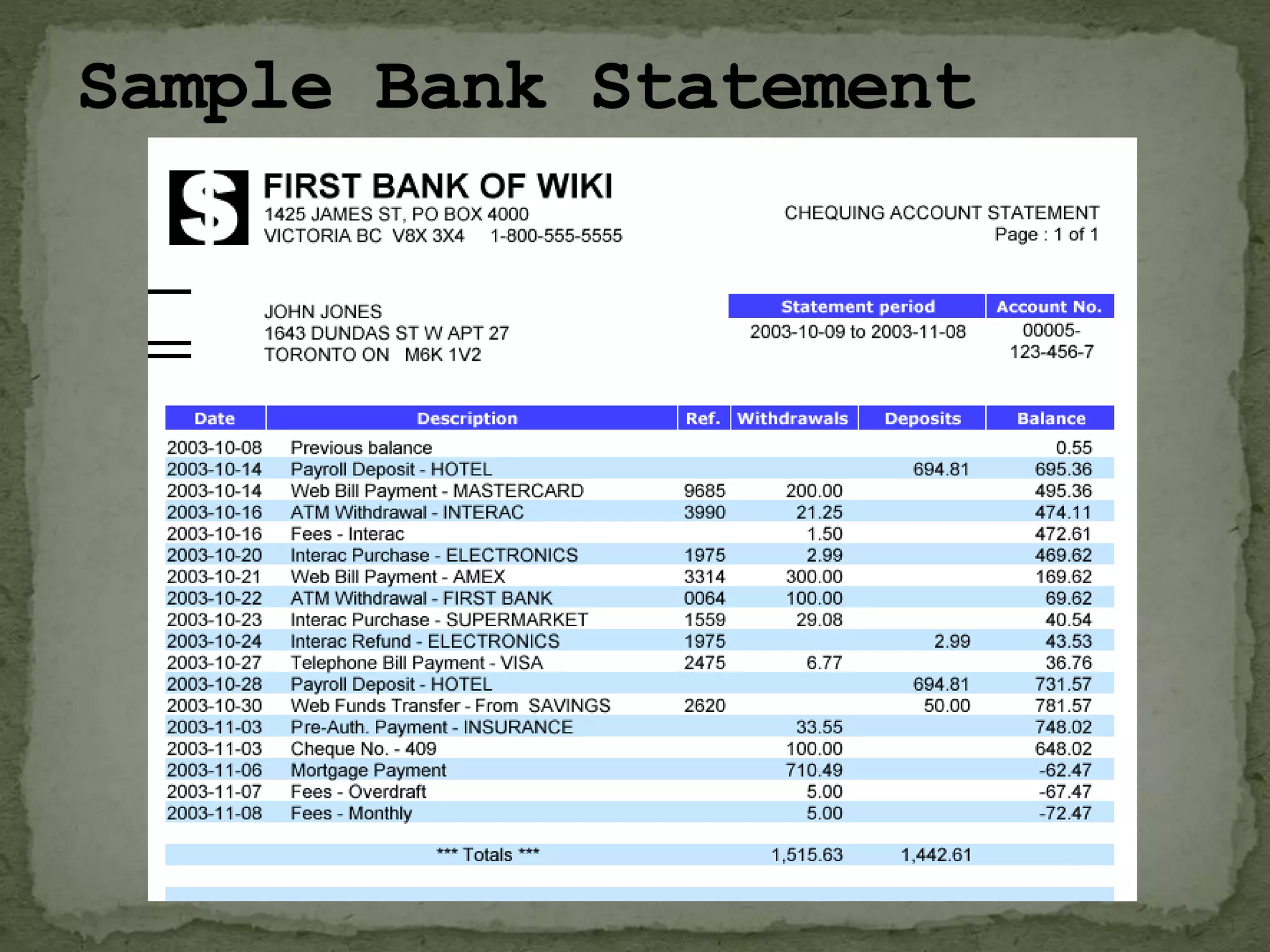
 a summary of financial
transactions which have occurred over a
given period on a bank account held by
a person or business with a financial
institution.
 a printed record of the balance in a
bank account and the amounts that have
been paid into it and withdrawn from
it, issued periodically to the holder
of the account.
1.Paper statements
- paper statements produced
monthly, quarterly or even annually.
2 Electronic statements
- can be viewed online, and downloaded
or printed by the customer. To reduce
the cost of postage and the generation
of paper bank statements, some
financial institutions encourage their
customers to receive bank statements
electronically,
 Make budgeting easier
- keeping track of your finances should be
easier than spending simply with cash.
 Identify fraudulent transactions
- banks are legally responsible for
refunding fraudulent transactions, unless
it's proved a customer was grossly
negligent. However, it's important to
check yourself, as unauthorized
transactions not identified may never be
refunded.

Check and Bank Statement

  • 1.
    Ella B. Dimaiwat BSAETM(Bachelor of Science in Agri-Ecotourism Management) Central Bicol State University of Agriculture
  • 3.
    Name and address Yourname and address are preprinted on the check for your convenience and tell the person or company to whom you’re giving the check — known as the payee — that you’re the one who wrote it.
  • 4.
    Date This is whereyou write today’s date. Pay to the order of This is where you write the name of the person or company who will be receiving the money. If you’re making a withdrawal for yourself, you will write “Cash” here.
  • 5.
    Bank name The nameof the bank that holds your account appears here. Written amount The amount in words is written on this line. You start at the left edge of the line and when you’re finished, you will draw a line through the remaining empty space as far as the word “Dollars.”
  • 6.
    Signature line Your signatureshould be the last thing you complete. It gives the bank permission, or authorization, to release the money to the payee. Check number This is the check number. This reference number will help you keep track of your payments by check. Each time you write a check, you should record the check number, date, payee, and amount in your check register, and calculate your new balance.
  • 7.
     Personal check- issued by individual w ith checking or governments.  Business check - issued by business.  Cashier or Manager - purchased from the bank.  Certified check - personal or business check.  Money order - purchased from post offic e and certain store.
  • 8.
     Maker -it has liability  Drawee - the banks have the check  Payee - individual / creditors
  • 9.
     a summaryof financial transactions which have occurred over a given period on a bank account held by a person or business with a financial institution.  a printed record of the balance in a bank account and the amounts that have been paid into it and withdrawn from it, issued periodically to the holder of the account.
  • 10.
    1.Paper statements - paperstatements produced monthly, quarterly or even annually. 2 Electronic statements - can be viewed online, and downloaded or printed by the customer. To reduce the cost of postage and the generation of paper bank statements, some financial institutions encourage their customers to receive bank statements electronically,
  • 12.
     Make budgetingeasier - keeping track of your finances should be easier than spending simply with cash.  Identify fraudulent transactions - banks are legally responsible for refunding fraudulent transactions, unless it's proved a customer was grossly negligent. However, it's important to check yourself, as unauthorized transactions not identified may never be refunded.