CREDIT CARD
Ella B. Dimaiwat
BSAETM (Bachelor of Science in Agri-Ecotourism Management)
Central Bicol State University of Agriculture
Credit Cards
A small plastic card that is used to buy things that you agree to
pay for later.
A card authorizing purchases on credit.
Used like money that credit limits and accompanying charges.
Amount charged to the card are paid at later date.
Standard-size plastic token, with a magnetic stripe that holds a
machine readable code.
History of a Credit Card
In the beginning as far as 9000 B.C. with the cattle and camels,
currency took some truly odd shapes, from cowrie shells, bronze and
copper imitation cowrie shells and gold and silver nuggets to Chinese
deerskin notes and Native American stringed wampum beads.
The Dawn Of Credit Cards
According to historian Jonathan Kenoyer, the concept of using a
valueless instrument to represent banking transactions dates back
5,000 years ,when the ancient Mesopotamians used clay tablets to
conduct trade with the Harappan civilization.
History of Credit Card
In American Circa 1800s. Is the Westward expansion, merchants would use
credit card and charge plate to extend credit to local farmers and ranchers,
allowing them to for go playing their bills until they harvested the coins of
that era.
In early 1900s, a few US department store and oil companies took credit one
step further by issuing their own proprietary card, the precursor to modern-
day store cards.
What will credit cards look like in 25,50, or 100 years ? Judging by the
changes we see around us today , from rapidly evolving online and mobile
payment technologies to home appliances that monitor and digitally reorder
their own contents, card payment will likely be increasingly integrated into
our lives in new and creative ways.
As a harbinger of payment options to come, Apple introduced Apple Pay in
2014,first mobile payment technology in widespread use. It’s certainly
possible that today’s teens may never use a physical credit card, preferring
the convenience of the card payment app embedded in their smartphone.s
How to Use Credit Card
Don’t Spend Beyond Your Means
o Make a budget
o Make sure that your credit card spending does’nt exceed the budgeted amount
Transfer Balances When Necessary
o Have a lot debt piled up on one card with a high interest rate ,try to transfer it to another card with
lower rates.
Use It For Emergencies
o One of the benefits of having ba credit card is that you’re always covered in case of emergency.
How To Use Credit Card
Pay It Off Every Month
oSmart credit card holders know that they should pay their debts off every
month. The APR—or annual percentage rate—only serves to pile on debt and
take cash out of your pocket.
Transaction
General: Agreement, contract, exchange, understanding, or transfer
of cash or property that occurs between two or more parties and
establishment a legal obligation.
Accounting: Event that effects a change in the asset, liability, or net
worth account. Transactions are recorded first in journal and then
posted to a ledger.
Banking: Activity affecting a bank account and performed by the
account holder or at his or her request.
Transaction
Commerce: Exchange of goods or services between a buyer and a
seller.
3 component:
oTransfer of goods/service and money.
oTransfer of title which may or may not be accompanied by a transfer of
possession.
oTransfer of exchange rights.
Computing: Event or process(such as an input message) initiated or
involved by a user or computer program , regarded as a single unit of
work and requiring a RECORD to be generated for processing in a
database.
Transaction
Computing: Event or process(such as an input message)
initiated or involved by a user or computer program , regarded
as a single unit of work and requiring a RECORD to be
generated for processing in a database.
Advantage of Credit Card
Pocket size
Easily portable
Relatively secure
Have no intrinsic value
It can give the ability to pay for items and necessities when you do
not have cash or money.
It can be a replacement of cash
No searching for an ATM or keeping cash on-hand
Benefits of Credit Card
Emergencies and unexpected expenses
It is convenience, can save time and trouble
Reward and promos
Record keeping
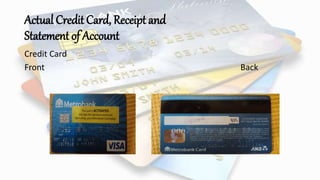
Actual Credit Card, Receipt and
Statement of Account
Credit Card
Front Back
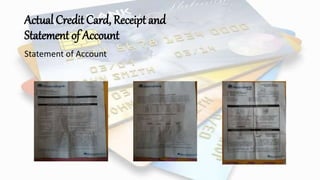
Actual Credit Card, Receipt and
Statement of Account
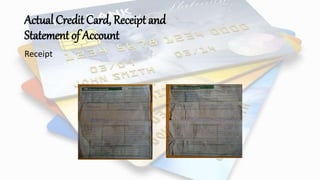
Actual Credit Card, Receipt and
Statement of Account
Receipt

Credit Card

  • 1.
    CREDIT CARD Ella B.Dimaiwat BSAETM (Bachelor of Science in Agri-Ecotourism Management) Central Bicol State University of Agriculture
  • 2.
    Credit Cards A smallplastic card that is used to buy things that you agree to pay for later. A card authorizing purchases on credit. Used like money that credit limits and accompanying charges. Amount charged to the card are paid at later date. Standard-size plastic token, with a magnetic stripe that holds a machine readable code.
  • 3.
    History of aCredit Card In the beginning as far as 9000 B.C. with the cattle and camels, currency took some truly odd shapes, from cowrie shells, bronze and copper imitation cowrie shells and gold and silver nuggets to Chinese deerskin notes and Native American stringed wampum beads. The Dawn Of Credit Cards According to historian Jonathan Kenoyer, the concept of using a valueless instrument to represent banking transactions dates back 5,000 years ,when the ancient Mesopotamians used clay tablets to conduct trade with the Harappan civilization.
  • 4.
    History of CreditCard In American Circa 1800s. Is the Westward expansion, merchants would use credit card and charge plate to extend credit to local farmers and ranchers, allowing them to for go playing their bills until they harvested the coins of that era. In early 1900s, a few US department store and oil companies took credit one step further by issuing their own proprietary card, the precursor to modern- day store cards. What will credit cards look like in 25,50, or 100 years ? Judging by the changes we see around us today , from rapidly evolving online and mobile payment technologies to home appliances that monitor and digitally reorder their own contents, card payment will likely be increasingly integrated into our lives in new and creative ways. As a harbinger of payment options to come, Apple introduced Apple Pay in 2014,first mobile payment technology in widespread use. It’s certainly possible that today’s teens may never use a physical credit card, preferring the convenience of the card payment app embedded in their smartphone.s
  • 5.
    How to UseCredit Card Don’t Spend Beyond Your Means o Make a budget o Make sure that your credit card spending does’nt exceed the budgeted amount Transfer Balances When Necessary o Have a lot debt piled up on one card with a high interest rate ,try to transfer it to another card with lower rates. Use It For Emergencies o One of the benefits of having ba credit card is that you’re always covered in case of emergency.
  • 6.
    How To UseCredit Card Pay It Off Every Month oSmart credit card holders know that they should pay their debts off every month. The APR—or annual percentage rate—only serves to pile on debt and take cash out of your pocket.
  • 7.
    Transaction General: Agreement, contract,exchange, understanding, or transfer of cash or property that occurs between two or more parties and establishment a legal obligation. Accounting: Event that effects a change in the asset, liability, or net worth account. Transactions are recorded first in journal and then posted to a ledger. Banking: Activity affecting a bank account and performed by the account holder or at his or her request.
  • 8.
    Transaction Commerce: Exchange ofgoods or services between a buyer and a seller. 3 component: oTransfer of goods/service and money. oTransfer of title which may or may not be accompanied by a transfer of possession. oTransfer of exchange rights. Computing: Event or process(such as an input message) initiated or involved by a user or computer program , regarded as a single unit of work and requiring a RECORD to be generated for processing in a database.
  • 9.
    Transaction Computing: Event orprocess(such as an input message) initiated or involved by a user or computer program , regarded as a single unit of work and requiring a RECORD to be generated for processing in a database.
  • 10.
    Advantage of CreditCard Pocket size Easily portable Relatively secure Have no intrinsic value It can give the ability to pay for items and necessities when you do not have cash or money. It can be a replacement of cash No searching for an ATM or keeping cash on-hand
  • 11.
    Benefits of CreditCard Emergencies and unexpected expenses It is convenience, can save time and trouble Reward and promos Record keeping
  • 12.
    Actual Credit Card,Receipt and Statement of Account Credit Card Front Back
  • 13.
    Actual Credit Card,Receipt and Statement of Account Statement of Account
  • 14.
    Actual Credit Card,Receipt and Statement of Account Receipt