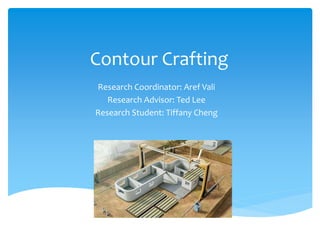
Contour Crafting
Research Coordinator: Aref Vali
Research Advisor: Ted Lee
Research Student: Tiffany Cheng
 What is Contour Crafting?
 Research Purpose
 Summary of tasks
 Phase I goals
 Current Results
 Phase II goals – CHE 491
 Future applications
Overview
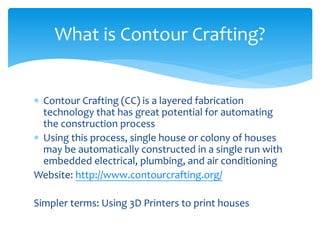
 Contour Crafting (CC) is a layered fabrication
technology that has great potential for automating
the construction process
 Using this process, single house or colony of houses
may be automatically constructed in a single run with
embedded electrical, plumbing, and air conditioning
Website: http://www.contourcrafting.org/
Simpler terms: Using 3D Printers to print houses
What is Contour Crafting?
 To modify the mechanics of traditional 3D printers to
work with fiber glass and gypsum
 To adjust the materials and material ratios which
includes plaster, fiber glass, dispersant, retarder…etc
to work with 3D printers
Research Purpose
 Daily tasks includes
1) Organize experiment table
2) Help prepare and mix materials
3) Record data, observation, results, and advise on
future suggestions
4) Conduct background literature review and create
summary sheets
5) Occasionally help order materials/material samples
from companies to try in lab
Summary of Tasks
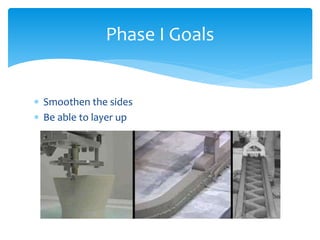
 Smoothen the sides
 Be able to layer up
Phase I Goals
 Try different ratios of plaster to fiber glass
 Add dispersant to help mixing
 Add retarder to adjust curing time
 Try different temperature of water (room temp vs
cold water)
 Try materials from different companies
Methodology
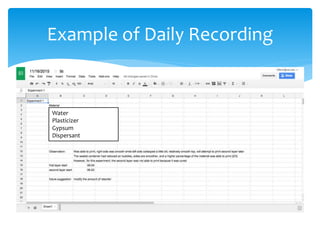
Example of Daily Recording
Water
Plasticizer
Gypsum
Dispersant
 Best curing time is about 45-60 minutes, when under
pressure ~15 minutes
 Best pH is around 5-7
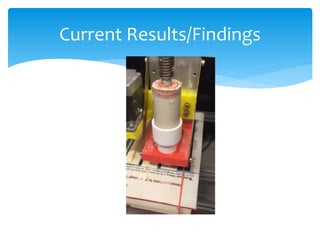
 Header was adjusted to be shorter to print smoother
sides
 Best fiber glass percentage is around 2-5%
Current Results/Findings
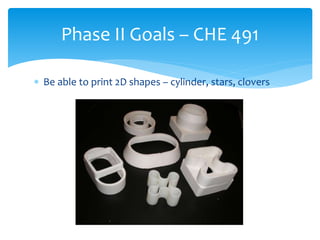
 Be able to print 2D shapes – cylinder, stars, clovers
Phase II Goals – CHE 491
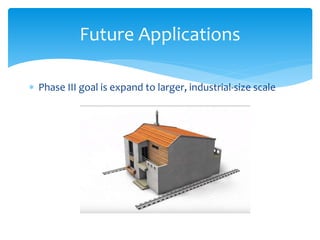
 Phase III goal is expand to larger, industrial-size scale
Future Applications
Questions/Comments?

CHE 391 Contour Crafting Presentation

  • 1.
    Contour Crafting Research Coordinator:Aref Vali Research Advisor: Ted Lee Research Student: Tiffany Cheng
  • 2.
     What isContour Crafting?  Research Purpose  Summary of tasks  Phase I goals  Current Results  Phase II goals – CHE 491  Future applications Overview
  • 3.
     Contour Crafting(CC) is a layered fabrication technology that has great potential for automating the construction process  Using this process, single house or colony of houses may be automatically constructed in a single run with embedded electrical, plumbing, and air conditioning Website: http://www.contourcrafting.org/ Simpler terms: Using 3D Printers to print houses What is Contour Crafting?
  • 4.
     To modifythe mechanics of traditional 3D printers to work with fiber glass and gypsum  To adjust the materials and material ratios which includes plaster, fiber glass, dispersant, retarder…etc to work with 3D printers Research Purpose
  • 5.
     Daily tasksincludes 1) Organize experiment table 2) Help prepare and mix materials 3) Record data, observation, results, and advise on future suggestions 4) Conduct background literature review and create summary sheets 5) Occasionally help order materials/material samples from companies to try in lab Summary of Tasks
  • 6.
     Smoothen thesides  Be able to layer up Phase I Goals
  • 7.
     Try differentratios of plaster to fiber glass  Add dispersant to help mixing  Add retarder to adjust curing time  Try different temperature of water (room temp vs cold water)  Try materials from different companies Methodology
  • 8.
    Example of DailyRecording Water Plasticizer Gypsum Dispersant
  • 9.
     Best curingtime is about 45-60 minutes, when under pressure ~15 minutes  Best pH is around 5-7  Header was adjusted to be shorter to print smoother sides  Best fiber glass percentage is around 2-5% Current Results/Findings
  • 10.
  • 11.
     Be ableto print 2D shapes – cylinder, stars, clovers Phase II Goals – CHE 491
  • 12.
     Phase IIIgoal is expand to larger, industrial-size scale Future Applications
  • 13.

Editor's Notes

  • #9 All documents are shared on a google drive including lab results, literature review summary