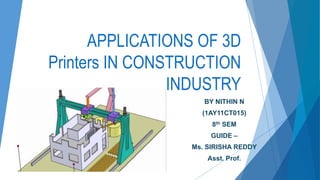

BY NITHIN N
(1AY11CT015)
8th SEM
GUIDE –
Ms. SIRISHA REDDY
Asst. Prof.
APPLICATIONS OF 3D
Printers IN CONSTRUCTION
INDUSTRY
Contents
Details of
3D printing
Applications
Applications
in
construction
industry
Future
development
(Print a building)
Conclusion
Outline
 What is 3-d printing ?
 History
 How it works ?
 General principles
 Different methods of 3-d Printing
 APPLICATIONS IN CONSTRUCTION INDUSTRY
 Advantages
 Disadvantages
 Conclusion
 References
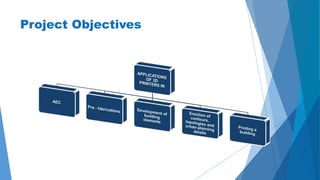
Project Objectives
INTRODUCTION
What Is 3D Printing?
3D printing is a form of additive manufacturing in
which components are fabricated in an additive
fashion by adding successive layers of material
together
It is also known as:
Rapid prototyping
Additive manufacturing
Additive Manufacturing:
 A process of making three dimensional solid objects
from a digital file (CAD model)
 The creation of a 3D printed object is achieved using
additive processes
 In an additive process an object is created by laying
down successive layers of material until the entire
object is created. Each of these layers can be seen as
a thinly sliced horizontal cross-section of the eventual
object
History
 The technology for printing physical 3D objects from digital data was first developed by Chuck Hull in 1984.
He named the technique as Stereo lithography and obtained a patent for the technique in 1986
History
1986
• Hull coined the term Stereo lithography when he patented his new system
1992
• The first Stereolithographic Apparatus (SLA) is made by 3D Systems
1999
• The first ever 3D organ, a bladder, is created with the patient’s own cells. This means that there is little chance of the organ being
rejected by the body
2002
• A miniture kidney is created that can filter blood and produce diluted urine in an animal.
2006
• The Selective Laser Sintering machine is built and allows for mass customisation in manufacturing industrial parts
2008
• A prosthetic leg is created with a complex structure that requires no assembly. This opens the doorway to customized prosthetic
limbs. Revolution in technology by rooting of REPRAP concept
2009
• Innovative bioprinting company, Organovo, creates the first blood vessel to be bioprinted
2011
• Printing Service, I - materialize, starts offering 14K gold and sterling silver as a printable material.
2012
• Alternative 3D printing processes were introduced at the entry level of the market
2014
• New era of industrial revolution - Big firms started acquiring start-ups. Theoretical and practical structures were aimed at.
How 3D Printing Works
A person creates a 3D
image of an item using a
computer-aided design
(CAD) software program.
The CAD information is
sent to the printer.
The printer forms the item
by depositing the material
in layers—starting from
the bottom layer—onto a
platform. In some cases
light or lasers are used to
harden the material.
General Principles
• Modeling
• Printing
• Finishing
Modeling
 Additive manufacturing takes virtual blueprints from computer aided
design (CAD) or animation modeling software and "slices" them into digital
cross-sections for the machine to successively use as a guideline for printing
Printing
 To perform a print, the machine reads the design and lays down successive
layers of liquid, powder, or sheet material to build the model from a series of
cross sections. These layers, which correspond to the virtual cross sections
from the CAD model, are joined together or automatically fused to create the
final shape.
 The primary advantage of this technique is its ability to create almost any shape
or geometric feature
Finishing
 Though the printer-produced resolution is sufficient for many applications,
printing a slightly oversized version of the desired object in standard resolution,
and then removing material with a higher-resolution subtractive process can
achieve a higher-resolution
Different Methods
• Stereo lithography
• Selective laser sintering (SLS)
• Fused deposition modeling (FDM)
• Ink-Jet 3D printing
Stereo lithography
 Stereo lithography is a process for creating three-dimensional objects using a computer-
controlled laser to build the required structure, layer by layer. It does this by using a resin
known as liquid photopolymer that hardens when in contact with the air
Selective laser sintering (SLS)
 Selective laser sintering (SLS) is an additive manufacturing technique that uses a high
power laser to fuse small particles of plastic, metal (direct metal laser sintering),ceramic
or glass powders into a mass that has a desired 3-dimensional shape
Fused deposition modeling (FDM)
• Commonly used for modeling, prototyping, and production applications.
• Here a hot thermoplastic is extruded from a temperature-controlled print head to produce
fairly robust objects to a high degree of accuracy.
Ink-Jet 3D Printing
 It creates the model one layer at a time by spreading a layer of powder and inkjet printing
binder in the cross-section of the part.
 It is the most widely used 3-D Printing technology these days
 While all inkjet technologies can fundamentally be described as the digitally controlled
ejection of drops of fluid from a print head onto a substrate, this is accomplished in a
variety of ways.
 There are 2-types of print head for the generation of liquid drops
 Drop-On-Demand (DOD) and Continuous-Jet (CJ)
Stereo lithography SLS
FDM
Applications
Applications
 Apparel
 Education and research
 Art / AEC
 Rapid manufacturing
 Mass customization
 Automobiles
 Electric Motors and Generators
 Spaceflight
 Domestic use
 Medical
Applications
With nearly LIMITLESS applications,
Just think of the POSSIBILITIES…………
PRINT A BUILDING
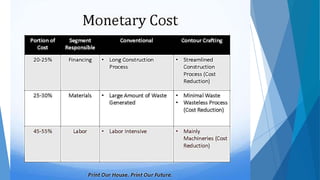
CONTOUR CRAFTING
LITERATURE REVIEW
 Using Contour Crafting, Khoshnevis reports that he has created walls that are six feet high, by
adding layers of concrete six inches high and four inches thick. The walls have a compressive
stress of 10,000 pounds per square inch. This technology, Khoshnevis projects, will be able to
print a 2,500 square foot house in less than a day [1]
 A Dutch firm named Universe Architecture is planning on building a 12,000 square foot,
Möbius strip shaped home by 3D printing sections on-site and then assembling them. It plans
to use a printer capable of printing structures as large as 6 X 9 meters [2]
 Similarly, the Amsterdam-based firm Dus Artchitects is in the process of printing a
canal house [3]
 WinSun, unlike the innovators previously discussed, uses a massive printer – 490’ X
33’ X 20’ – to print pieces of houses in a factory and then assembles them on-site.
WinSun makes the houses using recycled construction material, industrial waste, and
tailings which are then reinforced with fiberglass. And, most impressively, WinSun has
printed ten houses in less than a day, each measuring 200 square meters and costing
less than $5,000. The company even constructed its own 10,000 square meter office
in a month using an assembly line of four 3D printers [4]
Steps needed to make the customer's building ready to print
Throughout the design project, the process of dividing a
building into printable parts was informally
referred to as chunking (i.e. converting into multiple chunks)
Process Flow Diagram of Printer
P
R
I
N
T
B
R
I
C
K
S
Assembly of printed columns in progress
Assembly of printed/precast slabs
Suitable solution to connect the walls
APPLICATIONS IN AEC
Interior elements
REFERENCES
 [1] A video of the Contour Crafter performing its basic operations may be
viewed here:http://www.youtube.com/watch?v=-yv-IWdSdns, and the Contour
Crafting website may be viewed here: http://craft.usc.edu/CC/modem.html.
 [2] An article explaining Universe Architecture’s project may be accessed
at:http://www.dezeen.com/2013/01/20/dutch-architects-to-use-3d-printer-to-
build-a-house/. And, Universe Architecture’s website may be accessed
here: http://www.universearchitecture.com/.
 [3] Read more: http://www.dailymail.co.uk/sciencetech/article-2594234/The-3D-
printed-HOUSE-Technology-used-construct-entire-building-including-furniture-
Amsterdam.html#ixzz3WXL1ePwj
 [4] An article further describing WinSun’s process may be found
here:http://blogs.wsj.com/corporate-intelligence/2014/04/15/how-a-chinese-
company-built-10-homes-in-24-hours/?mod=e2fb. And, a video may be found
here:https://www.youtube.com/watch?v=SObzNdyRTBs.
Questions..??
Application of 3D printers

Application of 3D printers

  • 1.
    BY NITHIN N (1AY11CT015) 8thSEM GUIDE – Ms. SIRISHA REDDY Asst. Prof. APPLICATIONS OF 3D Printers IN CONSTRUCTION INDUSTRY
  • 2.
  • 3.
    Outline  What is3-d printing ?  History  How it works ?  General principles  Different methods of 3-d Printing  APPLICATIONS IN CONSTRUCTION INDUSTRY  Advantages  Disadvantages  Conclusion  References
  • 4.
  • 5.
  • 6.
    What Is 3DPrinting? 3D printing is a form of additive manufacturing in which components are fabricated in an additive fashion by adding successive layers of material together It is also known as: Rapid prototyping Additive manufacturing
  • 7.
    Additive Manufacturing:  Aprocess of making three dimensional solid objects from a digital file (CAD model)  The creation of a 3D printed object is achieved using additive processes  In an additive process an object is created by laying down successive layers of material until the entire object is created. Each of these layers can be seen as a thinly sliced horizontal cross-section of the eventual object
  • 8.
    History  The technologyfor printing physical 3D objects from digital data was first developed by Chuck Hull in 1984. He named the technique as Stereo lithography and obtained a patent for the technique in 1986
  • 9.
    History 1986 • Hull coinedthe term Stereo lithography when he patented his new system 1992 • The first Stereolithographic Apparatus (SLA) is made by 3D Systems 1999 • The first ever 3D organ, a bladder, is created with the patient’s own cells. This means that there is little chance of the organ being rejected by the body 2002 • A miniture kidney is created that can filter blood and produce diluted urine in an animal. 2006 • The Selective Laser Sintering machine is built and allows for mass customisation in manufacturing industrial parts 2008 • A prosthetic leg is created with a complex structure that requires no assembly. This opens the doorway to customized prosthetic limbs. Revolution in technology by rooting of REPRAP concept 2009 • Innovative bioprinting company, Organovo, creates the first blood vessel to be bioprinted 2011 • Printing Service, I - materialize, starts offering 14K gold and sterling silver as a printable material. 2012 • Alternative 3D printing processes were introduced at the entry level of the market 2014 • New era of industrial revolution - Big firms started acquiring start-ups. Theoretical and practical structures were aimed at.
  • 10.
    How 3D PrintingWorks A person creates a 3D image of an item using a computer-aided design (CAD) software program. The CAD information is sent to the printer. The printer forms the item by depositing the material in layers—starting from the bottom layer—onto a platform. In some cases light or lasers are used to harden the material.
  • 11.
  • 12.
    Modeling  Additive manufacturingtakes virtual blueprints from computer aided design (CAD) or animation modeling software and "slices" them into digital cross-sections for the machine to successively use as a guideline for printing Printing  To perform a print, the machine reads the design and lays down successive layers of liquid, powder, or sheet material to build the model from a series of cross sections. These layers, which correspond to the virtual cross sections from the CAD model, are joined together or automatically fused to create the final shape.  The primary advantage of this technique is its ability to create almost any shape or geometric feature Finishing  Though the printer-produced resolution is sufficient for many applications, printing a slightly oversized version of the desired object in standard resolution, and then removing material with a higher-resolution subtractive process can achieve a higher-resolution
  • 13.
    Different Methods • Stereolithography • Selective laser sintering (SLS) • Fused deposition modeling (FDM) • Ink-Jet 3D printing
  • 14.
    Stereo lithography  Stereolithography is a process for creating three-dimensional objects using a computer- controlled laser to build the required structure, layer by layer. It does this by using a resin known as liquid photopolymer that hardens when in contact with the air Selective laser sintering (SLS)  Selective laser sintering (SLS) is an additive manufacturing technique that uses a high power laser to fuse small particles of plastic, metal (direct metal laser sintering),ceramic or glass powders into a mass that has a desired 3-dimensional shape Fused deposition modeling (FDM) • Commonly used for modeling, prototyping, and production applications. • Here a hot thermoplastic is extruded from a temperature-controlled print head to produce fairly robust objects to a high degree of accuracy. Ink-Jet 3D Printing  It creates the model one layer at a time by spreading a layer of powder and inkjet printing binder in the cross-section of the part.  It is the most widely used 3-D Printing technology these days  While all inkjet technologies can fundamentally be described as the digitally controlled ejection of drops of fluid from a print head onto a substrate, this is accomplished in a variety of ways.  There are 2-types of print head for the generation of liquid drops  Drop-On-Demand (DOD) and Continuous-Jet (CJ)
  • 15.
  • 16.
  • 17.
    Applications  Apparel  Educationand research  Art / AEC  Rapid manufacturing  Mass customization  Automobiles  Electric Motors and Generators  Spaceflight  Domestic use  Medical
  • 18.
  • 19.
    With nearly LIMITLESSapplications, Just think of the POSSIBILITIES…………
  • 23.
  • 25.
  • 28.
    LITERATURE REVIEW  UsingContour Crafting, Khoshnevis reports that he has created walls that are six feet high, by adding layers of concrete six inches high and four inches thick. The walls have a compressive stress of 10,000 pounds per square inch. This technology, Khoshnevis projects, will be able to print a 2,500 square foot house in less than a day [1]  A Dutch firm named Universe Architecture is planning on building a 12,000 square foot, Möbius strip shaped home by 3D printing sections on-site and then assembling them. It plans to use a printer capable of printing structures as large as 6 X 9 meters [2]  Similarly, the Amsterdam-based firm Dus Artchitects is in the process of printing a canal house [3]  WinSun, unlike the innovators previously discussed, uses a massive printer – 490’ X 33’ X 20’ – to print pieces of houses in a factory and then assembles them on-site. WinSun makes the houses using recycled construction material, industrial waste, and tailings which are then reinforced with fiberglass. And, most impressively, WinSun has printed ten houses in less than a day, each measuring 200 square meters and costing less than $5,000. The company even constructed its own 10,000 square meter office in a month using an assembly line of four 3D printers [4]
  • 29.
    Steps needed tomake the customer's building ready to print Throughout the design project, the process of dividing a building into printable parts was informally referred to as chunking (i.e. converting into multiple chunks)
  • 30.
  • 31.
  • 32.
    Assembly of printedcolumns in progress
  • 33.
    Assembly of printed/precastslabs Suitable solution to connect the walls
  • 37.
  • 39.
  • 44.
    REFERENCES  [1] Avideo of the Contour Crafter performing its basic operations may be viewed here:http://www.youtube.com/watch?v=-yv-IWdSdns, and the Contour Crafting website may be viewed here: http://craft.usc.edu/CC/modem.html.  [2] An article explaining Universe Architecture’s project may be accessed at:http://www.dezeen.com/2013/01/20/dutch-architects-to-use-3d-printer-to- build-a-house/. And, Universe Architecture’s website may be accessed here: http://www.universearchitecture.com/.  [3] Read more: http://www.dailymail.co.uk/sciencetech/article-2594234/The-3D- printed-HOUSE-Technology-used-construct-entire-building-including-furniture- Amsterdam.html#ixzz3WXL1ePwj  [4] An article further describing WinSun’s process may be found here:http://blogs.wsj.com/corporate-intelligence/2014/04/15/how-a-chinese- company-built-10-homes-in-24-hours/?mod=e2fb. And, a video may be found here:https://www.youtube.com/watch?v=SObzNdyRTBs.
  • 45.