CHALLENGES FACED BY FARMERS
DUE TO ENVIRONMENTAL
CHANGES
SUBMITTED BY:
JATIN CHAUHAN [11702228](RK17DMB54)
MOHD. FARHAN KHAN [11702200](RK17DMB55)
YASH KHANNA [11702261](RK17DMB56)
Submitted To
Dr. Aditya Agrahari,
Assistant Professor(CHE110)
INDEX
1. …………………………………………………………………………………..INTRODUCTION
2. .….……………………………………………………………………….…..BRIEF OVERVIEW
3. ……………………………………………………………………………...CLIMATIC CHANGE
4. ……….....……………………………………………...IMPACT OF CLIMATIC CHANGE
5. …………….…………………………….……….…WATER & INDUSTRIAL POLLUTION
6. ………………….……………………………….…CLIMATIC CHANGE &WATER CYCLE
7. ………………….…………………………………..……WATER CYCLE AT LOCAL LEVEL
8. ………………………………..…………………..…………………………………..HEAT WAVE
9. …………………………………….……………..………………………………………ACID RAIN
10. ……………………………………….……………..…………………………WATER SCARCITY
11. ……………………..……………..………SOIL DEGRADATION & LAND POLLUTION
12. …………...…21st CENTURY CHALLENGES FACED BY DEVELOPING NATION
13. ……………………………………………………………………………………….…..CONTENTS
INTRODUCTION
One of the major challenges facing humans is to
provide an good standard of Living for present and
future generations: Proper food ,water ,energy , safe
Shelter and a healthy environment.
But , Global Environmental issues such as land
Degradation, loss of Biodiversity , Ozone layer
depletion along with human-induced climatic change ,
threatens our ability to meet the Basic human needs.
BRIEF
OVERVIEW
CLIMATIC CHANGE
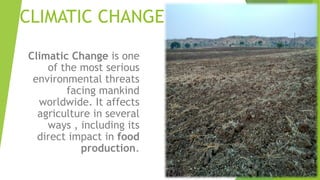
Climatic Change is one
of the most serious
environmental threats
facing mankind
worldwide. It affects
agriculture in several
ways , including its
direct impact in food
production.
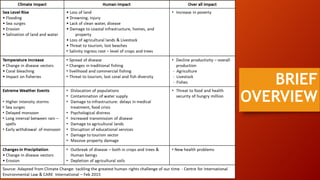
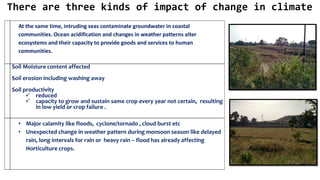
At the same time, intruding seas contaminate groundwater in coastal
communities. Ocean acidification and changes in weather patterns alter
ecosystems and their capacity to provide goods and services to human
communities.
Soil Moisture content affected
Soil erosion including washing away
Soil productivity
✓ reduced
✓ capacity to grow and sustain same crop every year not certain, resulting
in low yield or crop failure .
• Major calamity like floods, cyclone/tornado , cloud burst etc
• Unexpected change in weather pattern during monsoon season like delayed
rain, long intervals for rain or heavy rain – flood has already affecting
Horticulture crops.
There are three kinds of impact of change in climate
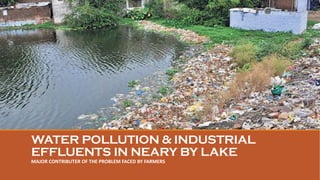
WATER POLLUTION & INDUSTRIAL
EFFLUENTS IN NEARY BY LAKE
MAJOR CONTRIBUTER OF THE PROBLEM FACED BY FARMERS
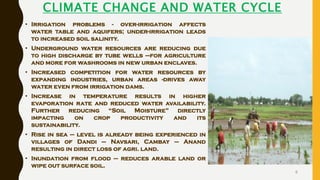
CLIMATE CHANGE AND WATER CYCLE
• Irrigation problems - over-irrigation affects
water table and aquifers; under-irrigation leads
to increased soil salinity.
• Underground water resources are reducing due
to high discharge by tube wells –for agriculture
and more for washrooms in new urban enclaves.
• Increased competition for water resources by
expanding industries, urban areas -drives away
water even from irrigation dams.
• Increase in temperature results in higher
evaporation rate and reduced water availability.
Further reducing “Soil Moisture” directly
impacting on crop productivity and its
sustainability.
• Rise in sea – level is already being experienced in
villages of Dandi – Navsari, Cambay – Anand
resulting in direct loss of agri. land.
• Inundation from flood – reduces arable land or
wipe out surface soil.
8
9
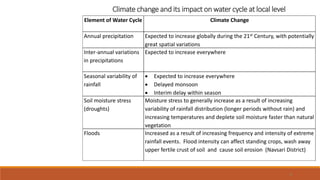
Climate change and its impact on water cycle at local level
Element of Water Cycle Climate Change
Annual precipitation Expected to increase globally during the 21st Century, with potentially
great spatial variations
Inter-annual variations
in precipitations
Expected to increase everywhere
Seasonal variability of
rainfall
• Expected to increase everywhere
• Delayed monsoon
• Interim delay within season
Soil moisture stress
(droughts)
Moisture stress to generally increase as a result of increasing
variability of rainfall distribution (longer periods without rain) and
increasing temperatures and deplete soil moisture faster than natural
vegetation
Floods Increased as a result of increasing frequency and intensity of extreme
rainfall events. Flood intensity can affect standing crops, wash away
upper fertile crust of soil and cause soil erosion (Navsari District)
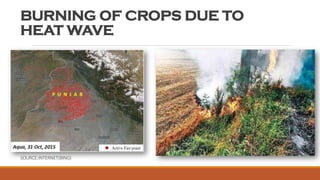
BURNING OF CROPS DUE TO
HEAT WAVE
SOURCE:INTERNET(BING)
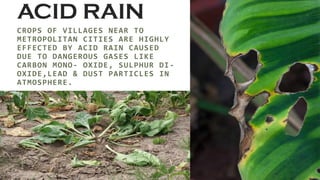
ACID RAIN
CROPS OF VILLAGES NEAR TO
METROPOLITAN CITIES ARE HIGHLY
EFFECTED BY ACID RAIN CAUSED
DUE TO DANGEROUS GASES LIKE
CARBON MONO- OXIDE, SULPHUR DI-
OXIDE,LEAD & DUST PARTICLES IN
ATMOSPHERE.
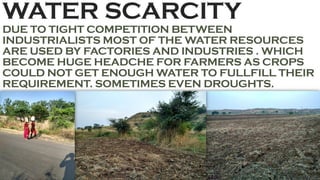
WATER SCARCITY
DUE TO TIGHT COMPETITION BETWEEN
INDUSTRIALISTS MOST OF THE WATER RESOURCES
ARE USED BY FACTORIES AND INDUSTRIES . WHICH
BECOME HUGE HEADCHE FOR FARMERS AS CROPS
COULD NOT GET ENOUGH WATER TO FULLFILL THEIR
REQUIREMENT. SOMETIMES EVEN DROUGHTS.
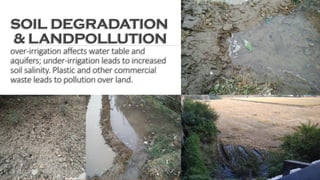
SOIL DEGRADATION
& LANDPOLLUTION
over-irrigation affects water table and
aquifers; under-irrigation leads to increased
soil salinity. Plastic and other commercial
waste leads to pollution over land.
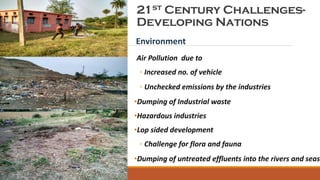
21st Century Challenges-
Developing Nations
Environment
Air Pollution due to
◦ Increased no. of vehicle
◦ Unchecked emissions by the industries
•Dumping of Industrial waste
•Hazardous industries
•Lop sided development
◦ Challenge for flora and fauna
•Dumping of untreated effluents into the rivers and seas
Presentation Title
V
I
S
I
T
THANK YOU
J A I J A W A N ! J A I K I S A N !

CHALLENGES FACED BY FARMERS DUE TO ENVIRONMENTAL CHANGES

  • 1.
    CHALLENGES FACED BYFARMERS DUE TO ENVIRONMENTAL CHANGES SUBMITTED BY: JATIN CHAUHAN [11702228](RK17DMB54) MOHD. FARHAN KHAN [11702200](RK17DMB55) YASH KHANNA [11702261](RK17DMB56) Submitted To Dr. Aditya Agrahari, Assistant Professor(CHE110)
  • 2.
    INDEX 1. …………………………………………………………………………………..INTRODUCTION 2. .….……………………………………………………………………….…..BRIEFOVERVIEW 3. ……………………………………………………………………………...CLIMATIC CHANGE 4. ……….....……………………………………………...IMPACT OF CLIMATIC CHANGE 5. …………….…………………………….……….…WATER & INDUSTRIAL POLLUTION 6. ………………….……………………………….…CLIMATIC CHANGE &WATER CYCLE 7. ………………….…………………………………..……WATER CYCLE AT LOCAL LEVEL 8. ………………………………..…………………..…………………………………..HEAT WAVE 9. …………………………………….……………..………………………………………ACID RAIN 10. ……………………………………….……………..…………………………WATER SCARCITY 11. ……………………..……………..………SOIL DEGRADATION & LAND POLLUTION 12. …………...…21st CENTURY CHALLENGES FACED BY DEVELOPING NATION 13. ……………………………………………………………………………………….…..CONTENTS
  • 3.
    INTRODUCTION One of themajor challenges facing humans is to provide an good standard of Living for present and future generations: Proper food ,water ,energy , safe Shelter and a healthy environment. But , Global Environmental issues such as land Degradation, loss of Biodiversity , Ozone layer depletion along with human-induced climatic change , threatens our ability to meet the Basic human needs.
  • 4.
  • 5.
    CLIMATIC CHANGE Climatic Changeis one of the most serious environmental threats facing mankind worldwide. It affects agriculture in several ways , including its direct impact in food production.
  • 6.
    At the sametime, intruding seas contaminate groundwater in coastal communities. Ocean acidification and changes in weather patterns alter ecosystems and their capacity to provide goods and services to human communities. Soil Moisture content affected Soil erosion including washing away Soil productivity ✓ reduced ✓ capacity to grow and sustain same crop every year not certain, resulting in low yield or crop failure . • Major calamity like floods, cyclone/tornado , cloud burst etc • Unexpected change in weather pattern during monsoon season like delayed rain, long intervals for rain or heavy rain – flood has already affecting Horticulture crops. There are three kinds of impact of change in climate
  • 7.
    WATER POLLUTION &INDUSTRIAL EFFLUENTS IN NEARY BY LAKE MAJOR CONTRIBUTER OF THE PROBLEM FACED BY FARMERS
  • 8.
    CLIMATE CHANGE ANDWATER CYCLE • Irrigation problems - over-irrigation affects water table and aquifers; under-irrigation leads to increased soil salinity. • Underground water resources are reducing due to high discharge by tube wells –for agriculture and more for washrooms in new urban enclaves. • Increased competition for water resources by expanding industries, urban areas -drives away water even from irrigation dams. • Increase in temperature results in higher evaporation rate and reduced water availability. Further reducing “Soil Moisture” directly impacting on crop productivity and its sustainability. • Rise in sea – level is already being experienced in villages of Dandi – Navsari, Cambay – Anand resulting in direct loss of agri. land. • Inundation from flood – reduces arable land or wipe out surface soil. 8
  • 9.
    9 Climate change andits impact on water cycle at local level Element of Water Cycle Climate Change Annual precipitation Expected to increase globally during the 21st Century, with potentially great spatial variations Inter-annual variations in precipitations Expected to increase everywhere Seasonal variability of rainfall • Expected to increase everywhere • Delayed monsoon • Interim delay within season Soil moisture stress (droughts) Moisture stress to generally increase as a result of increasing variability of rainfall distribution (longer periods without rain) and increasing temperatures and deplete soil moisture faster than natural vegetation Floods Increased as a result of increasing frequency and intensity of extreme rainfall events. Flood intensity can affect standing crops, wash away upper fertile crust of soil and cause soil erosion (Navsari District)
  • 10.
    BURNING OF CROPSDUE TO HEAT WAVE SOURCE:INTERNET(BING)
  • 11.
    ACID RAIN CROPS OFVILLAGES NEAR TO METROPOLITAN CITIES ARE HIGHLY EFFECTED BY ACID RAIN CAUSED DUE TO DANGEROUS GASES LIKE CARBON MONO- OXIDE, SULPHUR DI- OXIDE,LEAD & DUST PARTICLES IN ATMOSPHERE.
  • 12.
    WATER SCARCITY DUE TOTIGHT COMPETITION BETWEEN INDUSTRIALISTS MOST OF THE WATER RESOURCES ARE USED BY FACTORIES AND INDUSTRIES . WHICH BECOME HUGE HEADCHE FOR FARMERS AS CROPS COULD NOT GET ENOUGH WATER TO FULLFILL THEIR REQUIREMENT. SOMETIMES EVEN DROUGHTS.
  • 13.
    SOIL DEGRADATION & LANDPOLLUTION over-irrigationaffects water table and aquifers; under-irrigation leads to increased soil salinity. Plastic and other commercial waste leads to pollution over land.
  • 14.
    21st Century Challenges- DevelopingNations Environment Air Pollution due to ◦ Increased no. of vehicle ◦ Unchecked emissions by the industries •Dumping of Industrial waste •Hazardous industries •Lop sided development ◦ Challenge for flora and fauna •Dumping of untreated effluents into the rivers and seas Presentation Title
  • 15.
  • 17.
    THANK YOU J AI J A W A N ! J A I K I S A N !