DROUGHT-causes, effects and
prevention :disaster management
DISASTER
 A disaster is a serious disruption occurring over a
short or long period of time that causes
widespread human, material, economic or
environmental loss which exceeds the ability of
the affected community or society to cope using
its own resources.
TYPES OF Disaster
 Natural Disaster:caused without any human
influence.For instance Floods and Tsunamis etc.
 Man-Made Disaster: caused due to human
activity.For instance Bhopal Gas Tragedy.
 Hybrid Disaster:caused due to both natural force
and natural force.For instance Soil erosion due to
deforestation and landslide due to heavy rainfall
etc.
Drought
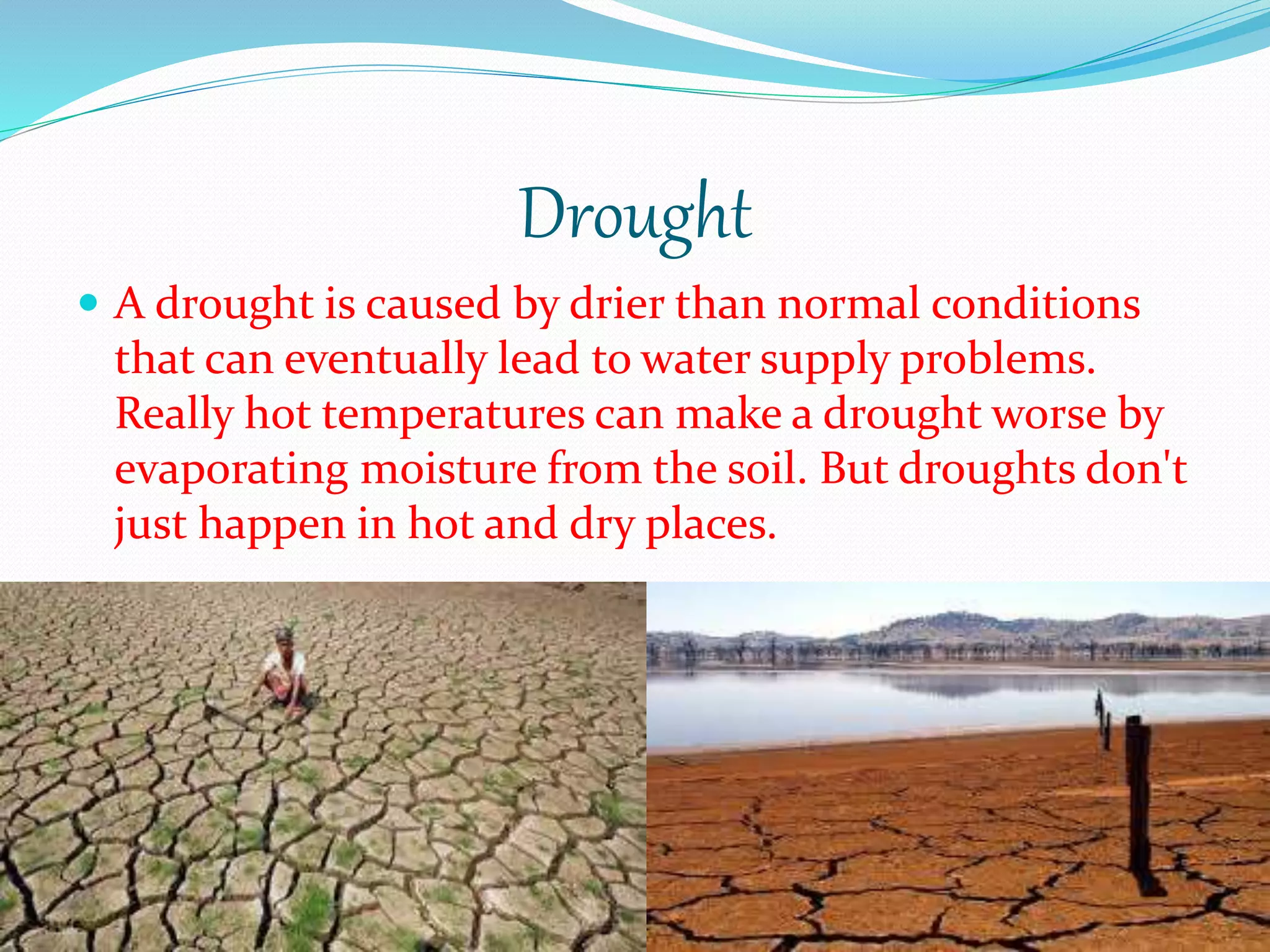
 A drought is caused by drier than normal conditions
that can eventually lead to water supply problems.
Really hot temperatures can make a drought worse by
evaporating moisture from the soil. But droughts don't
just happen in hot and dry places.
Drought In Maharashtra
 The 2013 drought in Maharashtra in India came about
after the region received lower rainfall during
the monsoon season June to September 2012. It is
considered as the region's worst drought in 40 years.
The worst-hit areas
in Maharashtra were Solapur, Parbhani, Ahmednagar,
Latur, Pune, Satara, Beed and Nashik. Residents
of Latur, Osmanabad, Nanded, Aurangabad, Jalna, Jalg
aon and Dhule districts were also affected by
this famine.
Causes Of Drought
 1) Land and water temperatures cause drought:As overall temperatures
increase more water evaporates and severe weather conditions increase.
Landscapes and crops need more water to survive and overall the demand for
water increases. This is why it is so important to consider changes in ET when
discussing water savings. You might be using more water or less water
depending on weather conditions.
 2) Soil moisture levels also contribute to drought:When soil moisture is
depleted there is less evaporation of water to create clouds. Surface
temperatures rise, more water is needed and less is available which contributes
to a more severe drought.
 3) Drought can also be a supply and demand of water issue:When a
region is growing rapidly the demand for water can exceed the supply. When
weather conditions, temperatures or air patterns push a region toward a
drought the demand for water by people can offset or worsen the situation
depending on how the region reacts. Excessive irrigation is an excellent of
people contributing to a drought.
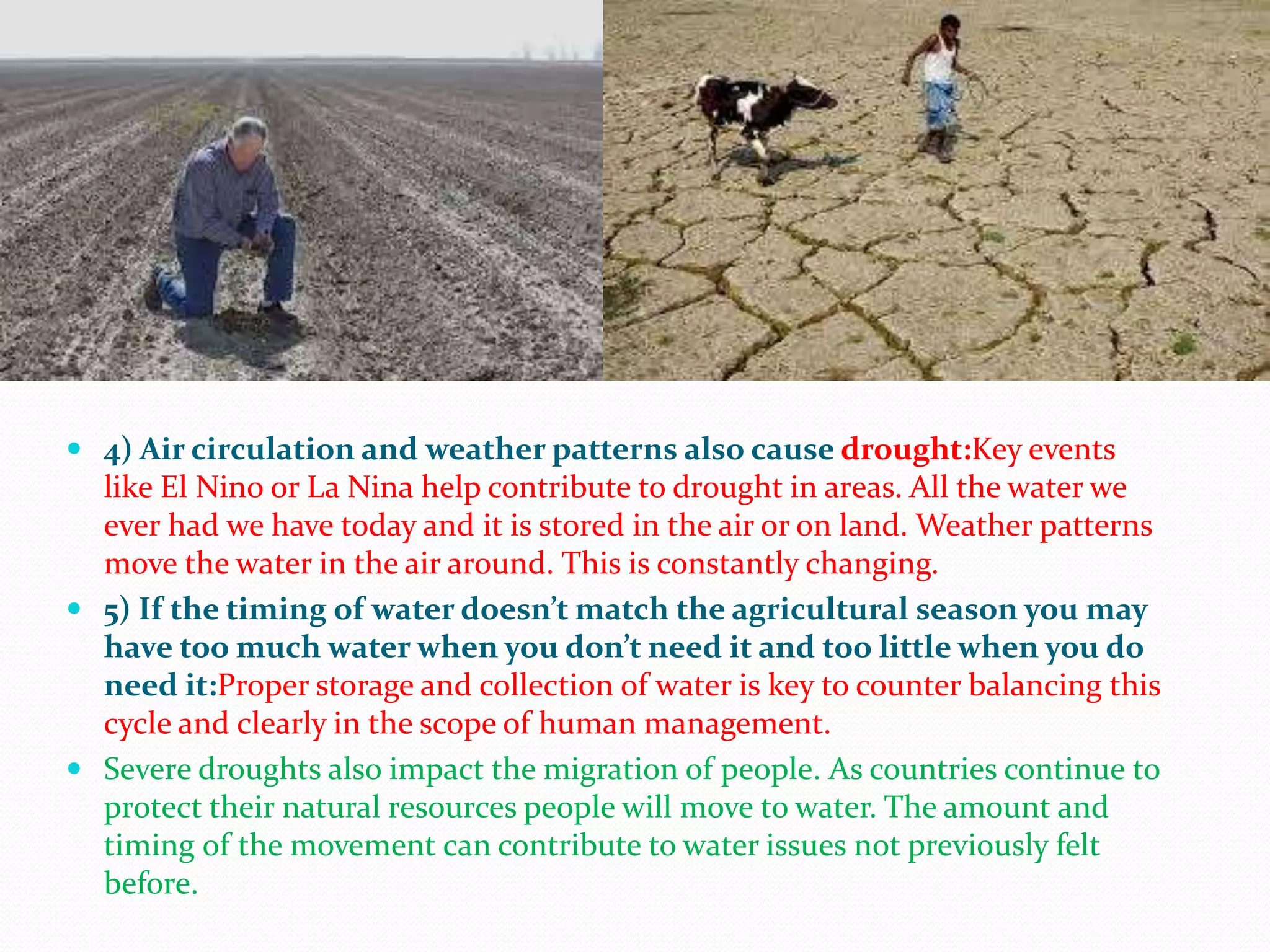
 4) Air circulation and weather patterns also cause drought:Key events
like El Nino or La Nina help contribute to drought in areas. All the water we
ever had we have today and it is stored in the air or on land. Weather patterns
move the water in the air around. This is constantly changing.
 5) If the timing of water doesn’t match the agricultural season you may
have too much water when you don’t need it and too little when you do
need it:Proper storage and collection of water is key to counter balancing this
cycle and clearly in the scope of human management.
 Severe droughts also impact the migration of people. As countries continue to
protect their natural resources people will move to water. The amount and
timing of the movement can contribute to water issues not previously felt
before.
Effects Of Drought
 1) Hunger and Famine:Drought conditions often provide too little water to
support food crops, through either natural precipitation or irrigation using reserve
water supplies. The same problem affects grass and grain used to feed livestock and
poultry. When drought undermines or destroys food sources, people go hungry.
When the drought is severe and continues over a long period, famine may occur.
Many of us remember the 1984 famine in Ethiopia, which was the result of a deadly
combination of a severe drought and a dangerously ineffective government.
Hundreds of thousands died as a result.
 2) Not Enough Drinking Water:All living things must have water to survive.
People can live for weeks without food, but only a few days without water. In places
like California, drought is experienced mainly as an inconvenience, perhaps with
some economic losses, but in very poor countries the consequences are much more
direct. When desperate for water to drink, people will turn to untreated sources that
can make them sick.
 3) Disease:Drought often creates a lack of clean water for drinking, public
sanitation and personal hygiene, which can lead to a wide range of life-
threatening diseases. The problem of water access is critical: every year,
millions are sickened or die due to lack of clean water access and sanitation,
and droughts only make the problem worse.
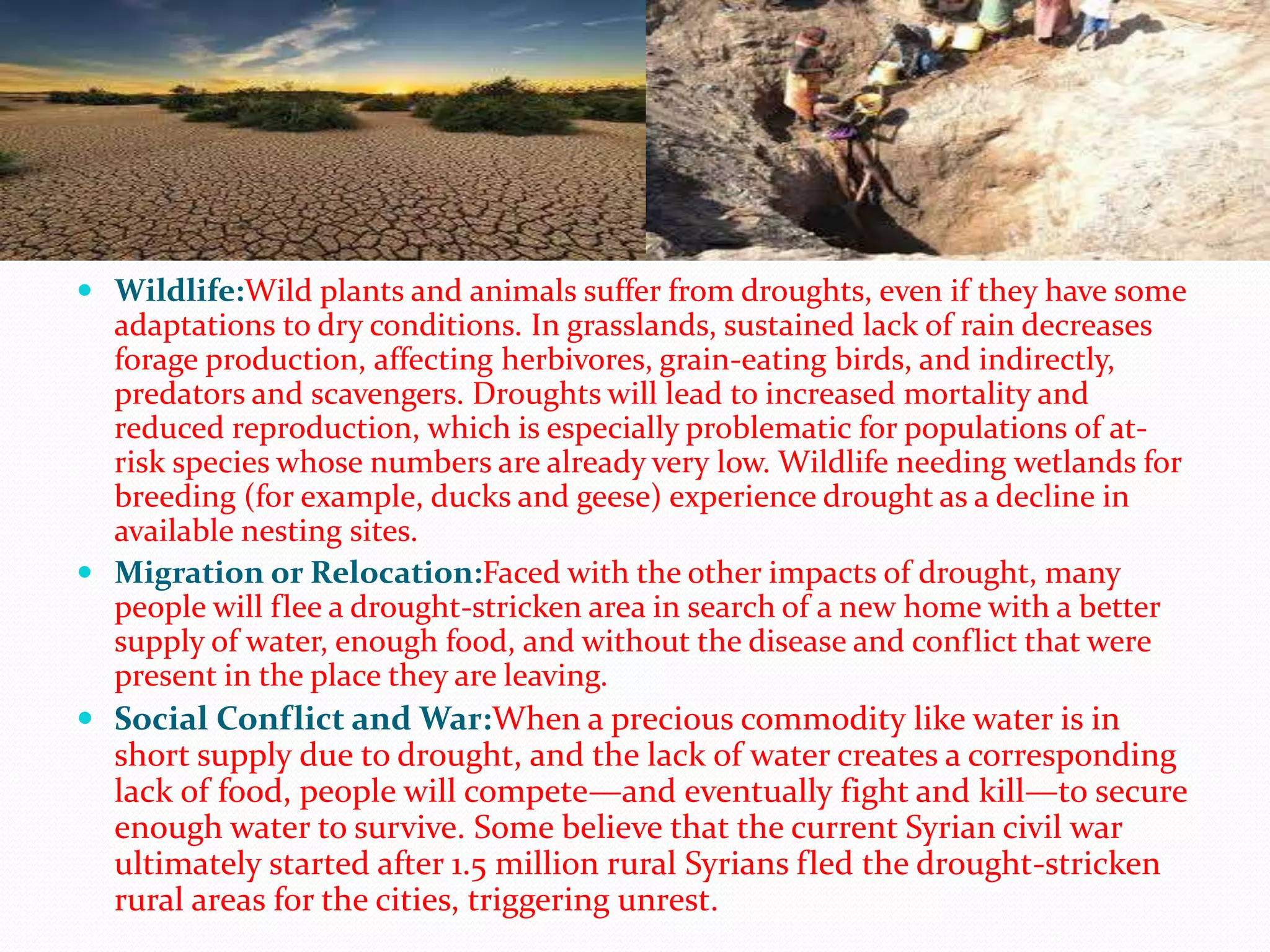
 Wildlife:Wild plants and animals suffer from droughts, even if they have some
adaptations to dry conditions. In grasslands, sustained lack of rain decreases
forage production, affecting herbivores, grain-eating birds, and indirectly,
predators and scavengers. Droughts will lead to increased mortality and
reduced reproduction, which is especially problematic for populations of at-
risk species whose numbers are already very low. Wildlife needing wetlands for
breeding (for example, ducks and geese) experience drought as a decline in
available nesting sites.
 Migration or Relocation:Faced with the other impacts of drought, many
people will flee a drought-stricken area in search of a new home with a better
supply of water, enough food, and without the disease and conflict that were
present in the place they are leaving.
 Social Conflict and War:When a precious commodity like water is in
short supply due to drought, and the lack of water creates a corresponding
lack of food, people will compete—and eventually fight and kill—to secure
enough water to survive. Some believe that the current Syrian civil war
ultimately started after 1.5 million rural Syrians fled the drought-stricken
rural areas for the cities, triggering unrest.
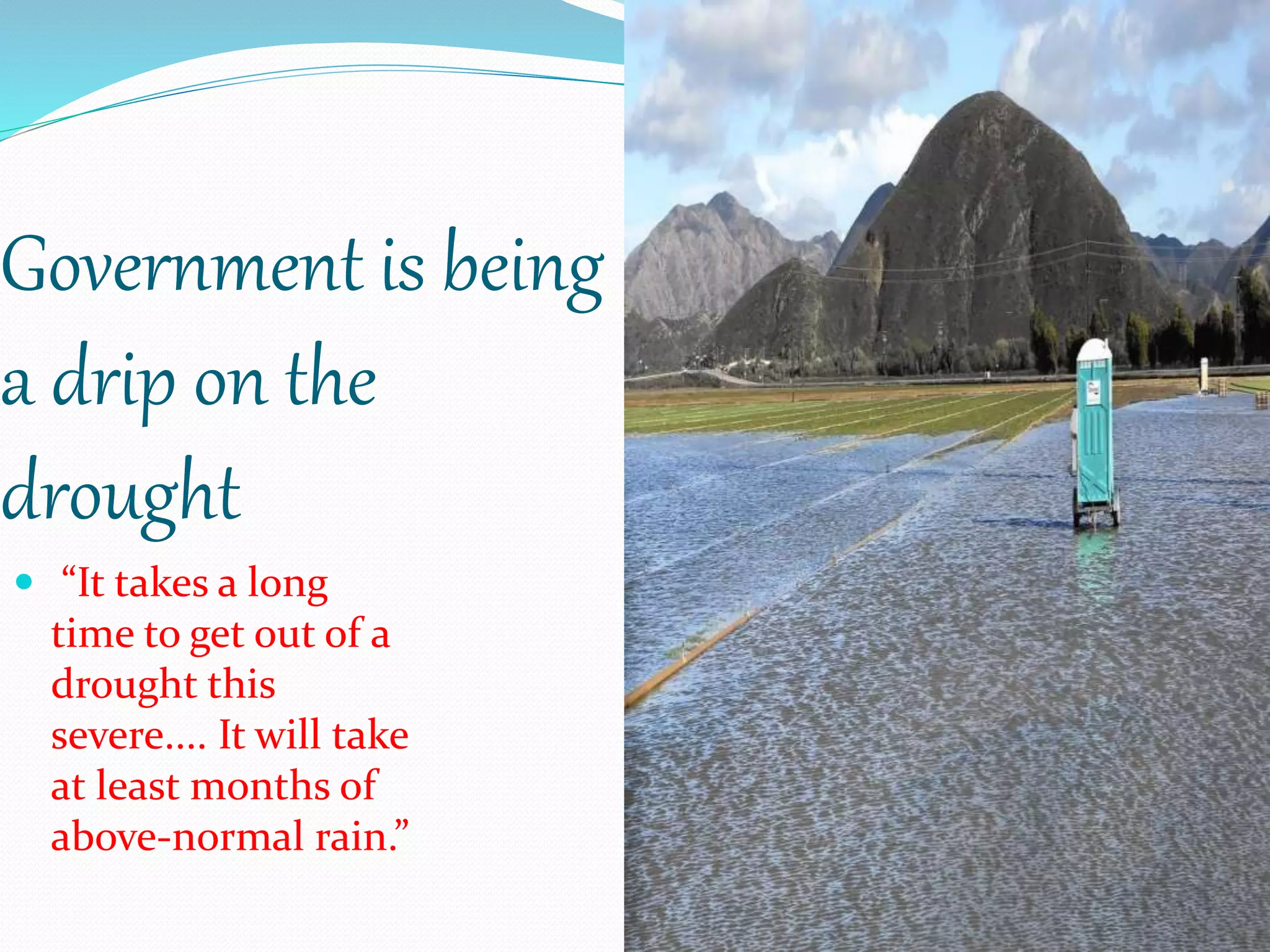
Government is being
a drip on the
drought
 “It takes a long
time to get out of a
drought this
severe.... It will take
at least months of
above-normal rain.”
PRECAUTIONS TAKEN TO PREVENT
DROUGHT
 Operate automatic clothes washers only when they are fully
loaded or set the appropriate water level for the size of your load.
 Avoid letting the water run while brushing your teeth, washing
your face or shaving.
 Place a bucket in the shower to catch excess water for watering
plants.
 Store drinking water in the refrigerator. Do not let the tap run
while you are waiting for water to cool.
 Avoid wasting water waiting for it to get hot. Capture it for other
uses such as plant watering or heat it on the stove or in a
microwave.
 Operate automatic dishwashers only when they are fully loaded.
Use the "light wash" feature, if available, to use less water.
 Hand wash dishes by filling two containers—one with soapy
water and the other with rinse water containing a small amount
of chlorine bleach.
CONCLUSION
 Droughts are a natural disaster that nobody can
stop from coming, but we can prepare for the
effects of this natural disaster to make it less
difficult. There are many human and natural
system impacts that this force of nature costs that
we should be aware of.
Disaster Management(Drought)

Disaster Management(Drought)

  • 1.
  • 2.
    DISASTER  A disasteris a serious disruption occurring over a short or long period of time that causes widespread human, material, economic or environmental loss which exceeds the ability of the affected community or society to cope using its own resources.
  • 3.
    TYPES OF Disaster Natural Disaster:caused without any human influence.For instance Floods and Tsunamis etc.  Man-Made Disaster: caused due to human activity.For instance Bhopal Gas Tragedy.  Hybrid Disaster:caused due to both natural force and natural force.For instance Soil erosion due to deforestation and landslide due to heavy rainfall etc.
  • 4.
    Drought  A droughtis caused by drier than normal conditions that can eventually lead to water supply problems. Really hot temperatures can make a drought worse by evaporating moisture from the soil. But droughts don't just happen in hot and dry places.
  • 5.
    Drought In Maharashtra The 2013 drought in Maharashtra in India came about after the region received lower rainfall during the monsoon season June to September 2012. It is considered as the region's worst drought in 40 years. The worst-hit areas in Maharashtra were Solapur, Parbhani, Ahmednagar, Latur, Pune, Satara, Beed and Nashik. Residents of Latur, Osmanabad, Nanded, Aurangabad, Jalna, Jalg aon and Dhule districts were also affected by this famine.
  • 6.
    Causes Of Drought 1) Land and water temperatures cause drought:As overall temperatures increase more water evaporates and severe weather conditions increase. Landscapes and crops need more water to survive and overall the demand for water increases. This is why it is so important to consider changes in ET when discussing water savings. You might be using more water or less water depending on weather conditions.  2) Soil moisture levels also contribute to drought:When soil moisture is depleted there is less evaporation of water to create clouds. Surface temperatures rise, more water is needed and less is available which contributes to a more severe drought.  3) Drought can also be a supply and demand of water issue:When a region is growing rapidly the demand for water can exceed the supply. When weather conditions, temperatures or air patterns push a region toward a drought the demand for water by people can offset or worsen the situation depending on how the region reacts. Excessive irrigation is an excellent of people contributing to a drought.
  • 7.
     4) Aircirculation and weather patterns also cause drought:Key events like El Nino or La Nina help contribute to drought in areas. All the water we ever had we have today and it is stored in the air or on land. Weather patterns move the water in the air around. This is constantly changing.  5) If the timing of water doesn’t match the agricultural season you may have too much water when you don’t need it and too little when you do need it:Proper storage and collection of water is key to counter balancing this cycle and clearly in the scope of human management.  Severe droughts also impact the migration of people. As countries continue to protect their natural resources people will move to water. The amount and timing of the movement can contribute to water issues not previously felt before.
  • 8.
    Effects Of Drought 1) Hunger and Famine:Drought conditions often provide too little water to support food crops, through either natural precipitation or irrigation using reserve water supplies. The same problem affects grass and grain used to feed livestock and poultry. When drought undermines or destroys food sources, people go hungry. When the drought is severe and continues over a long period, famine may occur. Many of us remember the 1984 famine in Ethiopia, which was the result of a deadly combination of a severe drought and a dangerously ineffective government. Hundreds of thousands died as a result.  2) Not Enough Drinking Water:All living things must have water to survive. People can live for weeks without food, but only a few days without water. In places like California, drought is experienced mainly as an inconvenience, perhaps with some economic losses, but in very poor countries the consequences are much more direct. When desperate for water to drink, people will turn to untreated sources that can make them sick.  3) Disease:Drought often creates a lack of clean water for drinking, public sanitation and personal hygiene, which can lead to a wide range of life- threatening diseases. The problem of water access is critical: every year, millions are sickened or die due to lack of clean water access and sanitation, and droughts only make the problem worse.
  • 9.
     Wildlife:Wild plantsand animals suffer from droughts, even if they have some adaptations to dry conditions. In grasslands, sustained lack of rain decreases forage production, affecting herbivores, grain-eating birds, and indirectly, predators and scavengers. Droughts will lead to increased mortality and reduced reproduction, which is especially problematic for populations of at- risk species whose numbers are already very low. Wildlife needing wetlands for breeding (for example, ducks and geese) experience drought as a decline in available nesting sites.  Migration or Relocation:Faced with the other impacts of drought, many people will flee a drought-stricken area in search of a new home with a better supply of water, enough food, and without the disease and conflict that were present in the place they are leaving.  Social Conflict and War:When a precious commodity like water is in short supply due to drought, and the lack of water creates a corresponding lack of food, people will compete—and eventually fight and kill—to secure enough water to survive. Some believe that the current Syrian civil war ultimately started after 1.5 million rural Syrians fled the drought-stricken rural areas for the cities, triggering unrest.
  • 10.
    Government is being adrip on the drought  “It takes a long time to get out of a drought this severe.... It will take at least months of above-normal rain.”
  • 11.
    PRECAUTIONS TAKEN TOPREVENT DROUGHT  Operate automatic clothes washers only when they are fully loaded or set the appropriate water level for the size of your load.  Avoid letting the water run while brushing your teeth, washing your face or shaving.  Place a bucket in the shower to catch excess water for watering plants.  Store drinking water in the refrigerator. Do not let the tap run while you are waiting for water to cool.  Avoid wasting water waiting for it to get hot. Capture it for other uses such as plant watering or heat it on the stove or in a microwave.  Operate automatic dishwashers only when they are fully loaded. Use the "light wash" feature, if available, to use less water.  Hand wash dishes by filling two containers—one with soapy water and the other with rinse water containing a small amount of chlorine bleach.
  • 12.
    CONCLUSION  Droughts area natural disaster that nobody can stop from coming, but we can prepare for the effects of this natural disaster to make it less difficult. There are many human and natural system impacts that this force of nature costs that we should be aware of.