The Chassis
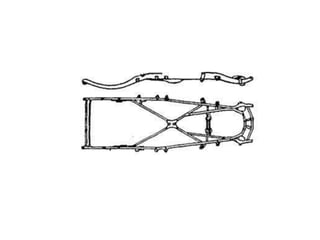
• The chassis frame supports the various components and the body,
and keeps them in correct positions.
• The frame must be light, but sufficiently strong to withstand the
weight and rated load of the vehicle without having appreciable
distortion.
• It must also be rigid enough to safeguard the components against
the action of different forces.
• The chassis design includes the selection of suitable shapes and
cross-section of chassis-members.
• Moreover the design looks into the reinforcement of the
chassis side- and cross-member joints, and the various
methods of fastening them together.
• The materials most commonly used for frame construction is
cold-rolled open-hearth steel, but sometimes heat treated alloy
steel that has equivalent strength with less weight is also used.
• The steel is usually cold-pressed into channel sections so that
the frame becomes strong and light.
• Heavy-duty trucks sometimes use frames made from I-sections
and other structural forms.
Chassis Side- and Cross-member Fastening
Riveted Joints.
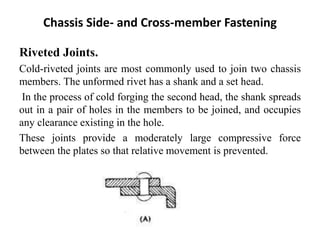
Cold-riveted joints are most commonly used to join two chassis
members. The unformed rivet has a shank and a set head.
In the process of cold forging the second head, the shank spreads
out in a pair of holes in the members to be joined, and occupies
any clearance existing in the hole.
These joints provide a moderately large compressive force
between the plates so that relative movement is prevented.
Bolted Joints
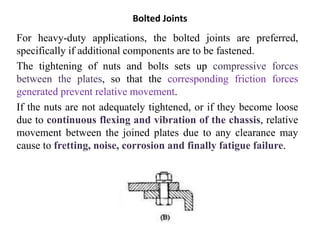
For heavy-duty applications, the bolted joints are preferred,
specifically if additional components are to be fastened.
The tightening of nuts and bolts sets up compressive forces
between the plates, so that the corresponding friction forces
generated prevent relative movement.
If the nuts are not adequately tightened, or if they become loose
due to continuous flexing and vibration of the chassis, relative
movement between the joined plates due to any clearance may
cause to fretting, noise, corrosion and finally fatigue failure.
Welded Joints
• Generally chassis side- and cross-members are not welded
together. However subsections are frequently joined by lap
welding.
• The problem with welded joints is that they produce thermal
distortion and, in case of the rigid frame, high stress
concentration develops at the joints, which may eventually
crack.
• Additionally, welding destroys any previous heat treatment
around the joint thereby weakening the structure. Although
precautions are available to prevent these problems but they
are expensive to apply.

Chassis Introduction

  • 1.
    The Chassis • Thechassis frame supports the various components and the body, and keeps them in correct positions. • The frame must be light, but sufficiently strong to withstand the weight and rated load of the vehicle without having appreciable distortion. • It must also be rigid enough to safeguard the components against the action of different forces. • The chassis design includes the selection of suitable shapes and cross-section of chassis-members.
  • 2.
    • Moreover thedesign looks into the reinforcement of the chassis side- and cross-member joints, and the various methods of fastening them together. • The materials most commonly used for frame construction is cold-rolled open-hearth steel, but sometimes heat treated alloy steel that has equivalent strength with less weight is also used. • The steel is usually cold-pressed into channel sections so that the frame becomes strong and light. • Heavy-duty trucks sometimes use frames made from I-sections and other structural forms.
  • 4.
    Chassis Side- andCross-member Fastening Riveted Joints. Cold-riveted joints are most commonly used to join two chassis members. The unformed rivet has a shank and a set head. In the process of cold forging the second head, the shank spreads out in a pair of holes in the members to be joined, and occupies any clearance existing in the hole. These joints provide a moderately large compressive force between the plates so that relative movement is prevented.
  • 5.
    Bolted Joints For heavy-dutyapplications, the bolted joints are preferred, specifically if additional components are to be fastened. The tightening of nuts and bolts sets up compressive forces between the plates, so that the corresponding friction forces generated prevent relative movement. If the nuts are not adequately tightened, or if they become loose due to continuous flexing and vibration of the chassis, relative movement between the joined plates due to any clearance may cause to fretting, noise, corrosion and finally fatigue failure.
  • 6.
    Welded Joints • Generallychassis side- and cross-members are not welded together. However subsections are frequently joined by lap welding. • The problem with welded joints is that they produce thermal distortion and, in case of the rigid frame, high stress concentration develops at the joints, which may eventually crack. • Additionally, welding destroys any previous heat treatment around the joint thereby weakening the structure. Although precautions are available to prevent these problems but they are expensive to apply.