www.TransformingTransportation.org
Charting the Path to a Sustainable
Mobility Future:
Three Revolutions in Global Transportation by 2030/2050
Lew Fulton, UC Davis, ITS STEPS Program
Presented at Transforming Transportation 2017
Charting the Path to a Sustainable Mobility Future: Three
Revolutions in Global Transportation by 2030/2050
Lew Fulton
UC Davis, ITS STEPS Program Transforming Transportation
January 13, 2017
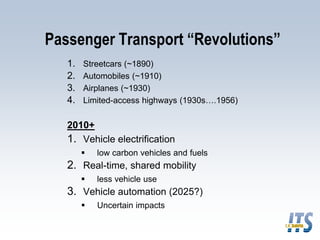
Passenger Transport “Revolutions”
1. Streetcars (~1890)
2. Automobiles (~1910)
3. Airplanes (~1930)
4. Limited-access highways (1930s….1956)
2010+
1. Vehicle electrification
 low carbon vehicles and fuels
2. Real-time, shared mobility
 less vehicle use
3. Vehicle automation (2025?)
 Uncertain impacts
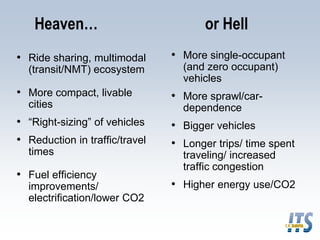
Heaven… or Hell
• Ride sharing, multimodal
(transit/NMT) ecosystem
• More compact, livable
cities
• “Right-sizing” of vehicles
• Reduction in traffic/travel
times
• Fuel efficiency
improvements/
electrification/lower CO2
• More single-occupant
(and zero occupant)
vehicles
• More sprawl/car-
dependence
• Bigger vehicles
• Longer trips/ time spent
traveling/ increased
traffic congestion
• Higher energy use/CO2
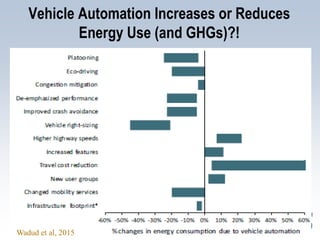
Vehicle Automation Increases or Reduces
Energy Use (and GHGs)?!
Wadud et al, 2015
Questions and conflicts
• Automation – lower per-trip costs, lower “time cost” for being
in vehicles – longer trips?
– Empty running (zero passengers) of vehicles
• For-hire vehicles – giving discounts for sharing may be less
interesting with no driver costs
• Ride sharing – at conflict with public transit use?
• Private vehicles – decreased negative costs may mean less
public sharing?
• Assumed electrification with automation – but not necessarily
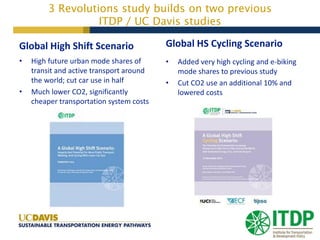
3 Revolutions study builds on two previous
ITDP / UC Davis studies
Global High Shift Scenario
• High future urban mode shares of
transit and active transport around
the world; cut car use in half
• Much lower CO2, significantly
cheaper transportation system costs
Global HS Cycling Scenario
• Added very high cycling and e-biking
mode shares to previous study
• Cut CO2 use an additional 10% and
lowered costs
Study scope – two main aspects
• Investigate and report on the current (2016) status
of a range of types of new mobility services around
the world
• Create 3 Revolutions urban passenger/vehicle travel
scenarios to 2030, 2050
Creating 3 Revolutions scenarios to 2030, 2050
• Explore scenarios related to how much the technologies and
services could grow and shape future transport
• How may patterns vary in different countries?
• What types of overall mobility, energy and environmental
impacts might these services have in the context of broader
urban transport system developments?
• Explore interactions between the three revolutions
• Develop narratives on how each scenario could develop
• Identification of policies that could steer existing trends to
maximize mobility and sustainability benefits to cities
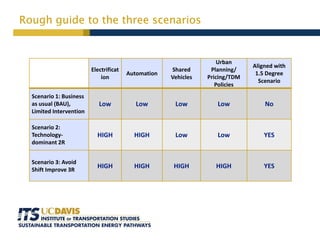
Rough guide to the three scenarios
Electrificat
ion
Automation
Shared
Vehicles
Urban
Planning/
Pricing/TDM
Policies
Aligned with
1.5 Degree
Scenario
Scenario 1: Business
as usual (BAU),
Limited Intervention
Low Low Low Low No
Scenario 2:
Technology-
dominant 2R
HIGH HIGH Low Low YES
Scenario 3: Avoid
Shift Improve 3R
HIGH HIGH HIGH HIGH YES
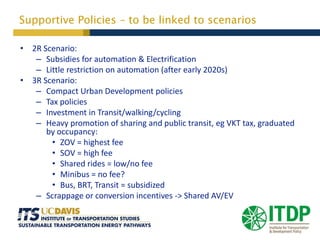
Supportive Policies – to be linked to scenarios
• 2R Scenario:
– Subsidies for automation & Electrification
– Little restriction on automation (after early 2020s)
• 3R Scenario:
– Compact Urban Development policies
– Tax policies
– Investment in Transit/walking/cycling
– Heavy promotion of sharing and public transit, eg VKT tax, graduated
by occupancy:
• ZOV = highest fee
• SOV = high fee
• Shared rides = low/no fee
• Minibus = no fee?
• Bus, BRT, Transit = subsidized
– Scrappage or conversion incentives -> Shared AV/EV
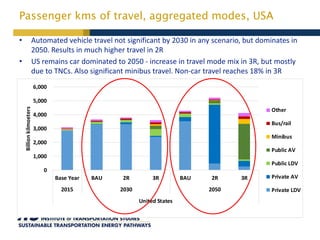
Passenger kms of travel, aggregated modes, USA
• Automated vehicle travel not significant by 2030 in any scenario, but dominates in
2050. Results in much higher travel in 2R
• US remains car dominated to 2050 - increase in travel mode mix in 3R, but mostly
due to TNCs. Also significant minibus travel. Non-car travel reaches 18% in 3R
0
1,000
2,000
3,000
4,000
5,000
6,000
Base Year BAU 2R 3R BAU 2R 3R
2015 2030 2050
United States
Billionkilmoeters
Other
Bus/rail
Minibus
Public AV
Public LDV
Private AV
Private LDV
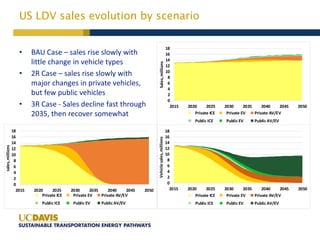
US LDV sales evolution by scenario
• BAU Case – sales rise slowly with
little change in vehicle types
• 2R Case – sales rise slowly with
major changes in private vehicles,
but few public vehicles
• 3R Case - Sales decline fast through
2035, then recover somewhat
0
2
4
6
8
10
12
14
16
18
2015 2020 2025 2030 2035 2040 2045 2050
Sales,millions
Private ICE Private EV Private AV/EV
Public ICE Public EV Public AV/EV
0
2
4
6
8
10
12
14
16
18
2015 2020 2025 2030 2035 2040 2045 2050
sales,millions
Private ICE Private EV Private AV/EV
Public ICE Public EV Public AV/EV
0
2
4
6
8
10
12
14
16
18
2015 2020 2025 2030 2035 2040 2045 2050
Vehiclesales,millions
Private ICE Private EV Private AV/EV
Public ICE Public EV Public AV/EV
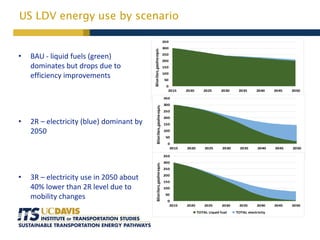
US LDV energy use by scenario
• BAU - liquid fuels (green)
dominates but drops due to
efficiency improvements
• 2R – electricity (blue) dominant by
2050
• 3R – electricity use in 2050 about
40% lower than 2R level due to
mobility changes
0
50
100
150
200
250
300
350
2015 2020 2025 2030 2035 2040 2045 2050
Bilionliters,gasolineequiv.
TOTAL Liquid fuel TOTAL electricity
0
50
100
150
200
250
300
350
2015 2020 2025 2030 2035 2040 2045 2050
Bilionliters,gasolineequiv.
TOTAL Liquid fuel TOTAL electricity
0
50
100
150
200
250
300
350
2015 2020 2025 2030 2035 2040 2045 2050
Bilionliters,gasolineequiv.
TOTAL Liquid fuel TOTAL electricity
Next Steps
• Refine results, add 1R, finish cost analysis
• Develop full narratives and integrate policy requirements
• Deeper visualizations to output set
• Report launch in March 2017 (I hope)

Charting the Path to a Sustainable Mobility Future

  • 1.
    www.TransformingTransportation.org Charting the Pathto a Sustainable Mobility Future: Three Revolutions in Global Transportation by 2030/2050 Lew Fulton, UC Davis, ITS STEPS Program Presented at Transforming Transportation 2017
  • 2.
    Charting the Pathto a Sustainable Mobility Future: Three Revolutions in Global Transportation by 2030/2050 Lew Fulton UC Davis, ITS STEPS Program Transforming Transportation January 13, 2017
  • 3.
    Passenger Transport “Revolutions” 1.Streetcars (~1890) 2. Automobiles (~1910) 3. Airplanes (~1930) 4. Limited-access highways (1930s….1956) 2010+ 1. Vehicle electrification  low carbon vehicles and fuels 2. Real-time, shared mobility  less vehicle use 3. Vehicle automation (2025?)  Uncertain impacts
  • 4.
    Heaven… or Hell •Ride sharing, multimodal (transit/NMT) ecosystem • More compact, livable cities • “Right-sizing” of vehicles • Reduction in traffic/travel times • Fuel efficiency improvements/ electrification/lower CO2 • More single-occupant (and zero occupant) vehicles • More sprawl/car- dependence • Bigger vehicles • Longer trips/ time spent traveling/ increased traffic congestion • Higher energy use/CO2
  • 5.
    Vehicle Automation Increasesor Reduces Energy Use (and GHGs)?! Wadud et al, 2015
  • 6.
    Questions and conflicts •Automation – lower per-trip costs, lower “time cost” for being in vehicles – longer trips? – Empty running (zero passengers) of vehicles • For-hire vehicles – giving discounts for sharing may be less interesting with no driver costs • Ride sharing – at conflict with public transit use? • Private vehicles – decreased negative costs may mean less public sharing? • Assumed electrification with automation – but not necessarily
  • 7.
    3 Revolutions studybuilds on two previous ITDP / UC Davis studies Global High Shift Scenario • High future urban mode shares of transit and active transport around the world; cut car use in half • Much lower CO2, significantly cheaper transportation system costs Global HS Cycling Scenario • Added very high cycling and e-biking mode shares to previous study • Cut CO2 use an additional 10% and lowered costs
  • 8.
    Study scope –two main aspects • Investigate and report on the current (2016) status of a range of types of new mobility services around the world • Create 3 Revolutions urban passenger/vehicle travel scenarios to 2030, 2050
  • 9.
    Creating 3 Revolutionsscenarios to 2030, 2050 • Explore scenarios related to how much the technologies and services could grow and shape future transport • How may patterns vary in different countries? • What types of overall mobility, energy and environmental impacts might these services have in the context of broader urban transport system developments? • Explore interactions between the three revolutions • Develop narratives on how each scenario could develop • Identification of policies that could steer existing trends to maximize mobility and sustainability benefits to cities
  • 10.
    Rough guide tothe three scenarios Electrificat ion Automation Shared Vehicles Urban Planning/ Pricing/TDM Policies Aligned with 1.5 Degree Scenario Scenario 1: Business as usual (BAU), Limited Intervention Low Low Low Low No Scenario 2: Technology- dominant 2R HIGH HIGH Low Low YES Scenario 3: Avoid Shift Improve 3R HIGH HIGH HIGH HIGH YES
  • 11.
    Supportive Policies –to be linked to scenarios • 2R Scenario: – Subsidies for automation & Electrification – Little restriction on automation (after early 2020s) • 3R Scenario: – Compact Urban Development policies – Tax policies – Investment in Transit/walking/cycling – Heavy promotion of sharing and public transit, eg VKT tax, graduated by occupancy: • ZOV = highest fee • SOV = high fee • Shared rides = low/no fee • Minibus = no fee? • Bus, BRT, Transit = subsidized – Scrappage or conversion incentives -> Shared AV/EV
  • 12.
    Passenger kms oftravel, aggregated modes, USA • Automated vehicle travel not significant by 2030 in any scenario, but dominates in 2050. Results in much higher travel in 2R • US remains car dominated to 2050 - increase in travel mode mix in 3R, but mostly due to TNCs. Also significant minibus travel. Non-car travel reaches 18% in 3R 0 1,000 2,000 3,000 4,000 5,000 6,000 Base Year BAU 2R 3R BAU 2R 3R 2015 2030 2050 United States Billionkilmoeters Other Bus/rail Minibus Public AV Public LDV Private AV Private LDV
  • 13.
    US LDV salesevolution by scenario • BAU Case – sales rise slowly with little change in vehicle types • 2R Case – sales rise slowly with major changes in private vehicles, but few public vehicles • 3R Case - Sales decline fast through 2035, then recover somewhat 0 2 4 6 8 10 12 14 16 18 2015 2020 2025 2030 2035 2040 2045 2050 Sales,millions Private ICE Private EV Private AV/EV Public ICE Public EV Public AV/EV 0 2 4 6 8 10 12 14 16 18 2015 2020 2025 2030 2035 2040 2045 2050 sales,millions Private ICE Private EV Private AV/EV Public ICE Public EV Public AV/EV 0 2 4 6 8 10 12 14 16 18 2015 2020 2025 2030 2035 2040 2045 2050 Vehiclesales,millions Private ICE Private EV Private AV/EV Public ICE Public EV Public AV/EV
  • 14.
    US LDV energyuse by scenario • BAU - liquid fuels (green) dominates but drops due to efficiency improvements • 2R – electricity (blue) dominant by 2050 • 3R – electricity use in 2050 about 40% lower than 2R level due to mobility changes 0 50 100 150 200 250 300 350 2015 2020 2025 2030 2035 2040 2045 2050 Bilionliters,gasolineequiv. TOTAL Liquid fuel TOTAL electricity 0 50 100 150 200 250 300 350 2015 2020 2025 2030 2035 2040 2045 2050 Bilionliters,gasolineequiv. TOTAL Liquid fuel TOTAL electricity 0 50 100 150 200 250 300 350 2015 2020 2025 2030 2035 2040 2045 2050 Bilionliters,gasolineequiv. TOTAL Liquid fuel TOTAL electricity
  • 15.
    Next Steps • Refineresults, add 1R, finish cost analysis • Develop full narratives and integrate policy requirements • Deeper visualizations to output set • Report launch in March 2017 (I hope)