The Artificial Heart:
A Design Example


    BIOE 1000
  October 18, 2001
The Human Heart
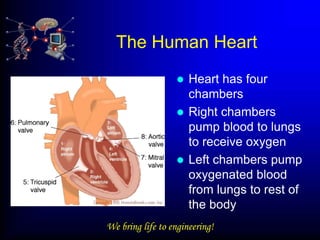
                   Heart has four
                    chambers
                   Right chambers
                    pump blood to lungs
                    to receive oxygen
                   Left chambers pump
                    oxygenated blood
                    from lungs to rest of
                    the body
We bring life to engineering!
The Human Heart
 Right and left atria receive blood
 Right and left ventricles pump blood
 Valves produce one-way blood flow
  from atria    ventricles    arteries
 Energy to pump blood comes from
  nutrients and oxygen in blood
 The blood supply to the heart is
  provided by coronary arteries
            We bring life to engineering!
Heart Disease
 Heart attack: blockage of coronary artery
  damages portion of heart muscle
 Congestive heart failure: gradual weakening
  of heart
 Millions suffer from heart disease
    – Many cases are treatable with lifestyle changes,
      drugs and/or surgery
    – Surviving patients suffering from most severe
      cases need new hearts!

                 We bring life to engineering!
The Need for a Heart
                Substitute
 100,000 Americans/year suffering from
  severe heart disease need new hearts
 Only 2,000 patients receive heart
  transplants
 Conclusion: many patients die waiting
  for a new heart!
 A suitable alternative to donor hearts
  could prolong thousands of lives

            We bring life to engineering!
History of Heart
                              Substitutes
   WWII: first open heart
    surgeries
   1953: heart-lung machine
    successfully used during
    heart surgery
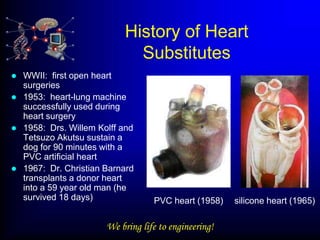
   1958: Drs. Willem Kolff and
    Tetsuzo Akutsu sustain a
    dog for 90 minutes with a
    PVC artificial heart
   1967: Dr. Christian Barnard
    transplants a donor heart
    into a 59 year old man (he
    survived 18 days)               PVC heart (1958)    silicone heart (1965)

                        We bring life to engineering!
History of Heart
                             Substitutes
                                             1969: Dr. Denton Cooley
                                              uses an artificial heart to
                                              sustain a patient waiting for
                                              a donor (survived 3 days)
                                             1972: Cyclosporine
                                              introduced to suppress
                                              immune responses of
                                              transplant recipients
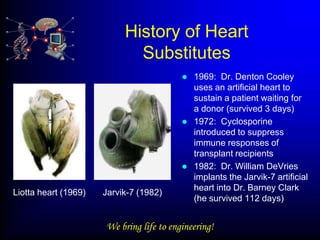
                                             1982: Dr. William DeVries
                                              implants the Jarvik-7 artificial
                                              heart into Dr. Barney Clark
Liotta heart (1969)   Jarvik-7 (1982)
                                              (he survived 112 days)


                      We bring life to engineering!
Why Heart Substitutes Fail

 Immune response “rejects” transplant or
  side effects due to immune suppression
 Infection due to tubes and wires passing
  through skin
 Formation of clots
 Damage to red blood cells
 Lack of pulsatile blood flow?

            We bring life to engineering!
Design Process
   Identify the problem or need to address
   Specify details/criteria of an adequate
    solution to your problem
   Implement various solutions that meet the
    criteria you specified
   Test to determine which solution is most
    viable
   Further testing to refine the solution you
    chose

                We bring life to engineering!
Design Refinement
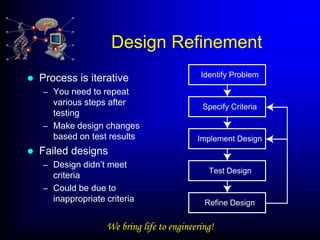
                                             Identify Problem
   Process is iterative
    – You need to repeat
      various steps after                     Specify Criteria
      testing
    – Make design changes
      based on test results                 Implement Design
   Failed designs
    – Design didn’t meet
                                               Test Design
      criteria
    – Could be due to
      inappropriate criteria                  Refine Design


                    We bring life to engineering!
Criteria for a Heart
                       Substitute
   Must fit into chest cavity and connect to atria,
    pulmonary artery and aorta quickly
   Provide an adequate blood flow (8 – 10
    liters/min)
   Send deoxygenated blood to the lungs and
    oxygenated blood to the body
   Operate continuously for an indefinite period
    of time
   Provide adequate warning if something is
    wrong or if it is going to fail
                 We bring life to engineering!
Criteria for a Heart
                     Substitute
   Should increase/decrease blood flow based
    on patient activity level
   Should not evoke an immune response
   No wires or tubes that penetrate the skin
   Should not produce blood clots
   Should not damage red blood cells
   Ideally should have pulsatile blood flow
   Many others we haven’t thought of!
               We bring life to engineering!
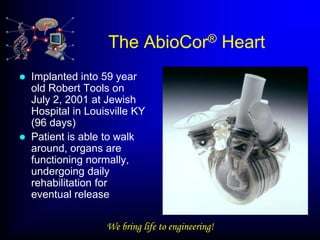
The AbioCor® Heart
 Implanted into 59 year
  old Robert Tools on
  July 2, 2001 at Jewish
  Hospital in Louisville KY
  (96 days)
 Patient is able to walk
  around, organs are
  functioning normally,
  undergoing daily
  rehabilitation for
  eventual release

                  We bring life to engineering!
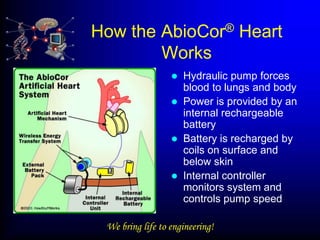
How the AbioCor® Heart
        Works
                     Hydraulic pump forces
                      blood to lungs and body
                     Power is provided by an
                      internal rechargeable
                      battery
                     Battery is recharged by
                      coils on surface and
                      below skin
                     Internal controller
                      monitors system and
                      controls pump speed

 We bring life to engineering!
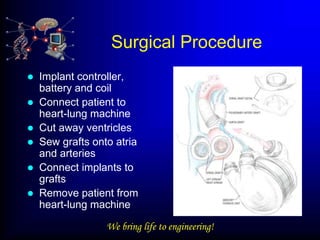
Surgical Procedure
   Implant controller,
    battery and coil
   Connect patient to
    heart-lung machine
   Cut away ventricles
   Sew grafts onto atria
    and arteries
   Connect implants to
    grafts
   Remove patient from
    heart-lung machine

                  We bring life to engineering!
AbioCor® Design Criteria
   Grapefruit size, weighs 2 lbs, requires a 7
    hour surgery for implantation
   Can provide up to 8 liters/min of blood to the
    lungs and body
   Has two chambers for pumping
    deoxygenated blood to the lungs and
    oxygenated blood to the body
   Wireless energy transfer system allows for
    continuous operation
   Internal controller monitors operation
                We bring life to engineering!
AbioCor® Design Criteria
   Internal controller increases/decreases blood
    flow based on blood oxygen levels
   Materials are inert to the immune system
   Completely contained within the chest – no
    wires or tubing through skin!
   Made of special materials and special pump
    design to prevent clots and RBC damage
   Pumping alternates between chambers,
    creating a pulsatile blood flow

                We bring life to engineering!

Artificial heart

  • 1.
    The Artificial Heart: ADesign Example BIOE 1000 October 18, 2001
  • 2.
    The Human Heart  Heart has four chambers  Right chambers pump blood to lungs to receive oxygen  Left chambers pump oxygenated blood from lungs to rest of the body We bring life to engineering!
  • 3.
    The Human Heart Right and left atria receive blood  Right and left ventricles pump blood  Valves produce one-way blood flow from atria ventricles arteries  Energy to pump blood comes from nutrients and oxygen in blood  The blood supply to the heart is provided by coronary arteries We bring life to engineering!
  • 4.
    Heart Disease  Heartattack: blockage of coronary artery damages portion of heart muscle  Congestive heart failure: gradual weakening of heart  Millions suffer from heart disease – Many cases are treatable with lifestyle changes, drugs and/or surgery – Surviving patients suffering from most severe cases need new hearts! We bring life to engineering!
  • 5.
    The Need fora Heart Substitute  100,000 Americans/year suffering from severe heart disease need new hearts  Only 2,000 patients receive heart transplants  Conclusion: many patients die waiting for a new heart!  A suitable alternative to donor hearts could prolong thousands of lives We bring life to engineering!
  • 6.
    History of Heart Substitutes  WWII: first open heart surgeries  1953: heart-lung machine successfully used during heart surgery  1958: Drs. Willem Kolff and Tetsuzo Akutsu sustain a dog for 90 minutes with a PVC artificial heart  1967: Dr. Christian Barnard transplants a donor heart into a 59 year old man (he survived 18 days) PVC heart (1958) silicone heart (1965) We bring life to engineering!
  • 7.
    History of Heart Substitutes  1969: Dr. Denton Cooley uses an artificial heart to sustain a patient waiting for a donor (survived 3 days)  1972: Cyclosporine introduced to suppress immune responses of transplant recipients  1982: Dr. William DeVries implants the Jarvik-7 artificial heart into Dr. Barney Clark Liotta heart (1969) Jarvik-7 (1982) (he survived 112 days) We bring life to engineering!
  • 8.
    Why Heart SubstitutesFail  Immune response “rejects” transplant or side effects due to immune suppression  Infection due to tubes and wires passing through skin  Formation of clots  Damage to red blood cells  Lack of pulsatile blood flow? We bring life to engineering!
  • 9.
    Design Process  Identify the problem or need to address  Specify details/criteria of an adequate solution to your problem  Implement various solutions that meet the criteria you specified  Test to determine which solution is most viable  Further testing to refine the solution you chose We bring life to engineering!
  • 10.
    Design Refinement Identify Problem  Process is iterative – You need to repeat various steps after Specify Criteria testing – Make design changes based on test results Implement Design  Failed designs – Design didn’t meet Test Design criteria – Could be due to inappropriate criteria Refine Design We bring life to engineering!
  • 11.
    Criteria for aHeart Substitute  Must fit into chest cavity and connect to atria, pulmonary artery and aorta quickly  Provide an adequate blood flow (8 – 10 liters/min)  Send deoxygenated blood to the lungs and oxygenated blood to the body  Operate continuously for an indefinite period of time  Provide adequate warning if something is wrong or if it is going to fail We bring life to engineering!
  • 12.
    Criteria for aHeart Substitute  Should increase/decrease blood flow based on patient activity level  Should not evoke an immune response  No wires or tubes that penetrate the skin  Should not produce blood clots  Should not damage red blood cells  Ideally should have pulsatile blood flow  Many others we haven’t thought of! We bring life to engineering!
  • 13.
    The AbioCor® Heart Implanted into 59 year old Robert Tools on July 2, 2001 at Jewish Hospital in Louisville KY (96 days)  Patient is able to walk around, organs are functioning normally, undergoing daily rehabilitation for eventual release We bring life to engineering!
  • 14.
    How the AbioCor®Heart Works  Hydraulic pump forces blood to lungs and body  Power is provided by an internal rechargeable battery  Battery is recharged by coils on surface and below skin  Internal controller monitors system and controls pump speed We bring life to engineering!
  • 15.
    Surgical Procedure  Implant controller, battery and coil  Connect patient to heart-lung machine  Cut away ventricles  Sew grafts onto atria and arteries  Connect implants to grafts  Remove patient from heart-lung machine We bring life to engineering!
  • 16.
    AbioCor® Design Criteria  Grapefruit size, weighs 2 lbs, requires a 7 hour surgery for implantation  Can provide up to 8 liters/min of blood to the lungs and body  Has two chambers for pumping deoxygenated blood to the lungs and oxygenated blood to the body  Wireless energy transfer system allows for continuous operation  Internal controller monitors operation We bring life to engineering!
  • 17.
    AbioCor® Design Criteria  Internal controller increases/decreases blood flow based on blood oxygen levels  Materials are inert to the immune system  Completely contained within the chest – no wires or tubing through skin!  Made of special materials and special pump design to prevent clots and RBC damage  Pumping alternates between chambers, creating a pulsatile blood flow We bring life to engineering!