Characterization of
Supramolecular Polymers
Zohaib Hussain
 Problems
 Characterization methods
 Vapor pressure osmometry
 Theoretical estimation of molecular weight from binding const
ant
 Size exclusion chromatography
 Viscometry
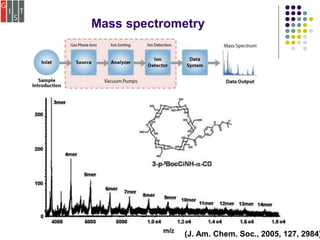
 Mass spectrometry
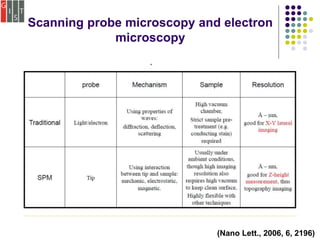
 Scanning probe microscopy and electron microscopy
 Others
Contents
Problems with Supramolecular Polymers
Characterization
(Chem. Soc. Rev., 2012, 41, 5922-5932)
 Dynamic nature of
supramolecular polymer bonding,
 Factors that significantly influences the
original molecular organization of a
supramolecular polymer.
 Solvent concentration
 Temperature
 Composition
 Stimuli from the surrounding environment
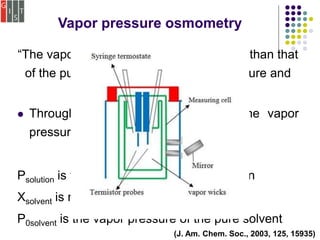
Vapor pressure osmometry
“The vapor pressure of a solution is lower than that
of the pure solvent at the same temperature and
pressure”.
 Through Raoult's law, the Mn and the vapor
pressure can be related.
Psolution = ΧsolventP0solvent
Psolution is the vapor pressure of the solution
Χsolvent is mole fraction of the solvent
P0solvent is the vapor pressure of the pure solvent
(J. Am. Chem. Soc., 2003, 125, 15935)
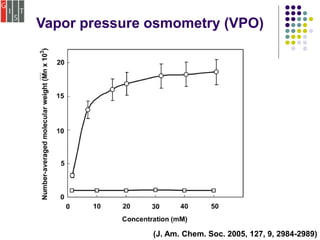
Vapor pressure osmometry
(J. Am. Chem. Soc. 2005, 127, 9, 2984-2989)
Vapor pressure osmometry (VPO)
Theoretical estimation of molecular
weight from binding constant
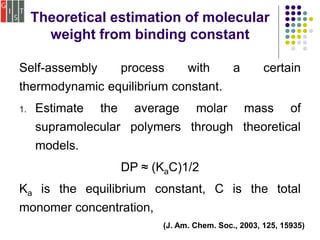
Self-assembly process with a certain
thermodynamic equilibrium constant.
1. Estimate the average molar mass of
supramolecular polymers through theoretical
models.
DP ≈ (KaC)1/2
Ka is the equilibrium constant, C is the total
monomer concentration,
(J. Am. Chem. Soc., 2003, 125, 15935)
Theoretical estimation of molecular
weight from binding constant
(Chem. Rev., 2001, 101, 4071)
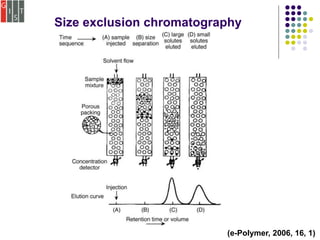
Size exclusion chromatography
(e-Polymer, 2006, 16, 1)
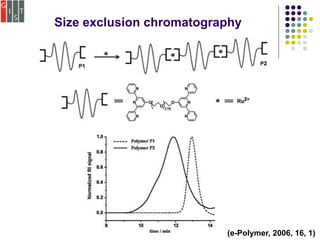
Size exclusion chromatography
(e-Polymer, 2006, 16, 1)
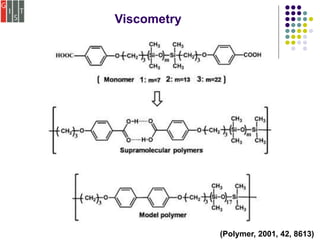
Viscometry
 To determine a polymer molecular weight distribution.
 The relationship between the intrinsic viscosity and the
molecular weight can be expressed by the empirical
 Mark–Houwink equation, [η] = KMa, (K and a are both emp
irical constants)
 For a given polymer, values of K and a may be obtained
from suitable calibration experiments with a series of
sharp fractions..
(Chem. Soc. Rev., 2012, 41, 5922-5932)
Viscometry
(Polymer, 2001, 42, 8613)
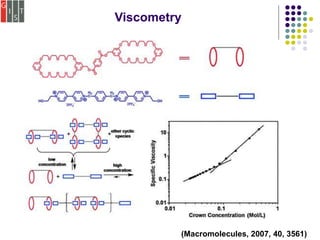
Viscometry
(Macromolecules, 2007, 40, 3561)
Mass spectrometry
(J. Am. Chem. Soc., 2005, 127, 2984)
Scanning probe microscopy and electron
microscopy
(Nano Lett., 2006, 6, 2196)
Scanning probe microscopy and electron
microscopy
(Nano Lett., 2006, 6, 2196)
Other Methods
 Matrix-assisted laser desorption ionization time-of
-flight mass spectrometry (MALDI-TOF-MS)
(J. Am. Chem. Soc., 2003, 125, 15935; Chem. Rev. 2015, 115, 15, 7196-7239)
Characterization of Supramolecular Polymers

Characterization of Supramolecular Polymers

  • 1.
  • 2.
     Problems  Characterizationmethods  Vapor pressure osmometry  Theoretical estimation of molecular weight from binding const ant  Size exclusion chromatography  Viscometry  Mass spectrometry  Scanning probe microscopy and electron microscopy  Others Contents
  • 3.
    Problems with SupramolecularPolymers Characterization (Chem. Soc. Rev., 2012, 41, 5922-5932)  Dynamic nature of supramolecular polymer bonding,  Factors that significantly influences the original molecular organization of a supramolecular polymer.  Solvent concentration  Temperature  Composition  Stimuli from the surrounding environment
  • 4.
    Vapor pressure osmometry “Thevapor pressure of a solution is lower than that of the pure solvent at the same temperature and pressure”.  Through Raoult's law, the Mn and the vapor pressure can be related. Psolution = ΧsolventP0solvent Psolution is the vapor pressure of the solution Χsolvent is mole fraction of the solvent P0solvent is the vapor pressure of the pure solvent (J. Am. Chem. Soc., 2003, 125, 15935)
  • 5.
    Vapor pressure osmometry (J.Am. Chem. Soc. 2005, 127, 9, 2984-2989)
  • 6.
    (J. Am. Chem.Soc. 2005, 127, 9, 2984-2989) Vapor pressure osmometry (VPO)
  • 7.
    Theoretical estimation ofmolecular weight from binding constant Self-assembly process with a certain thermodynamic equilibrium constant. 1. Estimate the average molar mass of supramolecular polymers through theoretical models. DP ≈ (KaC)1/2 Ka is the equilibrium constant, C is the total monomer concentration, (J. Am. Chem. Soc., 2003, 125, 15935)
  • 8.
    Theoretical estimation ofmolecular weight from binding constant (Chem. Rev., 2001, 101, 4071)
  • 9.
  • 10.
  • 11.
    Viscometry  To determinea polymer molecular weight distribution.  The relationship between the intrinsic viscosity and the molecular weight can be expressed by the empirical  Mark–Houwink equation, [η] = KMa, (K and a are both emp irical constants)  For a given polymer, values of K and a may be obtained from suitable calibration experiments with a series of sharp fractions.. (Chem. Soc. Rev., 2012, 41, 5922-5932)
  • 12.
  • 13.
  • 14.
    Mass spectrometry (J. Am.Chem. Soc., 2005, 127, 2984)
  • 15.
    Scanning probe microscopyand electron microscopy (Nano Lett., 2006, 6, 2196)
  • 16.
    Scanning probe microscopyand electron microscopy (Nano Lett., 2006, 6, 2196)
  • 17.
    Other Methods  Matrix-assistedlaser desorption ionization time-of -flight mass spectrometry (MALDI-TOF-MS) (J. Am. Chem. Soc., 2003, 125, 15935; Chem. Rev. 2015, 115, 15, 7196-7239)