Albia Dugger • Miami Dade College
Chapter 7
Tobacco
Nicotine
• Nicotine is the addictive ingredient in tobacco – 90% of
smokers become dependent
• C. Everett Koop claimed that nicotine dependence is as
powerful as heroin and cocaine dependence
• In 1988, the American Psychiatric Association recognized
nicotine dependency as a disorder
History of Tobacco Use
• 600-900 AD: Mexican stone carvings depict smoking
• Early 1600s: Thousands of tobacco shops in London
• 17th century: Smoking condemned by the Pope
• 1828: Nicotine was isolated and identified as poisonous and
addictive
History of Tobacco Use
• Early 1600s: Jamestown settlers planted tobacco
• 1776: Tobacco production provided funds for colonial settlers
to fight the Revolutionary War against England
• Early 1800s: Tobacco was used as snuff, cigars, and pipes,
and chewing tobacco – not cigarettes
• 1883: The cigarette rolling machine was patented
History of Tobacco Use
• Early 1900s: Tobacco companies began marketing
campaigns to promote cigarettes
• Cigarettes were the first of the tobacco products marketed to
women
• Cigarettes were less costly and milder than cigars, which
increased their popularity with young people
Opposition and Escalation
• 1798: Physician Benjamin Rush condemned tobacco for its
adverse health effects
• Several states banned the sale of tobacco to children
• During World War I, the YMCA, the U.S. Army, and other
groups distributed cigarettes to soldiers
• During World War II, cigarette manufacturers donated
cigarettes to soldiers in combat
Costs of Smoking
• An increase in cost reduces the demand for cigarettes
• Many states tax cigarettes to pay for programs such as
smoking prevention and hospital treatment for the uninsured
• The federal government also amasses substantial tax
revenues from tobacco sales
• However, higher taxes encourage a black market for
cigarettes
Cigarette Excise Taxes
Extent of Tobacco Use
• Smoking increased until 1964, when the Public Health Service
issued Smoking and Health: Report of the Advisory
Committee to the Surgeon General
• The percentage of adult Americans who smoke decreased
from 42.4% in 1965 to 20.6% in 2009
Tar and Nicotine Levels
• Tar is a carcinogenic component of tobacco
• Nicotine is the psychoactive component in tobacco
responsible for stimulation and tobacco dependence
• Although levels of tar and nicotine in cigarettes have been
reduced, this has increased the number of cigarettes smoked,
as smokers smoke more to get more nicotine
Demographics of Smoking
• More adult males smoke than adult females
• College students smoke less than young adults who are not in
college
• Parents who smoke are more likely to have children who
smoke
• Smoking rates are correlated with education and occupation
Smoking by Adolescents
• Smoking by
adolescents has
declined only slightly
Women and Smoking
• In 1965, 34% of women smoked – currently, approximately
17.9% of women smoke cigarettes
• Less-educated women are three times more likely to smoke
than women with more education
• Cigarette smoking reduces a woman’s life by 14 years
• Lung cancer is the leading fatal cancer among US women
• Women smokers have higher rates of depression,
osteoporosis, peptic ulcers, and cataracts
Smokeless Tobacco
• Use of smokeless tobacco (snuff and chewing tobacco) has
nearly tripled in the last twenty years
• Nicotine in smokeless tobacco is absorbed quickly through
the mucous lining of the mouth, making it highly addicting
• The nicotine in one dip of snuff equals four cigarettes
• Smokeless tobacco has a higher level of the carcinogen NNK
than regular tobacco
Snus
• Snus are a tobacco product packaged in small pouches that
go under one’s upper lip
• Usage is increasing in response to antismoking views,
increased taxes on cigarettes and expanding smoke-free
ordinances
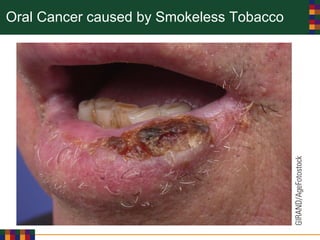
Oral Cancer caused by Smokeless Tobacco
Tobacco Use in Other Countries
• According to the World Health Organization, tobacco use is
the leading cause of preventable death in the world
• In China, over half of all males aged 15 and older smoke
• Smoking rates in industrialized countries are decreasing, but
in underdeveloped countries, they are increasing
• US tobacco companies export more than $2 billion worth of
tobacco products
Clove Cigarettes and Bidis
• Clove cigarettes
• Made from tobacco and cloves; contain more tar, nicotine,
and carbon monoxide than commercial cigarettes
• Eugenol
• Ingredient in clove cigarettes that provides aroma and
reduces coughing reflex
• Bidis
• Flavored cigarettes from India that have considerably
higher concentrations of nicotine than regular cigarettes
Light Cigarettes
• Light cigarettes are advertised as having less tar and nicotine
• Account for the vast majority of cigarettes sold
• 2011: Federal judge ruled that tobacco companies must admit
that they have lied about light cigarettes
• People who smoke light cigarettes receive the same amount
of nicotine and tar as those smoking regular cigarettes
Cigars
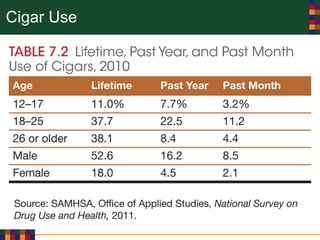
• 1990: Increase in cigar bars and restaurant cigar nights
• Sales of small cigars (cigarillos) have increased
• Taxed at a lower rate than cigarettes
• Fewer restrictions placed on their promotion
• Health hazards are associated with cigar smoking:
• Nicotine levels higher than cigarettes
• 34% higher cancer rate than nonsmokers
• Higher rates of cancers of the mouth, throat, and
esophagus than cigarette smokers
Cigar Use
Characteristics of Smoking and Smokers
• Tobacco use tends to have triggers:
• Following a meal
• Talking on the phone
• Drinking coffee
• Being around other smokers
• Tobacco contains acetaldehyde, a chemical with sedating
properties similar to those of alcohol
• Nicotine improves cognitive performance slightly
Tobacco Use by Young People
• 60% of new smokers initiate smoking prior age 18
• One third of youths who smoked three or four cigarettes a day
developed nicotine dependence
• By 8th grade, 2.9% of students smoke on a daily basis
• One predictor of tobacco use among boys is
aggressive/disruptive behavior
Tobacco Use by Young People
• Young people smoke to appear mature, to display
independence, to cope with stress, or to bond with peers
• Adolescent smoking has a high correlation with psychological
distress
• Most important factors in whether a teenager smokes:
• If the teenager’s friends smoke
• If perceived benefits outweigh the risks
• If the teenager’s household includes smokers
Tobacco Use by Young People
• When teaching young people about the dangers of tobacco,
one challenge is that harmful effects take years to appear
• Emphasizing short-term or cosmetic effects may have a
greater impact
• Most programs that are information based have been
ineffective in reducing the onset of smoking
• Tobacco prevention programs outside of schools are more
effective with high-risk youths
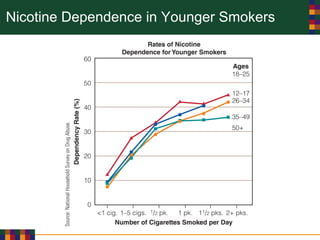
Nicotine Dependence in Younger Smokers
Respected Adults Influence Decisions
Nicotine Tolerance and Dependence
• Smokers and chewers build-up tolerance quickly, some in a
matter of weeks
• Most people continue to use tobacco products because
nicotine is addictive – however, most people who quit are able
to do so without nicotine replacement
• Nicotine addicts develop tolerance, have a strong desire for
continued use, and undergo withdrawal
Nicotine Withdrawal Symptoms
• Lower heart rate
• Tremors
• Aggressiveness
• Hunger
• Heart palpitations
• Headaches
• Anxiety
• Lower blood pressure
• Shorter attention span
• Increased circulation
• Insomnia
• Fatigue
• Drowsiness
• Craving for nicotine
Pharmacology of Tobacco
• 4,000 chemicals are found in tobacco smoke
• Used as an insecticide
• 60 mg can cause human death
• Carcinogenic
• Nicotine
• Releases stimulant norepinephrine
• Depression follows arousal
• Constricts blood vessels
• Stays in the body for 8 to 12 hours
Physical Effects on the Individual
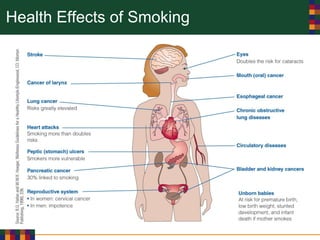
• Smoking is responsible for nearly one in five US deaths
• Most prominent behavioral cause of lung cancer, other
respiratory diseases, and cardiovascular diseases
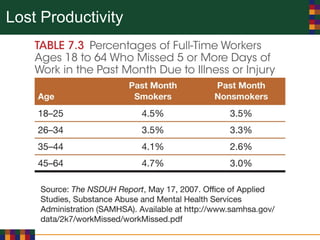
• Responsible for $167 billion in annual health-related
economic losses in the US
• $75 billion in direct medical costs
• $92 billion in lost productivity
Health Effects of Smoking
Lost Productivity
Heart Disease and Strokes
• Smoking causes more cardiovascular deaths than cancer
deaths
• Smoking is implicated in 30% of all deaths from coronary
heart disease
• Risk of heart attack and stroke increases among women who
smoke cigarettes and use oral contraceptives
• Cardiovascular damage is correlated with the frequency and
length of time a person smokes
Heart Disease and Strokes
• Nicotine raises the heart rate and blood pressure, forcing the
heart to work harder
• Carbon monoxide impedes the oxygen-carrying capacity of
the blood, impairs circulation, increases cholesterol deposits
and arteriosclerosis
• Buerger’s disease can result in amputation of the extremities
as a result of poor circulation
Respiratory Diseases
• Respiratory conditions caused by smoking:
• Chronic coughing and shortness of breath
• Chronic bronchitis and emphysema (COPD)
• Bronchitis
• Smoke irritates bronchi; tar builds up on cilia; breathing
becomes more labored
• Emphysema
• Disabling, incurable disease
• Lungs lose elasticity, unable to retain air
Cancer
• There are dozens of carcinogenic gases in tobacco smoke,
including ammonia, benzopyrene, hydrogen cyanide,
nitrosamines, and vinyl chloride
• Most cancer-causing substances are found in the tar of
tobacco, though nicotine has been implicated as well
• Cigarette smoking is responsible for at least 30% of all
cancers deaths and 87% of lung cancer deaths
Cancer
• Cigarette smoking is the leading risk factor for cancers of the
larynx, mouth, esophagus, pancreas, and bladder
• Increases chances of developing cancers of the oral cavity,
pancreas, esophagus, kidney, larynx, trachea, and bladder
• Higher risk of developing non-Hodgkin’s lymphoma
• Oral and pharyngeal cancers account for almost 8,000 deaths
annually in the United States
Warning Signs of Oral Cancer
• Sore in the mouth that does not heal
• White or red patch on the gums, tongue, tonsil, or mouth
• Lump or thickening in the cheek
• Sore throat or a feeling that something is caught in the throat
• Difficulty chewing or swallowing
• Difficulty moving the jaw or tongue
• Numbness of the tongue or other area of the mouth
• Swelling of the jaw that causes dentures to fit poorly
• Loosening of teeth or pain around the teeth or jaw
• Voice changes
• Lump or mass in the neck
• Weight loss
Impact of Smoking During Pregnancy
• Smoking interferes with the fetus:
• Babies weigh less and are more likely to be premature
• Higher incidence of spontaneous abortions
• Higher rate of stillbirths
• Higher rate of sudden infant death syndrome (SIDS)
• Higher risk of cleft lip and cleft palate
• Higher rates of psychological problems
• Significantly reduces fertility in women
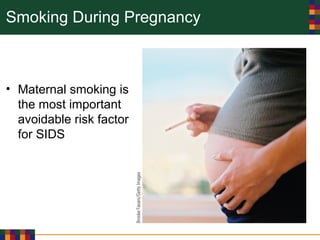
Smoking During Pregnancy
• Maternal smoking is
the most important
avoidable risk factor
for SIDS
Tobacco and Physical Activity
• Ability to engage in physical activity is impaired:
• Mucous membranes of the trachea and the bronchial
tubes enlarge, restricting air passage
• Alveoli in the lungs receive less oxygen
• Smoking impairs sexual activity:
• Carbon monoxide reduces testosterone production
• Erectile dysfunction due to nicotine
• Sperm count and motility is reduced
• Impairs normal sexual response in young women
Passive Smoke
• Passive smoke
• Tobacco smoke present in the air from someone else’s
smoking and inhaled by others
• Environmental tobacco smoke
• Smoke in the air as a result of someone smoking
• Mainstream smoke
• Smoke exhaled by a smoker
• Sidestream smoke
• Smoke from the burning end of a cigarette, pipe, or cigar
Passive Smoke
• Passive smoke is blamed for 3,400 lung cancer deaths each
year
• The extent of harm is related to the degree of exposure
• Sidestream smoke contains more nicotine and carbon
monoxide than mainstream smoke
• Children of smokers have five times as much cotinine in their
urine as children of nonsmokers
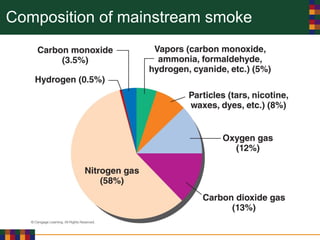
Composition of mainstream smoke
Effects on Nonsmokers
• Passive smoke is linked to:
• Lung cancer
• Urinary tract problems
• Cancers of the liver, pancreas, and breast cancer
• Type 2 diabetes and multiple sclerosis
• Heart attack
• The Environmental Protection Agency declared secondhand
smoke a carcinogen in 1993
Effects on Children of Smokers
• Children exposed to cigarette smoke:
• Higher incidence of atopic dermatitis (eczema)
• Respiratory infections (colds, bronchitis, pneumonia)
• Absent from school more often
• Higher incidence of asthma
• Childhood allergies
• Physical aggression and hyperactivity-impulsivity
• Dental cavities
Rights of Smokers versus Nonsmokers
• Anti-smoking legislation:
• Federal minimum age of 18 to purchase tobacco products
• Local tobacco control ordinances against smoking in
public areas and private workplaces
• Airline passengers on commercial flights within the US
were forbidden from smoking
• 2012, FDA mandates more prominent health warnings on
all cigarette packaging and advertisements
• New York City banned smoking in restaurants, and
tobacco ads within 1,000 feet of a school
State Cigarette Excise Tax Rates
Rights of Smokers versus Nonsmokers
• The Master Settlement Agreement:
• Legislation requires the tobacco industry to pay $206
billion among all 50 states in exchange for an end to
litigation against the four largest tobacco companies
• Compensate states for medical costs resulting from
cigarette smoking
• Creates a $500 million fund to educate young people
about the risks of smoking
• Tobacco companies are no longer liable for addiction or
dependence claims, class action suits, and claims of
punitive damages
Cessation Techniques
• Seventy percent of smokers say that they want to quit
• Withdrawal symptoms can be intense, leading to anxiety and
depressed mood
• Most people require five to seven attempts to quit before they
are successful
• Stopping smokeless tobacco is more difficult than quitting
cigarettes
Cessation Techniques
• Obstacles:
• Many activities trigger smoking
• Many are concerned about gaining weight once they stop
• Confidence is crucial in how long one remains abstinent
• Smoking cessation programs:
• 90% quit without a formal treatment program
• Nicotine replacement therapy helps many smokers
• Other therapies have not been proven to help
Cessation Techniques
• Nicotine Gum and Lozenges
• Reduce withdrawal symptoms
• Increases success by 10%
• Nicotine Patches
• Can deliver dangerously high doses to those who continue
smoking
• Nicotine Inhalers
• Can irritate nasal passages
Cessation Techniques
• Drug Therapy
• Zyban reduces the desire for nicotine; side effects include
convulsions and delirium
• Chantix treats nicotine addiction
• Antianxiety drugs can reduce irritability
• Three vaccines are being developed to prevent nicotine
addiction
Cessation Techniques
• Aversive Techniques
• Rapid smoking causes smokers to exceed their tolerance
levels and become ill
• Electric shock – benefits are short-term at best
• Behavior Modification
• The smoker learns new or alternative behaviors to use in
place of smoking
• May include support groups or a buddy system
Cessation Techniques
• Hypnosis
• Works best with people who want it to work
• Not found any more effective than other treatments
• Acupuncture
• Minimal evidence of effectiveness
• Claims to release endorphins and reduce physical
symptoms of withdrawal

Goldberg Chapter 7

  • 1.
    Albia Dugger •Miami Dade College Chapter 7 Tobacco
  • 2.
    Nicotine • Nicotine isthe addictive ingredient in tobacco – 90% of smokers become dependent • C. Everett Koop claimed that nicotine dependence is as powerful as heroin and cocaine dependence • In 1988, the American Psychiatric Association recognized nicotine dependency as a disorder
  • 3.
    History of TobaccoUse • 600-900 AD: Mexican stone carvings depict smoking • Early 1600s: Thousands of tobacco shops in London • 17th century: Smoking condemned by the Pope • 1828: Nicotine was isolated and identified as poisonous and addictive
  • 4.
    History of TobaccoUse • Early 1600s: Jamestown settlers planted tobacco • 1776: Tobacco production provided funds for colonial settlers to fight the Revolutionary War against England • Early 1800s: Tobacco was used as snuff, cigars, and pipes, and chewing tobacco – not cigarettes • 1883: The cigarette rolling machine was patented
  • 5.
    History of TobaccoUse • Early 1900s: Tobacco companies began marketing campaigns to promote cigarettes • Cigarettes were the first of the tobacco products marketed to women • Cigarettes were less costly and milder than cigars, which increased their popularity with young people
  • 6.
    Opposition and Escalation •1798: Physician Benjamin Rush condemned tobacco for its adverse health effects • Several states banned the sale of tobacco to children • During World War I, the YMCA, the U.S. Army, and other groups distributed cigarettes to soldiers • During World War II, cigarette manufacturers donated cigarettes to soldiers in combat
  • 7.
    Costs of Smoking •An increase in cost reduces the demand for cigarettes • Many states tax cigarettes to pay for programs such as smoking prevention and hospital treatment for the uninsured • The federal government also amasses substantial tax revenues from tobacco sales • However, higher taxes encourage a black market for cigarettes
  • 8.
  • 9.
  • 10.
    Extent of TobaccoUse • Smoking increased until 1964, when the Public Health Service issued Smoking and Health: Report of the Advisory Committee to the Surgeon General • The percentage of adult Americans who smoke decreased from 42.4% in 1965 to 20.6% in 2009
  • 11.
    Tar and NicotineLevels • Tar is a carcinogenic component of tobacco • Nicotine is the psychoactive component in tobacco responsible for stimulation and tobacco dependence • Although levels of tar and nicotine in cigarettes have been reduced, this has increased the number of cigarettes smoked, as smokers smoke more to get more nicotine
  • 12.
    Demographics of Smoking •More adult males smoke than adult females • College students smoke less than young adults who are not in college • Parents who smoke are more likely to have children who smoke • Smoking rates are correlated with education and occupation
  • 13.
    Smoking by Adolescents •Smoking by adolescents has declined only slightly
  • 14.
    Women and Smoking •In 1965, 34% of women smoked – currently, approximately 17.9% of women smoke cigarettes • Less-educated women are three times more likely to smoke than women with more education • Cigarette smoking reduces a woman’s life by 14 years • Lung cancer is the leading fatal cancer among US women • Women smokers have higher rates of depression, osteoporosis, peptic ulcers, and cataracts
  • 15.
    Smokeless Tobacco • Useof smokeless tobacco (snuff and chewing tobacco) has nearly tripled in the last twenty years • Nicotine in smokeless tobacco is absorbed quickly through the mucous lining of the mouth, making it highly addicting • The nicotine in one dip of snuff equals four cigarettes • Smokeless tobacco has a higher level of the carcinogen NNK than regular tobacco
  • 16.
    Snus • Snus area tobacco product packaged in small pouches that go under one’s upper lip • Usage is increasing in response to antismoking views, increased taxes on cigarettes and expanding smoke-free ordinances
  • 17.
    Oral Cancer causedby Smokeless Tobacco
  • 18.
    Tobacco Use inOther Countries • According to the World Health Organization, tobacco use is the leading cause of preventable death in the world • In China, over half of all males aged 15 and older smoke • Smoking rates in industrialized countries are decreasing, but in underdeveloped countries, they are increasing • US tobacco companies export more than $2 billion worth of tobacco products
  • 19.
    Clove Cigarettes andBidis • Clove cigarettes • Made from tobacco and cloves; contain more tar, nicotine, and carbon monoxide than commercial cigarettes • Eugenol • Ingredient in clove cigarettes that provides aroma and reduces coughing reflex • Bidis • Flavored cigarettes from India that have considerably higher concentrations of nicotine than regular cigarettes
  • 20.
    Light Cigarettes • Lightcigarettes are advertised as having less tar and nicotine • Account for the vast majority of cigarettes sold • 2011: Federal judge ruled that tobacco companies must admit that they have lied about light cigarettes • People who smoke light cigarettes receive the same amount of nicotine and tar as those smoking regular cigarettes
  • 21.
    Cigars • 1990: Increasein cigar bars and restaurant cigar nights • Sales of small cigars (cigarillos) have increased • Taxed at a lower rate than cigarettes • Fewer restrictions placed on their promotion • Health hazards are associated with cigar smoking: • Nicotine levels higher than cigarettes • 34% higher cancer rate than nonsmokers • Higher rates of cancers of the mouth, throat, and esophagus than cigarette smokers
  • 22.
  • 23.
    Characteristics of Smokingand Smokers • Tobacco use tends to have triggers: • Following a meal • Talking on the phone • Drinking coffee • Being around other smokers • Tobacco contains acetaldehyde, a chemical with sedating properties similar to those of alcohol • Nicotine improves cognitive performance slightly
  • 24.
    Tobacco Use byYoung People • 60% of new smokers initiate smoking prior age 18 • One third of youths who smoked three or four cigarettes a day developed nicotine dependence • By 8th grade, 2.9% of students smoke on a daily basis • One predictor of tobacco use among boys is aggressive/disruptive behavior
  • 25.
    Tobacco Use byYoung People • Young people smoke to appear mature, to display independence, to cope with stress, or to bond with peers • Adolescent smoking has a high correlation with psychological distress • Most important factors in whether a teenager smokes: • If the teenager’s friends smoke • If perceived benefits outweigh the risks • If the teenager’s household includes smokers
  • 26.
    Tobacco Use byYoung People • When teaching young people about the dangers of tobacco, one challenge is that harmful effects take years to appear • Emphasizing short-term or cosmetic effects may have a greater impact • Most programs that are information based have been ineffective in reducing the onset of smoking • Tobacco prevention programs outside of schools are more effective with high-risk youths
  • 27.
    Nicotine Dependence inYounger Smokers
  • 28.
  • 29.
    Nicotine Tolerance andDependence • Smokers and chewers build-up tolerance quickly, some in a matter of weeks • Most people continue to use tobacco products because nicotine is addictive – however, most people who quit are able to do so without nicotine replacement • Nicotine addicts develop tolerance, have a strong desire for continued use, and undergo withdrawal
  • 30.
    Nicotine Withdrawal Symptoms •Lower heart rate • Tremors • Aggressiveness • Hunger • Heart palpitations • Headaches • Anxiety • Lower blood pressure • Shorter attention span • Increased circulation • Insomnia • Fatigue • Drowsiness • Craving for nicotine
  • 31.
    Pharmacology of Tobacco •4,000 chemicals are found in tobacco smoke • Used as an insecticide • 60 mg can cause human death • Carcinogenic • Nicotine • Releases stimulant norepinephrine • Depression follows arousal • Constricts blood vessels • Stays in the body for 8 to 12 hours
  • 32.
    Physical Effects onthe Individual • Smoking is responsible for nearly one in five US deaths • Most prominent behavioral cause of lung cancer, other respiratory diseases, and cardiovascular diseases • Responsible for $167 billion in annual health-related economic losses in the US • $75 billion in direct medical costs • $92 billion in lost productivity
  • 33.
  • 34.
  • 35.
    Heart Disease andStrokes • Smoking causes more cardiovascular deaths than cancer deaths • Smoking is implicated in 30% of all deaths from coronary heart disease • Risk of heart attack and stroke increases among women who smoke cigarettes and use oral contraceptives • Cardiovascular damage is correlated with the frequency and length of time a person smokes
  • 36.
    Heart Disease andStrokes • Nicotine raises the heart rate and blood pressure, forcing the heart to work harder • Carbon monoxide impedes the oxygen-carrying capacity of the blood, impairs circulation, increases cholesterol deposits and arteriosclerosis • Buerger’s disease can result in amputation of the extremities as a result of poor circulation
  • 37.
    Respiratory Diseases • Respiratoryconditions caused by smoking: • Chronic coughing and shortness of breath • Chronic bronchitis and emphysema (COPD) • Bronchitis • Smoke irritates bronchi; tar builds up on cilia; breathing becomes more labored • Emphysema • Disabling, incurable disease • Lungs lose elasticity, unable to retain air
  • 38.
    Cancer • There aredozens of carcinogenic gases in tobacco smoke, including ammonia, benzopyrene, hydrogen cyanide, nitrosamines, and vinyl chloride • Most cancer-causing substances are found in the tar of tobacco, though nicotine has been implicated as well • Cigarette smoking is responsible for at least 30% of all cancers deaths and 87% of lung cancer deaths
  • 39.
    Cancer • Cigarette smokingis the leading risk factor for cancers of the larynx, mouth, esophagus, pancreas, and bladder • Increases chances of developing cancers of the oral cavity, pancreas, esophagus, kidney, larynx, trachea, and bladder • Higher risk of developing non-Hodgkin’s lymphoma • Oral and pharyngeal cancers account for almost 8,000 deaths annually in the United States
  • 40.
    Warning Signs ofOral Cancer • Sore in the mouth that does not heal • White or red patch on the gums, tongue, tonsil, or mouth • Lump or thickening in the cheek • Sore throat or a feeling that something is caught in the throat • Difficulty chewing or swallowing • Difficulty moving the jaw or tongue • Numbness of the tongue or other area of the mouth • Swelling of the jaw that causes dentures to fit poorly • Loosening of teeth or pain around the teeth or jaw • Voice changes • Lump or mass in the neck • Weight loss
  • 41.
    Impact of SmokingDuring Pregnancy • Smoking interferes with the fetus: • Babies weigh less and are more likely to be premature • Higher incidence of spontaneous abortions • Higher rate of stillbirths • Higher rate of sudden infant death syndrome (SIDS) • Higher risk of cleft lip and cleft palate • Higher rates of psychological problems • Significantly reduces fertility in women
  • 42.
    Smoking During Pregnancy •Maternal smoking is the most important avoidable risk factor for SIDS
  • 43.
    Tobacco and PhysicalActivity • Ability to engage in physical activity is impaired: • Mucous membranes of the trachea and the bronchial tubes enlarge, restricting air passage • Alveoli in the lungs receive less oxygen • Smoking impairs sexual activity: • Carbon monoxide reduces testosterone production • Erectile dysfunction due to nicotine • Sperm count and motility is reduced • Impairs normal sexual response in young women
  • 44.
    Passive Smoke • Passivesmoke • Tobacco smoke present in the air from someone else’s smoking and inhaled by others • Environmental tobacco smoke • Smoke in the air as a result of someone smoking • Mainstream smoke • Smoke exhaled by a smoker • Sidestream smoke • Smoke from the burning end of a cigarette, pipe, or cigar
  • 45.
    Passive Smoke • Passivesmoke is blamed for 3,400 lung cancer deaths each year • The extent of harm is related to the degree of exposure • Sidestream smoke contains more nicotine and carbon monoxide than mainstream smoke • Children of smokers have five times as much cotinine in their urine as children of nonsmokers
  • 46.
  • 47.
    Effects on Nonsmokers •Passive smoke is linked to: • Lung cancer • Urinary tract problems • Cancers of the liver, pancreas, and breast cancer • Type 2 diabetes and multiple sclerosis • Heart attack • The Environmental Protection Agency declared secondhand smoke a carcinogen in 1993
  • 48.
    Effects on Childrenof Smokers • Children exposed to cigarette smoke: • Higher incidence of atopic dermatitis (eczema) • Respiratory infections (colds, bronchitis, pneumonia) • Absent from school more often • Higher incidence of asthma • Childhood allergies • Physical aggression and hyperactivity-impulsivity • Dental cavities
  • 49.
    Rights of Smokersversus Nonsmokers • Anti-smoking legislation: • Federal minimum age of 18 to purchase tobacco products • Local tobacco control ordinances against smoking in public areas and private workplaces • Airline passengers on commercial flights within the US were forbidden from smoking • 2012, FDA mandates more prominent health warnings on all cigarette packaging and advertisements • New York City banned smoking in restaurants, and tobacco ads within 1,000 feet of a school
  • 50.
  • 51.
    Rights of Smokersversus Nonsmokers • The Master Settlement Agreement: • Legislation requires the tobacco industry to pay $206 billion among all 50 states in exchange for an end to litigation against the four largest tobacco companies • Compensate states for medical costs resulting from cigarette smoking • Creates a $500 million fund to educate young people about the risks of smoking • Tobacco companies are no longer liable for addiction or dependence claims, class action suits, and claims of punitive damages
  • 52.
    Cessation Techniques • Seventypercent of smokers say that they want to quit • Withdrawal symptoms can be intense, leading to anxiety and depressed mood • Most people require five to seven attempts to quit before they are successful • Stopping smokeless tobacco is more difficult than quitting cigarettes
  • 53.
    Cessation Techniques • Obstacles: •Many activities trigger smoking • Many are concerned about gaining weight once they stop • Confidence is crucial in how long one remains abstinent • Smoking cessation programs: • 90% quit without a formal treatment program • Nicotine replacement therapy helps many smokers • Other therapies have not been proven to help
  • 54.
    Cessation Techniques • NicotineGum and Lozenges • Reduce withdrawal symptoms • Increases success by 10% • Nicotine Patches • Can deliver dangerously high doses to those who continue smoking • Nicotine Inhalers • Can irritate nasal passages
  • 55.
    Cessation Techniques • DrugTherapy • Zyban reduces the desire for nicotine; side effects include convulsions and delirium • Chantix treats nicotine addiction • Antianxiety drugs can reduce irritability • Three vaccines are being developed to prevent nicotine addiction
  • 56.
    Cessation Techniques • AversiveTechniques • Rapid smoking causes smokers to exceed their tolerance levels and become ill • Electric shock – benefits are short-term at best • Behavior Modification • The smoker learns new or alternative behaviors to use in place of smoking • May include support groups or a buddy system
  • 57.
    Cessation Techniques • Hypnosis •Works best with people who want it to work • Not found any more effective than other treatments • Acupuncture • Minimal evidence of effectiveness • Claims to release endorphins and reduce physical symptoms of withdrawal

Editor's Notes

  • #14 While cigarette smoking by adults has declined significantly, smoking by adolescents has declined only slightly.
  • #18 Smokeless tobacco was the cause of this squamous cell carcinoma in the oral cavity.
  • #28 Figure 7.1 Data from the National Household Survey on Drug Abuse show that the rate of nicotine dependence is higher among those younger than age 25 than in other age groups and that the dependence in these younger people develops with less exposure to nicotine.
  • #29 Parents and respected adults influence teenagers’ decisions to smoke.
  • #34 Figure 7.2 Health Effects of Smoking
  • #43 Pregnant women who smoke increase the risk of having preterm pregnancies and babies with low birth weights.
  • #47 Figure 7.3 Chemical composition of mainstream smoke