History of tobacco
There are many reasons young people begin using tobacco.
Teenagers, and even preteens, are developing behaviours,
social connections, and attitudes. They often experiment with
different behaviours because they see these behaviours in
peers they admire, in adults they hope to be like someday, or
in media or entertainment idols. Much is known about the use
of tobacco products, especially their effects on the health of
those who smoke cigarettes. What’s known includes two grim
facts: Tobacco use is the leading cause of preventable,
premature death in the United States. And thousands of kids
start smoking every day in the United States, many starting a
lifetime of addiction.
But what federal regulators and researchers know less about
is exactly why people start using a specific tobacco product
such as cigarettes, cigars, pipes and/or chewing tobacco.
They also want to know why and when people stop smoking
or using other tobacco products, and why they start up again.
A cigar is defined as any roll of tobacco wrapped in leaf
tobacco, or in any substance containing tobacco, and which is
typically smoked without a filter. The prevalence of cigar
consumption has been progressively decreasing worldwide of
the 30% of the English population who were regular smokers
in 2002, only 5% were cigar smokers. Cigar smoke contains
a class of highly carcinat levels significantly higher than
those found in cigarette smoke. Biochemical analysis has
shown that, for an equal number of grams of tobacco
smoked, tar, carbon monoxide and ammonia are produced in
larger quantities through the burning of cigars than through
the burning of cigarettes.
Narghiles are also known as water pipes, argilehs,
gozas, hookahs, shishas, etc. It has been suggested
that the narghile originated in India and has been
widely used for over 400 years. It is now more
commonly used in the countries of the Arabian
Peninsula, as well as in Turkey, Bangladesh and
Pakistan. However, in recent years, a true rebirth of
its use has been observed, principally among young
people, including those in western countries. It is
believed that there are currently more than 100
million people worldwide who use a narghile on a
daily basis.
Many terms are used to describe smokeless tobacco
products. Such terms include oral tobacco, chewing
tobacco, snuff, snus, etc. All oral forms of tobacco
contain agents that
cause cancer, principally mouth and pancreatic cancer,
as well as other health problems such as periodontal
disease, bone loss, tooth loss, discoloration of teeth and
halitosis. Types of smokeless tobacco are-
1 Chewing tobacco
2 Dipping tobacco
3 Snuff
4 Snus
5 Gutka
6 Tobacco gum
A cigarette is a small cylinder of finely cut tobacco
leaves rolled in thin paper for smoking. The cigarette is
ignited at one end and allowed to smoulder; its smoke
is inhaled from the other end, which is held in or to the
mouth; in some cases, a cigarette holder may be used,
as well. Most modern manufactured cigarettes are
filtered and also include reconstituted tobacco and
other additives. The term cigarette, as commonly used,
refers to a tobacco cigarette, but can apply to similar
devices containing other substances, such as cannabis.
A cigarette is distinguished from a cigar by its smaller
size, use of processed leaf, and paper wrapping, which
is normally white, though other colours and flavours
are also available. Cigars are typically composed
entirely of whole-leaf tobacco.
The health effects of tobacco are the effects that use of
tobacco has on human health, and concern about health
effects of tobacco has a long history. Research has
focused primarily on cigarette tobacco smoking. In
1950, Richard Doll published research in the British
Medical Journal showing a close link between smoking
and lung cancer. Four years later, in 1954, the British
Doctors Study, a study of some 40,000 doctors over 20
years, confirmed the suggestion, based on which the
government issued advice that smoking and lung cancer
rates were related.
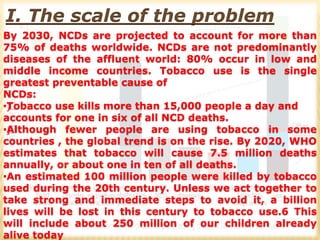
I. The scale of the problem
By 2030, NCDs are projected to account for more than
75% of deaths worldwide. NCDs are not predominantly
diseases of the affluent world: 80% occur in low and
middle income countries. Tobacco use is the single
greatest preventable cause of
NCDs:
•ƒTobacco use kills more than 15,000 people a day and
accounts for one in six of all NCD deaths.
•ƒAlthough fewer people are using tobacco in some
countries , the global trend is on the rise. By 2020, WHO
estimates that tobacco will cause 7.5 million deaths
annually, or about one in ten of all deaths.
•An estimated 100 million people were killed by tobacco
used during the 20th century. Unless we act together to
take strong and immediate steps to avoid it, a billion
lives will be lost in this century to tobacco use.6 This
will include about 250 million of our children already
alive today
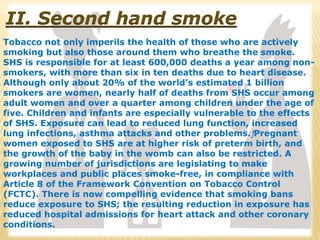
II. Second hand smoke
Tobacco not only imperils the health of those who are actively
smoking but also those around them who breathe the smoke.
SHS is responsible for at least 600,000 deaths a year among non-
smokers, with more than six in ten deaths due to heart disease.
Although only about 20% of the world’s estimated 1 billion
smokers are women, nearly half of deaths from SHS occur among
adult women and over a quarter among children under the age of
five. Children and infants are especially vulnerable to the effects
of SHS. Exposure can lead to reduced lung function, increased
lung infections, asthma attacks and other problems.ƒPregnant
women exposed to SHS are at higher risk of preterm birth, and
the growth of the baby in the womb can also be restricted. A
growing number of jurisdictions are legislating to make
workplaces and public places smoke-free, in compliance with
Article 8 of the Framework Convention on Tobacco Control
(FCTC). There is now compelling evidence that smoking bans
reduce exposure to SHS; the resulting reduction in exposure has
reduced hospital admissions for heart attack and other coronary
conditions.
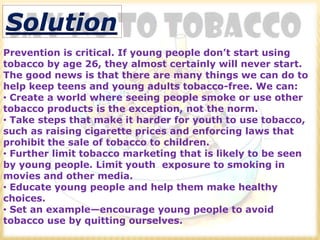
Solution
Prevention is critical. If young people don’t start using
tobacco by age 26, they almost certainly will never start.
The good news is that there are many things we can do to
help keep teens and young adults tobacco-free. We can:
• Create a world where seeing people smoke or use other
tobacco products is the exception, not the norm.
• Take steps that make it harder for youth to use tobacco,
such as raising cigarette prices and enforcing laws that
prohibit the sale of tobacco to children.
• Further limit tobacco marketing that is likely to be seen
by young people. Limit youth exposure to smoking in
movies and other media.
• Educate young people and help them make healthy
choices.
• Set an example—encourage young people to avoid
tobacco use by quitting ourselves.
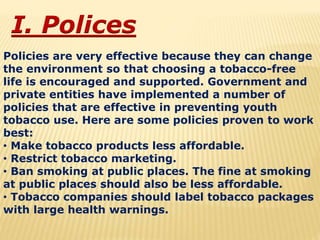
I. Polices
Policies are very effective because they can change
the environment so that choosing a tobacco-free
life is encouraged and supported. Government and
private entities have implemented a number of
policies that are effective in preventing youth
tobacco use. Here are some policies proven to work
best:
• Make tobacco products less affordable.
• Restrict tobacco marketing.
• Ban smoking at public places. The fine at smoking
at public places should also be less affordable.
• Tobacco companies should label tobacco packages
with large health warnings.
Conclusion
Tobacco use among young Americans has gone down since
the 1994 Surgeon General’s report, the first
comprehensive report on youth and tobacco. But the
number of young tobacco users in this country remains far
too high.
The 3,800 young people who smoke their first cigarette
today are at great risk for developing a serious chronic
disease from smoking. And half of long-term smokers die
prematurely from a tobacco-related disease.
As a society, we can no longer allow our young people’s
health to go up in smoke. We must work together to
prevent teens and young adults from using tobacco, and
we must continue to help those who start using tobacco to
quit. In doing so, we will help young people live longer and
healthier lives than the generation who came before them.
And we will end the tobacco epidemic in this country. Let’s
finish what we started—help make the next generation
tobacco-free!
Tobacco a leading risk factor

Tobacco a leading risk factor

  • 3.
  • 4.
    There are manyreasons young people begin using tobacco. Teenagers, and even preteens, are developing behaviours, social connections, and attitudes. They often experiment with different behaviours because they see these behaviours in peers they admire, in adults they hope to be like someday, or in media or entertainment idols. Much is known about the use of tobacco products, especially their effects on the health of those who smoke cigarettes. What’s known includes two grim facts: Tobacco use is the leading cause of preventable, premature death in the United States. And thousands of kids start smoking every day in the United States, many starting a lifetime of addiction. But what federal regulators and researchers know less about is exactly why people start using a specific tobacco product such as cigarettes, cigars, pipes and/or chewing tobacco. They also want to know why and when people stop smoking or using other tobacco products, and why they start up again.
  • 5.
    A cigar isdefined as any roll of tobacco wrapped in leaf tobacco, or in any substance containing tobacco, and which is typically smoked without a filter. The prevalence of cigar consumption has been progressively decreasing worldwide of the 30% of the English population who were regular smokers in 2002, only 5% were cigar smokers. Cigar smoke contains a class of highly carcinat levels significantly higher than those found in cigarette smoke. Biochemical analysis has shown that, for an equal number of grams of tobacco smoked, tar, carbon monoxide and ammonia are produced in larger quantities through the burning of cigars than through the burning of cigarettes.
  • 6.
    Narghiles are alsoknown as water pipes, argilehs, gozas, hookahs, shishas, etc. It has been suggested that the narghile originated in India and has been widely used for over 400 years. It is now more commonly used in the countries of the Arabian Peninsula, as well as in Turkey, Bangladesh and Pakistan. However, in recent years, a true rebirth of its use has been observed, principally among young people, including those in western countries. It is believed that there are currently more than 100 million people worldwide who use a narghile on a daily basis.
  • 7.
    Many terms areused to describe smokeless tobacco products. Such terms include oral tobacco, chewing tobacco, snuff, snus, etc. All oral forms of tobacco contain agents that cause cancer, principally mouth and pancreatic cancer, as well as other health problems such as periodontal disease, bone loss, tooth loss, discoloration of teeth and halitosis. Types of smokeless tobacco are- 1 Chewing tobacco 2 Dipping tobacco 3 Snuff 4 Snus 5 Gutka 6 Tobacco gum
  • 8.
    A cigarette isa small cylinder of finely cut tobacco leaves rolled in thin paper for smoking. The cigarette is ignited at one end and allowed to smoulder; its smoke is inhaled from the other end, which is held in or to the mouth; in some cases, a cigarette holder may be used, as well. Most modern manufactured cigarettes are filtered and also include reconstituted tobacco and other additives. The term cigarette, as commonly used, refers to a tobacco cigarette, but can apply to similar devices containing other substances, such as cannabis. A cigarette is distinguished from a cigar by its smaller size, use of processed leaf, and paper wrapping, which is normally white, though other colours and flavours are also available. Cigars are typically composed entirely of whole-leaf tobacco.
  • 9.
    The health effectsof tobacco are the effects that use of tobacco has on human health, and concern about health effects of tobacco has a long history. Research has focused primarily on cigarette tobacco smoking. In 1950, Richard Doll published research in the British Medical Journal showing a close link between smoking and lung cancer. Four years later, in 1954, the British Doctors Study, a study of some 40,000 doctors over 20 years, confirmed the suggestion, based on which the government issued advice that smoking and lung cancer rates were related.
  • 10.
    I. The scaleof the problem By 2030, NCDs are projected to account for more than 75% of deaths worldwide. NCDs are not predominantly diseases of the affluent world: 80% occur in low and middle income countries. Tobacco use is the single greatest preventable cause of NCDs: •ƒTobacco use kills more than 15,000 people a day and accounts for one in six of all NCD deaths. •ƒAlthough fewer people are using tobacco in some countries , the global trend is on the rise. By 2020, WHO estimates that tobacco will cause 7.5 million deaths annually, or about one in ten of all deaths. •An estimated 100 million people were killed by tobacco used during the 20th century. Unless we act together to take strong and immediate steps to avoid it, a billion lives will be lost in this century to tobacco use.6 This will include about 250 million of our children already alive today
  • 11.
    II. Second handsmoke Tobacco not only imperils the health of those who are actively smoking but also those around them who breathe the smoke. SHS is responsible for at least 600,000 deaths a year among non- smokers, with more than six in ten deaths due to heart disease. Although only about 20% of the world’s estimated 1 billion smokers are women, nearly half of deaths from SHS occur among adult women and over a quarter among children under the age of five. Children and infants are especially vulnerable to the effects of SHS. Exposure can lead to reduced lung function, increased lung infections, asthma attacks and other problems.ƒPregnant women exposed to SHS are at higher risk of preterm birth, and the growth of the baby in the womb can also be restricted. A growing number of jurisdictions are legislating to make workplaces and public places smoke-free, in compliance with Article 8 of the Framework Convention on Tobacco Control (FCTC). There is now compelling evidence that smoking bans reduce exposure to SHS; the resulting reduction in exposure has reduced hospital admissions for heart attack and other coronary conditions.
  • 12.
    Solution Prevention is critical.If young people don’t start using tobacco by age 26, they almost certainly will never start. The good news is that there are many things we can do to help keep teens and young adults tobacco-free. We can: • Create a world where seeing people smoke or use other tobacco products is the exception, not the norm. • Take steps that make it harder for youth to use tobacco, such as raising cigarette prices and enforcing laws that prohibit the sale of tobacco to children. • Further limit tobacco marketing that is likely to be seen by young people. Limit youth exposure to smoking in movies and other media. • Educate young people and help them make healthy choices. • Set an example—encourage young people to avoid tobacco use by quitting ourselves.
  • 13.
    I. Polices Policies arevery effective because they can change the environment so that choosing a tobacco-free life is encouraged and supported. Government and private entities have implemented a number of policies that are effective in preventing youth tobacco use. Here are some policies proven to work best: • Make tobacco products less affordable. • Restrict tobacco marketing. • Ban smoking at public places. The fine at smoking at public places should also be less affordable. • Tobacco companies should label tobacco packages with large health warnings.
  • 14.
    Conclusion Tobacco use amongyoung Americans has gone down since the 1994 Surgeon General’s report, the first comprehensive report on youth and tobacco. But the number of young tobacco users in this country remains far too high. The 3,800 young people who smoke their first cigarette today are at great risk for developing a serious chronic disease from smoking. And half of long-term smokers die prematurely from a tobacco-related disease. As a society, we can no longer allow our young people’s health to go up in smoke. We must work together to prevent teens and young adults from using tobacco, and we must continue to help those who start using tobacco to quit. In doing so, we will help young people live longer and healthier lives than the generation who came before them. And we will end the tobacco epidemic in this country. Let’s finish what we started—help make the next generation tobacco-free!