Toward a Tobacco-Free
Society
      Chapter 11


© 2012 McGraw-Hill Companies. All Rights Reserved.
Who Uses Tobacco?
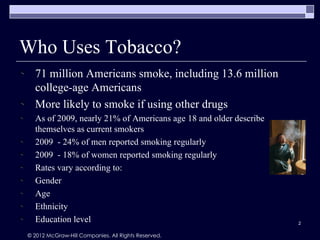
  71 million Americans smoke, including 13.6 million
  college-age Americans
  More likely to smoke if using other drugs
  As of 2009, nearly 21% of Americans age 18 and older describe
  themselves as current smokers
  2009 - 24% of men reported smoking regularly
  2009 - 18% of women reported smoking regularly
  Rates vary according to:
  Gender
  Age
  Ethnicity
  Education level                                                 2

© 2012 McGraw-Hill Companies. All Rights Reserved.
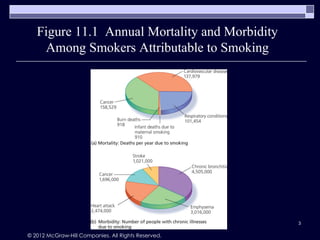
Figure 11.1 Annual Mortality and Morbidity
    Among Smokers Attributable to Smoking


                                                     3

© 2012 McGraw-Hill Companies. All Rights Reserved.
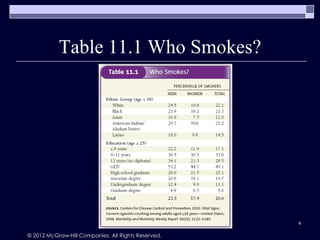
Table 11.1 Who Smokes?


                                                     4

© 2012 McGraw-Hill Companies. All Rights Reserved.
Young People and Tobacco
  As of June, 2010, federal crime to sell tobacco
  products to anyone under 18 years of age
  Minors smoke an estimated 800 million packs of
  cigarettes each year
  Each day 1,000 teens become regular smokers
  One third of these teens will die prematurely
  because of tobacco


                                                     5

© 2012 McGraw-Hill Companies. All Rights Reserved.
Why People Use Tobacco
   Nicotine Addiction
             Powerful psychoactive drug
               Reaches brain via bloodstream in seconds
               Most physically addictive of the psychoactive drugs
               Loss of control
               Tolerance and withdrawal


                                                                      6

© 2012 McGraw-Hill Companies. All Rights Reserved.
Social and Psychological Factors
      Established habits or cues to trigger smoking
      Secondary reinforcers
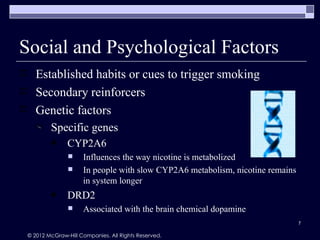
      Genetic factors
            Specific genes
                  CYP2A6
                       Influences the way nicotine is metabolized
                       In people with slow CYP2A6 metabolism, nicotine remains
                        in system longer
                  DRD2
                       Associated with the brain chemical dopamine
                                                                                  7

    © 2012 McGraw-Hill Companies. All Rights Reserved.
When Do Smokers Start?
      Nearly 90% of all adult smokers started smoking
       before age 18
      Every day 1,000 Americans under age 18 start
       smoking
      Every day about 1,800 Americans 18 and older start
       smoking
      Average age to start is 15


                                                            8

    © 2012 McGraw-Hill Companies. All Rights Reserved.
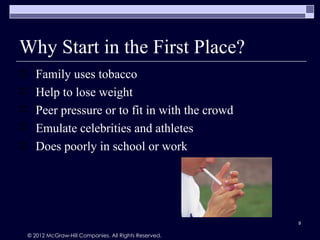
Why Start in the First Place?
      Family uses tobacco
      Help to lose weight
      Peer pressure or to fit in with the crowd
      Emulate celebrities and athletes
      Does poorly in school or work


                                                         9

    © 2012 McGraw-Hill Companies. All Rights Reserved.
Rationalizing the Dangers
     Choosing to smoke means denying the health risks that
      come from smoking
     Young people convince themselves they will not be
      vulnerable to tobacco’s dangers
     Most teenagers believe they can stop smoking whenever
      they want, but are actually more vulnerable to nicotine
     In polls, about 75% of smoking teens state they wish they
      had never started!


                                                                  10

 © 2012 McGraw-Hill Companies. All Rights Reserved.
Emulating Smoking in the Media
          Media portrayals of smoking are key influences
          on young people who start smoking
          Films do not reflect actual patterns of use, but are
          successful forms of advertising
          Some groups suggest an automatic “R” rating for
          any film that shows tobacco use


                                                                 11

© 2012 McGraw-Hill Companies. All Rights Reserved.
Health Hazards
     Tobacco adversely affects nearly every part of the
      body
     Contains hundreds of damaging chemical
      substances
     Unfiltered cigarettes = 5 billion particles per
      cubic millimeter
     50,000 times more than smoggy urban air
     Condensed particles in the cigarette produce the
      tar, a brown, sticky mass
                                                           12

© 2012 McGraw-Hill Companies. All Rights Reserved.
Carcinogens and Poisons
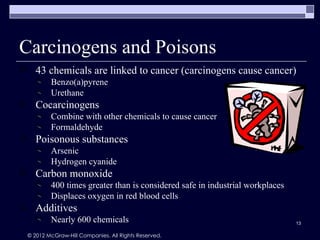
      43 chemicals are linked to cancer (carcinogens cause cancer)
            Benzo(a)pyrene
            Urethane
      Cocarcinogens
            Combine with other chemicals to cause cancer
            Formaldehyde
      Poisonous substances
            Arsenic
            Hydrogen cyanide
      Carbon monoxide
            400 times greater than is considered safe in industrial workplaces
            Displaces oxygen in red blood cells
      Additives
            Nearly 600 chemicals                                                 13

    © 2012 McGraw-Hill Companies. All Rights Reserved.
Inhaling Tobacco Smoke
      All smokers absorb some gases, tar, and nicotine
      Those who inhale keep these substances in their bodies
      Smoke goes directly into mouth, throat, and respiratory
       tract
      Bypasses the nose that normally filters out 75% of
       foreign matter
      Sidestream smoke = uninhaled smoke from a burning
       cigarette (that nonsmokers may breathe)


                                                                 14

    © 2012 McGraw-Hill Companies. All Rights Reserved.
“Reduced Harm” Cigarettes
   Low-tar, low-nicotine, or filtered cigarettes
   No such thing as a safe cigarette
   Often smoke more
   As of June 2010, regulations prohibit labeling
    cigarettes with “light,” “mild,” or “low.”


                                                     15

© 2012 McGraw-Hill Companies. All Rights Reserved.
Menthol Cigarettes
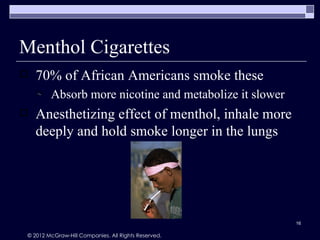
   70% of African Americans smoke these
        Absorb more nicotine and metabolize it slower
   Anesthetizing effect of menthol, inhale more
    deeply and hold smoke longer in the lungs


                                                        16

© 2012 McGraw-Hill Companies. All Rights Reserved.
Immediate Effects of Smoking
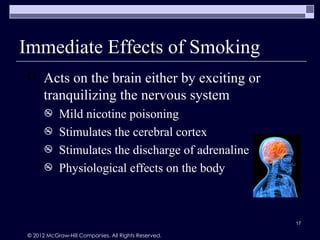
     Acts on the brain either by exciting or
      tranquilizing the nervous system
          Mild nicotine poisoning
          Stimulates the cerebral cortex
          Stimulates the discharge of adrenaline
          Physiological effects on the body


                                                     17

© 2012 McGraw-Hill Companies. All Rights Reserved.
Long-Term Effects of Smoking
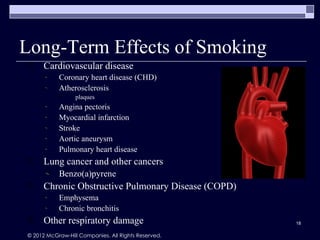
     Cardiovascular disease
           Coronary heart disease (CHD)
           Atherosclerosis
                 plaques
           Angina pectoris
           Myocardial infarction
           Stroke
           Aortic aneurysm
           Pulmonary heart disease
     Lung cancer and other cancers
           Benzo(a)pyrene
     Chronic Obstructive Pulmonary Disease (COPD)
           Emphysema
           Chronic bronchitis
     Other respiratory damage                       18

© 2012 McGraw-Hill Companies. All Rights Reserved.
Additional Health, Cosmetic, and
Economic Concerns
   Ulcers
   Impotence
   Reproductive health problems
   Dental diseases
   Diminished physical senses
   Injuries
   Cosmetic concerns
   Economic costs                                    19

 © 2012 McGraw-Hill Companies. All Rights Reserved.
Cumulative Effects
      Reduced life expectancy
      Males who start before age 15 are half as likely to live to
       75 versus those who never smoked
      Lung cancer
      Reduced quality of life
      Female smokers spend 17% more sick days in bed than
       nonsmokers
      Both men and women show a greater rate of acute and
       chronic diseases
                                                                 20

    © 2012 McGraw-Hill Companies. All Rights Reserved.
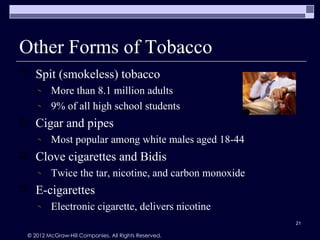
Other Forms of Tobacco
      Spit (smokeless) tobacco
            More than 8.1 million adults
            9% of all high school students
      Cigar and pipes
            Most popular among white males aged 18-44
      Clove cigarettes and Bidis
            Twice the tar, nicotine, and carbon monoxide
      E-cigarettes
            Electronic cigarette, delivers nicotine
                                                           21

    © 2012 McGraw-Hill Companies. All Rights Reserved.
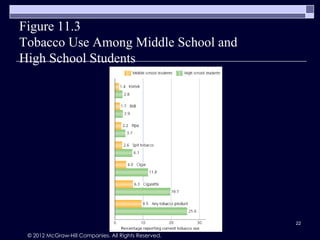
Figure 11.3
Tobacco Use Among Middle School and
High School Students


                                                      22

 © 2012 McGraw-Hill Companies. All Rights Reserved.
The Effects of Smoking on the
Nonsmoker
   Environmental tobacco smoke (ETS)
        “Secondhand smoke”
        EPA designated ETS as a Class A carcinogen
        DHHS National Toxicology Program - “known
         human carcinogen”
        Surgeon General “there is no safe level of
         exposure to ETS; even brief exposure can cause
         serious harm”

                                                          23

 © 2012 McGraw-Hill Companies. All Rights Reserved.
Environmental Tobacco Smoke
      Mainstream smoke
            Smoke exhaled by smokers
      Sidestream smoke
            Smoke from the burning end of a cigarette, cigar, or pipe
            85% of smoke in a room is sidestream smoke
            Not filtered, so twice the tar and nicotine
            Three times the benzo(a)pyrene
            Three times the carbon monoxide and ammonia
      Smoke from a cigar can be even more dangerous
            30 times more carbon monoxide
                                                                        24

    © 2012 McGraw-Hill Companies. All Rights Reserved.
ETS Effects
      Develop cough, headaches, nasal discomfort, eye
       irritation, breathlessness, sinus problems
      Those with allergies tend to suffer the most
      Causes 3,400 deaths due to lung cancer
      Contributes to about 46,000 overall deaths each year
      20% increase in the progression of atherosclerosis
      Contributes to increased asthma attacks, and
       increased risk for breast and cervical cancers

                                                          25

    © 2012 McGraw-Hill Companies. All Rights Reserved.
Infants, Children, and ETS
      More likely to develop
            Bronchitis, pneumonia, respiratory infections
            More complications from asthma
            Greatly increased chance of SIDS
            Low birth weight
            Bronchitis
      Chemicals from smoking show up in breast milk


                                                            26

    © 2012 McGraw-Hill Companies. All Rights Reserved.
Avoiding ETS
   Speak up tactfully
   Display reminders
   Don’t allow smoking in your home or room
   Open a window
   Sit in the nonsmoking section
   Fight for a smoke-free environment
   Discuss quitting strategies
                                                     27

© 2012 McGraw-Hill Companies. All Rights Reserved.
Smoking and Pregnancy
     Almost doubles risk of miscarriage
     Causes hundreds of infant deaths in U.S.
     Premature birth, low birth weight, long-
      term impairments in growth and
      intellectual development
     Possible higher risks of getting cancer
     16.4% of pregnant women smoke
                                                     28

© 2012 McGraw-Hill Companies. All Rights Reserved.
Cost of Tobacco Use to Society
   Annual health care expenditures related to
    smoking exceed $96 billion
   Annual cost of lost productivity nearly $97
    billion
   Costs far exceed tax revenues that states
    collect


                                                      29

 © 2012 McGraw-Hill Companies. All Rights Reserved.
What Can Be Done?
      Action at the local level
      Action at the state and federal level
      Action at the international level
            WHO
            World No Tobacco Day (May 31)
      Action in the private sector
•      Smoke-free restaurants and other businesses
      Individual action

                                                         30

    © 2012 McGraw-Hill Companies. All Rights Reserved.
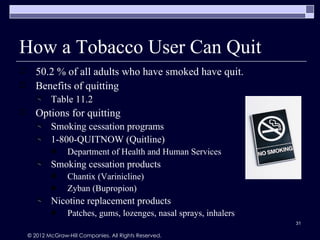
How a Tobacco User Can Quit
      50.2 % of all adults who have smoked have quit.
      Benefits of quitting
            Table 11.2
      Options for quitting
            Smoking cessation programs
            1-800-QUITNOW (Quitline)
                  Department of Health and Human Services
            Smoking cessation products
                  Chantix (Varinicline)
                  Zyban (Bupropion)
            Nicotine replacement products
                  Patches, gums, lozenges, nasal sprays, inhalers
                                                                    31

    © 2012 McGraw-Hill Companies. All Rights Reserved.
Toward a Tobacco-Free
Society
      Chapter 11


© 2012 McGraw-Hill Companies. All Rights Reserved.

Chapter 11 Powerpoint

  • 1.
    Toward a Tobacco-Free Society Chapter 11 © 2012 McGraw-Hill Companies. All Rights Reserved.
  • 2.
    Who Uses Tobacco? 71 million Americans smoke, including 13.6 million college-age Americans More likely to smoke if using other drugs As of 2009, nearly 21% of Americans age 18 and older describe themselves as current smokers 2009 - 24% of men reported smoking regularly 2009 - 18% of women reported smoking regularly Rates vary according to: Gender Age Ethnicity Education level 2 © 2012 McGraw-Hill Companies. All Rights Reserved.
  • 3.
    Figure 11.1 AnnualMortality and Morbidity Among Smokers Attributable to Smoking 3 © 2012 McGraw-Hill Companies. All Rights Reserved.
  • 4.
    Table 11.1 WhoSmokes? 4 © 2012 McGraw-Hill Companies. All Rights Reserved.
  • 5.
    Young People andTobacco As of June, 2010, federal crime to sell tobacco products to anyone under 18 years of age Minors smoke an estimated 800 million packs of cigarettes each year Each day 1,000 teens become regular smokers One third of these teens will die prematurely because of tobacco 5 © 2012 McGraw-Hill Companies. All Rights Reserved.
  • 6.
    Why People UseTobacco  Nicotine Addiction  Powerful psychoactive drug  Reaches brain via bloodstream in seconds  Most physically addictive of the psychoactive drugs  Loss of control  Tolerance and withdrawal 6 © 2012 McGraw-Hill Companies. All Rights Reserved.
  • 7.
    Social and PsychologicalFactors  Established habits or cues to trigger smoking  Secondary reinforcers  Genetic factors Specific genes CYP2A6  Influences the way nicotine is metabolized  In people with slow CYP2A6 metabolism, nicotine remains in system longer DRD2  Associated with the brain chemical dopamine 7 © 2012 McGraw-Hill Companies. All Rights Reserved.
  • 8.
    When Do SmokersStart?  Nearly 90% of all adult smokers started smoking before age 18  Every day 1,000 Americans under age 18 start smoking  Every day about 1,800 Americans 18 and older start smoking  Average age to start is 15 8 © 2012 McGraw-Hill Companies. All Rights Reserved.
  • 9.
    Why Start inthe First Place?  Family uses tobacco  Help to lose weight  Peer pressure or to fit in with the crowd  Emulate celebrities and athletes  Does poorly in school or work 9 © 2012 McGraw-Hill Companies. All Rights Reserved.
  • 10.
    Rationalizing the Dangers  Choosing to smoke means denying the health risks that come from smoking  Young people convince themselves they will not be vulnerable to tobacco’s dangers  Most teenagers believe they can stop smoking whenever they want, but are actually more vulnerable to nicotine  In polls, about 75% of smoking teens state they wish they had never started! 10 © 2012 McGraw-Hill Companies. All Rights Reserved.
  • 11.
    Emulating Smoking inthe Media Media portrayals of smoking are key influences on young people who start smoking Films do not reflect actual patterns of use, but are successful forms of advertising Some groups suggest an automatic “R” rating for any film that shows tobacco use 11 © 2012 McGraw-Hill Companies. All Rights Reserved.
  • 12.
    Health Hazards  Tobacco adversely affects nearly every part of the body  Contains hundreds of damaging chemical substances  Unfiltered cigarettes = 5 billion particles per cubic millimeter  50,000 times more than smoggy urban air  Condensed particles in the cigarette produce the tar, a brown, sticky mass 12 © 2012 McGraw-Hill Companies. All Rights Reserved.
  • 13.
    Carcinogens and Poisons  43 chemicals are linked to cancer (carcinogens cause cancer) Benzo(a)pyrene Urethane  Cocarcinogens Combine with other chemicals to cause cancer Formaldehyde  Poisonous substances Arsenic Hydrogen cyanide  Carbon monoxide 400 times greater than is considered safe in industrial workplaces Displaces oxygen in red blood cells  Additives Nearly 600 chemicals 13 © 2012 McGraw-Hill Companies. All Rights Reserved.
  • 14.
    Inhaling Tobacco Smoke  All smokers absorb some gases, tar, and nicotine  Those who inhale keep these substances in their bodies  Smoke goes directly into mouth, throat, and respiratory tract  Bypasses the nose that normally filters out 75% of foreign matter  Sidestream smoke = uninhaled smoke from a burning cigarette (that nonsmokers may breathe) 14 © 2012 McGraw-Hill Companies. All Rights Reserved.
  • 15.
    “Reduced Harm” Cigarettes  Low-tar, low-nicotine, or filtered cigarettes  No such thing as a safe cigarette  Often smoke more  As of June 2010, regulations prohibit labeling cigarettes with “light,” “mild,” or “low.” 15 © 2012 McGraw-Hill Companies. All Rights Reserved.
  • 16.
    Menthol Cigarettes  70% of African Americans smoke these Absorb more nicotine and metabolize it slower  Anesthetizing effect of menthol, inhale more deeply and hold smoke longer in the lungs 16 © 2012 McGraw-Hill Companies. All Rights Reserved.
  • 17.
    Immediate Effects ofSmoking  Acts on the brain either by exciting or tranquilizing the nervous system  Mild nicotine poisoning  Stimulates the cerebral cortex  Stimulates the discharge of adrenaline  Physiological effects on the body 17 © 2012 McGraw-Hill Companies. All Rights Reserved.
  • 18.
    Long-Term Effects ofSmoking  Cardiovascular disease Coronary heart disease (CHD) Atherosclerosis plaques Angina pectoris Myocardial infarction Stroke Aortic aneurysm Pulmonary heart disease  Lung cancer and other cancers Benzo(a)pyrene  Chronic Obstructive Pulmonary Disease (COPD) Emphysema Chronic bronchitis  Other respiratory damage 18 © 2012 McGraw-Hill Companies. All Rights Reserved.
  • 19.
    Additional Health, Cosmetic,and Economic Concerns  Ulcers  Impotence  Reproductive health problems  Dental diseases  Diminished physical senses  Injuries  Cosmetic concerns  Economic costs 19 © 2012 McGraw-Hill Companies. All Rights Reserved.
  • 20.
    Cumulative Effects  Reduced life expectancy  Males who start before age 15 are half as likely to live to 75 versus those who never smoked  Lung cancer  Reduced quality of life  Female smokers spend 17% more sick days in bed than nonsmokers  Both men and women show a greater rate of acute and chronic diseases 20 © 2012 McGraw-Hill Companies. All Rights Reserved.
  • 21.
    Other Forms ofTobacco  Spit (smokeless) tobacco More than 8.1 million adults 9% of all high school students  Cigar and pipes Most popular among white males aged 18-44  Clove cigarettes and Bidis Twice the tar, nicotine, and carbon monoxide  E-cigarettes Electronic cigarette, delivers nicotine 21 © 2012 McGraw-Hill Companies. All Rights Reserved.
  • 22.
    Figure 11.3 Tobacco UseAmong Middle School and High School Students 22 © 2012 McGraw-Hill Companies. All Rights Reserved.
  • 23.
    The Effects ofSmoking on the Nonsmoker  Environmental tobacco smoke (ETS)  “Secondhand smoke”  EPA designated ETS as a Class A carcinogen  DHHS National Toxicology Program - “known human carcinogen”  Surgeon General “there is no safe level of exposure to ETS; even brief exposure can cause serious harm” 23 © 2012 McGraw-Hill Companies. All Rights Reserved.
  • 24.
    Environmental Tobacco Smoke  Mainstream smoke Smoke exhaled by smokers  Sidestream smoke Smoke from the burning end of a cigarette, cigar, or pipe 85% of smoke in a room is sidestream smoke Not filtered, so twice the tar and nicotine Three times the benzo(a)pyrene Three times the carbon monoxide and ammonia  Smoke from a cigar can be even more dangerous 30 times more carbon monoxide 24 © 2012 McGraw-Hill Companies. All Rights Reserved.
  • 25.
    ETS Effects  Develop cough, headaches, nasal discomfort, eye irritation, breathlessness, sinus problems  Those with allergies tend to suffer the most  Causes 3,400 deaths due to lung cancer  Contributes to about 46,000 overall deaths each year  20% increase in the progression of atherosclerosis  Contributes to increased asthma attacks, and increased risk for breast and cervical cancers 25 © 2012 McGraw-Hill Companies. All Rights Reserved.
  • 26.
    Infants, Children, andETS  More likely to develop Bronchitis, pneumonia, respiratory infections More complications from asthma Greatly increased chance of SIDS Low birth weight Bronchitis  Chemicals from smoking show up in breast milk 26 © 2012 McGraw-Hill Companies. All Rights Reserved.
  • 27.
    Avoiding ETS  Speak up tactfully  Display reminders  Don’t allow smoking in your home or room  Open a window  Sit in the nonsmoking section  Fight for a smoke-free environment  Discuss quitting strategies 27 © 2012 McGraw-Hill Companies. All Rights Reserved.
  • 28.
    Smoking and Pregnancy  Almost doubles risk of miscarriage  Causes hundreds of infant deaths in U.S.  Premature birth, low birth weight, long- term impairments in growth and intellectual development  Possible higher risks of getting cancer  16.4% of pregnant women smoke 28 © 2012 McGraw-Hill Companies. All Rights Reserved.
  • 29.
    Cost of TobaccoUse to Society  Annual health care expenditures related to smoking exceed $96 billion  Annual cost of lost productivity nearly $97 billion  Costs far exceed tax revenues that states collect 29 © 2012 McGraw-Hill Companies. All Rights Reserved.
  • 30.
    What Can BeDone?  Action at the local level  Action at the state and federal level  Action at the international level WHO World No Tobacco Day (May 31)  Action in the private sector • Smoke-free restaurants and other businesses  Individual action 30 © 2012 McGraw-Hill Companies. All Rights Reserved.
  • 31.
    How a TobaccoUser Can Quit  50.2 % of all adults who have smoked have quit.  Benefits of quitting Table 11.2  Options for quitting Smoking cessation programs 1-800-QUITNOW (Quitline) Department of Health and Human Services Smoking cessation products Chantix (Varinicline) Zyban (Bupropion) Nicotine replacement products Patches, gums, lozenges, nasal sprays, inhalers 31 © 2012 McGraw-Hill Companies. All Rights Reserved.
  • 32.
    Toward a Tobacco-Free Society Chapter 11 © 2012 McGraw-Hill Companies. All Rights Reserved.

Editor's Notes

  • #4 Figure 11.1 Annual mortality and morbidity among smokers attributable to smoking
  • #5 Table 11.1 Who Smokes?
  • #23 Figure 11.5 Tobacco use among middle school and high school students