Understanding Intercultural
  Communication Second Edition
   Chapter 6

   What is the Connection between Verbal
   Communication & Culture?

   Stella Ting-Toomey & Leeva C. Chung


   OXFORD UNIVERSITY PRESS

PowerPoint Slides Designed by Alex Flecky and Noorie Baig
TODAY’S MENU
I. Human Language: Distinctive
Features   and Rule Patterns
II. Appreciating Diverse Language
    Functions
III.     Verbal Communication
Styles: A    General Framework
IV. Intercultural Reality Check: Do-
Ables
Do you know…

•   The Top-3 Countries with the Most Native
    English-Language Speakers?

•   The Top-3 Countries with the Most Native
    Spanish-Language Speakers?

•   The Top-3 Most Widely-Spoken
    Languages Worldwide?
                          (Ethnologue Database, 2010-11)
I. Human Language: Distinctive
Features
  and Rule Patterns
Language:
    An arbitrary, symbolic system that labels
    and categorizes objects, events, groups,
    people, ideas, feelings, experiences, and
    many other phenomena.


Can you guess how many languages exist
 worldwide?
I. Human Language: Distinctive
Features
  and Rule Patterns
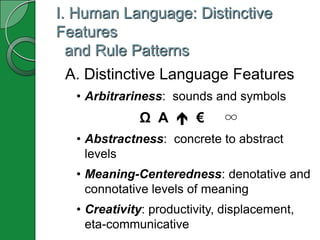
 A. Distinctive Language Features
  • Arbitrariness: sounds and symbols
             Ω A  €         ∞
  • Abstractness: concrete to abstract
    levels
  • Meaning-Centeredness: denotative and
    connotative levels of meaning
  • Creativity: productivity, displacement,
    eta-communicative
I. Human Language: Distinctive
Features and Rule Patterns

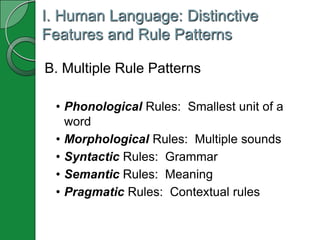
B. Multiple Rule Patterns

 • Phonological Rules: Smallest unit of a
   word
 • Morphological Rules: Multiple sounds
 • Syntactic Rules: Grammar
 • Semantic Rules: Meaning
 • Pragmatic Rules: Contextual rules
II. Appreciating Diverse
Language Functions


Click here to find out the “Meaning of Love”
     From 7 Billion Others from YouTube
II. Appreciating Diverse Language
Functions

 A. Cultural Worldview Function
      •   Linear worldview vs. Relational worldview

 B.       Everyday Social Reality Function
 C.       Cognitive Shaping Function
      •   Sapir-Whorf Hypothesis: “the shaper of ideas”
      •   Strong Form vs. Weak Form

 D. Group Membership Function
      •   Code switching (Click to view related video)

 E.       Social Change Function
II. Appreciating Diverse Language
Functions: Cultural Worldview
Function
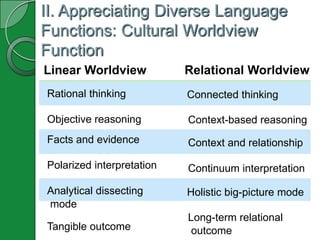
Linear Worldview           Relational Worldview
Rational thinking          Connected thinking

Objective reasoning        Context-based reasoning
Facts and evidence         Context and relationship

Polarized interpretation   Continuum interpretation

Analytical dissecting      Holistic big-picture mode
mode
                           Long-term relational
Tangible outcome            outcome
II. Verbal Communication Styles:
     A General Framework
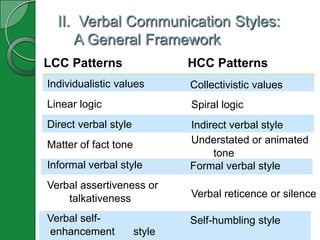
LCC Patterns                  HCC Patterns
Individualistic values        Collectivistic values
Linear logic                  Spiral logic
Direct verbal style           Indirect verbal style
Matter of fact tone           Understated or animated
                                   tone
Informal verbal style         Formal verbal style
Verbal assertiveness or
    talkativeness             Verbal reticence or silence

Verbal self-                  Self-humbling style
enhancement           style
II. Verbal Communication Styles: A General Framework


 LCC – HCC Application Analysis:
 •   The Joy Luck Club: Film Clip
 •   Roommates Video

 DISCUSSION QUESTIONS:
 •   Compare and contrast the different verbal styles of the
     people in the videos.
 •   What did the low-context communicator say/do? What
     did the high-context communicator say/do?
 •   What recommendations do you have for these
     communicators to make this conversation go better?
II. Verbal Communication Styles: A General
Framework

Beliefs Expressed in Talk and Silence
  • Silence is interpreted and evaluated differently
    across cultures and between persons.
  • How do you interpret silence?


Take a look at how the Japanese people use
 silence to mean different things…
IV. Intercultural Reality Check: Do-
Ables
  When using your native language with a
   nonnative speaker, to be flexible verbal
   communicators, try to practice the following
   guidelines:

   – Practice intercultural empathy
   – Learn to paraphrase and perception check
   – Use multiple modes of presentation
   – Practice language variation usage
   – Pay attention to nonverbal tone of voice
   – Understand basic differences of LCC and HCC
     patterns
   – Use nonverbal gestures to complement
Parting Thoughts…

             If you talk to a man
      in a language he understands,
           that goes to his head.
    If you talk to him in his language,
           that goes to his heart.
                     ~ Nelson Mandela


           Learn a new language
              and get a new soul.
                       ~ Czech Proverb

Chapter6

  • 1.
    Understanding Intercultural Communication Second Edition Chapter 6 What is the Connection between Verbal Communication & Culture? Stella Ting-Toomey & Leeva C. Chung OXFORD UNIVERSITY PRESS PowerPoint Slides Designed by Alex Flecky and Noorie Baig
  • 2.
    TODAY’S MENU I. HumanLanguage: Distinctive Features and Rule Patterns II. Appreciating Diverse Language Functions III. Verbal Communication Styles: A General Framework IV. Intercultural Reality Check: Do- Ables
  • 3.
    Do you know… • The Top-3 Countries with the Most Native English-Language Speakers? • The Top-3 Countries with the Most Native Spanish-Language Speakers? • The Top-3 Most Widely-Spoken Languages Worldwide? (Ethnologue Database, 2010-11)
  • 4.
    I. Human Language:Distinctive Features and Rule Patterns Language: An arbitrary, symbolic system that labels and categorizes objects, events, groups, people, ideas, feelings, experiences, and many other phenomena. Can you guess how many languages exist worldwide?
  • 5.
    I. Human Language:Distinctive Features and Rule Patterns A. Distinctive Language Features • Arbitrariness: sounds and symbols Ω A  € ∞ • Abstractness: concrete to abstract levels • Meaning-Centeredness: denotative and connotative levels of meaning • Creativity: productivity, displacement, eta-communicative
  • 6.
    I. Human Language:Distinctive Features and Rule Patterns B. Multiple Rule Patterns • Phonological Rules: Smallest unit of a word • Morphological Rules: Multiple sounds • Syntactic Rules: Grammar • Semantic Rules: Meaning • Pragmatic Rules: Contextual rules
  • 7.
    II. Appreciating Diverse LanguageFunctions Click here to find out the “Meaning of Love” From 7 Billion Others from YouTube
  • 8.
    II. Appreciating DiverseLanguage Functions A. Cultural Worldview Function • Linear worldview vs. Relational worldview B. Everyday Social Reality Function C. Cognitive Shaping Function • Sapir-Whorf Hypothesis: “the shaper of ideas” • Strong Form vs. Weak Form D. Group Membership Function • Code switching (Click to view related video) E. Social Change Function
  • 9.
    II. Appreciating DiverseLanguage Functions: Cultural Worldview Function Linear Worldview Relational Worldview Rational thinking Connected thinking Objective reasoning Context-based reasoning Facts and evidence Context and relationship Polarized interpretation Continuum interpretation Analytical dissecting Holistic big-picture mode mode Long-term relational Tangible outcome outcome
  • 10.
    II. Verbal CommunicationStyles: A General Framework LCC Patterns HCC Patterns Individualistic values Collectivistic values Linear logic Spiral logic Direct verbal style Indirect verbal style Matter of fact tone Understated or animated tone Informal verbal style Formal verbal style Verbal assertiveness or talkativeness Verbal reticence or silence Verbal self- Self-humbling style enhancement style
  • 11.
    II. Verbal CommunicationStyles: A General Framework LCC – HCC Application Analysis: • The Joy Luck Club: Film Clip • Roommates Video DISCUSSION QUESTIONS: • Compare and contrast the different verbal styles of the people in the videos. • What did the low-context communicator say/do? What did the high-context communicator say/do? • What recommendations do you have for these communicators to make this conversation go better?
  • 12.
    II. Verbal CommunicationStyles: A General Framework Beliefs Expressed in Talk and Silence • Silence is interpreted and evaluated differently across cultures and between persons. • How do you interpret silence? Take a look at how the Japanese people use silence to mean different things…
  • 13.
    IV. Intercultural RealityCheck: Do- Ables When using your native language with a nonnative speaker, to be flexible verbal communicators, try to practice the following guidelines: – Practice intercultural empathy – Learn to paraphrase and perception check – Use multiple modes of presentation – Practice language variation usage – Pay attention to nonverbal tone of voice – Understand basic differences of LCC and HCC patterns – Use nonverbal gestures to complement
  • 14.
    Parting Thoughts… If you talk to a man in a language he understands, that goes to his head. If you talk to him in his language, that goes to his heart. ~ Nelson Mandela Learn a new language and get a new soul. ~ Czech Proverb