Chapter 4
Verbal
Communication
• Describe the power of language—the
system of symbols we use to think
about and communicate our
experiences and feelings
• Identify the ways language works to
help people communicate—the five
functional communication
competencies
Chapter Outcomes
Chapter Outcomes
(cont.)
• Label communication problems
with language and how to address
them
• Describe how language reflects,
builds on, and determines context
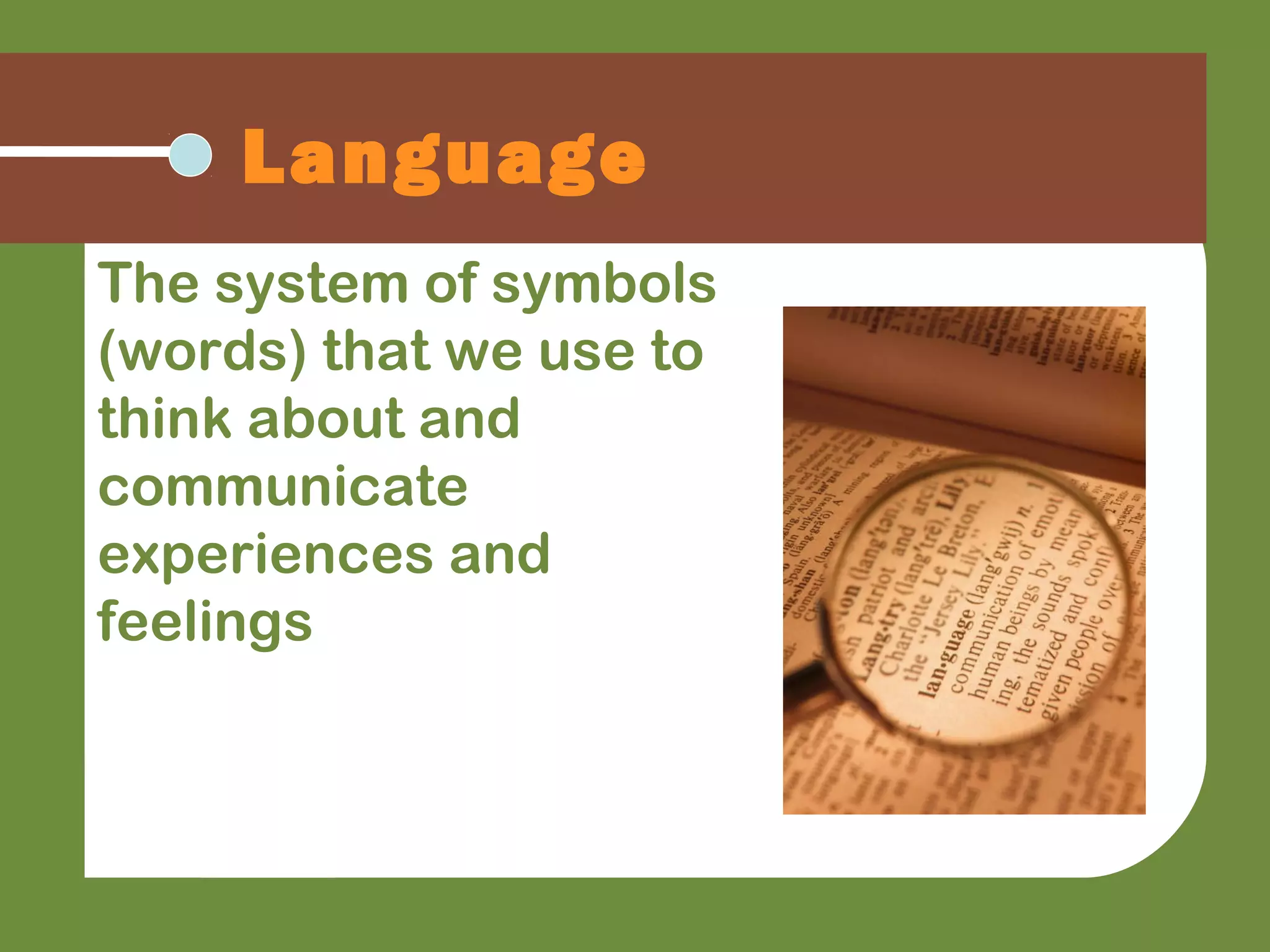
The system of symbols
(words) that we use to
think about and
communicate
experiences and
feelings
Language
• Language is symbolic.
• Words have multiple meanings.
– Denotative: accepted definition
– Connotative: emotional or attitudinal
response
• Thought informs language and vice
versa.
– Cognitive language: specific symbols
used to describe ideas, situations, and so
on
The Nature of
Language
• Language is ruled by a system of
rules (grammar).
– Phonological rules: pronunciation
– Syntactic rules: word placement in a
sentence
• Language is bound by context.
– Competent communication means
understanding a situation.
The Nature of
Language (cont.)
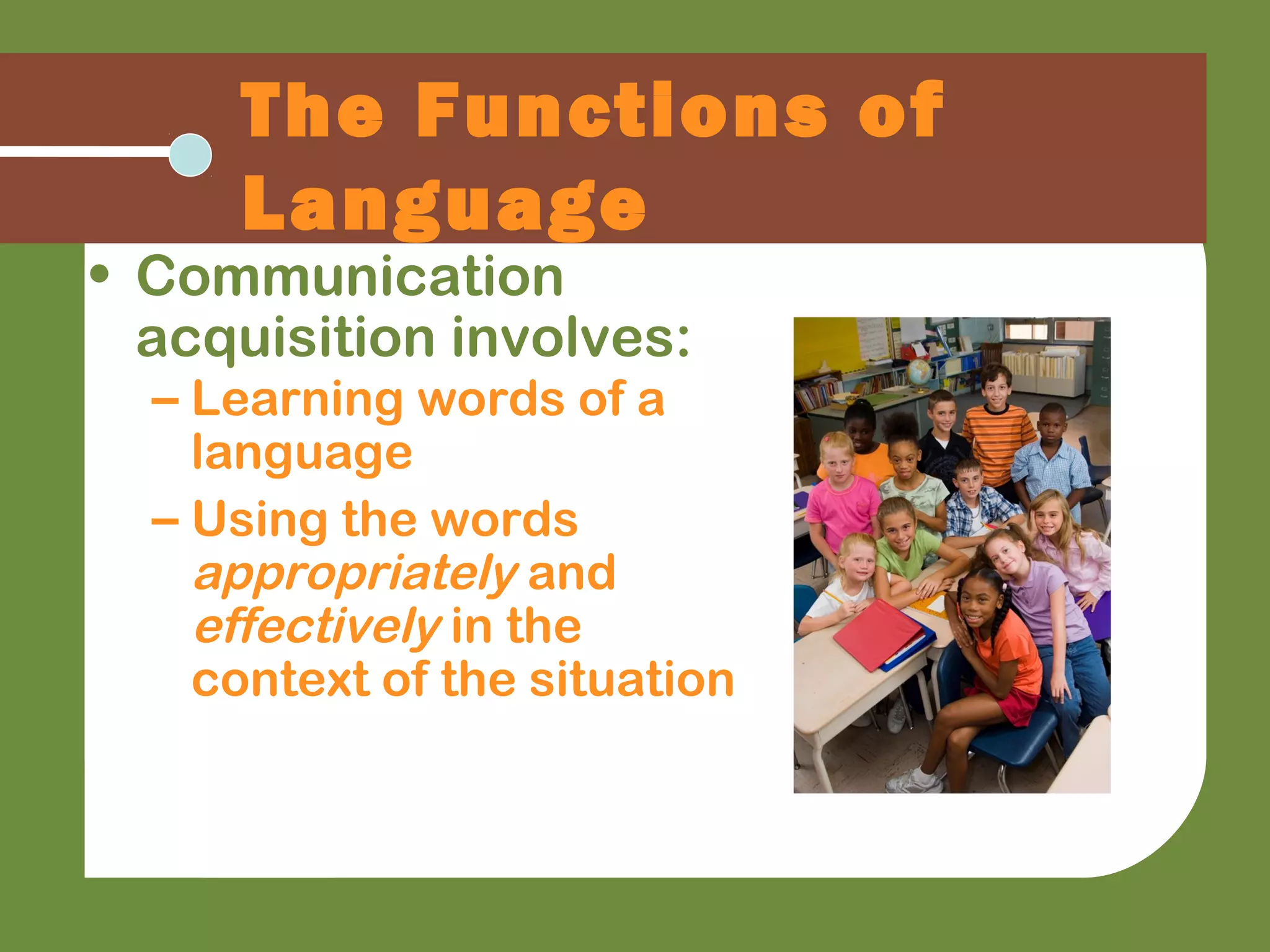
• Communication
acquisition involves:
– Learning words of a
language
– Using the words
appropriately and
effectively in the
context of the situation
The Functions of
Language
Functional
Communication
Competencies
• Using language as a means of control to
influence oneself, others, environment
• Using language to share information,
which involves:
– Questioning
– Describing
– Reinforcing
– Withholding
Functional
Communication
Competencies (cont.)
• Using language to express feelings
appropriately and effectively
• Using language to express creativity
– Imagining: ability to think, play, and be
creative in communication
• Using language as a form of ritual
– Ritualizing: learning the rules for
managing conversations and relationships
Problems with
Language
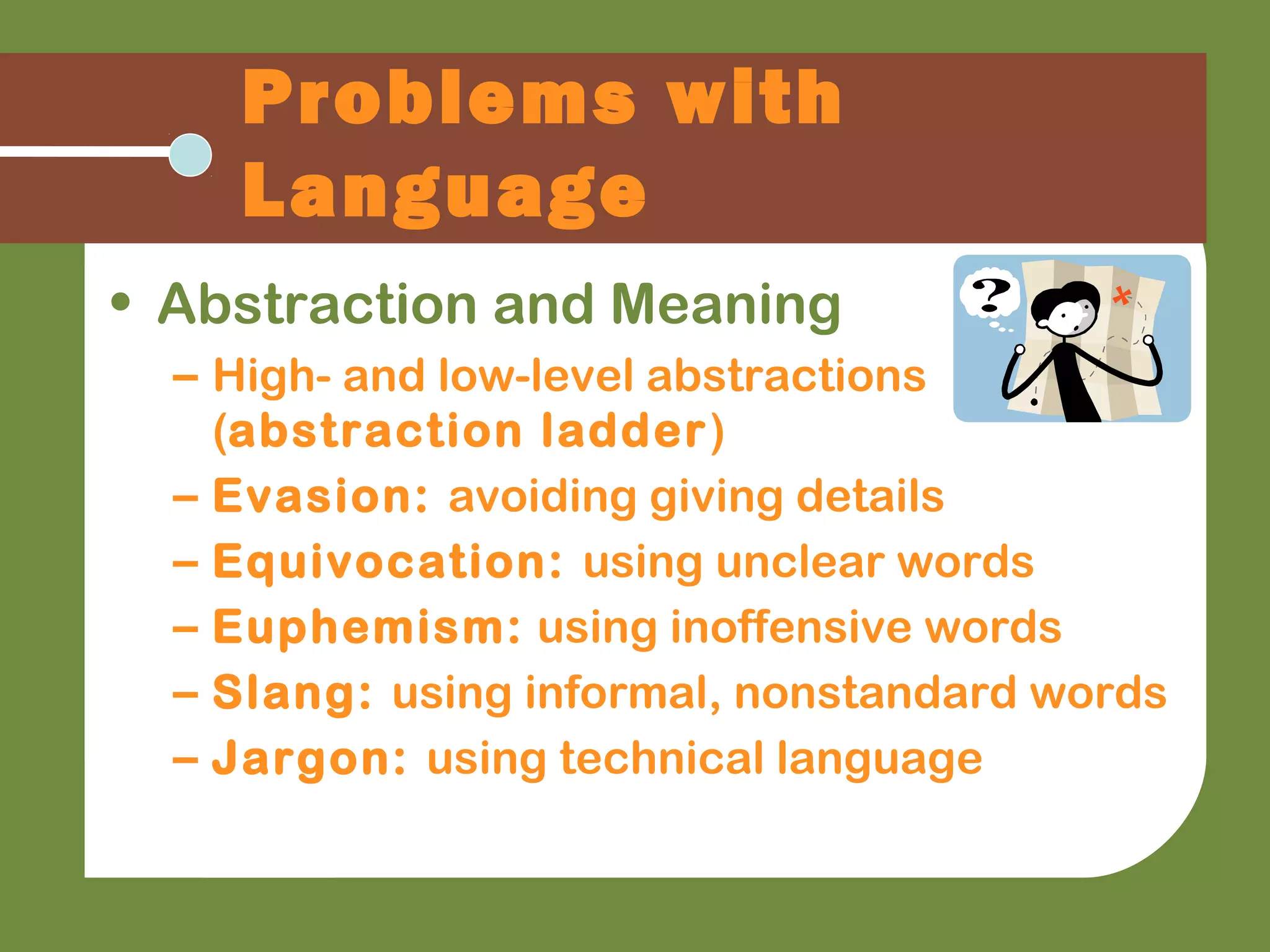
• Abstraction and Meaning
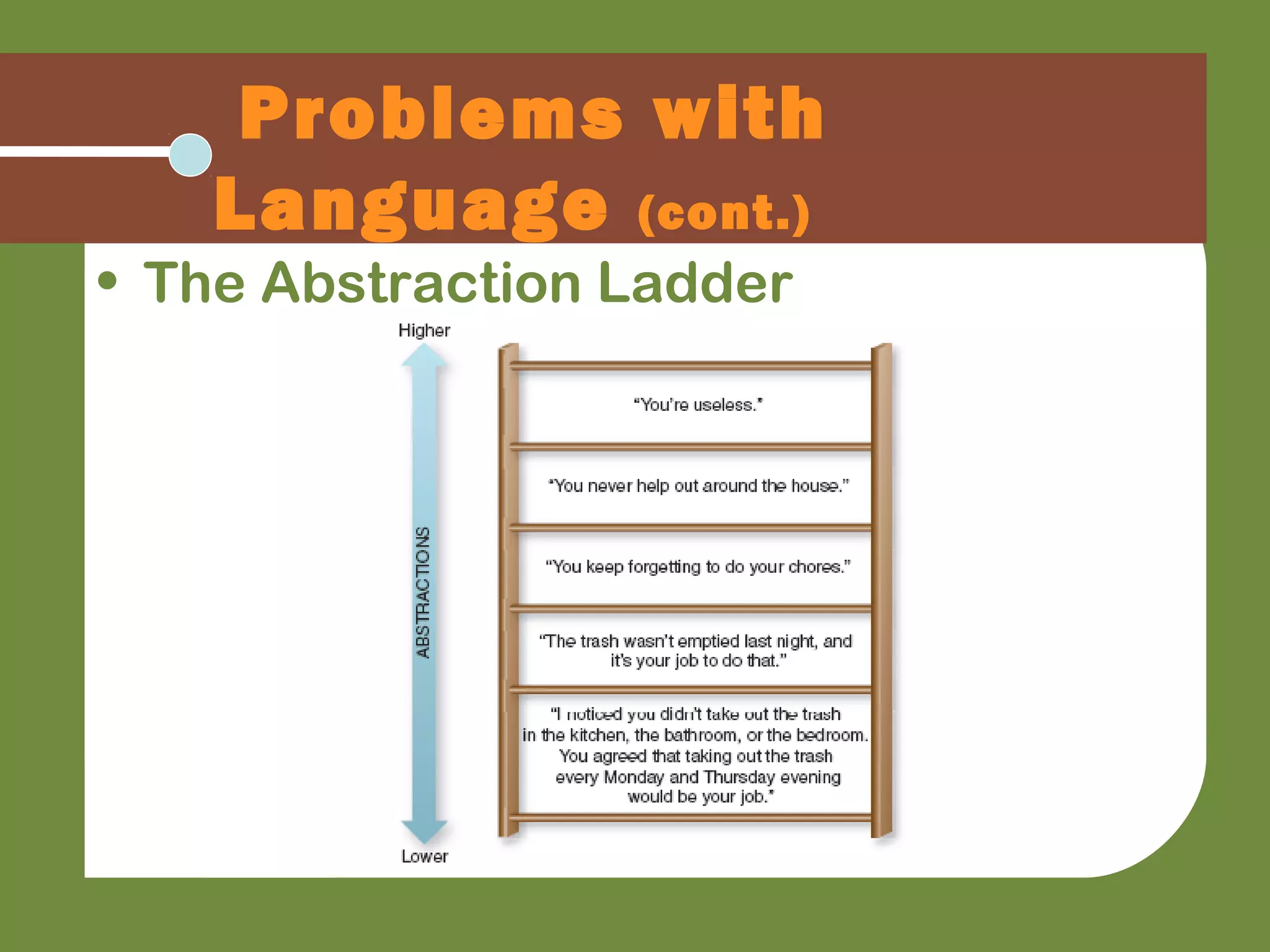
– High- and low-level abstractions
(abstraction ladder)
– Evasion: avoiding giving details
– Equivocation: using unclear words
– Euphemism: using inoffensive words
– Slang: using informal, nonstandard words
– Jargon: using technical language
Problems with
Language (cont.)
• The Abstraction Ladder
Problems with
Language (cont.)
• Situation and Meaning
– Semantics: meanings words have for
people based on relationships between
symbols, objects, people, and concepts
– Pragmatics: ability to use cultural
symbol systems appropriately
• Limits of Labeling
– Accepting labels may overlook
individual differences.
The Dangers of Biased
Language (cont.)
• Biased language openly excludes or
implies something negative about certain
groups.
• Politically correct language uses
neutral terms in place of biased language.
– May avoid real issues in favor of politeness
– Allows people to be both sensitive and
accurate when choosing words
The Dangers of Biased
Language (cont.)
• Profanity: insulting, rude, vulgar, or
disrespectful words or expressions
– Some may see offensive words as reasonably
hostile, based on the situational context.
• Civility: social norm for appropriate
behavior
– Follow guidelines for civil language.
Guidelines for More
Civil Language
• Use no words rather than offensive ones.
• Use words appropriate to your specific
listener.
• Choose temperate, accurate words over
inflammatory ones when commenting on
ideas, issues, or persons.
• Use objective, respectful, nondiscriminatory
language.
• Use clean language at all times when at
work.
Language in Context
• Language reflects context
(Have a variety of speech repertoires)
• Language builds on context
(Adjust language to situation)
• Language determines context
(Choose formal / informal language)
Language in Context
(cont.)
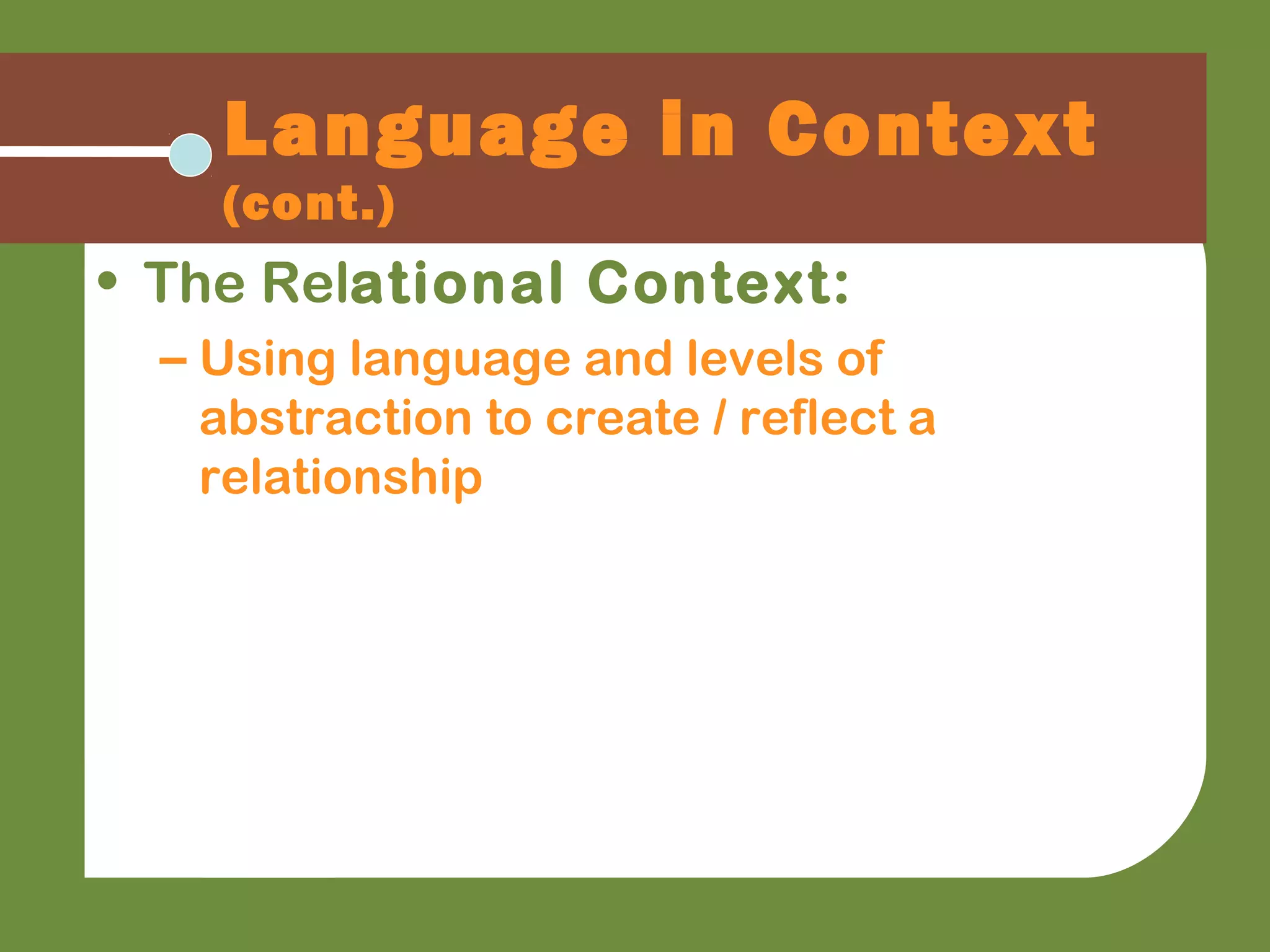
• The Relational Context:
– Using language and levels of
abstraction to create / reflect a
relationship
Language in Context
(cont.)
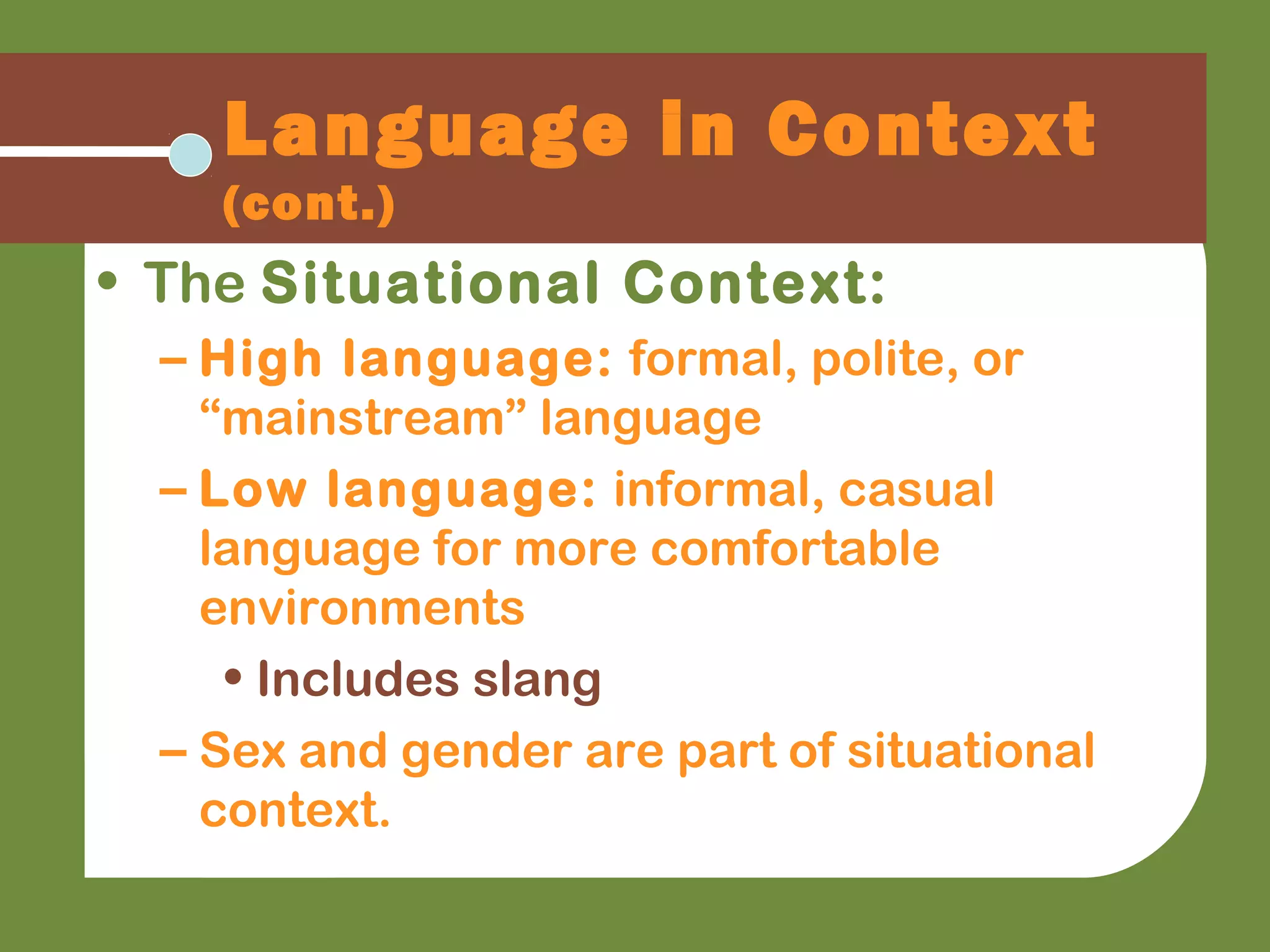
• The Situational Context:
– High language: formal, polite, or
“mainstream” language
– Low language: informal, casual
language for more comfortable
environments
• Includes slang
– Sex and gender are part of situational
context.
Language in Context
(cont.)
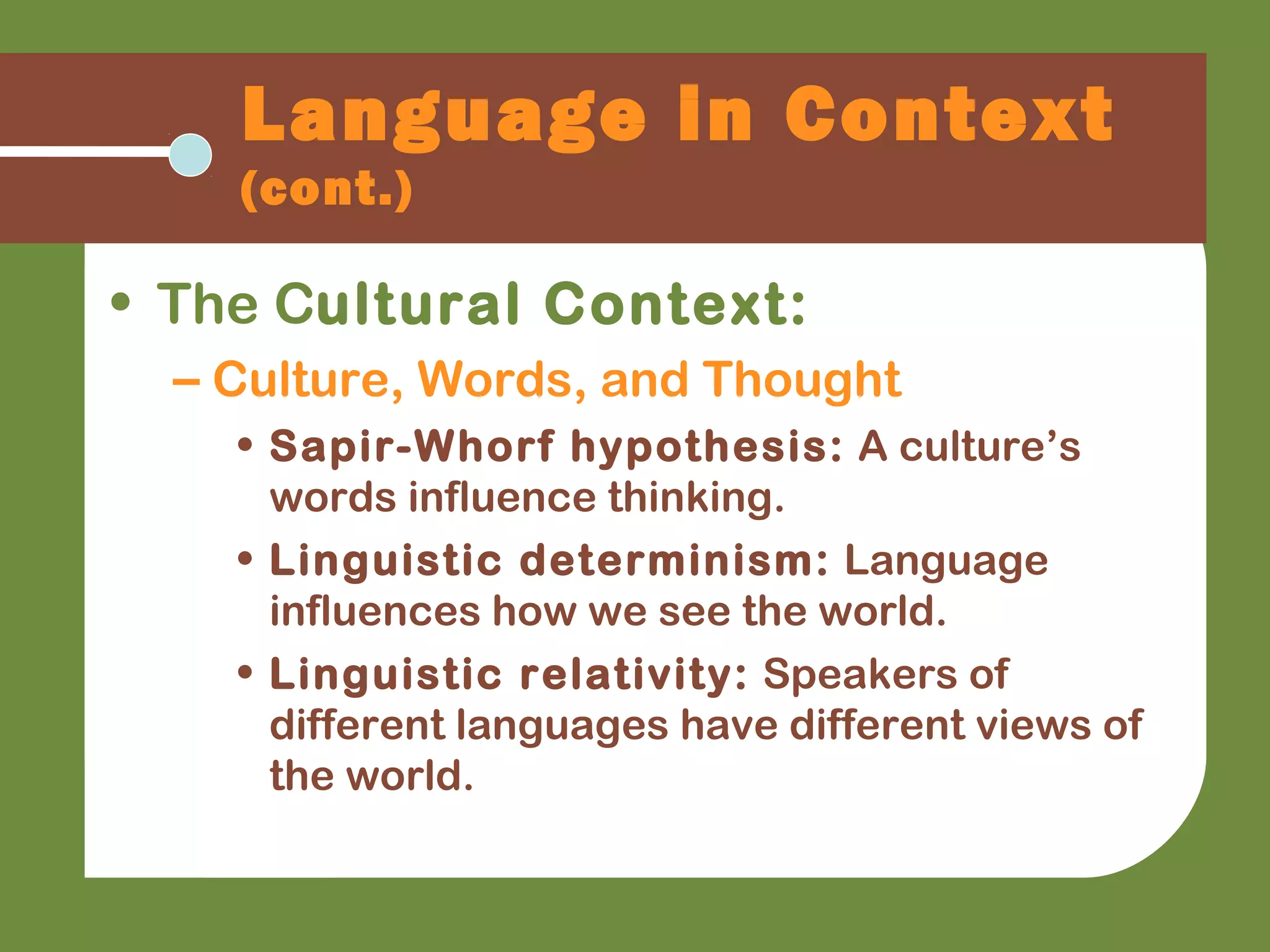
• The Cultural Context:
– Culture, Words, and Thought
• Sapir-Whorf hypothesis: A culture’s
words influence thinking.
• Linguistic determinism: Language
influences how we see the world.
• Linguistic relativity: Speakers of
different languages have different views of
the world.
Language in Context
(cont.)
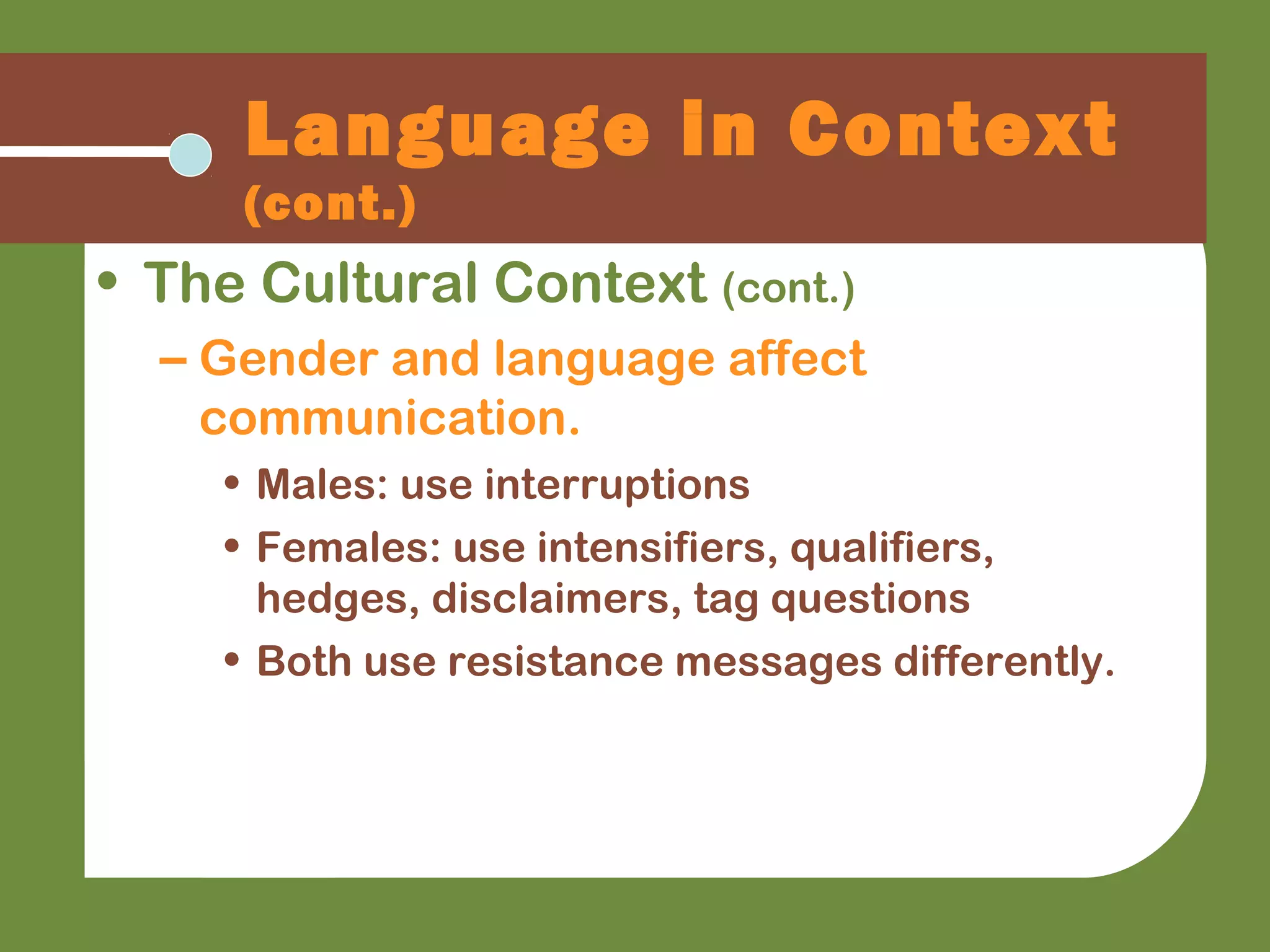
• The Cultural Context (cont.)
– Gender and language affect
communication.
• Males: use interruptions
• Females: use intensifiers, qualifiers,
hedges, disclaimers, tag questions
• Both use resistance messages differently.
Language in Context
(cont.)
• The Cultural Context (cont.)
– Geography and language affect
communication and understanding of
the world.
– Accommodation means adapting to
another person.
• Code switching
• Style switching
Language in Context
(cont.)
• Mediated contexts
– Communication via technology requires
strong, clear language.
• Powerful or intense language may receive
more attention.
– English has become the language of the
Internet and mass media.
– Acronyms and emoticons can enhance,
or hinder, communication.

Real comm2e ch4

  • 1.
  • 2.
    • Describe thepower of language—the system of symbols we use to think about and communicate our experiences and feelings • Identify the ways language works to help people communicate—the five functional communication competencies Chapter Outcomes
  • 3.
    Chapter Outcomes (cont.) • Labelcommunication problems with language and how to address them • Describe how language reflects, builds on, and determines context
  • 4.
    The system ofsymbols (words) that we use to think about and communicate experiences and feelings Language
  • 5.
    • Language issymbolic. • Words have multiple meanings. – Denotative: accepted definition – Connotative: emotional or attitudinal response • Thought informs language and vice versa. – Cognitive language: specific symbols used to describe ideas, situations, and so on The Nature of Language
  • 6.
    • Language isruled by a system of rules (grammar). – Phonological rules: pronunciation – Syntactic rules: word placement in a sentence • Language is bound by context. – Competent communication means understanding a situation. The Nature of Language (cont.)
  • 7.
    • Communication acquisition involves: –Learning words of a language – Using the words appropriately and effectively in the context of the situation The Functions of Language
  • 8.
    Functional Communication Competencies • Using languageas a means of control to influence oneself, others, environment • Using language to share information, which involves: – Questioning – Describing – Reinforcing – Withholding
  • 9.
    Functional Communication Competencies (cont.) • Usinglanguage to express feelings appropriately and effectively • Using language to express creativity – Imagining: ability to think, play, and be creative in communication • Using language as a form of ritual – Ritualizing: learning the rules for managing conversations and relationships
  • 10.
    Problems with Language • Abstractionand Meaning – High- and low-level abstractions (abstraction ladder) – Evasion: avoiding giving details – Equivocation: using unclear words – Euphemism: using inoffensive words – Slang: using informal, nonstandard words – Jargon: using technical language
  • 11.
    Problems with Language (cont.) •The Abstraction Ladder
  • 12.
    Problems with Language (cont.) •Situation and Meaning – Semantics: meanings words have for people based on relationships between symbols, objects, people, and concepts – Pragmatics: ability to use cultural symbol systems appropriately • Limits of Labeling – Accepting labels may overlook individual differences.
  • 13.
    The Dangers ofBiased Language (cont.) • Biased language openly excludes or implies something negative about certain groups. • Politically correct language uses neutral terms in place of biased language. – May avoid real issues in favor of politeness – Allows people to be both sensitive and accurate when choosing words
  • 14.
    The Dangers ofBiased Language (cont.) • Profanity: insulting, rude, vulgar, or disrespectful words or expressions – Some may see offensive words as reasonably hostile, based on the situational context. • Civility: social norm for appropriate behavior – Follow guidelines for civil language.
  • 15.
    Guidelines for More CivilLanguage • Use no words rather than offensive ones. • Use words appropriate to your specific listener. • Choose temperate, accurate words over inflammatory ones when commenting on ideas, issues, or persons. • Use objective, respectful, nondiscriminatory language. • Use clean language at all times when at work.
  • 16.
    Language in Context •Language reflects context (Have a variety of speech repertoires) • Language builds on context (Adjust language to situation) • Language determines context (Choose formal / informal language)
  • 17.
    Language in Context (cont.) •The Relational Context: – Using language and levels of abstraction to create / reflect a relationship
  • 18.
    Language in Context (cont.) •The Situational Context: – High language: formal, polite, or “mainstream” language – Low language: informal, casual language for more comfortable environments • Includes slang – Sex and gender are part of situational context.
  • 19.
    Language in Context (cont.) •The Cultural Context: – Culture, Words, and Thought • Sapir-Whorf hypothesis: A culture’s words influence thinking. • Linguistic determinism: Language influences how we see the world. • Linguistic relativity: Speakers of different languages have different views of the world.
  • 20.
    Language in Context (cont.) •The Cultural Context (cont.) – Gender and language affect communication. • Males: use interruptions • Females: use intensifiers, qualifiers, hedges, disclaimers, tag questions • Both use resistance messages differently.
  • 21.
    Language in Context (cont.) •The Cultural Context (cont.) – Geography and language affect communication and understanding of the world. – Accommodation means adapting to another person. • Code switching • Style switching
  • 22.
    Language in Context (cont.) •Mediated contexts – Communication via technology requires strong, clear language. • Powerful or intense language may receive more attention. – English has become the language of the Internet and mass media. – Acronyms and emoticons can enhance, or hinder, communication.