Understanding Intercultural
  Communication Second Edition
   Chapter 8

   What Causes us to Hold Biases Against
   Outgroups?

   Stella Ting-Toomey & Leeva C. Chung


   OXFORD UNIVERSITY PRESS

PowerPoint Slides Designed by Alex Flecky and Noorie Baig
TODAY’S MENU
I. Human Perception Tendencies:
 Some General Principles
II. Biased Intergroup Filters:
    Ethnocentrism and Stereotypes
III. Marking Ingroup/Outgroup
     Membership Boundaries
IV. Shattered Lens: Prejudice,
    Discrimination, and Racism
V. Intercultural Reality Check: Do-
I. Human Perception Tendencies:
Some
  General Principles
Human perception:
 • Process of selecting cues quickly from the
   environment, organizing them into a
   coherent pattern and labeling that pattern,
   and interpreting that pattern in
   accordance with our expectation.
Quick three-step process:
   • Selective attention
   • Selective organization and labeling
   • Selective interpretation.
Perception Test

YouTube Perception Test

How many times does the team wearing
 white pass the basketball?
II. Biased Intergroup Filters:
   Ethnocentrism and Stereotypes
A. Ethnocentrism and Communication
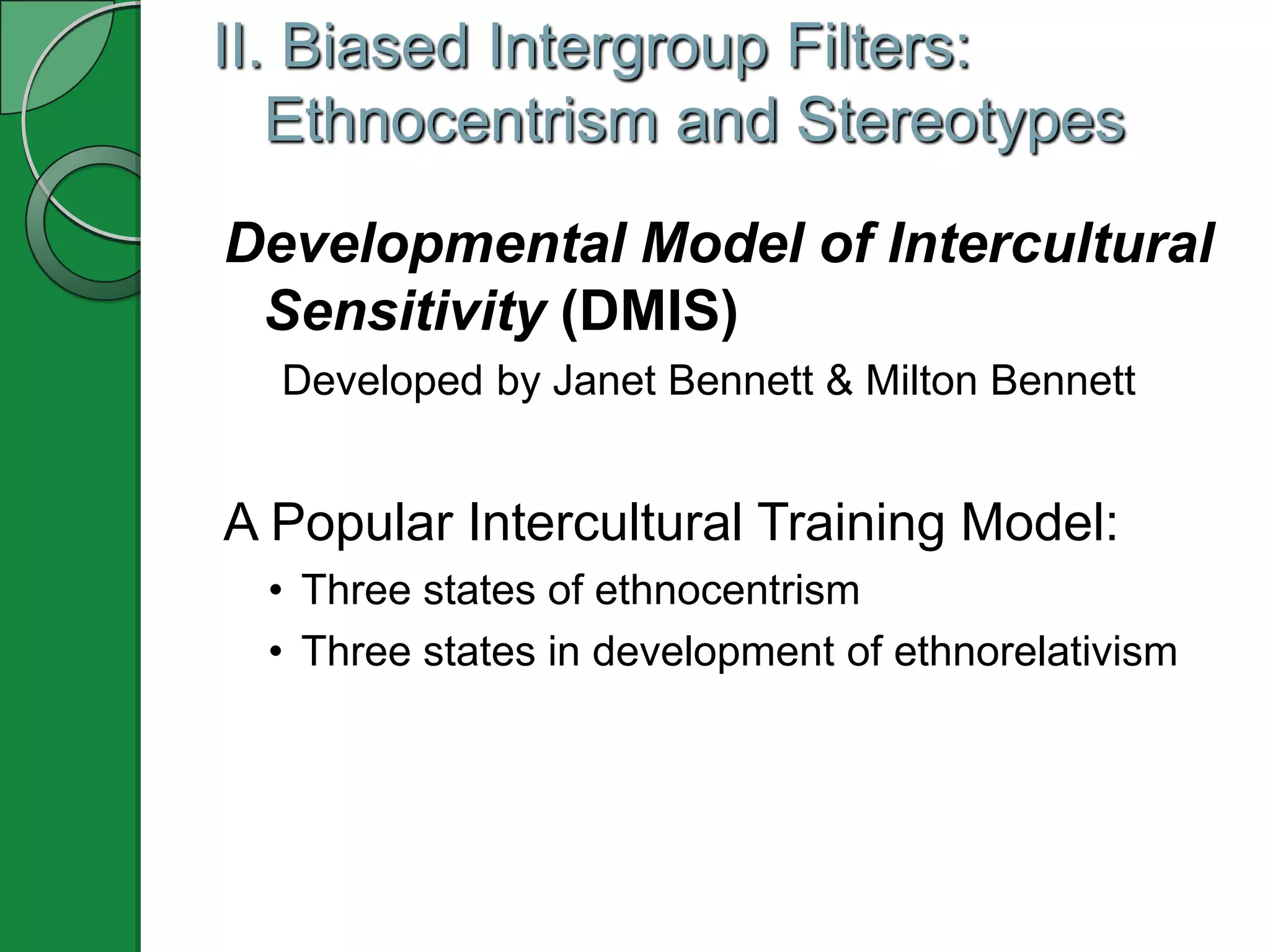
  Ethnocentrism: derived from two Greek
    words:
    Ethno: ―one’s own ethnic or cultural
 group‖
    Centrism: ―One’s own group should be
    looked upon as the center of the world‖
 Degrees of ethnocentrism:
 • Distance of disparagement (high ethnocentrism)
 • Distance of avoidance (moderate
   ethnocentrism)
II. Biased Intergroup Filters:
   Ethnocentrism and Stereotypes
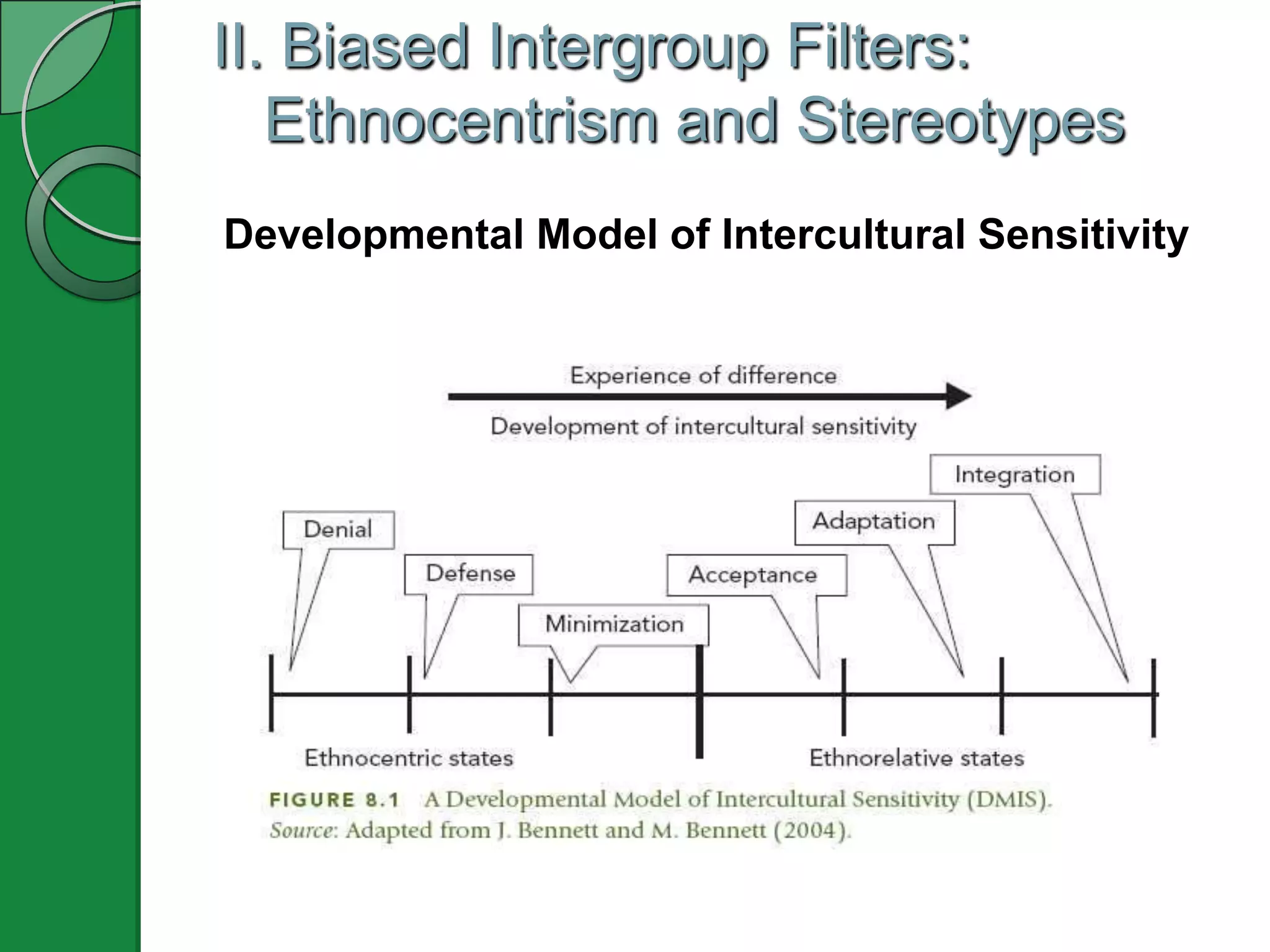
Developmental Model of Intercultural
 Sensitivity (DMIS)
  Developed by Janet Bennett & Milton Bennett


A Popular Intercultural Training Model:
 • Three states of ethnocentrism
 • Three states in development of ethnorelativism
II. Biased Intergroup Filters:
   Ethnocentrism and Stereotypes
Developmental Model of Intercultural Sensitivity
II. Biased Intergroup Filters:
   Ethnocentrism and Stereotypes

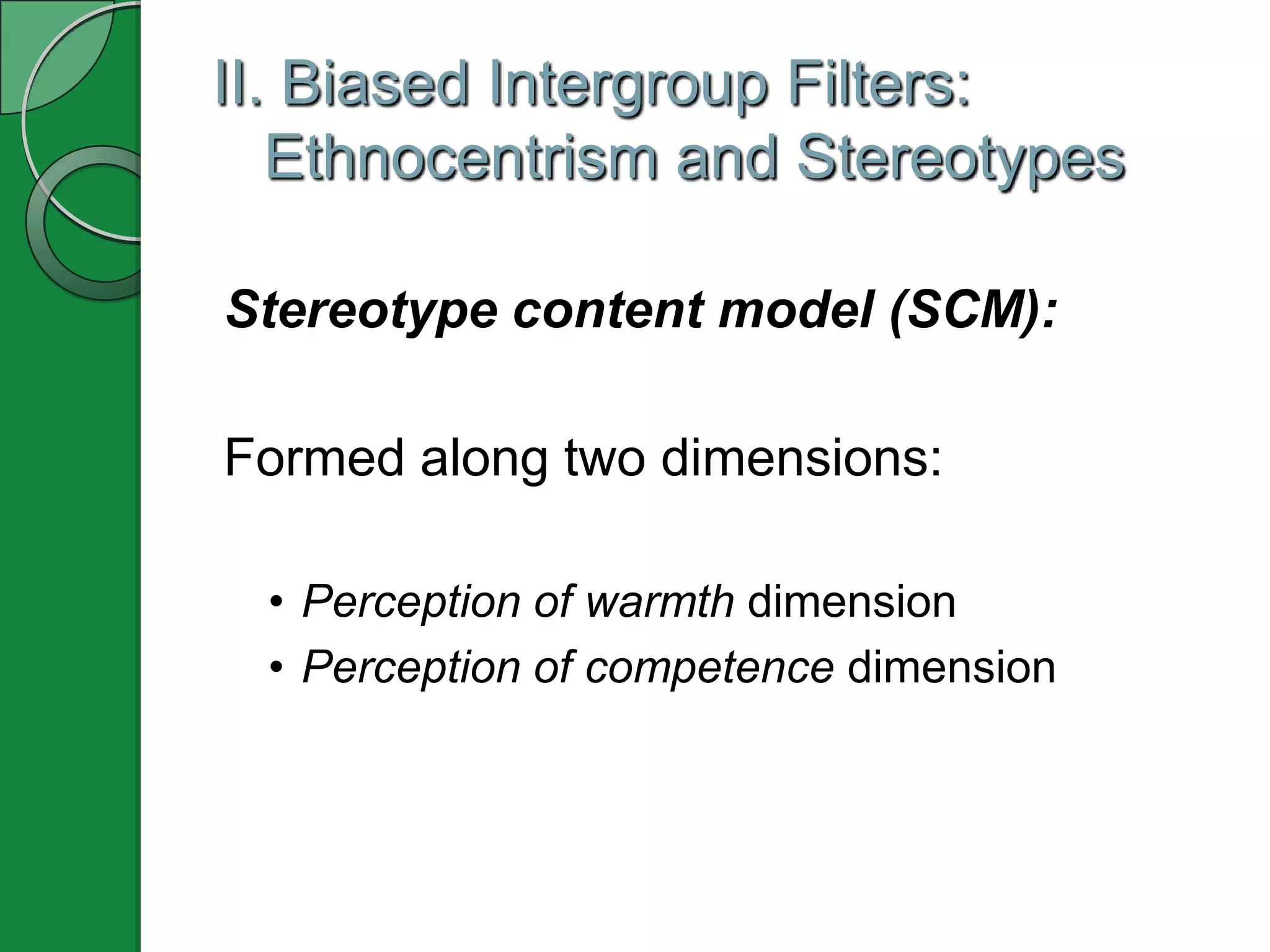
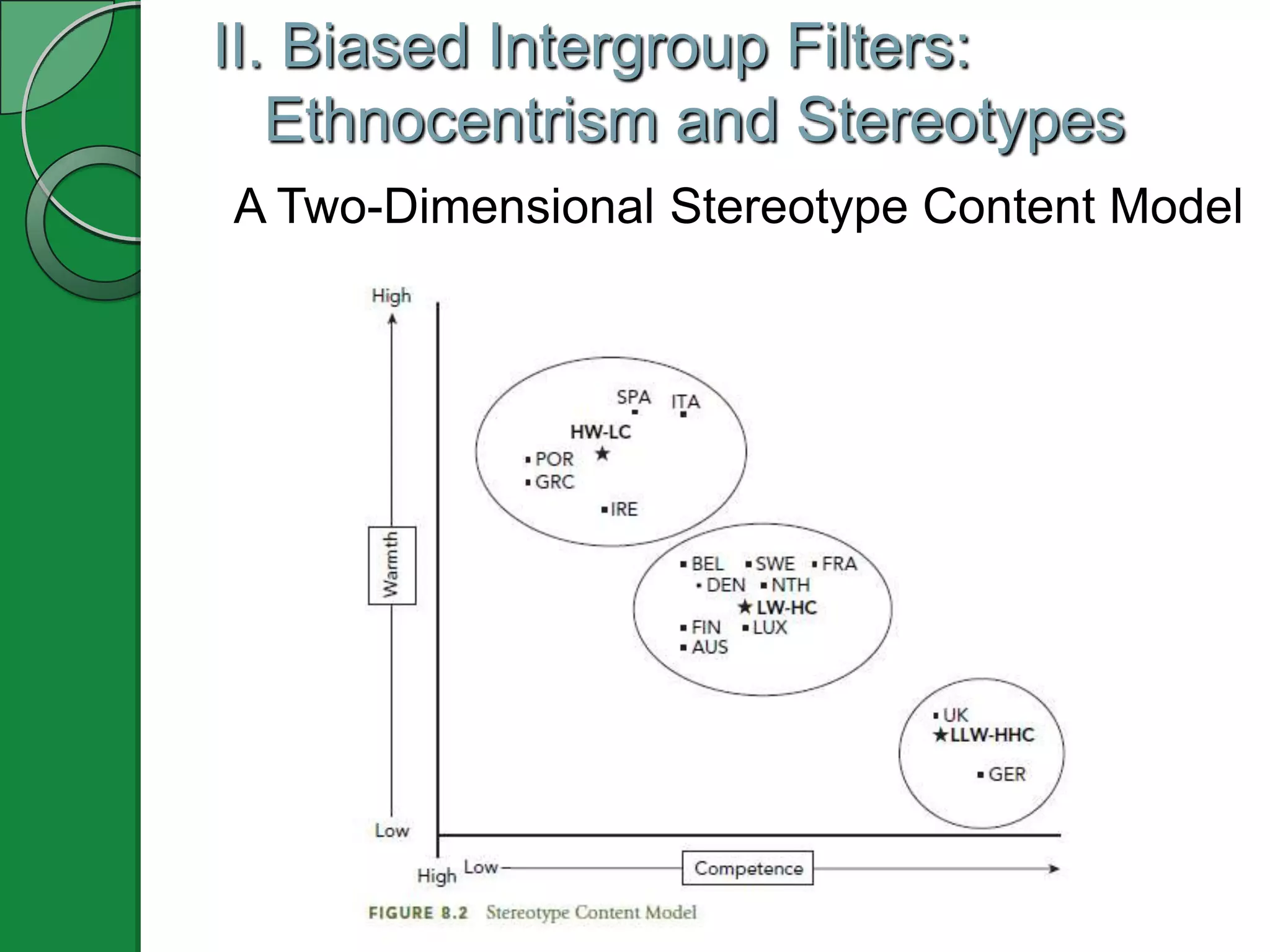
Stereotype content model (SCM):

Formed along two dimensions:

 • Perception of warmth dimension
 • Perception of competence dimension
II. Biased Intergroup Filters:
   Ethnocentrism and Stereotypes
A Two-Dimensional Stereotype Content Model
II. Biased Intergroup Filters:
   Ethnocentrism and Stereotypes

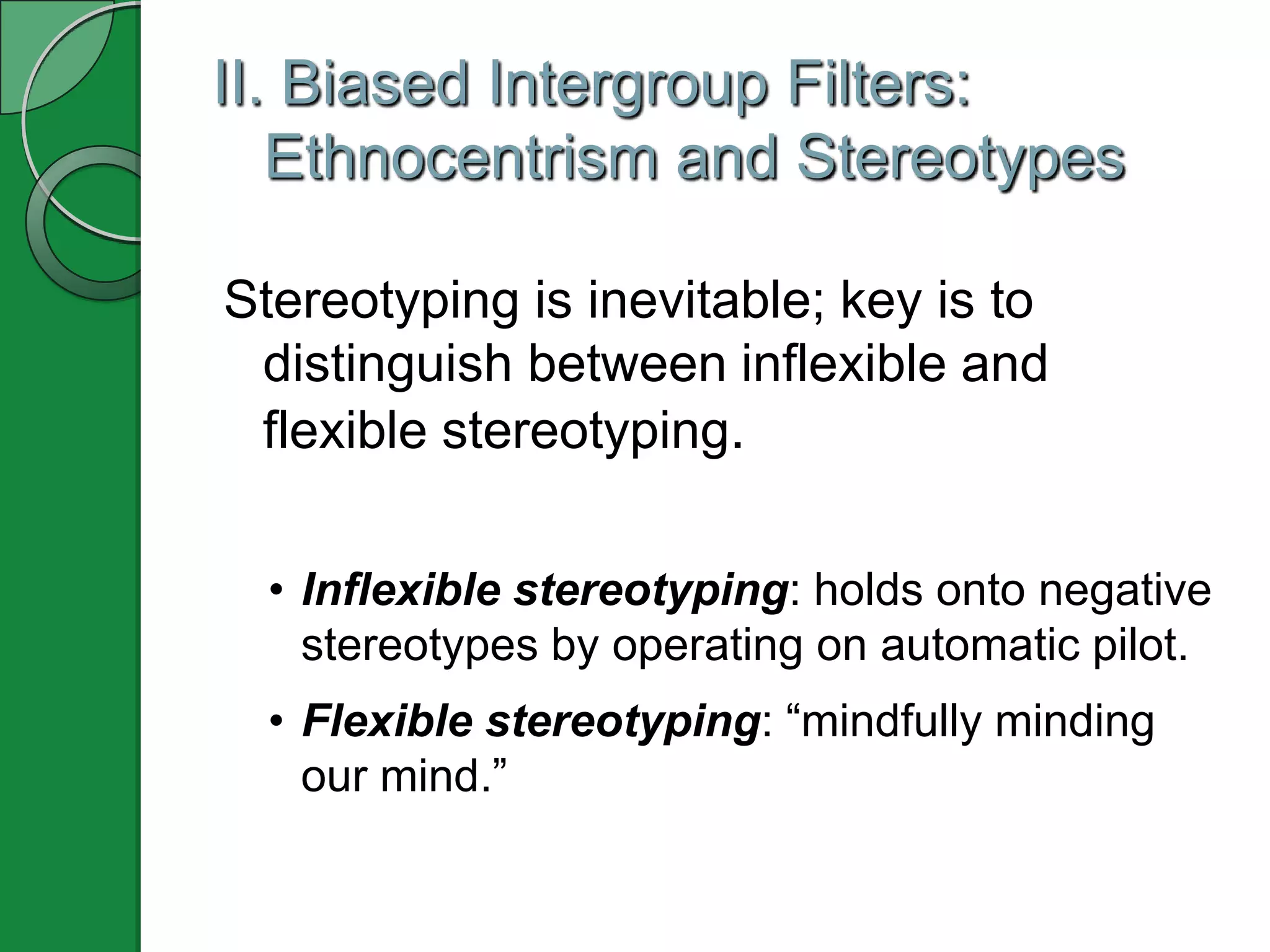
Stereotyping is inevitable; key is to
 distinguish between inflexible and
 flexible stereotyping.

  • Inflexible stereotyping: holds onto negative
    stereotypes by operating on automatic pilot.
  • Flexible stereotyping: ―mindfully minding
    our mind.‖
II. Biased Intergroup Filters:
    Ethnocentrism and
 Stereotypes
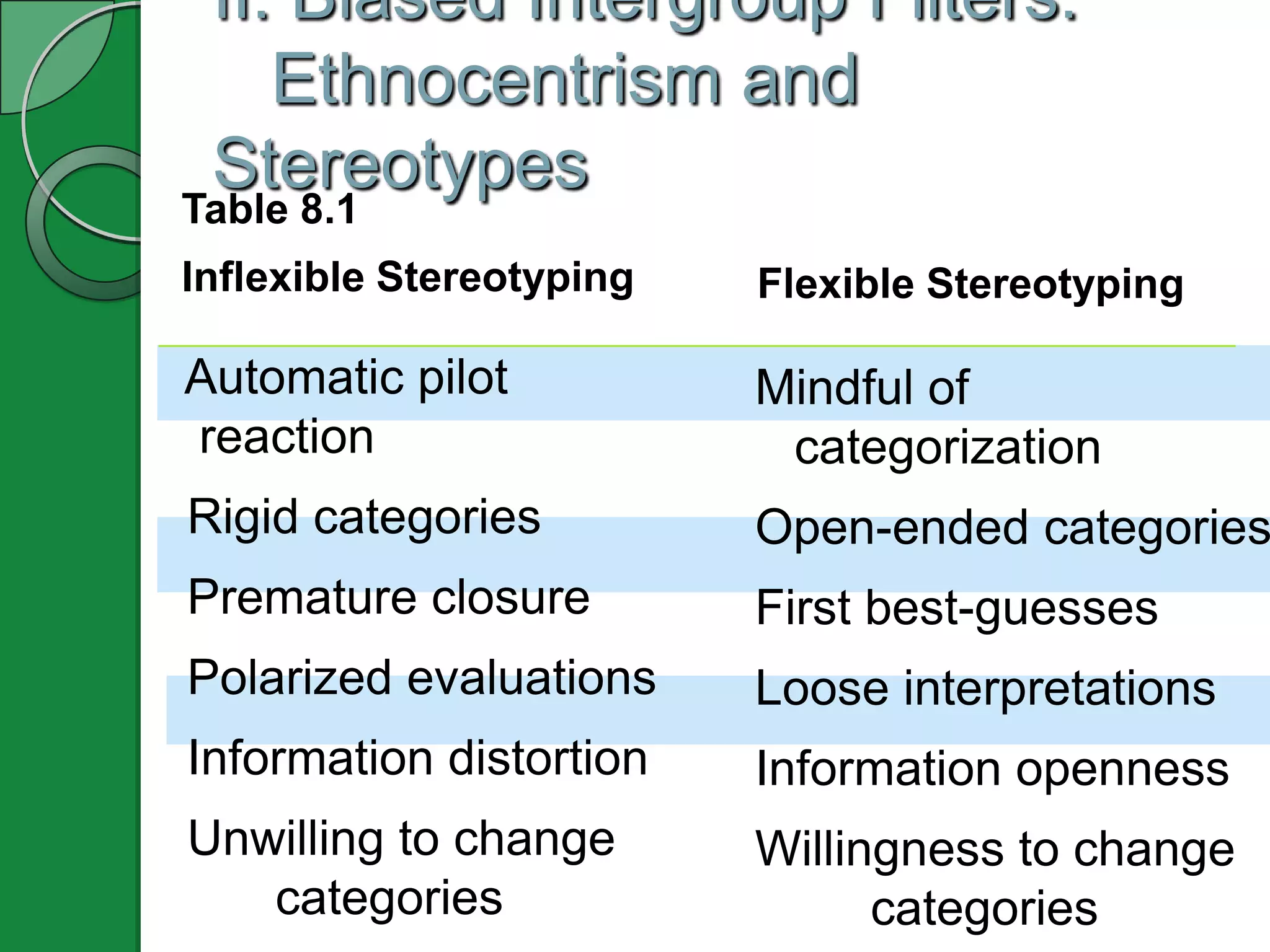
Table 8.1
Inflexible Stereotyping   Flexible Stereotyping

Automatic pilot           Mindful of
reaction                   categorization
Rigid categories          Open-ended categories
Premature closure         First best-guesses
Polarized evaluations     Loose interpretations
Information distortion    Information openness
Unwilling to change       Willingness to change
   categories                   categories
II. Biased Intergroup Filters:
 Ethnocentrism
    and Stereotypes
Click here to view UCLA student Alexandra
 Wallace’s rant on Asian students in the library
  • What are your interpretations?
  • Apology accepted? Forgive & forget? Forgive but not
    forget?


Click here to view Jimmy Wong’s reaction to
 Alexandra Wallace
  • What did you think of Wong’s response to Alex?
II. Biased Intergroup Filters:
Ethnocentrism
   and Stereotypes
B. Stereotypes and Communication
  Stereotypes:
    • Exaggerated pictures about a group of people
      on the basis of inflexible beliefs and
      expectations about the characteristics or
      behaviors of the group.


•   What are some factors that shape
    stereotypes?

Click here to view a clip from The Color of Friendship
III. Marking Ingroup-Outgroup
     Membership Boundaries
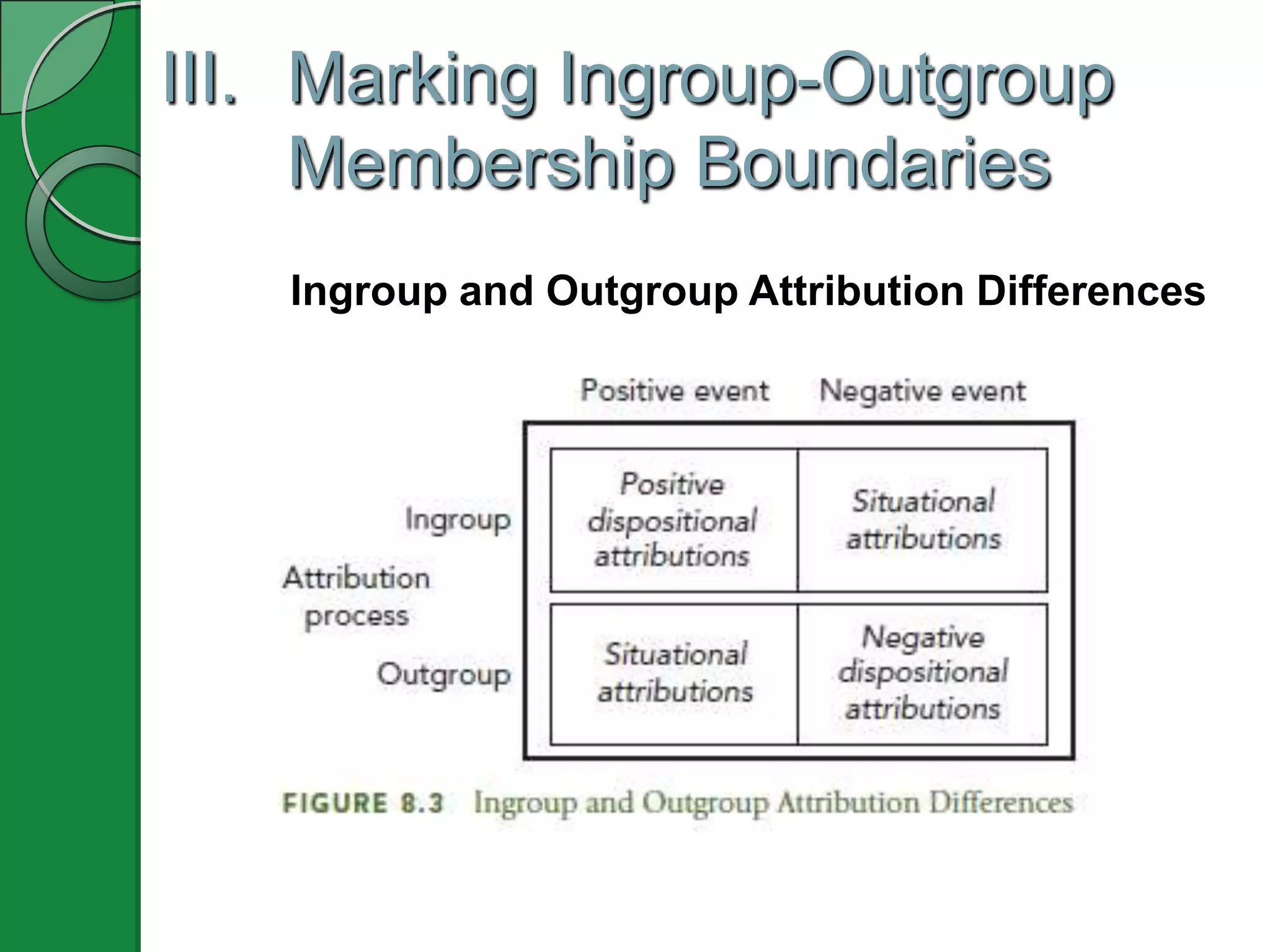
   Ingroup and Outgroup Attribution Differences
III. Marking Ingroup-Outgroup
    Membership Boundaries
A. Us versus Them
   Social identity theory:
    Study of ingroup, outgroup membership,
    how emotional attachment to social
 group    plays key role in forming
 social/personal      identity.

 Ingroup: feel connected to.
 Outgroup: feel emotionally and psychologically
 detached.
III. Marking Ingroup/Outgroup
    Membership Boundaries
B. Group Membership Struggle

C. Intergroup Attribution Biases
 Attributions: the explanations—the
 meanings       of why people behave as
 they do.
  • Fundamental attribution error
  • Principle of negativity
  • Favorable self-bias and other-derogation
    principle
  • Self-effacement bias
III. Marking Ingroup/Outgroup
    Membership Boundaries
Media Analysis: Crash film clip


Reflection Questions:
•   Where did the wife acquire her fear and
    biases?
•   Do you think stereotypes—both negative
    and positive—have their place? How so?
•   Where do we learn our stereotypes?
IV. Shattered Lens: Prejudice,
   Discrimination, and Racism
Prejudice:
 Describes an individual’s feelings and
 predispositions toward outgroup members
 in a pejorative or negative direction, but can
 also mean the opposite: One can be
 indiscriminately for or against members of a
 particular group.

Four explanations for development of
 prejudice:
  • Exploitation theory
  • Scapegoating theory
IV. Shattered Lens: Prejudice,
   Discrimination, and Racism
B. Prejudiced Remarks . . .or Innocent
 Jokes?

Click here to watch a clip on how some ingroup
  members treat their own members like outgroup
  members.


Where to draw the line question is difficult to
 answer. . .
Click here to move toward the conscious competence
  stage with respect to stereotyping, prejudice and
  discrimination.
IV. Shattered Lens: Prejudice,
   Discrimination, and Racism
C. Four Discriminatory Practices
  Discrimination:
 Verbal and nonverbal actions that carry out
 prejudiced attitudes. Four practices:


  •   Isolate discrimination:
  •   Small-group discrimination
  •   Direct institutional discrimination
  •   Indirect institutional discrimination
IV. Shattered Lens: Prejudice,
   Discrimination, and Racism
D. Different Types of Racism
  Racism involves three principles:
   • Feelings of superiority based on biological or
     racial differences;
   • Strong ingroup preferences and the rejection of
     outgroups, different in customs or beliefs; and
   • Doctrine that conveys special advantage to
     those in power.
  Three basic examples of racism:
   • Racial profiling
   • Perpetuating stereotypic images
   • Hate crimes
V. Intercultural Reality Check: Do-
Ables

•   Be honest about your own biases.
•   Understand where you learn your
    stereotypes.
•   Seek accurate identity membership
    knowledge.
•   Get involved in diverse identity
    communities.
•   Cultivate constructive, intergroup contacts.
•   Work on positive, interdependent task
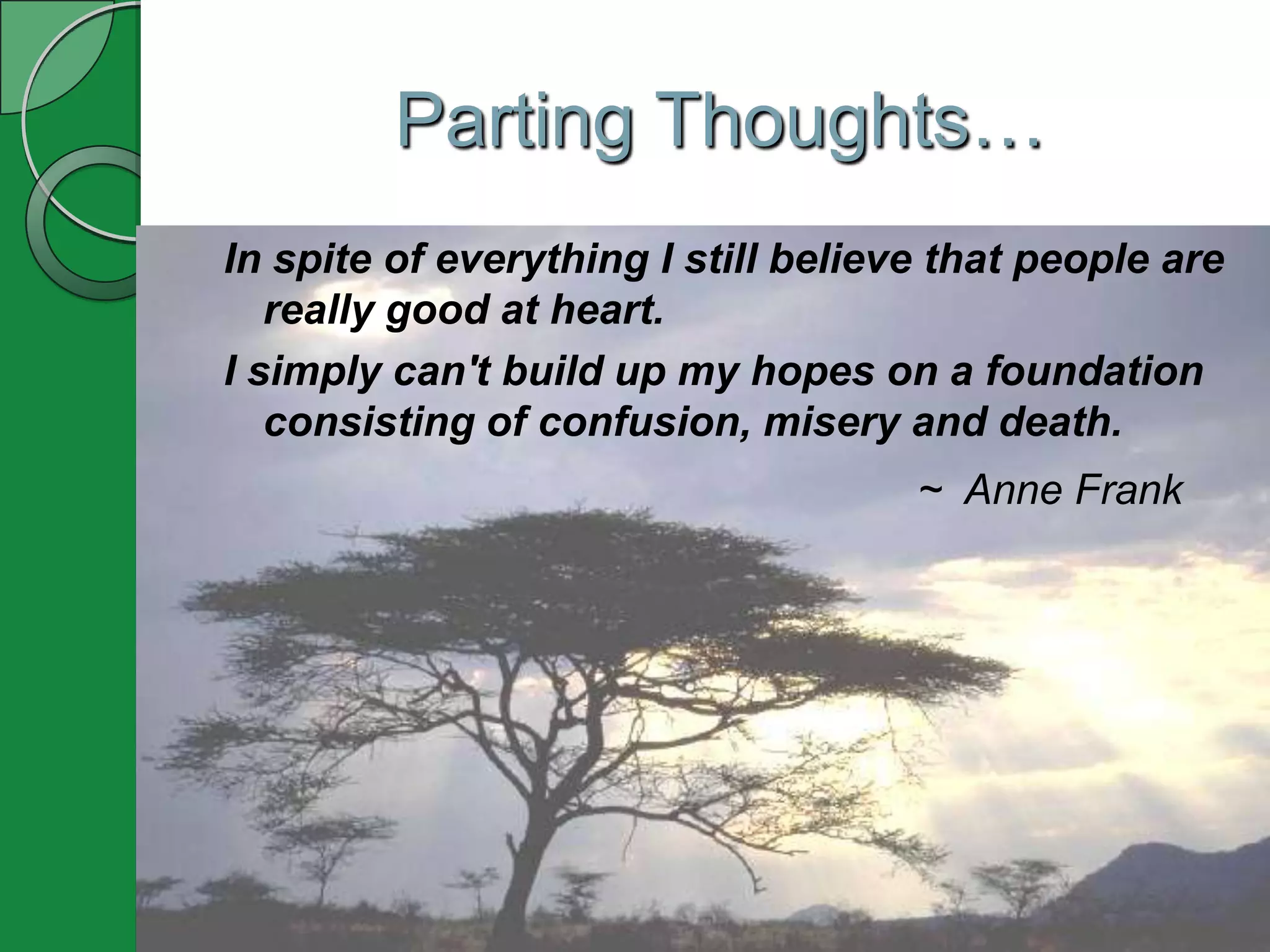
Parting Thoughts…
In spite of everything I still believe that people are
   really good at heart.
I simply can't build up my hopes on a foundation
   consisting of confusion, misery and death.
                                     ~ Anne Frank

Chapter8

  • 1.
    Understanding Intercultural Communication Second Edition Chapter 8 What Causes us to Hold Biases Against Outgroups? Stella Ting-Toomey & Leeva C. Chung OXFORD UNIVERSITY PRESS PowerPoint Slides Designed by Alex Flecky and Noorie Baig
  • 2.
    TODAY’S MENU I. HumanPerception Tendencies: Some General Principles II. Biased Intergroup Filters: Ethnocentrism and Stereotypes III. Marking Ingroup/Outgroup Membership Boundaries IV. Shattered Lens: Prejudice, Discrimination, and Racism V. Intercultural Reality Check: Do-
  • 3.
    I. Human PerceptionTendencies: Some General Principles Human perception: • Process of selecting cues quickly from the environment, organizing them into a coherent pattern and labeling that pattern, and interpreting that pattern in accordance with our expectation. Quick three-step process: • Selective attention • Selective organization and labeling • Selective interpretation.
  • 4.
    Perception Test YouTube PerceptionTest How many times does the team wearing white pass the basketball?
  • 5.
    II. Biased IntergroupFilters: Ethnocentrism and Stereotypes A. Ethnocentrism and Communication Ethnocentrism: derived from two Greek words: Ethno: ―one’s own ethnic or cultural group‖ Centrism: ―One’s own group should be looked upon as the center of the world‖ Degrees of ethnocentrism: • Distance of disparagement (high ethnocentrism) • Distance of avoidance (moderate ethnocentrism)
  • 6.
    II. Biased IntergroupFilters: Ethnocentrism and Stereotypes Developmental Model of Intercultural Sensitivity (DMIS) Developed by Janet Bennett & Milton Bennett A Popular Intercultural Training Model: • Three states of ethnocentrism • Three states in development of ethnorelativism
  • 7.
    II. Biased IntergroupFilters: Ethnocentrism and Stereotypes Developmental Model of Intercultural Sensitivity
  • 8.
    II. Biased IntergroupFilters: Ethnocentrism and Stereotypes Stereotype content model (SCM): Formed along two dimensions: • Perception of warmth dimension • Perception of competence dimension
  • 9.
    II. Biased IntergroupFilters: Ethnocentrism and Stereotypes A Two-Dimensional Stereotype Content Model
  • 10.
    II. Biased IntergroupFilters: Ethnocentrism and Stereotypes Stereotyping is inevitable; key is to distinguish between inflexible and flexible stereotyping. • Inflexible stereotyping: holds onto negative stereotypes by operating on automatic pilot. • Flexible stereotyping: ―mindfully minding our mind.‖
  • 11.
    II. Biased IntergroupFilters: Ethnocentrism and Stereotypes Table 8.1 Inflexible Stereotyping Flexible Stereotyping Automatic pilot Mindful of reaction categorization Rigid categories Open-ended categories Premature closure First best-guesses Polarized evaluations Loose interpretations Information distortion Information openness Unwilling to change Willingness to change categories categories
  • 12.
    II. Biased IntergroupFilters: Ethnocentrism and Stereotypes Click here to view UCLA student Alexandra Wallace’s rant on Asian students in the library • What are your interpretations? • Apology accepted? Forgive & forget? Forgive but not forget? Click here to view Jimmy Wong’s reaction to Alexandra Wallace • What did you think of Wong’s response to Alex?
  • 13.
    II. Biased IntergroupFilters: Ethnocentrism and Stereotypes B. Stereotypes and Communication Stereotypes: • Exaggerated pictures about a group of people on the basis of inflexible beliefs and expectations about the characteristics or behaviors of the group. • What are some factors that shape stereotypes? Click here to view a clip from The Color of Friendship
  • 14.
    III. Marking Ingroup-Outgroup Membership Boundaries Ingroup and Outgroup Attribution Differences
  • 15.
    III. Marking Ingroup-Outgroup Membership Boundaries A. Us versus Them Social identity theory: Study of ingroup, outgroup membership, how emotional attachment to social group plays key role in forming social/personal identity. Ingroup: feel connected to. Outgroup: feel emotionally and psychologically detached.
  • 16.
    III. Marking Ingroup/Outgroup Membership Boundaries B. Group Membership Struggle C. Intergroup Attribution Biases Attributions: the explanations—the meanings of why people behave as they do. • Fundamental attribution error • Principle of negativity • Favorable self-bias and other-derogation principle • Self-effacement bias
  • 17.
    III. Marking Ingroup/Outgroup Membership Boundaries Media Analysis: Crash film clip Reflection Questions: • Where did the wife acquire her fear and biases? • Do you think stereotypes—both negative and positive—have their place? How so? • Where do we learn our stereotypes?
  • 18.
    IV. Shattered Lens:Prejudice, Discrimination, and Racism Prejudice: Describes an individual’s feelings and predispositions toward outgroup members in a pejorative or negative direction, but can also mean the opposite: One can be indiscriminately for or against members of a particular group. Four explanations for development of prejudice: • Exploitation theory • Scapegoating theory
  • 19.
    IV. Shattered Lens:Prejudice, Discrimination, and Racism B. Prejudiced Remarks . . .or Innocent Jokes? Click here to watch a clip on how some ingroup members treat their own members like outgroup members. Where to draw the line question is difficult to answer. . . Click here to move toward the conscious competence stage with respect to stereotyping, prejudice and discrimination.
  • 20.
    IV. Shattered Lens:Prejudice, Discrimination, and Racism C. Four Discriminatory Practices Discrimination: Verbal and nonverbal actions that carry out prejudiced attitudes. Four practices: • Isolate discrimination: • Small-group discrimination • Direct institutional discrimination • Indirect institutional discrimination
  • 21.
    IV. Shattered Lens:Prejudice, Discrimination, and Racism D. Different Types of Racism Racism involves three principles: • Feelings of superiority based on biological or racial differences; • Strong ingroup preferences and the rejection of outgroups, different in customs or beliefs; and • Doctrine that conveys special advantage to those in power. Three basic examples of racism: • Racial profiling • Perpetuating stereotypic images • Hate crimes
  • 22.
    V. Intercultural RealityCheck: Do- Ables • Be honest about your own biases. • Understand where you learn your stereotypes. • Seek accurate identity membership knowledge. • Get involved in diverse identity communities. • Cultivate constructive, intergroup contacts. • Work on positive, interdependent task
  • 23.
    Parting Thoughts… In spiteof everything I still believe that people are really good at heart. I simply can't build up my hopes on a foundation consisting of confusion, misery and death. ~ Anne Frank