1
Physiology of
The Cardiovascular System
2
FUNCTIONS OF THE CVS
• Transport and distribute essential substances to
the tissues.
• Remove metabolic byproducts.
• Adjustment of oxygen and nutrient supply in
different physiologic states.
• Regulation of body temperature.
• Humoral communication.
3
Components of the CVS
CVS composed of
 Heart: Pumping center
 Blood vessels
 Arteries: Distributing system
 Capillaries: Exchange system
 Veins: Collecting system
 Blood: circulating connective tissue
4
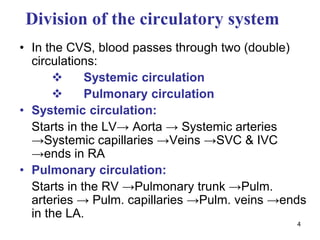
Division of the circulatory system
• In the CVS, blood passes through two (double)
circulations:
 Systemic circulation
 Pulmonary circulation
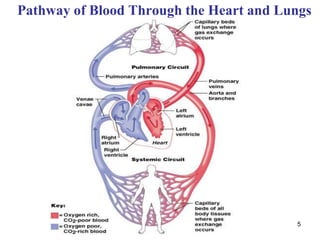
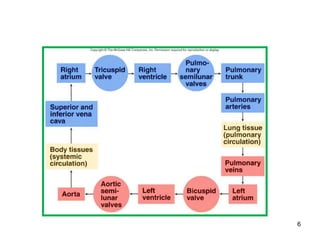
• Systemic circulation:
Starts in the LV→ Aorta → Systemic arteries
→Systemic capillaries →Veins →SVC & IVC
→ends in RA
• Pulmonary circulation:
Starts in the RV →Pulmonary trunk →Pulm.
arteries → Pulm. capillaries →Pulm. veins →ends
in the LA.
5
Pathway of Blood Through the Heart and Lungs
6
7
The Heart
• Heart is the hollow, muscular organ that plays a
central pumping role
• Composed of 4-chambers;
• 2 atria and 2 ventricles
• Size: Approximately equivalent to clenched fist
• Weight: 280 to 320 gram in average adults
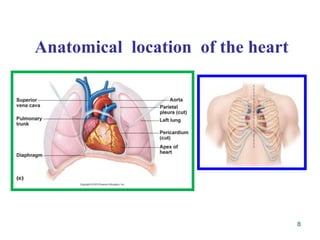
• It is situated between two lungs in the
mediastinum.
Anatomical location of the heart
8
9
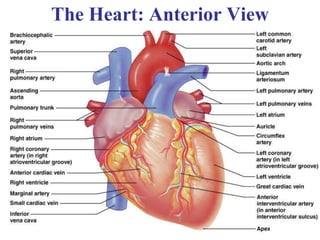
The Heart: Anterior View
10
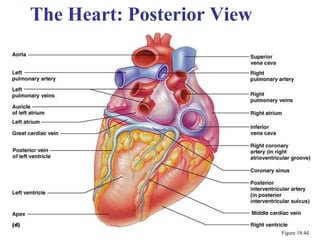
The Heart: Posterior View
Figure 18.4d
11
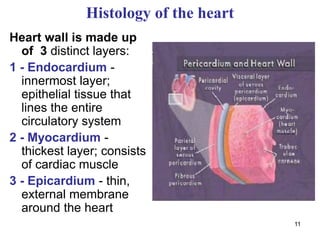
Histology of the heart
Heart wall is made up
of 3 distinct layers:
1 - Endocardium -
innermost layer;
epithelial tissue that
lines the entire
circulatory system
2 - Myocardium -
thickest layer; consists
of cardiac muscle
3 - Epicardium - thin,
external membrane
around the heart
12
Cardiac muscle (Myocardium)
•Myocardium is the middle layer of wall of the heart
•Cardiac muscle cells are straited, mononucleated
and branched
•connected to each other through intercalated disks
•Intercalated disks: Specialized cell-cell contacts:
• Desmosomes hold cells together and
• Gap junctions allow conduction of action
potentials.
•Electrically, cardiac muscle behaves as single unit
13
Properties of cardiac muscles
• Cardiac muscles have 4 physiological
properties. These are;
 Autorhythmicity
 Excitability
 Conductivity
 Contractility
14
Autorhythmicity
• It is the ability of the heart to generate
cardiac impulse and to beat regularly
independent of any external stimulus.
• The heart is provided with specialized
excitatory and conductive muscle systems
having two functions:
1. They generate rhythmic cardiac impulse
2. They conduct cardiac impulse
15
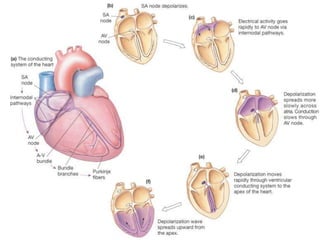
Specialized excitatory and conducting system of
the heart
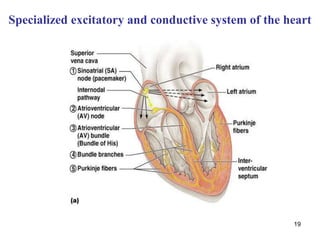
1. Sino-atrial node (SA-node):
Located on the posterior wall of the Rt-atrium
inferior to the opening of the SVC
The heart beat is initiated by the pacemaker (SA
Node)
SA-nodal fibres have a special capability to
discharge repetitive and rhythmic cardiac
impulse.
They repeatedly depolarize to threshold
spontaneously
It generates impulse at a frequency of 80-
Cont’d
2. Atrioventricular node (AV-node): in which
impulse from the atria delayed to be conducted to
the ventricle.
• Site of nodal delay
• located in the right atrium, close to the
interventricular septum.
• It is the Potential pacemaker (if SA node fails).
16
Cont’d
3. Atrioventricular bundle (bundle of His):
which conducts impulse from the atria to the
ventricle.
• The only site where action potentials can
conduct from the atria to the ventricles
• The rest of atrioventricular boundary
consist of unexcitable connective tissue
17
Cont’d
4. Right and left bundle branches
• They extend through the interventricular
septum toward the apex of the heart.
5. Purkinje fibers: conduct cardiac impulse
to the rest of ventricles
18
19
Specialized excitatory and conductive system of the heart
20
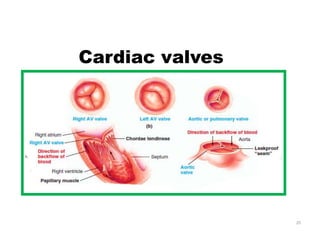
Cardiac valves
• Cardiac valves are made up of fibrous
connective tissues.
• The valves direct blood flow (One way valves)
• Each have fibrous connective tissue:
• Prevent enlargement of valve opening
• Anchor valve flaps.
• Opening and closing of valves occur passively
as a result of pressure differences.
• Valve closure prevents backflow of blood during
and after contraction.
21
Types of cardiac valves
 There are 4 types of heart valves:
– Inlet valves => AV (atrioventricular) valves.
Tricuspid(RAV) and mitral or Bicuspid(LAV).
– Outlet valves => Semilunar valves.
 Aortic and Pulmonary semilunar valves.
22
AV valves
• Formed from thin flaps of
tissue joined at base to
connective tissue ring.
23
• AV valves are not identical:
– Tricuspid : 3 flaps
– Bicuspid: 2 flaps : Also called
Mitral valve
– Open to ward the heart
• Open during diastole.
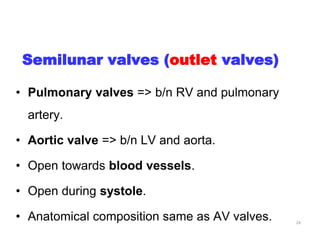
Semilunar valves (outlet valves)
• Pulmonary valves => b/n RV and pulmonary
artery.
• Aortic valve => b/n LV and aorta.
• Open towards blood vessels.
• Open during systole.
• Anatomical composition same as AV valves. 24
25
Cardiac valves
26
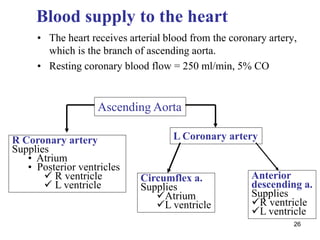
Blood supply to the heart
• The heart receives arterial blood from the coronary artery,
which is the branch of ascending aorta.
• Resting coronary blood flow = 250 ml/min, 5% CO
Ascending Aorta
L Coronary artery
R Coronary artery
Supplies
• Atrium
• Posterior ventricles
 R ventricle
 L ventricle
Circumflex a.
Supplies
Atrium
L ventricle
Anterior
descending a.
Supplies
R ventricle
L ventricle
27
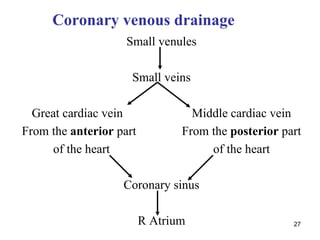
Coronary venous drainage
Small venules
Small veins
Great cardiac vein Middle cardiac vein
From the anterior part From the posterior part
of the heart of the heart
Coronary sinus
R Atrium
Cardiac innervation
• Sympathetic  innervates almost all parts of heart.
• increase myocardial contractility, accelerates heart rate
• Parasympathetic (from vagus):
 Mainly innervates: SA node, Atria and AV node.
 No ventricular innervations of parasympathetic.
 Strong stimulation of vagus, has no effect on ventricles
 decrease myocardial contractility, reduces heart rate
28
29
Excitation-contraction coupling in cardiac muscle
• It is a mechanism by which an action potential causes
contraction of myocardium.
• It has the following sequences
Auto-rhythmicity Membrane depolarization T-
tubule depolarization Release of Ca2+ from SR +
from T-tubule (ECF) Ca2+ activates contractile
molecules Sliding of filaments Contraction
• The action potential of cardiac muscle has a prolonged
refractory period.
Advantage: prevents tetanic contraction of the heart
30
Ca2+
signaling in cardiac muscle
DHPR
(DHPR)
Ca2+
Entry of Ca2+
during
action potential
1 Ca2+
out
for 3 Na+
in
Inhibited by digitalis & ouabain;
indirectly Na+
/Ca2+
exchange 
[Ca2+
]in
Affected by epinephrine () and ACh ()
The Cardiac Cycle
(diastole and systole)
• Activities in the heart in a single beat
• It refers to the repeating pattern of contraction and
relaxation of the heart.
– The period from the end of one heart contraction to the
end of the next.
– Systole:
• Phase of ventricular contraction.
– Diastole:
• Phase of ventricular relaxation.
• Diastole is longer than systole.
31
Cont’d
• There are 72 cycles completed per minute.
• During systole, heart contracts and pumps the
blood through arteries.
• During diastole, heart relaxes and blood is
filled in the heart.
• Duration of each cycle = 0.8 second:
 Ventricular diastole = 0.5 second.
 Ventricular systole = 0.3 second.
32
Heart sounds
• Heart sounds are associated (usually) with
valve closure.
• Heart sounds are the sounds produced by
mechanical activities of heart during each cardiac
cycle.
• First heart sound => Closure of AV valves:
 Occurs at beginning of isovolumic
contraction. 33
• Second heart sound => Closure of Aortic &
Pulmonic valves (Semilunar valves):
 Occur at end of ejection (at onset of
ventricular diastole)
• Third heart sound (sometimes): - due to rapid
ventricular filling.
• Fourth heart sound (occasionally): - during
atrial contraction.
Third and fourth sounds occur: normally in
children 34
Cont’d
• S1: is always audible, has a LUBB-sound
• S2: is always audible, has DUBB-sound
• Continuous heart sound: Lubb-Dubb, Lubb-
Dubb
• Heart sounds are produced by:
1. Flow of blood through cardiac chambers
2. Contraction of cardiac muscle
35
36
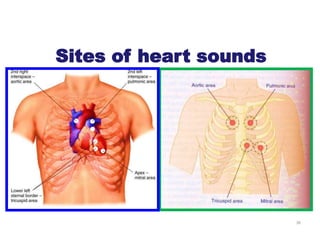
Sites of heart sounds
37
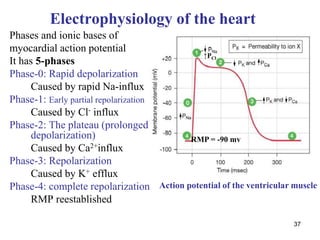
Electrophysiology of the heart
Phases and ionic bases of
myocardial action potential
It has 5-phases
Phase-0: Rapid depolarization
Caused by rapid Na-influx
Phase-1: Early partial repolarization
Caused by Cl- influx
Phase-2: The plateau (prolonged
depolarization)
Caused by Ca2+influx
Phase-3: Repolarization
Caused by K+ efflux
Phase-4: complete repolarization
RMP reestablished
Action potential of the ventricular muscle
RMP = -90 mv
↑PCl
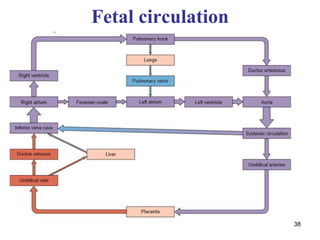
Fetal circulation
38
Blood vessels
• Their role is to direct the flow of blood from the
heart to the capillaries, and back to the heart.
 Characteristics of blood vessels:
– Arteries and arterioles => carry blood away
from heart.
– Capillaries => site of exchange.
– Venules, veins => return blood to heart.
39
Types of blood vessels
1. Elastic vessels:
 Example: Aorta, big
arteries.
 Pressure storing
components
 High ability of stretching
and recoiling.
2. Resistance vessels:
 Example: small arteries and
arterioles.
 High muscular component.
 Develop high resistance
 Regulate blood flow.
40
Cont’d
3. Exchange vessels: made
up endothelium and
basement membrane.
 Thin enough for
exchange.
4. Capacitance vessels (big
to small veins).
 Very high capacity of
distension.
 It can accommodate
large volume of blood
(60-70% of blood
volume).
41
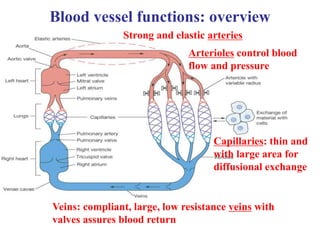
Blood vessel functions: overview
Strong and elastic arteries
Arterioles control blood
flow and pressure
Capillaries: thin and
with large area for
diffusional exchange
Veins: compliant, large, low resistance veins with
valves assures blood return
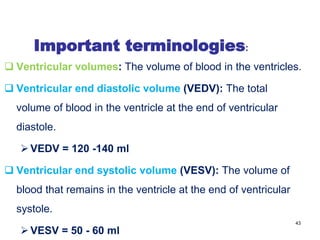
Important terminologies:
 Ventricular volumes: The volume of blood in the ventricles.
 Ventricular end diastolic volume (VEDV): The total
volume of blood in the ventricle at the end of ventricular
diastole.
VEDV = 120 -140 ml
 Ventricular end systolic volume (VESV): The volume of
blood that remains in the ventricle at the end of ventricular
systole.
VESV = 50 - 60 ml
43
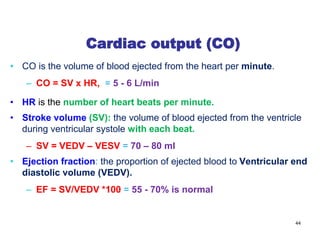
Cardiac output (CO)
• CO is the volume of blood ejected from the heart per minute.
– CO = SV x HR, = 5 - 6 L/min
• HR is the number of heart beats per minute.
• Stroke volume (SV): the volume of blood ejected from the ventricle
during ventricular systole with each beat.
– SV = VEDV – VESV = 70 – 80 ml
• Ejection fraction: the proportion of ejected blood to Ventricular end
diastolic volume (VEDV).
– EF = SV/VEDV *100 = 55 - 70% is normal
44
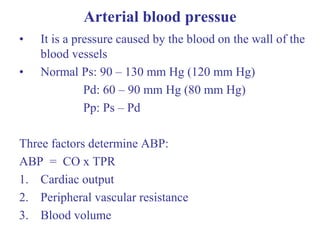
Arterial blood pressue
• It is a pressure caused by the blood on the wall of the
blood vessels
• Normal Ps: 90 – 130 mm Hg (120 mm Hg)
Pd: 60 – 90 mm Hg (80 mm Hg)
Pp: Ps – Pd
Three factors determine ABP:
ABP = CO x TPR
1. Cardiac output
2. Peripheral vascular resistance
3. Blood volume
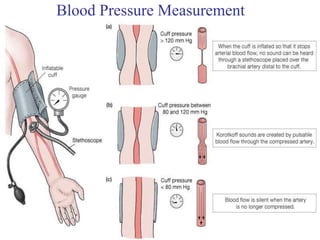
Blood Pressure Measurement
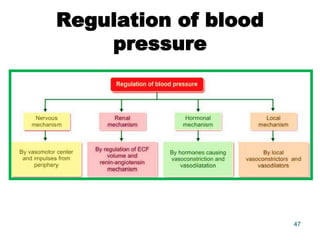
Regulation of blood
pressure
47
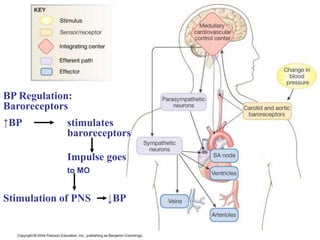
BP Regulation:
Baroreceptors
↑BP stimulates
baroreceptors
Impulse goes
to MO
Stimulation of PNS ↓BP
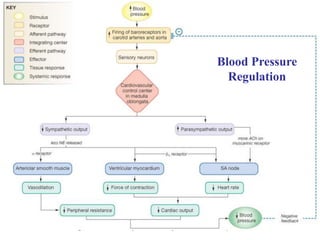
Regulation of Blood Pressure
Figure 15-22: The baroreceptor reflex: the response to increased blood pressure
Blood Pressure
Regulation
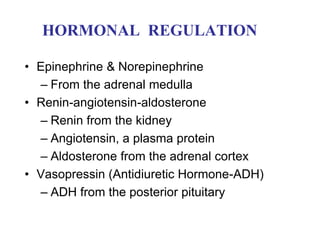
HORMONAL REGULATION
• Epinephrine & Norepinephrine
– From the adrenal medulla
• Renin-angiotensin-aldosterone
– Renin from the kidney
– Angiotensin, a plasma protein
– Aldosterone from the adrenal cortex
• Vasopressin (Antidiuretic Hormone-ADH)
– ADH from the posterior pituitary
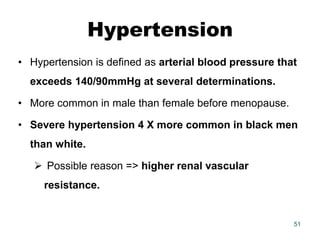
Hypertension
• Hypertension is defined as arterial blood pressure that
exceeds 140/90mmHg at several determinations.
• More common in male than female before menopause.
• Severe hypertension 4 X more common in black men
than white.
 Possible reason => higher renal vascular
resistance.
51
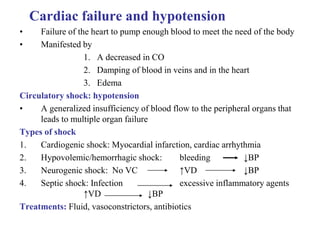
Cardiac failure and hypotension
• Failure of the heart to pump enough blood to meet the need of the body
• Manifested by
1. A decreased in CO
2. Damping of blood in veins and in the heart
3. Edema
Circulatory shock: hypotension
• A generalized insufficiency of blood flow to the peripheral organs that
leads to multiple organ failure
Types of shock
1. Cardiogenic shock: Myocardial infarction, cardiac arrhythmia
2. Hypovolemic/hemorrhagic shock: bleeding ↓BP
3. Neurogenic shock: No VC ↑VD ↓BP
4. Septic shock: Infection excessive inflammatory agents
↑VD ↓BP
Treatments: Fluid, vasoconstrictors, antibiotics

chapter_5_CVS_Physiology_-1.ppt

  • 1.
  • 2.
    2 FUNCTIONS OF THECVS • Transport and distribute essential substances to the tissues. • Remove metabolic byproducts. • Adjustment of oxygen and nutrient supply in different physiologic states. • Regulation of body temperature. • Humoral communication.
  • 3.
    3 Components of theCVS CVS composed of  Heart: Pumping center  Blood vessels  Arteries: Distributing system  Capillaries: Exchange system  Veins: Collecting system  Blood: circulating connective tissue
  • 4.
    4 Division of thecirculatory system • In the CVS, blood passes through two (double) circulations:  Systemic circulation  Pulmonary circulation • Systemic circulation: Starts in the LV→ Aorta → Systemic arteries →Systemic capillaries →Veins →SVC & IVC →ends in RA • Pulmonary circulation: Starts in the RV →Pulmonary trunk →Pulm. arteries → Pulm. capillaries →Pulm. veins →ends in the LA.
  • 5.
    5 Pathway of BloodThrough the Heart and Lungs
  • 6.
  • 7.
    7 The Heart • Heartis the hollow, muscular organ that plays a central pumping role • Composed of 4-chambers; • 2 atria and 2 ventricles • Size: Approximately equivalent to clenched fist • Weight: 280 to 320 gram in average adults • It is situated between two lungs in the mediastinum.
  • 8.
  • 9.
  • 10.
    10 The Heart: PosteriorView Figure 18.4d
  • 11.
    11 Histology of theheart Heart wall is made up of 3 distinct layers: 1 - Endocardium - innermost layer; epithelial tissue that lines the entire circulatory system 2 - Myocardium - thickest layer; consists of cardiac muscle 3 - Epicardium - thin, external membrane around the heart
  • 12.
    12 Cardiac muscle (Myocardium) •Myocardiumis the middle layer of wall of the heart •Cardiac muscle cells are straited, mononucleated and branched •connected to each other through intercalated disks •Intercalated disks: Specialized cell-cell contacts: • Desmosomes hold cells together and • Gap junctions allow conduction of action potentials. •Electrically, cardiac muscle behaves as single unit
  • 13.
    13 Properties of cardiacmuscles • Cardiac muscles have 4 physiological properties. These are;  Autorhythmicity  Excitability  Conductivity  Contractility
  • 14.
    14 Autorhythmicity • It isthe ability of the heart to generate cardiac impulse and to beat regularly independent of any external stimulus. • The heart is provided with specialized excitatory and conductive muscle systems having two functions: 1. They generate rhythmic cardiac impulse 2. They conduct cardiac impulse
  • 15.
    15 Specialized excitatory andconducting system of the heart 1. Sino-atrial node (SA-node): Located on the posterior wall of the Rt-atrium inferior to the opening of the SVC The heart beat is initiated by the pacemaker (SA Node) SA-nodal fibres have a special capability to discharge repetitive and rhythmic cardiac impulse. They repeatedly depolarize to threshold spontaneously It generates impulse at a frequency of 80-
  • 16.
    Cont’d 2. Atrioventricular node(AV-node): in which impulse from the atria delayed to be conducted to the ventricle. • Site of nodal delay • located in the right atrium, close to the interventricular septum. • It is the Potential pacemaker (if SA node fails). 16
  • 17.
    Cont’d 3. Atrioventricular bundle(bundle of His): which conducts impulse from the atria to the ventricle. • The only site where action potentials can conduct from the atria to the ventricles • The rest of atrioventricular boundary consist of unexcitable connective tissue 17
  • 18.
    Cont’d 4. Right andleft bundle branches • They extend through the interventricular septum toward the apex of the heart. 5. Purkinje fibers: conduct cardiac impulse to the rest of ventricles 18
  • 19.
    19 Specialized excitatory andconductive system of the heart
  • 20.
  • 21.
    Cardiac valves • Cardiacvalves are made up of fibrous connective tissues. • The valves direct blood flow (One way valves) • Each have fibrous connective tissue: • Prevent enlargement of valve opening • Anchor valve flaps. • Opening and closing of valves occur passively as a result of pressure differences. • Valve closure prevents backflow of blood during and after contraction. 21
  • 22.
    Types of cardiacvalves  There are 4 types of heart valves: – Inlet valves => AV (atrioventricular) valves. Tricuspid(RAV) and mitral or Bicuspid(LAV). – Outlet valves => Semilunar valves.  Aortic and Pulmonary semilunar valves. 22
  • 23.
    AV valves • Formedfrom thin flaps of tissue joined at base to connective tissue ring. 23 • AV valves are not identical: – Tricuspid : 3 flaps – Bicuspid: 2 flaps : Also called Mitral valve – Open to ward the heart • Open during diastole.
  • 24.
    Semilunar valves (outletvalves) • Pulmonary valves => b/n RV and pulmonary artery. • Aortic valve => b/n LV and aorta. • Open towards blood vessels. • Open during systole. • Anatomical composition same as AV valves. 24
  • 25.
  • 26.
    26 Blood supply tothe heart • The heart receives arterial blood from the coronary artery, which is the branch of ascending aorta. • Resting coronary blood flow = 250 ml/min, 5% CO Ascending Aorta L Coronary artery R Coronary artery Supplies • Atrium • Posterior ventricles  R ventricle  L ventricle Circumflex a. Supplies Atrium L ventricle Anterior descending a. Supplies R ventricle L ventricle
  • 27.
    27 Coronary venous drainage Smallvenules Small veins Great cardiac vein Middle cardiac vein From the anterior part From the posterior part of the heart of the heart Coronary sinus R Atrium
  • 28.
    Cardiac innervation • Sympathetic innervates almost all parts of heart. • increase myocardial contractility, accelerates heart rate • Parasympathetic (from vagus):  Mainly innervates: SA node, Atria and AV node.  No ventricular innervations of parasympathetic.  Strong stimulation of vagus, has no effect on ventricles  decrease myocardial contractility, reduces heart rate 28
  • 29.
    29 Excitation-contraction coupling incardiac muscle • It is a mechanism by which an action potential causes contraction of myocardium. • It has the following sequences Auto-rhythmicity Membrane depolarization T- tubule depolarization Release of Ca2+ from SR + from T-tubule (ECF) Ca2+ activates contractile molecules Sliding of filaments Contraction • The action potential of cardiac muscle has a prolonged refractory period. Advantage: prevents tetanic contraction of the heart
  • 30.
    30 Ca2+ signaling in cardiacmuscle DHPR (DHPR) Ca2+ Entry of Ca2+ during action potential 1 Ca2+ out for 3 Na+ in Inhibited by digitalis & ouabain; indirectly Na+ /Ca2+ exchange  [Ca2+ ]in Affected by epinephrine () and ACh ()
  • 31.
    The Cardiac Cycle (diastoleand systole) • Activities in the heart in a single beat • It refers to the repeating pattern of contraction and relaxation of the heart. – The period from the end of one heart contraction to the end of the next. – Systole: • Phase of ventricular contraction. – Diastole: • Phase of ventricular relaxation. • Diastole is longer than systole. 31
  • 32.
    Cont’d • There are72 cycles completed per minute. • During systole, heart contracts and pumps the blood through arteries. • During diastole, heart relaxes and blood is filled in the heart. • Duration of each cycle = 0.8 second:  Ventricular diastole = 0.5 second.  Ventricular systole = 0.3 second. 32
  • 33.
    Heart sounds • Heartsounds are associated (usually) with valve closure. • Heart sounds are the sounds produced by mechanical activities of heart during each cardiac cycle. • First heart sound => Closure of AV valves:  Occurs at beginning of isovolumic contraction. 33
  • 34.
    • Second heartsound => Closure of Aortic & Pulmonic valves (Semilunar valves):  Occur at end of ejection (at onset of ventricular diastole) • Third heart sound (sometimes): - due to rapid ventricular filling. • Fourth heart sound (occasionally): - during atrial contraction. Third and fourth sounds occur: normally in children 34
  • 35.
    Cont’d • S1: isalways audible, has a LUBB-sound • S2: is always audible, has DUBB-sound • Continuous heart sound: Lubb-Dubb, Lubb- Dubb • Heart sounds are produced by: 1. Flow of blood through cardiac chambers 2. Contraction of cardiac muscle 35
  • 36.
  • 37.
    37 Electrophysiology of theheart Phases and ionic bases of myocardial action potential It has 5-phases Phase-0: Rapid depolarization Caused by rapid Na-influx Phase-1: Early partial repolarization Caused by Cl- influx Phase-2: The plateau (prolonged depolarization) Caused by Ca2+influx Phase-3: Repolarization Caused by K+ efflux Phase-4: complete repolarization RMP reestablished Action potential of the ventricular muscle RMP = -90 mv ↑PCl
  • 38.
  • 39.
    Blood vessels • Theirrole is to direct the flow of blood from the heart to the capillaries, and back to the heart.  Characteristics of blood vessels: – Arteries and arterioles => carry blood away from heart. – Capillaries => site of exchange. – Venules, veins => return blood to heart. 39
  • 40.
    Types of bloodvessels 1. Elastic vessels:  Example: Aorta, big arteries.  Pressure storing components  High ability of stretching and recoiling. 2. Resistance vessels:  Example: small arteries and arterioles.  High muscular component.  Develop high resistance  Regulate blood flow. 40
  • 41.
    Cont’d 3. Exchange vessels:made up endothelium and basement membrane.  Thin enough for exchange. 4. Capacitance vessels (big to small veins).  Very high capacity of distension.  It can accommodate large volume of blood (60-70% of blood volume). 41
  • 42.
    Blood vessel functions:overview Strong and elastic arteries Arterioles control blood flow and pressure Capillaries: thin and with large area for diffusional exchange Veins: compliant, large, low resistance veins with valves assures blood return
  • 43.
    Important terminologies:  Ventricularvolumes: The volume of blood in the ventricles.  Ventricular end diastolic volume (VEDV): The total volume of blood in the ventricle at the end of ventricular diastole. VEDV = 120 -140 ml  Ventricular end systolic volume (VESV): The volume of blood that remains in the ventricle at the end of ventricular systole. VESV = 50 - 60 ml 43
  • 44.
    Cardiac output (CO) •CO is the volume of blood ejected from the heart per minute. – CO = SV x HR, = 5 - 6 L/min • HR is the number of heart beats per minute. • Stroke volume (SV): the volume of blood ejected from the ventricle during ventricular systole with each beat. – SV = VEDV – VESV = 70 – 80 ml • Ejection fraction: the proportion of ejected blood to Ventricular end diastolic volume (VEDV). – EF = SV/VEDV *100 = 55 - 70% is normal 44
  • 45.
    Arterial blood pressue •It is a pressure caused by the blood on the wall of the blood vessels • Normal Ps: 90 – 130 mm Hg (120 mm Hg) Pd: 60 – 90 mm Hg (80 mm Hg) Pp: Ps – Pd Three factors determine ABP: ABP = CO x TPR 1. Cardiac output 2. Peripheral vascular resistance 3. Blood volume
  • 46.
  • 47.
  • 48.
  • 49.
    Regulation of BloodPressure Figure 15-22: The baroreceptor reflex: the response to increased blood pressure Blood Pressure Regulation
  • 50.
    HORMONAL REGULATION • Epinephrine& Norepinephrine – From the adrenal medulla • Renin-angiotensin-aldosterone – Renin from the kidney – Angiotensin, a plasma protein – Aldosterone from the adrenal cortex • Vasopressin (Antidiuretic Hormone-ADH) – ADH from the posterior pituitary
  • 51.
    Hypertension • Hypertension isdefined as arterial blood pressure that exceeds 140/90mmHg at several determinations. • More common in male than female before menopause. • Severe hypertension 4 X more common in black men than white.  Possible reason => higher renal vascular resistance. 51
  • 52.
    Cardiac failure andhypotension • Failure of the heart to pump enough blood to meet the need of the body • Manifested by 1. A decreased in CO 2. Damping of blood in veins and in the heart 3. Edema Circulatory shock: hypotension • A generalized insufficiency of blood flow to the peripheral organs that leads to multiple organ failure Types of shock 1. Cardiogenic shock: Myocardial infarction, cardiac arrhythmia 2. Hypovolemic/hemorrhagic shock: bleeding ↓BP 3. Neurogenic shock: No VC ↑VD ↓BP 4. Septic shock: Infection excessive inflammatory agents ↑VD ↓BP Treatments: Fluid, vasoconstrictors, antibiotics