CHAPTER 33: Scheduling
Responses to Questions:
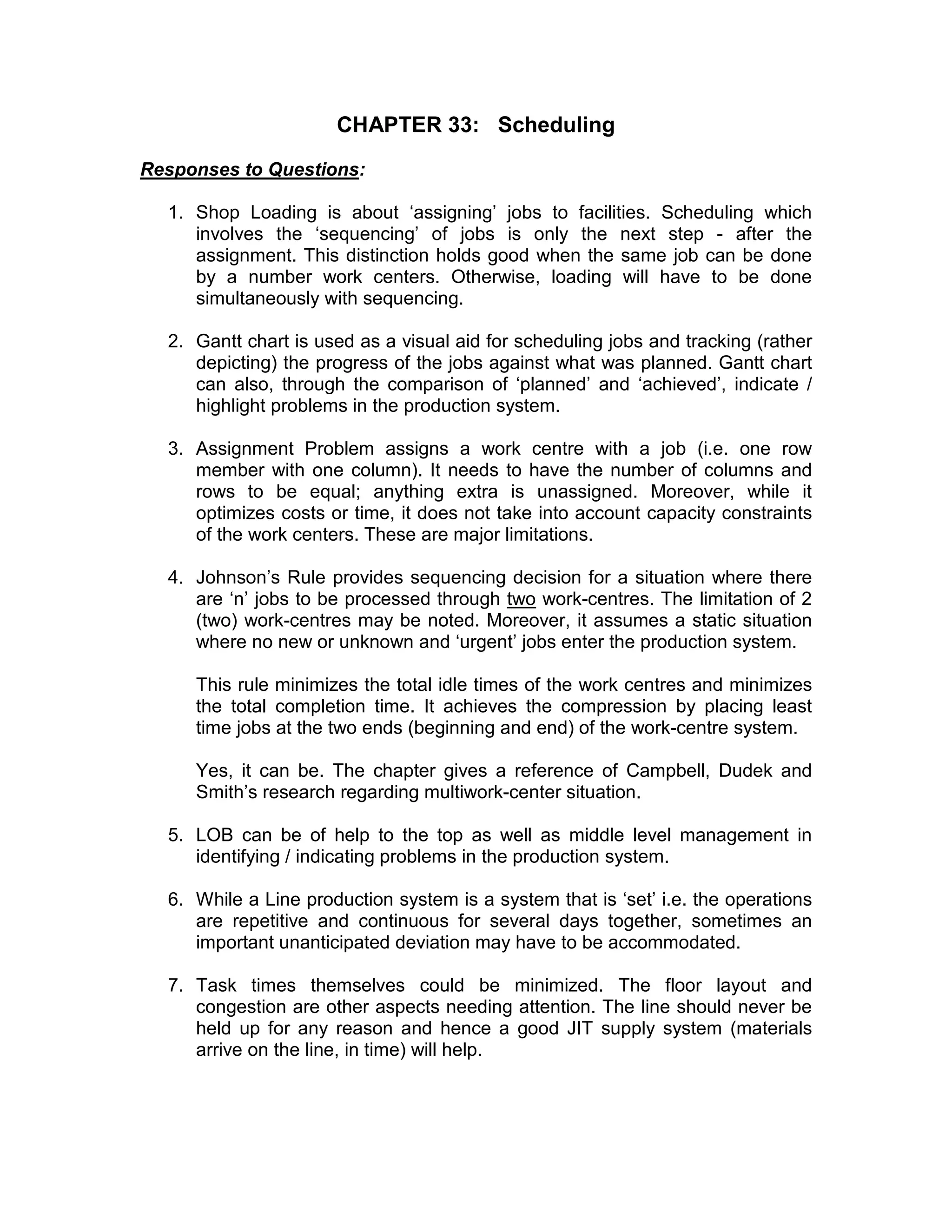
1. Shop Loading is about ‘assigning’ jobs to facilities. Scheduling which
involves the ‘sequencing’ of jobs is only the next step - after the
assignment. This distinction holds good when the same job can be done
by a number work centers. Otherwise, loading will have to be done
simultaneously with sequencing.
2. Gantt chart is used as a visual aid for scheduling jobs and tracking (rather
depicting) the progress of the jobs against what was planned. Gantt chart
can also, through the comparison of ‘planned’ and ‘achieved’, indicate /
highlight problems in the production system.
3. Assignment Problem assigns a work centre with a job (i.e. one row
member with one column). It needs to have the number of columns and
rows to be equal; anything extra is unassigned. Moreover, while it
optimizes costs or time, it does not take into account capacity constraints
of the work centers. These are major limitations.
4. Johnson’s Rule provides sequencing decision for a situation where there
are ‘n’ jobs to be processed through two work-centres. The limitation of 2
(two) work-centres may be noted. Moreover, it assumes a static situation
where no new or unknown and ‘urgent’ jobs enter the production system.
This rule minimizes the total idle times of the work centres and minimizes
the total completion time. It achieves the compression by placing least
time jobs at the two ends (beginning and end) of the work-centre system.
Yes, it can be. The chapter gives a reference of Campbell, Dudek and
Smith’s research regarding multiwork-center situation.
5. LOB can be of help to the top as well as middle level management in
identifying / indicating problems in the production system.
6. While a Line production system is a system that is ‘set’ i.e. the operations
are repetitive and continuous for several days together, sometimes an
important unanticipated deviation may have to be accommodated.
7. Task times themselves could be minimized. The floor layout and
congestion are other aspects needing attention. The line should never be
held up for any reason and hence a good JIT supply system (materials
arrive on the line, in time) will help.
2
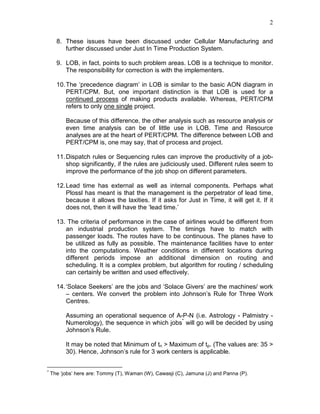
8. These issues have been discussed under Cellular Manufacturing and
further discussed under Just In Time Production System.
9. LOB, in fact, points to such problem areas. LOB is a technique to monitor.
The responsibility for correction is with the implementers.
10.The ‘precedence diagram’ in LOB is similar to the basic AON diagram in
PERT/CPM. But, one important distinction is that LOB is used for a
continued process of making products available. Whereas, PERT/CPM
refers to only one single project.
Because of this difference, the other analysis such as resource analysis or
even time analysis can be of little use in LOB. Time and Resource
analyses are at the heart of PERT/CPM. The difference between LOB and
PERT/CPM is, one may say, that of process and project.
11.Dispatch rules or Sequencing rules can improve the productivity of a job-
shop significantly, if the rules are judiciously used. Different rules seem to
improve the performance of the job shop on different parameters.
12.Lead time has external as well as internal components. Perhaps what
Plossl has meant is that the management is the perpetrator of lead time,
because it allows the laxities. If it asks for Just in Time, it will get it. If it
does not, then it will have the ‘lead time.’
13. The criteria of performance in the case of airlines would be different from
an industrial production system. The timings have to match with
passenger loads. The routes have to be continuous. The planes have to
be utilized as fully as possible. The maintenance facilities have to enter
into the computations. Weather conditions in different locations during
different periods impose an additional dimension on routing and
scheduling. It is a complex problem, but algorithm for routing / scheduling
can certainly be written and used effectively.
14.‘Solace Seekers’ are the jobs and ‘Solace Givers’ are the machines/ work
– centers. We convert the problem into Johnson’s Rule for Three Work
Centres.
Assuming an operational sequence of A-P-N (i.e. Astrology - Palmistry -
Numerology), the sequence in which jobs*
will go will be decided by using
Johnson’s Rule.
It may be noted that Minimum of tn > Maximum of tp. (The values are: 35 >
30). Hence, Johnson’s rule for 3 work centers is applicable.
*
The ‘jobs’ here are: Tommy (T), Waman (W), Cawasji (C), Jamuna (J) and Panna (P).
3
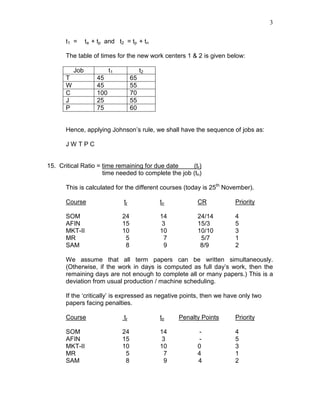
t1 = ta + tp and t2 = tp + tn
The table of times for the new work centers 1 & 2 is given below:
Job t1 t2
T 45 65
W 45 55
C 100 70
J 25 55
P 75 60
Hence, applying Johnson’s rule, we shall have the sequence of jobs as:
J W T P C
15. Critical Ratio = time remaining for due date (tr)
time needed to complete the job (tn)
This is calculated for the different courses (today is 25th
November).
Course tr tn CR Priority
SOM 24 14 24/14 4
AFIN 15 3 15/3 5
MKT-II 10 10 10/10 3
MR 5 7 5/7 1
SAM 8 9 8/9 2
We assume that all term papers can be written simultaneously.
(Otherwise, if the work in days is computed as full day’s work, then the
remaining days are not enough to complete all or many papers.) This is a
deviation from usual production / machine scheduling.
If the ‘critically’ is expressed as negative points, then we have only two
papers facing penalties.
Course tr tn Penalty Points Priority
SOM 24 14 - 4
AFIN 15 3 - 5
MKT-II 10 10 0 3
MR 5 7 4 1
SAM 8 9 4 2
4
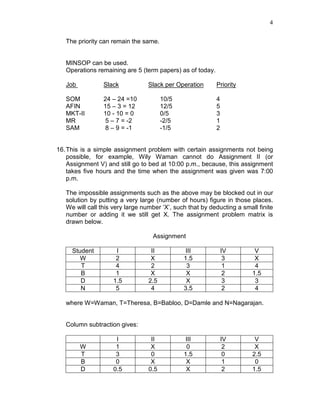
The priority can remain the same.
MINSOP can be used.
Operations remaining are 5 (term papers) as of today.
Job Slack Slack per Operation Priority
SOM 24 – 24 =10 10/5 4
AFIN 15 – 3 = 12 12/5 5
MKT-II 10 - 10 = 0 0/5 3
MR 5 – 7 = -2 -2/5 1
SAM 8 – 9 = -1 -1/5 2
16.This is a simple assignment problem with certain assignments not being
possible, for example, Wily Waman cannot do Assignment II (or
Assignment V) and still go to bed at 10:00 p.m., because, this assignment
takes five hours and the time when the assignment was given was 7:00
p.m.
The impossible assignments such as the above may be blocked out in our
solution by putting a very large (number of hours) figure in those places.
We will call this very large number ‘X’, such that by deducting a small finite
number or adding it we still get X. The assignment problem matrix is
drawn below.
Assignment
Student I II III IV V
W 2 X 1.5 3 X
T 4 2 3 1 4
B 1 X X 2 1.5
D 1.5 2.5 X 3 3
N 5 4 3.5 2 4
where W=Waman, T=Theresa, B=Babloo, D=Damle and N=Nagarajan.
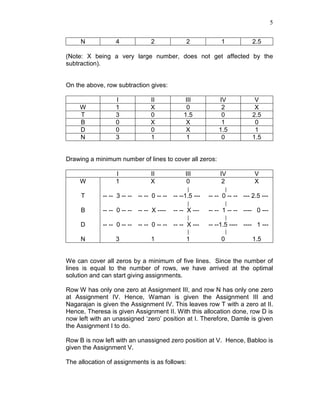
Column subtraction gives:
I II III IV V
W 1 X 0 2 X
T 3 0 1.5 0 2.5
B 0 X X 1 0
D 0.5 0.5 X 2 1.5
5
N 4 2 2 1 2.5
(Note: X being a very large number, does not get affected by the
subtraction).
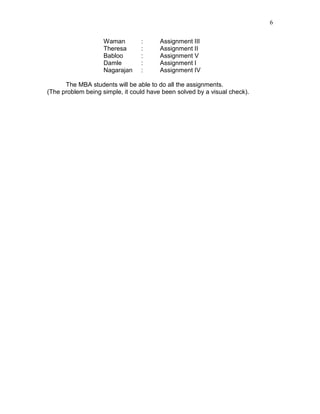
On the above, row subtraction gives:
I II III IV V
W 1 X 0 2 X
T 3 0 1.5 0 2.5
B 0 X X 1 0
D 0 0 X 1.5 1
N 3 1 1 0 1.5
Drawing a minimum number of lines to cover all zeros:
I II III IV V
W 1 X 0 2 X
T -- -- 3 -- -- -- -- 0 -- -- -- --1.5 --- -- -- 0 -- -- --- 2.5 ---
B -- -- 0 -- -- -- -- X ---- -- -- X --- -- -- 1 -- -- ---- 0 ---
D -- -- 0 -- -- -- -- 0 -- -- -- -- X --- -- --1.5 ---- ---- 1 ---
N 3 1 1 0 1.5
We can cover all zeros by a minimum of five lines. Since the number of
lines is equal to the number of rows, we have arrived at the optimal
solution and can start giving assignments.
Row W has only one zero at Assignment III, and row N has only one zero
at Assignment IV. Hence, Waman is given the Assignment III and
Nagarajan is given the Assignment IV. This leaves row T with a zero at II.
Hence, Theresa is given Assignment II. With this allocation done, row D is
now left with an unassigned ‘zero’ position at I. Therefore, Damle is given
the Assignment I to do.
Row B is now left with an unassigned zero position at V. Hence, Babloo is
given the Assignment V.
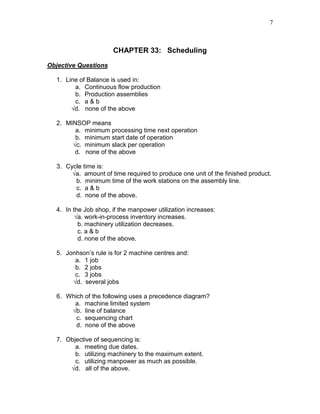
The allocation of assignments is as follows:
6
Waman : Assignment III
Theresa : Assignment II
Babloo : Assignment V
Damle : Assignment I
Nagarajan : Assignment IV
The MBA students will be able to do all the assignments.
(The problem being simple, it could have been solved by a visual check).
7
CHAPTER 33: Scheduling
Objective Questions
1. Line of Balance is used in:
a. Continuous flow production
b. Production assemblies
c. a & b
√d. none of the above
2. MINSOP means
a. minimum processing time next operation
b. minimum start date of operation
√c. minimum slack per operation
d. none of the above
3. Cycle time is:
√a. amount of time required to produce one unit of the finished product.
b. minimum time of the work stations on the assembly line.
c. a & b
d. none of the above.
4. In the Job shop, if the manpower utilization increases:
√a. work-in-process inventory increases.
b. machinery utilization decreases.
c. a & b
d. none of the above.
5. Jonhson’s rule is for 2 machine centres and:
a. 1 job
b. 2 jobs
c. 3 jobs
√d. several jobs
6. Which of the following uses a precedence diagram?
a. machine limited system
√b. line of balance
c. sequencing chart
d. none of the above
7. Objective of sequencing is:
a. meeting due dates.
b. utilizing machinery to the maximum extent.
c. utilizing manpower as much as possible.
√d. all of the above.
8
8. Four jobs A, B, C and D are to be sequenced through a work centre. The
process times are four, three, two and one hour, respectively. If the
sequencing is done by MINPRT (i.e. SOT) rule, the average completion
time for the four jobs is:
a. 2 hours
b. 2.5 hours
c. 4 hours
√d. 5 hours
9. With MINSOP dispatch rule, the sequencing of jobs for a given set of jobs:
a. may change every day.
b. may change at every work centre.
√c. a & b
d. none of the above.
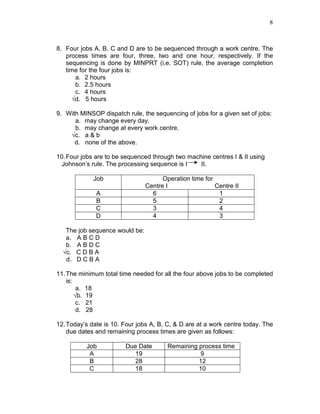
10.Four jobs are to be sequenced through two machine centres I & II using
Johnson’s rule. The processing sequence is I II.
Job Operation time for
Centre I Centre II
A 6 1
B 5 2
C 3 4
D 4 3
The job sequence would be:
a. A B C D
b. A B D C
√c. C D B A
d. D C B A
11.The minimum total time needed for all the four above jobs to be completed
is:
a. 18
√b. 19
c. 21
d. 28
12.Today’s date is 10. Four jobs A, B, C, & D are at a work centre today. The
due dates and remaining process times are given as follows:
Job Due Date Remaining process time
A 19 9
B 28 12
C 18 10
9
D 13 4
Using the Minimum Critical Ratio rule, the sequence is:
a. ABCD b. ACDB c. CDAB √d. DCAB
13. The line of balance is:
a. the assembly line that is balanced.
b. the balanced line layout.
c. the line of flow of the product through a balanced assembly line.
√d. none of the above
14. MINPRT dispatch rule:
√a pushes long operation time jobs way back in the queue.
b. pushes jobs with least slack to the front of the queue.
c. pushes jobs with least slacks to the back of the queue.
d. none of the above.
15. In an Assignment Problem used in shop loading:
√a. number of rows should be equal to the number of columns.
b. number of rows and columns need not be equal.
c. matrix of rows and columns is not always necessary.
d. the total of process times across all rows and columns needs to be
equal.
16. Minimum critical ratio rule is called:
a. MINPRT
b. MINSOP
c. MINSD
√d none of the above.

Production & Operation Management Chapter33[1]

  • 1.
    CHAPTER 33: Scheduling Responsesto Questions: 1. Shop Loading is about ‘assigning’ jobs to facilities. Scheduling which involves the ‘sequencing’ of jobs is only the next step - after the assignment. This distinction holds good when the same job can be done by a number work centers. Otherwise, loading will have to be done simultaneously with sequencing. 2. Gantt chart is used as a visual aid for scheduling jobs and tracking (rather depicting) the progress of the jobs against what was planned. Gantt chart can also, through the comparison of ‘planned’ and ‘achieved’, indicate / highlight problems in the production system. 3. Assignment Problem assigns a work centre with a job (i.e. one row member with one column). It needs to have the number of columns and rows to be equal; anything extra is unassigned. Moreover, while it optimizes costs or time, it does not take into account capacity constraints of the work centers. These are major limitations. 4. Johnson’s Rule provides sequencing decision for a situation where there are ‘n’ jobs to be processed through two work-centres. The limitation of 2 (two) work-centres may be noted. Moreover, it assumes a static situation where no new or unknown and ‘urgent’ jobs enter the production system. This rule minimizes the total idle times of the work centres and minimizes the total completion time. It achieves the compression by placing least time jobs at the two ends (beginning and end) of the work-centre system. Yes, it can be. The chapter gives a reference of Campbell, Dudek and Smith’s research regarding multiwork-center situation. 5. LOB can be of help to the top as well as middle level management in identifying / indicating problems in the production system. 6. While a Line production system is a system that is ‘set’ i.e. the operations are repetitive and continuous for several days together, sometimes an important unanticipated deviation may have to be accommodated. 7. Task times themselves could be minimized. The floor layout and congestion are other aspects needing attention. The line should never be held up for any reason and hence a good JIT supply system (materials arrive on the line, in time) will help.
  • 2.
    2 8. These issueshave been discussed under Cellular Manufacturing and further discussed under Just In Time Production System. 9. LOB, in fact, points to such problem areas. LOB is a technique to monitor. The responsibility for correction is with the implementers. 10.The ‘precedence diagram’ in LOB is similar to the basic AON diagram in PERT/CPM. But, one important distinction is that LOB is used for a continued process of making products available. Whereas, PERT/CPM refers to only one single project. Because of this difference, the other analysis such as resource analysis or even time analysis can be of little use in LOB. Time and Resource analyses are at the heart of PERT/CPM. The difference between LOB and PERT/CPM is, one may say, that of process and project. 11.Dispatch rules or Sequencing rules can improve the productivity of a job- shop significantly, if the rules are judiciously used. Different rules seem to improve the performance of the job shop on different parameters. 12.Lead time has external as well as internal components. Perhaps what Plossl has meant is that the management is the perpetrator of lead time, because it allows the laxities. If it asks for Just in Time, it will get it. If it does not, then it will have the ‘lead time.’ 13. The criteria of performance in the case of airlines would be different from an industrial production system. The timings have to match with passenger loads. The routes have to be continuous. The planes have to be utilized as fully as possible. The maintenance facilities have to enter into the computations. Weather conditions in different locations during different periods impose an additional dimension on routing and scheduling. It is a complex problem, but algorithm for routing / scheduling can certainly be written and used effectively. 14.‘Solace Seekers’ are the jobs and ‘Solace Givers’ are the machines/ work – centers. We convert the problem into Johnson’s Rule for Three Work Centres. Assuming an operational sequence of A-P-N (i.e. Astrology - Palmistry - Numerology), the sequence in which jobs* will go will be decided by using Johnson’s Rule. It may be noted that Minimum of tn > Maximum of tp. (The values are: 35 > 30). Hence, Johnson’s rule for 3 work centers is applicable. * The ‘jobs’ here are: Tommy (T), Waman (W), Cawasji (C), Jamuna (J) and Panna (P).
  • 3.
    3 t1 = ta+ tp and t2 = tp + tn The table of times for the new work centers 1 & 2 is given below: Job t1 t2 T 45 65 W 45 55 C 100 70 J 25 55 P 75 60 Hence, applying Johnson’s rule, we shall have the sequence of jobs as: J W T P C 15. Critical Ratio = time remaining for due date (tr) time needed to complete the job (tn) This is calculated for the different courses (today is 25th November). Course tr tn CR Priority SOM 24 14 24/14 4 AFIN 15 3 15/3 5 MKT-II 10 10 10/10 3 MR 5 7 5/7 1 SAM 8 9 8/9 2 We assume that all term papers can be written simultaneously. (Otherwise, if the work in days is computed as full day’s work, then the remaining days are not enough to complete all or many papers.) This is a deviation from usual production / machine scheduling. If the ‘critically’ is expressed as negative points, then we have only two papers facing penalties. Course tr tn Penalty Points Priority SOM 24 14 - 4 AFIN 15 3 - 5 MKT-II 10 10 0 3 MR 5 7 4 1 SAM 8 9 4 2
  • 4.
    4 The priority canremain the same. MINSOP can be used. Operations remaining are 5 (term papers) as of today. Job Slack Slack per Operation Priority SOM 24 – 24 =10 10/5 4 AFIN 15 – 3 = 12 12/5 5 MKT-II 10 - 10 = 0 0/5 3 MR 5 – 7 = -2 -2/5 1 SAM 8 – 9 = -1 -1/5 2 16.This is a simple assignment problem with certain assignments not being possible, for example, Wily Waman cannot do Assignment II (or Assignment V) and still go to bed at 10:00 p.m., because, this assignment takes five hours and the time when the assignment was given was 7:00 p.m. The impossible assignments such as the above may be blocked out in our solution by putting a very large (number of hours) figure in those places. We will call this very large number ‘X’, such that by deducting a small finite number or adding it we still get X. The assignment problem matrix is drawn below. Assignment Student I II III IV V W 2 X 1.5 3 X T 4 2 3 1 4 B 1 X X 2 1.5 D 1.5 2.5 X 3 3 N 5 4 3.5 2 4 where W=Waman, T=Theresa, B=Babloo, D=Damle and N=Nagarajan. Column subtraction gives: I II III IV V W 1 X 0 2 X T 3 0 1.5 0 2.5 B 0 X X 1 0 D 0.5 0.5 X 2 1.5
  • 5.
    5 N 4 22 1 2.5 (Note: X being a very large number, does not get affected by the subtraction). On the above, row subtraction gives: I II III IV V W 1 X 0 2 X T 3 0 1.5 0 2.5 B 0 X X 1 0 D 0 0 X 1.5 1 N 3 1 1 0 1.5 Drawing a minimum number of lines to cover all zeros: I II III IV V W 1 X 0 2 X T -- -- 3 -- -- -- -- 0 -- -- -- --1.5 --- -- -- 0 -- -- --- 2.5 --- B -- -- 0 -- -- -- -- X ---- -- -- X --- -- -- 1 -- -- ---- 0 --- D -- -- 0 -- -- -- -- 0 -- -- -- -- X --- -- --1.5 ---- ---- 1 --- N 3 1 1 0 1.5 We can cover all zeros by a minimum of five lines. Since the number of lines is equal to the number of rows, we have arrived at the optimal solution and can start giving assignments. Row W has only one zero at Assignment III, and row N has only one zero at Assignment IV. Hence, Waman is given the Assignment III and Nagarajan is given the Assignment IV. This leaves row T with a zero at II. Hence, Theresa is given Assignment II. With this allocation done, row D is now left with an unassigned ‘zero’ position at I. Therefore, Damle is given the Assignment I to do. Row B is now left with an unassigned zero position at V. Hence, Babloo is given the Assignment V. The allocation of assignments is as follows:
  • 6.
    6 Waman : AssignmentIII Theresa : Assignment II Babloo : Assignment V Damle : Assignment I Nagarajan : Assignment IV The MBA students will be able to do all the assignments. (The problem being simple, it could have been solved by a visual check).
  • 7.
    7 CHAPTER 33: Scheduling ObjectiveQuestions 1. Line of Balance is used in: a. Continuous flow production b. Production assemblies c. a & b √d. none of the above 2. MINSOP means a. minimum processing time next operation b. minimum start date of operation √c. minimum slack per operation d. none of the above 3. Cycle time is: √a. amount of time required to produce one unit of the finished product. b. minimum time of the work stations on the assembly line. c. a & b d. none of the above. 4. In the Job shop, if the manpower utilization increases: √a. work-in-process inventory increases. b. machinery utilization decreases. c. a & b d. none of the above. 5. Jonhson’s rule is for 2 machine centres and: a. 1 job b. 2 jobs c. 3 jobs √d. several jobs 6. Which of the following uses a precedence diagram? a. machine limited system √b. line of balance c. sequencing chart d. none of the above 7. Objective of sequencing is: a. meeting due dates. b. utilizing machinery to the maximum extent. c. utilizing manpower as much as possible. √d. all of the above.
  • 8.
    8 8. Four jobsA, B, C and D are to be sequenced through a work centre. The process times are four, three, two and one hour, respectively. If the sequencing is done by MINPRT (i.e. SOT) rule, the average completion time for the four jobs is: a. 2 hours b. 2.5 hours c. 4 hours √d. 5 hours 9. With MINSOP dispatch rule, the sequencing of jobs for a given set of jobs: a. may change every day. b. may change at every work centre. √c. a & b d. none of the above. 10.Four jobs are to be sequenced through two machine centres I & II using Johnson’s rule. The processing sequence is I II. Job Operation time for Centre I Centre II A 6 1 B 5 2 C 3 4 D 4 3 The job sequence would be: a. A B C D b. A B D C √c. C D B A d. D C B A 11.The minimum total time needed for all the four above jobs to be completed is: a. 18 √b. 19 c. 21 d. 28 12.Today’s date is 10. Four jobs A, B, C, & D are at a work centre today. The due dates and remaining process times are given as follows: Job Due Date Remaining process time A 19 9 B 28 12 C 18 10
  • 9.
    9 D 13 4 Usingthe Minimum Critical Ratio rule, the sequence is: a. ABCD b. ACDB c. CDAB √d. DCAB 13. The line of balance is: a. the assembly line that is balanced. b. the balanced line layout. c. the line of flow of the product through a balanced assembly line. √d. none of the above 14. MINPRT dispatch rule: √a pushes long operation time jobs way back in the queue. b. pushes jobs with least slack to the front of the queue. c. pushes jobs with least slacks to the back of the queue. d. none of the above. 15. In an Assignment Problem used in shop loading: √a. number of rows should be equal to the number of columns. b. number of rows and columns need not be equal. c. matrix of rows and columns is not always necessary. d. the total of process times across all rows and columns needs to be equal. 16. Minimum critical ratio rule is called: a. MINPRT b. MINSOP c. MINSD √d none of the above.