Campus session 2Developing your research design
Topic?You will have begun to think of your research topic.  It might be a problem you want to solve, a question you want answered or an idea you want tested.  You will have begun the process of challenging the topic to determine if its ‘worthwhile’
Topic?The ‘so what’ factorThe nice to know testIs it done to deathDoes it push your buttons?Is it bleeding obvious?
exercise 1Pair off and explain your topic to your partnerAsk them for a one sentence response to your topicCan they list 5 things they know about that topic?repeat the process in reverse
Research design you ask?You need to develop a way to collect, analyse and interpret information that can be used to solve, answer, prove, inform, explore, describe your topic
What is research design?A research design is like a master plan that outlines the type of information to be collected, the sources of data and the methods to be used to collect and analyse the required information. The objectives of your research are included in the research design to make sure that you gather the appropriate information that will help solve the marketing management problem.In real terms research design looks at the rationale of why we are conducting our inquiry in a certain way and suggests tools that can be used to collect data in a way that supports the aims and outcomes of the research
Research approachesThere is more than one way to approach your research problem.  Research approaches are designed by you as a researcher in order to provide you with the ‘best’ data or information.
secondary and primary research
Secondary research approachesSecondary research is information that already exists. Examples of secondary research include research projects already undertaken by other people, census data, features in journals, newspapers, databases, internal company documents like memos and annual reports.Secondary data can be oral as well as written, and also incorporates information from industry experts.  
What is secondary data?  identify the problembetter define the problemdevelop an approach to the problemformulate an appropriate research design. It can also…answer certain research questionshelp to interpret primary data more insightfully
Evaluating secondary dataNot all secondary is 100% reliable.  I mean would you believe everything you read on the net?
Apparently according to some guy on the internetI have been left over US$4 million by a Prince and all I have to do is give him my bank account number and passwords!
Evaluating secondary dataSecondary data needs to be evaluated on the:methodology used to collect the data
accuracy of the data
currency of the data
objectivity of the data
content of the data
dependability of the data Evaluation is required to ensure that its use does not weaken the objectivity, accuracy, and credibility of your research.
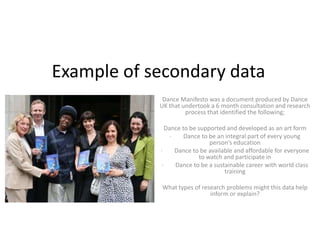
Example of secondary dataDance Manifesto was a document produced by Dance UK that undertook a 6 month consultation and research process that identified the following;Dance to be supported and developed as an art form·        Dance to be an integral part of every young person’s education·        Dance to be available and affordable for everyone to watch and participate in·        Dance to be a sustainable career with world class trainingWhat types of research problems might this data help inform or explain?
Primary researchPrimary research is information collected directly by the researcher and is gathered to address the problem at hand. This includes instruments such as surveys, interviews and focus groups and observation
exercise 2Pair off with someone differentIn 100 words or less explain your topic idea to each otherOn a sheet of paper, draw two columns like thisList some ideas of some primary and secondary sources of data that you might use to inform your problem or topic
Types of research approachesAll information is not made the same way.  Information can be represented, explained or expressed in different forms and therefore used for different purposes
quantitative and qualitative Researchers need different types of data to solve different types of problems.   
Qualitative researchThe purpose of qualitative research is to gain insights from participants about their feelings and motivations. This form of data results from an attempt to specify the quality of the relationship between two or more things.  Key words: emotions, attitudes, reactions and beliefs.
Quantitative research Quantitative research involves interviewing a large number of people in an attempt to quantify the relationship between two or more thingsKey words: numerical measurements, percentages, proportions, graphs, charts and statistics.   
Horses for coursesYou need to undertake different types of research in order to solve different research problems or questions
Exploratory researchExploratory research helps the researcher develop an understanding of the problem.  It is often used in the initial stages of the research.  Exploratory research can be used to;develop a focus and direction for conclusive research
uncover problems and identify variables that need to be measured
help formulate a hypothesis or an educated guess about the outcome of a test
designed to answer a research question

Campus Session 2

  • 1.
    Campus session 2Developingyour research design
  • 2.
    Topic?You will havebegun to think of your research topic. It might be a problem you want to solve, a question you want answered or an idea you want tested. You will have begun the process of challenging the topic to determine if its ‘worthwhile’
  • 3.
    Topic?The ‘so what’factorThe nice to know testIs it done to deathDoes it push your buttons?Is it bleeding obvious?
  • 4.
    exercise 1Pair offand explain your topic to your partnerAsk them for a one sentence response to your topicCan they list 5 things they know about that topic?repeat the process in reverse
  • 5.
    Research design youask?You need to develop a way to collect, analyse and interpret information that can be used to solve, answer, prove, inform, explore, describe your topic
  • 6.
    What is researchdesign?A research design is like a master plan that outlines the type of information to be collected, the sources of data and the methods to be used to collect and analyse the required information. The objectives of your research are included in the research design to make sure that you gather the appropriate information that will help solve the marketing management problem.In real terms research design looks at the rationale of why we are conducting our inquiry in a certain way and suggests tools that can be used to collect data in a way that supports the aims and outcomes of the research
  • 7.
    Research approachesThere ismore than one way to approach your research problem. Research approaches are designed by you as a researcher in order to provide you with the ‘best’ data or information.
  • 8.
  • 9.
    Secondary research approachesSecondaryresearch is information that already exists. Examples of secondary research include research projects already undertaken by other people, census data, features in journals, newspapers, databases, internal company documents like memos and annual reports.Secondary data can be oral as well as written, and also incorporates information from industry experts.  
  • 10.
    What is secondarydata?  identify the problembetter define the problemdevelop an approach to the problemformulate an appropriate research design. It can also…answer certain research questionshelp to interpret primary data more insightfully
  • 11.
    Evaluating secondary dataNotall secondary is 100% reliable. I mean would you believe everything you read on the net?
  • 12.
    Apparently according tosome guy on the internetI have been left over US$4 million by a Prince and all I have to do is give him my bank account number and passwords!
  • 13.
    Evaluating secondary dataSecondarydata needs to be evaluated on the:methodology used to collect the data
  • 14.
  • 15.
  • 16.
  • 17.
  • 18.
    dependability of thedata Evaluation is required to ensure that its use does not weaken the objectivity, accuracy, and credibility of your research.
  • 19.
    Example of secondarydataDance Manifesto was a document produced by Dance UK that undertook a 6 month consultation and research process that identified the following;Dance to be supported and developed as an art form·        Dance to be an integral part of every young person’s education·        Dance to be available and affordable for everyone to watch and participate in·        Dance to be a sustainable career with world class trainingWhat types of research problems might this data help inform or explain?
  • 20.
    Primary researchPrimary researchis information collected directly by the researcher and is gathered to address the problem at hand. This includes instruments such as surveys, interviews and focus groups and observation
  • 21.
    exercise 2Pair offwith someone differentIn 100 words or less explain your topic idea to each otherOn a sheet of paper, draw two columns like thisList some ideas of some primary and secondary sources of data that you might use to inform your problem or topic
  • 22.
    Types of researchapproachesAll information is not made the same way. Information can be represented, explained or expressed in different forms and therefore used for different purposes
  • 23.
    quantitative and qualitativeResearchers need different types of data to solve different types of problems.   
  • 24.
    Qualitative researchThe purposeof qualitative research is to gain insights from participants about their feelings and motivations. This form of data results from an attempt to specify the quality of the relationship between two or more things. Key words: emotions, attitudes, reactions and beliefs.
  • 25.
    Quantitative research Quantitativeresearch involves interviewing a large number of people in an attempt to quantify the relationship between two or more thingsKey words: numerical measurements, percentages, proportions, graphs, charts and statistics.  
  • 26.
    Horses for coursesYouneed to undertake different types of research in order to solve different research problems or questions
  • 27.
    Exploratory researchExploratory researchhelps the researcher develop an understanding of the problem. It is often used in the initial stages of the research. Exploratory research can be used to;develop a focus and direction for conclusive research
  • 28.
    uncover problems andidentify variables that need to be measured
  • 29.
    help formulate ahypothesis or an educated guess about the outcome of a test
  • 30.
    designed to answera research question