EARTH AND LIFE SCIENCE
LESSON 1:
THE ORIGIN AND
SYSTEMS OF EARTH
FORMATION OF THE UNIVERSE
It is difficult to completely understand the formation of the early universe
because no human has ever witnessed it. The science of cosmology provides various
hypotheses that explain the origin of the universe based on its present properties or
characteristics.
There are numerous theories about the formation of the early universe. Here are some of
these:
1. THE BIG BANG THEORY
It remains the prevailing cosmological model for the early development of the
universe. It provides the best explanation of the origin of the universe and is implicitly
accepted. According to this theory, the universe was once very small and very hot
expanded until it massively exploded around 13.7 billion years ago (considered the age of
the universe). This was according to Georges Lemaitre.
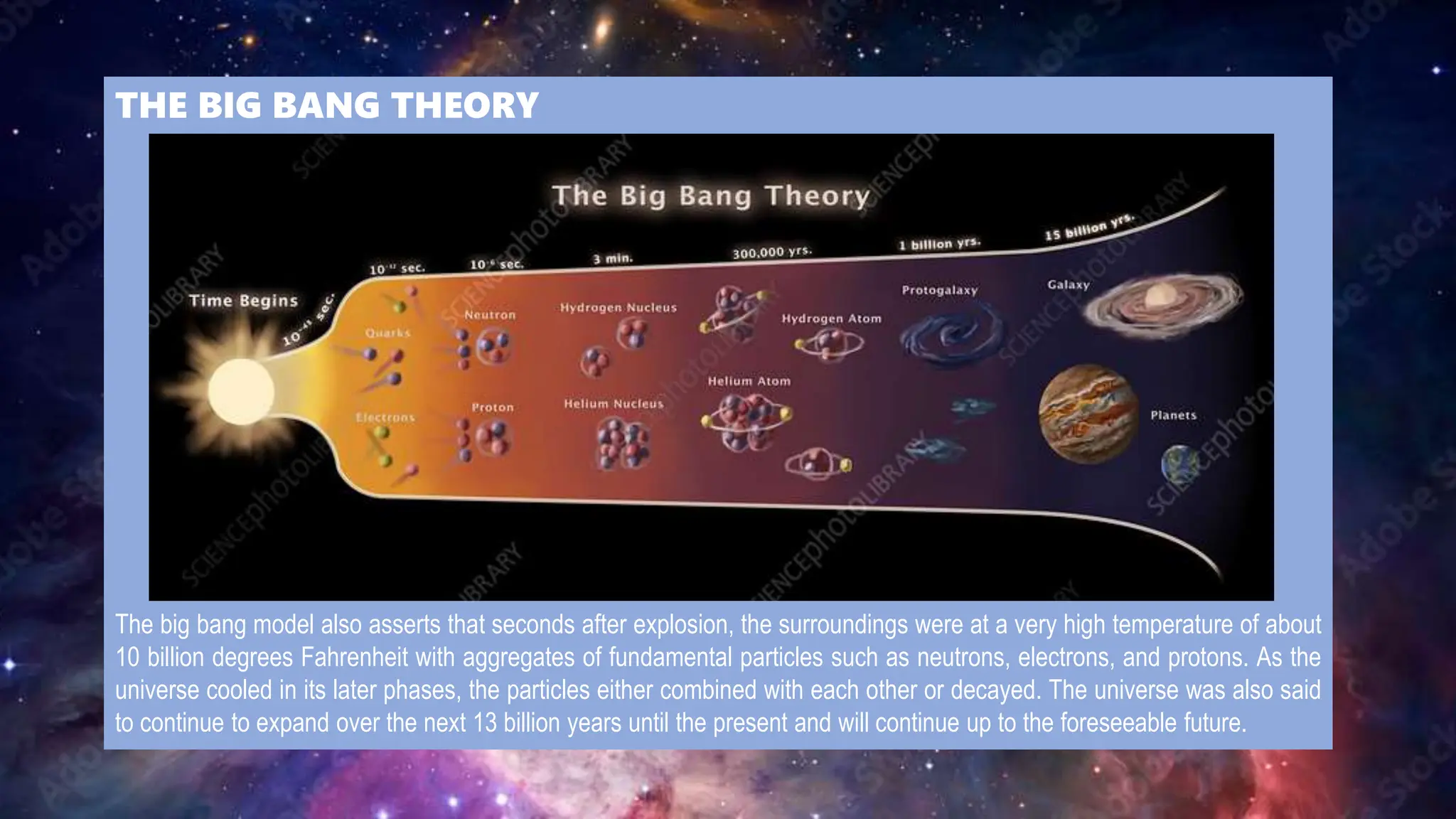
THE BIG BANG THEORY
The big bang model also asserts that seconds after explosion, the surroundings were at a very high temperature of about
10 billion degrees Fahrenheit with aggregates of fundamental particles such as neutrons, electrons, and protons. As the
universe cooled in its later phases, the particles either combined with each other or decayed. The universe was also said
to continue to expand over the next 13 billion years until the present and will continue up to the foreseeable future.
2. STEADY STATE THEORY
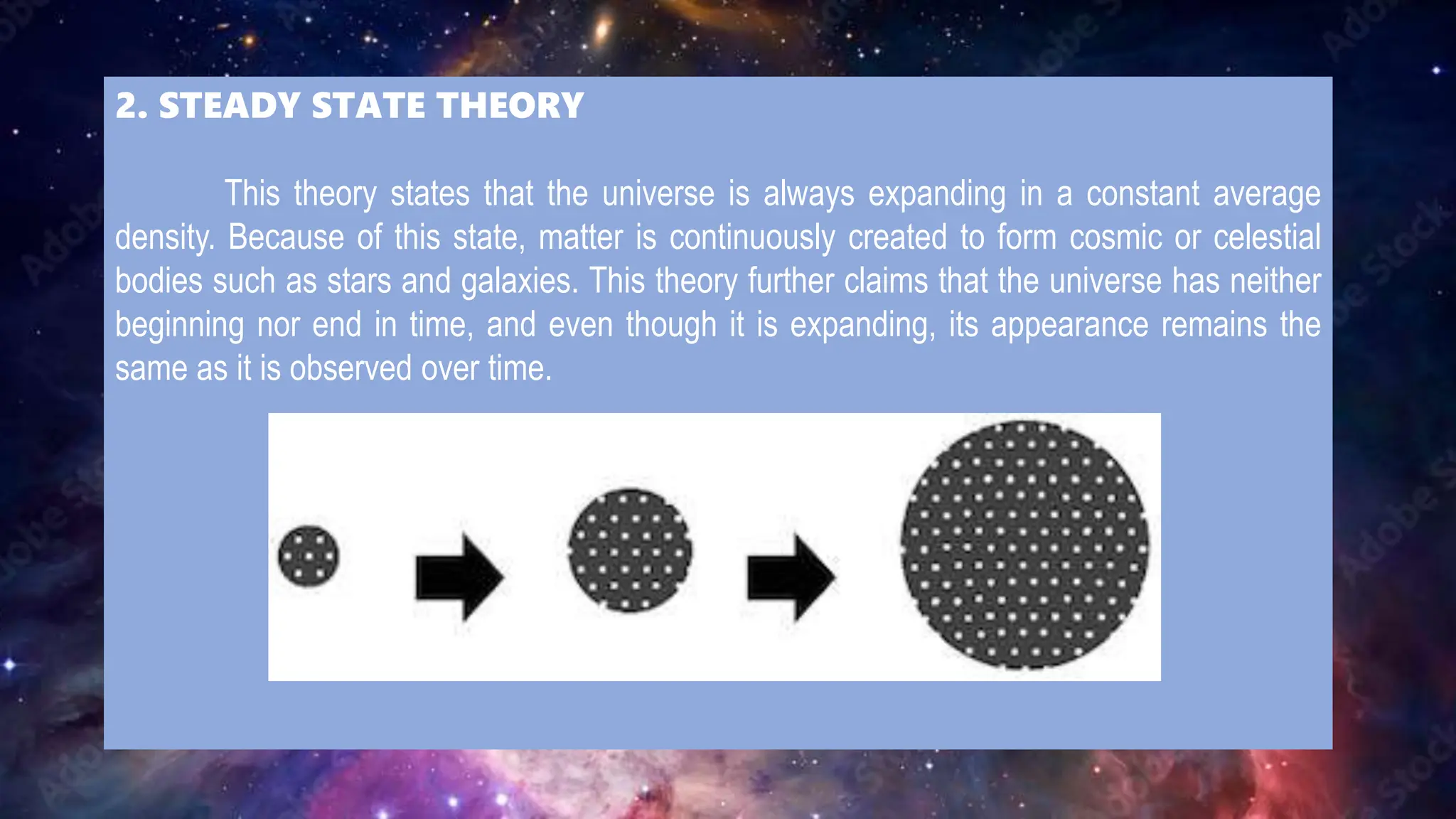
This theory states that the universe is always expanding in a constant average
density. Because of this state, matter is continuously created to form cosmic or celestial
bodies such as stars and galaxies. This theory further claims that the universe has neither
beginning nor end in time, and even though it is expanding, its appearance remains the
same as it is observed over time.
2. STEADY STATE THEORY
The steady state theory was first proposed by Sir James Jeans in 1920. It gained
popularity after it was revised by Fred Hoyle, Hermann Bondi and Thomas Gold in 1948 as
an alternative to the big bang theory. However, towards the 1960s, much evidence was
produced that would contradict the steadiness or the unchanging state of the universe.
When certain galactic bodies (quasars and radio galaxies) were found only at far distances
in space, it just disproved the idea that similar bodies are created and found everywhere.
This implies that the universe is actually evolving (and not steady.
3. COSMIC INFLATION THEORY
The most recent cosmic inflation theory was proposed by physicists Alan Guth and
Andrei Linde in the 1980s. The term inflation refers to the raid expansion of space-time.
According to this theory, the early universe was a rapidly expanding bubble of pure energy
vacuum. It did not have any matter or radiation. After the expansion and cooling that arised
from this inflation, the potential energy converted into the kinetic energy of matter and
radiation. Then, a big bang occurred because of the extremely hot and dense condition of
matter.
3. COSMIC INFLATION THEORY
The cosmic inflation theory became an accepted hypothesis because it answered many
puzzling observations from the big bang theory:
1. The homogeneity of objects in space. During the expansion period, objects that
used to be in contact got farther away from one another. Their composition, however,
remained almost intact.
2. Its appearance of flatness or smoothness. The continuous expansion dilutes or
gradually loses the curvature of objects.
3. The formation of stars and star systems in later years. The theory asserts that
during expansion, small density fluctuations happen. This causes gravity to attract gas into
masses, giving birth to stars and eventually galaxies.
FORMATION OF STAR SYSTEMS
Just like the origin of the universe, there are many theories on how star systems
began. By far, the nebular hypothesis, though it may not be used to explain the evolution of
all star systems, seems to be the most accepted theory on the formation of the solar
system. Other theories, however, provide equally substantial pieces of evidence that are
worth considering, and may apply to other star systems.
1. NEBULAR HYPOTHESIS
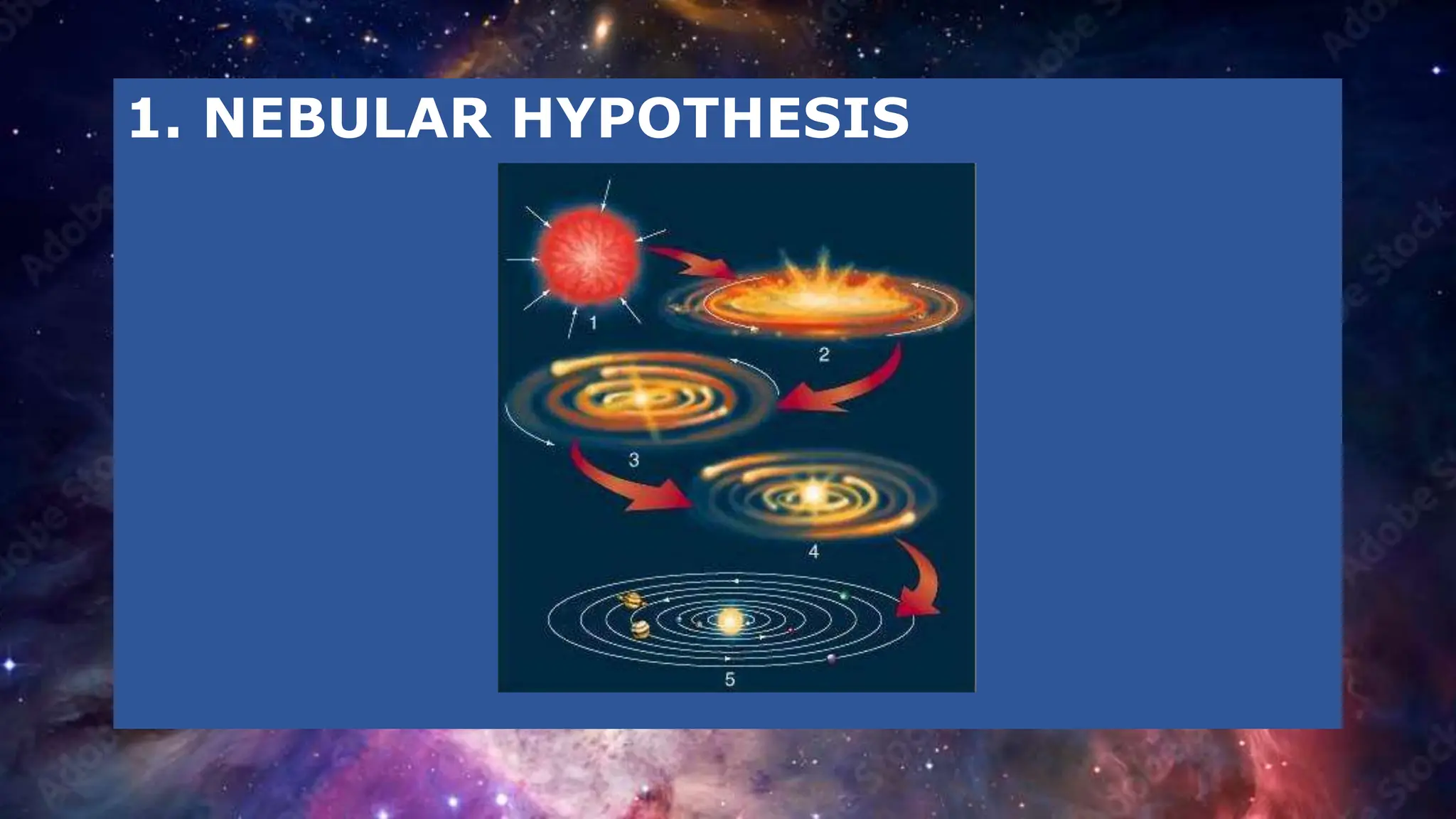
The nebular hypothesis was developed by Immanuel Kant and Pierre-Simon
Laplace in the 18th century. It was the model used to explain the formation and evolution of
the solar system. It presupposes that around 4.6 billion years ago, a star system was
formed from a rotating gas cloud or nebula of extremely hot gas. When the gas cooled, the
nebula began to shrink, and as it became smaller, it rotated faster, forming a disklike
shape. The angular momentum from the nebula’s rotation and gravitational force from the
mass of the nebula formed the rings of gas outside. As the nebula continued to shrink,
these rings condensed into various densities of planets and their satellites. The remaining
part of the nebula, which has the most mass, formed the Sun.
1. NEBULAR HYPOTHESIS
2. THE PLANETESIMAL AND TIDAL
THEORIES
The planetesimal and tidal theories were developed by Thomas Chamberlin and Forest
Moulton during the early 20th century, and James Jeans and Harold Jeffreys in 1918. In
both theories, a star supposedly passed close to the sun. The gravitational pull of the
passing star raised tides found on the surface of the sun. Some of this erupted matter was
detached and plunged into elliptical orbits around the sun. Some of the smaller masses
quickly cooled to become solid bodies called planetesimals. Others grew in size because
of the collision with passing objects in space, eventually forming larger clumps and
gathering more and more matter.
2. THE PLANETESIMAL AND TIDAL THEORIES
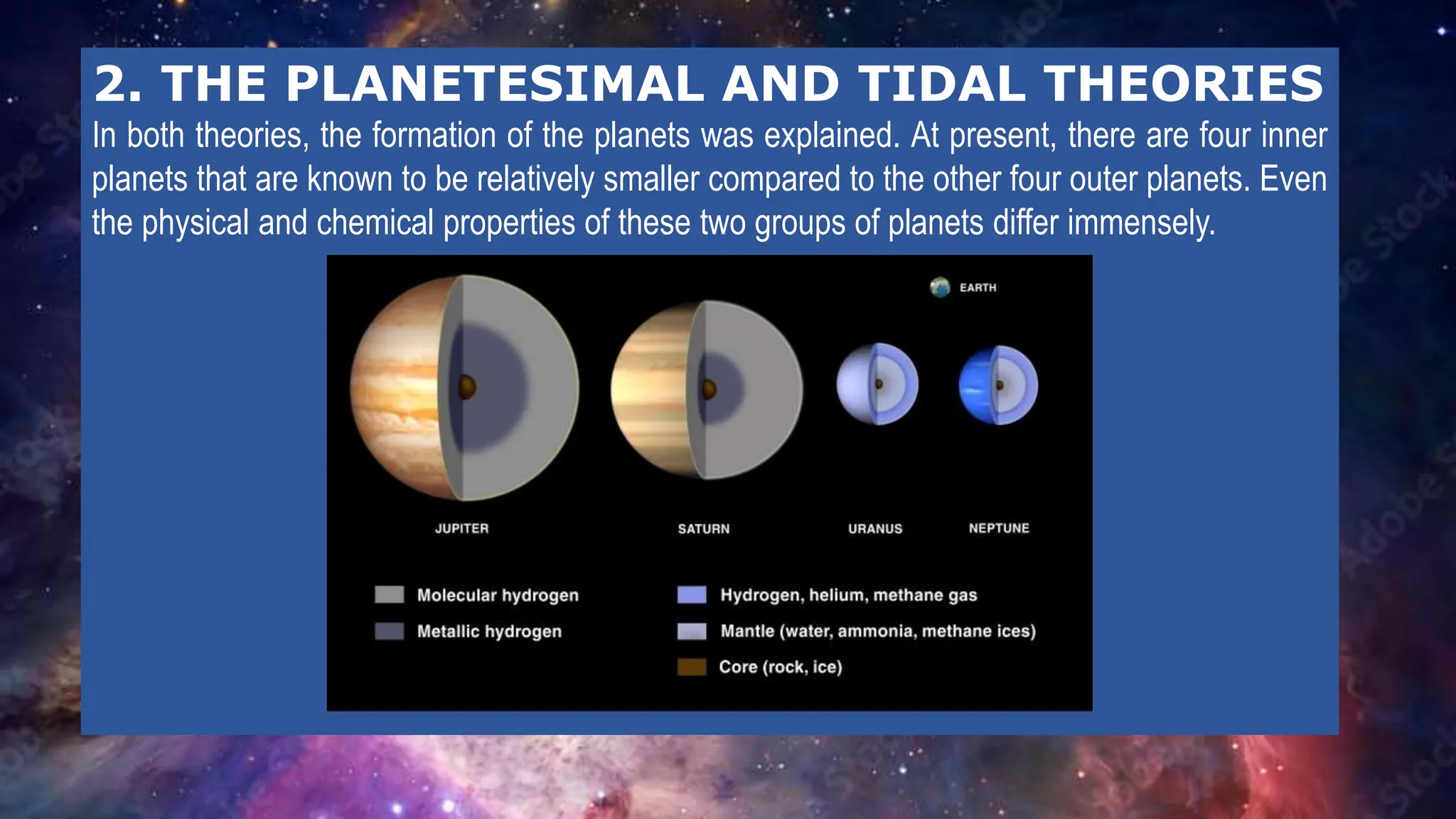
In both theories, the formation of the planets was explained. At present, there are four inner
planets that are known to be relatively smaller compared to the other four outer planets. Even
the physical and chemical properties of these two groups of planets differ immensely.
2. THE PLANETESIMAL AND TIDAL THEORIES
The four outer planets namely Jupiter, Saturn, Uranus, and Neptune are called gas
planets because they are made up of only primary materials (helium and hydrogen) similar to
the composition of the sun. These giant gas planets are believed to have remained gaseous
in nature because of their great distance from the sun. The lower temperature, known to be
observed beyond the frost line, allowed the condensation of gas, forming a less dense huge
planet.
On the other hand, the four inner planets name Mercury, Venus, Earth, and Mars are
called terrestrial or telluric planets because they have solid surfaces and are mostly
composed of silicate rocks and metals. Earth is one of the inner planets, and as such, it
shares some common characteristics with the other terrestrial planets.

ELS_LESSON 1 Origin of the Universe Earth and Life Science

  • 1.
    EARTH AND LIFESCIENCE LESSON 1: THE ORIGIN AND SYSTEMS OF EARTH
  • 2.
    FORMATION OF THEUNIVERSE It is difficult to completely understand the formation of the early universe because no human has ever witnessed it. The science of cosmology provides various hypotheses that explain the origin of the universe based on its present properties or characteristics.
  • 3.
    There are numeroustheories about the formation of the early universe. Here are some of these: 1. THE BIG BANG THEORY It remains the prevailing cosmological model for the early development of the universe. It provides the best explanation of the origin of the universe and is implicitly accepted. According to this theory, the universe was once very small and very hot expanded until it massively exploded around 13.7 billion years ago (considered the age of the universe). This was according to Georges Lemaitre.
  • 4.
    THE BIG BANGTHEORY The big bang model also asserts that seconds after explosion, the surroundings were at a very high temperature of about 10 billion degrees Fahrenheit with aggregates of fundamental particles such as neutrons, electrons, and protons. As the universe cooled in its later phases, the particles either combined with each other or decayed. The universe was also said to continue to expand over the next 13 billion years until the present and will continue up to the foreseeable future.
  • 5.
    2. STEADY STATETHEORY This theory states that the universe is always expanding in a constant average density. Because of this state, matter is continuously created to form cosmic or celestial bodies such as stars and galaxies. This theory further claims that the universe has neither beginning nor end in time, and even though it is expanding, its appearance remains the same as it is observed over time.
  • 6.
    2. STEADY STATETHEORY The steady state theory was first proposed by Sir James Jeans in 1920. It gained popularity after it was revised by Fred Hoyle, Hermann Bondi and Thomas Gold in 1948 as an alternative to the big bang theory. However, towards the 1960s, much evidence was produced that would contradict the steadiness or the unchanging state of the universe. When certain galactic bodies (quasars and radio galaxies) were found only at far distances in space, it just disproved the idea that similar bodies are created and found everywhere. This implies that the universe is actually evolving (and not steady.
  • 7.
    3. COSMIC INFLATIONTHEORY The most recent cosmic inflation theory was proposed by physicists Alan Guth and Andrei Linde in the 1980s. The term inflation refers to the raid expansion of space-time. According to this theory, the early universe was a rapidly expanding bubble of pure energy vacuum. It did not have any matter or radiation. After the expansion and cooling that arised from this inflation, the potential energy converted into the kinetic energy of matter and radiation. Then, a big bang occurred because of the extremely hot and dense condition of matter.
  • 8.
  • 9.
    3. COSMIC INFLATIONTHEORY The cosmic inflation theory became an accepted hypothesis because it answered many puzzling observations from the big bang theory: 1. The homogeneity of objects in space. During the expansion period, objects that used to be in contact got farther away from one another. Their composition, however, remained almost intact. 2. Its appearance of flatness or smoothness. The continuous expansion dilutes or gradually loses the curvature of objects. 3. The formation of stars and star systems in later years. The theory asserts that during expansion, small density fluctuations happen. This causes gravity to attract gas into masses, giving birth to stars and eventually galaxies.
  • 10.
    FORMATION OF STARSYSTEMS Just like the origin of the universe, there are many theories on how star systems began. By far, the nebular hypothesis, though it may not be used to explain the evolution of all star systems, seems to be the most accepted theory on the formation of the solar system. Other theories, however, provide equally substantial pieces of evidence that are worth considering, and may apply to other star systems.
  • 11.
    1. NEBULAR HYPOTHESIS Thenebular hypothesis was developed by Immanuel Kant and Pierre-Simon Laplace in the 18th century. It was the model used to explain the formation and evolution of the solar system. It presupposes that around 4.6 billion years ago, a star system was formed from a rotating gas cloud or nebula of extremely hot gas. When the gas cooled, the nebula began to shrink, and as it became smaller, it rotated faster, forming a disklike shape. The angular momentum from the nebula’s rotation and gravitational force from the mass of the nebula formed the rings of gas outside. As the nebula continued to shrink, these rings condensed into various densities of planets and their satellites. The remaining part of the nebula, which has the most mass, formed the Sun.
  • 12.
  • 13.
    2. THE PLANETESIMALAND TIDAL THEORIES The planetesimal and tidal theories were developed by Thomas Chamberlin and Forest Moulton during the early 20th century, and James Jeans and Harold Jeffreys in 1918. In both theories, a star supposedly passed close to the sun. The gravitational pull of the passing star raised tides found on the surface of the sun. Some of this erupted matter was detached and plunged into elliptical orbits around the sun. Some of the smaller masses quickly cooled to become solid bodies called planetesimals. Others grew in size because of the collision with passing objects in space, eventually forming larger clumps and gathering more and more matter.
  • 14.
    2. THE PLANETESIMALAND TIDAL THEORIES In both theories, the formation of the planets was explained. At present, there are four inner planets that are known to be relatively smaller compared to the other four outer planets. Even the physical and chemical properties of these two groups of planets differ immensely.
  • 15.
    2. THE PLANETESIMALAND TIDAL THEORIES The four outer planets namely Jupiter, Saturn, Uranus, and Neptune are called gas planets because they are made up of only primary materials (helium and hydrogen) similar to the composition of the sun. These giant gas planets are believed to have remained gaseous in nature because of their great distance from the sun. The lower temperature, known to be observed beyond the frost line, allowed the condensation of gas, forming a less dense huge planet. On the other hand, the four inner planets name Mercury, Venus, Earth, and Mars are called terrestrial or telluric planets because they have solid surfaces and are mostly composed of silicate rocks and metals. Earth is one of the inner planets, and as such, it shares some common characteristics with the other terrestrial planets.