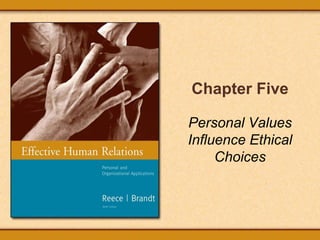
Chapter Five
Personal Values
Influence Ethical
Choices
Copyright © Houghton Mifflin Company. All rights reserved. 5 - 2
Chapter Preview: Personal Values
Influence Ethical Choices
• Developing a strong sense of character
• How values are formed
• Value conflicts and how to resolve them
• Making ethical decisions based on
personal values
• Corporate crime and steps to eliminate
it
Copyright © Houghton Mifflin Company. All rights reserved. 5 - 3
Character, Integrity and Moral Development
• Character is composed of your personal
standards of behavior including:
– Honesty
– Integrity
– Moral strength
Copyright © Houghton Mifflin Company. All rights reserved. 5 - 4
Integrity: A Dimension of Character
• Integrity is congruence between what
you
– know
– say
– do
• Practicing what you believe
demonstrates integrity
• Critical to successful relationships
Copyright © Houghton Mifflin Company. All rights reserved. 5 - 5
A Valued Character Trait
• People with integrity do what they say
they will do
• Are clear about what they stand for
• Think hard about what is right and
wrong
Copyright © Houghton Mifflin Company. All rights reserved. 5 - 6
The Corrosion of Character
• Richard Sennett believes decline of
character can be traced to:
– economic conditions
• fast-paced, high stress
• information-driven
– limited connections
• past
• neighbors
• selves
Copyright © Houghton Mifflin Company. All rights reserved. 5 - 7
Character Development
• Integrity can be developed
• Make and keep promises to self and
others
• Many organizations and educational
institutions believe in character training
Copyright © Houghton Mifflin Company. All rights reserved. 5 - 8
Six Pillars of Character
• According to the Josephson Institute of
Ethics:
– Trustworthiness Respect
– Responsibility Fairness
– Caring Citizenship
Copyright © Houghton Mifflin Company. All rights reserved. 5 - 9
Total Person Insight
People working together with integrity
and authenticity and collective
intelligence are profoundly more
effective as a business than people
living together based on politics, game
playing, and narrow self-interest.
Peter Senge
Author, The Fifth Discipline
Copyright © Houghton Mifflin Company. All rights reserved. 5 - 10
Personal Values
• Values are personal beliefs and
preferences that influence one’s
behavior
• Deep-seated in personality
• Exist at different levels of awareness
• Awareness of values enhances integrity
Copyright © Houghton Mifflin Company. All rights reserved. 5 - 11
Five-Part Valuing Process to Clarify and
Develop Values
• Thinking
– critical thinking
– distinguishing fact from opinion
• Feeling
– listening to “gut level”
• Communicating
– listening closely
– interacting with others
Copyright © Houghton Mifflin Company. All rights reserved. 5 - 12
Five-Part Valuing Process to Clarify and
Develop Values
• Choosing
– being well informed
• Acting
– repeatedly and consistently
Copyright © Houghton Mifflin Company. All rights reserved. 5 - 13
Identifying Your Core Values
• Core values are those that consistently
rank higher than others
• General principles and beliefs that guide
intermediate and long-term goals
• Influence the behavior of individuals and
organizations
Copyright © Houghton Mifflin Company. All rights reserved. 5 - 14
Values and Job Selection
• We often must choose among core
values
– High salary
– Security
– Meaningful work
– Lots of time off
• Most choices require compromising at
least one
Copyright © Houghton Mifflin Company. All rights reserved. 5 - 15
Values Shaping Influences
• Major influences that shape our values
are:
– People
– Events
– Family
– Religious groups
– Schools
– The media
Copyright © Houghton Mifflin Company. All rights reserved. 5 - 16
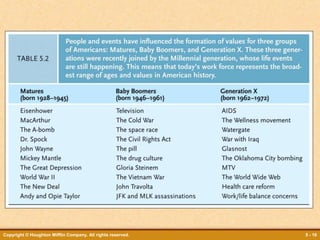
Copyright © Houghton Mifflin Company. All rights reserved. 5 - 17
Family
• Parents assume many roles
• Most important role is moral teacher
• Challenges to families:
– single-parent households
– two parents working outside the home
– care for elderly parents
– financial pressures
Copyright © Houghton Mifflin Company. All rights reserved. 5 - 18
Religious Groups
• Value priorities often developed through
religious training
– Religious doctrine
– Role models
• Many now seeking spiritual and moral
anchors in both personal lives and work
Copyright © Houghton Mifflin Company. All rights reserved. 5 - 19
Schools
• Some see character education as
fundamental aspect of education
• Values clarification common part of
curriculum in 70s
• Objections and fears about imposing
values, so much was eliminated
• Resurgence in the movement today
Copyright © Houghton Mifflin Company. All rights reserved. 5 - 20
Media
• Viewers often see
– people abusing and degrading each other
without consequences
– violence and antisocial behavior
• Research connecting television viewing
and
– depression
– desensitization of children
Copyright © Houghton Mifflin Company. All rights reserved. 5 - 21
People We Admire
• Modeling is shaping behavior to be like
people you admire
• Important for children and adults
• Leaders in the workplace are important
models for adults
Copyright © Houghton Mifflin Company. All rights reserved. 5 - 22
Avoiding Values Drift
• Values drift is the slow erosion of core
values over time
– exposure to conflicting situations
– pressure to compromise
• Reflect on core values when making
decisions at work
• Choose appropriate ethical behavior to
maintain integrity
Copyright © Houghton Mifflin Company. All rights reserved. 5 - 23
Avoiding Values Drift
• Organizations must constantly ask the
following questions:
–What do we stand for?
–Why do we exist?
• Successful companies, through
constant monitoring, adapt to a
changing environment without losing
sight of core values
Copyright © Houghton Mifflin Company. All rights reserved. 5 - 24
Values Conflicts
• Differences between individual’s
personal values is major cause of
values conflict
• Problems may be due to conflicts
between worker’s and the manager’s
value systems
Copyright © Houghton Mifflin Company. All rights reserved. 5 - 25
Values Conflicts
• Organizations should look for value
conflicts when addressing
organizational problems
– Declining quality
– Absenteeism
– Poor customer service
Copyright © Houghton Mifflin Company. All rights reserved. 5 - 26
Total Person Insight
If you want young people to take
notions like right and wrong
seriously, there is an indispensable
condition: they must be in the
presence of adults who take right
and wrong seriously.
William J. Bennett
Author, The Book of Virtues
Copyright © Houghton Mifflin Company. All rights reserved. 5 - 27
Internal Values Conflicts
• Internal values conflict occurs when a
person is caught between two or more
strongly held values.
• Value clarification minimizes conflicts
• Value ranking makes decisions easier
Copyright © Houghton Mifflin Company. All rights reserved. 5 - 28
Values Conflicts with Others
• Interpersonal conflicts may arise
between workers of different:
– Ages
– Races
– Cultures
– Ethnic backgrounds
– Gender
Copyright © Houghton Mifflin Company. All rights reserved. 5 - 29
Values Conflicts with Others
• Can be highly emotional issues that
disrupt friendships, work teams, and
productivity
• Often based on
– Interpretations of work ethics
– Priorities of work life and personal life
• Responses to situations can be difficult
and may require compromise
Copyright © Houghton Mifflin Company. All rights reserved. 5 - 30
Personal Values and Ethical Choices
• Ethics are principles that define
behavior as
– right
– good
– proper
• Provides means of evaluating and
deciding among options
• Rules that direct your conduct and
moral judgments
Copyright © Houghton Mifflin Company. All rights reserved. 5 - 31
Personal Values and Ethical Choices
• Jobs often present ethical dilemmas
• Each organization has different ethical
standards
• Some feel pressure to violate ethical
standards to meet business objectives
• Often faced with multiple options
– Rarely just one right and one wrong
answer
Copyright © Houghton Mifflin Company. All rights reserved. 5 - 32
The Right Choices
• Learn to distinguish between right and
wrong
– Seek your employer’s code of ethics or the
ethical code of your professional
organization
– Ask an experienced or trusted colleague
– Restrain from choosing wrong path
Copyright © Houghton Mifflin Company. All rights reserved. 5 - 33
The Right Choices
• Make sure your values are in harmony
with those of your employer
– Leads to success for individuals and
organizations
– Provides a strong bond among all
members of a work force
Copyright © Houghton Mifflin Company. All rights reserved. 5 - 34
The Right Choices
• Don’t let your life be driven by the desire
for immediate gratification
– People are often under pressure to show
the trappings of success
– Progress and prosperity have same
meaning to many
– Often means compromising values
Copyright © Houghton Mifflin Company. All rights reserved. 5 - 35
Total Person Insight
Nothing is more powerful for employees
than seeing their managers behave
according to their expressed values and
standards: nothing is more devastating
to the development of an ethical
environment than a manager who
violates the organization’s ethical
standards.
Dan Rice and Craig Dreilinger
Authors, Rights and Wrongs of Ethics
Copyright © Houghton Mifflin Company. All rights reserved. 5 - 36
Corporate Values and Ethical Choices
• Good corporate citizens consistently
make ethical decisions in the best
interest of
– Employees
– Customers
– Stockholders
– The community
Copyright © Houghton Mifflin Company. All rights reserved. 5 - 37
Corporate Values and Ethical Choices
• Organizations get into serious trouble
by ignoring ethical principles
• “Gray-area” situations cause difficulty in
choosing the right, ethical course of
action
• Even when right choice is clear,
competitive pressure can lead to poor
managerial decisions
Copyright © Houghton Mifflin Company. All rights reserved. 5 - 38
How to Prevent Corporate Crime
• Establish and support a strong code of
ethics
– Written statement of ethical expectations
can be a powerful force in preventing
unethical or criminal behavior
– Research suggests that companies also
need to create an “ethical climate”
Copyright © Houghton Mifflin Company. All rights reserved. 5 - 39
How to Prevent Corporate Crime
• Hire with care
– Priority in hiring process
– Identify a guiding set of values
– Hire people who share values and can
work together
– Screening and integrity tests
Copyright © Houghton Mifflin Company. All rights reserved. 5 - 40
How to Prevent Corporate Crime
• Provide ethics training
– Ethics codes developed and posted for
employees to read
– Provide opportunities for discussion of
ethical decisions
– Offer formal training sessions
Copyright © Houghton Mifflin Company. All rights reserved. 5 - 41
How to Prevent Corporate Crime
• Develop Support for Whistle-Blowing
– Revealing wrongdoing within an
organization
– Three choices:
• Keep quiet and keep working
• Leave the situation
• Report the situation
Copyright © Houghton Mifflin Company. All rights reserved. 5 - 42
Total Person Insight
All that is necessary for evil to
triumph is for good men to do
nothing
Edmund Burke
Nineteenth-century English political
philosopher
Copyright © Houghton Mifflin Company. All rights reserved. 5 - 43
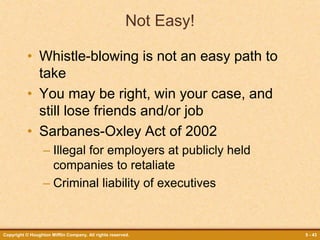
Not Easy!
• Whistle-blowing is not an easy path to
take
• You may be right, win your case, and
still lose friends and/or job
• Sarbanes-Oxley Act of 2002
– Illegal for employers at publicly held
companies to retaliate
– Criminal liability of executives
Copyright © Houghton Mifflin Company. All rights reserved. 5 - 44
Copyright © Houghton Mifflin Company. All rights reserved. 5 - 45
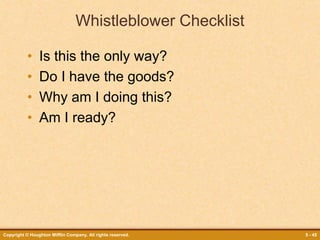
Whistleblower Checklist
• Is this the only way?
• Do I have the goods?
• Why am I doing this?
• Am I ready?
Copyright © Houghton Mifflin Company. All rights reserved. 5 - 46
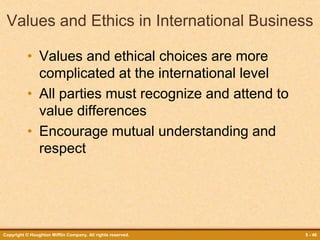
Values and Ethics in International Business
• Values and ethical choices are more
complicated at the international level
• All parties must recognize and attend to
value differences
• Encourage mutual understanding and
respect
Copyright © Houghton Mifflin Company. All rights reserved. 5 - 47
Values and Ethics in International Business
• Common ethical problems
– Bribery used to secure foreign contacts
– Human rights violations
– Lack of sensitivity to foreign customs
Copyright © Houghton Mifflin Company. All rights reserved. 5 - 48
Summary
• Strong sense of character grows from
personal standards of behavior
• Behaving according to values allows
you to maintain integrity
Copyright © Houghton Mifflin Company. All rights reserved. 5 - 49
Summary
• Values are the foundation for
– attitudes
– preferences
– opinions
– behavior
Copyright © Houghton Mifflin Company. All rights reserved. 5 - 50
Summary
• Values formed in early life and are
influenced by
– family
– religious beliefs
– schools
– the media
– role models
Copyright © Houghton Mifflin Company. All rights reserved. 5 - 51
Summary
• Internal conflicts arise when we must
choose between strongly held personal
values
• Conflicts with others are often based on
age, racial, religious, gender, or ethnic
differences
Copyright © Houghton Mifflin Company. All rights reserved. 5 - 52
Summary
• Value conflicts with others require
skilled interventions before they can be
resolved
• Clarified personal values make ethical
decisions easier
Copyright © Houghton Mifflin Company. All rights reserved. 5 - 53
Summary
• Shared values unifies employees by
providing guidelines for behavior and
decisions
• Corporate values and ethics are
receiving increased attention
Copyright © Houghton Mifflin Company. All rights reserved. 5 - 54
Summary
• Many organizations
– have ethics codes to help guide
employees’ behavior
– hire those who share their corporate values
and offer ethics training opportunities
• Growing international business presents
new ethical challenges

chapter05.ppt

  • 1.
  • 2.
    Copyright © HoughtonMifflin Company. All rights reserved. 5 - 2 Chapter Preview: Personal Values Influence Ethical Choices • Developing a strong sense of character • How values are formed • Value conflicts and how to resolve them • Making ethical decisions based on personal values • Corporate crime and steps to eliminate it
  • 3.
    Copyright © HoughtonMifflin Company. All rights reserved. 5 - 3 Character, Integrity and Moral Development • Character is composed of your personal standards of behavior including: – Honesty – Integrity – Moral strength
  • 4.
    Copyright © HoughtonMifflin Company. All rights reserved. 5 - 4 Integrity: A Dimension of Character • Integrity is congruence between what you – know – say – do • Practicing what you believe demonstrates integrity • Critical to successful relationships
  • 5.
    Copyright © HoughtonMifflin Company. All rights reserved. 5 - 5 A Valued Character Trait • People with integrity do what they say they will do • Are clear about what they stand for • Think hard about what is right and wrong
  • 6.
    Copyright © HoughtonMifflin Company. All rights reserved. 5 - 6 The Corrosion of Character • Richard Sennett believes decline of character can be traced to: – economic conditions • fast-paced, high stress • information-driven – limited connections • past • neighbors • selves
  • 7.
    Copyright © HoughtonMifflin Company. All rights reserved. 5 - 7 Character Development • Integrity can be developed • Make and keep promises to self and others • Many organizations and educational institutions believe in character training
  • 8.
    Copyright © HoughtonMifflin Company. All rights reserved. 5 - 8 Six Pillars of Character • According to the Josephson Institute of Ethics: – Trustworthiness Respect – Responsibility Fairness – Caring Citizenship
  • 9.
    Copyright © HoughtonMifflin Company. All rights reserved. 5 - 9 Total Person Insight People working together with integrity and authenticity and collective intelligence are profoundly more effective as a business than people living together based on politics, game playing, and narrow self-interest. Peter Senge Author, The Fifth Discipline
  • 10.
    Copyright © HoughtonMifflin Company. All rights reserved. 5 - 10 Personal Values • Values are personal beliefs and preferences that influence one’s behavior • Deep-seated in personality • Exist at different levels of awareness • Awareness of values enhances integrity
  • 11.
    Copyright © HoughtonMifflin Company. All rights reserved. 5 - 11 Five-Part Valuing Process to Clarify and Develop Values • Thinking – critical thinking – distinguishing fact from opinion • Feeling – listening to “gut level” • Communicating – listening closely – interacting with others
  • 12.
    Copyright © HoughtonMifflin Company. All rights reserved. 5 - 12 Five-Part Valuing Process to Clarify and Develop Values • Choosing – being well informed • Acting – repeatedly and consistently
  • 13.
    Copyright © HoughtonMifflin Company. All rights reserved. 5 - 13 Identifying Your Core Values • Core values are those that consistently rank higher than others • General principles and beliefs that guide intermediate and long-term goals • Influence the behavior of individuals and organizations
  • 14.
    Copyright © HoughtonMifflin Company. All rights reserved. 5 - 14 Values and Job Selection • We often must choose among core values – High salary – Security – Meaningful work – Lots of time off • Most choices require compromising at least one
  • 15.
    Copyright © HoughtonMifflin Company. All rights reserved. 5 - 15 Values Shaping Influences • Major influences that shape our values are: – People – Events – Family – Religious groups – Schools – The media
  • 16.
    Copyright © HoughtonMifflin Company. All rights reserved. 5 - 16
  • 17.
    Copyright © HoughtonMifflin Company. All rights reserved. 5 - 17 Family • Parents assume many roles • Most important role is moral teacher • Challenges to families: – single-parent households – two parents working outside the home – care for elderly parents – financial pressures
  • 18.
    Copyright © HoughtonMifflin Company. All rights reserved. 5 - 18 Religious Groups • Value priorities often developed through religious training – Religious doctrine – Role models • Many now seeking spiritual and moral anchors in both personal lives and work
  • 19.
    Copyright © HoughtonMifflin Company. All rights reserved. 5 - 19 Schools • Some see character education as fundamental aspect of education • Values clarification common part of curriculum in 70s • Objections and fears about imposing values, so much was eliminated • Resurgence in the movement today
  • 20.
    Copyright © HoughtonMifflin Company. All rights reserved. 5 - 20 Media • Viewers often see – people abusing and degrading each other without consequences – violence and antisocial behavior • Research connecting television viewing and – depression – desensitization of children
  • 21.
    Copyright © HoughtonMifflin Company. All rights reserved. 5 - 21 People We Admire • Modeling is shaping behavior to be like people you admire • Important for children and adults • Leaders in the workplace are important models for adults
  • 22.
    Copyright © HoughtonMifflin Company. All rights reserved. 5 - 22 Avoiding Values Drift • Values drift is the slow erosion of core values over time – exposure to conflicting situations – pressure to compromise • Reflect on core values when making decisions at work • Choose appropriate ethical behavior to maintain integrity
  • 23.
    Copyright © HoughtonMifflin Company. All rights reserved. 5 - 23 Avoiding Values Drift • Organizations must constantly ask the following questions: –What do we stand for? –Why do we exist? • Successful companies, through constant monitoring, adapt to a changing environment without losing sight of core values
  • 24.
    Copyright © HoughtonMifflin Company. All rights reserved. 5 - 24 Values Conflicts • Differences between individual’s personal values is major cause of values conflict • Problems may be due to conflicts between worker’s and the manager’s value systems
  • 25.
    Copyright © HoughtonMifflin Company. All rights reserved. 5 - 25 Values Conflicts • Organizations should look for value conflicts when addressing organizational problems – Declining quality – Absenteeism – Poor customer service
  • 26.
    Copyright © HoughtonMifflin Company. All rights reserved. 5 - 26 Total Person Insight If you want young people to take notions like right and wrong seriously, there is an indispensable condition: they must be in the presence of adults who take right and wrong seriously. William J. Bennett Author, The Book of Virtues
  • 27.
    Copyright © HoughtonMifflin Company. All rights reserved. 5 - 27 Internal Values Conflicts • Internal values conflict occurs when a person is caught between two or more strongly held values. • Value clarification minimizes conflicts • Value ranking makes decisions easier
  • 28.
    Copyright © HoughtonMifflin Company. All rights reserved. 5 - 28 Values Conflicts with Others • Interpersonal conflicts may arise between workers of different: – Ages – Races – Cultures – Ethnic backgrounds – Gender
  • 29.
    Copyright © HoughtonMifflin Company. All rights reserved. 5 - 29 Values Conflicts with Others • Can be highly emotional issues that disrupt friendships, work teams, and productivity • Often based on – Interpretations of work ethics – Priorities of work life and personal life • Responses to situations can be difficult and may require compromise
  • 30.
    Copyright © HoughtonMifflin Company. All rights reserved. 5 - 30 Personal Values and Ethical Choices • Ethics are principles that define behavior as – right – good – proper • Provides means of evaluating and deciding among options • Rules that direct your conduct and moral judgments
  • 31.
    Copyright © HoughtonMifflin Company. All rights reserved. 5 - 31 Personal Values and Ethical Choices • Jobs often present ethical dilemmas • Each organization has different ethical standards • Some feel pressure to violate ethical standards to meet business objectives • Often faced with multiple options – Rarely just one right and one wrong answer
  • 32.
    Copyright © HoughtonMifflin Company. All rights reserved. 5 - 32 The Right Choices • Learn to distinguish between right and wrong – Seek your employer’s code of ethics or the ethical code of your professional organization – Ask an experienced or trusted colleague – Restrain from choosing wrong path
  • 33.
    Copyright © HoughtonMifflin Company. All rights reserved. 5 - 33 The Right Choices • Make sure your values are in harmony with those of your employer – Leads to success for individuals and organizations – Provides a strong bond among all members of a work force
  • 34.
    Copyright © HoughtonMifflin Company. All rights reserved. 5 - 34 The Right Choices • Don’t let your life be driven by the desire for immediate gratification – People are often under pressure to show the trappings of success – Progress and prosperity have same meaning to many – Often means compromising values
  • 35.
    Copyright © HoughtonMifflin Company. All rights reserved. 5 - 35 Total Person Insight Nothing is more powerful for employees than seeing their managers behave according to their expressed values and standards: nothing is more devastating to the development of an ethical environment than a manager who violates the organization’s ethical standards. Dan Rice and Craig Dreilinger Authors, Rights and Wrongs of Ethics
  • 36.
    Copyright © HoughtonMifflin Company. All rights reserved. 5 - 36 Corporate Values and Ethical Choices • Good corporate citizens consistently make ethical decisions in the best interest of – Employees – Customers – Stockholders – The community
  • 37.
    Copyright © HoughtonMifflin Company. All rights reserved. 5 - 37 Corporate Values and Ethical Choices • Organizations get into serious trouble by ignoring ethical principles • “Gray-area” situations cause difficulty in choosing the right, ethical course of action • Even when right choice is clear, competitive pressure can lead to poor managerial decisions
  • 38.
    Copyright © HoughtonMifflin Company. All rights reserved. 5 - 38 How to Prevent Corporate Crime • Establish and support a strong code of ethics – Written statement of ethical expectations can be a powerful force in preventing unethical or criminal behavior – Research suggests that companies also need to create an “ethical climate”
  • 39.
    Copyright © HoughtonMifflin Company. All rights reserved. 5 - 39 How to Prevent Corporate Crime • Hire with care – Priority in hiring process – Identify a guiding set of values – Hire people who share values and can work together – Screening and integrity tests
  • 40.
    Copyright © HoughtonMifflin Company. All rights reserved. 5 - 40 How to Prevent Corporate Crime • Provide ethics training – Ethics codes developed and posted for employees to read – Provide opportunities for discussion of ethical decisions – Offer formal training sessions
  • 41.
    Copyright © HoughtonMifflin Company. All rights reserved. 5 - 41 How to Prevent Corporate Crime • Develop Support for Whistle-Blowing – Revealing wrongdoing within an organization – Three choices: • Keep quiet and keep working • Leave the situation • Report the situation
  • 42.
    Copyright © HoughtonMifflin Company. All rights reserved. 5 - 42 Total Person Insight All that is necessary for evil to triumph is for good men to do nothing Edmund Burke Nineteenth-century English political philosopher
  • 43.
    Copyright © HoughtonMifflin Company. All rights reserved. 5 - 43 Not Easy! • Whistle-blowing is not an easy path to take • You may be right, win your case, and still lose friends and/or job • Sarbanes-Oxley Act of 2002 – Illegal for employers at publicly held companies to retaliate – Criminal liability of executives
  • 44.
    Copyright © HoughtonMifflin Company. All rights reserved. 5 - 44
  • 45.
    Copyright © HoughtonMifflin Company. All rights reserved. 5 - 45 Whistleblower Checklist • Is this the only way? • Do I have the goods? • Why am I doing this? • Am I ready?
  • 46.
    Copyright © HoughtonMifflin Company. All rights reserved. 5 - 46 Values and Ethics in International Business • Values and ethical choices are more complicated at the international level • All parties must recognize and attend to value differences • Encourage mutual understanding and respect
  • 47.
    Copyright © HoughtonMifflin Company. All rights reserved. 5 - 47 Values and Ethics in International Business • Common ethical problems – Bribery used to secure foreign contacts – Human rights violations – Lack of sensitivity to foreign customs
  • 48.
    Copyright © HoughtonMifflin Company. All rights reserved. 5 - 48 Summary • Strong sense of character grows from personal standards of behavior • Behaving according to values allows you to maintain integrity
  • 49.
    Copyright © HoughtonMifflin Company. All rights reserved. 5 - 49 Summary • Values are the foundation for – attitudes – preferences – opinions – behavior
  • 50.
    Copyright © HoughtonMifflin Company. All rights reserved. 5 - 50 Summary • Values formed in early life and are influenced by – family – religious beliefs – schools – the media – role models
  • 51.
    Copyright © HoughtonMifflin Company. All rights reserved. 5 - 51 Summary • Internal conflicts arise when we must choose between strongly held personal values • Conflicts with others are often based on age, racial, religious, gender, or ethnic differences
  • 52.
    Copyright © HoughtonMifflin Company. All rights reserved. 5 - 52 Summary • Value conflicts with others require skilled interventions before they can be resolved • Clarified personal values make ethical decisions easier
  • 53.
    Copyright © HoughtonMifflin Company. All rights reserved. 5 - 53 Summary • Shared values unifies employees by providing guidelines for behavior and decisions • Corporate values and ethics are receiving increased attention
  • 54.
    Copyright © HoughtonMifflin Company. All rights reserved. 5 - 54 Summary • Many organizations – have ethics codes to help guide employees’ behavior – hire those who share their corporate values and offer ethics training opportunities • Growing international business presents new ethical challenges