DAY 1-2
Think and Tell
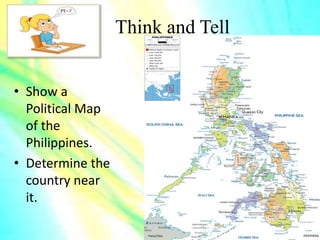
• Show a
Political Map
of the
Philippines.
• Determine the
country near
it.
Find Out and Learn
Place a poster in each corner of the room.
Then read a statement, and tell students to go
to the corner that best describes how they
feel about that statement. Here are some
examples of statements:
– The Philippines should handle alone the security
of the West Philippine Sea without any help from
any other countries.
– The United States of America should provide
direct assistance in the security of the West
Philippine Sea.
Find Out and Learn
– The issue on the security of the West Philippine
should be handle only of the countries in the
Southeast Asian Region.
– The USA should only provide military equipment
for the security of the West Philippine Sea and will
not directly involve in its security.
Encourage students to voice their opinions
from their respective corners. Then have
each group gathered in response to a
statement work together to write a clear
statement explaining their position.
Find Out and Learn
• What is your opinion about your desired
statements you have chosen?
• Should the USA have a direct involvement in the
following issue? Why or why not?
• Why do the Philippines should handle alone the
security of its territory?
• What can you say about the USA giving military
equipment for the security our territory? Will it
benefit us or the US?
• Should the security of the west Philippine sea be
handle by the accepting the direct assistance of
our Southeast Asian neighbors?
Try And Learn
Group Activity
The Teacher will provide certain activities to
be perform or discuss in the class after they
are finish.
Group I – Statement No. 3
Make a “Brainstorming Web”
Group II - Statement No. 4
Make a “Discussion Web”
Try And Learn
Group III - Statement No. 1
Make a Poem
Group IV - Statement 1 and 2
Make a “Venn Diagram”
Do And Learn
Debate
Group 1 and 2
Talk about the issue of the second statement.
Group 3 and 4
Talks about the issue of the third statement.
The two groups will draw lots to take the pros
and cons.
REMEMBER!
•What did you learn on the
following issues?
Write About It
• Bongbong on bilateral talks: China opened the
door, we shut it
MANILA, Philippines - Sen. Ferdinand "Bongbong"
Marcos Jr. perceives the Philippines' rejection of
bilateral talks with China as a wasted opportunity
to resolve the maritime dispute over the South
China Sea.
"China opened the door and we shut it. The
Chinese said let's talk and we snubbed them,"
Marcos said during a media forum, adding that
the country failed to take advantage of the given
opportunity.
Write About It
• READ: China to Philippines: Let's sit down and
talk
According to the senator, there are only three
ways to resolve the said dispute: by war,
adjudication or multilateral or bilateral
agreements.
Marcos ruled out war and arbitration since
the Chinese would not recognize the latter.
"So talk, and tell them: we are not happy with
what you are doing and we do not agree with
what you are doing. But the next thing you say is:
how do we fix this?" the senator said.
Write About It
The Senate Committee of Foreign Relations
chair noted that the Philippines will not lose
anything if accept China's invitation to a dialogue
on the maritime dispute.
"We should talk to China bilaterally because it
is still the best option. Our Filipino businessmen
can also help by reaching out to their Chinese
counterparts and friends in China and try to come
up with a solution that will persuade both
governments to, at least, sit down and negotiate,
or at most, resolve the problem outright," Marcos
said.
Write About It
Marcos stressed that the Philippines
should not be "snobbish" in dealing with
"superpower" China. He added that he cannot
see any reason not to talk with China.
"We're strategically important to any great
power in Asia-Pacific, but we have to play that
role even-handedly. We have to stop thinking
in terms of kakampi ko ang Chinese, kakampi
ko ang Kano. Ang kakampi mo lang Pilipino,"
the senator added.
Write About It
The Philippines sent a delegation to the
United Nations Arbitral Tribunal to defend its
stand against China's nine-dash line claim over
the South China Sea.
DAY 3
Think and Tell
Sample Outline
The Rock Cycle
Think and Tell
• Outlining is arranging notes so that important ideas
stand out and make clear which point supports
each of the important ideas.
– Things to remember in making an outline;
– The title for the outline should be used in the report
itself.
– Use Roman numerals I, II, III etc. to number topic from
the others.
– Use capital letters A, B, C, D, to indicate subheadings.
– Use Arabic numerals 1, 2, 3 to number detail headings.
Think and Tell
– Subdivisions of the same kind should fall under the
same alignment and indention: B under A, 2 under
1.
– A period is needed after the letter or number of
each heading but not after the heading itself.
– The first letter of each heading should be
capitalized. (Tell the pupils that the term main
headings is used for main ideas and subheadings for
the supporting details in an outline.
Find Out and Learn
Read the selection and have students reflect
on how the tour text activity supported their
understanding about the selection.
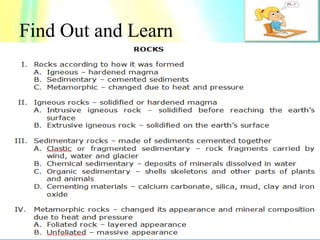
Rocks
There are many kinds of rocks. Generally,
according to how they are formed, rocks are
classified as igneous, sedimentary or
metamorphic.
Find Out and Learn
• Igneous Rocks
Deep within the earth’s surface exists
molten or melted materials known as magma.
This molten rock material is extremely hot
with temperature ranging from 749˚ to
1093˚C. High pressure may force the magma
to work its way upward to the earth’s surface
through the cracks or fissures. When these
molten rock materials cool off and solidify,
they form what we call igneous rocks which
mean “formed by fire.”
Find Out and Learn
Igneous rocks occur in two principal forms:
intrusive igneous rock and extrusive igneous
rock. Intrusive igneous rocks are igneous rocks
that do not rise all the way to the surface of
the earth. They hardened up before reaching
the earth’s surface. They have coarse mineral
grains and crystals that can be easily seen.
These are also called plutonic rocks. Extrusive
igneous rocks are formed and solidified on the
surface of the earth.
Find Out and Learn
They are usually fine grained, glassy or finely
crystalline in texture. Since these rocks are
formed from molten materials that are
expelled by volcanic eruptions, they are also
called volcanic rocks or pyroclastic rocks.
• Sedimentary Rocks
There are rocks that consist of materials
that were once was part of older rocks or of
plants and animal parts.
Find Out and Learn
These rocks were deposited millions of years
ago as layers of loose materials which become
cemented together. They are called
sedimentary rocks from the word “sediments”.
They are grouped into three: 1) classic or
fragmental sedimentary, 2) chemical
sedimentary, and 3) organic sedimentary.
Classic or fragmental sedimentary is
composed of rock fragments carried and
deposited by wind, water or glacier and are
cemented together.
Find Out and Learn
Chemical sedimentary is composed of
deposits of minerals dissolved in water. The
evaporation of water causes the minerals to
crystallize leaving mineral deposits. Organic
sedimentary is composed of shells, skeletons
and other parts of plants or animals.
Many different substances can act as
cement that bind the sedimentary rocks. Of
these, the most common are calcium
carbonate, silica, mud, clay and iron oxide.
Find Out and Learn
• Metamorphic Rock
Rocks that have changed its appearance and
sometimes its mineral composition due to either
extreme heat or pressure are called metamorphic
rocks. They often show a layered structure but
some are said to be massive. Metamorphic rocks
that layered in appearance are known as foliated
rocks while those that are massive are known as
unfoliated rocks. All kinds of rocks, including
igneous and sedimentary, usually undergo
metamorphism and produce the so called
metamorphic rocks.
Find Out and Learn
Answer the following questions.
1. What are the three main kinds of rocks?
2. What are the principal forms of igneous rocks?
3. What are the three groups of sedimentary rocks?
a. What make up clastic or fragmental sedimentary?
b. What make up chemical sedimentary?
c. What make up organic sedimentary?
4. What are the 2 kinds of metamorphic rock?
Differentiate.
5. What are our natural resources?
6. Why is it necessary to conserve our natural resources?
7. As young boys and girls, how can you help conserve
our mineral resources?
Find Out and Learn
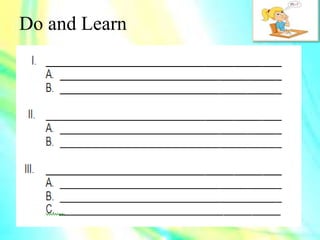
Here is a skeleton key of the outline that we will prepare.
I. ____________________________________________
A. ____________________________________________
B. ____________________________________________
C. ____________________________________________
II. ____________________________________________
A. ____________________________________________
B. ____________________________________________
III.____________________________________________
A. ____________________________________________
B. ____________________________________________
Find Out and Learn
C. _________________________________________
D. _________________________________________
IV.___________________________________________
A. _________________________________________
B. ____________________________________________
• What does the very first line at the top represent?
• What do the Roman numerals represent? What are
found after each Roman numeral?
• What do the capital letters represent?
• How are the capital letters written as compared with the
Roman numerals?
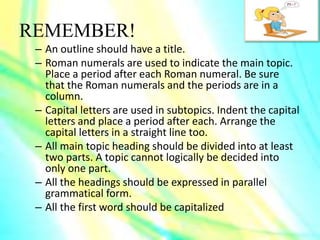
REMEMBER!
– An outline should have a title.
– Roman numerals are used to indicate the main topic.
Place a period after each Roman numeral. Be sure
that the Roman numerals and the periods are in a
column.
– Capital letters are used in subtopics. Indent the capital
letters and place a period after each. Arrange the
capital letters in a straight line too.
– All main topic heading should be divided into at least
two parts. A topic cannot logically be decided into
only one part.
– All the headings should be expressed in parallel
grammatical form.
– All the first word should be capitalized
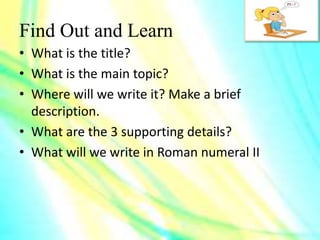
Find Out and Learn
• What is the title?
• What is the main topic?
• Where will we write it? Make a brief
description.
• What are the 3 supporting details?
• What will we write in Roman numeral II
Find Out and Learn
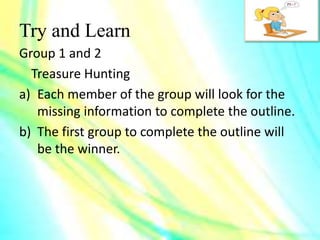
Try and Learn
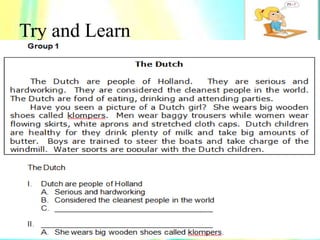
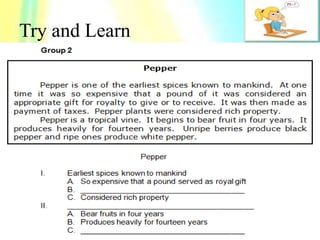
Group 1 and 2
Treasure Hunting
a) Each member of the group will look for the
missing information to complete the outline.
b) The first group to complete the outline will
be the winner.
Try and Learn
Try and Learn
Try and Learn
Group 3 and 4
Pairing/Brainstorming
Directions:
1. Read the selection/paragraph.
2. Discuss or share ideas with a partner.
3. Identify the main topic and subtopics.
4. Make an outline
Try and Learn
• Group 3
In some parts of the world, hundreds of
people are injured or killed by lightning strikes
each year. Most death occur out in the open
or under trees. To protect yourself from
lightning avoid isolated trees or tall structures.
Go to the bottom of the hill or ravine. Stay
inside your house home or building. Get out
of the shower or tub.
Try and Learn
• Group 4
The skin on your lips is especially sensitive. Dry
weather can cause it to chap and even crack.
Applying a moisturizer to your lips daily or as
needed can help. You can use a lip balm or skin
moisturizer. The greasier the product the better.
A humidifier to moisten the air in your home can
also help. In addition, avoid wetting your lips.
And if you’re outside for a long period of time,
cover your lips with a mask.
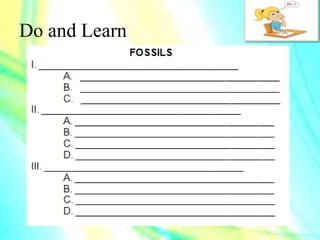
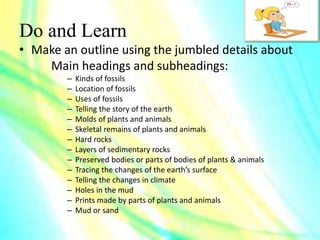
Do and Learn
• Make an outline using the jumbled details about
Main headings and subheadings:
– Kinds of fossils
– Location of fossils
– Uses of fossils
– Telling the story of the earth
– Molds of plants and animals
– Skeletal remains of plants and animals
– Hard rocks
– Layers of sedimentary rocks
– Preserved bodies or parts of bodies of plants & animals
– Tracing the changes of the earth’s surface
– Telling the changes in climate
– Holes in the mud
– Prints made by parts of plants and animals
– Mud or sand
Do and Learn
REMEMBER!
Outlining is arranging notes so that
important ideas stand out and make
clear which point suppots each of the
important ideas.
REMEMBER!
h. The title for the outline should be
used in the report itself.
i. Use Roman numerals I, II, III etc. to
number topic from the others.
j. Use capital letters A, B, C, D, to
indicate subheadings.
k. Use Arabic numerals 1, 2, 3 to
number detail headings.
REMEMBER!
l. Subdivisions of the same kind should fall
under the same alignment and indention: B
under A, 2 under 1.
m. A period is needed after the letter or
number of each heading but not after the
heading itself.
n. The first letter of each heading should be
capitalized. (Tell the pupils that the term
main headings is used for main ideas and
subheadings for the supporting details in an
outline.
Do and Learn
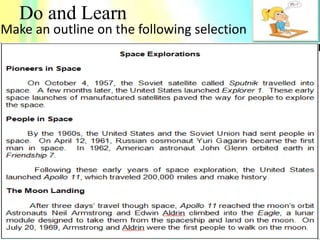
Make an outline on the following selection
Do and Learn
DAY 4
Think and Tell
Think and Tell
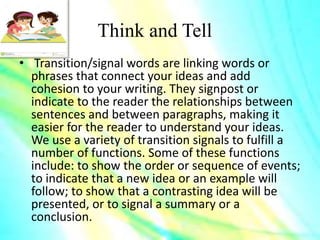
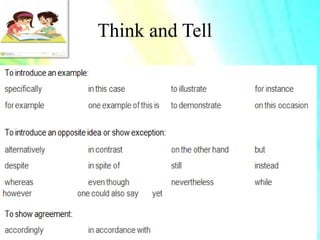
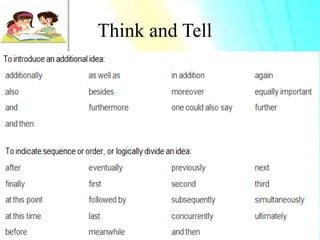
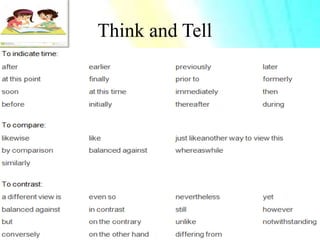
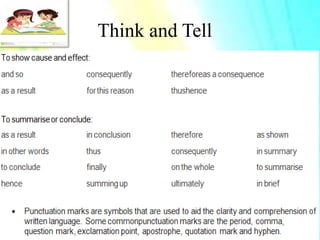
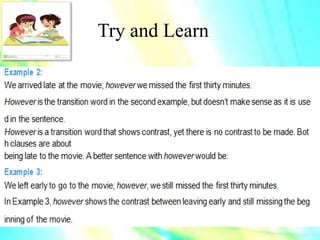
• Transition/signal words are linking words or
phrases that connect your ideas and add
cohesion to your writing. They signpost or
indicate to the reader the relationships between
sentences and between paragraphs, making it
easier for the reader to understand your ideas.
We use a variety of transition signals to fulfill a
number of functions. Some of these functions
include: to show the order or sequence of events;
to indicate that a new idea or an example will
follow; to show that a contrasting idea will be
presented, or to signal a summary or a
conclusion.
Think and Tell
Think and Tell
Think and Tell
Think and Tell
Find Out and Learn
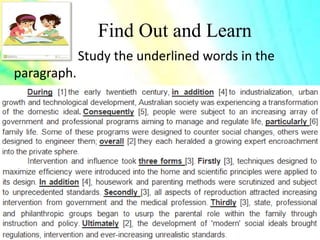
Study the underlined words in the
paragraph.
Find Out and Learn
[1] Indicating a specific time
[2] Indicating a conclusion
[3] To indicate sequence and logically divide an
idea
[4] Indicating extra information
[5] Indicating a result
[6] To add emphasis
Find Out and Learn
Answer the following.
• What does the first underlined word on the first
sentence indicate?
• How about the second underlined word, what does
it indicate?
• What are the transition words used in the second
sentence? What does each indicate?
• On the second paragraph, what are the transition
words used? What do they indicate?
• What are the punctuation marks mostly used in the
following paragraphs?
Try and Learn
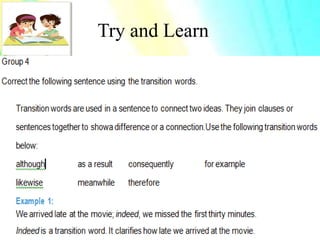
Group 1
When you write an essay, you need to use transitio
n words in order to connect ideas together.
Sequence: first, then, next, after that, thus,
therefore, in conclusion, lastly, to conclude
Try and Learn
Directions: Read each sentence and use a transitional word to s
how sequence.
Example A: I went to the restaurant. I sat next to my
friend.
Answer: I went to the restaurant. Then, I sat next to
my friend.
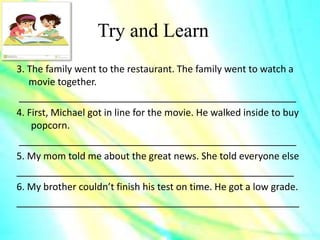
1. Susan played basketball at the park. Susan walked home.
_________________________________________________
2. John and David went to the movies. They went to get ice cre
am.
___________________________________________________
Try and Learn
3. The family went to the restaurant. The family went to watch a
movie together.
____________________________________________________
4. First, Michael got in line for the movie. He walked inside to buy
popcorn.
____________________________________________________
5. My mom told me about the great news. She told everyone else
____________________________________________________
6. My brother couldn’t finish his test on time. He got a low grade.
_____________________________________________________
Try and Learn
Group 2
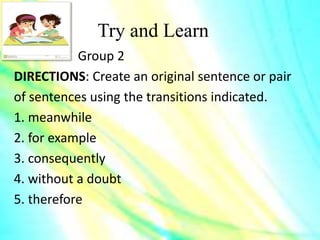
DIRECTIONS: Create an original sentence or pair
of sentences using the transitions indicated.
1. meanwhile
2. for example
3. consequently
4. without a doubt
5. therefore
Try and Learn
Group 3
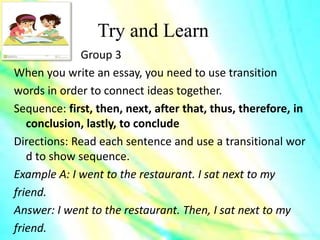
When you write an essay, you need to use transition
words in order to connect ideas together.
Sequence: first, then, next, after that, thus, therefore, in
conclusion, lastly, to conclude
Directions: Read each sentence and use a transitional wor
d to show sequence.
Example A: I went to the restaurant. I sat next to my
friend.
Answer: I went to the restaurant. Then, I sat next to my
friend.
Try and Learn
Try and Learn
Try and Learn
Try and Learn
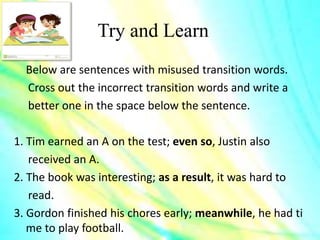
Below are sentences with misused transition words.
Cross out the incorrect transition words and write a
better one in the space below the sentence.
1. Tim earned an A on the test; even so, Justin also
received an A.
2. The book was interesting; as a result, it was hard to
read.
3. Gordon finished his chores early; meanwhile, he had ti
me to play football.
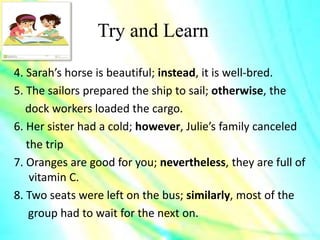
Try and Learn
4. Sarah’s horse is beautiful; instead, it is well-bred.
5. The sailors prepared the ship to sail; otherwise, the
dock workers loaded the cargo.
6. Her sister had a cold; however, Julie’s family canceled
the trip
7. Oranges are good for you; nevertheless, they are full of
vitamin C.
8. Two seats were left on the bus; similarly, most of the
group had to wait for the next on.
Do and Learn
Write 5 sentences that use transitional/signal
words. Observe proper punctuation marks.
Write it in your notebook.
REMEMBER!
Transition/signal words are linking
words or phrases that connect your
ideas and add cohesion to your
writing. They signpost or indicate to
the reader the relationships between
sentences and between paragraphs,
making it easier for the reader to
understand your ideas.
REMEMBER!
We use a variety of transition signals
to fulfill a number of functions. Some
of these functions include: to show the
order or sequence of events; to
indicate that a new idea or an example
will follow; to show that a contrasting
idea will be presented, or to signal a
summary or a conclusion.
REMEMBER!
Punctuation marks are symbols that
are used to aid the clarity and
comprehension of written language.
Some common punctuation marks are
the period, comma, question mark,
exclamation point, apostrophe,
quotation mark and hyphen.
Write and Learn
Select a topic from the list below. Write a
paragraph about that topic using at least three
transition words. Circle each transition word
used in your paragraph.
a sport eating healthy foods a vacation
a holiday living with a disability a pet
DAY 5
Think and Tell
Find Out and Learn
BAYANIHAN= KAPALPAKAN MO, PASAN-PASAN
KO!
• What can you say about the video clips?
• Describe the negative portrayal in our
government. What can you say about it?
• *According to the video clips, what can you
say about the parliamentary system? Will it
benefit our country? Give your opinions
about it.
Try and Learn
• Let the groups do the following activity.
Group 1
Make a “Cluster Map” on the video clips watch.
Group 2
Make a “Venn Diagram” about the parliamentary
system and our present government system?
Group 3
Compose a poem or a song about the video clip.
Group 4
Make a simple “Role Play” about the lessons of
the video clips.
Do and Learn
Watch the following video then make a simple
role play about it.
https://www.youtube.com/watch?v=2Dc-
lVLKTtY
Try and Learn
Watch the following videos then write 5
intelligent reactions about the concept of
how Filipino speak in English and how they
express it.
https://www.youtube.com/watch?v=UqlFT8zT8
V8

Q2 English Week 9.pptx

  • 2.
  • 3.
    Think and Tell •Show a Political Map of the Philippines. • Determine the country near it.
  • 4.
    Find Out andLearn Place a poster in each corner of the room. Then read a statement, and tell students to go to the corner that best describes how they feel about that statement. Here are some examples of statements: – The Philippines should handle alone the security of the West Philippine Sea without any help from any other countries. – The United States of America should provide direct assistance in the security of the West Philippine Sea.
  • 5.
    Find Out andLearn – The issue on the security of the West Philippine should be handle only of the countries in the Southeast Asian Region. – The USA should only provide military equipment for the security of the West Philippine Sea and will not directly involve in its security. Encourage students to voice their opinions from their respective corners. Then have each group gathered in response to a statement work together to write a clear statement explaining their position.
  • 6.
    Find Out andLearn • What is your opinion about your desired statements you have chosen? • Should the USA have a direct involvement in the following issue? Why or why not? • Why do the Philippines should handle alone the security of its territory? • What can you say about the USA giving military equipment for the security our territory? Will it benefit us or the US? • Should the security of the west Philippine sea be handle by the accepting the direct assistance of our Southeast Asian neighbors?
  • 7.
    Try And Learn GroupActivity The Teacher will provide certain activities to be perform or discuss in the class after they are finish. Group I – Statement No. 3 Make a “Brainstorming Web” Group II - Statement No. 4 Make a “Discussion Web”
  • 8.
    Try And Learn GroupIII - Statement No. 1 Make a Poem Group IV - Statement 1 and 2 Make a “Venn Diagram”
  • 9.
    Do And Learn Debate Group1 and 2 Talk about the issue of the second statement. Group 3 and 4 Talks about the issue of the third statement. The two groups will draw lots to take the pros and cons.
  • 10.
    REMEMBER! •What did youlearn on the following issues?
  • 11.
    Write About It •Bongbong on bilateral talks: China opened the door, we shut it MANILA, Philippines - Sen. Ferdinand "Bongbong" Marcos Jr. perceives the Philippines' rejection of bilateral talks with China as a wasted opportunity to resolve the maritime dispute over the South China Sea. "China opened the door and we shut it. The Chinese said let's talk and we snubbed them," Marcos said during a media forum, adding that the country failed to take advantage of the given opportunity.
  • 12.
    Write About It •READ: China to Philippines: Let's sit down and talk According to the senator, there are only three ways to resolve the said dispute: by war, adjudication or multilateral or bilateral agreements. Marcos ruled out war and arbitration since the Chinese would not recognize the latter. "So talk, and tell them: we are not happy with what you are doing and we do not agree with what you are doing. But the next thing you say is: how do we fix this?" the senator said.
  • 13.
    Write About It TheSenate Committee of Foreign Relations chair noted that the Philippines will not lose anything if accept China's invitation to a dialogue on the maritime dispute. "We should talk to China bilaterally because it is still the best option. Our Filipino businessmen can also help by reaching out to their Chinese counterparts and friends in China and try to come up with a solution that will persuade both governments to, at least, sit down and negotiate, or at most, resolve the problem outright," Marcos said.
  • 14.
    Write About It Marcosstressed that the Philippines should not be "snobbish" in dealing with "superpower" China. He added that he cannot see any reason not to talk with China. "We're strategically important to any great power in Asia-Pacific, but we have to play that role even-handedly. We have to stop thinking in terms of kakampi ko ang Chinese, kakampi ko ang Kano. Ang kakampi mo lang Pilipino," the senator added.
  • 15.
    Write About It ThePhilippines sent a delegation to the United Nations Arbitral Tribunal to defend its stand against China's nine-dash line claim over the South China Sea.
  • 16.
  • 17.
    Think and Tell SampleOutline The Rock Cycle
  • 18.
    Think and Tell •Outlining is arranging notes so that important ideas stand out and make clear which point supports each of the important ideas. – Things to remember in making an outline; – The title for the outline should be used in the report itself. – Use Roman numerals I, II, III etc. to number topic from the others. – Use capital letters A, B, C, D, to indicate subheadings. – Use Arabic numerals 1, 2, 3 to number detail headings.
  • 19.
    Think and Tell –Subdivisions of the same kind should fall under the same alignment and indention: B under A, 2 under 1. – A period is needed after the letter or number of each heading but not after the heading itself. – The first letter of each heading should be capitalized. (Tell the pupils that the term main headings is used for main ideas and subheadings for the supporting details in an outline.
  • 20.
    Find Out andLearn Read the selection and have students reflect on how the tour text activity supported their understanding about the selection. Rocks There are many kinds of rocks. Generally, according to how they are formed, rocks are classified as igneous, sedimentary or metamorphic.
  • 21.
    Find Out andLearn • Igneous Rocks Deep within the earth’s surface exists molten or melted materials known as magma. This molten rock material is extremely hot with temperature ranging from 749˚ to 1093˚C. High pressure may force the magma to work its way upward to the earth’s surface through the cracks or fissures. When these molten rock materials cool off and solidify, they form what we call igneous rocks which mean “formed by fire.”
  • 22.
    Find Out andLearn Igneous rocks occur in two principal forms: intrusive igneous rock and extrusive igneous rock. Intrusive igneous rocks are igneous rocks that do not rise all the way to the surface of the earth. They hardened up before reaching the earth’s surface. They have coarse mineral grains and crystals that can be easily seen. These are also called plutonic rocks. Extrusive igneous rocks are formed and solidified on the surface of the earth.
  • 23.
    Find Out andLearn They are usually fine grained, glassy or finely crystalline in texture. Since these rocks are formed from molten materials that are expelled by volcanic eruptions, they are also called volcanic rocks or pyroclastic rocks. • Sedimentary Rocks There are rocks that consist of materials that were once was part of older rocks or of plants and animal parts.
  • 24.
    Find Out andLearn These rocks were deposited millions of years ago as layers of loose materials which become cemented together. They are called sedimentary rocks from the word “sediments”. They are grouped into three: 1) classic or fragmental sedimentary, 2) chemical sedimentary, and 3) organic sedimentary. Classic or fragmental sedimentary is composed of rock fragments carried and deposited by wind, water or glacier and are cemented together.
  • 25.
    Find Out andLearn Chemical sedimentary is composed of deposits of minerals dissolved in water. The evaporation of water causes the minerals to crystallize leaving mineral deposits. Organic sedimentary is composed of shells, skeletons and other parts of plants or animals. Many different substances can act as cement that bind the sedimentary rocks. Of these, the most common are calcium carbonate, silica, mud, clay and iron oxide.
  • 26.
    Find Out andLearn • Metamorphic Rock Rocks that have changed its appearance and sometimes its mineral composition due to either extreme heat or pressure are called metamorphic rocks. They often show a layered structure but some are said to be massive. Metamorphic rocks that layered in appearance are known as foliated rocks while those that are massive are known as unfoliated rocks. All kinds of rocks, including igneous and sedimentary, usually undergo metamorphism and produce the so called metamorphic rocks.
  • 27.
    Find Out andLearn Answer the following questions. 1. What are the three main kinds of rocks? 2. What are the principal forms of igneous rocks? 3. What are the three groups of sedimentary rocks? a. What make up clastic or fragmental sedimentary? b. What make up chemical sedimentary? c. What make up organic sedimentary? 4. What are the 2 kinds of metamorphic rock? Differentiate. 5. What are our natural resources? 6. Why is it necessary to conserve our natural resources? 7. As young boys and girls, how can you help conserve our mineral resources?
  • 28.
    Find Out andLearn Here is a skeleton key of the outline that we will prepare. I. ____________________________________________ A. ____________________________________________ B. ____________________________________________ C. ____________________________________________ II. ____________________________________________ A. ____________________________________________ B. ____________________________________________ III.____________________________________________ A. ____________________________________________ B. ____________________________________________
  • 29.
    Find Out andLearn C. _________________________________________ D. _________________________________________ IV.___________________________________________ A. _________________________________________ B. ____________________________________________ • What does the very first line at the top represent? • What do the Roman numerals represent? What are found after each Roman numeral? • What do the capital letters represent? • How are the capital letters written as compared with the Roman numerals?
  • 30.
    REMEMBER! – An outlineshould have a title. – Roman numerals are used to indicate the main topic. Place a period after each Roman numeral. Be sure that the Roman numerals and the periods are in a column. – Capital letters are used in subtopics. Indent the capital letters and place a period after each. Arrange the capital letters in a straight line too. – All main topic heading should be divided into at least two parts. A topic cannot logically be decided into only one part. – All the headings should be expressed in parallel grammatical form. – All the first word should be capitalized
  • 31.
    Find Out andLearn • What is the title? • What is the main topic? • Where will we write it? Make a brief description. • What are the 3 supporting details? • What will we write in Roman numeral II
  • 32.
  • 33.
    Try and Learn Group1 and 2 Treasure Hunting a) Each member of the group will look for the missing information to complete the outline. b) The first group to complete the outline will be the winner.
  • 34.
  • 35.
  • 36.
    Try and Learn Group3 and 4 Pairing/Brainstorming Directions: 1. Read the selection/paragraph. 2. Discuss or share ideas with a partner. 3. Identify the main topic and subtopics. 4. Make an outline
  • 37.
    Try and Learn •Group 3 In some parts of the world, hundreds of people are injured or killed by lightning strikes each year. Most death occur out in the open or under trees. To protect yourself from lightning avoid isolated trees or tall structures. Go to the bottom of the hill or ravine. Stay inside your house home or building. Get out of the shower or tub.
  • 38.
    Try and Learn •Group 4 The skin on your lips is especially sensitive. Dry weather can cause it to chap and even crack. Applying a moisturizer to your lips daily or as needed can help. You can use a lip balm or skin moisturizer. The greasier the product the better. A humidifier to moisten the air in your home can also help. In addition, avoid wetting your lips. And if you’re outside for a long period of time, cover your lips with a mask.
  • 39.
    Do and Learn •Make an outline using the jumbled details about Main headings and subheadings: – Kinds of fossils – Location of fossils – Uses of fossils – Telling the story of the earth – Molds of plants and animals – Skeletal remains of plants and animals – Hard rocks – Layers of sedimentary rocks – Preserved bodies or parts of bodies of plants & animals – Tracing the changes of the earth’s surface – Telling the changes in climate – Holes in the mud – Prints made by parts of plants and animals – Mud or sand
  • 40.
  • 41.
    REMEMBER! Outlining is arrangingnotes so that important ideas stand out and make clear which point suppots each of the important ideas.
  • 42.
    REMEMBER! h. The titlefor the outline should be used in the report itself. i. Use Roman numerals I, II, III etc. to number topic from the others. j. Use capital letters A, B, C, D, to indicate subheadings. k. Use Arabic numerals 1, 2, 3 to number detail headings.
  • 43.
    REMEMBER! l. Subdivisions ofthe same kind should fall under the same alignment and indention: B under A, 2 under 1. m. A period is needed after the letter or number of each heading but not after the heading itself. n. The first letter of each heading should be capitalized. (Tell the pupils that the term main headings is used for main ideas and subheadings for the supporting details in an outline.
  • 44.
    Do and Learn Makean outline on the following selection
  • 45.
  • 46.
  • 47.
  • 48.
    Think and Tell •Transition/signal words are linking words or phrases that connect your ideas and add cohesion to your writing. They signpost or indicate to the reader the relationships between sentences and between paragraphs, making it easier for the reader to understand your ideas. We use a variety of transition signals to fulfill a number of functions. Some of these functions include: to show the order or sequence of events; to indicate that a new idea or an example will follow; to show that a contrasting idea will be presented, or to signal a summary or a conclusion.
  • 49.
  • 50.
  • 51.
  • 52.
  • 53.
    Find Out andLearn Study the underlined words in the paragraph.
  • 54.
    Find Out andLearn [1] Indicating a specific time [2] Indicating a conclusion [3] To indicate sequence and logically divide an idea [4] Indicating extra information [5] Indicating a result [6] To add emphasis
  • 55.
    Find Out andLearn Answer the following. • What does the first underlined word on the first sentence indicate? • How about the second underlined word, what does it indicate? • What are the transition words used in the second sentence? What does each indicate? • On the second paragraph, what are the transition words used? What do they indicate? • What are the punctuation marks mostly used in the following paragraphs?
  • 56.
    Try and Learn Group1 When you write an essay, you need to use transitio n words in order to connect ideas together. Sequence: first, then, next, after that, thus, therefore, in conclusion, lastly, to conclude
  • 57.
    Try and Learn Directions:Read each sentence and use a transitional word to s how sequence. Example A: I went to the restaurant. I sat next to my friend. Answer: I went to the restaurant. Then, I sat next to my friend. 1. Susan played basketball at the park. Susan walked home. _________________________________________________ 2. John and David went to the movies. They went to get ice cre am. ___________________________________________________
  • 58.
    Try and Learn 3.The family went to the restaurant. The family went to watch a movie together. ____________________________________________________ 4. First, Michael got in line for the movie. He walked inside to buy popcorn. ____________________________________________________ 5. My mom told me about the great news. She told everyone else ____________________________________________________ 6. My brother couldn’t finish his test on time. He got a low grade. _____________________________________________________
  • 59.
    Try and Learn Group2 DIRECTIONS: Create an original sentence or pair of sentences using the transitions indicated. 1. meanwhile 2. for example 3. consequently 4. without a doubt 5. therefore
  • 60.
    Try and Learn Group3 When you write an essay, you need to use transition words in order to connect ideas together. Sequence: first, then, next, after that, thus, therefore, in conclusion, lastly, to conclude Directions: Read each sentence and use a transitional wor d to show sequence. Example A: I went to the restaurant. I sat next to my friend. Answer: I went to the restaurant. Then, I sat next to my friend.
  • 61.
  • 62.
  • 63.
  • 64.
    Try and Learn Beloware sentences with misused transition words. Cross out the incorrect transition words and write a better one in the space below the sentence. 1. Tim earned an A on the test; even so, Justin also received an A. 2. The book was interesting; as a result, it was hard to read. 3. Gordon finished his chores early; meanwhile, he had ti me to play football.
  • 65.
    Try and Learn 4.Sarah’s horse is beautiful; instead, it is well-bred. 5. The sailors prepared the ship to sail; otherwise, the dock workers loaded the cargo. 6. Her sister had a cold; however, Julie’s family canceled the trip 7. Oranges are good for you; nevertheless, they are full of vitamin C. 8. Two seats were left on the bus; similarly, most of the group had to wait for the next on.
  • 66.
    Do and Learn Write5 sentences that use transitional/signal words. Observe proper punctuation marks. Write it in your notebook.
  • 67.
    REMEMBER! Transition/signal words arelinking words or phrases that connect your ideas and add cohesion to your writing. They signpost or indicate to the reader the relationships between sentences and between paragraphs, making it easier for the reader to understand your ideas.
  • 68.
    REMEMBER! We use avariety of transition signals to fulfill a number of functions. Some of these functions include: to show the order or sequence of events; to indicate that a new idea or an example will follow; to show that a contrasting idea will be presented, or to signal a summary or a conclusion.
  • 69.
    REMEMBER! Punctuation marks aresymbols that are used to aid the clarity and comprehension of written language. Some common punctuation marks are the period, comma, question mark, exclamation point, apostrophe, quotation mark and hyphen.
  • 70.
    Write and Learn Selecta topic from the list below. Write a paragraph about that topic using at least three transition words. Circle each transition word used in your paragraph. a sport eating healthy foods a vacation a holiday living with a disability a pet
  • 71.
  • 72.
  • 73.
    Find Out andLearn BAYANIHAN= KAPALPAKAN MO, PASAN-PASAN KO! • What can you say about the video clips? • Describe the negative portrayal in our government. What can you say about it? • *According to the video clips, what can you say about the parliamentary system? Will it benefit our country? Give your opinions about it.
  • 74.
    Try and Learn •Let the groups do the following activity. Group 1 Make a “Cluster Map” on the video clips watch. Group 2 Make a “Venn Diagram” about the parliamentary system and our present government system? Group 3 Compose a poem or a song about the video clip. Group 4 Make a simple “Role Play” about the lessons of the video clips.
  • 75.
    Do and Learn Watchthe following video then make a simple role play about it. https://www.youtube.com/watch?v=2Dc- lVLKTtY
  • 76.
    Try and Learn Watchthe following videos then write 5 intelligent reactions about the concept of how Filipino speak in English and how they express it. https://www.youtube.com/watch?v=UqlFT8zT8 V8