Objectives  Explain the purpose and various phases of the traditional systems development life cycle (SDLC) Explain when to use an adaptive approach to the SDLC in place of the more predictive traditional SDLC Describe how the more adaptive Unified Process (UP) life cycle uses iterative and incremental development Explain the differences between a model, a tool, a technique, and a methodology Object-Oriented Analysis and Design with the Unified Process
Objectives (continued) Describe the Unified Process as a comprehensive system development methodology that combines proven best practices with the iterative UP life cycle Describe the disciplines used in a UP development project Describe the key features of the object-oriented approach Explain how automated tools are used in system development Object-Oriented Analysis and Design with the Unified Process
Overview Traditional systems development life cycle (SDLC) Unified Process (UP) Iterative, incremental, adaptive approach to life cycle  Nine disciplines: six for system development, three for support Review object-oriented (OO) concepts  Describe computer support tools such as CASE  Apply UP to the development project of RMO Object-Oriented Analysis and Design with the Unified Process
Part 1 Object-Oriented Concepts Object-Oriented Analysis and Design with the Unified Process
Object-Oriented Concepts   Object-oriented analysis (OOA) Views a system as a collection of objects Executable software entities capable of responding to messages Represent real world things Required to solve the business problem Object-oriented design (OOD) Defines additional types of objects – GUI, database, communications Shows how the objects interact to complete tasks that solve the business problem Refines definition of objects from analysis to design to implementation Object-oriented programming (OOP): code the classes VB.NET, C#.Net, Java, C++, Simula67 (1 st  OOP language) Object-Oriented Analysis and Design with the Unified Process
  Recognizing the Benefits of OO Development   Original application of object-oriented technology Computer simulations  Graphical user interfaces Rationale for use in information systems Benefits of naturalness Reusability    Object-Oriented Analysis and Design with the Unified Process
Objects Are More Natural   OO approach mirrors human perception: objects moving through space  Some system developers resist OO development New programmers are more receptive to OO approach System users appreciate object-orientation They discuss the objects involved in their work Hierarchies are common tools for organizing knowledge Object-Oriented Analysis and Design with the Unified Process
Classes of Objects Can Be Reused   Classes of objects have a long shelf life Example: Customer class adaptability  Reused in systems where customer objects needed Extended through inheritance to a new subclass  Reused during analysis, design, and programming Classes may be stored, with implementation hidden, in class libraries Object-Oriented Analysis and Design with the Unified Process
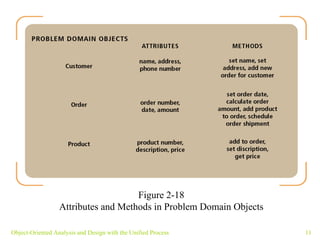
Understanding Object-Oriented Concepts Object: thing with attributes and behaviors  Types of objects User interface, Problem domain, Database, Etc. Attributes are associated with data Behaviors are associated with methods, functions, and procedures Object-Oriented Analysis and Design with the Unified Process
Object-Oriented Analysis and Design with the Unified Process Figure 2-18 Attributes and Methods in Problem Domain Objects
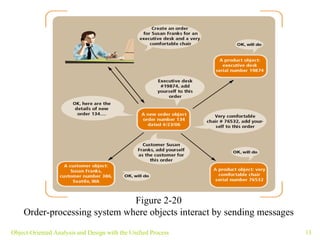
Understanding Object-Oriented Concepts (continued) Class: defines what all objects of a class represent Objects are instances of a class Customer object is an instance of a customer class Objects interact through messages Objects retain memory of transactions if persisted  Object-Oriented Analysis and Design with the Unified Process
Object-Oriented Analysis and Design with the Unified Process Figure 2-20 Order-processing system where objects interact by sending messages
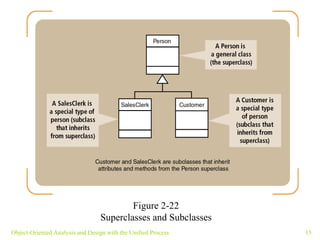
Understanding Object-Oriented Concepts (continued) Objects maintain associations (relationships) Encapsulation: combining attributes and methods into one unit Information hiding: attributes are private Inheritance: a class derives itself from another class Polymorphism: the same message be executed on different classes  Object-Oriented Analysis and Design with the Unified Process
Object-Oriented Analysis and Design with the Unified Process Figure 2-22 Superclasses and Subclasses
Part 2 The Unified Process Object-Oriented Analysis and Design with the Unified Process
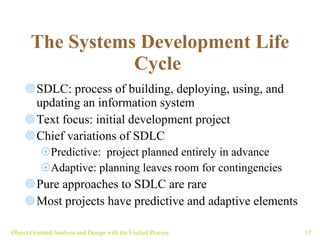
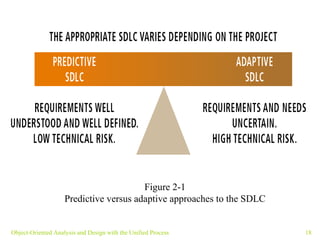
  The Systems Development Life Cycle   SDLC: process of building, deploying, using, and updating an information system  Text focus: initial development project Chief variations of SDLC  Predictive:  project planned entirely in advance  Adaptive: planning leaves room for contingencies Pure approaches to SDLC are rare  Most projects have predictive and adaptive elements Object-Oriented Analysis and Design with the Unified Process
Object-Oriented Analysis and Design with the Unified Process Figure 2-1 Predictive versus adaptive approaches to the SDLC
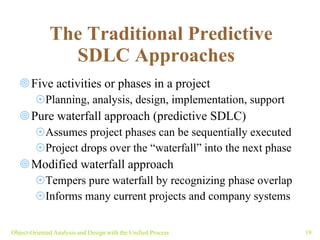
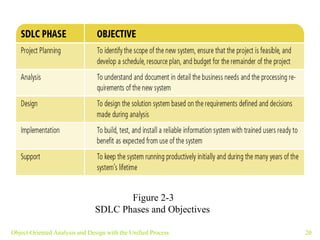
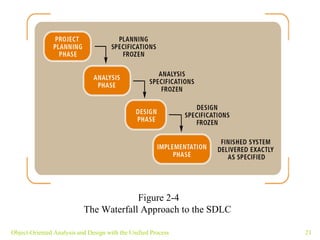
  The Traditional Predictive SDLC Approaches   Five activities or phases in a project Planning, analysis, design, implementation, support  Pure waterfall approach (predictive SDLC) Assumes project phases can be sequentially executed Project drops over the “waterfall” into the next phase Modified waterfall approach Tempers pure waterfall by recognizing phase overlap Informs many current projects and company systems Object-Oriented Analysis and Design with the Unified Process
Object-Oriented Analysis and Design with the Unified Process Figure 2-3 SDLC Phases and Objectives
Object-Oriented Analysis and Design with the Unified Process Figure 2-4 The Waterfall Approach to the SDLC
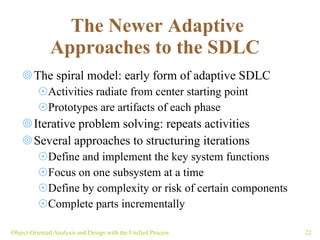
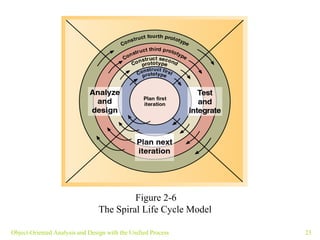
The Newer Adaptive Approaches to the SDLC   The spiral model: early form of adaptive SDLC Activities radiate from center starting point Prototypes are artifacts of each phase Iterative problem solving: repeats activities  Several approaches to structuring iterations  Define and implement the key system functions  Focus on one subsystem at a time Define by complexity or risk of certain components  Complete parts incrementally  Object-Oriented Analysis and Design with the Unified Process
Object-Oriented Analysis and Design with the Unified Process Figure 2-6 The Spiral Life Cycle Model
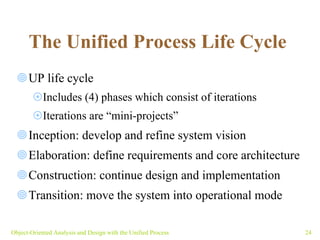
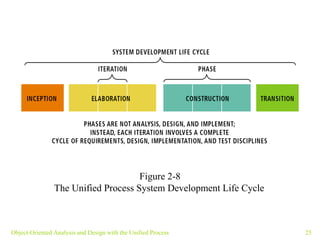
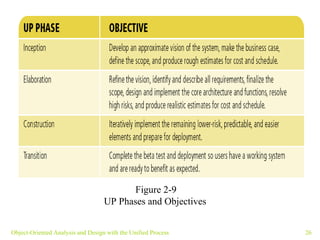
The Unified Process Life Cycle   UP life cycle Includes (4) phases which consist of iterations Iterations are “mini-projects”  Inception: develop and refine system vision Elaboration: define requirements and core architecture Construction: continue design and implementation Transition: move the system into operational mode Object-Oriented Analysis and Design with the Unified Process
Object-Oriented Analysis and Design with the Unified Process Figure 2-8 The Unified Process System Development Life Cycle
Object-Oriented Analysis and Design with the Unified Process Figure 2-9 UP Phases and Objectives
Methodologies, Models, Tools, and Techniques System development life cycle one of many models Analysts have a wide variety of aids beyond SDLC Object-Oriented Analysis and Design with the Unified Process
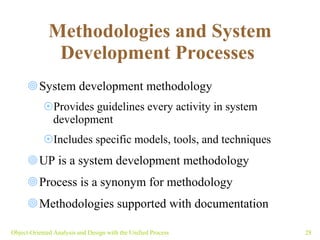
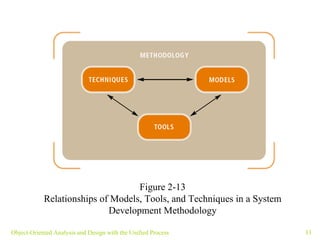
Methodologies and System Development Processes   System development methodology Provides guidelines every activity in system development Includes specific models, tools, and techniques UP is a system development methodology Process is a synonym for methodology  Methodologies supported with documentation  Object-Oriented Analysis and Design with the Unified Process
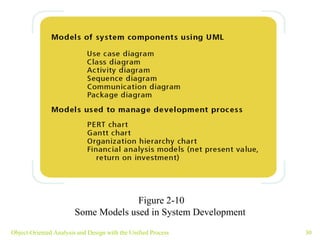
Models   Model abstract (separate) aspects of the real world Models come in many forms Physical analogs, mathematical, graphical System development models are highly abstract  Depict inputs, outputs, processes, data, objects,  interactions, locations, networks, and devices Unified Modeling Language (UML): standard notation PERT or Gantt charts: model project itself Object-Oriented Analysis and Design with the Unified Process
Object-Oriented Analysis and Design with the Unified Process Figure 2-10 Some Models used in System Development
Tools   Tool: software used to create models or components  Example tools  Project management software tools (Microsoft Project) Integrated development environments (IDEs) Code generators Computer-aided system engineering (CASE) - Jude Object-Oriented Analysis and Design with the Unified Process
Techniques   Technique Collection of guidelines  Enables an analyst to complete an activity or task Example techniques Domain-modeling , use case modeling, software-testing, user-interviewing techniques, relational database design techniques Proven techniques are embraced as “Best Practices” Object-Oriented Analysis and Design with the Unified Process
Object-Oriented Analysis and Design with the Unified Process Figure 2-13 Relationships of Models, Tools, and Techniques in a System Development Methodology
The Unified Process as a System Development Methodology   UP:  object-oriented system development methodology  UP should be tailored to organizational and project needs Project will be  use case driven Use case  Activity that the system carries out  Basis for defining requirements and designs  Object-Oriented Analysis and Design with the Unified Process
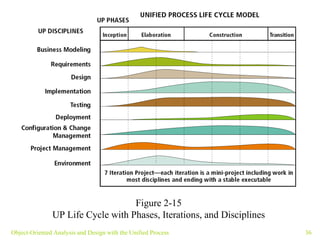
The Unified Process as a System Development Methodology   (continued) UP defines disciplines within each phase Discipline: set of functionally related activities  Iterations include activities from all disciplines  Activities in each discipline produce artifacts;  models, documents, source code, and executables  Object-Oriented Analysis and Design with the Unified Process
Object-Oriented Analysis and Design with the Unified Process Figure 2-15 UP Life Cycle with Phases, Iterations, and Disciplines
The UP Disciplines   Six main UP development disciplines Business modeling, requirements, design, implementation, testing, and deployment Each iteration  Similar to a mini-project Results in a completed portion of the system Three additional support disciplines Project management, configuration and change management, and environment Object-Oriented Analysis and Design with the Unified Process
Business Modeling   Purpose: understand business environment  Three major activities part of business modeling Understand surroundings  Create the system vision Create business models Object-Oriented Analysis and Design with the Unified Process
Requirements   Objective: document business requirements  Key drivers of activities: discovery and understanding Requirements discipline and business modeling map to traditional systems analysis Activities list Gather detailed information Define functional and nonfunctional requirements Develop user interface dialogs Evaluate requirements with users Object-Oriented Analysis and Design with the Unified Process
Design   Objective: design system based on requirements Six major activities in the design discipline Design support services architecture and deployment environment Design the software architecture Design use case realizations Design the database Design the system and user interfaces Design the system security and controls   Object-Oriented Analysis and Design with the Unified Process
Implementation   Objective: build or acquire needed system components Implementation activities  Build software components Acquire software components Integrate software components Object-Oriented Analysis and Design with the Unified Process
Testing  Testing is critical discipline Testing activities Define and conduct unit testing Define and conduct integration testing Define and conduct usability testing Define and conduct user acceptance testing In UP, acceptance testing occurs throughout the  building phase Object-Oriented Analysis and Design with the Unified Process
Deployment   Goal: conduct activities to make system operational Deployment activities  Acquire hardware and system software Package and install components Train users Convert and initialize data Deployment activities prominent in transition phase Object-Oriented Analysis and Design with the Unified Process
Project Management   Most important support discipline Project management activities Finalize the system and project scope Develop the project and iteration schedule Identify project risks and confirm feasibility Monitor and control the project’s plan  Monitor and control communications Monitor and control risks and outstanding issues Object-Oriented Analysis and Design with the Unified Process
Configuration and Change Management   Configuration and change discipline pertains to: Requirements Design Source code Executables The two activities in this discipline  Develop change control procedures Manage models and software components Object-Oriented Analysis and Design with the Unified Process
Environment   Development environment includes Available facilities Design of the workspace Forums for  team communication and interaction Environment discipline activities Select and configure the development tools Tailor the UP development process Provide technical support services Object-Oriented Analysis and Design with the Unified Process
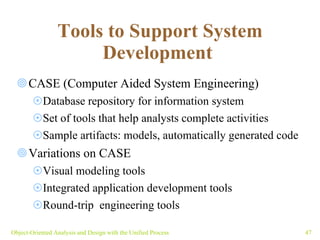
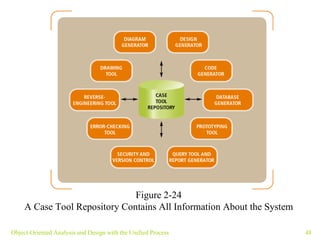
Tools to Support System Development   CASE (Computer Aided System Engineering) Database repository for information system Set of tools that help analysts complete activities  Sample artifacts: models, automatically generated code Variations on CASE Visual modeling tools Integrated application development tools Round-trip  engineering tools Object-Oriented Analysis and Design with the Unified Process
Object-Oriented Analysis and Design with the Unified Process Figure 2-24 A Case Tool Repository Contains All Information About the System
Tools to Support System Development (continued)   Microsoft Visio - emphasizes technical drawing  Rational Rose – IBM product XDE Professional Integrates  Microsoft Visual Studio.NET IDE   Together Jude Object-Oriented Analysis and Design with the Unified Process
Summary SDLC: set of activities required to complete system development project Predictive SDLC: executes project in sequential phases (waterfall approach) Adaptive SDLC: accommodates change and phase overlap Spiral SDLC model introduces iterations (cycles)  UP is an adaptive system development methodology UP life cycle includes four phases- inception, elaboration, construction, and transition  UP phases decomposed into one ore more iterations Iterations involve work in nine UP disciplines UP is object-oriented  Object-oriented concepts: object, class, methods, encapsulation, associations, inheritance, polymorphism  CASE: automation tools simplify development tasks Object-Oriented Analysis and Design with the Unified Process
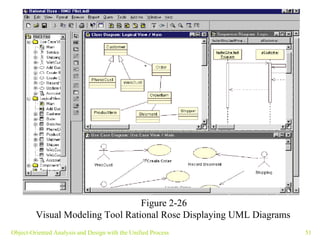
Object-Oriented Analysis and Design with the Unified Process Figure 2-26 Visual Modeling Tool Rational Rose Displaying UML Diagrams
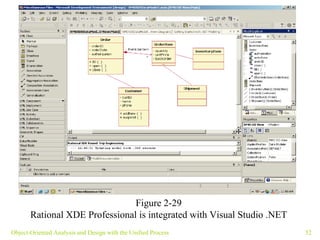
Object-Oriented Analysis and Design with the Unified Process Figure 2-29 Rational XDE Professional is integrated with Visual Studio .NET

Chapter02

  • 1.
  • 2.
    Objectives Explainthe purpose and various phases of the traditional systems development life cycle (SDLC) Explain when to use an adaptive approach to the SDLC in place of the more predictive traditional SDLC Describe how the more adaptive Unified Process (UP) life cycle uses iterative and incremental development Explain the differences between a model, a tool, a technique, and a methodology Object-Oriented Analysis and Design with the Unified Process
  • 3.
    Objectives (continued) Describethe Unified Process as a comprehensive system development methodology that combines proven best practices with the iterative UP life cycle Describe the disciplines used in a UP development project Describe the key features of the object-oriented approach Explain how automated tools are used in system development Object-Oriented Analysis and Design with the Unified Process
  • 4.
    Overview Traditional systemsdevelopment life cycle (SDLC) Unified Process (UP) Iterative, incremental, adaptive approach to life cycle Nine disciplines: six for system development, three for support Review object-oriented (OO) concepts Describe computer support tools such as CASE Apply UP to the development project of RMO Object-Oriented Analysis and Design with the Unified Process
  • 5.
    Part 1 Object-OrientedConcepts Object-Oriented Analysis and Design with the Unified Process
  • 6.
    Object-Oriented Concepts Object-oriented analysis (OOA) Views a system as a collection of objects Executable software entities capable of responding to messages Represent real world things Required to solve the business problem Object-oriented design (OOD) Defines additional types of objects – GUI, database, communications Shows how the objects interact to complete tasks that solve the business problem Refines definition of objects from analysis to design to implementation Object-oriented programming (OOP): code the classes VB.NET, C#.Net, Java, C++, Simula67 (1 st OOP language) Object-Oriented Analysis and Design with the Unified Process
  • 7.
      Recognizing theBenefits of OO Development Original application of object-oriented technology Computer simulations Graphical user interfaces Rationale for use in information systems Benefits of naturalness Reusability   Object-Oriented Analysis and Design with the Unified Process
  • 8.
    Objects Are MoreNatural OO approach mirrors human perception: objects moving through space Some system developers resist OO development New programmers are more receptive to OO approach System users appreciate object-orientation They discuss the objects involved in their work Hierarchies are common tools for organizing knowledge Object-Oriented Analysis and Design with the Unified Process
  • 9.
    Classes of ObjectsCan Be Reused Classes of objects have a long shelf life Example: Customer class adaptability Reused in systems where customer objects needed Extended through inheritance to a new subclass Reused during analysis, design, and programming Classes may be stored, with implementation hidden, in class libraries Object-Oriented Analysis and Design with the Unified Process
  • 10.
    Understanding Object-Oriented ConceptsObject: thing with attributes and behaviors Types of objects User interface, Problem domain, Database, Etc. Attributes are associated with data Behaviors are associated with methods, functions, and procedures Object-Oriented Analysis and Design with the Unified Process
  • 11.
    Object-Oriented Analysis andDesign with the Unified Process Figure 2-18 Attributes and Methods in Problem Domain Objects
  • 12.
    Understanding Object-Oriented Concepts(continued) Class: defines what all objects of a class represent Objects are instances of a class Customer object is an instance of a customer class Objects interact through messages Objects retain memory of transactions if persisted Object-Oriented Analysis and Design with the Unified Process
  • 13.
    Object-Oriented Analysis andDesign with the Unified Process Figure 2-20 Order-processing system where objects interact by sending messages
  • 14.
    Understanding Object-Oriented Concepts(continued) Objects maintain associations (relationships) Encapsulation: combining attributes and methods into one unit Information hiding: attributes are private Inheritance: a class derives itself from another class Polymorphism: the same message be executed on different classes Object-Oriented Analysis and Design with the Unified Process
  • 15.
    Object-Oriented Analysis andDesign with the Unified Process Figure 2-22 Superclasses and Subclasses
  • 16.
    Part 2 TheUnified Process Object-Oriented Analysis and Design with the Unified Process
  • 17.
      The SystemsDevelopment Life Cycle SDLC: process of building, deploying, using, and updating an information system Text focus: initial development project Chief variations of SDLC Predictive: project planned entirely in advance Adaptive: planning leaves room for contingencies Pure approaches to SDLC are rare Most projects have predictive and adaptive elements Object-Oriented Analysis and Design with the Unified Process
  • 18.
    Object-Oriented Analysis andDesign with the Unified Process Figure 2-1 Predictive versus adaptive approaches to the SDLC
  • 19.
      The TraditionalPredictive SDLC Approaches Five activities or phases in a project Planning, analysis, design, implementation, support Pure waterfall approach (predictive SDLC) Assumes project phases can be sequentially executed Project drops over the “waterfall” into the next phase Modified waterfall approach Tempers pure waterfall by recognizing phase overlap Informs many current projects and company systems Object-Oriented Analysis and Design with the Unified Process
  • 20.
    Object-Oriented Analysis andDesign with the Unified Process Figure 2-3 SDLC Phases and Objectives
  • 21.
    Object-Oriented Analysis andDesign with the Unified Process Figure 2-4 The Waterfall Approach to the SDLC
  • 22.
    The Newer AdaptiveApproaches to the SDLC The spiral model: early form of adaptive SDLC Activities radiate from center starting point Prototypes are artifacts of each phase Iterative problem solving: repeats activities Several approaches to structuring iterations Define and implement the key system functions Focus on one subsystem at a time Define by complexity or risk of certain components Complete parts incrementally Object-Oriented Analysis and Design with the Unified Process
  • 23.
    Object-Oriented Analysis andDesign with the Unified Process Figure 2-6 The Spiral Life Cycle Model
  • 24.
    The Unified ProcessLife Cycle UP life cycle Includes (4) phases which consist of iterations Iterations are “mini-projects” Inception: develop and refine system vision Elaboration: define requirements and core architecture Construction: continue design and implementation Transition: move the system into operational mode Object-Oriented Analysis and Design with the Unified Process
  • 25.
    Object-Oriented Analysis andDesign with the Unified Process Figure 2-8 The Unified Process System Development Life Cycle
  • 26.
    Object-Oriented Analysis andDesign with the Unified Process Figure 2-9 UP Phases and Objectives
  • 27.
    Methodologies, Models, Tools,and Techniques System development life cycle one of many models Analysts have a wide variety of aids beyond SDLC Object-Oriented Analysis and Design with the Unified Process
  • 28.
    Methodologies and SystemDevelopment Processes System development methodology Provides guidelines every activity in system development Includes specific models, tools, and techniques UP is a system development methodology Process is a synonym for methodology Methodologies supported with documentation Object-Oriented Analysis and Design with the Unified Process
  • 29.
    Models Model abstract (separate) aspects of the real world Models come in many forms Physical analogs, mathematical, graphical System development models are highly abstract Depict inputs, outputs, processes, data, objects, interactions, locations, networks, and devices Unified Modeling Language (UML): standard notation PERT or Gantt charts: model project itself Object-Oriented Analysis and Design with the Unified Process
  • 30.
    Object-Oriented Analysis andDesign with the Unified Process Figure 2-10 Some Models used in System Development
  • 31.
    Tools Tool: software used to create models or components Example tools Project management software tools (Microsoft Project) Integrated development environments (IDEs) Code generators Computer-aided system engineering (CASE) - Jude Object-Oriented Analysis and Design with the Unified Process
  • 32.
    Techniques Technique Collection of guidelines Enables an analyst to complete an activity or task Example techniques Domain-modeling , use case modeling, software-testing, user-interviewing techniques, relational database design techniques Proven techniques are embraced as “Best Practices” Object-Oriented Analysis and Design with the Unified Process
  • 33.
    Object-Oriented Analysis andDesign with the Unified Process Figure 2-13 Relationships of Models, Tools, and Techniques in a System Development Methodology
  • 34.
    The Unified Processas a System Development Methodology UP: object-oriented system development methodology UP should be tailored to organizational and project needs Project will be use case driven Use case Activity that the system carries out Basis for defining requirements and designs Object-Oriented Analysis and Design with the Unified Process
  • 35.
    The Unified Processas a System Development Methodology (continued) UP defines disciplines within each phase Discipline: set of functionally related activities Iterations include activities from all disciplines Activities in each discipline produce artifacts; models, documents, source code, and executables Object-Oriented Analysis and Design with the Unified Process
  • 36.
    Object-Oriented Analysis andDesign with the Unified Process Figure 2-15 UP Life Cycle with Phases, Iterations, and Disciplines
  • 37.
    The UP Disciplines Six main UP development disciplines Business modeling, requirements, design, implementation, testing, and deployment Each iteration Similar to a mini-project Results in a completed portion of the system Three additional support disciplines Project management, configuration and change management, and environment Object-Oriented Analysis and Design with the Unified Process
  • 38.
    Business Modeling Purpose: understand business environment Three major activities part of business modeling Understand surroundings Create the system vision Create business models Object-Oriented Analysis and Design with the Unified Process
  • 39.
    Requirements Objective: document business requirements Key drivers of activities: discovery and understanding Requirements discipline and business modeling map to traditional systems analysis Activities list Gather detailed information Define functional and nonfunctional requirements Develop user interface dialogs Evaluate requirements with users Object-Oriented Analysis and Design with the Unified Process
  • 40.
    Design Objective: design system based on requirements Six major activities in the design discipline Design support services architecture and deployment environment Design the software architecture Design use case realizations Design the database Design the system and user interfaces Design the system security and controls Object-Oriented Analysis and Design with the Unified Process
  • 41.
    Implementation Objective: build or acquire needed system components Implementation activities Build software components Acquire software components Integrate software components Object-Oriented Analysis and Design with the Unified Process
  • 42.
    Testing Testingis critical discipline Testing activities Define and conduct unit testing Define and conduct integration testing Define and conduct usability testing Define and conduct user acceptance testing In UP, acceptance testing occurs throughout the building phase Object-Oriented Analysis and Design with the Unified Process
  • 43.
    Deployment Goal: conduct activities to make system operational Deployment activities Acquire hardware and system software Package and install components Train users Convert and initialize data Deployment activities prominent in transition phase Object-Oriented Analysis and Design with the Unified Process
  • 44.
    Project Management Most important support discipline Project management activities Finalize the system and project scope Develop the project and iteration schedule Identify project risks and confirm feasibility Monitor and control the project’s plan Monitor and control communications Monitor and control risks and outstanding issues Object-Oriented Analysis and Design with the Unified Process
  • 45.
    Configuration and ChangeManagement Configuration and change discipline pertains to: Requirements Design Source code Executables The two activities in this discipline Develop change control procedures Manage models and software components Object-Oriented Analysis and Design with the Unified Process
  • 46.
    Environment Development environment includes Available facilities Design of the workspace Forums for team communication and interaction Environment discipline activities Select and configure the development tools Tailor the UP development process Provide technical support services Object-Oriented Analysis and Design with the Unified Process
  • 47.
    Tools to SupportSystem Development CASE (Computer Aided System Engineering) Database repository for information system Set of tools that help analysts complete activities Sample artifacts: models, automatically generated code Variations on CASE Visual modeling tools Integrated application development tools Round-trip engineering tools Object-Oriented Analysis and Design with the Unified Process
  • 48.
    Object-Oriented Analysis andDesign with the Unified Process Figure 2-24 A Case Tool Repository Contains All Information About the System
  • 49.
    Tools to SupportSystem Development (continued) Microsoft Visio - emphasizes technical drawing Rational Rose – IBM product XDE Professional Integrates Microsoft Visual Studio.NET IDE Together Jude Object-Oriented Analysis and Design with the Unified Process
  • 50.
    Summary SDLC: setof activities required to complete system development project Predictive SDLC: executes project in sequential phases (waterfall approach) Adaptive SDLC: accommodates change and phase overlap Spiral SDLC model introduces iterations (cycles) UP is an adaptive system development methodology UP life cycle includes four phases- inception, elaboration, construction, and transition UP phases decomposed into one ore more iterations Iterations involve work in nine UP disciplines UP is object-oriented Object-oriented concepts: object, class, methods, encapsulation, associations, inheritance, polymorphism CASE: automation tools simplify development tasks Object-Oriented Analysis and Design with the Unified Process
  • 51.
    Object-Oriented Analysis andDesign with the Unified Process Figure 2-26 Visual Modeling Tool Rational Rose Displaying UML Diagrams
  • 52.
    Object-Oriented Analysis andDesign with the Unified Process Figure 2-29 Rational XDE Professional is integrated with Visual Studio .NET