McGraw-Hill/Irwin © 2008 The McGraw-Hill Companies, Inc., All Rights Reserved.
Efficient Diversification
CHAPTER 6
6-2
6.1 DIVERSIFICATION AND
PORTFOLIO RISK
6-3
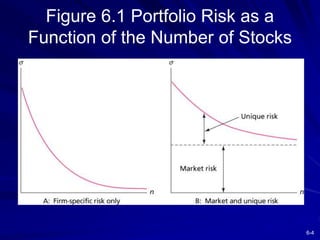
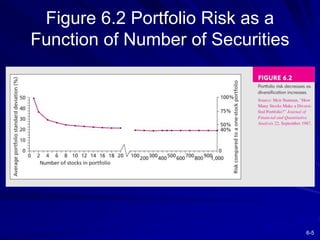
Diversification and Portfolio Risk
Market risk
– Systematic or Nondiversifiable
Firm-specific risk
– Diversifiable or nonsystematic
6-4
Figure 6.1 Portfolio Risk as a
Function of the Number of Stocks
6-5
Figure 6.2 Portfolio Risk as a
Function of Number of Securities
6-6
6.2 ASSET ALLOCATION WITH
TWO RISKY ASSETS
6-7
Covariance and Correlation
Portfolio risk depends on the correlation
between the returns of the assets in the
portfolio
Covariance and the correlation coefficient
provide a measure of the returns on two
assets to vary
6-8
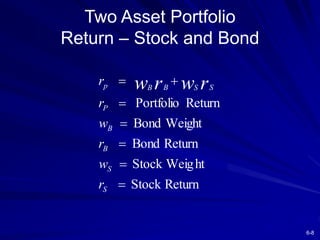
Two Asset Portfolio
Return – Stock and Bond
Return
Stock
ht
Stock Weig
Return
Bond
Weight
Bond
Return
Portfolio







S
S
B
B
P
S
S
B
B
p
r
w
r
w
r
r r
w
r
w
6-9
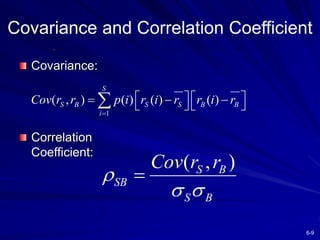
Covariance and Correlation Coefficient
Covariance:
Correlation
Coefficient:
1
( , ) ( ) ( ) ( )
S
S B S S B B
i
Cov r r p i r i r r i r

   
  
   

( , )
S B
SB
S B
Cov r r

 

6-10
Correlation Coefficients:
Possible Values
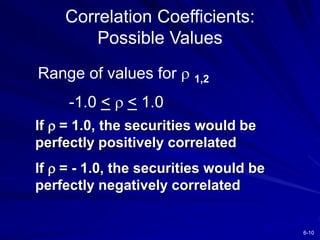
If  = 1.0, the securities would be
perfectly positively correlated
If  = - 1.0, the securities would be
perfectly negatively correlated
Range of values for  1,2
-1.0 <  < 1.0
6-11
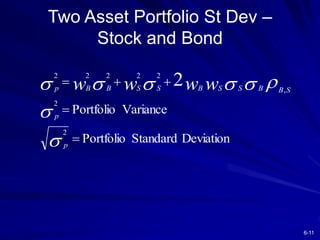
Two Asset Portfolio St Dev –
Stock and Bond
Deviation
Standard
Portfolio
Variance
Portfolio
2
2
,
2
2
2
2
2
2













p
p
S
B
B
S
S
B
S
S
B
B
p w
w
w
w
6-12
rp = Weighted average of the
n securities
p
2 = (Consider all pair-wise
covariance measures)
In General, For an n-Security Portfolio:
6-13
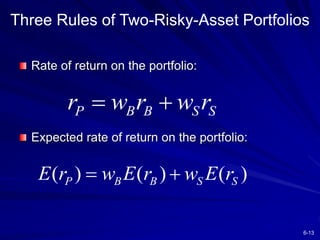
Three Rules of Two-Risky-Asset Portfolios
Rate of return on the portfolio:
Expected rate of return on the portfolio:
P B B S S
r w r w r
 
( ) ( ) ( )
P B B S S
E r w E r w E r
 
6-14
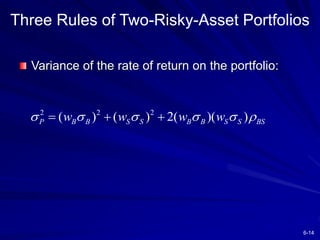
Three Rules of Two-Risky-Asset Portfolios
Variance of the rate of return on the portfolio:
2 2 2
( ) ( ) 2( )( )
P B B S S B B S S BS
w w w w
     
  
6-15
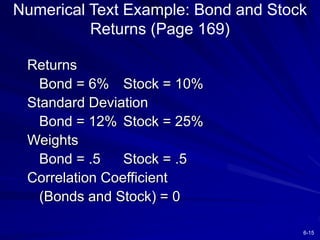
Numerical Text Example: Bond and Stock
Returns (Page 169)
Returns
Bond = 6% Stock = 10%
Standard Deviation
Bond = 12% Stock = 25%
Weights
Bond = .5 Stock = .5
Correlation Coefficient
(Bonds and Stock) = 0
6-16
Numerical Text Example: Bond and Stock
Returns (Page 169)
Return = 8%
.5(6) + .5 (10)
Standard Deviation = 13.87%
[(.5)2 (12)2 + (.5)2 (25)2 + …
2 (.5) (.5) (12) (25) (0)] ½
[192.25] ½ = 13.87
6-17
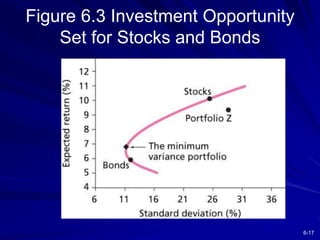
Figure 6.3 Investment Opportunity
Set for Stocks and Bonds
6-18
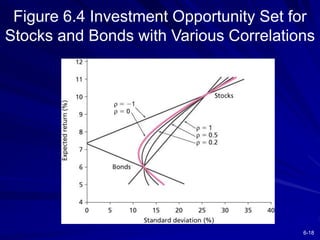
Figure 6.4 Investment Opportunity Set for
Stocks and Bonds with Various Correlations
6-19
6.3 THE OPTIMAL RISKY PORTFOLIO
WITH A RISK-FREE ASSET
6-20
Extending to Include Riskless Asset
The optimal combination becomes linear
A single combination of risky and riskless
assets will dominate
6-21
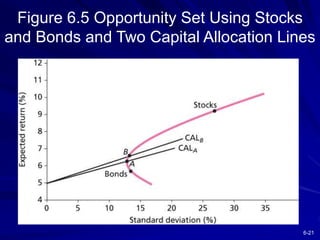
Figure 6.5 Opportunity Set Using Stocks
and Bonds and Two Capital Allocation Lines
6-22
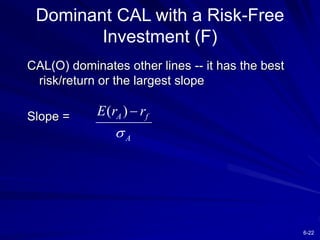
Dominant CAL with a Risk-Free
Investment (F)
CAL(O) dominates other lines -- it has the best
risk/return or the largest slope
Slope = ( )
A f
A
E r r


6-23
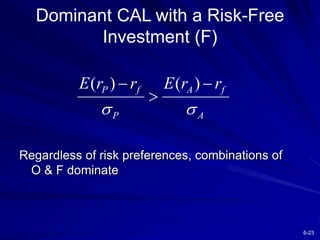
Dominant CAL with a Risk-Free
Investment (F)
Regardless of risk preferences, combinations of
O & F dominate
( ) ( )
P f A f
P A
E r r E r r
 
 

6-24
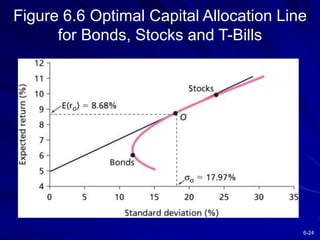
Figure 6.6 Optimal Capital Allocation Line
for Bonds, Stocks and T-Bills
6-25
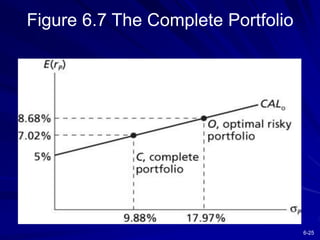
Figure 6.7 The Complete Portfolio
6-26
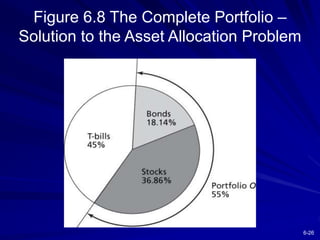
Figure 6.8 The Complete Portfolio –
Solution to the Asset Allocation Problem
6-27
6.4 EFFICIENT DIVERSIFICATION WITH
MANY RISKY ASSETS
6-28
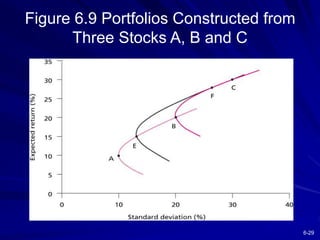
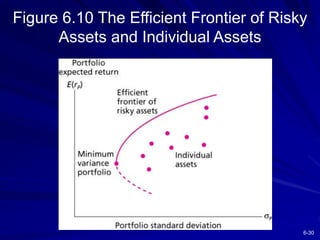
Extending Concepts to All Securities
The optimal combinations result in lowest
level of risk for a given return
The optimal trade-off is described as the
efficient frontier
These portfolios are dominant
6-29
Figure 6.9 Portfolios Constructed from
Three Stocks A, B and C
6-30
Figure 6.10 The Efficient Frontier of Risky
Assets and Individual Assets
6-31
6.5 A SINGLE-FACTOR ASSET MARKET
6-32
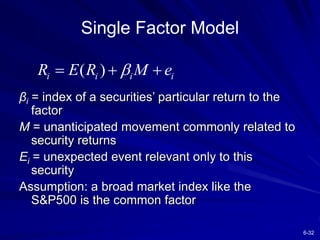
Single Factor Model
βi = index of a securities’ particular return to the
factor
M = unanticipated movement commonly related to
security returns
Ei = unexpected event relevant only to this
security
Assumption: a broad market index like the
S&P500 is the common factor
( )
i i i i
R E R M e

  
6-33
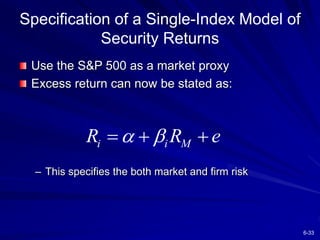
Specification of a Single-Index Model of
Security Returns
Use the S&P 500 as a market proxy
Excess return can now be stated as:
– This specifies the both market and firm risk
i i M
R R e
 
  
6-34
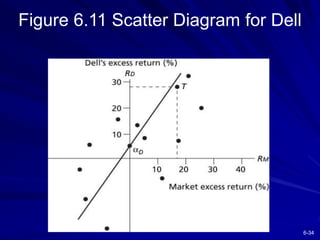
Figure 6.11 Scatter Diagram for Dell
6-35
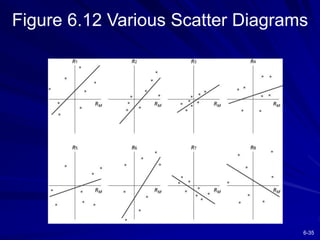
Figure 6.12 Various Scatter Diagrams
6-36
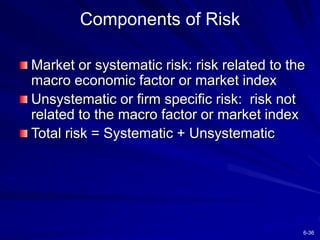
Components of Risk
Market or systematic risk: risk related to the
macro economic factor or market index
Unsystematic or firm specific risk: risk not
related to the macro factor or market index
Total risk = Systematic + Unsystematic
6-37
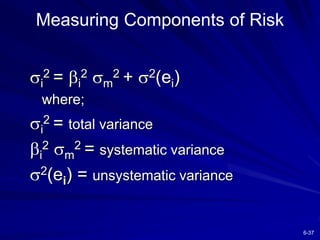
Measuring Components of Risk
i
2 = i
2 m
2 + 2(ei)
where;
i
2 = total variance
i
2 m
2 = systematic variance
2(ei) = unsystematic variance
6-38
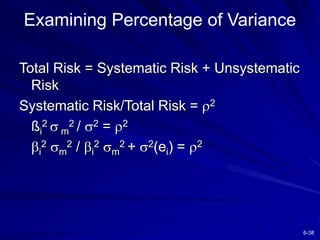
Total Risk = Systematic Risk + Unsystematic
Risk
Systematic Risk/Total Risk = 2
ßi
2  m
2 / 2 = 2
i
2 m
2 / i
2 m
2 + 2(ei) = 2
Examining Percentage of Variance
6-39
Advantages of the Single Index Model
Reduces the number of inputs for
diversification
Easier for security analysts to specialize
6-40
6.6 RISK OF LONG-TERM INVESTMENTS
6-41
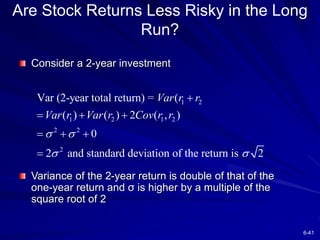
Are Stock Returns Less Risky in the Long
Run?
Consider a 2-year investment
Variance of the 2-year return is double of that of the
one-year return and σ is higher by a multiple of the
square root of 2
1 2
1 2 1 2
2 2
2
Var (2-year total return) = (
( ) ( ) 2 ( , )
0
2 and standard deviation of the return is 2
Var r r
Var r Var r Cov r r
 
 

  
  

6-42
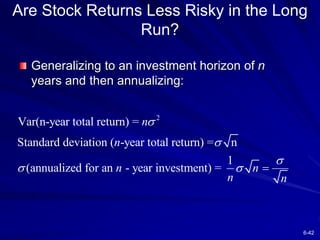
Are Stock Returns Less Risky in the Long
Run?
Generalizing to an investment horizon of n
years and then annualizing:
2
Var(n-year total return) =
Standard deviation ( -year total return) = n
1
(annualized for an - year investment) =
n
n
n n
n n



  
6-43
The Fly in the ‘Time Diversification’
Ointment
Annualized standard deviation is only appropriate
for short-term portfolios
Variance grows linearly with the number of years
Standard deviation grows in proportion to n
6-44
The Fly in the ‘Time Diversification’
Ointment
To compare investments in two different
time periods:
– Risk of the total (end of horizon) rate of return
– Accounts for magnitudes and probabilities

Chapter_006.ppt

  • 1.
    McGraw-Hill/Irwin © 2008The McGraw-Hill Companies, Inc., All Rights Reserved. Efficient Diversification CHAPTER 6
  • 2.
  • 3.
    6-3 Diversification and PortfolioRisk Market risk – Systematic or Nondiversifiable Firm-specific risk – Diversifiable or nonsystematic
  • 4.
    6-4 Figure 6.1 PortfolioRisk as a Function of the Number of Stocks
  • 5.
    6-5 Figure 6.2 PortfolioRisk as a Function of Number of Securities
  • 6.
    6-6 6.2 ASSET ALLOCATIONWITH TWO RISKY ASSETS
  • 7.
    6-7 Covariance and Correlation Portfoliorisk depends on the correlation between the returns of the assets in the portfolio Covariance and the correlation coefficient provide a measure of the returns on two assets to vary
  • 8.
    6-8 Two Asset Portfolio Return– Stock and Bond Return Stock ht Stock Weig Return Bond Weight Bond Return Portfolio        S S B B P S S B B p r w r w r r r w r w
  • 9.
    6-9 Covariance and CorrelationCoefficient Covariance: Correlation Coefficient: 1 ( , ) ( ) ( ) ( ) S S B S S B B i Cov r r p i r i r r i r              ( , ) S B SB S B Cov r r    
  • 10.
    6-10 Correlation Coefficients: Possible Values If = 1.0, the securities would be perfectly positively correlated If  = - 1.0, the securities would be perfectly negatively correlated Range of values for  1,2 -1.0 <  < 1.0
  • 11.
    6-11 Two Asset PortfolioSt Dev – Stock and Bond Deviation Standard Portfolio Variance Portfolio 2 2 , 2 2 2 2 2 2              p p S B B S S B S S B B p w w w w
  • 12.
    6-12 rp = Weightedaverage of the n securities p 2 = (Consider all pair-wise covariance measures) In General, For an n-Security Portfolio:
  • 13.
    6-13 Three Rules ofTwo-Risky-Asset Portfolios Rate of return on the portfolio: Expected rate of return on the portfolio: P B B S S r w r w r   ( ) ( ) ( ) P B B S S E r w E r w E r  
  • 14.
    6-14 Three Rules ofTwo-Risky-Asset Portfolios Variance of the rate of return on the portfolio: 2 2 2 ( ) ( ) 2( )( ) P B B S S B B S S BS w w w w         
  • 15.
    6-15 Numerical Text Example:Bond and Stock Returns (Page 169) Returns Bond = 6% Stock = 10% Standard Deviation Bond = 12% Stock = 25% Weights Bond = .5 Stock = .5 Correlation Coefficient (Bonds and Stock) = 0
  • 16.
    6-16 Numerical Text Example:Bond and Stock Returns (Page 169) Return = 8% .5(6) + .5 (10) Standard Deviation = 13.87% [(.5)2 (12)2 + (.5)2 (25)2 + … 2 (.5) (.5) (12) (25) (0)] ½ [192.25] ½ = 13.87
  • 17.
    6-17 Figure 6.3 InvestmentOpportunity Set for Stocks and Bonds
  • 18.
    6-18 Figure 6.4 InvestmentOpportunity Set for Stocks and Bonds with Various Correlations
  • 19.
    6-19 6.3 THE OPTIMALRISKY PORTFOLIO WITH A RISK-FREE ASSET
  • 20.
    6-20 Extending to IncludeRiskless Asset The optimal combination becomes linear A single combination of risky and riskless assets will dominate
  • 21.
    6-21 Figure 6.5 OpportunitySet Using Stocks and Bonds and Two Capital Allocation Lines
  • 22.
    6-22 Dominant CAL witha Risk-Free Investment (F) CAL(O) dominates other lines -- it has the best risk/return or the largest slope Slope = ( ) A f A E r r  
  • 23.
    6-23 Dominant CAL witha Risk-Free Investment (F) Regardless of risk preferences, combinations of O & F dominate ( ) ( ) P f A f P A E r r E r r     
  • 24.
    6-24 Figure 6.6 OptimalCapital Allocation Line for Bonds, Stocks and T-Bills
  • 25.
    6-25 Figure 6.7 TheComplete Portfolio
  • 26.
    6-26 Figure 6.8 TheComplete Portfolio – Solution to the Asset Allocation Problem
  • 27.
    6-27 6.4 EFFICIENT DIVERSIFICATIONWITH MANY RISKY ASSETS
  • 28.
    6-28 Extending Concepts toAll Securities The optimal combinations result in lowest level of risk for a given return The optimal trade-off is described as the efficient frontier These portfolios are dominant
  • 29.
    6-29 Figure 6.9 PortfoliosConstructed from Three Stocks A, B and C
  • 30.
    6-30 Figure 6.10 TheEfficient Frontier of Risky Assets and Individual Assets
  • 31.
  • 32.
    6-32 Single Factor Model βi= index of a securities’ particular return to the factor M = unanticipated movement commonly related to security returns Ei = unexpected event relevant only to this security Assumption: a broad market index like the S&P500 is the common factor ( ) i i i i R E R M e    
  • 33.
    6-33 Specification of aSingle-Index Model of Security Returns Use the S&P 500 as a market proxy Excess return can now be stated as: – This specifies the both market and firm risk i i M R R e     
  • 34.
    6-34 Figure 6.11 ScatterDiagram for Dell
  • 35.
    6-35 Figure 6.12 VariousScatter Diagrams
  • 36.
    6-36 Components of Risk Marketor systematic risk: risk related to the macro economic factor or market index Unsystematic or firm specific risk: risk not related to the macro factor or market index Total risk = Systematic + Unsystematic
  • 37.
    6-37 Measuring Components ofRisk i 2 = i 2 m 2 + 2(ei) where; i 2 = total variance i 2 m 2 = systematic variance 2(ei) = unsystematic variance
  • 38.
    6-38 Total Risk =Systematic Risk + Unsystematic Risk Systematic Risk/Total Risk = 2 ßi 2  m 2 / 2 = 2 i 2 m 2 / i 2 m 2 + 2(ei) = 2 Examining Percentage of Variance
  • 39.
    6-39 Advantages of theSingle Index Model Reduces the number of inputs for diversification Easier for security analysts to specialize
  • 40.
    6-40 6.6 RISK OFLONG-TERM INVESTMENTS
  • 41.
    6-41 Are Stock ReturnsLess Risky in the Long Run? Consider a 2-year investment Variance of the 2-year return is double of that of the one-year return and σ is higher by a multiple of the square root of 2 1 2 1 2 1 2 2 2 2 Var (2-year total return) = ( ( ) ( ) 2 ( , ) 0 2 and standard deviation of the return is 2 Var r r Var r Var r Cov r r            
  • 42.
    6-42 Are Stock ReturnsLess Risky in the Long Run? Generalizing to an investment horizon of n years and then annualizing: 2 Var(n-year total return) = Standard deviation ( -year total return) = n 1 (annualized for an - year investment) = n n n n n n      
  • 43.
    6-43 The Fly inthe ‘Time Diversification’ Ointment Annualized standard deviation is only appropriate for short-term portfolios Variance grows linearly with the number of years Standard deviation grows in proportion to n
  • 44.
    6-44 The Fly inthe ‘Time Diversification’ Ointment To compare investments in two different time periods: – Risk of the total (end of horizon) rate of return – Accounts for magnitudes and probabilities