A SEMINAR ON
LIPOSOMES IN DRUG
DELIVERY
1
By:Rajesh L. Dumpala
(B.Pharm, M. Pharm.) PhD. ( Pursuing)
Research Scientist,
Alembic Research Centre. Vadodara
E.Mail:-rdumpala64@gmail.com
 Introduction
 Structural components
 Rationale , Advantages and Disadvantages
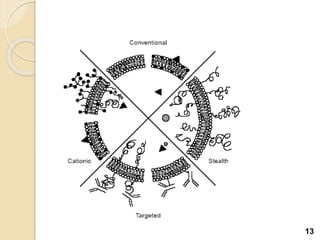
 Types of liposomes
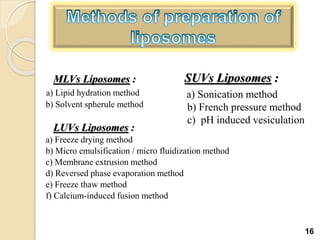
 Methods of preparation of liposomes
 Characterization of liposomes
 Pharmacokinetic & Pharmacodynamic of liposome
encapsulated drugs
 Stability of liposomes
 Recent advances
 Applications
 Marketed formulations of liposome products
 References
2
 Liposomes were first described by British haematologist
Dr. Alec D Bangham in 1961 (published 1964), at the
Babraham institute, Cambridge.
 The name liposome is derived from two Greek words
'Lipid' meaning fat and 'Soma' meaning body.
Definitions :
 Bangham et al.,1965 : Simple microscopic vesicles in
which an aqueous volume is entirely enclosed by a
membrane composed of lipid molecule.
 Weiner N. et al.,1989 : As a microstructure consisting of
one or more concentric spheres of lipid bilayer separated
by water or aqueous buffer compartments.
3
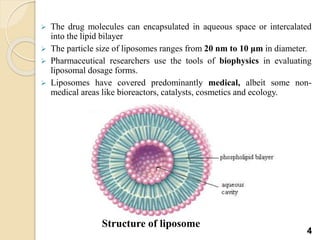
 The drug molecules can encapsulated in aqueous space or intercalated
into the lipid bilayer
 The particle size of liposomes ranges from 20 nm to 10 μm in diameter.
 Pharmaceutical researchers use the tools of biophysics in evaluating
liposomal dosage forms.
 Liposomes have covered predominantly medical, albeit some non-
medical areas like bioreactors, catalysts, cosmetics and ecology.
Structure of liposome
4
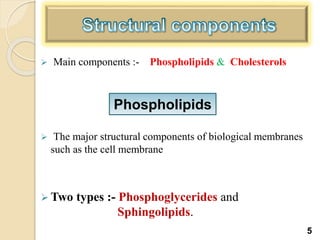
 Main components :- Phospholipids & Cholesterols
 The major structural components of biological membranes
such as the cell membrane
 Two types :- Phosphoglycerides and
Sphingolipids.
Phospholipids
5
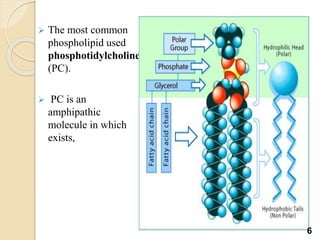
 The most common
phospholipid used
phosphotidylcholine
(PC).
 PC is an
amphipathic
molecule in which
exists,
6
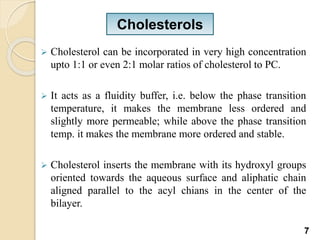
 Cholesterol can be incorporated in very high concentration
upto 1:1 or even 2:1 molar ratios of cholesterol to PC.
 It acts as a fluidity buffer, i.e. below the phase transition
temperature, it makes the membrane less ordered and
slightly more permeable; while above the phase transition
temp. it makes the membrane more ordered and stable.
 Cholesterol inserts the membrane with its hydroxyl groups
oriented towards the aqueous surface and aliphatic chain
aligned parallel to the acyl chians in the center of the
bilayer.
Cholesterols
7
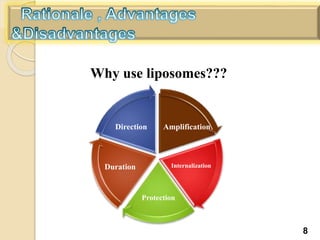
Why use liposomes???
Protection
Duration
Duration
Direction Amplification
Internalization
8
Advantages
 Provide controlled /sustained release drug delivery
 Provide targeted / site specific drug delivery
 Biodegradable and biocompatible
 Non ionic, non toxic and flexible
 Site avoidance effect
 Improved P/K effects (reduced elimination , circulation life
times)
 Enhanced drug solubility
 Can carry both lipid and water soluble drugs
9
 Improve drug and protein stability
 Improve efficacy and therapeutic index of drugs
 Can be administered through various routes
 Can incorporate micro and macro molecules
Disadvantages
 Short half life
 Less stability of liposomes
 Phospholipid undergoes oxidation,hydrolysis,leakage
 High production cost
10
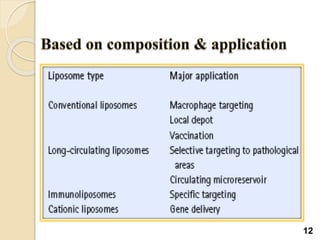
 Based on composition & application
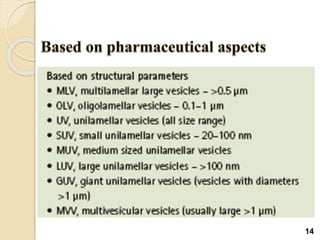
 Based on pharmaceutical aspects
11
12
13
14
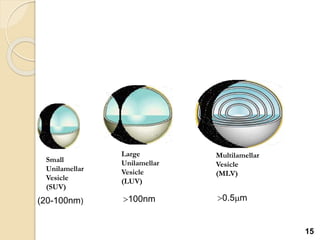
Small
Unilamellar
Vesicle
(SUV)
Large
Unilamellar
Vesicle
(LUV)
Multilamellar
Vesicle
(MLV)
(20-100nm) 100nm 0.5m
15
MLVs Liposomes :
a) Lipid hydration method
b) Solvent spherule method
LUVs Liposomes :
a) Freeze drying method
b) Micro emulsification / micro fluidization method
c) Membrane extrusion method
d) Reversed phase evaporation method
e) Freeze thaw method
f) Calcium-induced fusion method
SUVs Liposomes :
a) Sonication method
b) French pressure method
c) pH induced vesiculation
16
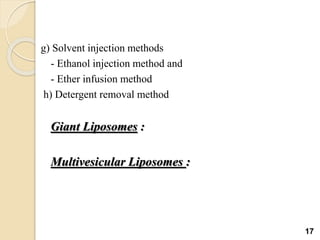
g) Solvent injection methods
- Ethanol injection method and
- Ether infusion method
h) Detergent removal method
Giant Liposomes :
Multivesicular Liposomes :
17
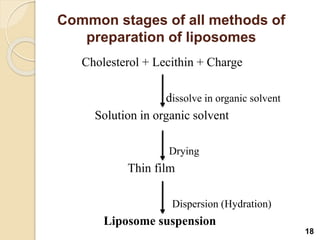
Common stages of all methods of
preparation of liposomes
Cholesterol + Lecithin + Charge
dissolve in organic solvent
Solution in organic solvent
Drying
Thin film
Dispersion (Hydration)
Liposome suspension
18
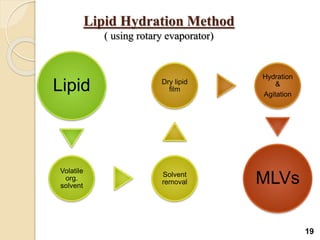
Lipid Hydration Method
( using rotary evaporator)
Lipid
Volatile
org.
solvent
Solvent
removal
Dry lipid
film
Hydration
&
Agitation
MLVs
19
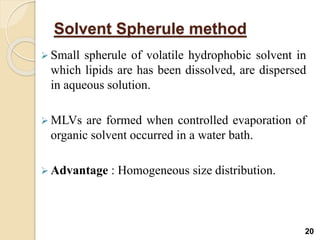
Solvent Spherule method
 Small spherule of volatile hydrophobic solvent in
which lipids are has been dissolved, are dispersed
in aqueous solution.
 MLVs are formed when controlled evaporation of
organic solvent occurred in a water bath.
 Advantage : Homogeneous size distribution.
20
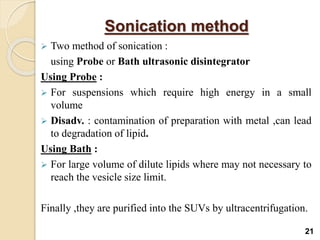
Sonication method
 Two method of sonication :
using Probe or Bath ultrasonic disintegrator
Using Probe :
 For suspensions which require high energy in a small
volume
 Disadv. : contamination of preparation with metal ,can lead
to degradation of lipid.
Using Bath :
 For large volume of dilute lipids where may not necessary to
reach the vesicle size limit.
Finally ,they are purified into the SUVs by ultracentrifugation.
21
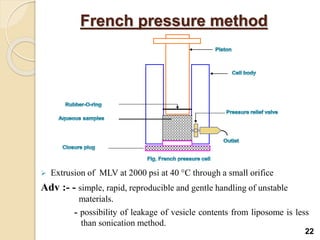
French pressure method
 Extrusion of MLV at 2000 psi at 40 °C through a small orifice
Adv :- - simple, rapid, reproducible and gentle handling of unstable
materials.
- possibility of leakage of vesicle contents from liposome is less
than sonication method.
22
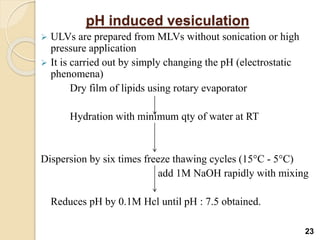
pH induced vesiculation
 ULVs are prepared from MLVs without sonication or high
pressure application
 It is carried out by simply changing the pH (electrostatic
phenomena)
Dry film of lipids using rotary evaporator
Hydration with minimum qty of water at RT
Dispersion by six times freeze thawing cycles (15°C - 5°C)
add 1M NaOH rapidly with mixing
Reduces pH by 0.1M Hcl until pH : 7.5 obtained.
23
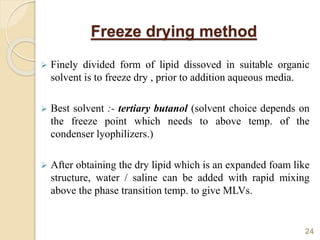
Freeze drying method
 Finely divided form of lipid dissoved in suitable organic
solvent is to freeze dry , prior to addition aqueous media.
 Best solvent :- tertiary butanol (solvent choice depends on
the freeze point which needs to above temp. of the
condenser lyophilizers.)
 After obtaining the dry lipid which is an expanded foam like
structure, water / saline can be added with rapid mixing
above the phase transition temp. to give MLVs.
24
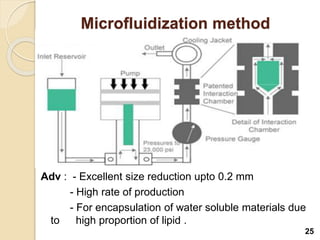
Microfluidization method
Adv : - Excellent size reduction upto 0.2 mm
- High rate of production
- For encapsulation of water soluble materials due
to high proportion of lipid .
25
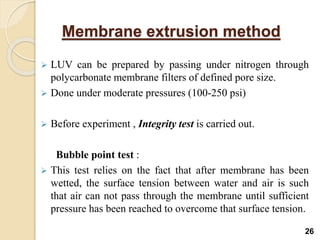
Membrane extrusion method
 LUV can be prepared by passing under nitrogen through
polycarbonate membrane filters of defined pore size.
 Done under moderate pressures (100-250 psi)
 Before experiment , Integrity test is carried out.
Bubble point test :
 This test relies on the fact that after membrane has been
wetted, the surface tension between water and air is such
that air can not pass through the membrane until sufficient
pressure has been reached to overcome that surface tension.
26
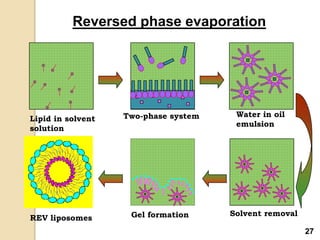
Lipid in solvent
solution
Two-phase system Water in oil
emulsion
Solvent removalGel formationREV liposomes
Reversed phase evaporation
27
Freeze thaw method
 In this method, rapid freezing and slowly thawing process
is used to rupture and re-fuse SUVs during which the solute
equilibrates between inside and outside, and the liposomes
themselves fuse and increase in markedly in size.
 The formation of unilamellar vesicles due to the fusion of
SUV during the processes of freezing and or thawing.
 Adv. : - High encapsulation efficiency (20-30 %)
28
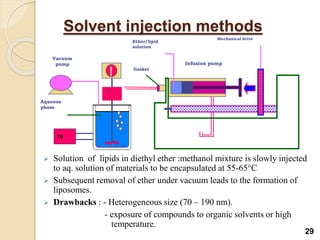
Solvent injection methods
 Solution of lipids in diethyl ether :methanol mixture is slowly injected
to aq. solution of materials to be encapsulated at 55-65°C
 Subsequent removal of ether under vacuum leads to the formation of
liposomes.
 Drawbacks : - Heterogeneous size (70 – 190 nm).
- exposure of compounds to organic solvents or high
temperature.
TB
Vacuum
pump
Mix
Gasket
Ether/lipid
solution
Mechanical drive
Infusion pump
Aqueous
phase
29
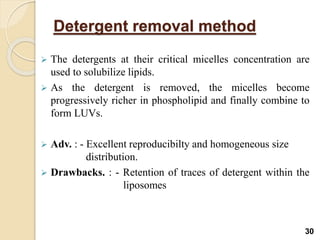
Detergent removal method
 The detergents at their critical micelles concentration are
used to solubilize lipids.
 As the detergent is removed, the micelles become
progressively richer in phospholipid and finally combine to
form LUVs.
 Adv. : - Excellent reproducibilty and homogeneous size
distribution.
 Drawbacks. : - Retention of traces of detergent within the
liposomes
30
Giant liposomes :
 Procedure : Dialysis of a methanol solution of PC in
presence of methylglucoside detergent against aq. Solution
containing up to 1M NaCl
 Liposomes range : 10 – 100 mm.
Multivesicular liposomes :
 The w/o emulsion was converted to organic solvent
spherules by the addition of emulsion to across solution.
 The evaporation of organic solvent resultes in formation of
multivesicular liposomes
 Size range : 5.6 – 29 pm
 Material to be encapsulated : Glucose, EDTA, human
DNA.
31
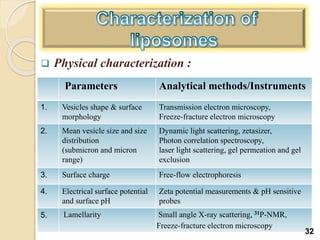
 Physical characterization :
Parameters Analytical methods/Instruments
1. Vesicles shape & surface
morphology
Transmission electron microscopy,
Freeze-fracture electron microscopy
2. Mean vesicle size and size
distribution
(submicron and micron
range)
Dynamic light scattering, zetasizer,
Photon correlation spectroscopy,
laser light scattering, gel permeation and gel
exclusion
3. Surface charge Free-flow electrophoresis
4. Electrical surface potential
and surface pH
Zeta potential measurements & pH sensitive
probes
5. Lamellarity Small angle X-ray scattering, 31P-NMR,
Freeze-fracture electron microscopy
32
Parameters Analytical methods/Instruments
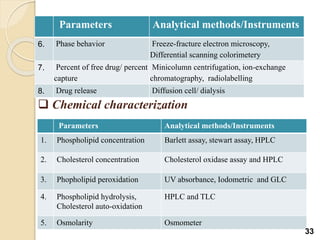
6. Phase behavior Freeze-fracture electron microscopy,
Differential scanning colorimetery
7. Percent of free drug/ percent
capture
Minicolumn centrifugation, ion-exchange
chromatography, radiolabelling
8. Drug release Diffusion cell/ dialysis
 Chemical characterization
Parameters Analytical methods/Instruments
1. Phospholipid concentration Barlett assay, stewart assay, HPLC
2. Cholesterol concentration Cholesterol oxidase assay and HPLC
3. Phopholipid peroxidation UV absorbance, Iodometric and GLC
4. Phospholipid hydrolysis,
Cholesterol auto-oxidation
HPLC and TLC
5. Osmolarity Osmometer
33
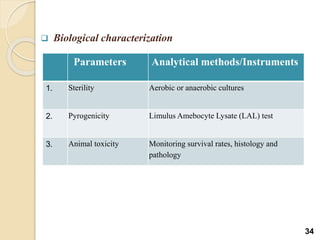
 Biological characterization
Parameters Analytical methods/Instruments
1. Sterility Aerobic or anaerobic cultures
2. Pyrogenicity Limulus Amebocyte Lysate (LAL) test
3. Animal toxicity Monitoring survival rates, histology and
pathology
34
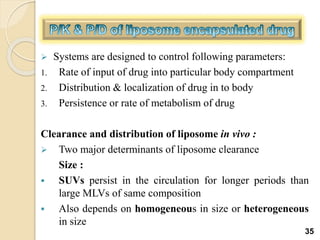
 Systems are designed to control following parameters:
1. Rate of input of drug into particular body compartment
2. Distribution & localization of drug in to body
3. Persistence or rate of metabolism of drug
Clearance and distribution of liposome in vivo :
 Two major determinants of liposome clearance
Size :
 SUVs persist in the circulation for longer periods than
large MLVs of same composition
 Also depends on homogeneous in size or heterogeneous
in size
35
Charge :
 SUVs with + and – charge retained longer time whereas
small negative vesicles are rapidly cleared
 After clearance from circulation, they are sequestered in
various tissues and organs
 MLVs :- mainly in liver & spleen (due to taken up presence
of hepatic and spleenic reticuloendothelial cells rather than
blood capillary)
- Lung (due to physical entrapment of liposomes in the
capillary beds of this organ)
 SUVs :- broader tissue distribution
36
 Pharmacodynamics of liposome encapsulated drug:
Pharmacodynamic effects
 Retardation of drug clearance from the circulation
 High drug accumulation in tissues rich in
reticuloendothelial cells, especially liver and spleen
 Retention of drug in tissue for large periods
 Protection of drug against metabolic degradation and
elimination
 Localized drug delivery primarily for cancer therapy
37
Chemical degradation
 Liposomal phospholipid oxidation and hydrolysis
Prevention :-
1. Start with freshly purified lipids & distilled solvents
2. Avoid procedure which involves high temp.
3. Carry out manufacturing in absence of oxygen
4. Deoxygenate aqueous solution with nitrogen
5. Store all liposome suspensions in inert atmosphere
6. Include anti-oxidants as a component of the lipid
membrane
7. Saturated lipid reduces level of oxidizable lipid in
membrane
38
Physical degradation
leakage and fusion of vesicles
Preventions:-
1. SUVs (prone to fusion) is stored at temp away from the
Tc.
2. Avoid high conc. of metal ions for liposome having
negative charge in the membrane and use of metal ion
chelater in the suspending buffer.
3. High molar ratio of cholesterol is most stable with
regarded to leakage of solute for large polar or ionic
molecule and low MW lipophilic compound.
4. Freezing / lyophillization / cryopreservation – most
suitable.
39
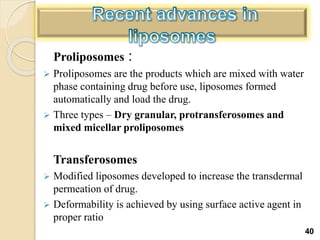
Proliposomes :
 Proliposomes are the products which are mixed with water
phase containing drug before use, liposomes formed
automatically and load the drug.
 Three types – Dry granular, protransferosomes and
mixed micellar proliposomes
Transferosomes
 Modified liposomes developed to increase the transdermal
permeation of drug.
 Deformability is achieved by using surface active agent in
proper ratio
40
Ethosomes
 Ethosomal system is a vesicular system composed mainly
of phospholipids & alcohol (ethanol or IPA, sometimes
polyols; glycol) in relatively high concentration & water.
 Better membrane permeability.
41
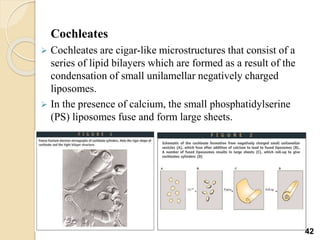
Cochleates
 Cochleates are cigar-like microstructures that consist of a
series of lipid bilayers which are formed as a result of the
condensation of small unilamellar negatively charged
liposomes.
 In the presence of calcium, the small phosphatidylserine
(PS) liposomes fuse and form large sheets.
42
 Cancer therapy and neoplasia
 Liposomes as carriers for vaccines
- as immunological adjuvants
- as carriers of antigens
- as carriers of drug in oral treatment
- for topical application
- for pulmonary delivery
 Lysosomal storage diseases
 Opthalmic delivery of drug
 Metal storage diseases
 Cell biological application
43
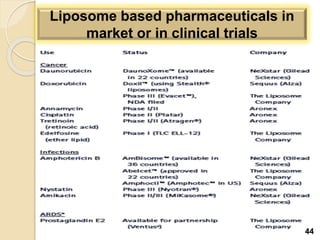
Liposome based pharmaceuticals in
market or in clinical trials
44
1. Controlled and novel drug delivery systems, by Sanjay K.
Jain and N.K. Jain
2. http//en.wikipedia.org/wiki/liposome
3. Mohammad Riaz, ‘Liposomes preparation methods’,
pakistan jouranal of pharmaceutical science.
4. www.pharmainfo.com(Sanjay S. Patel, Liposome: A
versatile platform for targeted delivery of drugs, vol. 4,
issue-5,2006.
45
 Chapter on  Liposomes

Chapter on Liposomes

  • 1.
    A SEMINAR ON LIPOSOMESIN DRUG DELIVERY 1 By:Rajesh L. Dumpala (B.Pharm, M. Pharm.) PhD. ( Pursuing) Research Scientist, Alembic Research Centre. Vadodara E.Mail:-rdumpala64@gmail.com
  • 2.
     Introduction  Structuralcomponents  Rationale , Advantages and Disadvantages  Types of liposomes  Methods of preparation of liposomes  Characterization of liposomes  Pharmacokinetic & Pharmacodynamic of liposome encapsulated drugs  Stability of liposomes  Recent advances  Applications  Marketed formulations of liposome products  References 2
  • 3.
     Liposomes werefirst described by British haematologist Dr. Alec D Bangham in 1961 (published 1964), at the Babraham institute, Cambridge.  The name liposome is derived from two Greek words 'Lipid' meaning fat and 'Soma' meaning body. Definitions :  Bangham et al.,1965 : Simple microscopic vesicles in which an aqueous volume is entirely enclosed by a membrane composed of lipid molecule.  Weiner N. et al.,1989 : As a microstructure consisting of one or more concentric spheres of lipid bilayer separated by water or aqueous buffer compartments. 3
  • 4.
     The drugmolecules can encapsulated in aqueous space or intercalated into the lipid bilayer  The particle size of liposomes ranges from 20 nm to 10 μm in diameter.  Pharmaceutical researchers use the tools of biophysics in evaluating liposomal dosage forms.  Liposomes have covered predominantly medical, albeit some non- medical areas like bioreactors, catalysts, cosmetics and ecology. Structure of liposome 4
  • 5.
     Main components:- Phospholipids & Cholesterols  The major structural components of biological membranes such as the cell membrane  Two types :- Phosphoglycerides and Sphingolipids. Phospholipids 5
  • 6.
     The mostcommon phospholipid used phosphotidylcholine (PC).  PC is an amphipathic molecule in which exists, 6
  • 7.
     Cholesterol canbe incorporated in very high concentration upto 1:1 or even 2:1 molar ratios of cholesterol to PC.  It acts as a fluidity buffer, i.e. below the phase transition temperature, it makes the membrane less ordered and slightly more permeable; while above the phase transition temp. it makes the membrane more ordered and stable.  Cholesterol inserts the membrane with its hydroxyl groups oriented towards the aqueous surface and aliphatic chain aligned parallel to the acyl chians in the center of the bilayer. Cholesterols 7
  • 8.
  • 9.
    Advantages  Provide controlled/sustained release drug delivery  Provide targeted / site specific drug delivery  Biodegradable and biocompatible  Non ionic, non toxic and flexible  Site avoidance effect  Improved P/K effects (reduced elimination , circulation life times)  Enhanced drug solubility  Can carry both lipid and water soluble drugs 9
  • 10.
     Improve drugand protein stability  Improve efficacy and therapeutic index of drugs  Can be administered through various routes  Can incorporate micro and macro molecules Disadvantages  Short half life  Less stability of liposomes  Phospholipid undergoes oxidation,hydrolysis,leakage  High production cost 10
  • 11.
     Based oncomposition & application  Based on pharmaceutical aspects 11
  • 12.
  • 13.
  • 14.
  • 15.
  • 16.
    MLVs Liposomes : a)Lipid hydration method b) Solvent spherule method LUVs Liposomes : a) Freeze drying method b) Micro emulsification / micro fluidization method c) Membrane extrusion method d) Reversed phase evaporation method e) Freeze thaw method f) Calcium-induced fusion method SUVs Liposomes : a) Sonication method b) French pressure method c) pH induced vesiculation 16
  • 17.
    g) Solvent injectionmethods - Ethanol injection method and - Ether infusion method h) Detergent removal method Giant Liposomes : Multivesicular Liposomes : 17
  • 18.
    Common stages ofall methods of preparation of liposomes Cholesterol + Lecithin + Charge dissolve in organic solvent Solution in organic solvent Drying Thin film Dispersion (Hydration) Liposome suspension 18
  • 19.
    Lipid Hydration Method (using rotary evaporator) Lipid Volatile org. solvent Solvent removal Dry lipid film Hydration & Agitation MLVs 19
  • 20.
    Solvent Spherule method Small spherule of volatile hydrophobic solvent in which lipids are has been dissolved, are dispersed in aqueous solution.  MLVs are formed when controlled evaporation of organic solvent occurred in a water bath.  Advantage : Homogeneous size distribution. 20
  • 21.
    Sonication method  Twomethod of sonication : using Probe or Bath ultrasonic disintegrator Using Probe :  For suspensions which require high energy in a small volume  Disadv. : contamination of preparation with metal ,can lead to degradation of lipid. Using Bath :  For large volume of dilute lipids where may not necessary to reach the vesicle size limit. Finally ,they are purified into the SUVs by ultracentrifugation. 21
  • 22.
    French pressure method Extrusion of MLV at 2000 psi at 40 °C through a small orifice Adv :- - simple, rapid, reproducible and gentle handling of unstable materials. - possibility of leakage of vesicle contents from liposome is less than sonication method. 22
  • 23.
    pH induced vesiculation ULVs are prepared from MLVs without sonication or high pressure application  It is carried out by simply changing the pH (electrostatic phenomena) Dry film of lipids using rotary evaporator Hydration with minimum qty of water at RT Dispersion by six times freeze thawing cycles (15°C - 5°C) add 1M NaOH rapidly with mixing Reduces pH by 0.1M Hcl until pH : 7.5 obtained. 23
  • 24.
    Freeze drying method Finely divided form of lipid dissoved in suitable organic solvent is to freeze dry , prior to addition aqueous media.  Best solvent :- tertiary butanol (solvent choice depends on the freeze point which needs to above temp. of the condenser lyophilizers.)  After obtaining the dry lipid which is an expanded foam like structure, water / saline can be added with rapid mixing above the phase transition temp. to give MLVs. 24
  • 25.
    Microfluidization method Adv :- Excellent size reduction upto 0.2 mm - High rate of production - For encapsulation of water soluble materials due to high proportion of lipid . 25
  • 26.
    Membrane extrusion method LUV can be prepared by passing under nitrogen through polycarbonate membrane filters of defined pore size.  Done under moderate pressures (100-250 psi)  Before experiment , Integrity test is carried out. Bubble point test :  This test relies on the fact that after membrane has been wetted, the surface tension between water and air is such that air can not pass through the membrane until sufficient pressure has been reached to overcome that surface tension. 26
  • 27.
    Lipid in solvent solution Two-phasesystem Water in oil emulsion Solvent removalGel formationREV liposomes Reversed phase evaporation 27
  • 28.
    Freeze thaw method In this method, rapid freezing and slowly thawing process is used to rupture and re-fuse SUVs during which the solute equilibrates between inside and outside, and the liposomes themselves fuse and increase in markedly in size.  The formation of unilamellar vesicles due to the fusion of SUV during the processes of freezing and or thawing.  Adv. : - High encapsulation efficiency (20-30 %) 28
  • 29.
    Solvent injection methods Solution of lipids in diethyl ether :methanol mixture is slowly injected to aq. solution of materials to be encapsulated at 55-65°C  Subsequent removal of ether under vacuum leads to the formation of liposomes.  Drawbacks : - Heterogeneous size (70 – 190 nm). - exposure of compounds to organic solvents or high temperature. TB Vacuum pump Mix Gasket Ether/lipid solution Mechanical drive Infusion pump Aqueous phase 29
  • 30.
    Detergent removal method The detergents at their critical micelles concentration are used to solubilize lipids.  As the detergent is removed, the micelles become progressively richer in phospholipid and finally combine to form LUVs.  Adv. : - Excellent reproducibilty and homogeneous size distribution.  Drawbacks. : - Retention of traces of detergent within the liposomes 30
  • 31.
    Giant liposomes : Procedure : Dialysis of a methanol solution of PC in presence of methylglucoside detergent against aq. Solution containing up to 1M NaCl  Liposomes range : 10 – 100 mm. Multivesicular liposomes :  The w/o emulsion was converted to organic solvent spherules by the addition of emulsion to across solution.  The evaporation of organic solvent resultes in formation of multivesicular liposomes  Size range : 5.6 – 29 pm  Material to be encapsulated : Glucose, EDTA, human DNA. 31
  • 32.
     Physical characterization: Parameters Analytical methods/Instruments 1. Vesicles shape & surface morphology Transmission electron microscopy, Freeze-fracture electron microscopy 2. Mean vesicle size and size distribution (submicron and micron range) Dynamic light scattering, zetasizer, Photon correlation spectroscopy, laser light scattering, gel permeation and gel exclusion 3. Surface charge Free-flow electrophoresis 4. Electrical surface potential and surface pH Zeta potential measurements & pH sensitive probes 5. Lamellarity Small angle X-ray scattering, 31P-NMR, Freeze-fracture electron microscopy 32
  • 33.
    Parameters Analytical methods/Instruments 6.Phase behavior Freeze-fracture electron microscopy, Differential scanning colorimetery 7. Percent of free drug/ percent capture Minicolumn centrifugation, ion-exchange chromatography, radiolabelling 8. Drug release Diffusion cell/ dialysis  Chemical characterization Parameters Analytical methods/Instruments 1. Phospholipid concentration Barlett assay, stewart assay, HPLC 2. Cholesterol concentration Cholesterol oxidase assay and HPLC 3. Phopholipid peroxidation UV absorbance, Iodometric and GLC 4. Phospholipid hydrolysis, Cholesterol auto-oxidation HPLC and TLC 5. Osmolarity Osmometer 33
  • 34.
     Biological characterization ParametersAnalytical methods/Instruments 1. Sterility Aerobic or anaerobic cultures 2. Pyrogenicity Limulus Amebocyte Lysate (LAL) test 3. Animal toxicity Monitoring survival rates, histology and pathology 34
  • 35.
     Systems aredesigned to control following parameters: 1. Rate of input of drug into particular body compartment 2. Distribution & localization of drug in to body 3. Persistence or rate of metabolism of drug Clearance and distribution of liposome in vivo :  Two major determinants of liposome clearance Size :  SUVs persist in the circulation for longer periods than large MLVs of same composition  Also depends on homogeneous in size or heterogeneous in size 35
  • 36.
    Charge :  SUVswith + and – charge retained longer time whereas small negative vesicles are rapidly cleared  After clearance from circulation, they are sequestered in various tissues and organs  MLVs :- mainly in liver & spleen (due to taken up presence of hepatic and spleenic reticuloendothelial cells rather than blood capillary) - Lung (due to physical entrapment of liposomes in the capillary beds of this organ)  SUVs :- broader tissue distribution 36
  • 37.
     Pharmacodynamics ofliposome encapsulated drug: Pharmacodynamic effects  Retardation of drug clearance from the circulation  High drug accumulation in tissues rich in reticuloendothelial cells, especially liver and spleen  Retention of drug in tissue for large periods  Protection of drug against metabolic degradation and elimination  Localized drug delivery primarily for cancer therapy 37
  • 38.
    Chemical degradation  Liposomalphospholipid oxidation and hydrolysis Prevention :- 1. Start with freshly purified lipids & distilled solvents 2. Avoid procedure which involves high temp. 3. Carry out manufacturing in absence of oxygen 4. Deoxygenate aqueous solution with nitrogen 5. Store all liposome suspensions in inert atmosphere 6. Include anti-oxidants as a component of the lipid membrane 7. Saturated lipid reduces level of oxidizable lipid in membrane 38
  • 39.
    Physical degradation leakage andfusion of vesicles Preventions:- 1. SUVs (prone to fusion) is stored at temp away from the Tc. 2. Avoid high conc. of metal ions for liposome having negative charge in the membrane and use of metal ion chelater in the suspending buffer. 3. High molar ratio of cholesterol is most stable with regarded to leakage of solute for large polar or ionic molecule and low MW lipophilic compound. 4. Freezing / lyophillization / cryopreservation – most suitable. 39
  • 40.
    Proliposomes :  Proliposomesare the products which are mixed with water phase containing drug before use, liposomes formed automatically and load the drug.  Three types – Dry granular, protransferosomes and mixed micellar proliposomes Transferosomes  Modified liposomes developed to increase the transdermal permeation of drug.  Deformability is achieved by using surface active agent in proper ratio 40
  • 41.
    Ethosomes  Ethosomal systemis a vesicular system composed mainly of phospholipids & alcohol (ethanol or IPA, sometimes polyols; glycol) in relatively high concentration & water.  Better membrane permeability. 41
  • 42.
    Cochleates  Cochleates arecigar-like microstructures that consist of a series of lipid bilayers which are formed as a result of the condensation of small unilamellar negatively charged liposomes.  In the presence of calcium, the small phosphatidylserine (PS) liposomes fuse and form large sheets. 42
  • 43.
     Cancer therapyand neoplasia  Liposomes as carriers for vaccines - as immunological adjuvants - as carriers of antigens - as carriers of drug in oral treatment - for topical application - for pulmonary delivery  Lysosomal storage diseases  Opthalmic delivery of drug  Metal storage diseases  Cell biological application 43
  • 44.
    Liposome based pharmaceuticalsin market or in clinical trials 44
  • 45.
    1. Controlled andnovel drug delivery systems, by Sanjay K. Jain and N.K. Jain 2. http//en.wikipedia.org/wiki/liposome 3. Mohammad Riaz, ‘Liposomes preparation methods’, pakistan jouranal of pharmaceutical science. 4. www.pharmainfo.com(Sanjay S. Patel, Liposome: A versatile platform for targeted delivery of drugs, vol. 4, issue-5,2006. 45