

Conducting
Marketing Research and
Forecasting Demand
Marketing Management, 13th
ed
4
Copyright © 2009 Pearson Education, Inc. Publishing as Prentice Hall
Chapter Questions
• What constitutes good marketing
research?
• What are good metrics for measuring
marketing productivity?
• How can marketers assess their return
on investment of marketing
expenditures?
• How can companies more accurately
measure and forecast demand
Copyright © 2009 Pearson Education, Inc. Publishing as Prentice Hall
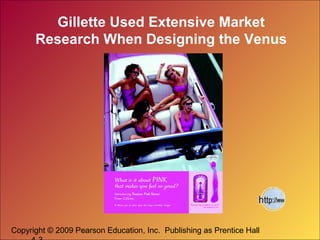
Gillette Used Extensive Market
Research When Designing the Venus
Copyright © 2009 Pearson Education, Inc. Publishing as Prentice Hall
What is Marketing Research?
Marketing research is the systematic
design, collection, analysis, and
reporting of data and findings relevant
to a specific marketing situation facing
the company.
Copyright © 2009 Pearson Education, Inc. Publishing as Prentice Hall
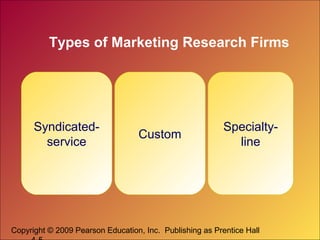
Types of Marketing Research Firms
Syndicated-
service
Custom
Specialty-
line
Copyright © 2009 Pearson Education, Inc. Publishing as Prentice Hall
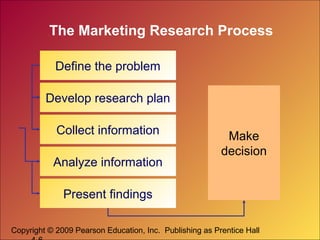
The Marketing Research Process
Define the problem
Develop research plan
Collect information
Analyze information
Present findings
Make
decision
Copyright © 2009 Pearson Education, Inc. Publishing as Prentice Hall
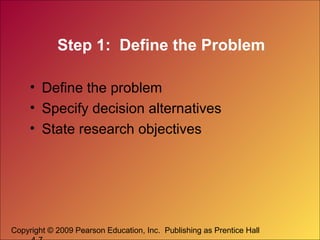
Step 1: Define the Problem
• Define the problem
• Specify decision alternatives
• State research objectives
Copyright © 2009 Pearson Education, Inc. Publishing as Prentice Hall
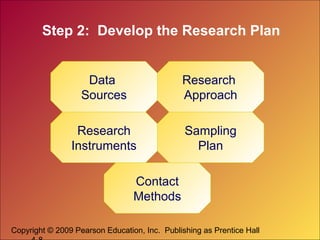
Step 2: Develop the Research Plan
Data
Sources
Contact
Methods
Research
Instruments
Sampling
Plan
Research
Approach
Copyright © 2009 Pearson Education, Inc. Publishing as Prentice Hall
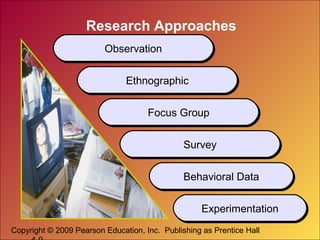
Research Approaches
ObservationObservation
Focus GroupFocus Group
SurveySurvey
Behavioral DataBehavioral Data
ExperimentationExperimentation
EthnographicEthnographic
Copyright © 2009 Pearson Education, Inc. Publishing as Prentice Hall
Focus Group in Session
Copyright © 2009 Pearson Education, Inc. Publishing as Prentice Hall
Research Instruments
Questionnaires
Qualitative Measures
Technological Devices
Copyright © 2009 Pearson Education, Inc. Publishing as Prentice Hall
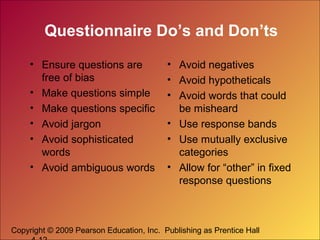
Questionnaire Do’s and Don’ts
• Ensure questions are
free of bias
• Make questions simple
• Make questions specific
• Avoid jargon
• Avoid sophisticated
words
• Avoid ambiguous words
• Avoid negatives
• Avoid hypotheticals
• Avoid words that could
be misheard
• Use response bands
• Use mutually exclusive
categories
• Allow for “other” in fixed
response questions
Copyright © 2009 Pearson Education, Inc. Publishing as Prentice Hall
Question Types—Dichotomous
In arranging this trip, did you contact
American Airlines?
 Yes  No
Copyright © 2009 Pearson Education, Inc. Publishing as Prentice Hall
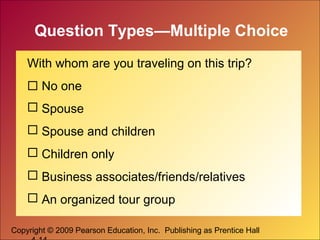
Question Types—Multiple Choice
With whom are you traveling on this trip?
 No one
 Spouse
 Spouse and children
 Children only
 Business associates/friends/relatives
 An organized tour group
Copyright © 2009 Pearson Education, Inc. Publishing as Prentice Hall
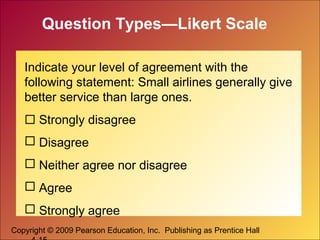
Question Types—Likert Scale
Indicate your level of agreement with the
following statement: Small airlines generally give
better service than large ones.
 Strongly disagree
 Disagree
 Neither agree nor disagree
 Agree
 Strongly agree
Copyright © 2009 Pearson Education, Inc. Publishing as Prentice Hall
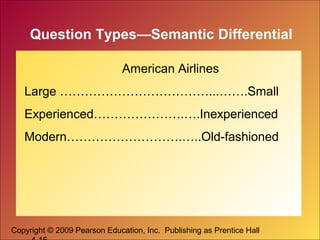
Question Types—Semantic Differential
American Airlines
Large ………………………………...…….Small
Experienced………………….….Inexperienced
Modern……………………….…..Old-fashioned
Copyright © 2009 Pearson Education, Inc. Publishing as Prentice Hall
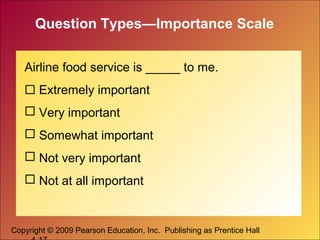
Question Types—Importance Scale
Airline food service is _____ to me.
 Extremely important
 Very important
 Somewhat important
 Not very important
 Not at all important
Copyright © 2009 Pearson Education, Inc. Publishing as Prentice Hall
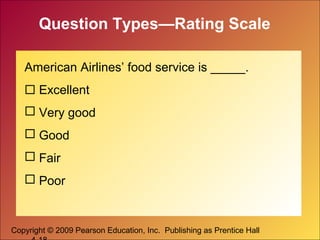
Question Types—Rating Scale
American Airlines’ food service is _____.
 Excellent
 Very good
 Good
 Fair
 Poor
Copyright © 2009 Pearson Education, Inc. Publishing as Prentice Hall
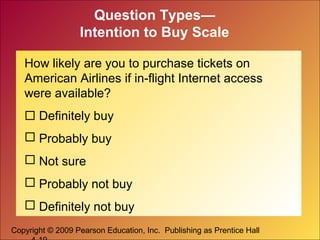
Question Types—
Intention to Buy Scale
How likely are you to purchase tickets on
American Airlines if in-flight Internet access
were available?
 Definitely buy
 Probably buy
 Not sure
 Probably not buy
 Definitely not buy
Copyright © 2009 Pearson Education, Inc. Publishing as Prentice Hall
Question Types—Completely
Unstructured
What is your opinion of American Airlines?
Copyright © 2009 Pearson Education, Inc. Publishing as Prentice Hall
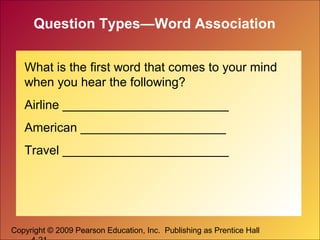
Question Types—Word Association
What is the first word that comes to your mind
when you hear the following?
Airline ________________________
American _____________________
Travel ________________________
Copyright © 2009 Pearson Education, Inc. Publishing as Prentice Hall
Question Types—
Sentence Completion
When I choose an airline, the most important
consideration in my decision is:
_____________________________________
_____________________________________
_____________________________________
_____________________________________
_____________________________________
_____________________________________
__________________.
Copyright © 2009 Pearson Education, Inc. Publishing as Prentice Hall
Question Types—Story Completion
“I flew American a few days ago. I noticed that
the exterior and interior of the plane had very
bright colors. This aroused in me the following
thoughts and feelings.” Now complete the story.
_______________________________________
_______________________________________
_______________________________________
_______________________________________
_______________________________________
_______________________________________
Copyright © 2009 Pearson Education, Inc. Publishing as Prentice Hall
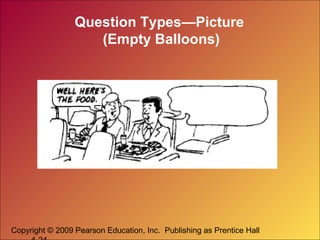
Question Types—Picture
(Empty Balloons)
Copyright © 2009 Pearson Education, Inc. Publishing as Prentice Hall
Question Types—Thematic
Apperception Test
Make up a story that reflects what you think is
happening in this picture.
Copyright © 2009 Pearson Education, Inc. Publishing as Prentice Hall
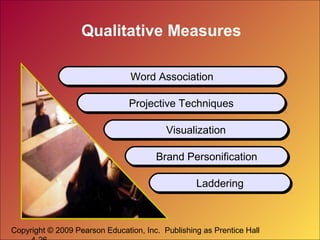
Qualitative Measures
Word AssociationWord Association
Projective TechniquesProjective Techniques
VisualizationVisualization
Brand PersonificationBrand Personification
LadderingLaddering
Copyright © 2009 Pearson Education, Inc. Publishing as Prentice Hall
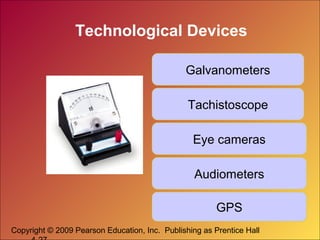
Technological Devices
Galvanometers
Tachistoscope
Eye cameras
Audiometers
GPS
Copyright © 2009 Pearson Education, Inc. Publishing as Prentice Hall
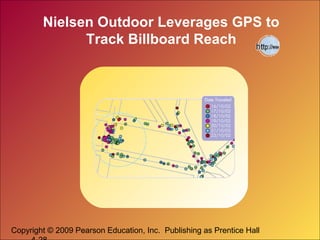
Nielsen Outdoor Leverages GPS to
Track Billboard Reach
Copyright © 2009 Pearson Education, Inc. Publishing as Prentice Hall
Sampling Plan
• Sampling unit: Who is to be surveyed?
• Sample size: How many people should be
surveyed?
• Sampling procedure: How should the
respondents be chosen?
Copyright © 2009 Pearson Education, Inc. Publishing as Prentice Hall
Table 4.2 Types of Samples
Probability Samples
• Simple random
• Stratified random
• Cluster
Nonprobability Samples
• Convenience
• Judgment
• Quota
Copyright © 2009 Pearson Education, Inc. Publishing as Prentice Hall
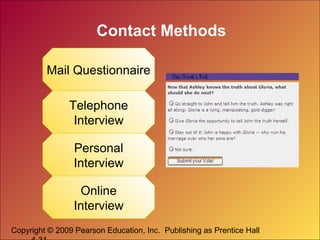
Contact Methods
Mail Questionnaire
Telephone
Interview
Personal
Interview
Online
Interview
Copyright © 2009 Pearson Education, Inc. Publishing as Prentice Hall
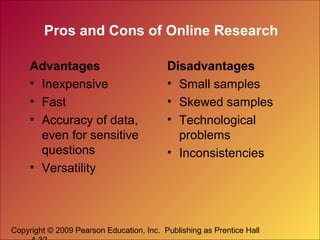
Pros and Cons of Online Research
Advantages
• Inexpensive
• Fast
• Accuracy of data,
even for sensitive
questions
• Versatility
Disadvantages
• Small samples
• Skewed samples
• Technological
problems
• Inconsistencies
Copyright © 2009 Pearson Education, Inc. Publishing as Prentice Hall
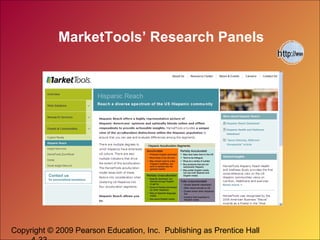
MarketTools’ Research Panels
Copyright © 2009 Pearson Education, Inc. Publishing as Prentice Hall
What is a
Marketing Decision Support System
(MDSS)?
A marketing decision support
system is a coordinated collection of
data, systems, tools, and techniques
with supporting hardware and software
by which an organization gathers and
interprets relevant information from
business and environment and turns it
into a basis for marketing action.
Copyright © 2009 Pearson Education, Inc. Publishing as Prentice Hall
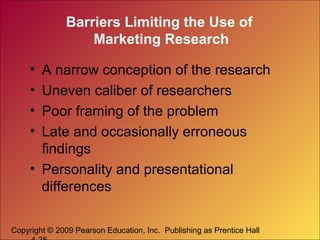
Barriers Limiting the Use of
Marketing Research
• A narrow conception of the research
• Uneven caliber of researchers
• Poor framing of the problem
• Late and occasionally erroneous
findings
• Personality and presentational
differences
Copyright © 2009 Pearson Education, Inc. Publishing as Prentice Hall
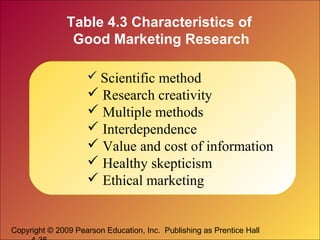
Table 4.3 Characteristics of
Good Marketing Research
 Scientific method
 Research creativity
 Multiple methods
 Interdependence
 Value and cost of information
 Healthy skepticism
 Ethical marketing
Copyright © 2009 Pearson Education, Inc. Publishing as Prentice Hall
What is Marketing Metrics?
Marketing metrics is the set of
measures that helps marketers
quantify, compare, and interpret
marketing performance.
Copyright © 2009 Pearson Education, Inc. Publishing as Prentice Hall
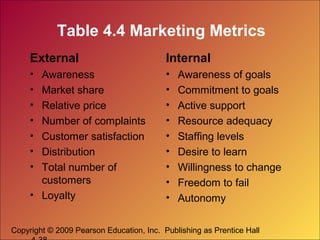
Table 4.4 Marketing Metrics
External
• Awareness
• Market share
• Relative price
• Number of complaints
• Customer satisfaction
• Distribution
• Total number of
customers
• Loyalty
Internal
• Awareness of goals
• Commitment to goals
• Active support
• Resource adequacy
• Staffing levels
• Desire to learn
• Willingness to change
• Freedom to fail
• Autonomy
Copyright © 2009 Pearson Education, Inc. Publishing as Prentice Hall
What is Marketing-Mix Modeling?
Marketing-mix models analyze data
from a variety of sources, such as
retailer scanner data, company
shipment data, pricing, media, and
promotion spending data, to
understand more precisely the effects
of specific marketing activities.
Copyright © 2009 Pearson Education, Inc. Publishing as Prentice Hall
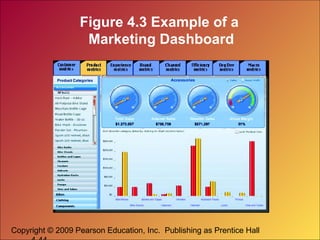
Marketing Dashboards
• A customer-performance scorecard
records how well the company is doing
year after year on customer-based
measures.
• A stakeholder-performance
scorecard tracks the satisfaction of
various constituencies who have a
critical interest in and impact on the
company’s performance including
employees, suppliers, banks,
distributors, retailers, and stockholders.
Copyright © 2009 Pearson Education, Inc. Publishing as Prentice Hall
Table 4.5 Sample Customer-Performance
Scorecard Measures
• % of new customers to average #
• % of lost customers to average #
• % of win-back customers to average #
• % of customers in various levels of satisfaction
• % of customers who would repurchase
• % of target market members with brand recall
• % of customers who say brand is most
preferred
Copyright © 2009 Pearson Education, Inc. Publishing as Prentice Hall
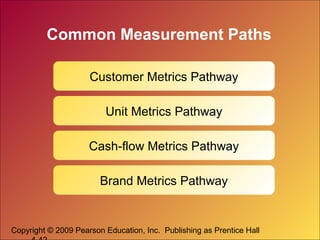
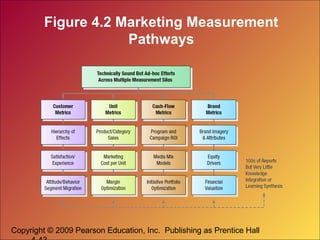
Common Measurement Paths
Customer Metrics Pathway
Unit Metrics Pathway
Cash-flow Metrics Pathway
Brand Metrics Pathway
Copyright © 2009 Pearson Education, Inc. Publishing as Prentice Hall
Figure 4.2 Marketing Measurement
Pathways
Copyright © 2009 Pearson Education, Inc. Publishing as Prentice Hall
Figure 4.3 Example of a
Marketing Dashboard
Copyright © 2009 Pearson Education, Inc. Publishing as Prentice Hall
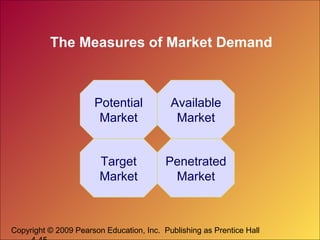
The Measures of Market Demand
Potential
Market
Penetrated
Market
Target
Market
Available
Market
Copyright © 2009 Pearson Education, Inc. Publishing as Prentice Hall
Vocabulary for Demand Measurement
• Market demand
• Market forecast
• Market potential
• Company demand
• Company sales forecast
• Company sales potential
Copyright © 2009 Pearson Education, Inc. Publishing as Prentice Hall
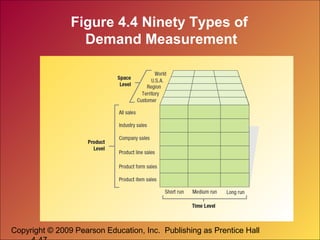
Figure 4.4 Ninety Types of
Demand Measurement
Copyright © 2009 Pearson Education, Inc. Publishing as Prentice Hall
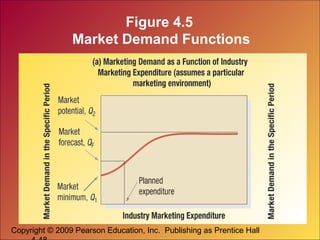
Figure 4.5
Market Demand Functions
Copyright © 2009 Pearson Education, Inc. Publishing as Prentice Hall
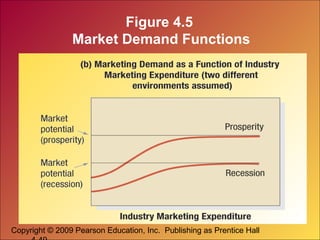
Figure 4.5
Market Demand Functions
Copyright © 2009 Pearson Education, Inc. Publishing as Prentice Hall
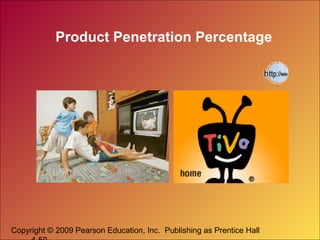
Product Penetration Percentage
Copyright © 2009 Pearson Education, Inc. Publishing as Prentice Hall
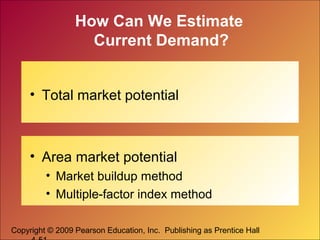
How Can We Estimate
Current Demand?
• Total market potential
• Area market potential
• Market buildup method
• Multiple-factor index method
Copyright © 2009 Pearson Education, Inc. Publishing as Prentice Hall
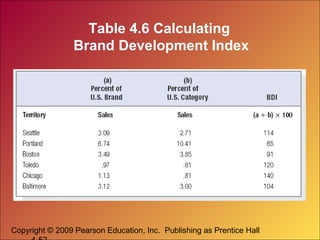
Table 4.6 Calculating
Brand Development Index
Copyright © 2009 Pearson Education, Inc. Publishing as Prentice Hall
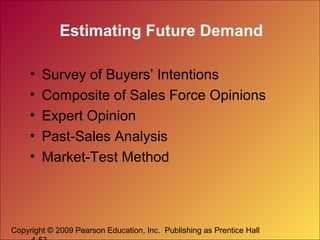
Estimating Future Demand
• Survey of Buyers’ Intentions
• Composite of Sales Force Opinions
• Expert Opinion
• Past-Sales Analysis
• Market-Test Method
Copyright © 2009 Pearson Education, Inc. Publishing as Prentice Hall
Marketing Debate
 What is the best type of marketing
research?
Take a position:
1. Marketing research should be quantitative.
or
2. Marketing research should be qualitative.
Copyright © 2009 Pearson Education, Inc. Publishing as Prentice Hall
Marketing Discussion
 When was the last time you
participated in a survey?
 How helpful do you think the
information you provided was?
 Could the research have been done
differently?

Kotlermm13 chapter 04

  • 1.
    Conducting Marketing Research and ForecastingDemand Marketing Management, 13th ed 4
  • 2.
    Copyright © 2009Pearson Education, Inc. Publishing as Prentice Hall Chapter Questions • What constitutes good marketing research? • What are good metrics for measuring marketing productivity? • How can marketers assess their return on investment of marketing expenditures? • How can companies more accurately measure and forecast demand
  • 3.
    Copyright © 2009Pearson Education, Inc. Publishing as Prentice Hall Gillette Used Extensive Market Research When Designing the Venus
  • 4.
    Copyright © 2009Pearson Education, Inc. Publishing as Prentice Hall What is Marketing Research? Marketing research is the systematic design, collection, analysis, and reporting of data and findings relevant to a specific marketing situation facing the company.
  • 5.
    Copyright © 2009Pearson Education, Inc. Publishing as Prentice Hall Types of Marketing Research Firms Syndicated- service Custom Specialty- line
  • 6.
    Copyright © 2009Pearson Education, Inc. Publishing as Prentice Hall The Marketing Research Process Define the problem Develop research plan Collect information Analyze information Present findings Make decision
  • 7.
    Copyright © 2009Pearson Education, Inc. Publishing as Prentice Hall Step 1: Define the Problem • Define the problem • Specify decision alternatives • State research objectives
  • 8.
    Copyright © 2009Pearson Education, Inc. Publishing as Prentice Hall Step 2: Develop the Research Plan Data Sources Contact Methods Research Instruments Sampling Plan Research Approach
  • 9.
    Copyright © 2009Pearson Education, Inc. Publishing as Prentice Hall Research Approaches ObservationObservation Focus GroupFocus Group SurveySurvey Behavioral DataBehavioral Data ExperimentationExperimentation EthnographicEthnographic
  • 10.
    Copyright © 2009Pearson Education, Inc. Publishing as Prentice Hall Focus Group in Session
  • 11.
    Copyright © 2009Pearson Education, Inc. Publishing as Prentice Hall Research Instruments Questionnaires Qualitative Measures Technological Devices
  • 12.
    Copyright © 2009Pearson Education, Inc. Publishing as Prentice Hall Questionnaire Do’s and Don’ts • Ensure questions are free of bias • Make questions simple • Make questions specific • Avoid jargon • Avoid sophisticated words • Avoid ambiguous words • Avoid negatives • Avoid hypotheticals • Avoid words that could be misheard • Use response bands • Use mutually exclusive categories • Allow for “other” in fixed response questions
  • 13.
    Copyright © 2009Pearson Education, Inc. Publishing as Prentice Hall Question Types—Dichotomous In arranging this trip, did you contact American Airlines?  Yes  No
  • 14.
    Copyright © 2009Pearson Education, Inc. Publishing as Prentice Hall Question Types—Multiple Choice With whom are you traveling on this trip?  No one  Spouse  Spouse and children  Children only  Business associates/friends/relatives  An organized tour group
  • 15.
    Copyright © 2009Pearson Education, Inc. Publishing as Prentice Hall Question Types—Likert Scale Indicate your level of agreement with the following statement: Small airlines generally give better service than large ones.  Strongly disagree  Disagree  Neither agree nor disagree  Agree  Strongly agree
  • 16.
    Copyright © 2009Pearson Education, Inc. Publishing as Prentice Hall Question Types—Semantic Differential American Airlines Large ………………………………...…….Small Experienced………………….….Inexperienced Modern……………………….…..Old-fashioned
  • 17.
    Copyright © 2009Pearson Education, Inc. Publishing as Prentice Hall Question Types—Importance Scale Airline food service is _____ to me.  Extremely important  Very important  Somewhat important  Not very important  Not at all important
  • 18.
    Copyright © 2009Pearson Education, Inc. Publishing as Prentice Hall Question Types—Rating Scale American Airlines’ food service is _____.  Excellent  Very good  Good  Fair  Poor
  • 19.
    Copyright © 2009Pearson Education, Inc. Publishing as Prentice Hall Question Types— Intention to Buy Scale How likely are you to purchase tickets on American Airlines if in-flight Internet access were available?  Definitely buy  Probably buy  Not sure  Probably not buy  Definitely not buy
  • 20.
    Copyright © 2009Pearson Education, Inc. Publishing as Prentice Hall Question Types—Completely Unstructured What is your opinion of American Airlines?
  • 21.
    Copyright © 2009Pearson Education, Inc. Publishing as Prentice Hall Question Types—Word Association What is the first word that comes to your mind when you hear the following? Airline ________________________ American _____________________ Travel ________________________
  • 22.
    Copyright © 2009Pearson Education, Inc. Publishing as Prentice Hall Question Types— Sentence Completion When I choose an airline, the most important consideration in my decision is: _____________________________________ _____________________________________ _____________________________________ _____________________________________ _____________________________________ _____________________________________ __________________.
  • 23.
    Copyright © 2009Pearson Education, Inc. Publishing as Prentice Hall Question Types—Story Completion “I flew American a few days ago. I noticed that the exterior and interior of the plane had very bright colors. This aroused in me the following thoughts and feelings.” Now complete the story. _______________________________________ _______________________________________ _______________________________________ _______________________________________ _______________________________________ _______________________________________
  • 24.
    Copyright © 2009Pearson Education, Inc. Publishing as Prentice Hall Question Types—Picture (Empty Balloons)
  • 25.
    Copyright © 2009Pearson Education, Inc. Publishing as Prentice Hall Question Types—Thematic Apperception Test Make up a story that reflects what you think is happening in this picture.
  • 26.
    Copyright © 2009Pearson Education, Inc. Publishing as Prentice Hall Qualitative Measures Word AssociationWord Association Projective TechniquesProjective Techniques VisualizationVisualization Brand PersonificationBrand Personification LadderingLaddering
  • 27.
    Copyright © 2009Pearson Education, Inc. Publishing as Prentice Hall Technological Devices Galvanometers Tachistoscope Eye cameras Audiometers GPS
  • 28.
    Copyright © 2009Pearson Education, Inc. Publishing as Prentice Hall Nielsen Outdoor Leverages GPS to Track Billboard Reach
  • 29.
    Copyright © 2009Pearson Education, Inc. Publishing as Prentice Hall Sampling Plan • Sampling unit: Who is to be surveyed? • Sample size: How many people should be surveyed? • Sampling procedure: How should the respondents be chosen?
  • 30.
    Copyright © 2009Pearson Education, Inc. Publishing as Prentice Hall Table 4.2 Types of Samples Probability Samples • Simple random • Stratified random • Cluster Nonprobability Samples • Convenience • Judgment • Quota
  • 31.
    Copyright © 2009Pearson Education, Inc. Publishing as Prentice Hall Contact Methods Mail Questionnaire Telephone Interview Personal Interview Online Interview
  • 32.
    Copyright © 2009Pearson Education, Inc. Publishing as Prentice Hall Pros and Cons of Online Research Advantages • Inexpensive • Fast • Accuracy of data, even for sensitive questions • Versatility Disadvantages • Small samples • Skewed samples • Technological problems • Inconsistencies
  • 33.
    Copyright © 2009Pearson Education, Inc. Publishing as Prentice Hall MarketTools’ Research Panels
  • 34.
    Copyright © 2009Pearson Education, Inc. Publishing as Prentice Hall What is a Marketing Decision Support System (MDSS)? A marketing decision support system is a coordinated collection of data, systems, tools, and techniques with supporting hardware and software by which an organization gathers and interprets relevant information from business and environment and turns it into a basis for marketing action.
  • 35.
    Copyright © 2009Pearson Education, Inc. Publishing as Prentice Hall Barriers Limiting the Use of Marketing Research • A narrow conception of the research • Uneven caliber of researchers • Poor framing of the problem • Late and occasionally erroneous findings • Personality and presentational differences
  • 36.
    Copyright © 2009Pearson Education, Inc. Publishing as Prentice Hall Table 4.3 Characteristics of Good Marketing Research  Scientific method  Research creativity  Multiple methods  Interdependence  Value and cost of information  Healthy skepticism  Ethical marketing
  • 37.
    Copyright © 2009Pearson Education, Inc. Publishing as Prentice Hall What is Marketing Metrics? Marketing metrics is the set of measures that helps marketers quantify, compare, and interpret marketing performance.
  • 38.
    Copyright © 2009Pearson Education, Inc. Publishing as Prentice Hall Table 4.4 Marketing Metrics External • Awareness • Market share • Relative price • Number of complaints • Customer satisfaction • Distribution • Total number of customers • Loyalty Internal • Awareness of goals • Commitment to goals • Active support • Resource adequacy • Staffing levels • Desire to learn • Willingness to change • Freedom to fail • Autonomy
  • 39.
    Copyright © 2009Pearson Education, Inc. Publishing as Prentice Hall What is Marketing-Mix Modeling? Marketing-mix models analyze data from a variety of sources, such as retailer scanner data, company shipment data, pricing, media, and promotion spending data, to understand more precisely the effects of specific marketing activities.
  • 40.
    Copyright © 2009Pearson Education, Inc. Publishing as Prentice Hall Marketing Dashboards • A customer-performance scorecard records how well the company is doing year after year on customer-based measures. • A stakeholder-performance scorecard tracks the satisfaction of various constituencies who have a critical interest in and impact on the company’s performance including employees, suppliers, banks, distributors, retailers, and stockholders.
  • 41.
    Copyright © 2009Pearson Education, Inc. Publishing as Prentice Hall Table 4.5 Sample Customer-Performance Scorecard Measures • % of new customers to average # • % of lost customers to average # • % of win-back customers to average # • % of customers in various levels of satisfaction • % of customers who would repurchase • % of target market members with brand recall • % of customers who say brand is most preferred
  • 42.
    Copyright © 2009Pearson Education, Inc. Publishing as Prentice Hall Common Measurement Paths Customer Metrics Pathway Unit Metrics Pathway Cash-flow Metrics Pathway Brand Metrics Pathway
  • 43.
    Copyright © 2009Pearson Education, Inc. Publishing as Prentice Hall Figure 4.2 Marketing Measurement Pathways
  • 44.
    Copyright © 2009Pearson Education, Inc. Publishing as Prentice Hall Figure 4.3 Example of a Marketing Dashboard
  • 45.
    Copyright © 2009Pearson Education, Inc. Publishing as Prentice Hall The Measures of Market Demand Potential Market Penetrated Market Target Market Available Market
  • 46.
    Copyright © 2009Pearson Education, Inc. Publishing as Prentice Hall Vocabulary for Demand Measurement • Market demand • Market forecast • Market potential • Company demand • Company sales forecast • Company sales potential
  • 47.
    Copyright © 2009Pearson Education, Inc. Publishing as Prentice Hall Figure 4.4 Ninety Types of Demand Measurement
  • 48.
    Copyright © 2009Pearson Education, Inc. Publishing as Prentice Hall Figure 4.5 Market Demand Functions
  • 49.
    Copyright © 2009Pearson Education, Inc. Publishing as Prentice Hall Figure 4.5 Market Demand Functions
  • 50.
    Copyright © 2009Pearson Education, Inc. Publishing as Prentice Hall Product Penetration Percentage
  • 51.
    Copyright © 2009Pearson Education, Inc. Publishing as Prentice Hall How Can We Estimate Current Demand? • Total market potential • Area market potential • Market buildup method • Multiple-factor index method
  • 52.
    Copyright © 2009Pearson Education, Inc. Publishing as Prentice Hall Table 4.6 Calculating Brand Development Index
  • 53.
    Copyright © 2009Pearson Education, Inc. Publishing as Prentice Hall Estimating Future Demand • Survey of Buyers’ Intentions • Composite of Sales Force Opinions • Expert Opinion • Past-Sales Analysis • Market-Test Method
  • 54.
    Copyright © 2009Pearson Education, Inc. Publishing as Prentice Hall Marketing Debate  What is the best type of marketing research? Take a position: 1. Marketing research should be quantitative. or 2. Marketing research should be qualitative.
  • 55.
    Copyright © 2009Pearson Education, Inc. Publishing as Prentice Hall Marketing Discussion  When was the last time you participated in a survey?  How helpful do you think the information you provided was?  Could the research have been done differently?

Editor's Notes

  • #11 Video icon links to Wild Planet snippet on product research methods.