4
Conducting
Marketing Research
1
Chapter Questions
 What constitutes good marketing research?
 What are the best metrics for measuring
marketing productivity?
 How can marketers assess their return on
investment of marketing expenditures?
Copyright © 2011 Pearson Education, Inc. Publishing as Prentice Hall 4-2
Venus Razor
Copyright © 2011 Pearson Education, Inc. Publishing as Prentice Hall 4-3
What is Marketing Research?
Marketing research is the systematic design,
collection, analysis, and reporting of data
and findings relevant to a specific marketing
situation facing the company.
Copyright © 2011 Pearson Education, Inc. Publishing as Prentice Hall 4-4
Copyright © 2011 Pearson Education, Inc. Publishing as Prentice Hall 4-5
Types of Marketing Research Firms
Syndicated
Custom
Specialty-line
Copyright © 2011 Pearson Education, Inc. Publishing as Prentice Hall 4-6
The Marketing Research Process
 Define the problem
 Develop research plan
 Collect information
 Analyze information
 Present findings
 Make decision
Copyright © 2011 Pearson Education, Inc. Publishing as Prentice Hall 4-7
Step 1: Define the Problem
 Define the problem
 Specify decision alternatives
 State research objectives
Types of Research
Copyright © 2011 Pearson Education, Inc. Publishing as Prentice Hall 4-8
Exploratory
Descriptive
Causal
Copyright © 2011 Pearson Education, Inc. Publishing as Prentice Hall 4-9
Step 2: Develop the Research Plan
 Data sources
 Research approach
 Research instruments
 Sampling plan
 Contact methods
Data sources
Copyright © 2011 Pearson Education, Inc. Publishing as Prentice Hall 4-10
Copyright © 2011 Pearson Education, Inc. Publishing as Prentice Hall 4-11
Research Approaches
 Observational and ethnographic
 Focus group
 Survey
 Behavioral
 Experimental
Focus Groups
Copyright © 2011 Pearson Education, Inc. Publishing as Prentice Hall 4-12
Copyright © 2011 Pearson Education, Inc. Publishing as Prentice Hall 4-13
Research Instruments
 Questionnaires
 Qualitative Measures
 Technological Devices
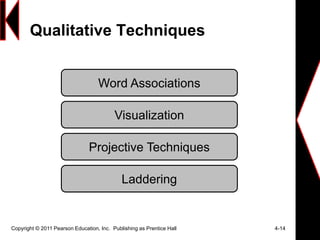
Qualitative Techniques
Copyright © 2011 Pearson Education, Inc. Publishing as Prentice Hall 4-14
Word Associations
Visualization
Projective Techniques
Laddering
Questionnaire Do’s and Don’ts
 Ensure questions are
free of bias
 Make questions simple
 Make questions specific
 Avoid jargon
 Avoid sophisticated
words
 Avoid ambiguous words
 Avoid negatives
 Avoid hypotheticals
 Avoid words that could
be misheard
 Use response bands
 Use mutually exclusive
categories
 Allow for “other” in fixed
response questions
Copyright © 2011 Pearson Education, Inc. Publishing as Prentice Hall 4-15
Copyright © 2011 Pearson Education, Inc. Publishing as Prentice Hall 4-16
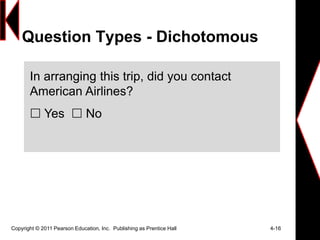
Question Types - Dichotomous
In arranging this trip, did you contact
American Airlines?
 Yes  No
Question Types – Multiple Choice
Copyright © 2011 Pearson Education, Inc. Publishing as Prentice Hall 4-17
With whom are you traveling on this trip?
 No one
 Spouse
 Spouse and children
 Children only
 Business associates/friends/relatives
 An organized tour group
Question Types – Likert Scale
Copyright © 2011 Pearson Education, Inc. Publishing as Prentice Hall 4-18
Indicate your level of agreement with the
following statement: Small airlines generally
give better service than large ones.
 Strongly disagree
 Disagree
 Neither agree nor disagree
 Agree
 Strongly agree
Question Types –
Semantic Differential
Copyright © 2011 Pearson Education, Inc. Publishing as Prentice Hall 4-19
American Airlines
Large ………………………………...…….Small
Experienced………………….….Inexperienced
Modern……………………….…..Old-fashioned
Question Types –
Importance Scale
Copyright © 2011 Pearson Education, Inc. Publishing as Prentice Hall 4-20
Airline food service is _____ to me.
 Extremely important
 Very important
 Somewhat important
 Not very important
 Not at all important
Question Types – Rating Scale
Copyright © 2011 Pearson Education, Inc. Publishing as Prentice Hall 4-21
American Airlines’ food service is _____.
 Excellent
 Very good
 Good
 Fair
 Poor
Question Types –
Intention to Buy Scale
Copyright © 2011 Pearson Education, Inc. Publishing as Prentice Hall 4-22
How likely are you to purchase tickets on
American Airlines if in-flight Internet access
were available?
 Definitely buy
 Probably buy
 Not sure
 Probably not buy
 Definitely not buy
Question Types –
Intention to Buy Scale
Copyright © 2011 Pearson Education, Inc. Publishing as Prentice Hall 4-23
How likely are you to purchase tickets on
American Airlines if in-flight Internet access
were available?
 Definitely buy
 Probably buy
 Not sure
 Probably not buy
 Definitely not buy
Question Types –
Completely Unstructured
Copyright © 2011 Pearson Education, Inc. Publishing as Prentice Hall 4-24
What is your opinion of American Airlines?
Question Types –
Word Association
Copyright © 2011 Pearson Education, Inc. Publishing as Prentice Hall 4-25
What is the first word that comes to your mind
when you hear the following?
Airline ________________________
American _____________________
Travel ________________________
Question Types –
Sentence Completion
Copyright © 2011 Pearson Education, Inc. Publishing as Prentice Hall 4-26
When I choose an airline, the most important
consideration in my decision is:
_____________________________________
_____________________________________
_____________________________________
_____________________________________
_____________________________________
_____________________________________
__________________.
Question Types –
Story Completion
Copyright © 2011 Pearson Education, Inc. Publishing as Prentice Hall 4-27
“I flew American a few days ago. I noticed
that the exterior and interior of the plane had
very bright colors. This aroused in me the
following thoughts and feelings.” Now
complete the story.
___________________________________
___________________________________
___________________________________
___________________________________
___________________________________
Technological Devices
 Galvanometers
 Tachistoscope
 Eye cameras
 Audiometers
 GPS
Copyright © 2011 Pearson Education, Inc. Publishing as Prentice Hall 4-28
Sampling Plan
 Sampling unit: Who is to be surveyed?
 Sample size: How many people should be
surveyed?
 Sampling procedure: How should the
respondents be chosen?
Copyright © 2011 Pearson Education, Inc. Publishing as Prentice Hall 4-29
Contact Methods
Copyright © 2011 Pearson Education, Inc. Publishing as Prentice Hall 4-30
Pros and Cons of
Online Research
Advantages
 Inexpensive
 Fast
 Accuracy of data
 Versatility
Disadvantages
 Small samples
 Skewed samples
 Technological
problems
 Inconsistencies
Copyright © 2011 Pearson Education, Inc. Publishing as Prentice Hall 4-31
What is a
Marketing Decision Support
System (MDSS)?
 A marketing decision support system is a
coordinated collection of data, systems,
tools, and techniques with supporting
hardware and software by which an
organization gathers and interprets relevant
information from business and environment
and turns it into a basis for marketing action.
Copyright © 2011 Pearson Education, Inc. Publishing as Prentice Hall 4-32
Barriers Limiting the Use of
Marketing Research
 A narrow conception of the research
 Uneven caliber of researchers
 Poor framing of the problem
 Late and occasionally erroneous findings
 Personality and presentational differences
Copyright © 2011 Pearson Education, Inc. Publishing as Prentice Hall 4-33
Market Research Can Fail
Copyright © 2011 Pearson Education, Inc. Publishing as Prentice Hall 4-34
Copyright © 2011 Pearson Education, Inc. Publishing as Prentice Hall 4-35
Table 4.3 Characteristics of
Good Marketing Research
 Scientific method
 Research creativity
 Multiple methods
 Interdependence
 Value and cost of information
 Healthy skepticism
 Ethical marketing
Copyright © 2011 Pearson Education, Inc. Publishing as Prentice Hall 4-36
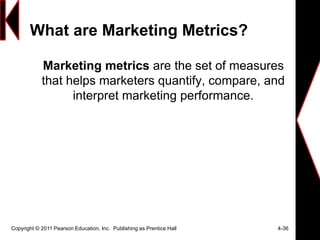
What are Marketing Metrics?
Marketing metrics are the set of measures
that helps marketers quantify, compare, and
interpret marketing performance.
Copyright © 2011 Pearson Education, Inc. Publishing as Prentice Hall 4-37
Table 4.4 Marketing Metrics
External
 Awareness
 Market share
 Relative price
 Number of complaints
 Customer satisfaction
 Distribution
 Total number of
customers
 Loyalty
Internal
 Awareness of goals
 Commitment to goals
 Active support
 Resource adequacy
 Staffing levels
 Desire to learn
 Willingness to change
 Freedom to fail
 Autonomy
Copyright © 2011 Pearson Education, Inc. Publishing as Prentice Hall 4-38
What is Marketing-Mix Modeling?
Marketing-mix models analyze data from a
variety of sources, such as retailer scanner
data, company shipment data, pricing,
media, and promotion spending data, to
understand more precisely the effects of
specific marketing activities.
Figure 4.2 Marketing
Measurement Pathway
Copyright © 2011 Pearson Education, Inc. Publishing as Prentice Hall 4-39
Figure 4.3 Marketing Dashboard
Copyright © 2011 Pearson Education, Inc. Publishing as Prentice Hall 4-40
Copyright © 2011 Pearson Education, Inc. Publishing as Prentice Hall 4-41
Table 4.4 Sample Customer-Performance
Scorecard Measures
 % of new customers to average #
 % of lost customers to average #
 % of win-back customers to average #
 % of customers in various levels of satisfaction
 % of customers who would repurchase
 % of target market members with brand recall
 % of customers who say brand is most preferred
For Review
 What constitutes good marketing research?
 What are the best metrics for measuring
marketing productivity?
 How can marketers assess their return on
investment of marketing expenditures?
Copyright © 2011 Pearson Education, Inc. Publishing as Prentice Hall 4-42

Kotler_MM_14e_04_sppt.ppt

  • 1.
  • 2.
    Chapter Questions  Whatconstitutes good marketing research?  What are the best metrics for measuring marketing productivity?  How can marketers assess their return on investment of marketing expenditures? Copyright © 2011 Pearson Education, Inc. Publishing as Prentice Hall 4-2
  • 3.
    Venus Razor Copyright ©2011 Pearson Education, Inc. Publishing as Prentice Hall 4-3
  • 4.
    What is MarketingResearch? Marketing research is the systematic design, collection, analysis, and reporting of data and findings relevant to a specific marketing situation facing the company. Copyright © 2011 Pearson Education, Inc. Publishing as Prentice Hall 4-4
  • 5.
    Copyright © 2011Pearson Education, Inc. Publishing as Prentice Hall 4-5 Types of Marketing Research Firms Syndicated Custom Specialty-line
  • 6.
    Copyright © 2011Pearson Education, Inc. Publishing as Prentice Hall 4-6 The Marketing Research Process  Define the problem  Develop research plan  Collect information  Analyze information  Present findings  Make decision
  • 7.
    Copyright © 2011Pearson Education, Inc. Publishing as Prentice Hall 4-7 Step 1: Define the Problem  Define the problem  Specify decision alternatives  State research objectives
  • 8.
    Types of Research Copyright© 2011 Pearson Education, Inc. Publishing as Prentice Hall 4-8 Exploratory Descriptive Causal
  • 9.
    Copyright © 2011Pearson Education, Inc. Publishing as Prentice Hall 4-9 Step 2: Develop the Research Plan  Data sources  Research approach  Research instruments  Sampling plan  Contact methods
  • 10.
    Data sources Copyright ©2011 Pearson Education, Inc. Publishing as Prentice Hall 4-10
  • 11.
    Copyright © 2011Pearson Education, Inc. Publishing as Prentice Hall 4-11 Research Approaches  Observational and ethnographic  Focus group  Survey  Behavioral  Experimental
  • 12.
    Focus Groups Copyright ©2011 Pearson Education, Inc. Publishing as Prentice Hall 4-12
  • 13.
    Copyright © 2011Pearson Education, Inc. Publishing as Prentice Hall 4-13 Research Instruments  Questionnaires  Qualitative Measures  Technological Devices
  • 14.
    Qualitative Techniques Copyright ©2011 Pearson Education, Inc. Publishing as Prentice Hall 4-14 Word Associations Visualization Projective Techniques Laddering
  • 15.
    Questionnaire Do’s andDon’ts  Ensure questions are free of bias  Make questions simple  Make questions specific  Avoid jargon  Avoid sophisticated words  Avoid ambiguous words  Avoid negatives  Avoid hypotheticals  Avoid words that could be misheard  Use response bands  Use mutually exclusive categories  Allow for “other” in fixed response questions Copyright © 2011 Pearson Education, Inc. Publishing as Prentice Hall 4-15
  • 16.
    Copyright © 2011Pearson Education, Inc. Publishing as Prentice Hall 4-16 Question Types - Dichotomous In arranging this trip, did you contact American Airlines?  Yes  No
  • 17.
    Question Types –Multiple Choice Copyright © 2011 Pearson Education, Inc. Publishing as Prentice Hall 4-17 With whom are you traveling on this trip?  No one  Spouse  Spouse and children  Children only  Business associates/friends/relatives  An organized tour group
  • 18.
    Question Types –Likert Scale Copyright © 2011 Pearson Education, Inc. Publishing as Prentice Hall 4-18 Indicate your level of agreement with the following statement: Small airlines generally give better service than large ones.  Strongly disagree  Disagree  Neither agree nor disagree  Agree  Strongly agree
  • 19.
    Question Types – SemanticDifferential Copyright © 2011 Pearson Education, Inc. Publishing as Prentice Hall 4-19 American Airlines Large ………………………………...…….Small Experienced………………….….Inexperienced Modern……………………….…..Old-fashioned
  • 20.
    Question Types – ImportanceScale Copyright © 2011 Pearson Education, Inc. Publishing as Prentice Hall 4-20 Airline food service is _____ to me.  Extremely important  Very important  Somewhat important  Not very important  Not at all important
  • 21.
    Question Types –Rating Scale Copyright © 2011 Pearson Education, Inc. Publishing as Prentice Hall 4-21 American Airlines’ food service is _____.  Excellent  Very good  Good  Fair  Poor
  • 22.
    Question Types – Intentionto Buy Scale Copyright © 2011 Pearson Education, Inc. Publishing as Prentice Hall 4-22 How likely are you to purchase tickets on American Airlines if in-flight Internet access were available?  Definitely buy  Probably buy  Not sure  Probably not buy  Definitely not buy
  • 23.
    Question Types – Intentionto Buy Scale Copyright © 2011 Pearson Education, Inc. Publishing as Prentice Hall 4-23 How likely are you to purchase tickets on American Airlines if in-flight Internet access were available?  Definitely buy  Probably buy  Not sure  Probably not buy  Definitely not buy
  • 24.
    Question Types – CompletelyUnstructured Copyright © 2011 Pearson Education, Inc. Publishing as Prentice Hall 4-24 What is your opinion of American Airlines?
  • 25.
    Question Types – WordAssociation Copyright © 2011 Pearson Education, Inc. Publishing as Prentice Hall 4-25 What is the first word that comes to your mind when you hear the following? Airline ________________________ American _____________________ Travel ________________________
  • 26.
    Question Types – SentenceCompletion Copyright © 2011 Pearson Education, Inc. Publishing as Prentice Hall 4-26 When I choose an airline, the most important consideration in my decision is: _____________________________________ _____________________________________ _____________________________________ _____________________________________ _____________________________________ _____________________________________ __________________.
  • 27.
    Question Types – StoryCompletion Copyright © 2011 Pearson Education, Inc. Publishing as Prentice Hall 4-27 “I flew American a few days ago. I noticed that the exterior and interior of the plane had very bright colors. This aroused in me the following thoughts and feelings.” Now complete the story. ___________________________________ ___________________________________ ___________________________________ ___________________________________ ___________________________________
  • 28.
    Technological Devices  Galvanometers Tachistoscope  Eye cameras  Audiometers  GPS Copyright © 2011 Pearson Education, Inc. Publishing as Prentice Hall 4-28
  • 29.
    Sampling Plan  Samplingunit: Who is to be surveyed?  Sample size: How many people should be surveyed?  Sampling procedure: How should the respondents be chosen? Copyright © 2011 Pearson Education, Inc. Publishing as Prentice Hall 4-29
  • 30.
    Contact Methods Copyright ©2011 Pearson Education, Inc. Publishing as Prentice Hall 4-30
  • 31.
    Pros and Consof Online Research Advantages  Inexpensive  Fast  Accuracy of data  Versatility Disadvantages  Small samples  Skewed samples  Technological problems  Inconsistencies Copyright © 2011 Pearson Education, Inc. Publishing as Prentice Hall 4-31
  • 32.
    What is a MarketingDecision Support System (MDSS)?  A marketing decision support system is a coordinated collection of data, systems, tools, and techniques with supporting hardware and software by which an organization gathers and interprets relevant information from business and environment and turns it into a basis for marketing action. Copyright © 2011 Pearson Education, Inc. Publishing as Prentice Hall 4-32
  • 33.
    Barriers Limiting theUse of Marketing Research  A narrow conception of the research  Uneven caliber of researchers  Poor framing of the problem  Late and occasionally erroneous findings  Personality and presentational differences Copyright © 2011 Pearson Education, Inc. Publishing as Prentice Hall 4-33
  • 34.
    Market Research CanFail Copyright © 2011 Pearson Education, Inc. Publishing as Prentice Hall 4-34
  • 35.
    Copyright © 2011Pearson Education, Inc. Publishing as Prentice Hall 4-35 Table 4.3 Characteristics of Good Marketing Research  Scientific method  Research creativity  Multiple methods  Interdependence  Value and cost of information  Healthy skepticism  Ethical marketing
  • 36.
    Copyright © 2011Pearson Education, Inc. Publishing as Prentice Hall 4-36 What are Marketing Metrics? Marketing metrics are the set of measures that helps marketers quantify, compare, and interpret marketing performance.
  • 37.
    Copyright © 2011Pearson Education, Inc. Publishing as Prentice Hall 4-37 Table 4.4 Marketing Metrics External  Awareness  Market share  Relative price  Number of complaints  Customer satisfaction  Distribution  Total number of customers  Loyalty Internal  Awareness of goals  Commitment to goals  Active support  Resource adequacy  Staffing levels  Desire to learn  Willingness to change  Freedom to fail  Autonomy
  • 38.
    Copyright © 2011Pearson Education, Inc. Publishing as Prentice Hall 4-38 What is Marketing-Mix Modeling? Marketing-mix models analyze data from a variety of sources, such as retailer scanner data, company shipment data, pricing, media, and promotion spending data, to understand more precisely the effects of specific marketing activities.
  • 39.
    Figure 4.2 Marketing MeasurementPathway Copyright © 2011 Pearson Education, Inc. Publishing as Prentice Hall 4-39
  • 40.
    Figure 4.3 MarketingDashboard Copyright © 2011 Pearson Education, Inc. Publishing as Prentice Hall 4-40
  • 41.
    Copyright © 2011Pearson Education, Inc. Publishing as Prentice Hall 4-41 Table 4.4 Sample Customer-Performance Scorecard Measures  % of new customers to average #  % of lost customers to average #  % of win-back customers to average #  % of customers in various levels of satisfaction  % of customers who would repurchase  % of target market members with brand recall  % of customers who say brand is most preferred
  • 42.
    For Review  Whatconstitutes good marketing research?  What are the best metrics for measuring marketing productivity?  How can marketers assess their return on investment of marketing expenditures? Copyright © 2011 Pearson Education, Inc. Publishing as Prentice Hall 4-42