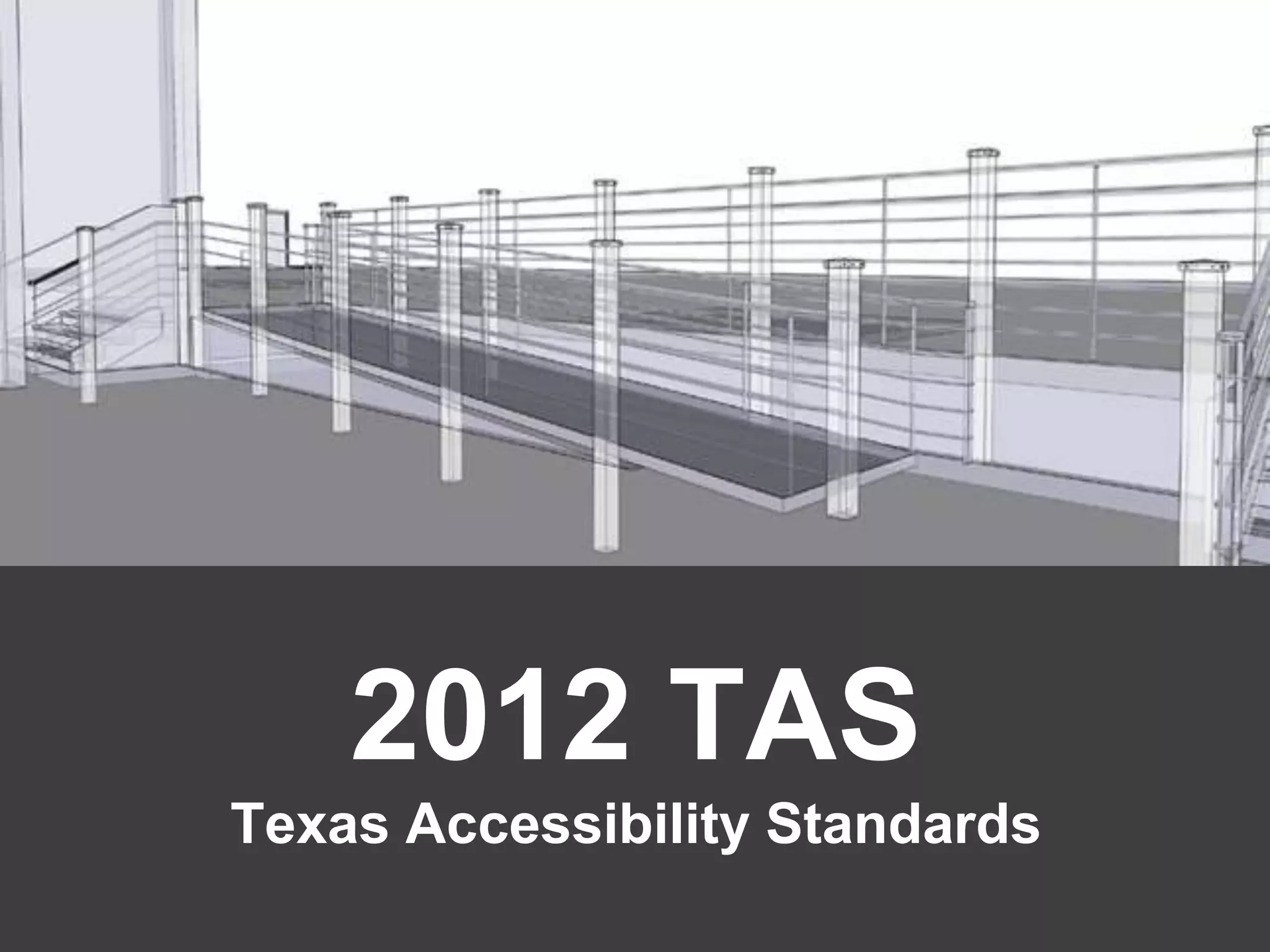
2012 TAS
Texas Accessibility Standards
Registered AccessibilitySpecialist (RAS)
An architectural project must be Registered with
the Texas Department of Licensing and
Regulation (TDLR), and a RAS must be hired to
perform:
a Plan Review (at the drawing stage)
an Inspection (at the completion of
construction)
on architectural projects (new construction or
remodeling) if the estimated construction cost is
$50,000 or more.
Registered AccessibilitySpecialist (RAS)
The purpose of the plan review and the
inspection is to ensure the project is compliant
with all requirements of the 2012 TAS (Texas
Accessibility Standards).
All public buildings in Texas, however, must be
compliant with the 2012 TAS, even if the
construction cost is under $50,000 (in that case,
a plan review and inspection are simply not
required.)
How to
apply
the
2012
TAS
CHAPTER
Required to be compliant
with the 2012 TAS:
Publicly Funded Facilities
Required to be compliant
with the 2012 TAS:
Publicly Funded Facilities
State Leased Facilities
Required to be compliant
with the 2012 TAS:
Publicly Funded Facilities
State Leased Facilities
Public Accommodations
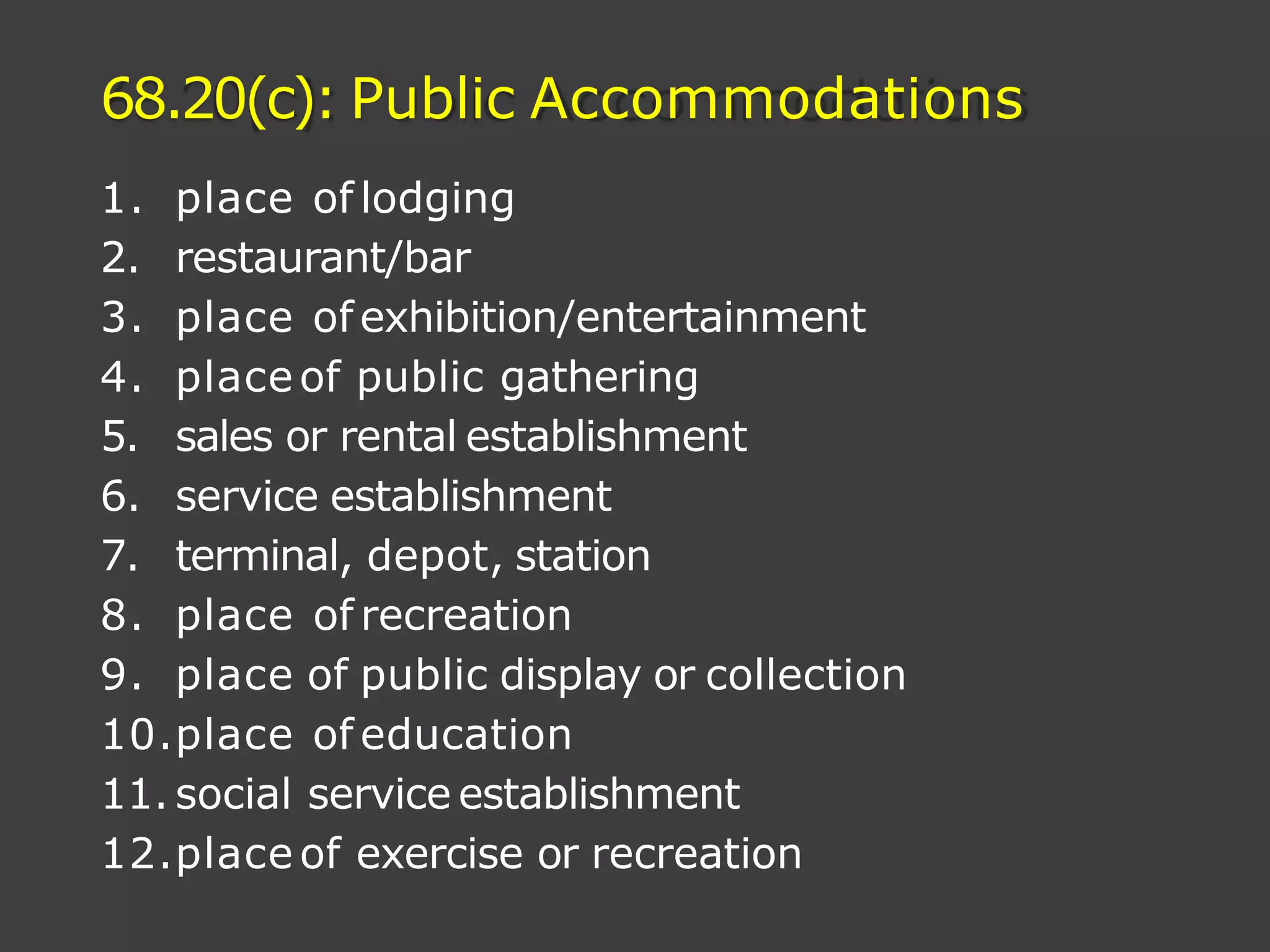
68.20(c): Public Accommodations
1. place of lodging
2. restaurant/bar
3. place of exhibition/entertainment
4. placeof public gathering
5. sales or rental establishment
6. service establishment
7. terminal, depot, station
8. place of recreation
9. place of public display or collection
10.place of education
11. social service establishment
12.place of exercise or recreation
Required to be compliant
with the 2012 TAS:
Publicly Funded Facilities
State Leased Facilities
Public Accommodations
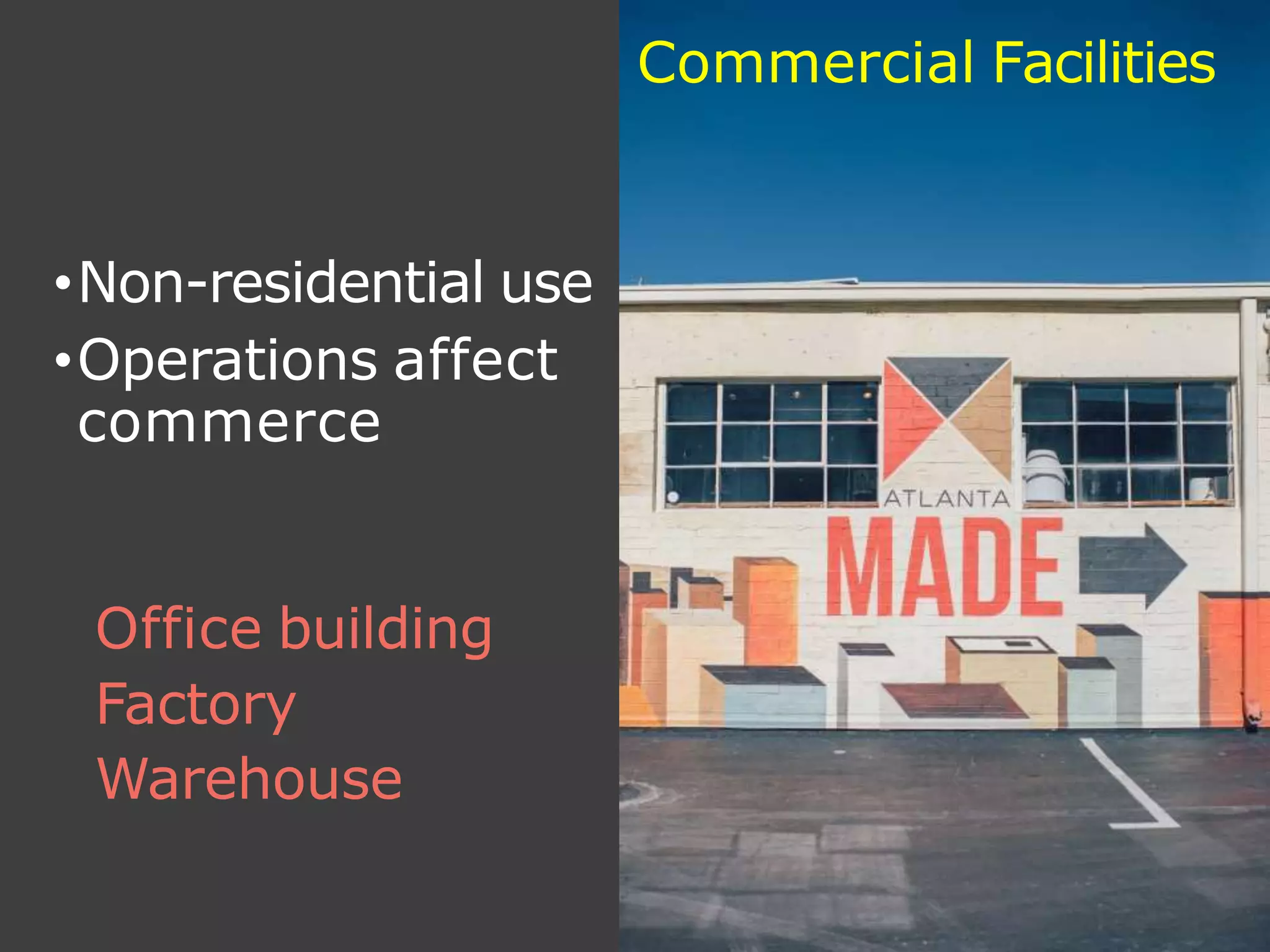
Commercial Facilities
•Non-residential use
•Operations affect
commerce
Office building
Factory
Warehouse
Commercial Facilities
Required to be compliant
with the 2012 TAS:
Publicly Funded Facilities
State Leased Facilities
Public Accommodations
Commercial Facilities
Religious Organizations
Chapter 2
Scoping
• How many?
• Where?
Building Blocks
Spaces and
clearances
needed for
accessibility
Chapter 3
302floor/ground surface
303changes in level
304 turning space
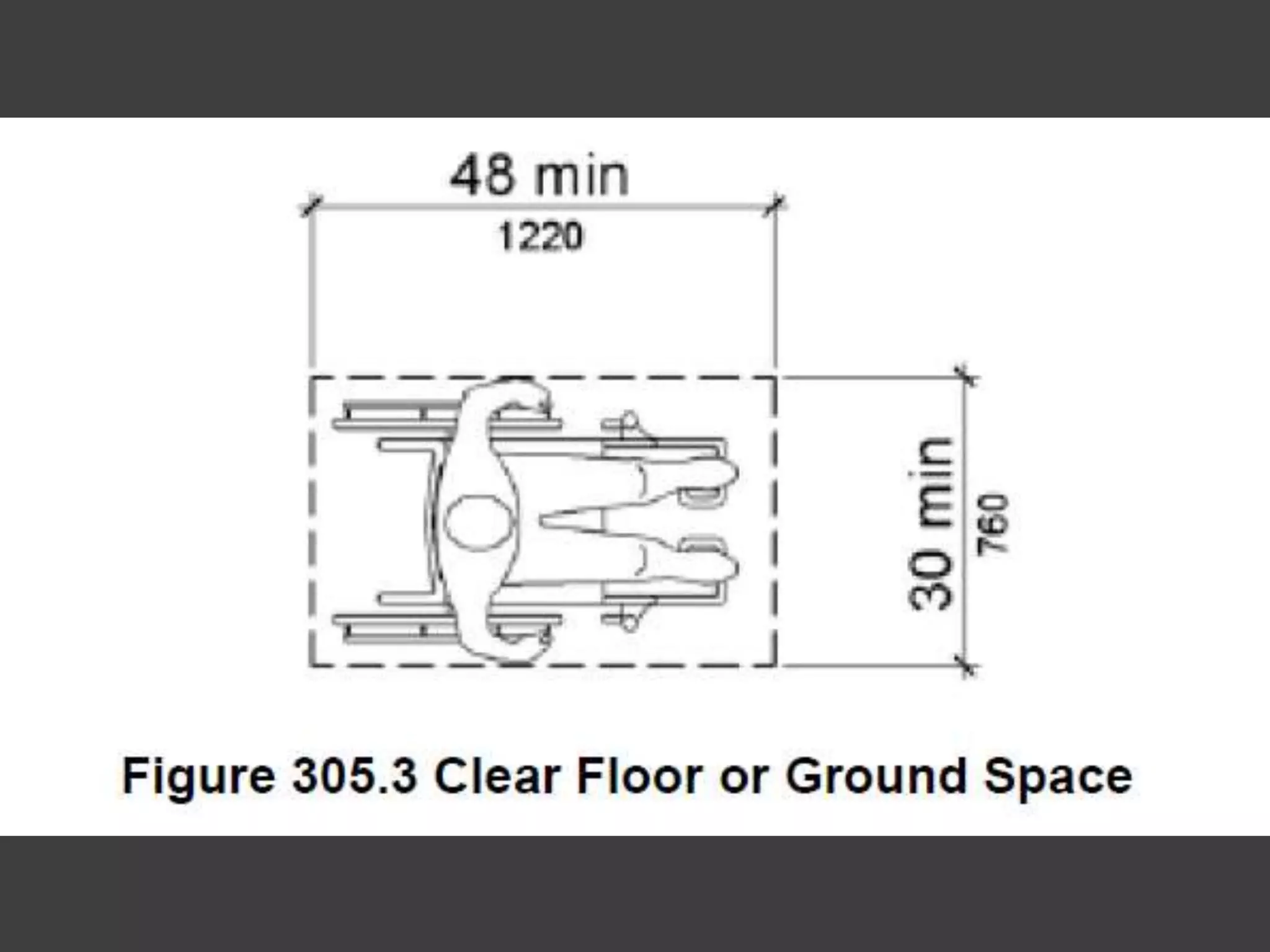
305 clear floorspace
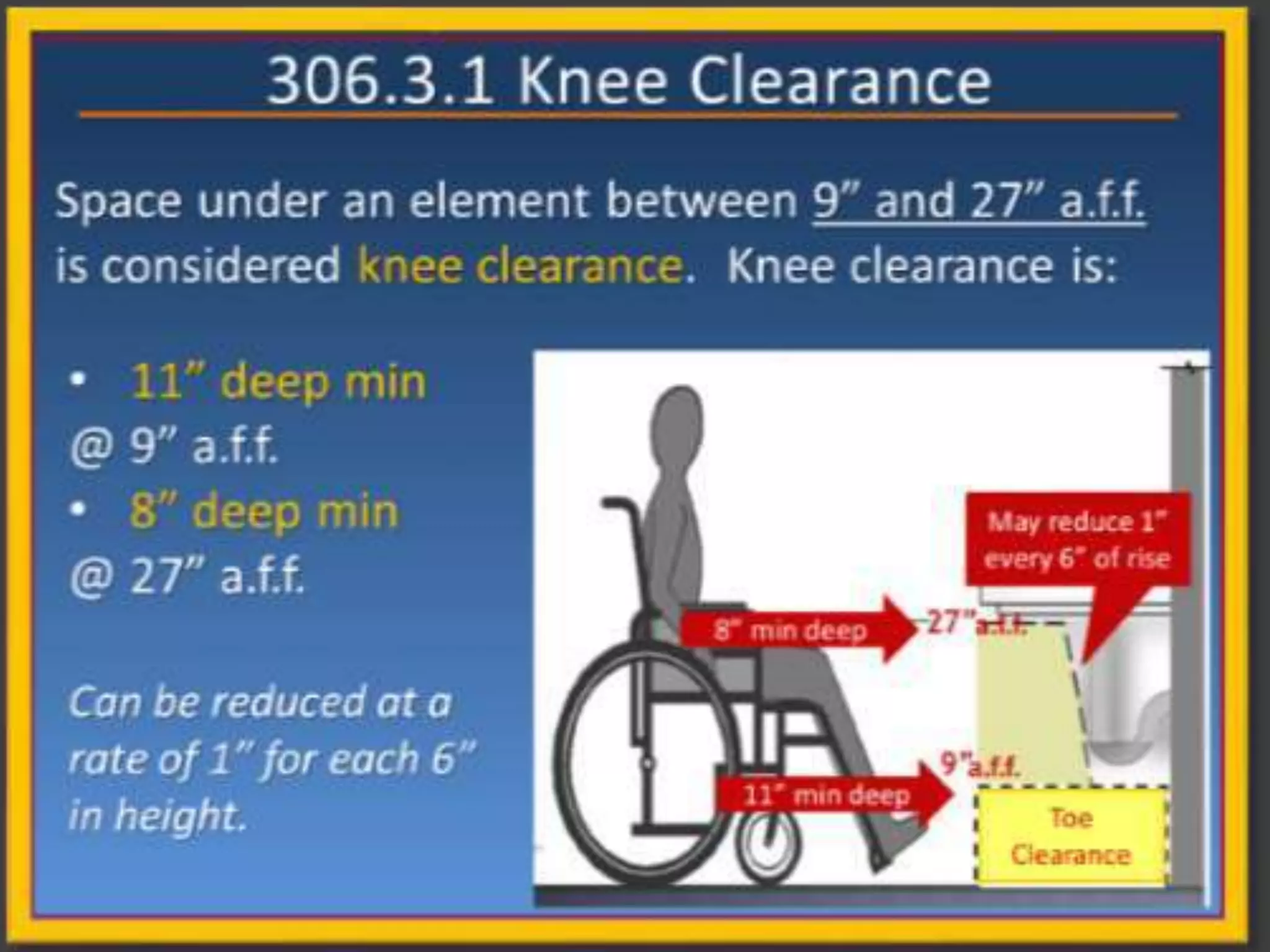
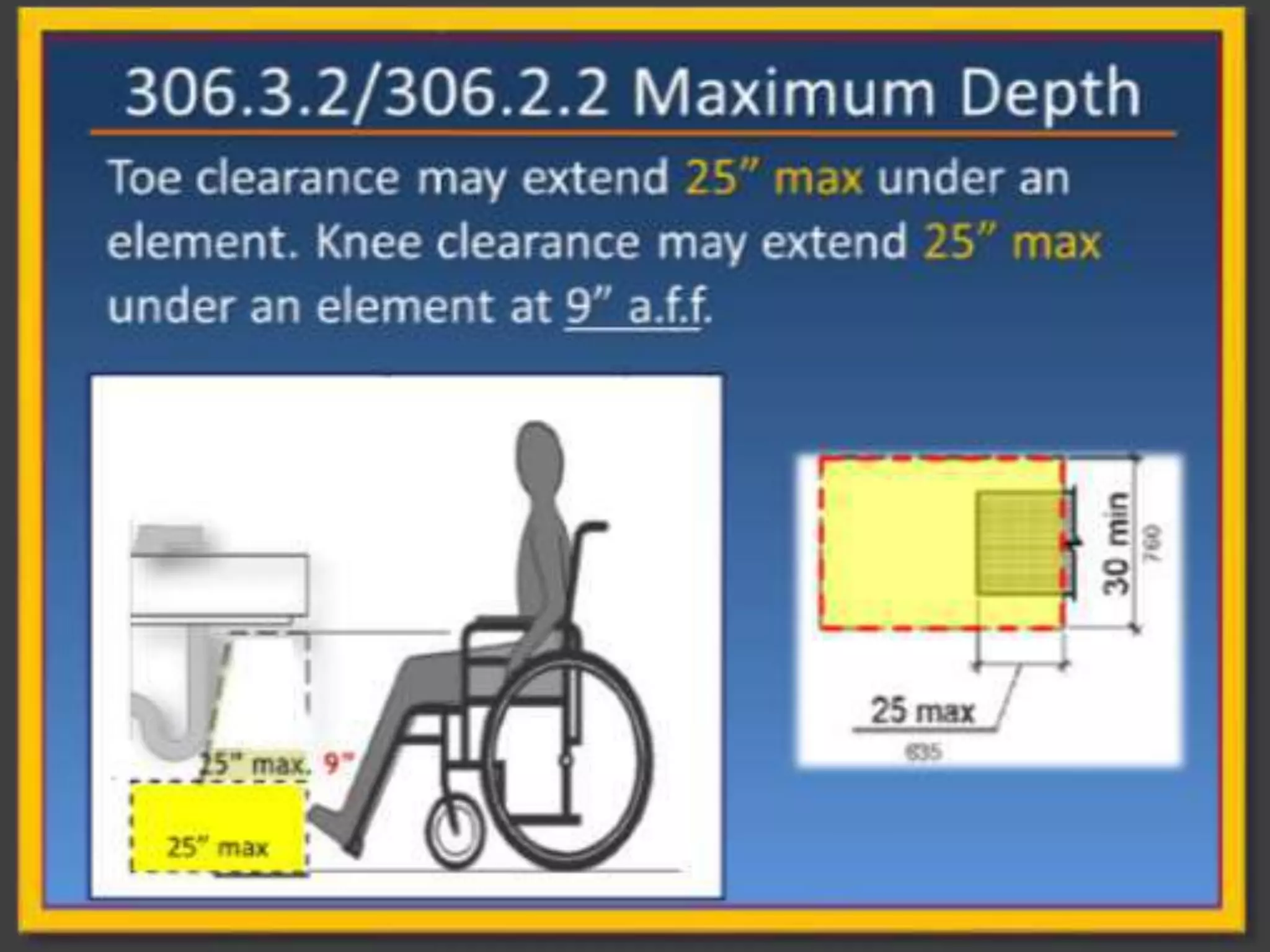
306 knee and toe clearance
307 protruding objects
308reach ranges
309operable parts
Technical Requirements
Details of what is required for
specific elements
Details are in
Chapters 4-10
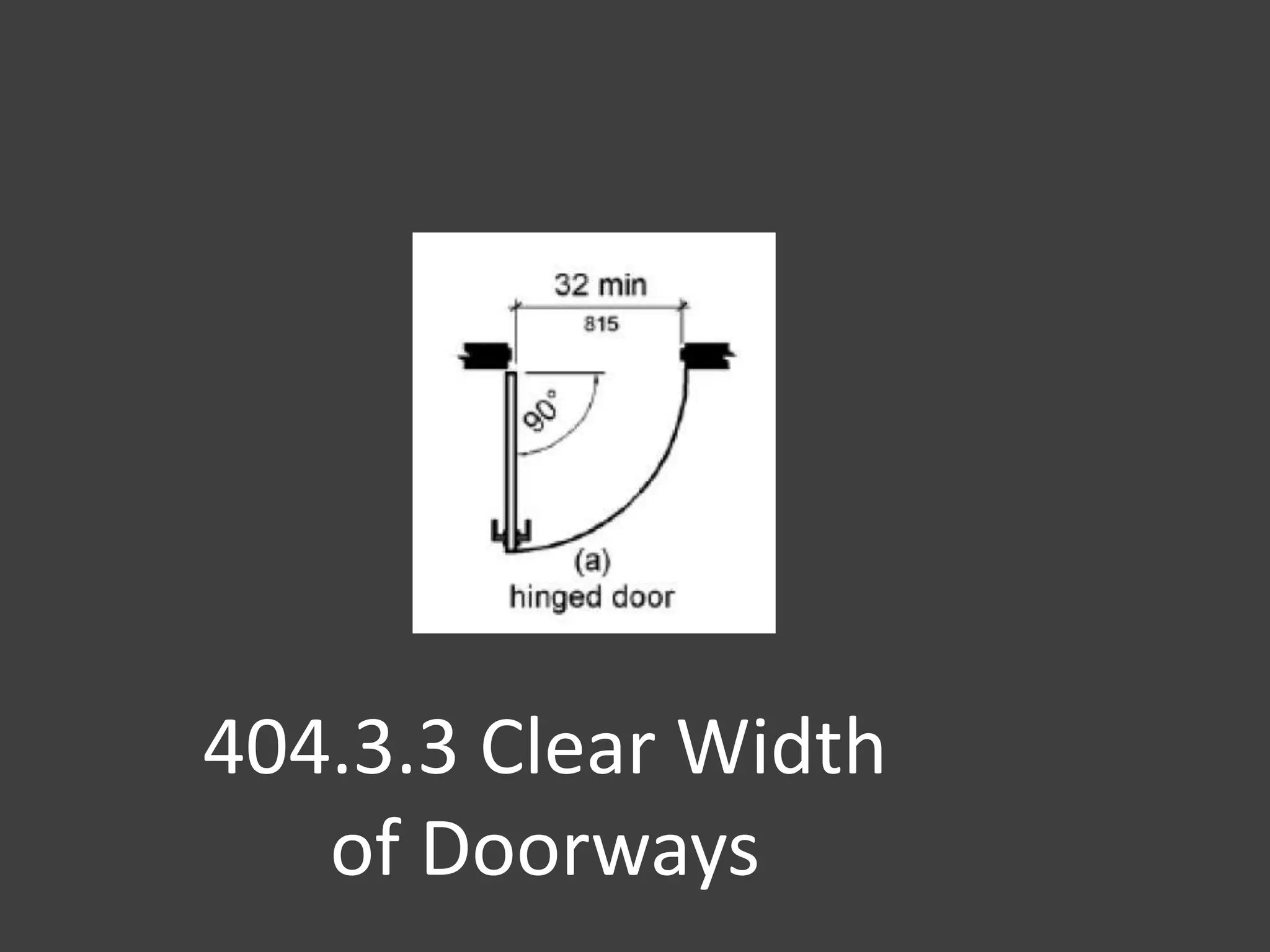
404.3.3 Clear Width
of Doorways
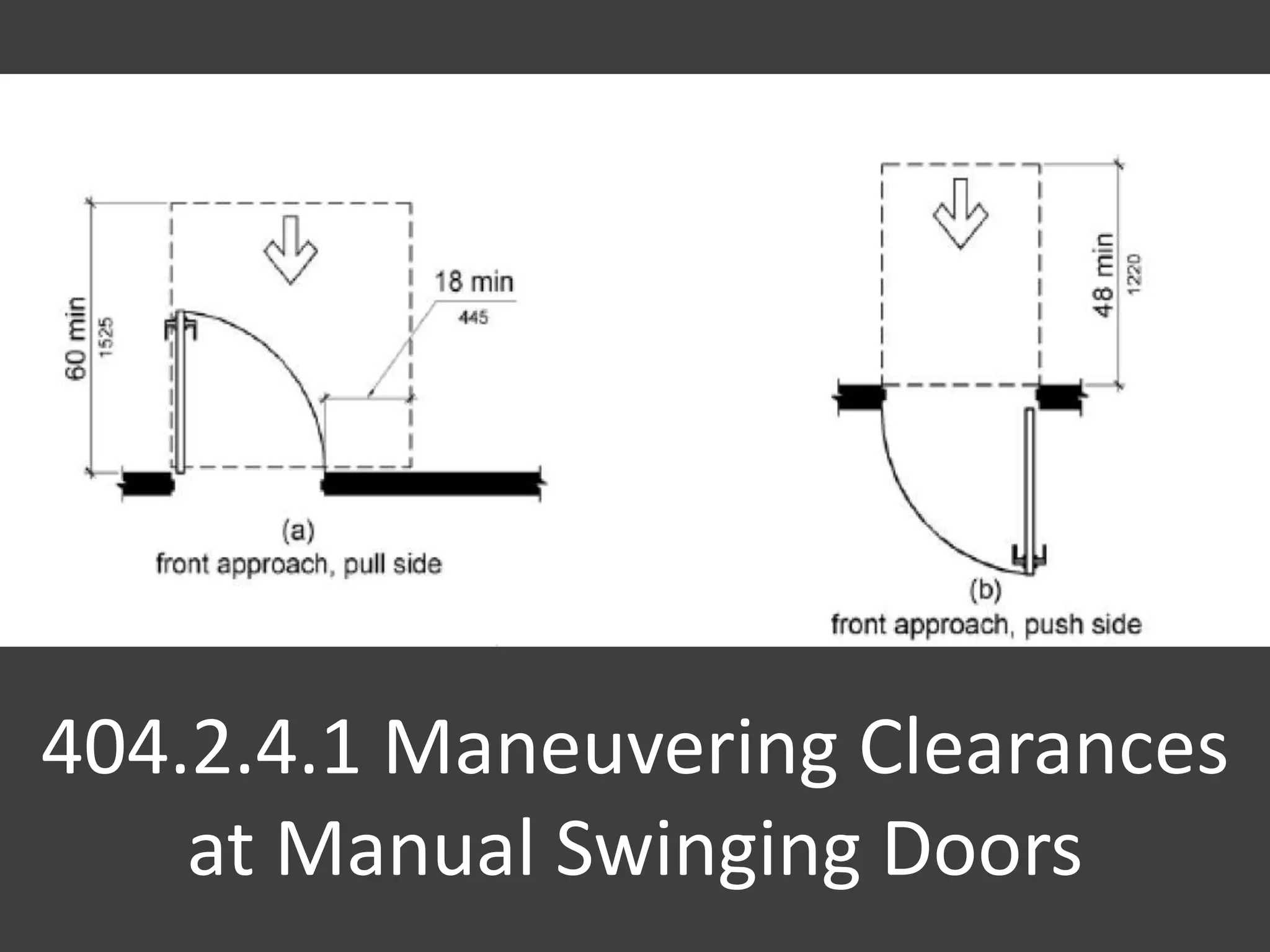
404.2.4.1 Maneuvering Clearances
at Manual Swinging Doors
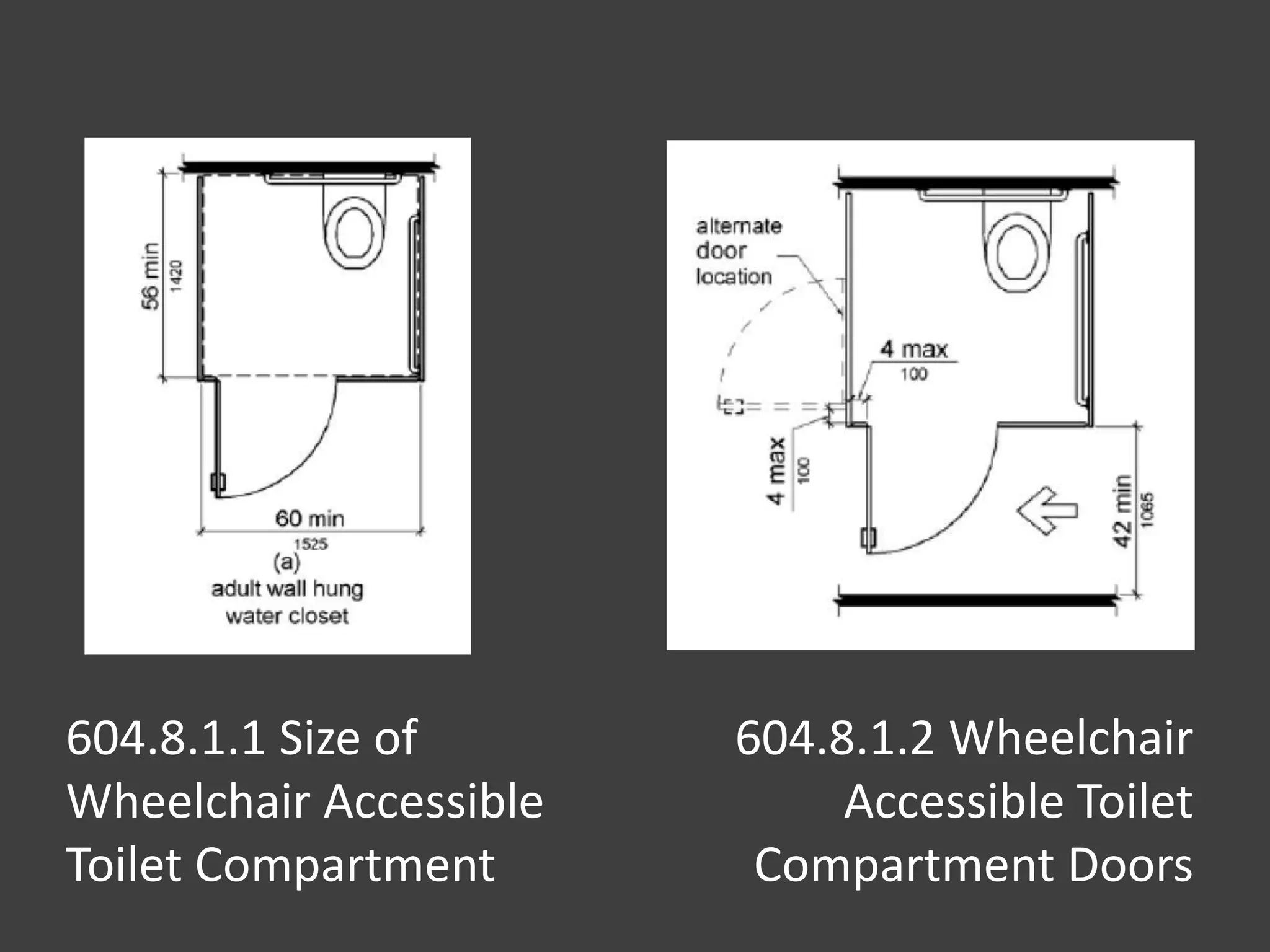
604.8.1.1 Size of
Wheelchair Accessible
Toilet Compartment
604.8.1.2 Wheelchair
Accessible Toilet
Compartment Doors
4 accessible routes
5 general site &building elements
6 plumbing
7 communication
8 special rooms, spaces & elements
9 built-in elements
10 recreation facilities
CHAPTERS
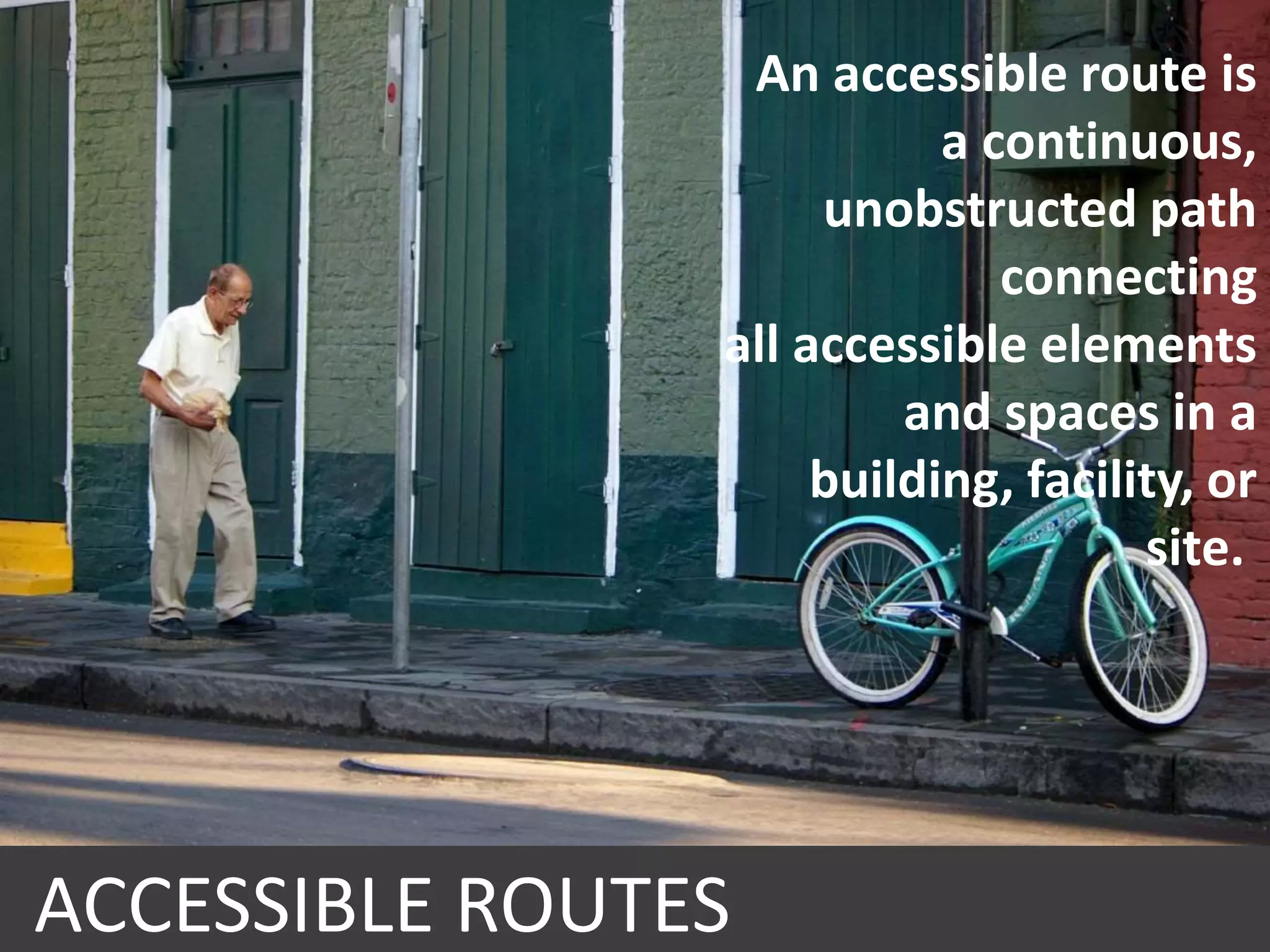
An accessible route is
a continuous,
unobstructed path
connecting
all accessible elements
and spaces in a
building, facility, or
site.
ACCESSIBLE ROUTES
accessible
routes are
required
from
arrival
points
like
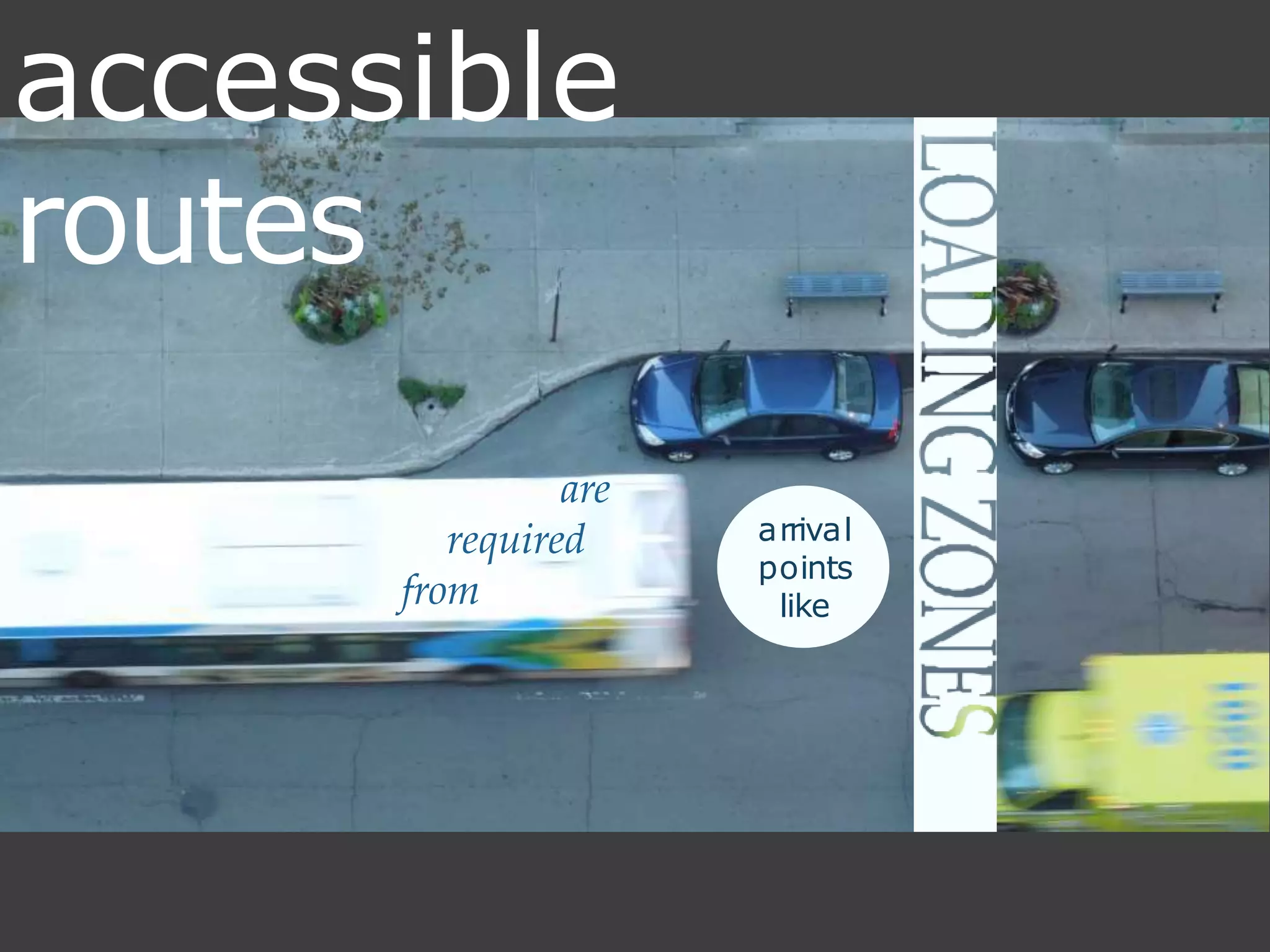
accessible
routes
arrival
points
like
are
required
from
accessible
routes
are
required
from
arrival
points
like
arrival
points
like
are
required
from
accessible
routes
arrival
points
like
are
required
from
accessible
routes
from
entrances
to all
of the
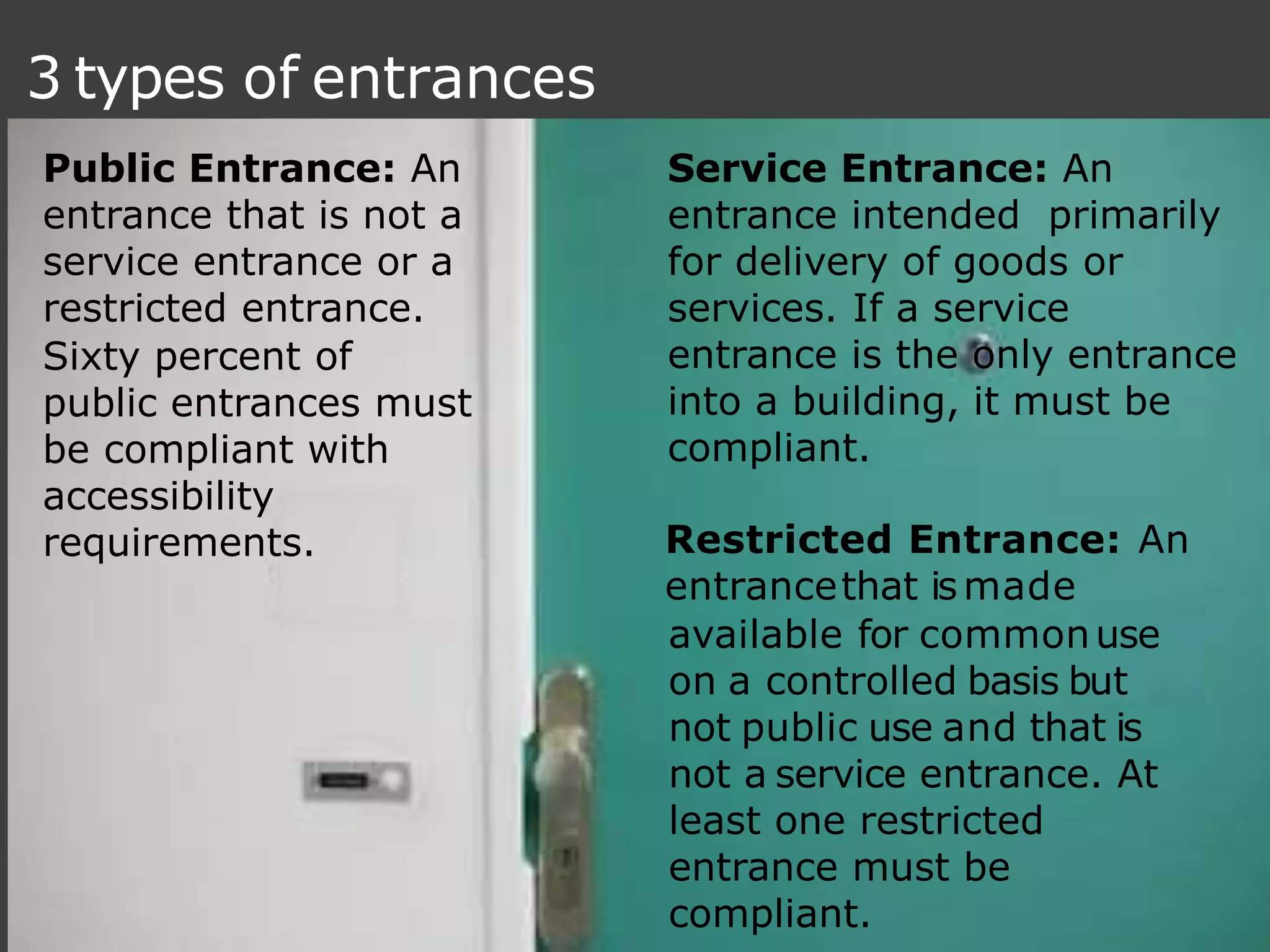
3 types of entrances
Restricted Entrance: An
entrancethat ismade
available for commonuse
on a controlled basis but
not public use and that is
not a service entrance. At
least one restricted
entrance must be
compliant.
Service Entrance: An
entrance intended primarily
for delivery of goods or
services. If a service
entrance is the only entrance
into a building, it must be
compliant.
Public Entrance: An
entrance that is not a
service entrance or a
restricted entrance.
Sixty percent of
public entrances must
be compliant with
accessibility
requirements.
accessible
elements & spaces
routesconnect
206.2.2
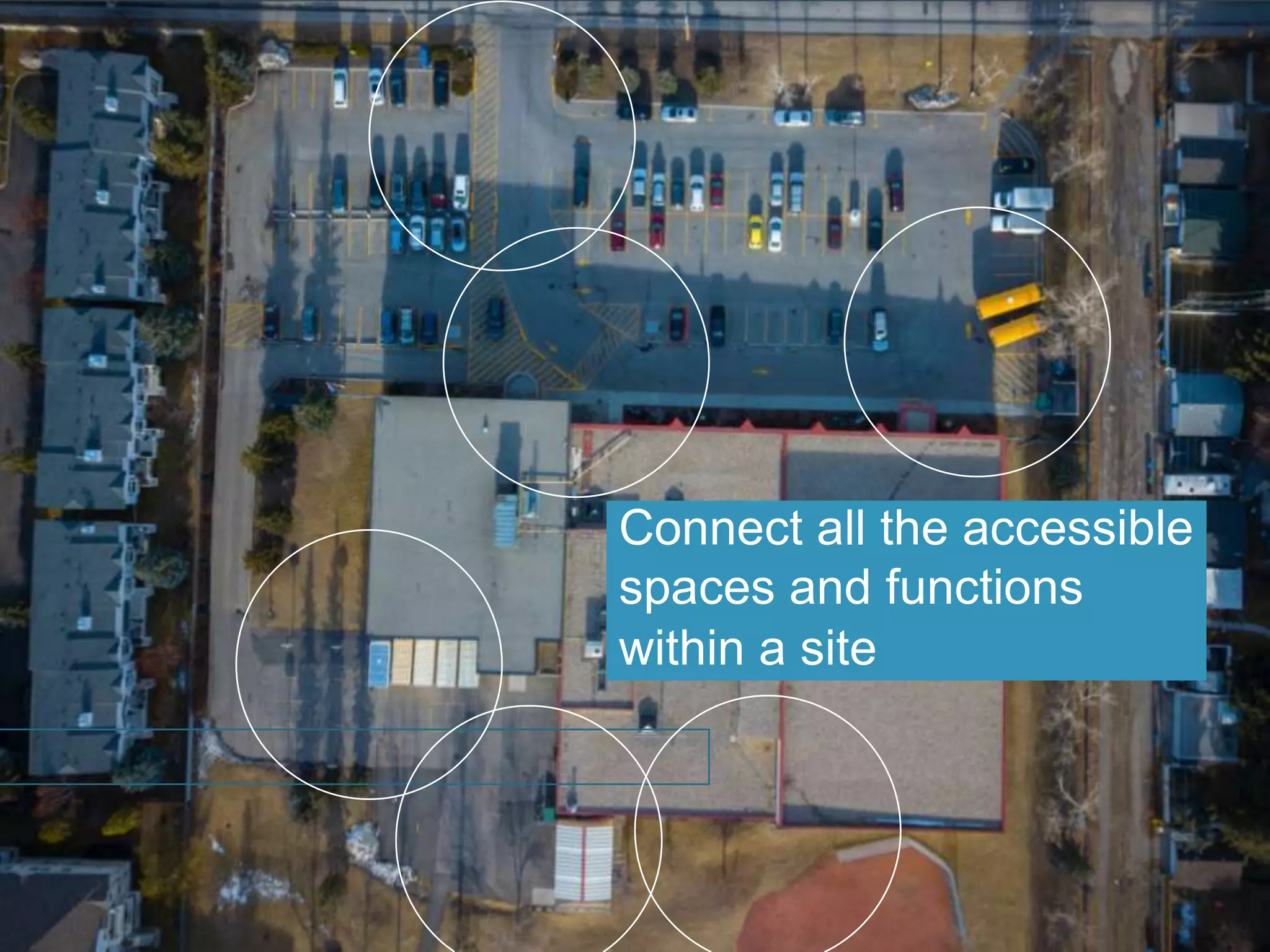
Connect all the accessible
spaces and functions
within a site
accessible
routes
levelsconnect
Let’s take this
levels thing
a step further.
in specific situations
206.2.3 multi-story buildings
206.2.5 restaurants
206.2.8 employee work areas
Accessible Routes
At least one accessible route
shall connect each story and
mezzanine in multi-story
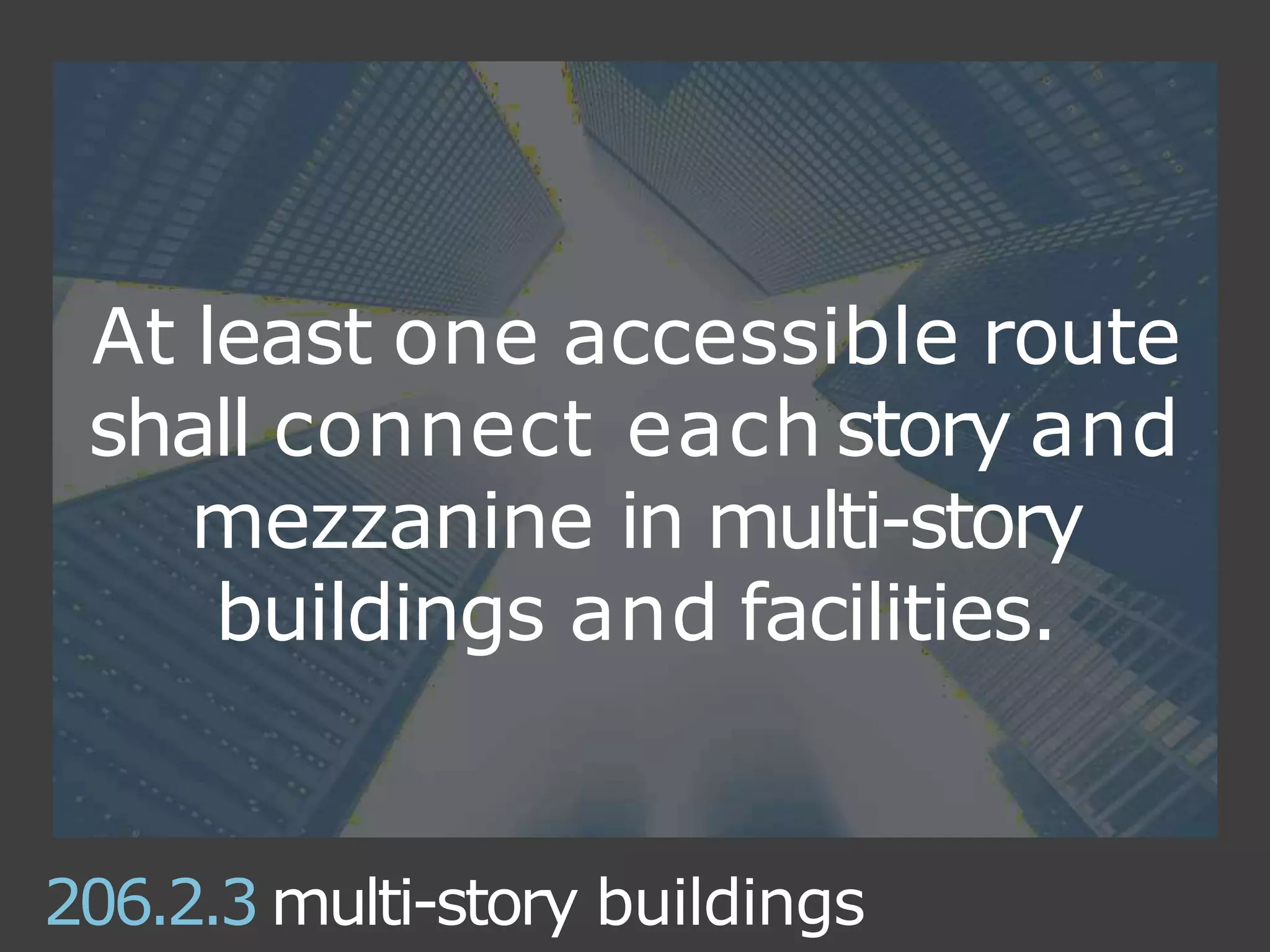
buildings and facilities.
206.2.3 multi-story buildings
accessible route between stories?
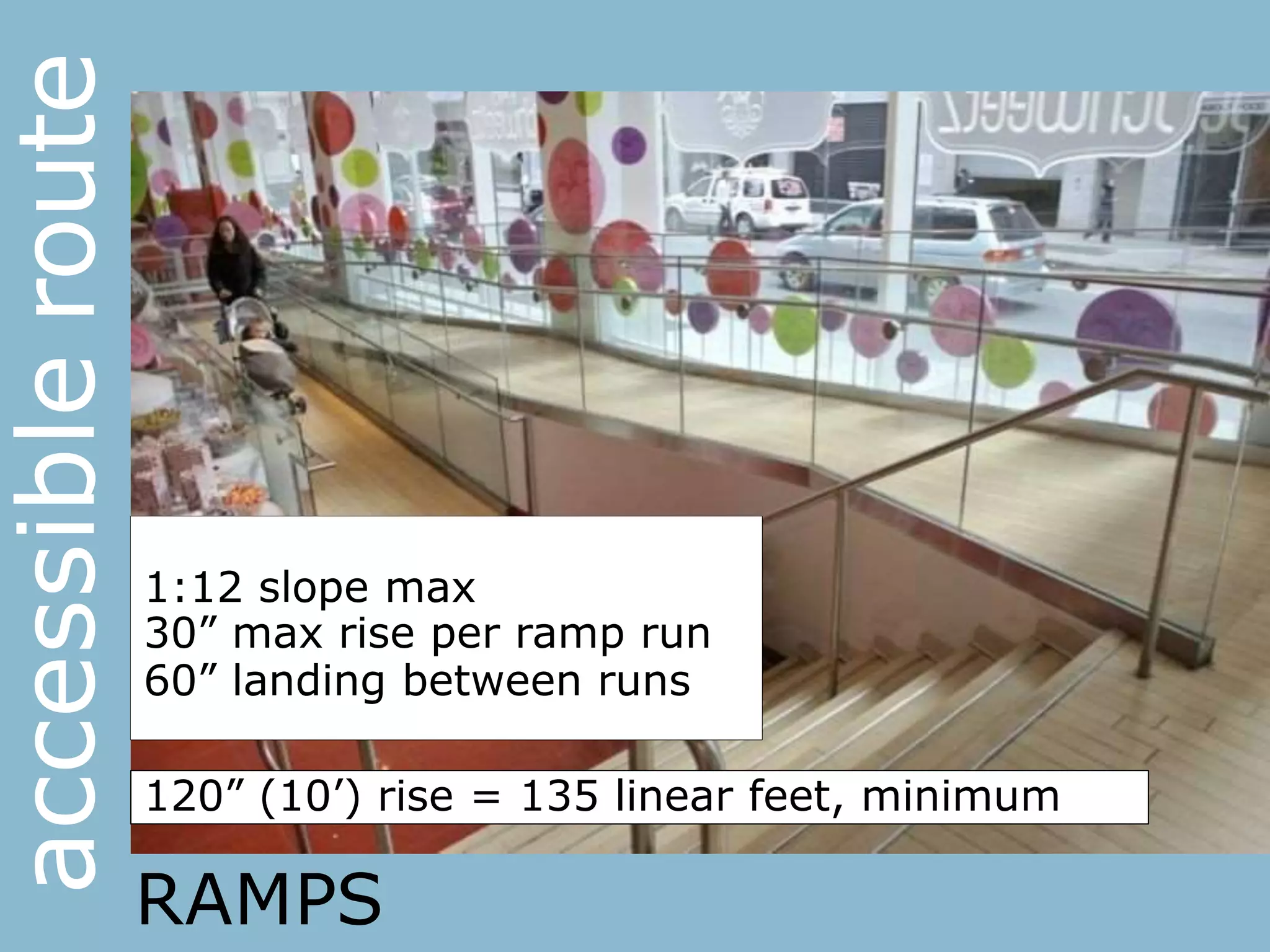
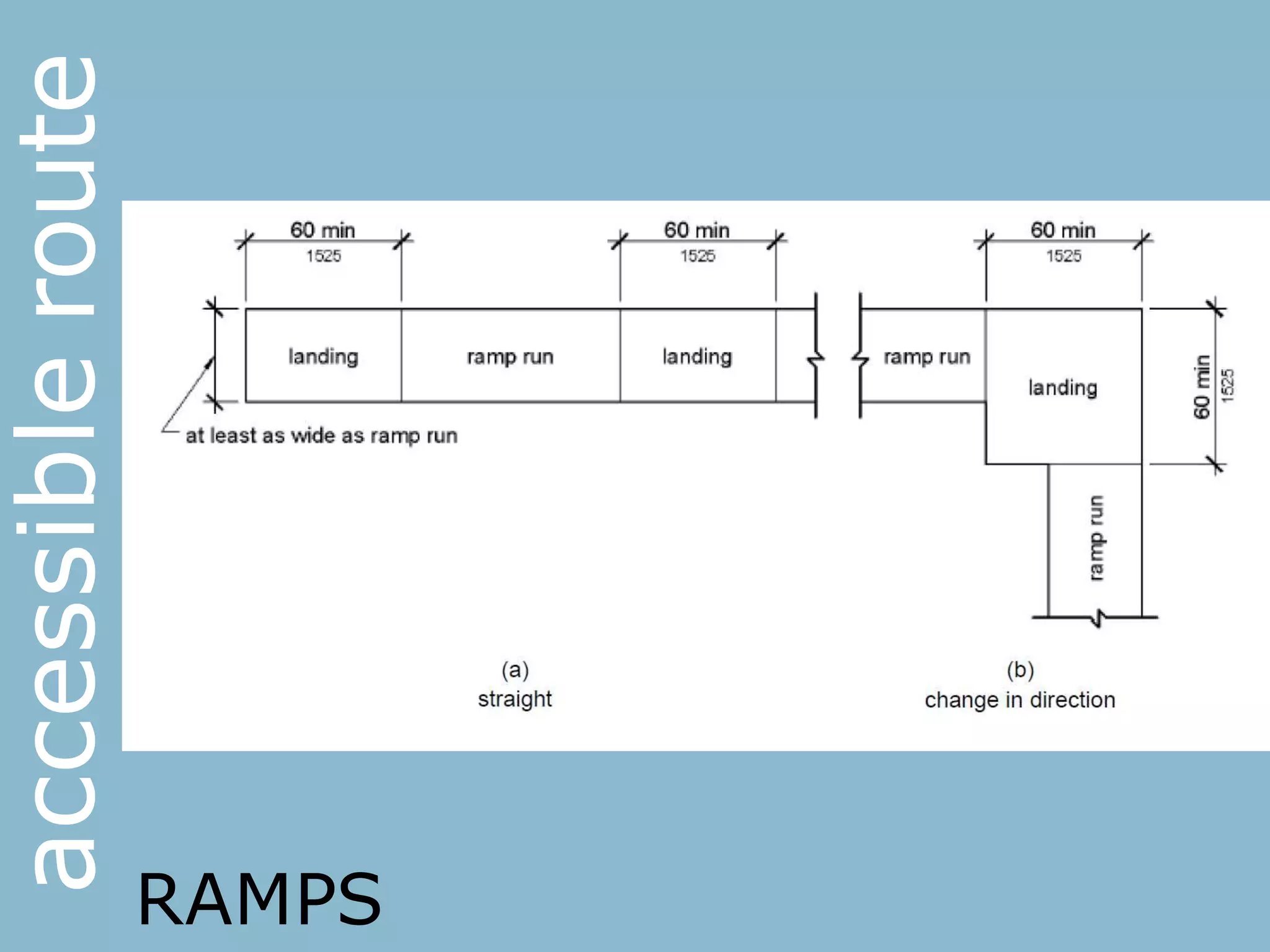
RAMPS
accessibleroute
1:12 slope max
30” max rise per ramp run
60” landing between runs
120” (10’) rise = 135 linear feet, minimum
RAMPS
accessibleroute
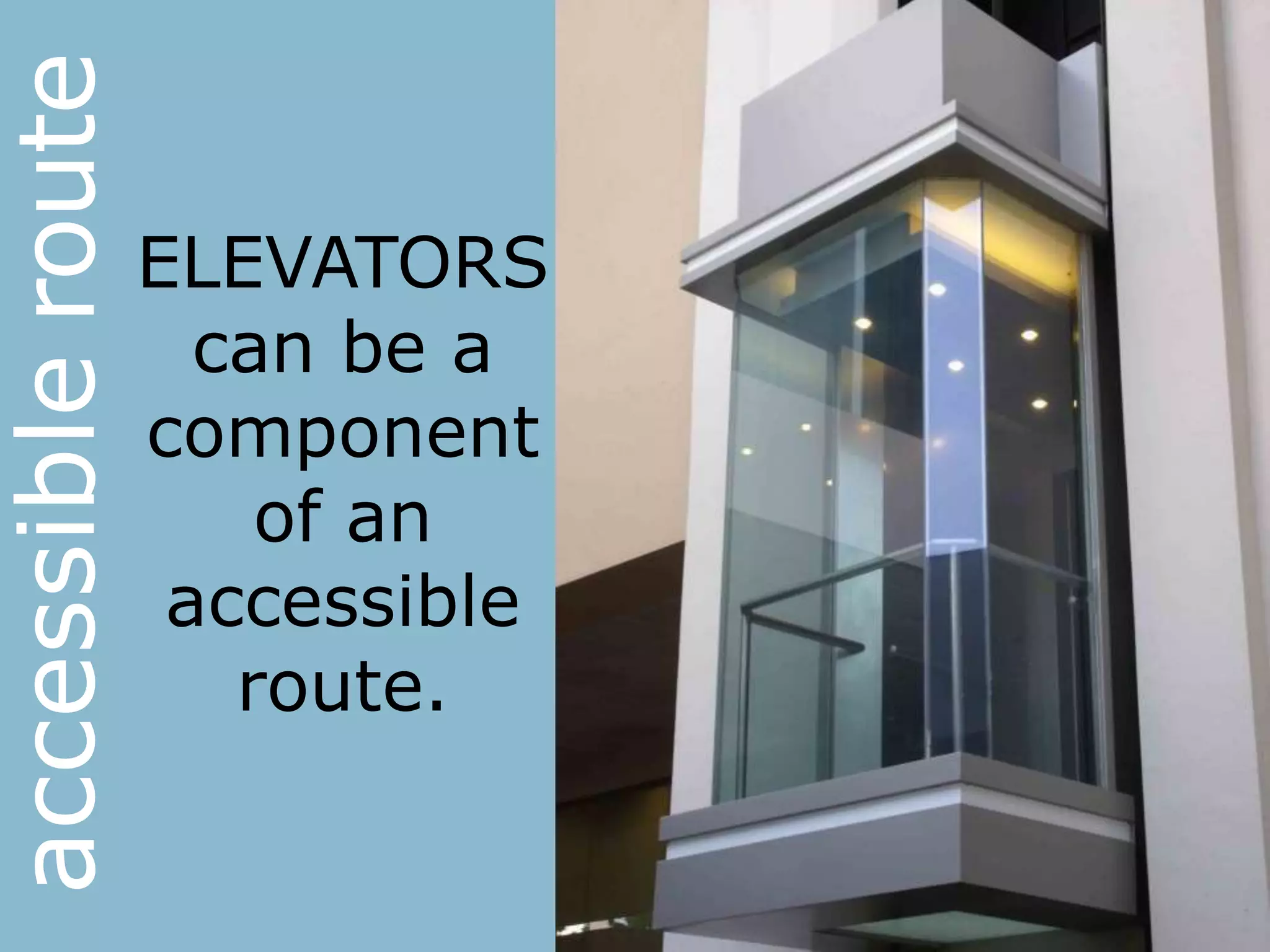
ELEVATORS
can be a
component
of an
accessible
route.
accessibleroute
408
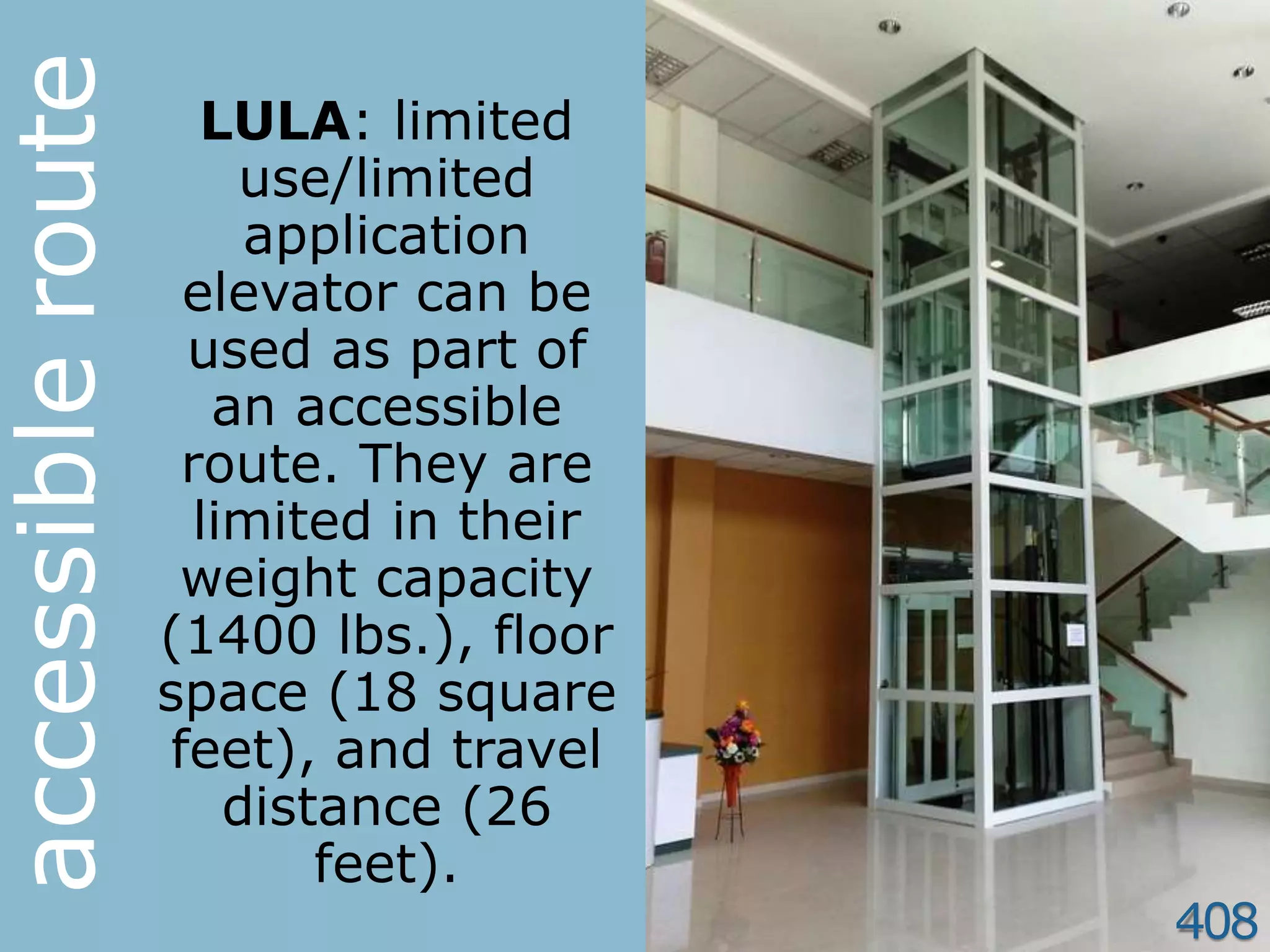
LULA: limited
use/limited
application
elevator can be
used as part of
an accessible
route. They are
limited in their
weight capacity
(1400 lbs.), floor
space (18 square
feet), and travel
distance (26
feet).
accessibleroute
410
accessibleroute
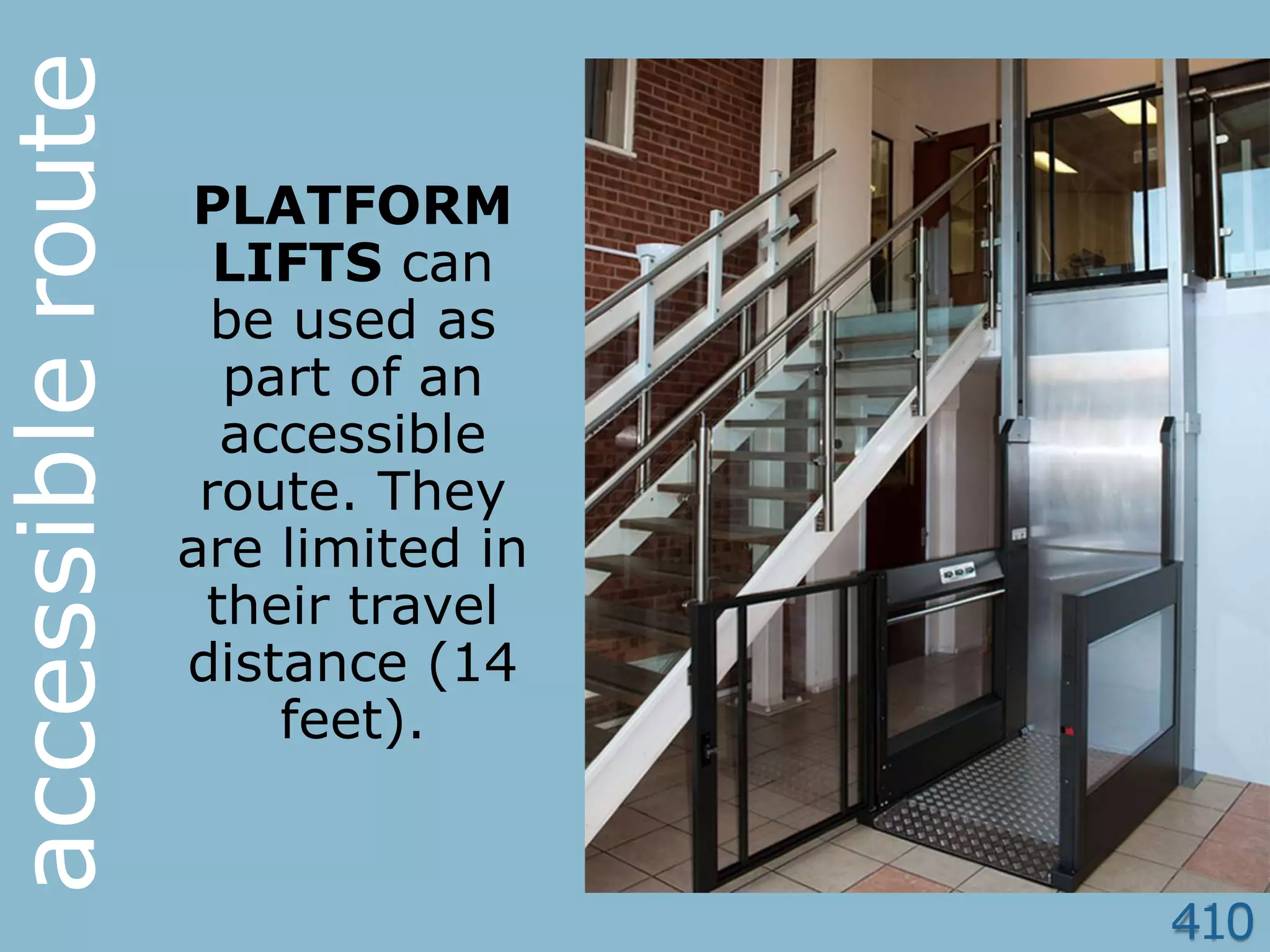
PLATFORM
LIFTS can
be used as
part of an
accessible
route. They
are limited in
their travel
distance (14
feet).
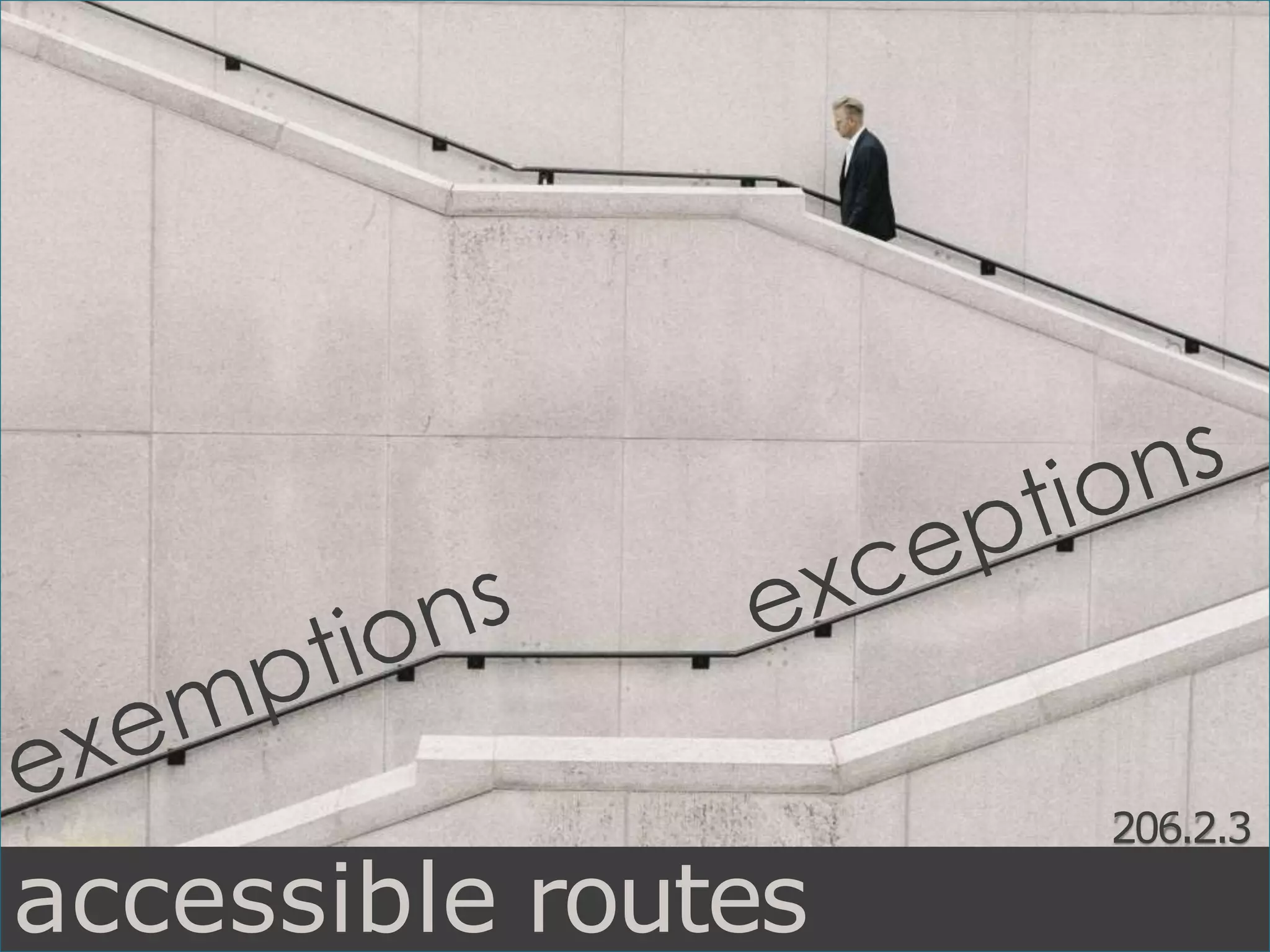
206.2.3
accessible routes
206.2.3 multi-story buildings
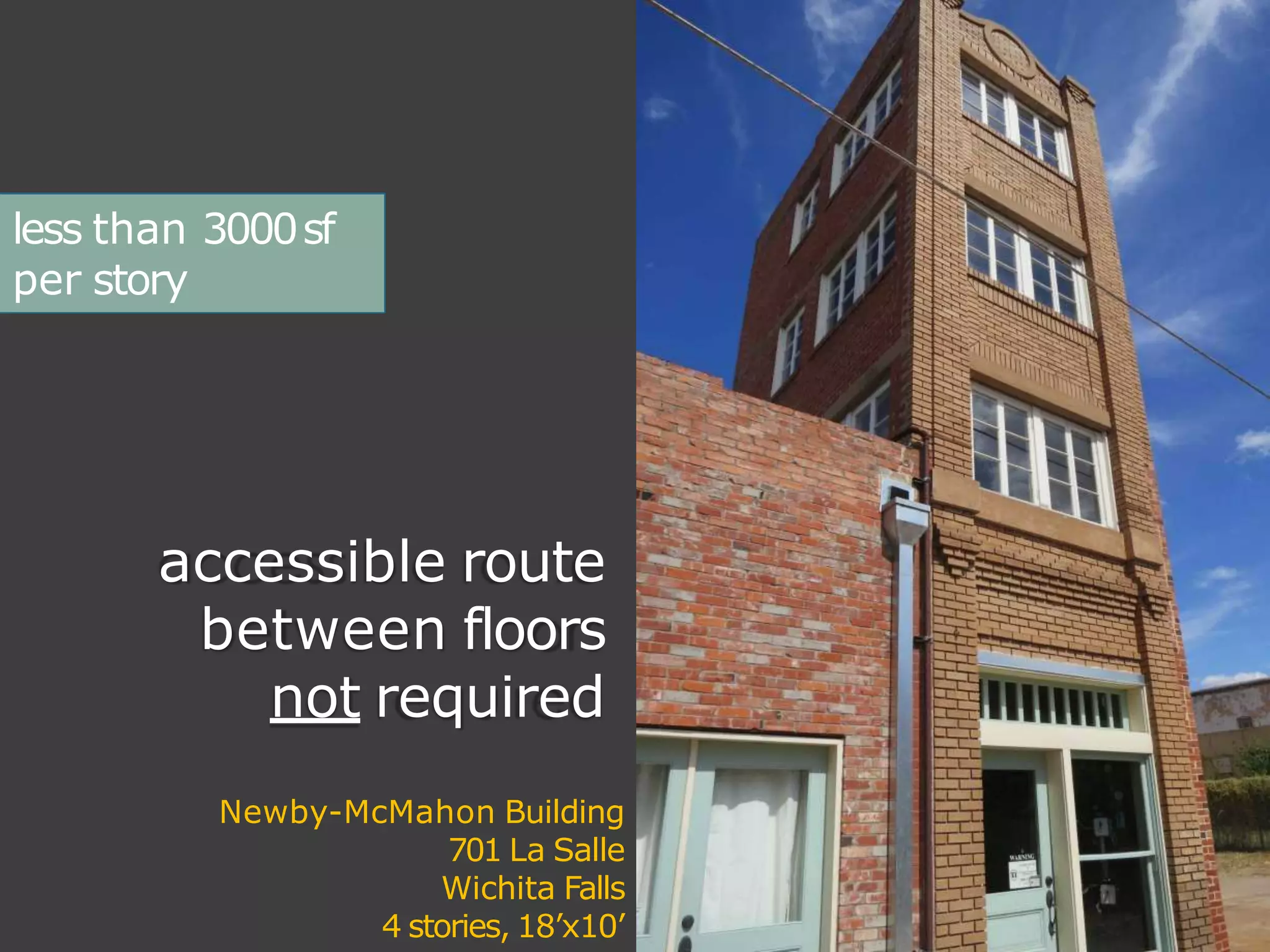
Exception 1
An accessible route is not required to connect
stories…
Inprivate facilities
That are less than 3 stories or haveless than
3000 sf per story
Provided that it isnot a shopping mall,
professional office of healthcare provider, or
used by a specified transportation provider.
Newby-McMahon Building
701 La Salle
Wichita Falls
4 stories, 18’x10’
accessible route
between floors
not required
less than 3000sf
per story
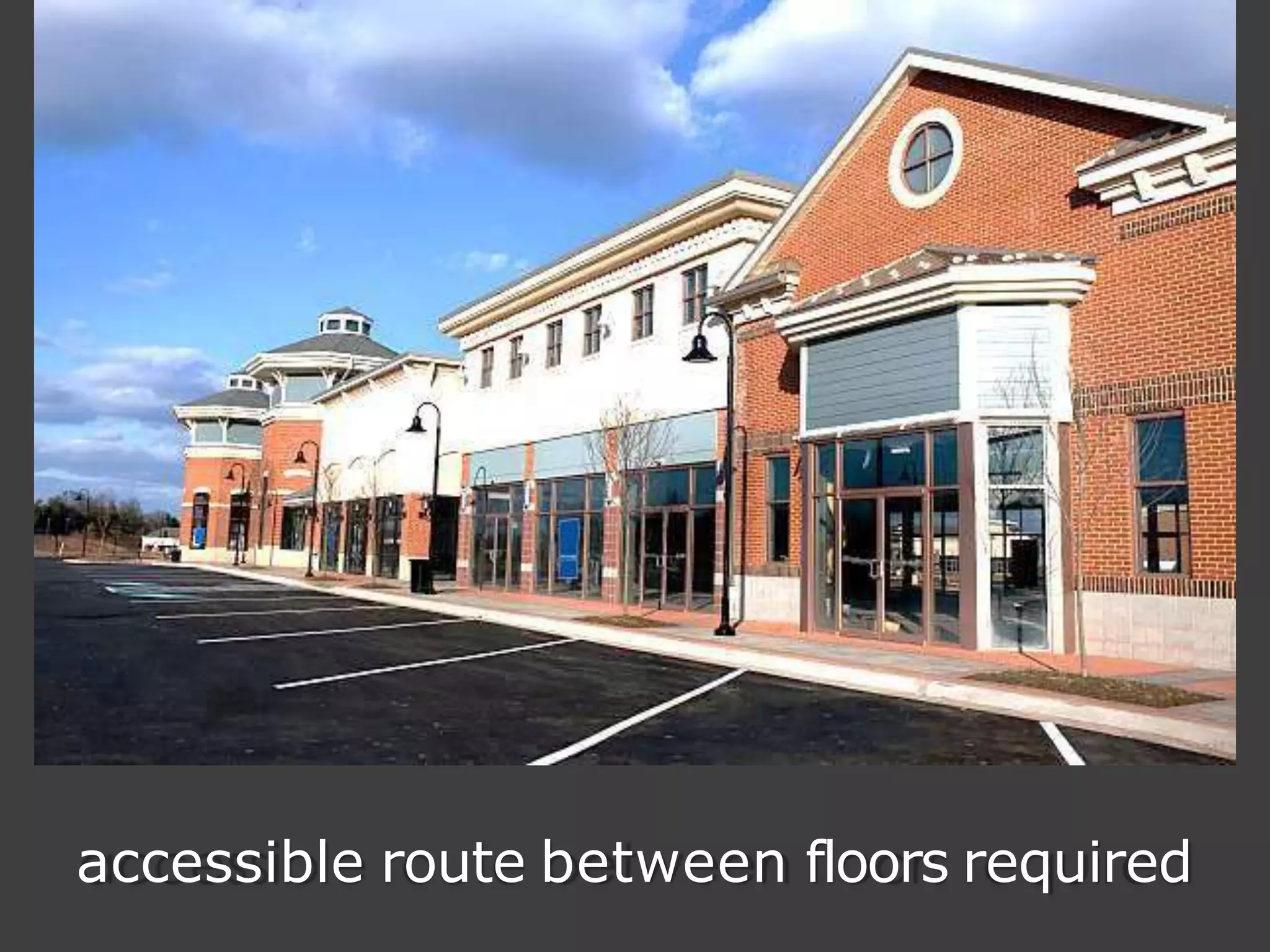
SHOPPING CENTER
If a shopping
center has more
than one story, an
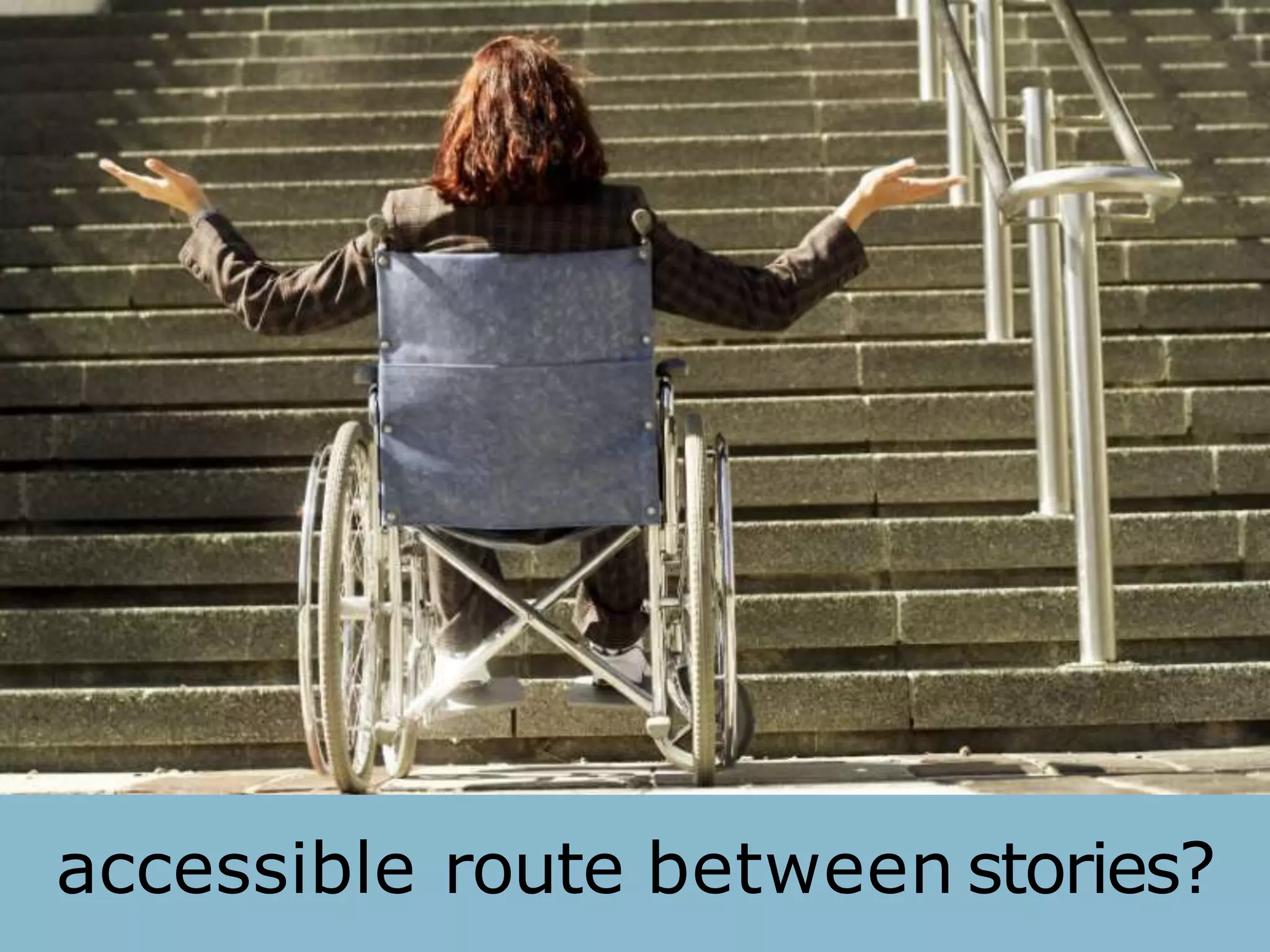
accessible route is
required to all
stories or
mezzanines.
206.2.3 Exception 1
accessible route between floors required
ONE STORY with
MEZZANINE
206.2.4 Exception 3
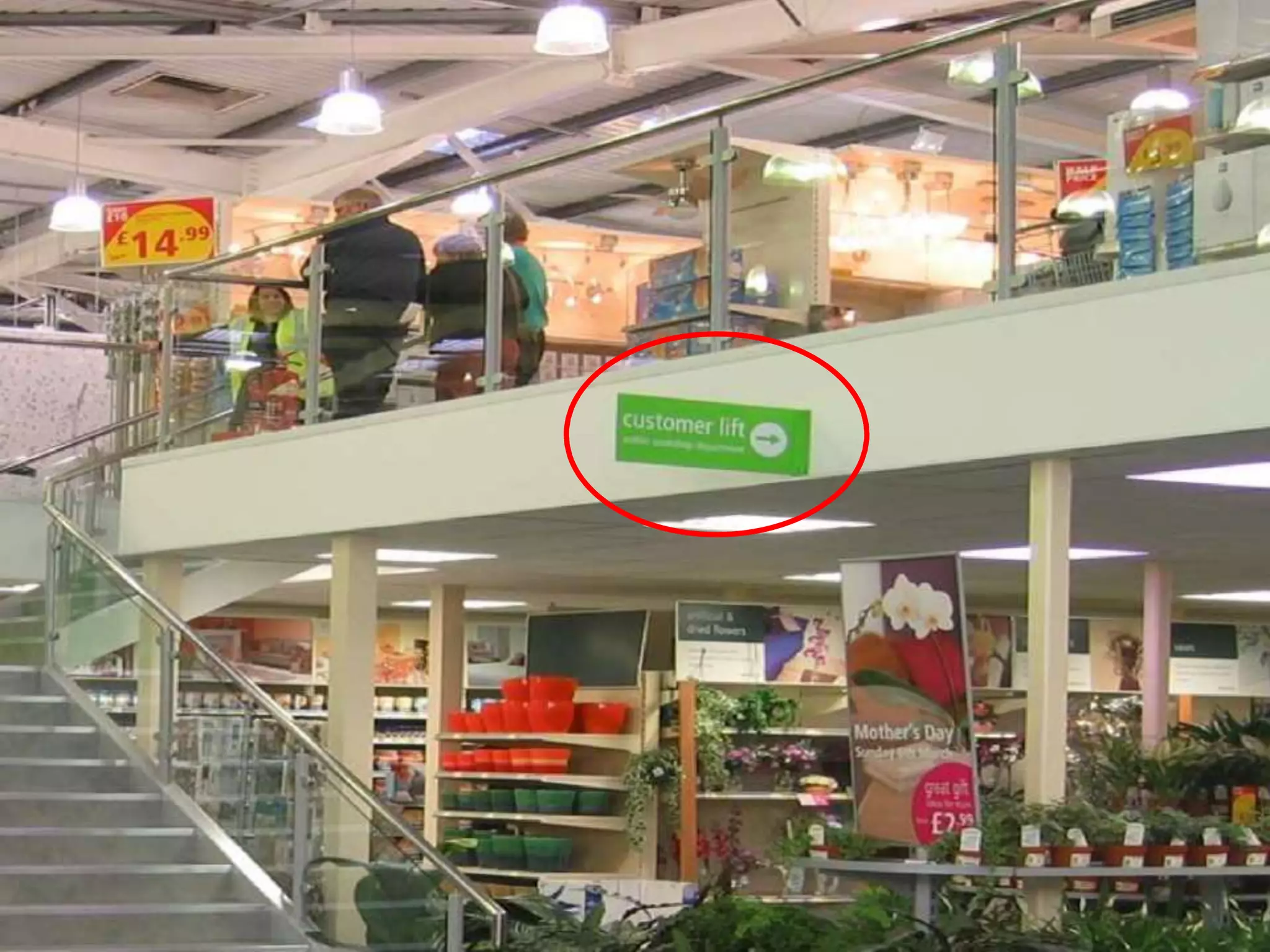
If a retail space
has only one story,
an accessible
route is not
required to the
mezzanines.
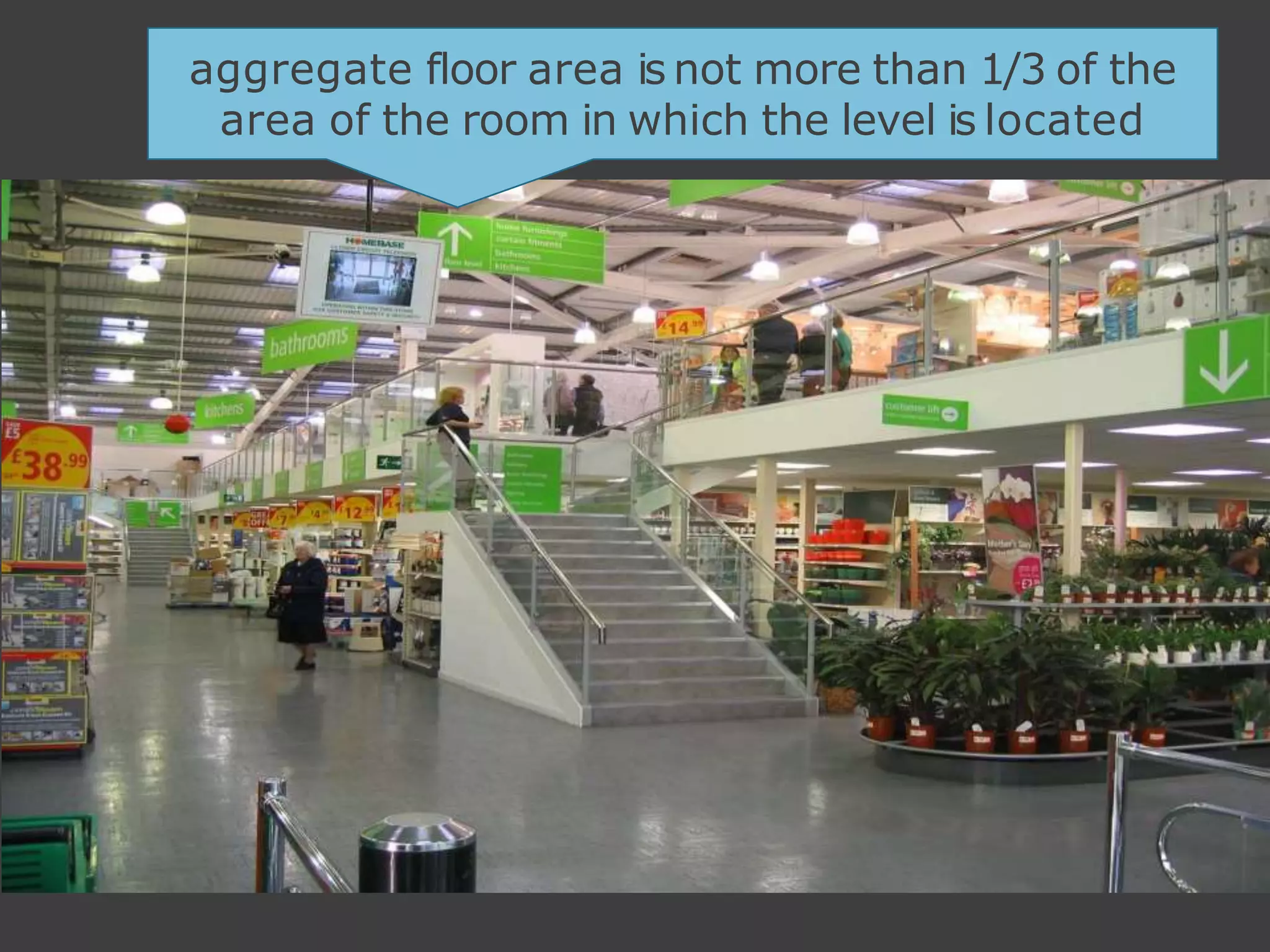
aggregate floor area is not more than 1/3 of the
area of the room in which the level is located
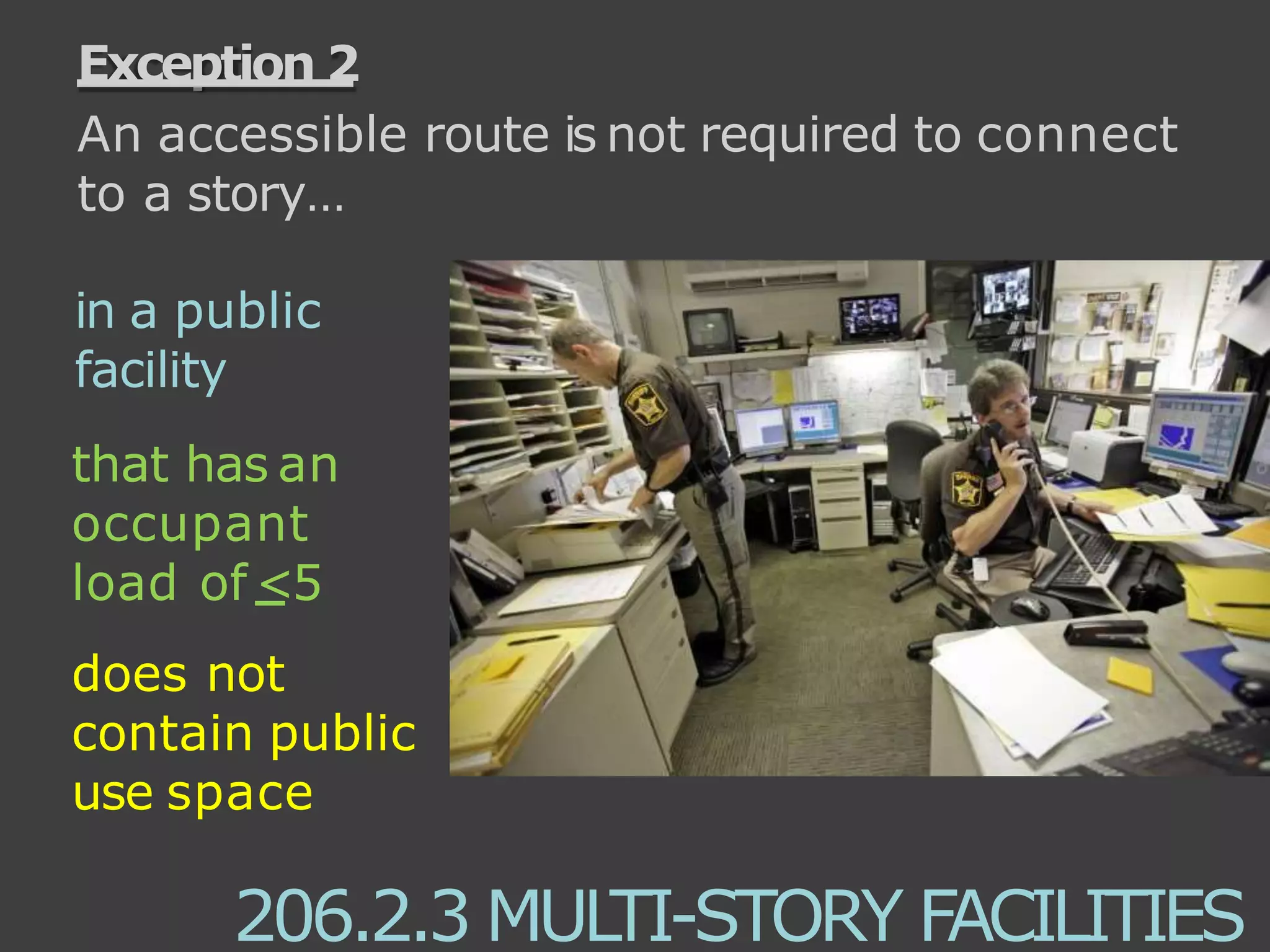
Exception 2
in a public
facility
that has an
occupant
load of <5
does not
contain public
use space
206.2.3 MULTI-STORY FACILITIES
An accessible route is not required to connect
to a story…
in specific situations
206.2.3 multi-story buildings
206.2.5 restaurants
206.2.8 employee work areas
Accessible Routes
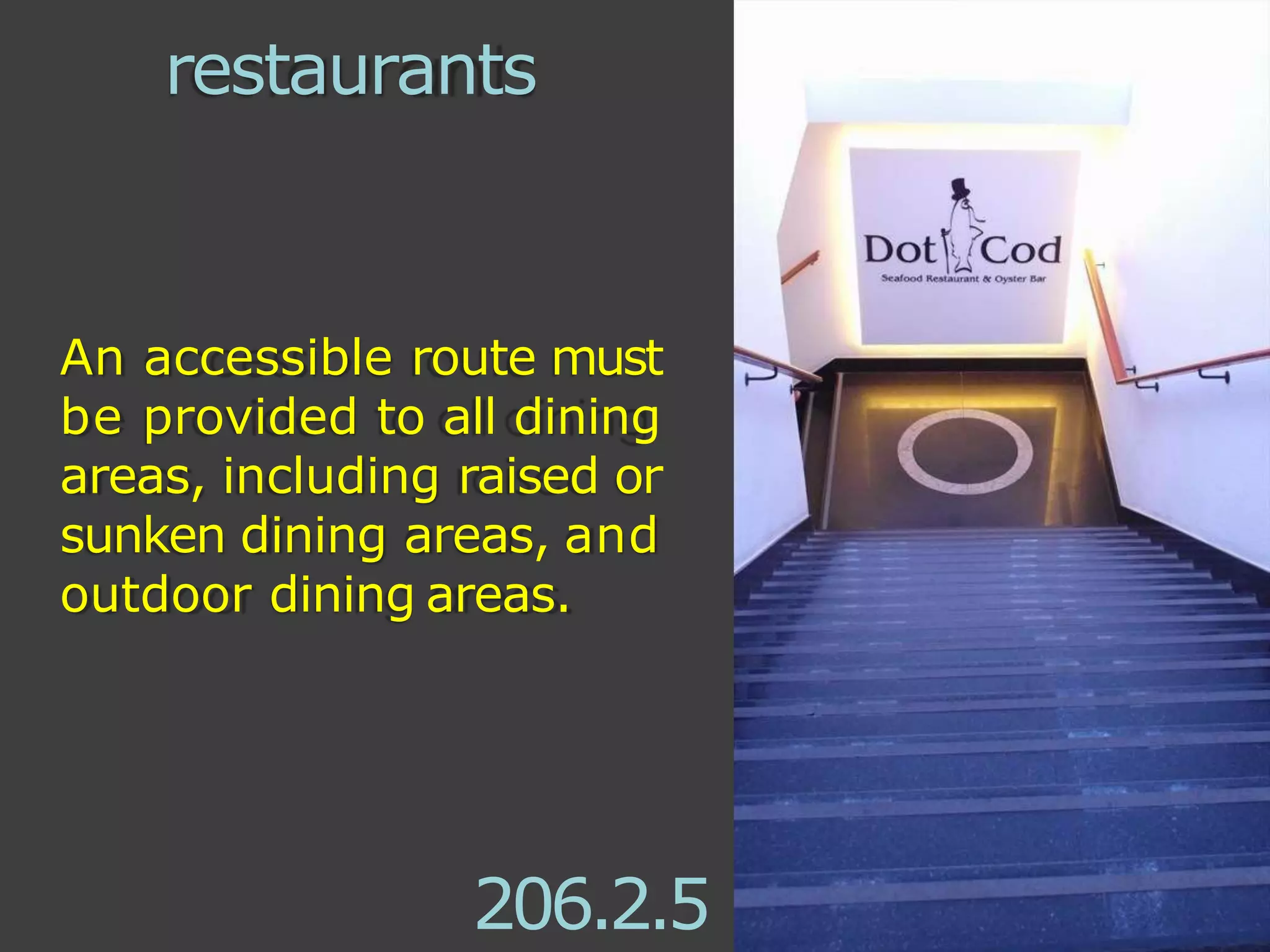
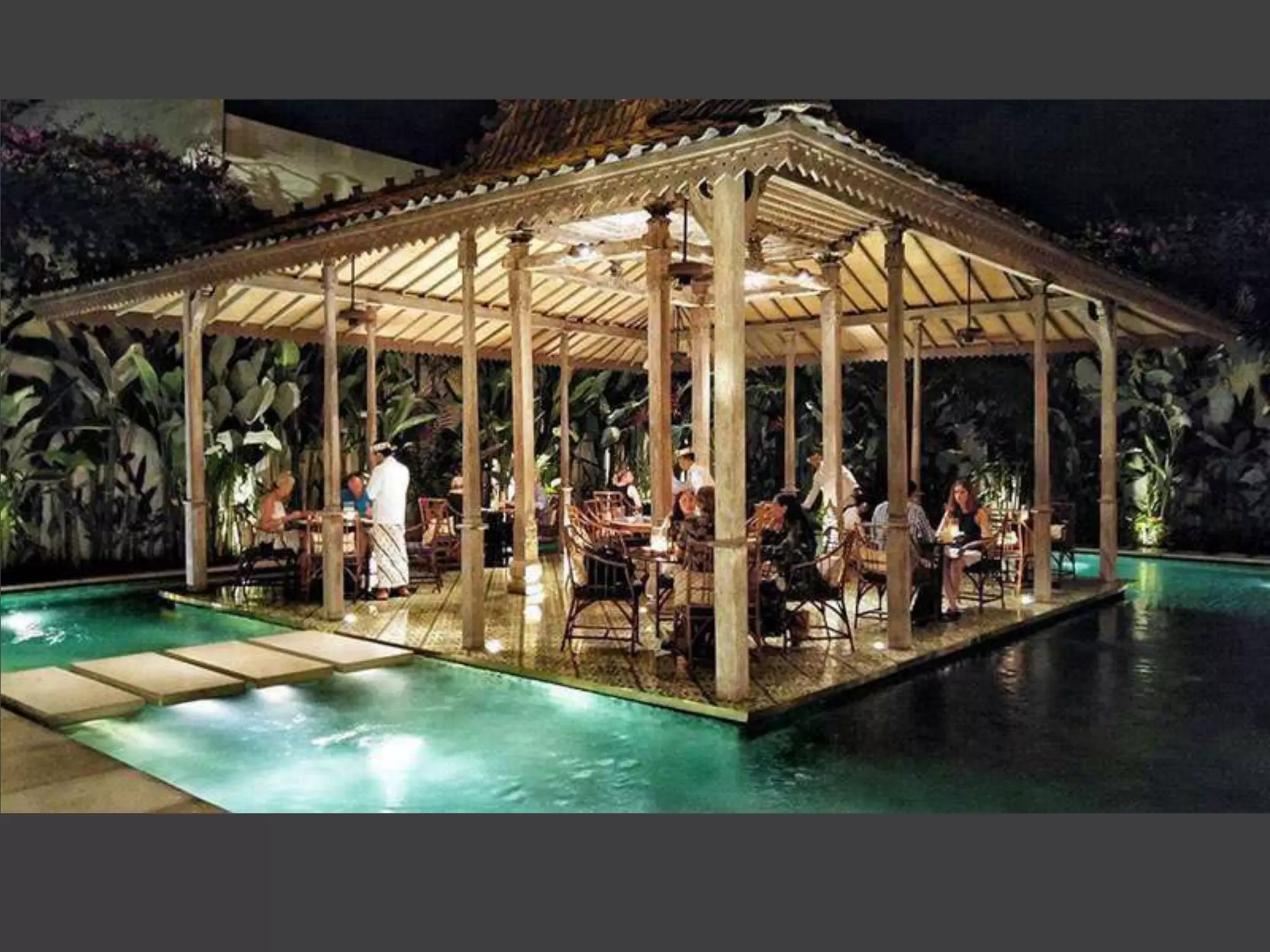
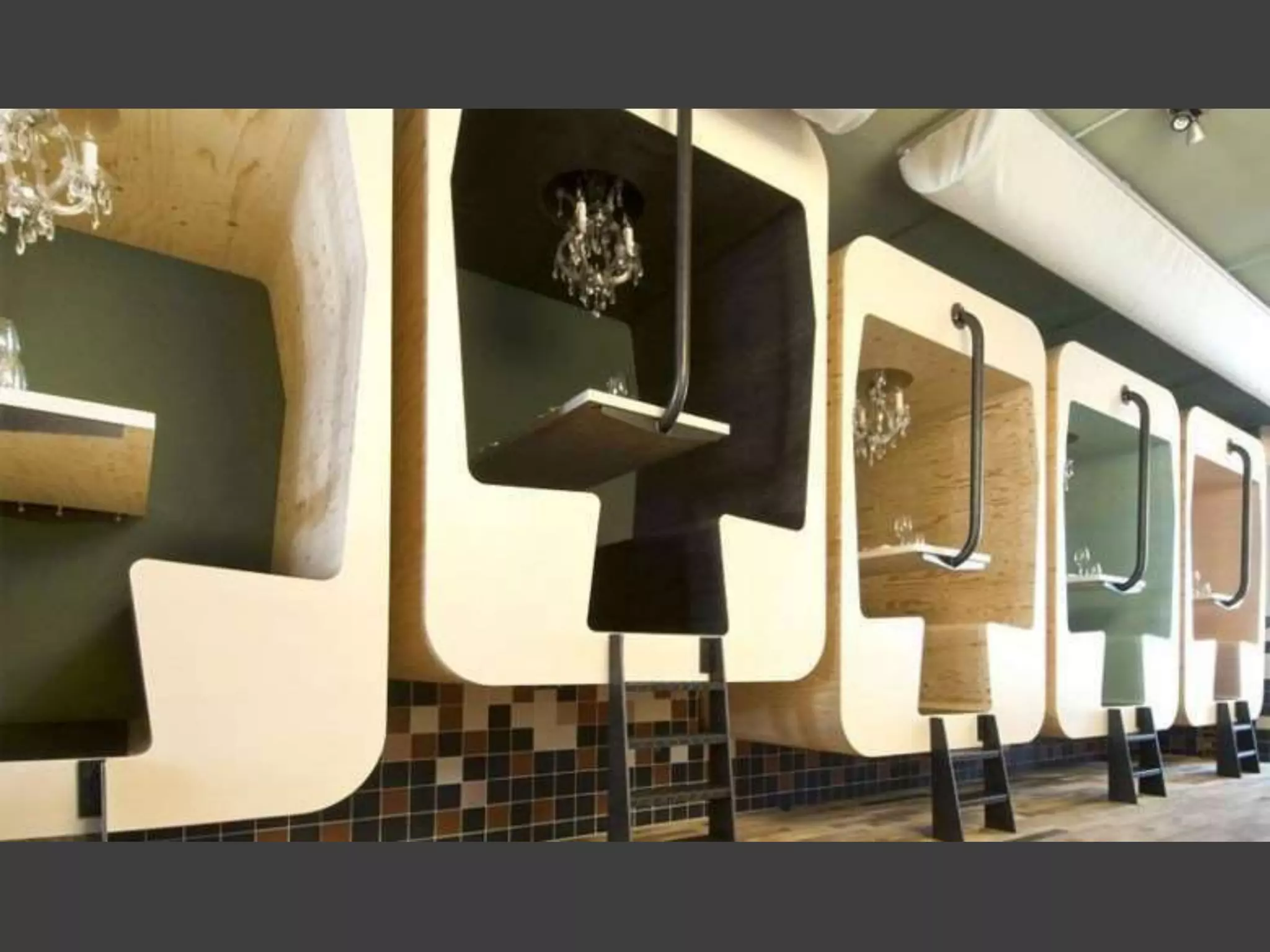
An accessible route must
be provided to all dining
areas, including raised or
sunken dining areas, and
outdoor dining areas.
206.2.5
restaurants
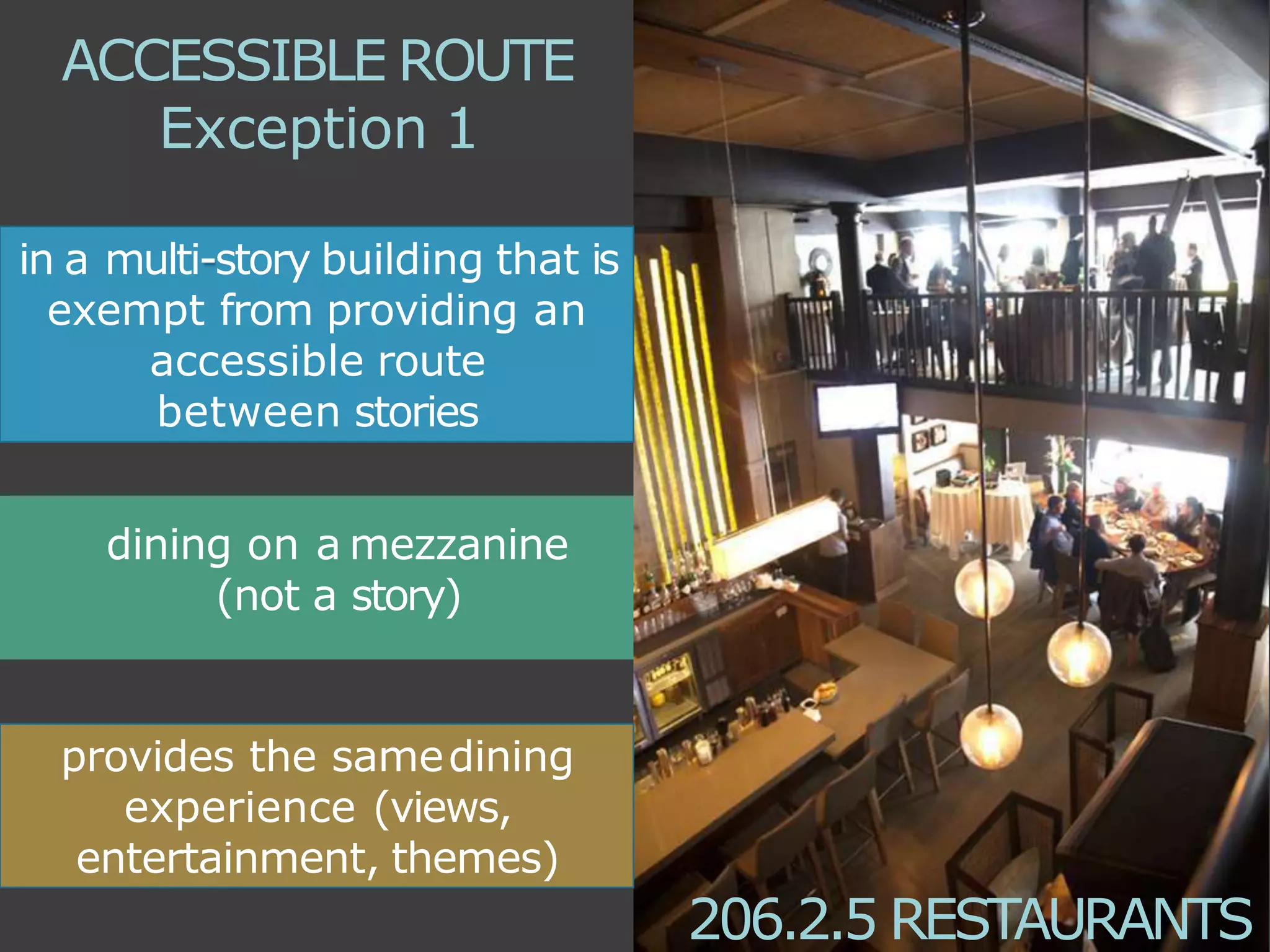
dining on a mezzanine
(not a story)
in a multi-story building that is
exempt from providing an
accessible route
between stories
provides the samedining
experience (views,
entertainment, themes)
206.2.5 RESTAURANTS
ACCESSIBLE ROUTE
Exception 1
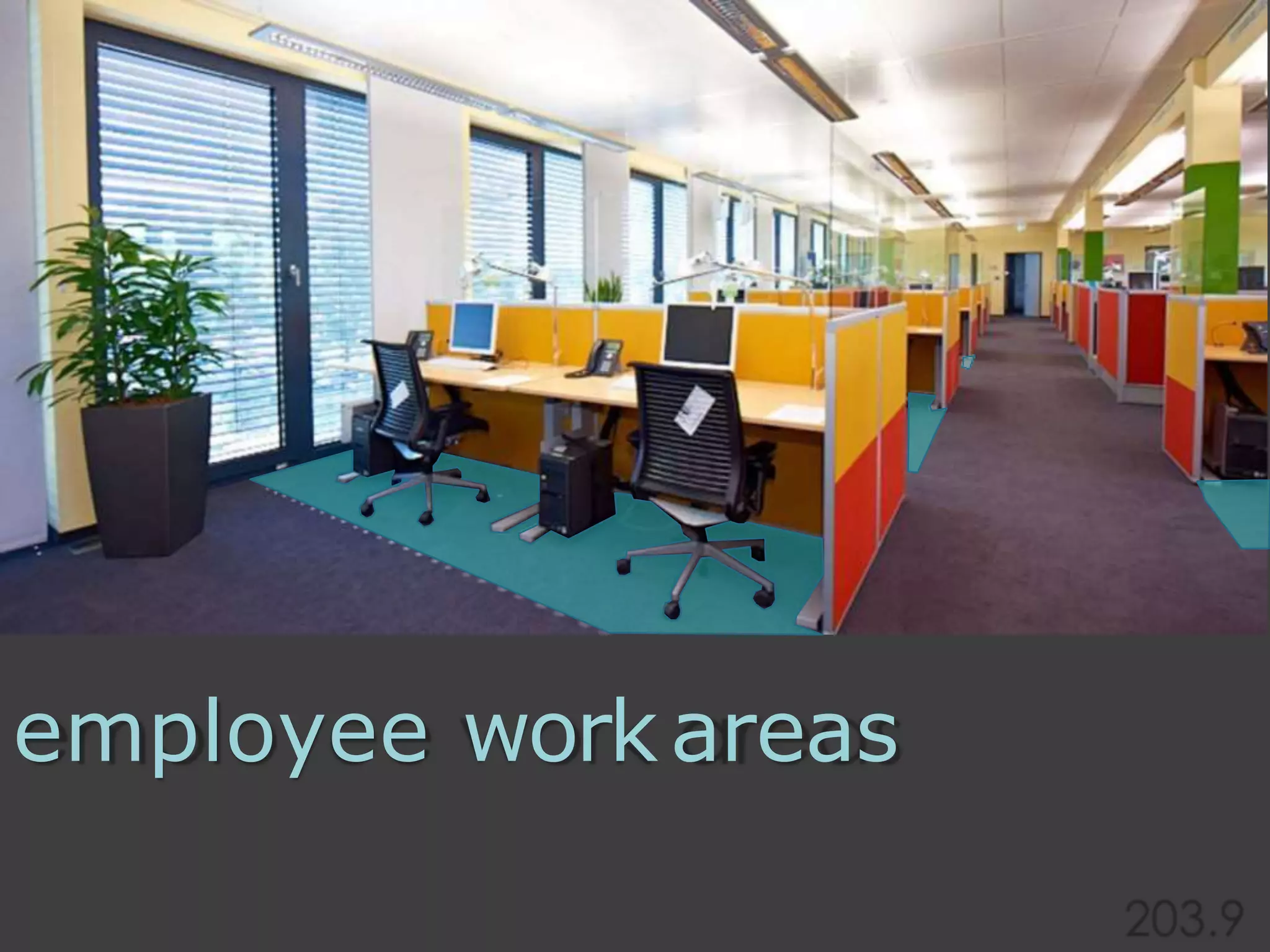
employee workarea
all or any portion
of a space:
• used only by
employees
• used only for
work
employee workarea
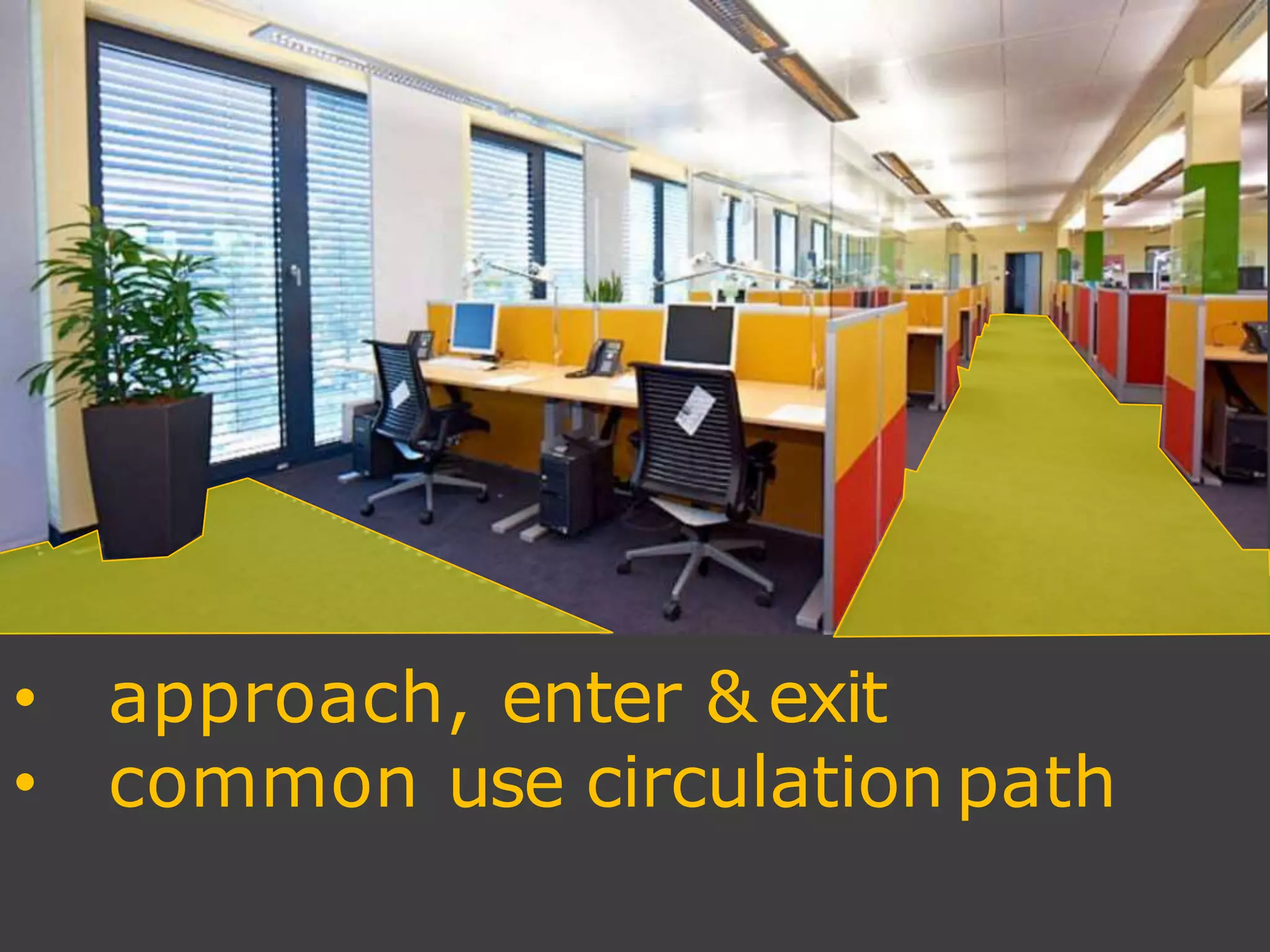
Approach, Enter, & Exit (203.9)
• Only accessibility requirement is that
employees with disabilities can
approach, enter, and exit the work area
Accessible CommonUse Circulation Path
within Employee Work Area(106.5.21)
• Circulation path can be shared by two
or more employees, if it’s not for
public use
employee workareas
• approach, enter & exit
• common use circulation path
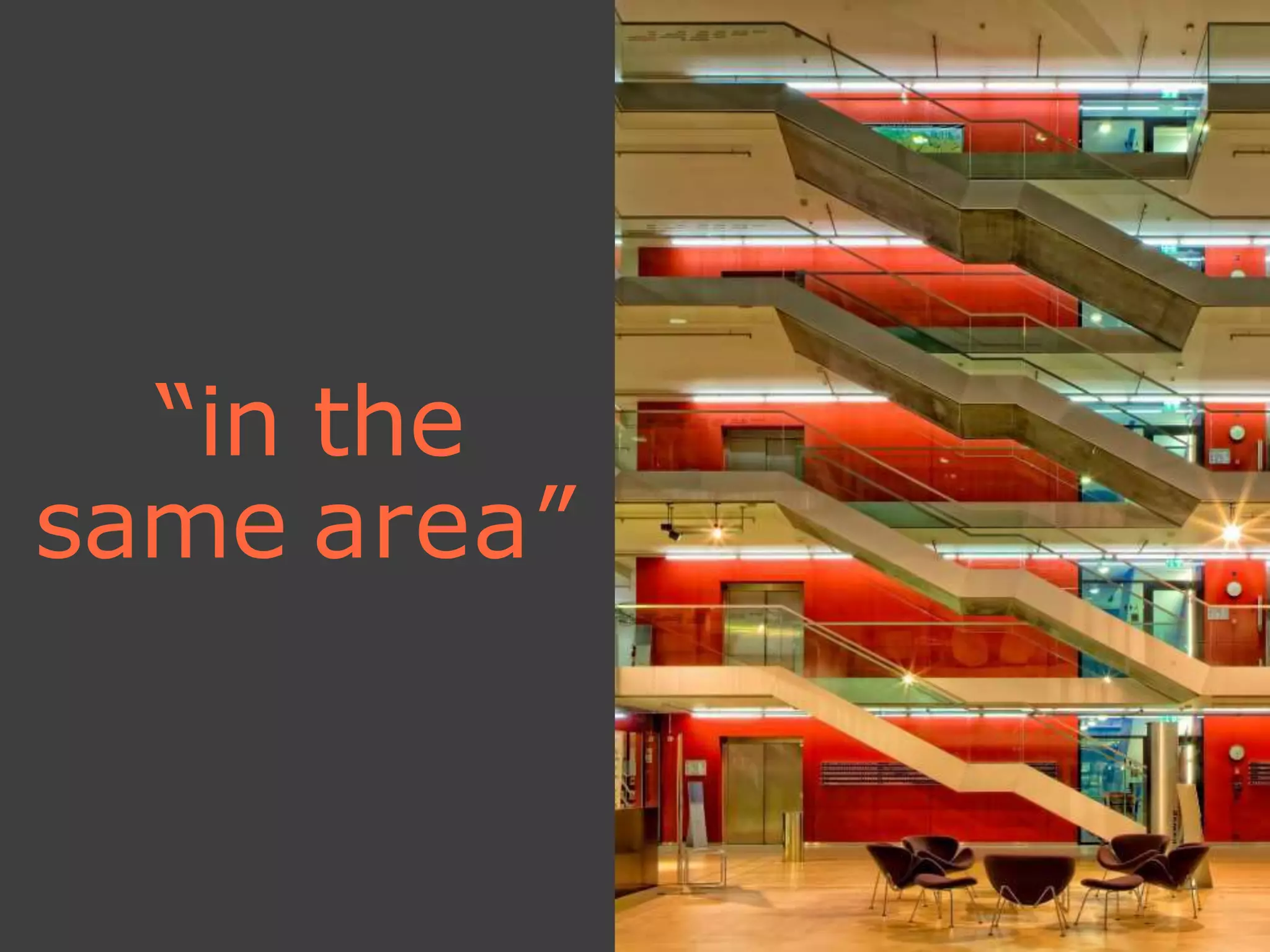
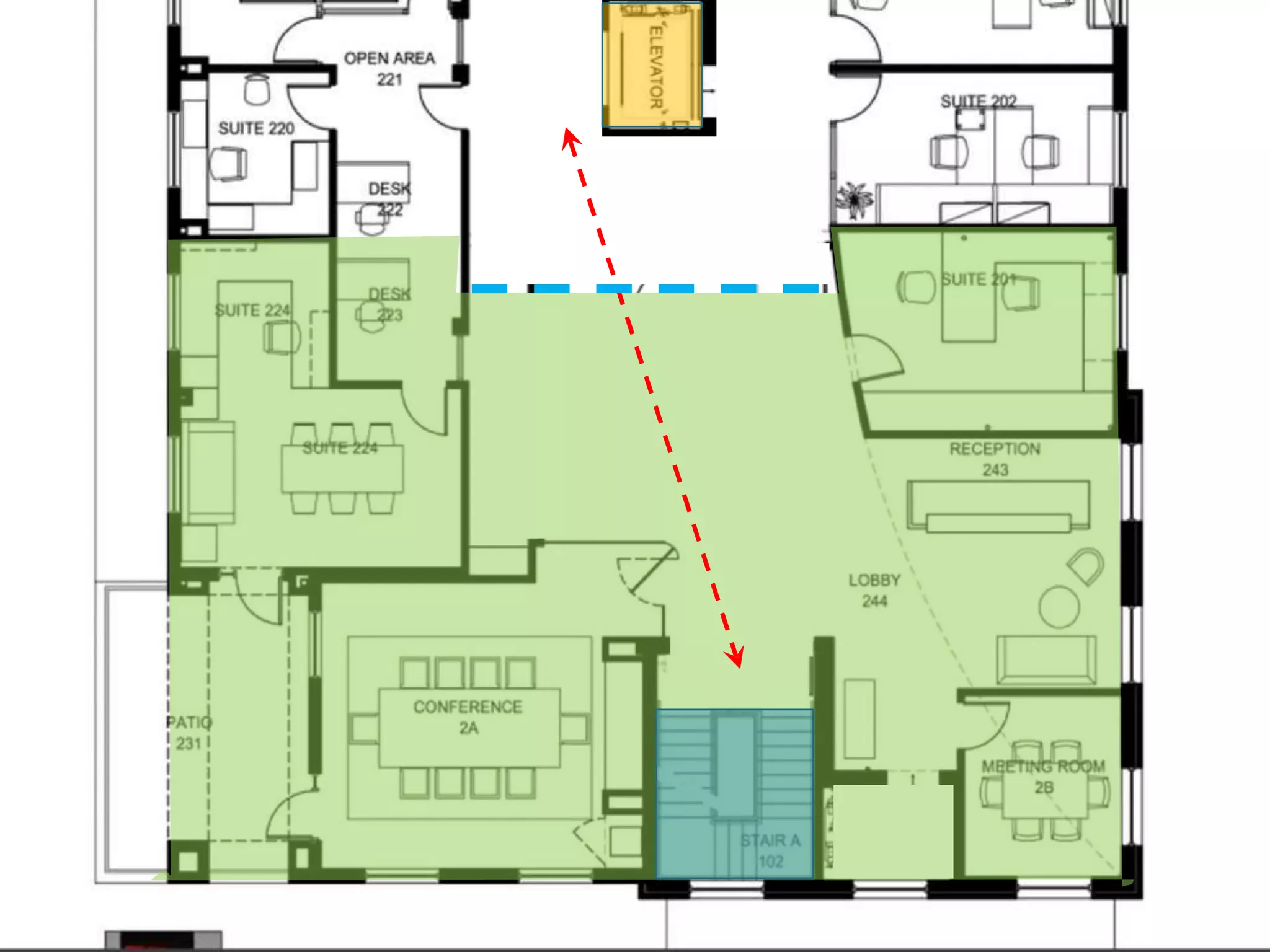
ACCESSIBLE
ROUTES
must be in the
same area as
general circulation
paths (including
stairs and
escalators).
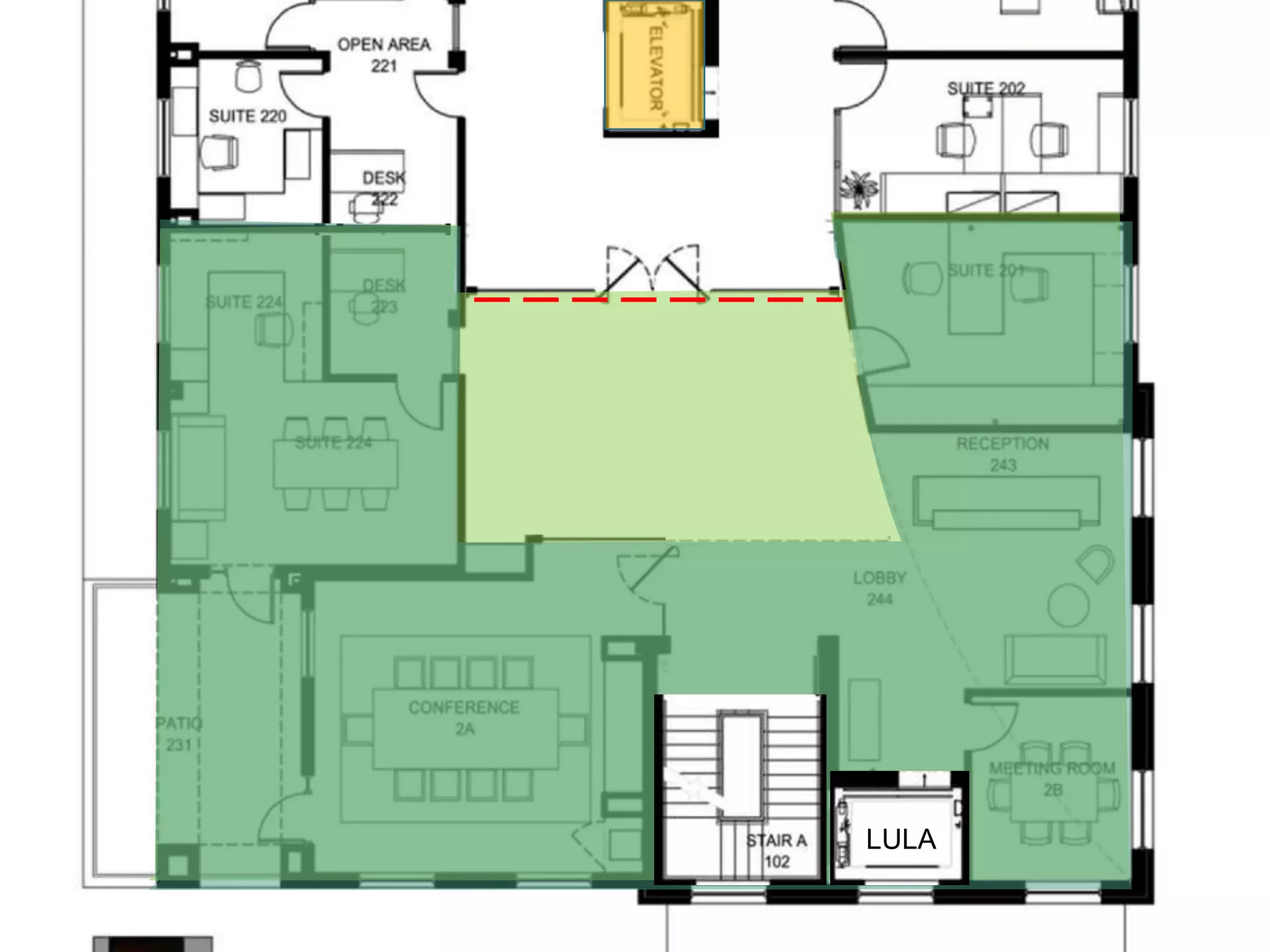
“in the
same area”
ACCESSIBLE
ROUTE
between floors
must be within the
tenant space if
there are stairs
between floors
within the tenant
space.
LULA
ACCESSIBLE
ROUTES
must be in the
same area as
general circulation
paths (including
stairs and
escalators).
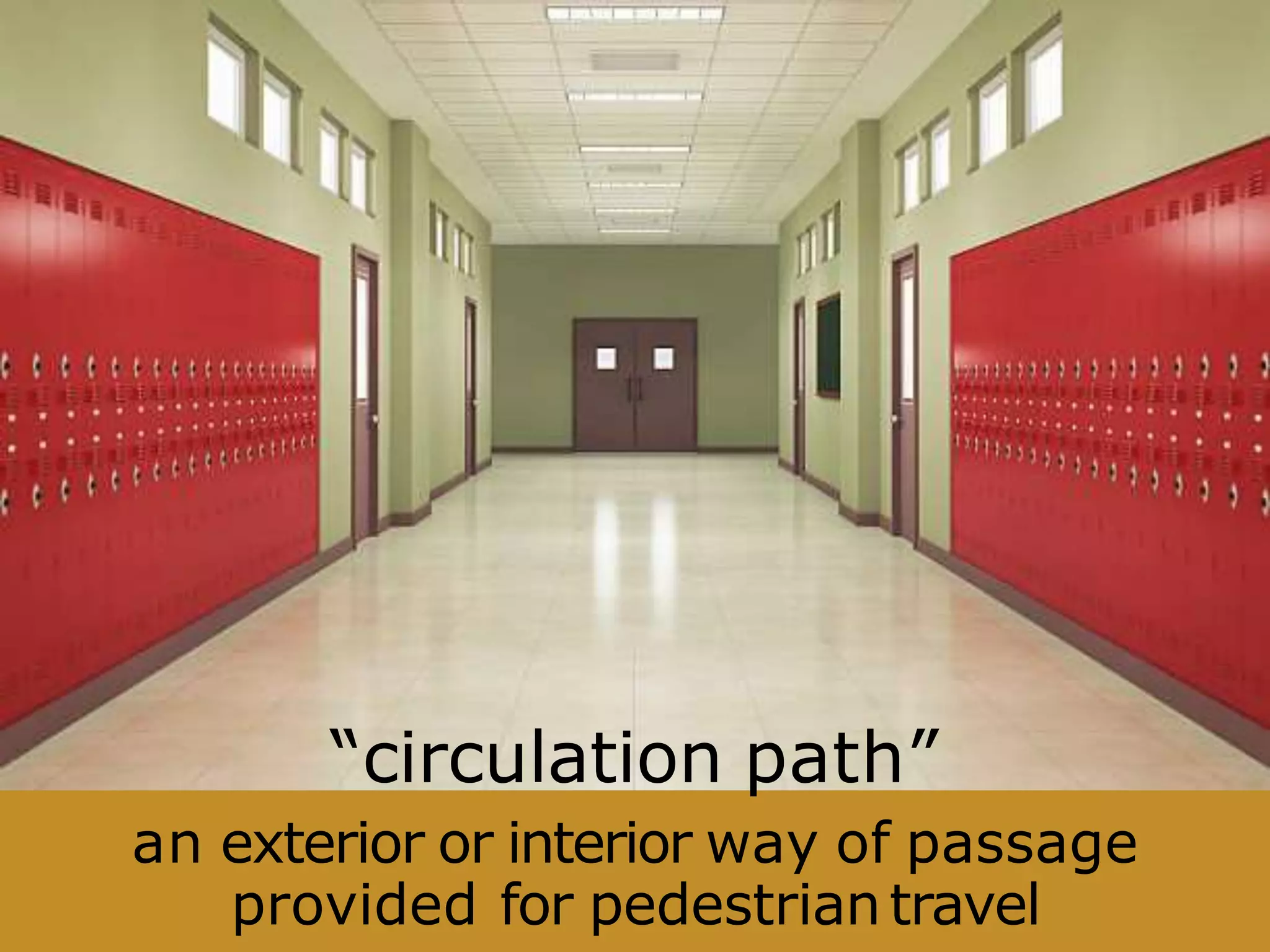
An exterior or interior way of passage
provided for pedestrian travel including,
but not limited to…
CIRCULATION PATH
• platform lifts
• ramps
• stairways
• landings
• walks
• hallways
• courtyards
• elevators
which brings us
to…
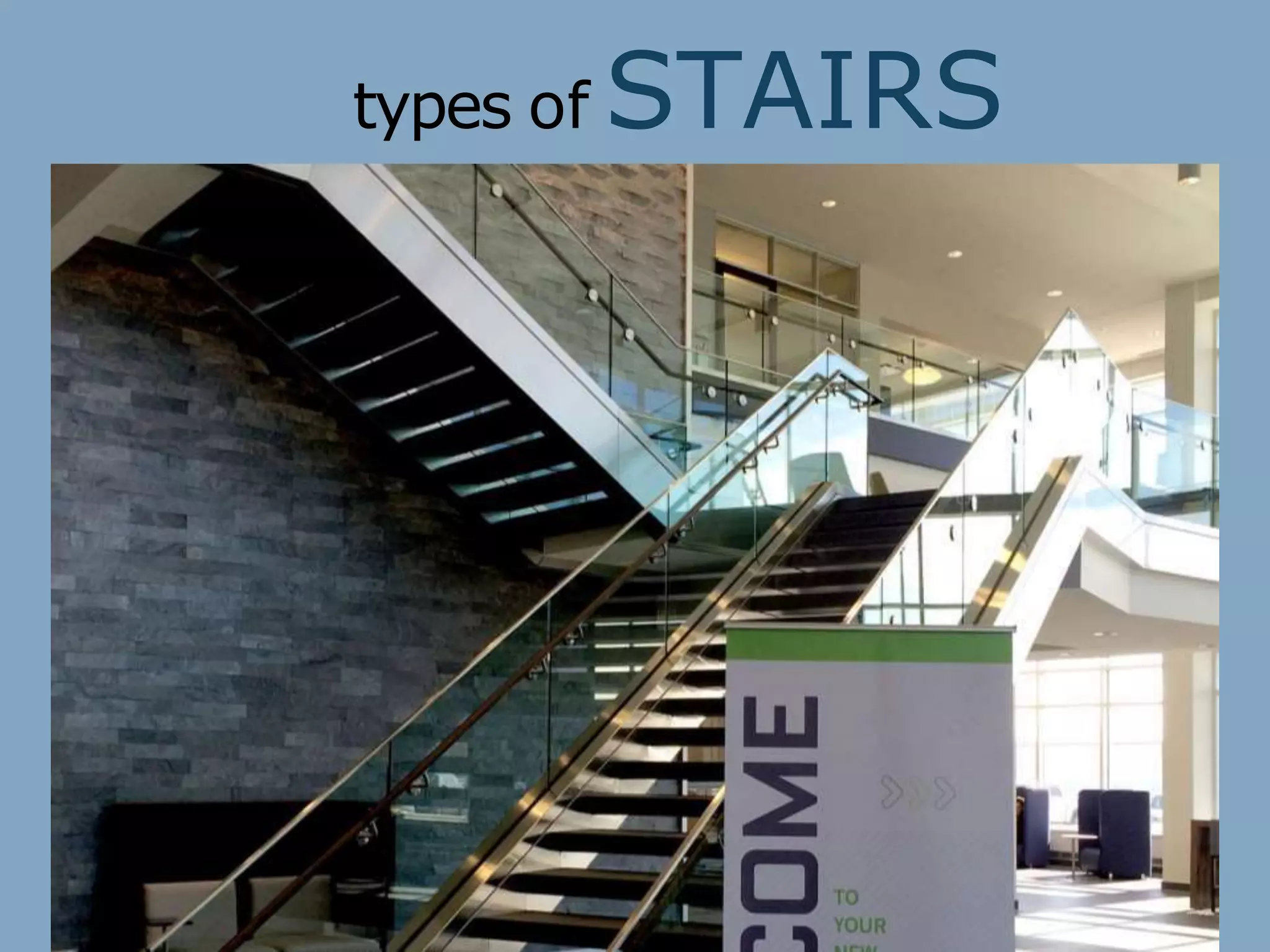
types of STAIRS
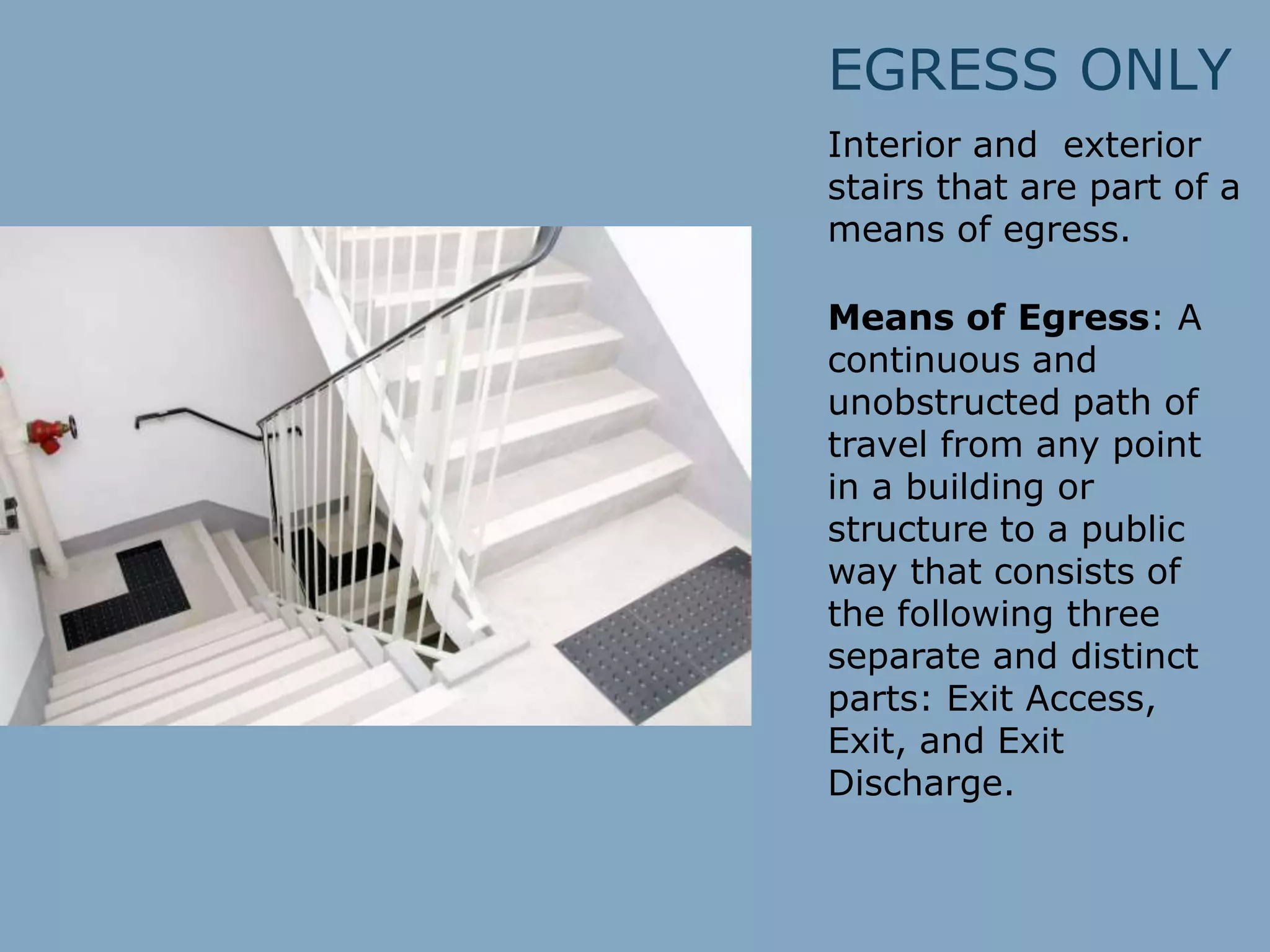
EGRESS ONLY
Interior and exterior
stairs that are part of a
means of egress.
Means of Egress: A
continuous and
unobstructed path of
travel from any point
in a building or
structure to a public
way that consists of
the following three
separate and distinct
parts: Exit Access,
Exit, and Exit
Discharge.
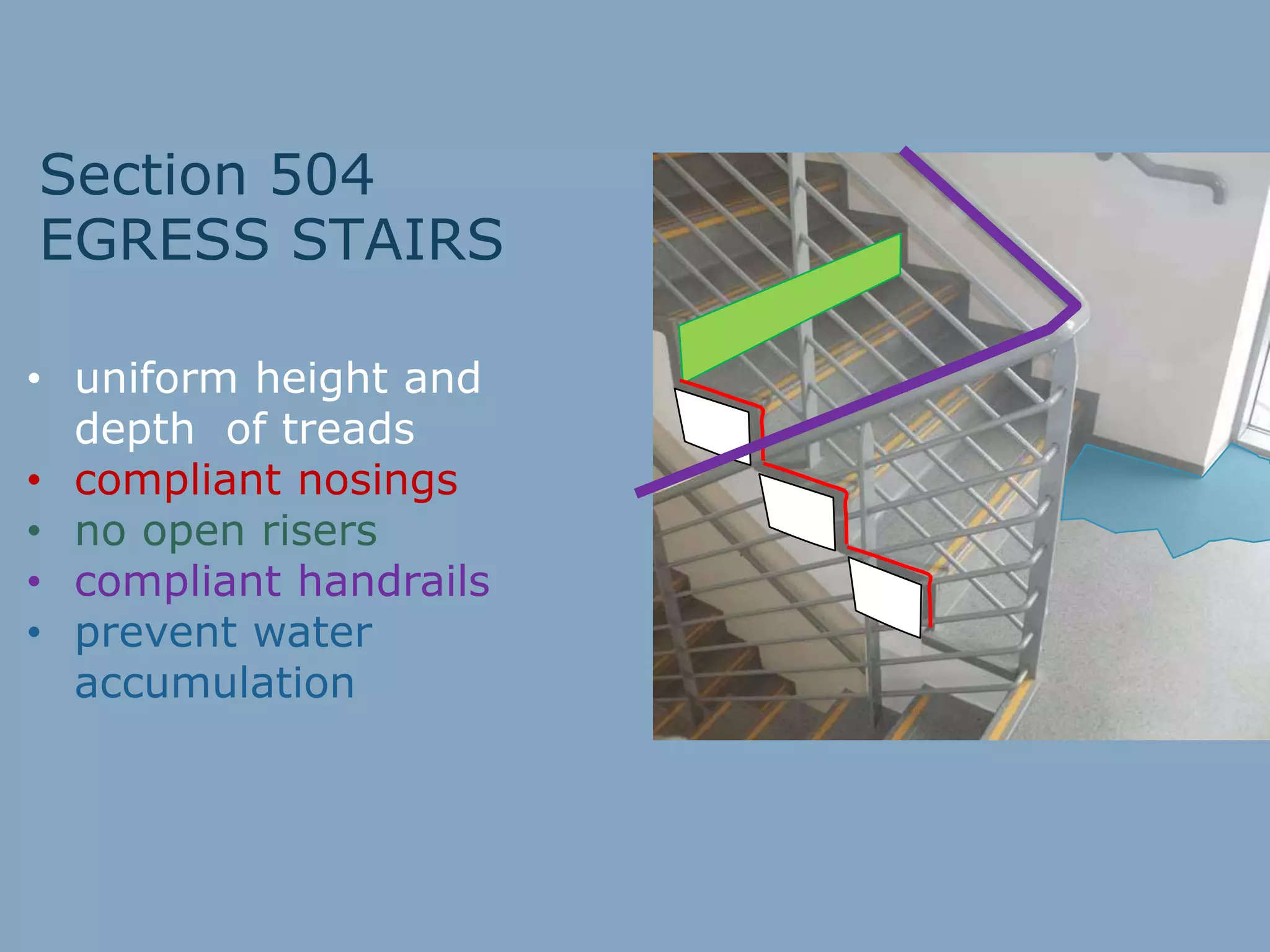
Section 504
EGRESS STAIRS
• uniform height and
depth of treads
• compliant nosings
• no open risers
• compliant handrails
• prevent water
accumulation
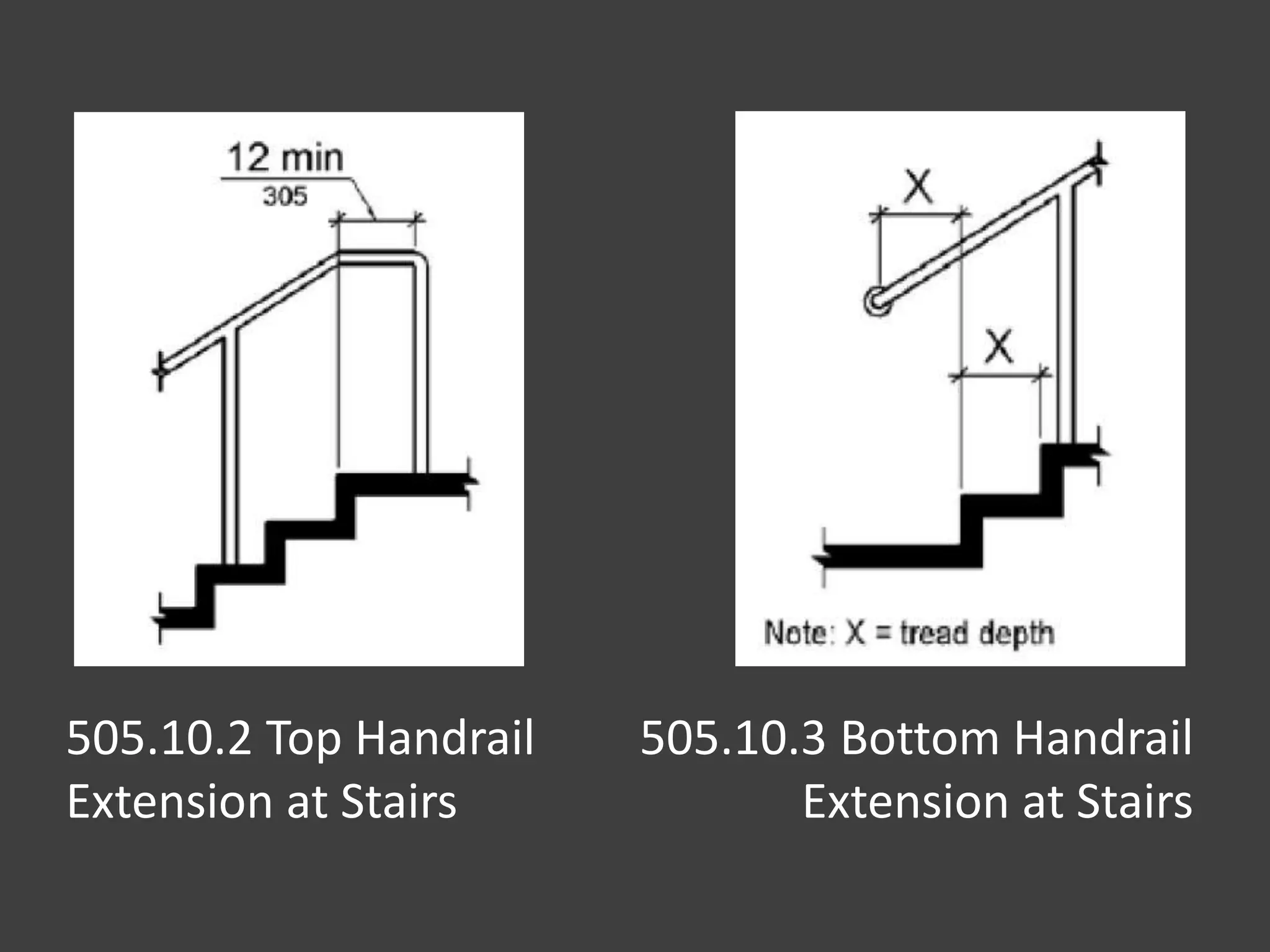
505.10.2 Top Handrail
Extension at Stairs
505.10.3 Bottom Handrail
Extension at Stairs
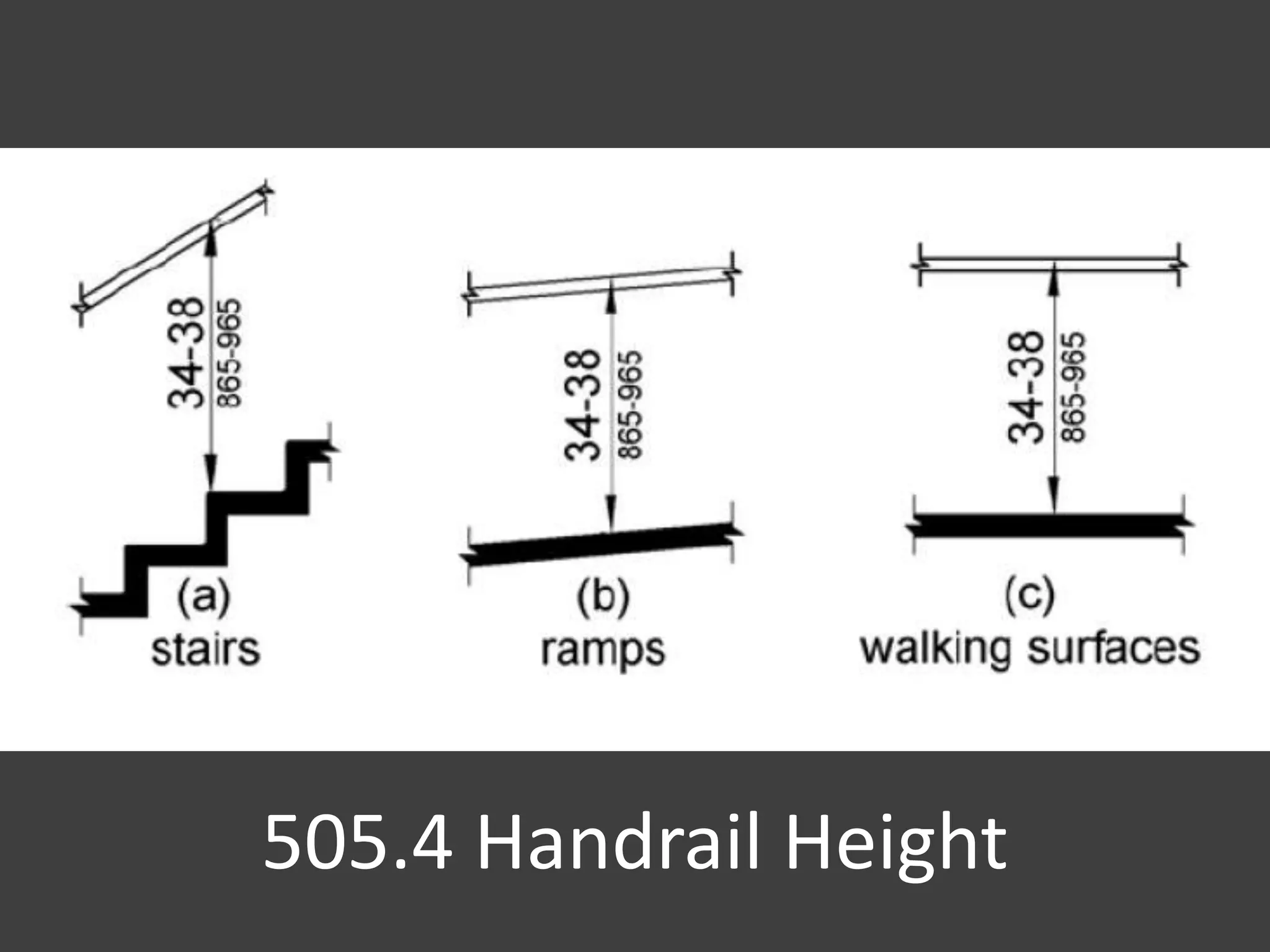
505.4 Handrail Height
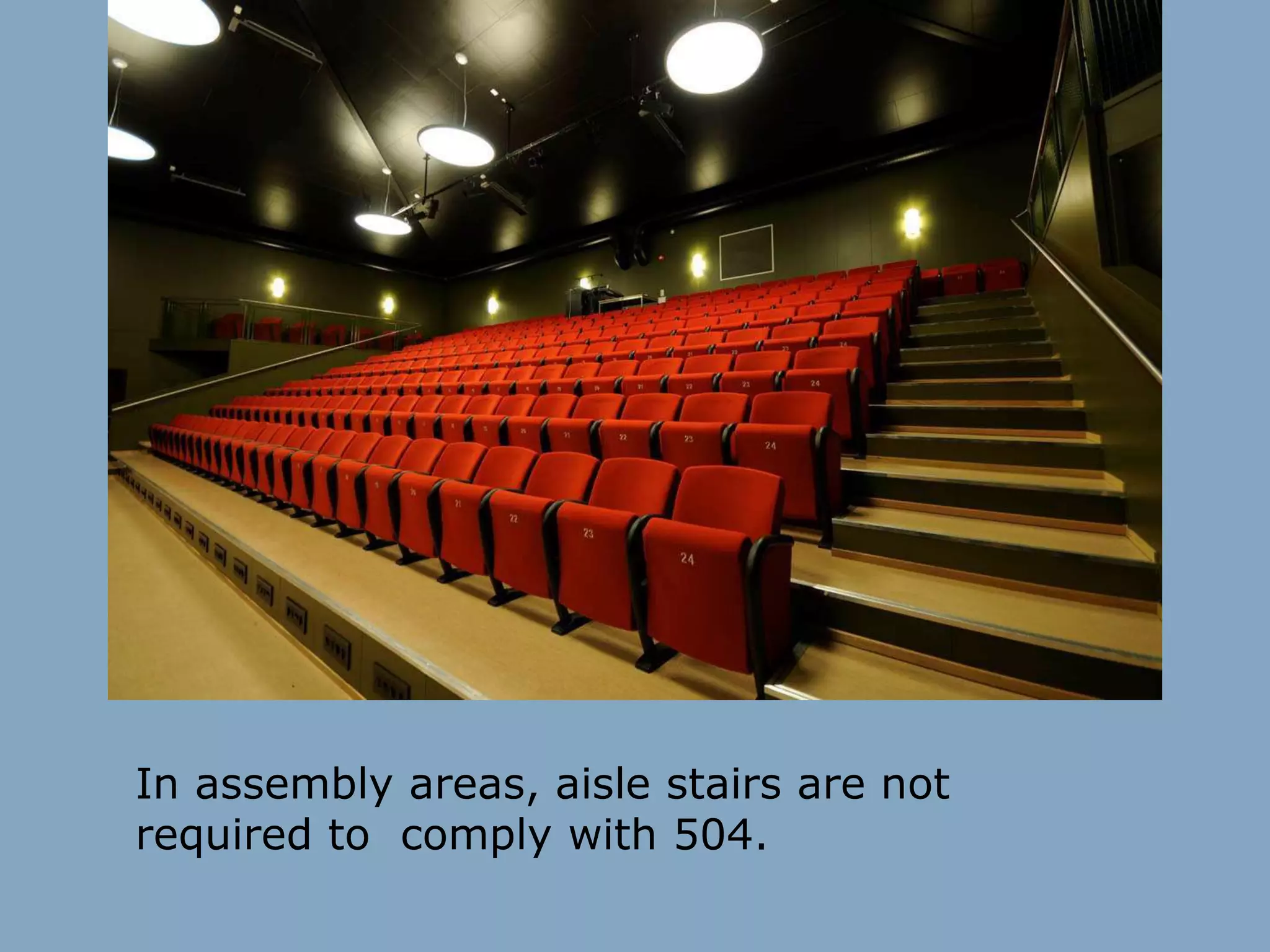
In assembly areas, aisle stairs are not
required to comply with 504.
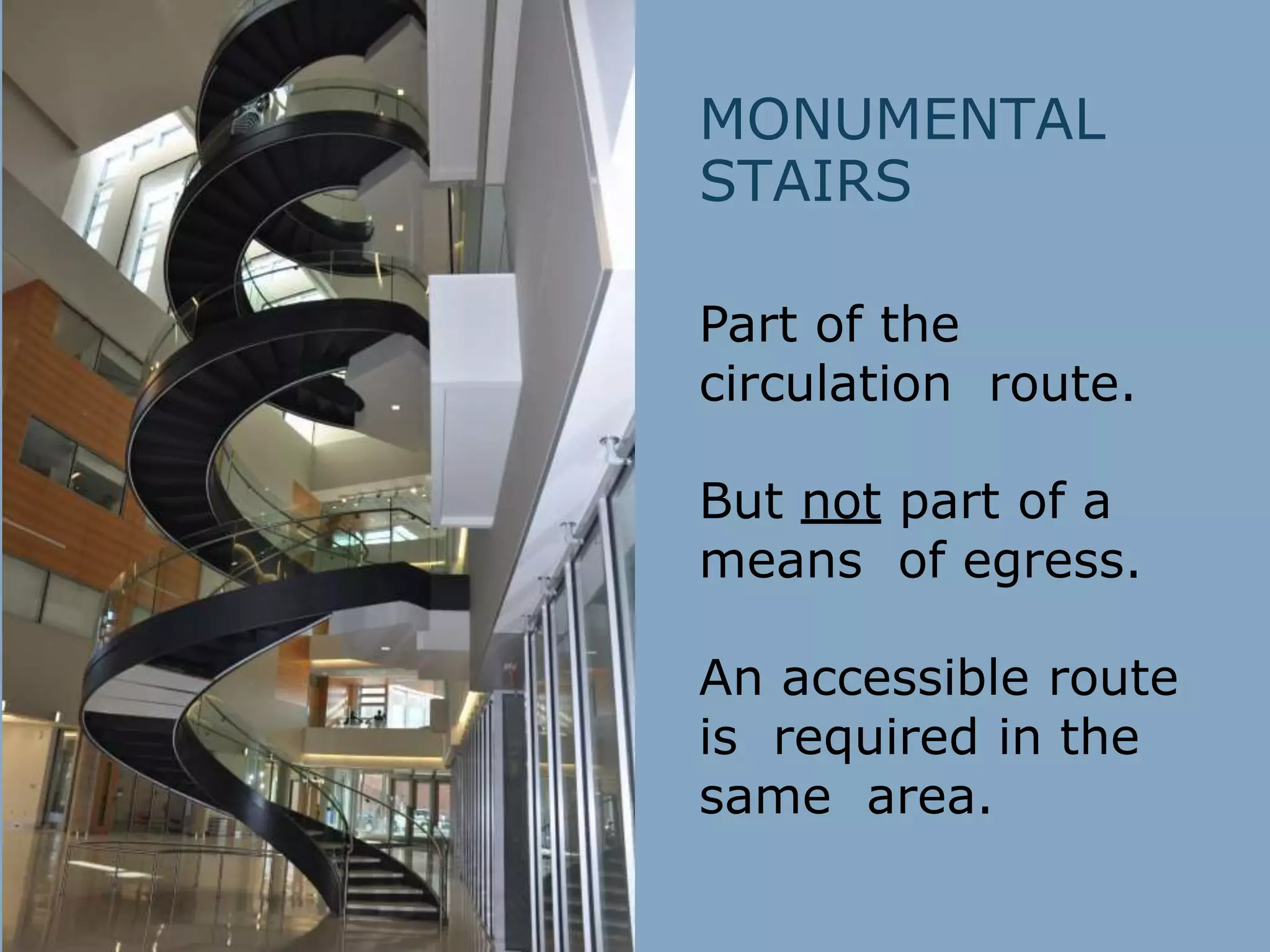
MONUMENTAL
STAIRS
Part of the
circulation route.
But not part of a
means of egress.
An accessible route
is required in the
same area.
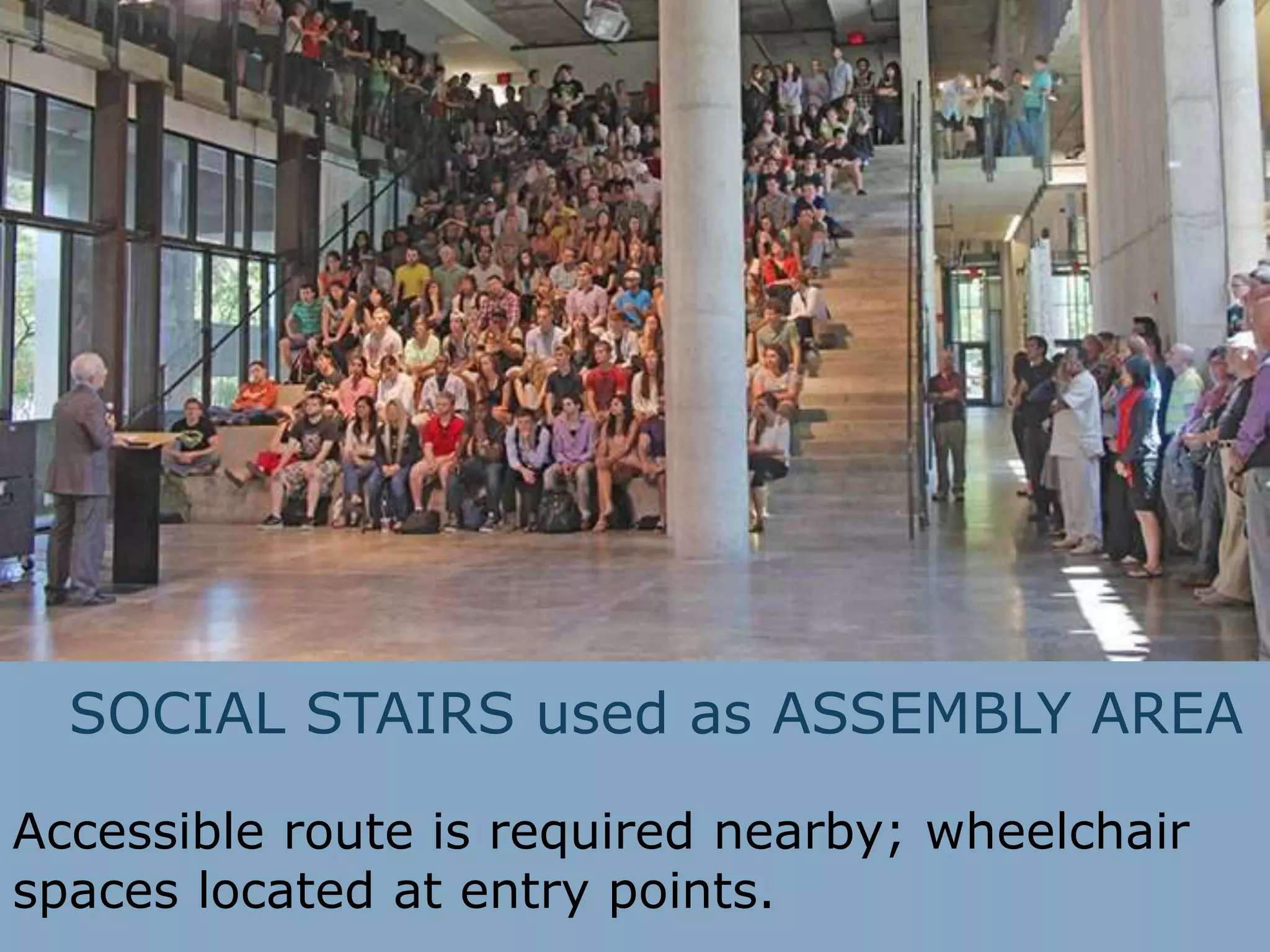
SOCIAL STAIRS used as ASSEMBLY AREA
Accessible route is required nearby; wheelchair
spaces located at entry points.
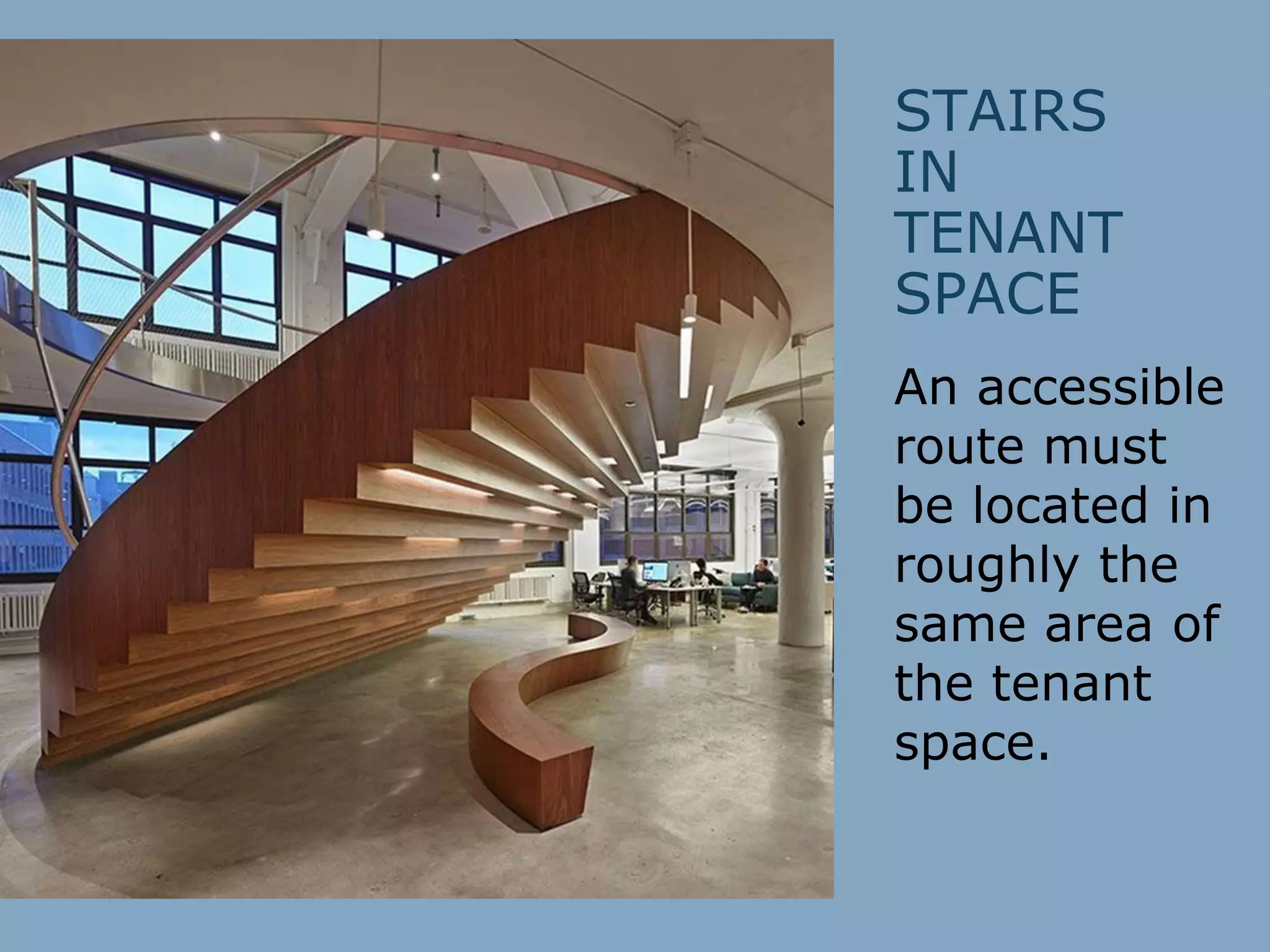
STAIRS
IN
TENANT
SPACE
An accessible
route must
be located in
roughly the
same area of
the tenant
space.
section
Primary Function
Primary Function
“A major activity for which the
facility isintended”
•Why isthe
space there?
•Do you go to
there to use
it?
Alterations
affecting
areas of
Primary
Function must
have compliant
Path of Travel
elements.
Path of
Travel
Elements
accessible routes
• connects all accessible spaces
• continuous
• in the same area as general
circulation paths
• Dispersed among parking zones
• Consists of space + access aisle
• on accessible route
accessible
parking
accessible
restrooms
• clearances
• clear floor space for one area is
allowed to overlap the clear
floor space in an adjacent area
• protruding object provisions
accessible
telephones
• clear floor space
• operable parts
• volume
drinking fountains
• at least two per floor
• clear floor space
• protruding object
considerations
CLARIFICATIONS
section
protruding objects
protruding objects
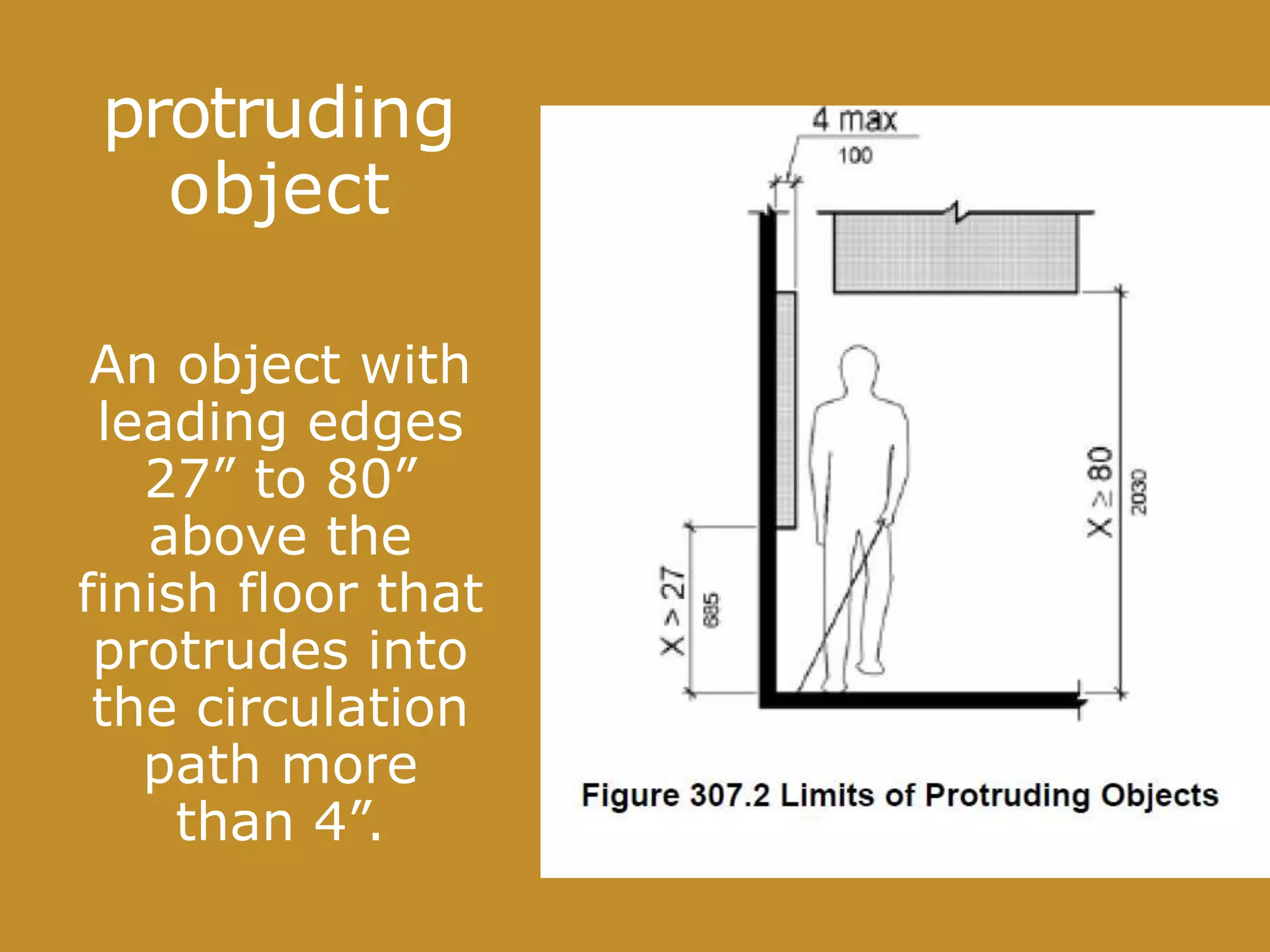
204.1 General. Objects maynot
protrude into circulation paths.
“circulation path”
an exterior or interior way of passage
provided for pedestriantravel
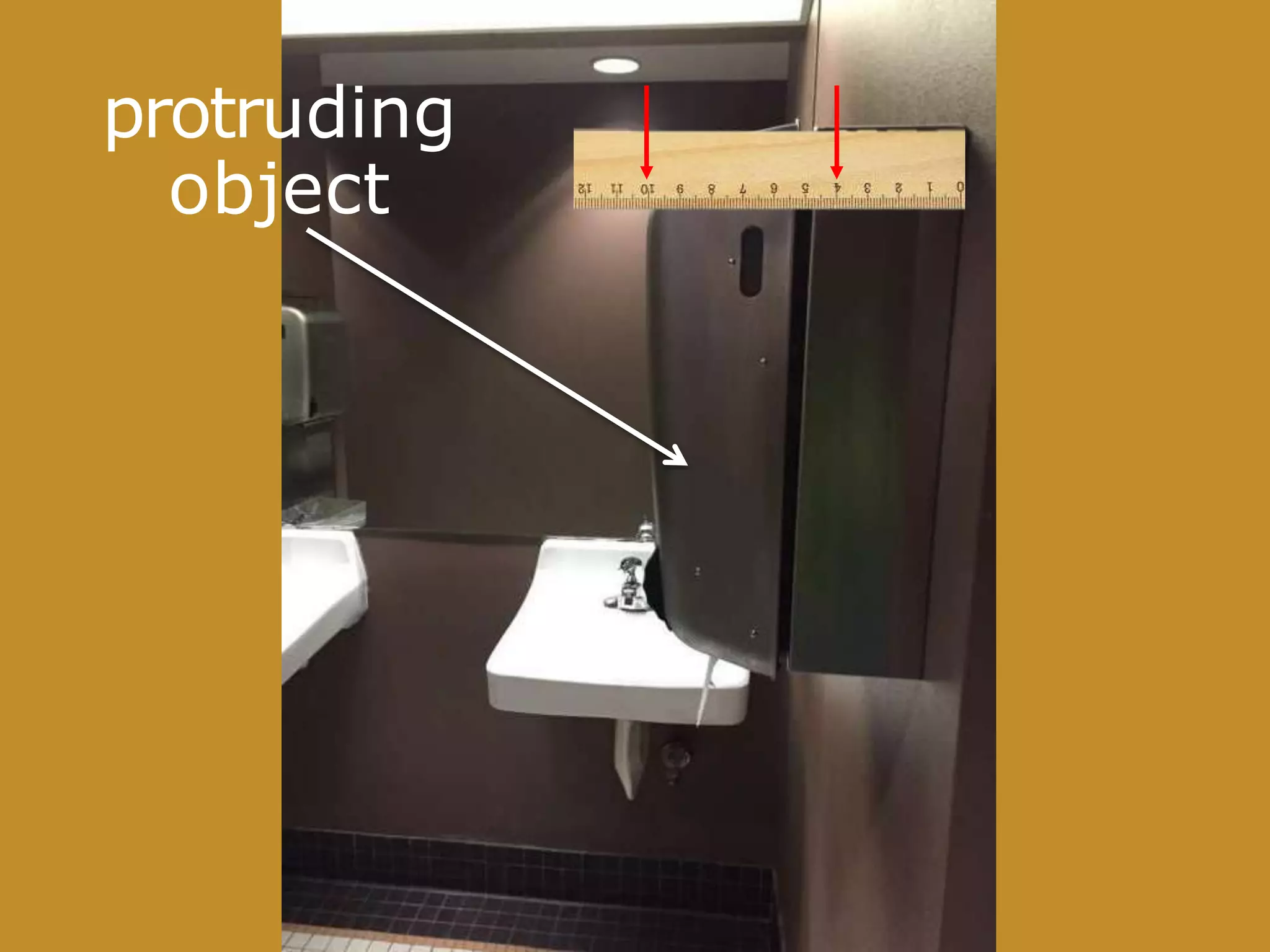
protruding
object
An object with
leading edges
27” to 80”
above the
finish floor that
protrudes into
the circulation
path more
than 4”.
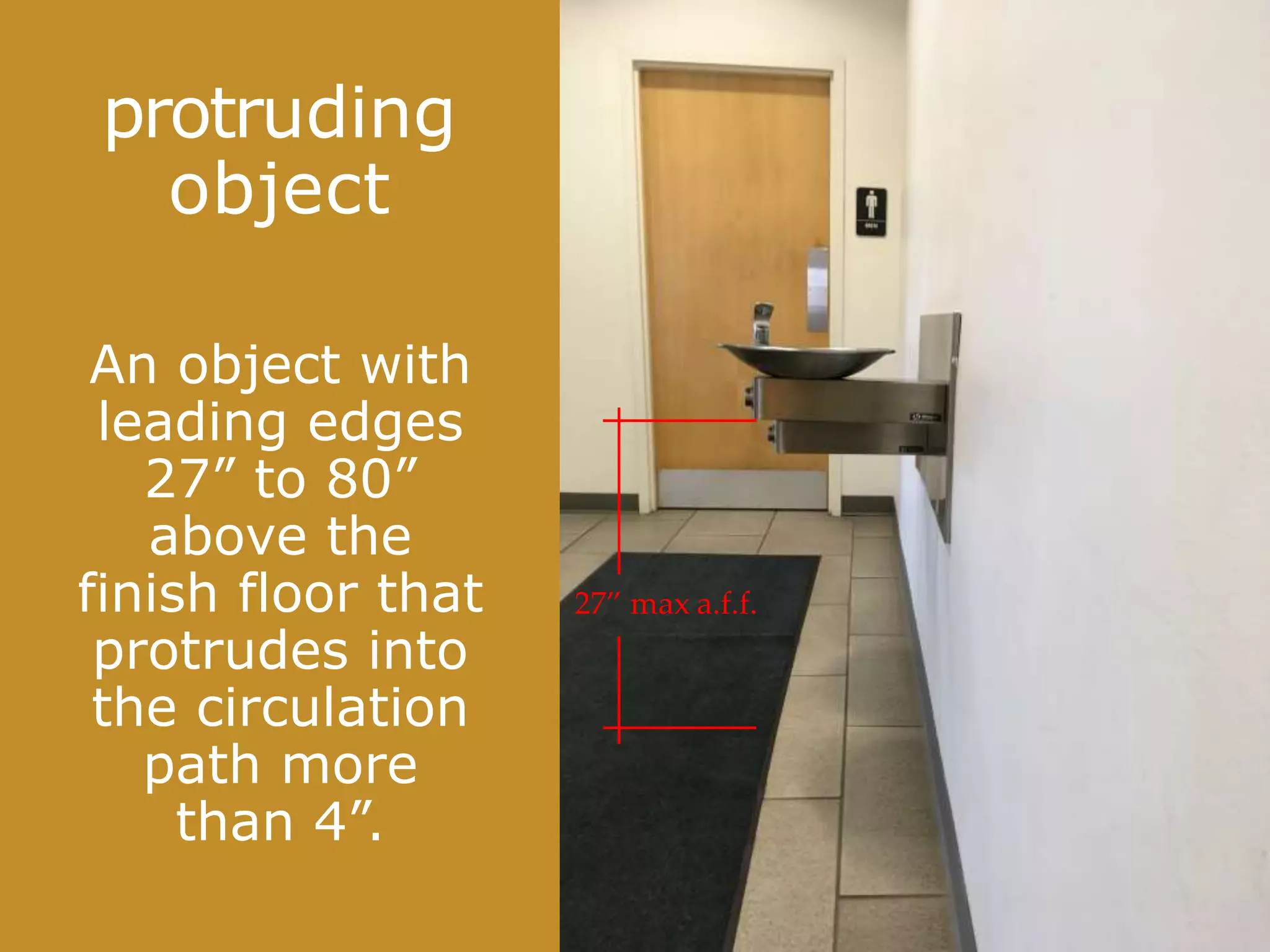
27” max a.f.f.
An object with
leading edges
27” to 80”
above the
finish floor that
protrudes into
the circulation
path more
than 4”.
protruding
object
protruding
object
An object with
leading edges
27” to 80”
above the
finish floor that
protrudes into
the circulation
path more
than 4”.
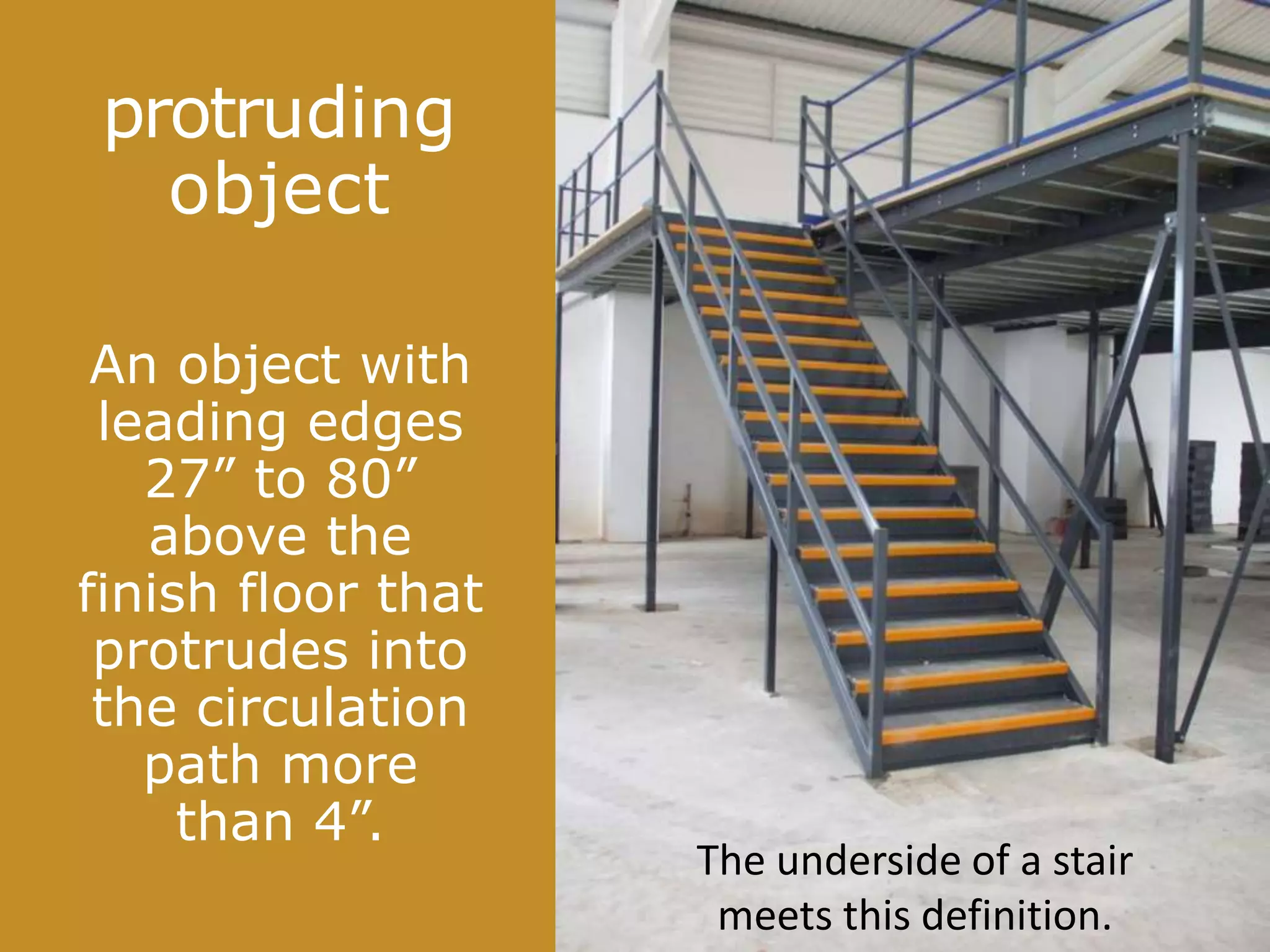
The underside of a stair
meets this definition.
protruding
object
The following accessibility provisions
come from the Texas Accessibility
Standards (TAS) 2012, which are
modeled on the provisions of the
Americans with Disabilities Act (ADA).
The full TAS 2012 can be downloaded
from:
http://www.tdlr.texas.gov/ab/2012TAS/20
12tascomplete.pdf
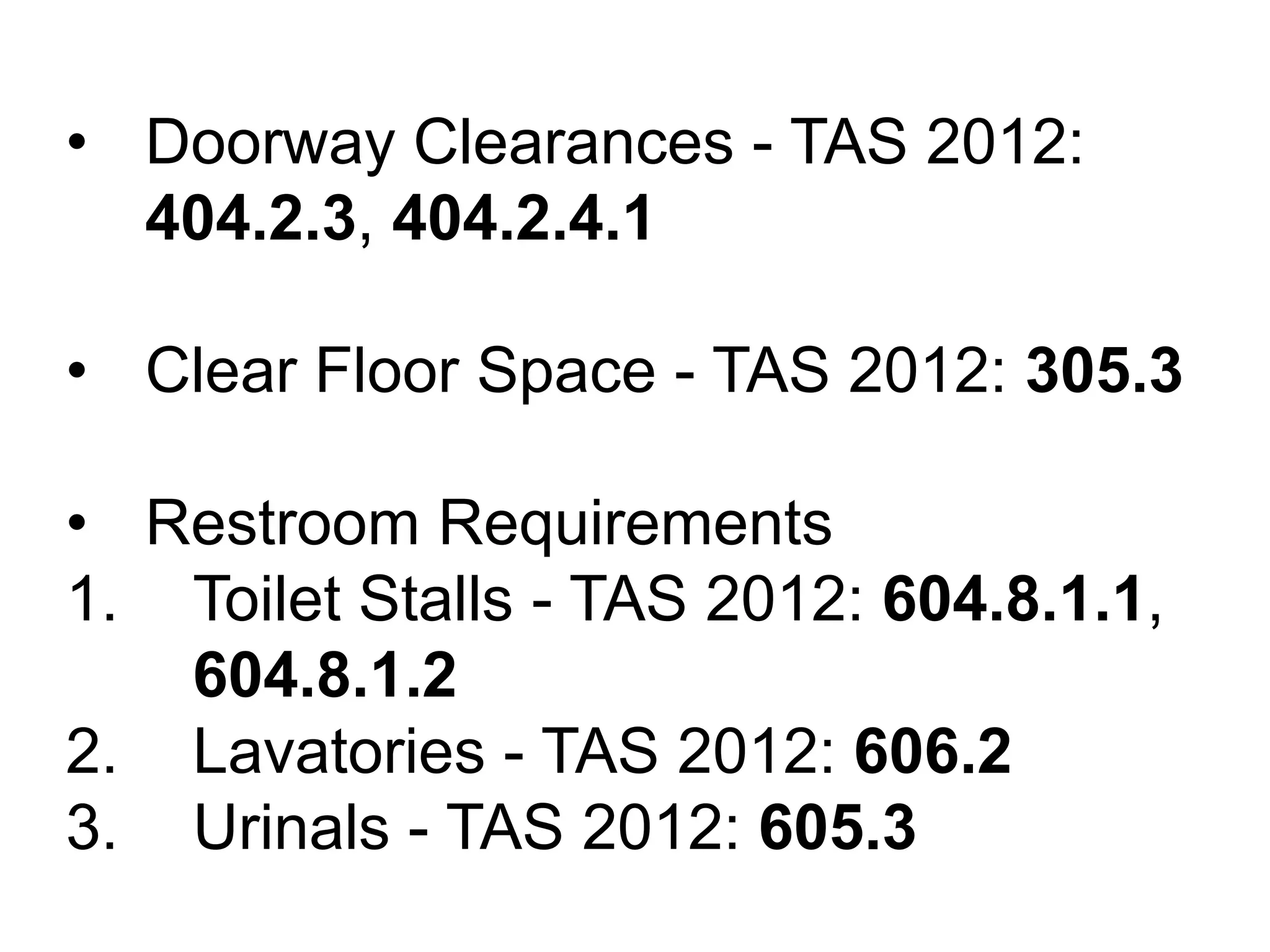
• Doorway Clearances - TAS 2012:
404.2.3, 404.2.4.1
• Clear Floor Space - TAS 2012: 305.3
• Restroom Requirements
1. Toilet Stalls - TAS 2012: 604.8.1.1,
604.8.1.2
2. Lavatories - TAS 2012: 606.2
3. Urinals - TAS 2012: 605.3
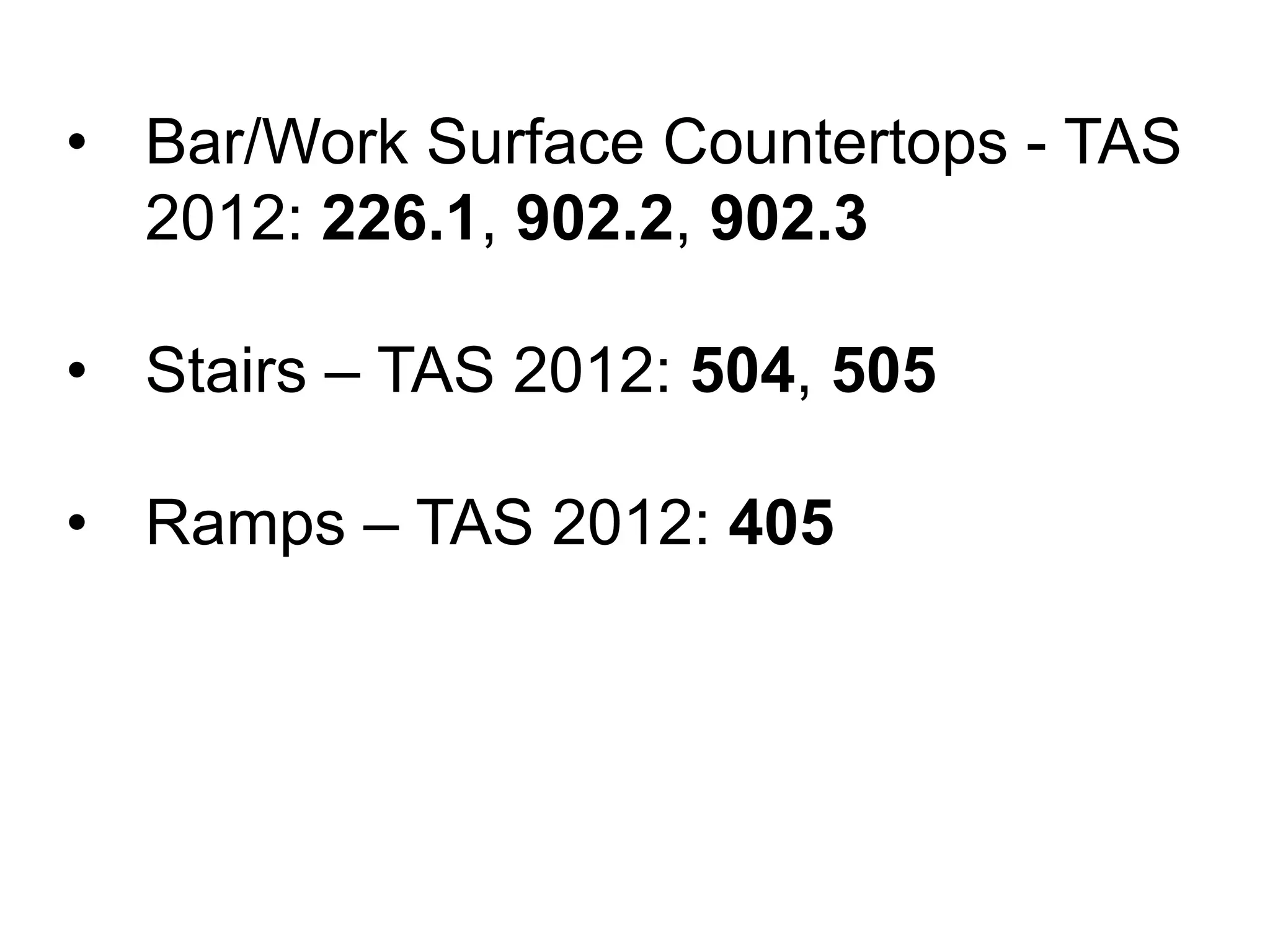
• Bar/Work Surface Countertops - TAS
2012: 226.1, 902.2, 902.3
• Stairs – TAS 2012: 504, 505
• Ramps – TAS 2012: 405

Using the TAS 2012