




Chapter 8:
Motivation Principles
and Theories
Why Do People Act as They Do?
Available on Amazon at
https://www.amazon.com/gp/product/0996
644938/ref=dbs_a_def_rwt_bibl_vppi_i2
or
https://pharmacylibrary.com/doi/book/10.2
1019/9781582123134
LEARNING OBJECTIVES
1. Describe the link between performance, morale, and motivation
2. Discuss the basic features of key motivation theories
3. Discuss practices that enhance motivation
4. Describe practices that de-motivate
MOTIVATION PRINCIPLES AND
THEORIES
Learning Objectives
Describe the link between performance, morale, and motivation
Discuss the basic features of key motivation theories
Discuss practices that enhance motivation
Describe practices that de-motivate
To influence change, pharmacists need a
fundamental understanding of theories of
motivation
This knowledge is needed because
leading change typically involves
motivating others to do things
The fact that leaders must rely upon others to
achieve their goals can be both a frustrating
and rewarding part of being a leader
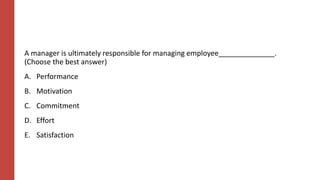
A manager is ultimately responsible for managing employee______________.
(Choose the best answer)
A. Performance
B. Motivation
C. Commitment
D. Effort
E. Satisfaction
WHAT IS THE RELATIONSHIP BETWEEN
MOTIVATION AND PERFORMANCE?
Do or do not.
There is no try.
Jedi Master Yoda
https://www.youtube.com/watch?v=BQ4yd2W50No
Motivation is "a force or influence that
causes someone to do something“
Internal or external
Motivation is related to performance in
that people who are motivated typically
perform tasks better
However, motivation and performance
are two distinct concepts that are not
always correlated
A person might be motivated to perform but lack other requirements needed to
perform well (e.g., talent, training)
Performance is what matters
Ultimately, you need to perform to influence change
Trying is good because it is a step to performance
• However, there is no “A” for “effort” in real life
High morale is good only in that satisfied people tend to perform better on average
• But we all know people who are happy when they do very little
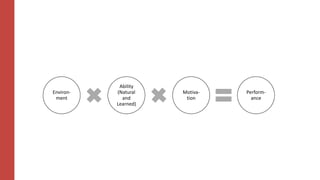
Motivation is only one of several requirements for the
performance of tasks. Performance requires:
1. An environment that encourages performance
2. Adequate training and experience
3. An individual's motivation to perform
Environ-
ment
Ability
(Natural
and
Learned)
Motiva-
tion
Perform-
ance
HOW DO MOTIVATION AND JOB
SATISFACTION DIFFER?
Motivation and job satisfaction are two
related but distinctly different constructs
Motivation is the desire or impulse to act, and
job satisfaction refers to pleasure or
contentment in a job based upon an
individual’s perceptions of their work,
colleagues, supervisors, and employers
Is motivation something that people
have or don’t have?
Or is motivation a function of how
individuals respond to their
environment?
Is there such a thing as an
“unmotivated” person?
Many self-motivated individuals do not need to be motivated by others.
Indeed, they can succeed in spite of their “so called” bosses.
Individuals differ in what motivates them
The better an activity is matched to the desires
& interests of an individual, the more motivated
he or she will be to complete it
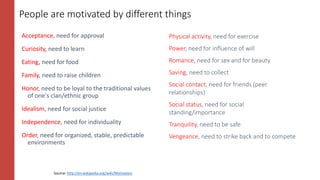
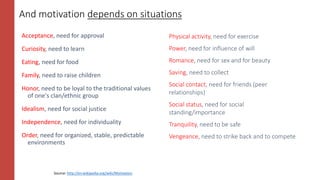
People are motivated by different things
Acceptance, need for approval
Curiosity, need to learn
Eating, need for food
Family, need to raise children
Honor, need to be loyal to the traditional values
of one's clan/ethnic group
Idealism, need for social justice
Independence, need for individuality
Order, need for organized, stable, predictable
environments
Physical activity, need for exercise
Power, need for influence of will
Romance, need for sex and for beauty
Saving, need to collect
Social contact, need for friends (peer
relationships)
Social status, need for social
standing/importance
Tranquility, need to be safe
Vengeance, need to strike back and to compete
Source: http://en.wikipedia.org/wiki/Motivation
And motivation depends on situations
Acceptance, need for approval
Curiosity, need to learn
Eating, need for food
Family, need to raise children
Honor, need to be loyal to the traditional values
of one's clan/ethnic group
Idealism, need for social justice
Independence, need for individuality
Order, need for organized, stable, predictable
environments
Physical activity, need for exercise
Power, need for influence of will
Romance, need for sex and for beauty
Saving, need to collect
Social contact, need for friends (peer
relationships)
Social status, need for social
standing/importance
Tranquility, need to be safe
Vengeance, need to strike back and to compete
Source: http://en.wikipedia.org/wiki/Motivation
This is obvious, but we see again and
again how desired activities are not
matched to the motivations of an
individual
Sometimes, we have to do things we
don’t want to do
Sometimes you need to give people a
little something to do a task that might
not be high of their priority list
Let’s review what was discussed
1. Trying hard is not enough. You must do.
2. High morale is desirable, but performance is more important.
3. Motivation depends a lot on the individual.
MOTIVATION THEORIES
Understanding basic lessons about motivation
can help pharmacists deal better with people
and help avoid misconceptions and missteps
that can lead to avoidable conflict and wasted
effort
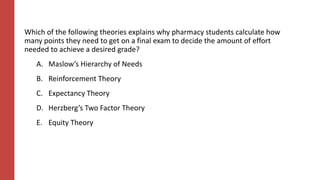
Which of the following theories explains why pharmacy students calculate how
many points they need to get on a final exam to decide the amount of effort
needed to achieve a desired grade?
A. Maslow’s Hierarchy of Needs
B. Reinforcement Theory
C. Expectancy Theory
D. Herzberg’s Two Factor Theory
E. Equity Theory
Expectancy Theory
Asserts that people's work effort is more intense depending how much
they perceive that the effort will result in a desired outcome (e.g., pay,
time off).
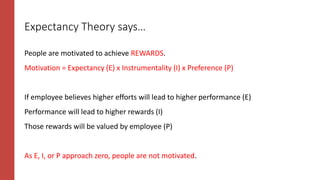
Expectancy Theory says…
People are motivated to achieve REWARDS.
Motivation = Expectancy (E) x Instrumentality (I) x Preference (P)
If employee believes higher efforts will lead to higher performance (E)
Performance will lead to higher rewards (I)
Those rewards will be valued by employee (P)
As E, I, or P approach zero, people are not motivated.
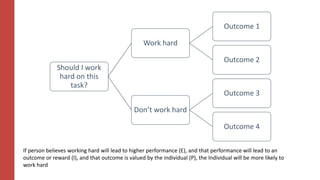
Should I work
hard on this
task?
Work hard
Outcome 1
Outcome 2
Don’t work hard
Outcome 3
Outcome 4
If person believes working hard will lead to higher performance (E), and that performance will lead to an
outcome or reward (I), and that outcome is valued by the individual (P), the Individual will be more likely to
work hard
Expectancy theory emphasizes the carrot (i.e., rewards) over the
stick (i.e., punishments) to drive behavior.
Sometimes the carrot is not enough to motivate, and a stick needs to be
applied.
Reinforcement Theory
Assumes that people will do things that result in good consequences
and avoid doing things that result in bad consequences
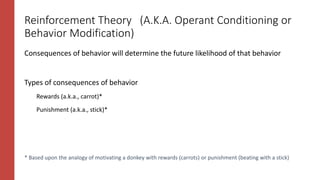
* Based upon the analogy of motivating a donkey with rewards (carrots) or punishment (beating with a stick)
Reinforcement Theory (A.K.A. Operant Conditioning or
Behavior Modification)
Consequences of behavior will determine the future likelihood of that behavior
Types of consequences of behavior
Rewards (a.k.a., carrot)*
Punishment (a.k.a., stick)*
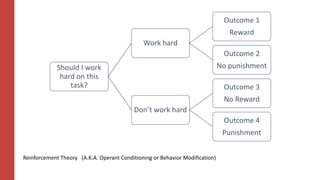
Should I work
hard on this
task?
Work hard
Outcome 1
Reward
Outcome 2
No punishment
Don’t work hard
Outcome 3
No Reward
Outcome 4
Punishment
Reinforcement Theory (A.K.A. Operant Conditioning or Behavior Modification)
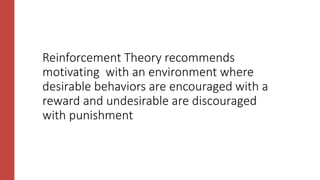
Reinforcement Theory recommends
motivating with an environment where
desirable behaviors are encouraged with a
reward and undesirable are discouraged
with punishment
One limitation with both expectancy &
reinforcement theories is that they
assume rational & unemotional behavior
Also, punishments & rewards can hurt relationships between
individuals.
How would you feel if your boss used manipulative strategies to
motivate you?
What is your boss telling you with manipulation?
__________________ states that the things that drive people can be grouped into
five categories with self-actualization at the top.
A. Maslow’s Hierarchy of Needs
B. Reinforcement Theory
C. Self-determination Theory
D. Herzberg’s Two Factor Theory
E. Equity Theory
Maslow’s Hierarchy of Needs
Needs exist in an ascending hierarchy
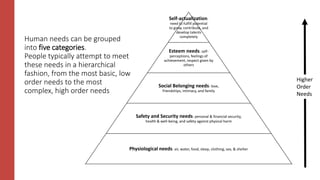
Human needs can be grouped
into five categories.
People typically attempt to meet
these needs in a hierarchical
fashion, from the most basic, low
order needs to the most
complex, high order needs
Higher
Order
Needs
Self-actualization:
need to fulfill potential
to grow, contribute, and
develop talents
completely
Esteem needs: self-
perceptions, feelings of
achievement, respect given by
others
Social Belonging needs: love,
friendships, intimacy, and family
Safety and Security needs: personal & financial security,
health & well-being, and safety against physical harm
Physiological needs: air, water, food, sleep, clothing, sex, & shelter
What we can learn from Maslow
People usually try to satisfy lower level needs first before attempting to meet
higher level needs
If our lower level needs are met (e.g., physiological, safety), they are less likely to
motivate individuals
Threats to lower level needs (e.g., fear of layoffs) get in the way of higher level
performance
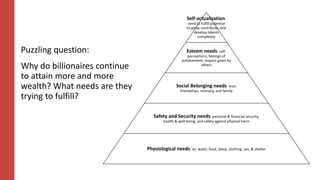
Puzzling question:
Why do billionaires continue
to attain more and more
wealth? What needs are they
trying to fulfill?
Self-actualization:
need to fulfill potential
to grow, contribute, and
develop talents
completely
Esteem needs: self-
perceptions, feelings of
achievement, respect given by
others
Social Belonging needs: love,
friendships, intimacy, and family
Safety and Security needs: personal & financial security,
health & well-being, and safety against physical harm
Physiological needs: air, water, food, sleep, clothing, sex, & shelter
_____________suggests that pharmacists who are intrinsically motivated are
driven less by the rewards they receive for doing a job and are driven more by the
benefits of doing the job itself (e.g., sense of achievement or personal growth).
A. Maslow’s Hierarchy of Needs
B. Reinforcement Theory
C. Self-determination Theory
D. Herzberg’s Two Factor Theory
E. Equity Theory
Herzberg’s Two-Factor Theory
What satisfies differs from what dissatisfies
Two types of job conditions
First -- Job conditions that dissatisfy, called maintenance factors, tend to do so when they
are not present and these dissatisfying conditions reduce worker motivation
1. Policies
2. Supervision
3. Interpersonal relations with one’s supervisor, peers, and subordinates
4. Salary
5. Job security
6. Personal life
7. Working conditions
8. Status
Whenever workers feel any of these conditions are wanting, job dissatisfaction and
lowered motivation likely result.
People who are primarily motivated by
maintenance (aka extrinsic motivators) are
called extrinsically motivated
Motivated by what they get from doing the job more than the job itself
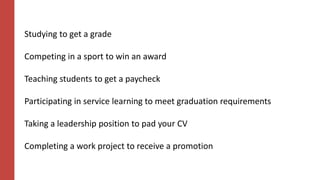
Studying to get a grade
Competing in a sport to win an award
Teaching students to get a paycheck
Participating in service learning to meet graduation requirements
Taking a leadership position to pad your CV
Completing a work project to receive a promotion
Two types of job conditions
Second -- Other aspects of jobs, called motivational factors, have the contrasting effect of
stimulating higher levels of job satisfaction and motivation when present, but causing
minimal dissatisfaction when absent
1. Achievement
2. Recognition
3. Advancement
4. The work itself
5. Possibilities for personal growth
6. Responsibility
When these conditions (or satisfiers) are present, workers tend to achieve greater
satisfaction in their job and job motivation. But when they are absent, workers are neither
satisfied nor dissatisfied.
People who are primarily motivated by
motivational factors (aka intrinsic motivators)
are called intrinsically motivated
Motivated by the job itself more than what they get in exchange for doing a job
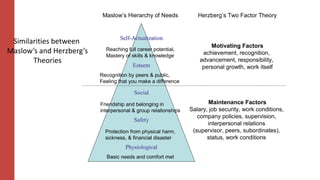
Maslow’s Hierarchy of Needs
EsteemEsteem
SocialSocial
SafetySafety
PhysiologicalPhysiological
SelfSelf--ActualizationActualization
Reaching full career potential,
Mastery of skills & knowledge
Recognition by peers & public,
Feeling that you make a difference
Protection from physical harm,
sickness, & financial disaster
Friendship and belonging in
interpersonal & group relationships
Basic needs and comfort met
Motivating Factors
achievement, recognition,
advancement, responsibility,
personal growth, work itself
Maintenance Factors
Salary, job security, work conditions,
company policies, supervision,
interpersonal relations
(supervisor, peers, subordinates),
status, work conditions
Herzberg’s Two Factor Theory
Similarities between
Maslow’s and Herzberg’s
Theories
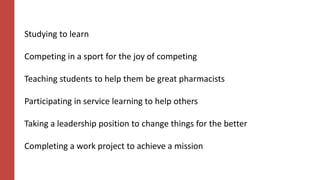
Studying to learn
Competing in a sport for the joy of competing
Teaching students to help them be great pharmacists
Participating in service learning to help others
Taking a leadership position to change things for the better
Completing a work project to achieve a mission
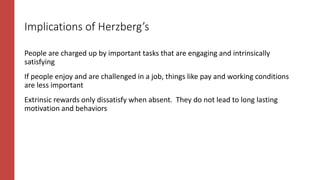
Implications of Herzberg’s
People are charged up by important tasks that are engaging and intrinsically
satisfying
If people enjoy and are challenged in a job, things like pay and working conditions
are less important
Extrinsic rewards only dissatisfy when absent. They do not lead to long lasting
motivation and behaviors
Which of the following theories states that peoples’ motivation is based upon their
judgement of what received from their effort compared to how much effort they
expended? For instance, if people feel that their pay is low, they may be more
likely to put in less effort.
A. Maslow’s Hierarchy of Needs
B. Reinforcement Theory
C. Expectancy Theory
D. Herzberg’s Two Factor Theory
E. Equity Theory
Equity Theory
Our satisfaction is determined by our comparison to others
Equity Theory argues that people are
motivated to act in order to correct perceived
instances of unfair treatment
It asserts that each of us keeps a mental tally
of present and past experiences with others
The equity (i.e., fairness) of these experiences
is judged by comparing what was received in
the relationship versus what was contributed
If we judge this relationship to be equitable,
we will be motivated to reciprocate with
some fair level of response
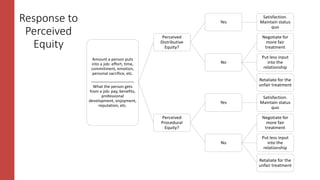
Response to
Perceived
Equity
Amount a person puts
into a job: effort, time,
commitment, emotion,
personal sacrifice, etc.
___________________
What the person gets
from a job: pay, benefits,
professional
development, enjoyment,
reputation, etc.
Perceived
Distributive
Equity?
Yes
Satisfaction.
Maintain status
quo
No
Negotiate for
more fair
treatment
Put less input
into the
relationship
Retaliate for the
unfair treatment
Perceived
Procedural
Equity?
Yes
Satisfaction.
Maintain status
quo
No
Negotiate for
more fair
treatment
Put less input
into the
relationship
Retaliate for the
unfair treatment
Puzzling question:
Why does rewarding this person with a 2% raise cause anger
and perceptions of inequity?
Caveats
Equity judgments are based on an individual's perceptions, which may have little to
do with what actually occurs
• Indeed, people tend to overestimate their contributions and underestimate
others
In addition, not all responses to inequity seek to correct unfair treatment
• Often, retaliation is a common response
Trust moderates perceptions of inequity
If we trust our partners, we are less likely to assume
unfair intentions or behaviors
And will be less likely respond negatively
The puzzle of motivation | Dan Pink
https://www.ted.com/talks/dan_pink_on_motivation?language=en
EMERGING THEORIES
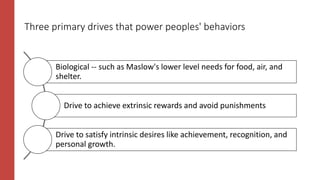
Three primary drives that power peoples' behaviors
Biological -- such as Maslow's lower level needs for food, air, and
shelter.
Drive to achieve extrinsic rewards and avoid punishments
Drive to satisfy intrinsic desires like achievement, recognition, and
personal growth.
Theories of motivation have emerged in recent years
that focus on increasing our understanding about
intrinsic motivation and the things associated with self-
motivation
Which of the following theories argues that motivation and engagement in work is
driven by a an individual’s desire for control over their life, competence in tasks,
and connection with others?
A. Maslow’s Hierarchy of Needs
B. Reinforcement Theory
C. Self-determination Theory
D. Herzberg’s Two Factor Theory
E. Equity Theory
Self-Determination Theory
“I am not what happened to me, I am
what I choose to become.”
― C.G. Jung
The only person you are destined to
become is the person you decide to be.
Ralph Waldo Emerson
“If you end up with a boring miserable life
because you listened to your mom, your dad,
your teacher, your priest, or some guy on
television telling you how to do your sh*t, then
you deserve it.”
Frank Zappa
States that people are innately self-motivated toward
personal growth
But that our self-motivation is often blocked by
their immediate surroundings and situations
By removing these barriers to self motivation,
we can help individuals achieve their highest
level of effort and performance
Self-determination theory
Motivation and engagement in tasks are influenced by an individuals' need to
• direct their own life (i.e., autonomy)
• to control the outcome and develop mastery (i.e., competence)
• connect with others and be a part of something greater than themselves (i.e.,
relatedness)
Environments that support these needs results in individuals who are more
engaged in tasks
Coercive leadership tactics tend to get in the way of self-determination
Theory of Sixteen Basic Desires
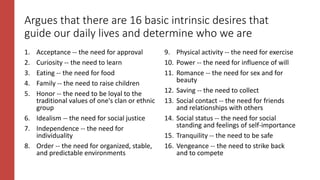
Argues that there are 16 basic intrinsic desires that
guide our daily lives and determine who we are
1. Acceptance -- the need for approval
2. Curiosity -- the need to learn
3. Eating -- the need for food
4. Family -- the need to raise children
5. Honor -- the need to be loyal to the
traditional values of one's clan or ethnic
group
6. Idealism -- the need for social justice
7. Independence -- the need for
individuality
8. Order -- the need for organized, stable,
and predictable environments
9. Physical activity -- the need for exercise
10. Power -- the need for influence of will
11. Romance -- the need for sex and for
beauty
12. Saving -- the need to collect
13. Social contact -- the need for friends
and relationships with others
14. Social status -- the need for social
standing and feelings of self-importance
15. Tranquility -- the need to be safe
16. Vengeance -- the need to strike back
and to compete
We all share these basic desires, but their relative
importance and ranking depends on each
individual and the circumstances
If you want to motivate anyone -- a classmate, co-
worker, subordinate, physician, or boss -- it would be
smart to consider what they care about.
Common sense, but we tend to focus on our own desires instead of the desires of
others
CONCLUSION
Pharmacists can learn a lot by understanding the most common theories of
motivation and their lessons about human behavior
This presentation prepares individuals for the next presentation deals with how to
use best evidence to motivate others and ourselves

Chapter Eight. Motivation Principles and Theories

  • 1.
    Chapter 8: Motivation Principles andTheories Why Do People Act as They Do?
  • 2.
    Available on Amazonat https://www.amazon.com/gp/product/0996 644938/ref=dbs_a_def_rwt_bibl_vppi_i2 or https://pharmacylibrary.com/doi/book/10.2 1019/9781582123134
  • 3.
    LEARNING OBJECTIVES 1. Describethe link between performance, morale, and motivation 2. Discuss the basic features of key motivation theories 3. Discuss practices that enhance motivation 4. Describe practices that de-motivate
  • 4.
  • 5.
    Learning Objectives Describe thelink between performance, morale, and motivation Discuss the basic features of key motivation theories Discuss practices that enhance motivation Describe practices that de-motivate
  • 6.
    To influence change,pharmacists need a fundamental understanding of theories of motivation
  • 7.
    This knowledge isneeded because leading change typically involves motivating others to do things
  • 8.
    The fact thatleaders must rely upon others to achieve their goals can be both a frustrating and rewarding part of being a leader
  • 9.
    A manager isultimately responsible for managing employee______________. (Choose the best answer) A. Performance B. Motivation C. Commitment D. Effort E. Satisfaction
  • 10.
    WHAT IS THERELATIONSHIP BETWEEN MOTIVATION AND PERFORMANCE?
  • 11.
    Do or donot. There is no try. Jedi Master Yoda https://www.youtube.com/watch?v=BQ4yd2W50No
  • 12.
    Motivation is "aforce or influence that causes someone to do something“ Internal or external
  • 13.
    Motivation is relatedto performance in that people who are motivated typically perform tasks better
  • 14.
    However, motivation andperformance are two distinct concepts that are not always correlated A person might be motivated to perform but lack other requirements needed to perform well (e.g., talent, training)
  • 15.
    Performance is whatmatters Ultimately, you need to perform to influence change Trying is good because it is a step to performance • However, there is no “A” for “effort” in real life High morale is good only in that satisfied people tend to perform better on average • But we all know people who are happy when they do very little
  • 16.
    Motivation is onlyone of several requirements for the performance of tasks. Performance requires: 1. An environment that encourages performance 2. Adequate training and experience 3. An individual's motivation to perform
  • 17.
  • 18.
    HOW DO MOTIVATIONAND JOB SATISFACTION DIFFER?
  • 19.
    Motivation and jobsatisfaction are two related but distinctly different constructs
  • 20.
    Motivation is thedesire or impulse to act, and job satisfaction refers to pleasure or contentment in a job based upon an individual’s perceptions of their work, colleagues, supervisors, and employers
  • 21.
    Is motivation somethingthat people have or don’t have? Or is motivation a function of how individuals respond to their environment?
  • 22.
    Is there sucha thing as an “unmotivated” person?
  • 23.
    Many self-motivated individualsdo not need to be motivated by others. Indeed, they can succeed in spite of their “so called” bosses.
  • 24.
    Individuals differ inwhat motivates them The better an activity is matched to the desires & interests of an individual, the more motivated he or she will be to complete it
  • 25.
    People are motivatedby different things Acceptance, need for approval Curiosity, need to learn Eating, need for food Family, need to raise children Honor, need to be loyal to the traditional values of one's clan/ethnic group Idealism, need for social justice Independence, need for individuality Order, need for organized, stable, predictable environments Physical activity, need for exercise Power, need for influence of will Romance, need for sex and for beauty Saving, need to collect Social contact, need for friends (peer relationships) Social status, need for social standing/importance Tranquility, need to be safe Vengeance, need to strike back and to compete Source: http://en.wikipedia.org/wiki/Motivation
  • 26.
    And motivation dependson situations Acceptance, need for approval Curiosity, need to learn Eating, need for food Family, need to raise children Honor, need to be loyal to the traditional values of one's clan/ethnic group Idealism, need for social justice Independence, need for individuality Order, need for organized, stable, predictable environments Physical activity, need for exercise Power, need for influence of will Romance, need for sex and for beauty Saving, need to collect Social contact, need for friends (peer relationships) Social status, need for social standing/importance Tranquility, need to be safe Vengeance, need to strike back and to compete Source: http://en.wikipedia.org/wiki/Motivation
  • 27.
    This is obvious,but we see again and again how desired activities are not matched to the motivations of an individual Sometimes, we have to do things we don’t want to do
  • 28.
    Sometimes you needto give people a little something to do a task that might not be high of their priority list
  • 29.
    Let’s review whatwas discussed 1. Trying hard is not enough. You must do. 2. High morale is desirable, but performance is more important. 3. Motivation depends a lot on the individual.
  • 30.
  • 31.
    Understanding basic lessonsabout motivation can help pharmacists deal better with people and help avoid misconceptions and missteps that can lead to avoidable conflict and wasted effort
  • 32.
    Which of thefollowing theories explains why pharmacy students calculate how many points they need to get on a final exam to decide the amount of effort needed to achieve a desired grade? A. Maslow’s Hierarchy of Needs B. Reinforcement Theory C. Expectancy Theory D. Herzberg’s Two Factor Theory E. Equity Theory
  • 33.
    Expectancy Theory Asserts thatpeople's work effort is more intense depending how much they perceive that the effort will result in a desired outcome (e.g., pay, time off).
  • 34.
    Expectancy Theory says… Peopleare motivated to achieve REWARDS. Motivation = Expectancy (E) x Instrumentality (I) x Preference (P) If employee believes higher efforts will lead to higher performance (E) Performance will lead to higher rewards (I) Those rewards will be valued by employee (P) As E, I, or P approach zero, people are not motivated.
  • 35.
    Should I work hardon this task? Work hard Outcome 1 Outcome 2 Don’t work hard Outcome 3 Outcome 4 If person believes working hard will lead to higher performance (E), and that performance will lead to an outcome or reward (I), and that outcome is valued by the individual (P), the Individual will be more likely to work hard
  • 36.
    Expectancy theory emphasizesthe carrot (i.e., rewards) over the stick (i.e., punishments) to drive behavior. Sometimes the carrot is not enough to motivate, and a stick needs to be applied.
  • 37.
    Reinforcement Theory Assumes thatpeople will do things that result in good consequences and avoid doing things that result in bad consequences
  • 38.
    * Based uponthe analogy of motivating a donkey with rewards (carrots) or punishment (beating with a stick) Reinforcement Theory (A.K.A. Operant Conditioning or Behavior Modification) Consequences of behavior will determine the future likelihood of that behavior Types of consequences of behavior Rewards (a.k.a., carrot)* Punishment (a.k.a., stick)*
  • 39.
    Should I work hardon this task? Work hard Outcome 1 Reward Outcome 2 No punishment Don’t work hard Outcome 3 No Reward Outcome 4 Punishment Reinforcement Theory (A.K.A. Operant Conditioning or Behavior Modification)
  • 40.
    Reinforcement Theory recommends motivatingwith an environment where desirable behaviors are encouraged with a reward and undesirable are discouraged with punishment
  • 41.
    One limitation withboth expectancy & reinforcement theories is that they assume rational & unemotional behavior
  • 42.
    Also, punishments &rewards can hurt relationships between individuals. How would you feel if your boss used manipulative strategies to motivate you? What is your boss telling you with manipulation?
  • 43.
    __________________ states thatthe things that drive people can be grouped into five categories with self-actualization at the top. A. Maslow’s Hierarchy of Needs B. Reinforcement Theory C. Self-determination Theory D. Herzberg’s Two Factor Theory E. Equity Theory
  • 44.
    Maslow’s Hierarchy ofNeeds Needs exist in an ascending hierarchy
  • 45.
    Human needs canbe grouped into five categories. People typically attempt to meet these needs in a hierarchical fashion, from the most basic, low order needs to the most complex, high order needs Higher Order Needs Self-actualization: need to fulfill potential to grow, contribute, and develop talents completely Esteem needs: self- perceptions, feelings of achievement, respect given by others Social Belonging needs: love, friendships, intimacy, and family Safety and Security needs: personal & financial security, health & well-being, and safety against physical harm Physiological needs: air, water, food, sleep, clothing, sex, & shelter
  • 46.
    What we canlearn from Maslow People usually try to satisfy lower level needs first before attempting to meet higher level needs If our lower level needs are met (e.g., physiological, safety), they are less likely to motivate individuals Threats to lower level needs (e.g., fear of layoffs) get in the way of higher level performance
  • 47.
    Puzzling question: Why dobillionaires continue to attain more and more wealth? What needs are they trying to fulfill? Self-actualization: need to fulfill potential to grow, contribute, and develop talents completely Esteem needs: self- perceptions, feelings of achievement, respect given by others Social Belonging needs: love, friendships, intimacy, and family Safety and Security needs: personal & financial security, health & well-being, and safety against physical harm Physiological needs: air, water, food, sleep, clothing, sex, & shelter
  • 48.
    _____________suggests that pharmacistswho are intrinsically motivated are driven less by the rewards they receive for doing a job and are driven more by the benefits of doing the job itself (e.g., sense of achievement or personal growth). A. Maslow’s Hierarchy of Needs B. Reinforcement Theory C. Self-determination Theory D. Herzberg’s Two Factor Theory E. Equity Theory
  • 49.
    Herzberg’s Two-Factor Theory Whatsatisfies differs from what dissatisfies
  • 50.
    Two types ofjob conditions First -- Job conditions that dissatisfy, called maintenance factors, tend to do so when they are not present and these dissatisfying conditions reduce worker motivation 1. Policies 2. Supervision 3. Interpersonal relations with one’s supervisor, peers, and subordinates 4. Salary 5. Job security 6. Personal life 7. Working conditions 8. Status Whenever workers feel any of these conditions are wanting, job dissatisfaction and lowered motivation likely result.
  • 51.
    People who areprimarily motivated by maintenance (aka extrinsic motivators) are called extrinsically motivated Motivated by what they get from doing the job more than the job itself
  • 52.
    Studying to geta grade Competing in a sport to win an award Teaching students to get a paycheck Participating in service learning to meet graduation requirements Taking a leadership position to pad your CV Completing a work project to receive a promotion
  • 53.
    Two types ofjob conditions Second -- Other aspects of jobs, called motivational factors, have the contrasting effect of stimulating higher levels of job satisfaction and motivation when present, but causing minimal dissatisfaction when absent 1. Achievement 2. Recognition 3. Advancement 4. The work itself 5. Possibilities for personal growth 6. Responsibility When these conditions (or satisfiers) are present, workers tend to achieve greater satisfaction in their job and job motivation. But when they are absent, workers are neither satisfied nor dissatisfied.
  • 54.
    People who areprimarily motivated by motivational factors (aka intrinsic motivators) are called intrinsically motivated Motivated by the job itself more than what they get in exchange for doing a job
  • 55.
    Maslow’s Hierarchy ofNeeds EsteemEsteem SocialSocial SafetySafety PhysiologicalPhysiological SelfSelf--ActualizationActualization Reaching full career potential, Mastery of skills & knowledge Recognition by peers & public, Feeling that you make a difference Protection from physical harm, sickness, & financial disaster Friendship and belonging in interpersonal & group relationships Basic needs and comfort met Motivating Factors achievement, recognition, advancement, responsibility, personal growth, work itself Maintenance Factors Salary, job security, work conditions, company policies, supervision, interpersonal relations (supervisor, peers, subordinates), status, work conditions Herzberg’s Two Factor Theory Similarities between Maslow’s and Herzberg’s Theories
  • 56.
    Studying to learn Competingin a sport for the joy of competing Teaching students to help them be great pharmacists Participating in service learning to help others Taking a leadership position to change things for the better Completing a work project to achieve a mission
  • 57.
    Implications of Herzberg’s Peopleare charged up by important tasks that are engaging and intrinsically satisfying If people enjoy and are challenged in a job, things like pay and working conditions are less important Extrinsic rewards only dissatisfy when absent. They do not lead to long lasting motivation and behaviors
  • 58.
    Which of thefollowing theories states that peoples’ motivation is based upon their judgement of what received from their effort compared to how much effort they expended? For instance, if people feel that their pay is low, they may be more likely to put in less effort. A. Maslow’s Hierarchy of Needs B. Reinforcement Theory C. Expectancy Theory D. Herzberg’s Two Factor Theory E. Equity Theory
  • 59.
    Equity Theory Our satisfactionis determined by our comparison to others
  • 60.
    Equity Theory arguesthat people are motivated to act in order to correct perceived instances of unfair treatment
  • 61.
    It asserts thateach of us keeps a mental tally of present and past experiences with others
  • 62.
    The equity (i.e.,fairness) of these experiences is judged by comparing what was received in the relationship versus what was contributed
  • 63.
    If we judgethis relationship to be equitable, we will be motivated to reciprocate with some fair level of response
  • 64.
    Response to Perceived Equity Amount aperson puts into a job: effort, time, commitment, emotion, personal sacrifice, etc. ___________________ What the person gets from a job: pay, benefits, professional development, enjoyment, reputation, etc. Perceived Distributive Equity? Yes Satisfaction. Maintain status quo No Negotiate for more fair treatment Put less input into the relationship Retaliate for the unfair treatment Perceived Procedural Equity? Yes Satisfaction. Maintain status quo No Negotiate for more fair treatment Put less input into the relationship Retaliate for the unfair treatment
  • 65.
    Puzzling question: Why doesrewarding this person with a 2% raise cause anger and perceptions of inequity?
  • 66.
    Caveats Equity judgments arebased on an individual's perceptions, which may have little to do with what actually occurs • Indeed, people tend to overestimate their contributions and underestimate others In addition, not all responses to inequity seek to correct unfair treatment • Often, retaliation is a common response
  • 67.
    Trust moderates perceptionsof inequity If we trust our partners, we are less likely to assume unfair intentions or behaviors And will be less likely respond negatively
  • 68.
    The puzzle ofmotivation | Dan Pink https://www.ted.com/talks/dan_pink_on_motivation?language=en
  • 69.
  • 70.
    Three primary drivesthat power peoples' behaviors Biological -- such as Maslow's lower level needs for food, air, and shelter. Drive to achieve extrinsic rewards and avoid punishments Drive to satisfy intrinsic desires like achievement, recognition, and personal growth.
  • 71.
    Theories of motivationhave emerged in recent years that focus on increasing our understanding about intrinsic motivation and the things associated with self- motivation
  • 72.
    Which of thefollowing theories argues that motivation and engagement in work is driven by a an individual’s desire for control over their life, competence in tasks, and connection with others? A. Maslow’s Hierarchy of Needs B. Reinforcement Theory C. Self-determination Theory D. Herzberg’s Two Factor Theory E. Equity Theory
  • 73.
  • 74.
    “I am notwhat happened to me, I am what I choose to become.” ― C.G. Jung
  • 75.
    The only personyou are destined to become is the person you decide to be. Ralph Waldo Emerson
  • 76.
    “If you endup with a boring miserable life because you listened to your mom, your dad, your teacher, your priest, or some guy on television telling you how to do your sh*t, then you deserve it.” Frank Zappa
  • 77.
    States that peopleare innately self-motivated toward personal growth
  • 78.
    But that ourself-motivation is often blocked by their immediate surroundings and situations
  • 79.
    By removing thesebarriers to self motivation, we can help individuals achieve their highest level of effort and performance
  • 80.
    Self-determination theory Motivation andengagement in tasks are influenced by an individuals' need to • direct their own life (i.e., autonomy) • to control the outcome and develop mastery (i.e., competence) • connect with others and be a part of something greater than themselves (i.e., relatedness) Environments that support these needs results in individuals who are more engaged in tasks Coercive leadership tactics tend to get in the way of self-determination
  • 81.
    Theory of SixteenBasic Desires
  • 82.
    Argues that thereare 16 basic intrinsic desires that guide our daily lives and determine who we are 1. Acceptance -- the need for approval 2. Curiosity -- the need to learn 3. Eating -- the need for food 4. Family -- the need to raise children 5. Honor -- the need to be loyal to the traditional values of one's clan or ethnic group 6. Idealism -- the need for social justice 7. Independence -- the need for individuality 8. Order -- the need for organized, stable, and predictable environments 9. Physical activity -- the need for exercise 10. Power -- the need for influence of will 11. Romance -- the need for sex and for beauty 12. Saving -- the need to collect 13. Social contact -- the need for friends and relationships with others 14. Social status -- the need for social standing and feelings of self-importance 15. Tranquility -- the need to be safe 16. Vengeance -- the need to strike back and to compete
  • 83.
    We all sharethese basic desires, but their relative importance and ranking depends on each individual and the circumstances
  • 84.
    If you wantto motivate anyone -- a classmate, co- worker, subordinate, physician, or boss -- it would be smart to consider what they care about. Common sense, but we tend to focus on our own desires instead of the desires of others
  • 85.
    CONCLUSION Pharmacists can learna lot by understanding the most common theories of motivation and their lessons about human behavior This presentation prepares individuals for the next presentation deals with how to use best evidence to motivate others and ourselves