Chapter    1
          The Changing Face
          of Business
Learning Goals

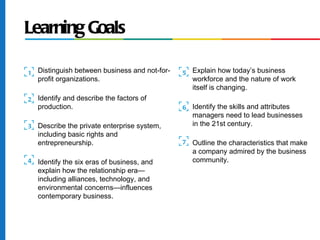
1   Distinguish between business and not-for-   5   Explain how today’s business
    profit organizations.                           workforce and the nature of work
                                                    itself is changing.
2   Identify and describe the factors of
    production.                                 6   Identify the skills and attributes
                                                    managers need to lead businesses
3   Describe the private enterprise system,         in the 21st century.
    including basic rights and
    entrepreneurship.                           7   Outline the characteristics that make
                                                    a company admired by the business
4   Identify the six eras of business, and          community.
    explain how the relationship era—
    including alliances, technology, and
    environmental concerns—influences
    contemporary business.
W is Business?
     hat

s   Profit-seeking activities and enterprises provide
    goods and services necessary to an economic
    system.
s   Profit-seeking is the reward for business people
    who take the risk involved to offer goods and
    services to customers.

s   See Fortune 500 for a list of major U.S.
    companies.
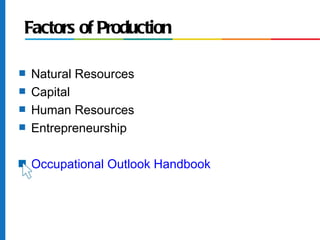
Factors of Production

s   Natural Resources
s   Capital
s   Human Resources
s   Entrepreneurship

s   Occupational Outlook Handbook
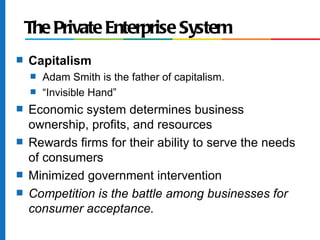
The Private Enterprise System
s   Capitalism
    s   Adam Smith is the father of capitalism.
    s   “Invisible Hand”
s   Economic system determines business
    ownership, profits, and resources
s   Rewards firms for their ability to serve the needs
    of consumers
s   Minimized government intervention
s   Competition is the battle among businesses for
    consumer acceptance.
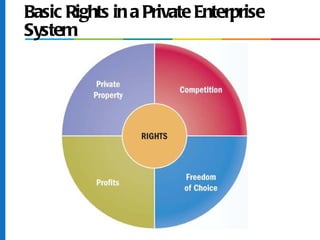
Basic Rights in a Private Enterprise
System
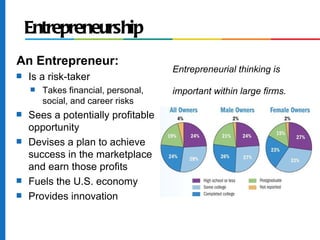
Entrepreneurship
An Entrepreneur:
                                     Entrepreneurial thinking is
s   Is a risk-taker
    s   Takes financial, personal,   important within large firms.
        social, and career risks
s   Sees a potentially profitable
    opportunity
s   Devises a plan to achieve
    success in the marketplace
    and earn those profits
s   Fuels the U.S. economy
s   Provides innovation
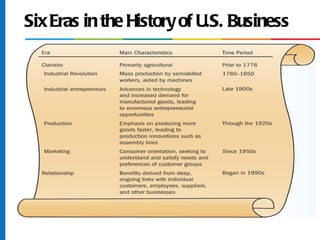
Six Eras in the History of U.S. Business
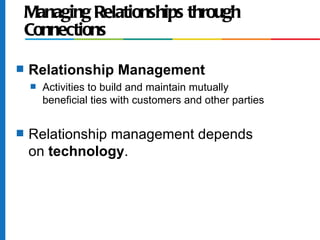
Managing Relationships through
    Connections

s   Relationship Management
    s   Activities to build and maintain mutually
        beneficial ties with customers and other parties


s   Relationship management depends
    on technology.
Strategic Alliances and Partnerships

s   A partnership is an affiliation of two or
    more companies that help each other
    achieve common goals.

s   A strategic alliance is a partnership
    formed to create a competitive advantage
    for both parties (see Amazon).
Today’s Business Workforce

s   Dedicated workers who can foster strong
    ties with customers
s   Capable of high-quality production
s   Able to compete in global markets
s   Technically savvy
Changes in the W orkforce:
    Aging Population
s   By 2030, the number of U.S. workers 65 or
    older will reach 72 million.
s   Many baby boomers are hitting the peak of
    their careers, while Generations X and Y are
    launching their careers.
s   Technology has intensified the hiring
    challenge by requiring workers to have ever
    more advanced skills.

s   U.S. Census Bureau
Changes in the W orkforce:
    Shrinking Labor Pool/Diversity
s   Economists predict the U.S. labor pool could
    soon fall short by as many as 10 million
    people.
s   The two fastest-growing ethnic populations in
    the United States are Hispanics and people of
    Asian origin.
s   Employee teams with individuals of different
    genders, ethnic backgrounds, cultures,
    religions, ages, and physical and mental
    abilities are more effective.
Changes in the Workforce:
    Outsourcing
s   Outsourcing is using outside vendors to
    produce goods or fulfill services and functions
    that were previously handled in-house or in-
    country.
s   Offshoring is the relocation of business
    processes to lower-cost locations overseas.
Changes in the W orkforce:
    Innovation through Collaboration
s   Younger workers are looking to something
    other than work-comes-first
s   Telecommuting and job-sharing
s   Part-time and temporary workers are growing
s   Collaboration is replacing working alone
s   Value risk-taking and innovation
The 21st-Century Manager

s   Critical-thinking

s   Creativity

s   Ability to lead change

s   Vision
Critical Thinking and Creativity

s   Critical thinking is the ability to analyze and
    assess information to pinpoint problems or
    opportunities.

s   Creativity is the capacity to develop novel
    solutions to perceived organizational
    problems.
Ability to Lead Change

s   Guide employees and organizations through
    changes
s   Managers must be comfortable with tough
    decisions.
s   Factors that require organizational change
    can come from external and internal sources.
W Makes a Company Admired?
     hat
s   Solid profits
s   Stable growth
s   Safe and challenging work environment
s   High-quality goods and services
s   Business ethics and social responsibility

s   Fortune’s list of Most Admired Companies
The Future of Business
s   New Technologies

s   Population Shifts
    s   Emerging nations

s   Shrinking Global Barriers
    s   Trade, communication, transportation

Chapter 1: Global Environment

  • 1.
    Chapter 1 The Changing Face of Business
  • 2.
    Learning Goals 1 Distinguish between business and not-for- 5 Explain how today’s business profit organizations. workforce and the nature of work itself is changing. 2 Identify and describe the factors of production. 6 Identify the skills and attributes managers need to lead businesses 3 Describe the private enterprise system, in the 21st century. including basic rights and entrepreneurship. 7 Outline the characteristics that make a company admired by the business 4 Identify the six eras of business, and community. explain how the relationship era— including alliances, technology, and environmental concerns—influences contemporary business.
  • 3.
    W is Business? hat s Profit-seeking activities and enterprises provide goods and services necessary to an economic system. s Profit-seeking is the reward for business people who take the risk involved to offer goods and services to customers. s See Fortune 500 for a list of major U.S. companies.
  • 4.
    Factors of Production s Natural Resources s Capital s Human Resources s Entrepreneurship s Occupational Outlook Handbook
  • 5.
    The Private EnterpriseSystem s Capitalism s Adam Smith is the father of capitalism. s “Invisible Hand” s Economic system determines business ownership, profits, and resources s Rewards firms for their ability to serve the needs of consumers s Minimized government intervention s Competition is the battle among businesses for consumer acceptance.
  • 6.
    Basic Rights ina Private Enterprise System
  • 7.
    Entrepreneurship An Entrepreneur: Entrepreneurial thinking is s Is a risk-taker s Takes financial, personal, important within large firms. social, and career risks s Sees a potentially profitable opportunity s Devises a plan to achieve success in the marketplace and earn those profits s Fuels the U.S. economy s Provides innovation
  • 8.
    Six Eras inthe History of U.S. Business
  • 9.
    Managing Relationships through Connections s Relationship Management s Activities to build and maintain mutually beneficial ties with customers and other parties s Relationship management depends on technology.
  • 10.
    Strategic Alliances andPartnerships s A partnership is an affiliation of two or more companies that help each other achieve common goals. s A strategic alliance is a partnership formed to create a competitive advantage for both parties (see Amazon).
  • 11.
    Today’s Business Workforce s Dedicated workers who can foster strong ties with customers s Capable of high-quality production s Able to compete in global markets s Technically savvy
  • 12.
    Changes in theW orkforce: Aging Population s By 2030, the number of U.S. workers 65 or older will reach 72 million. s Many baby boomers are hitting the peak of their careers, while Generations X and Y are launching their careers. s Technology has intensified the hiring challenge by requiring workers to have ever more advanced skills. s U.S. Census Bureau
  • 13.
    Changes in theW orkforce: Shrinking Labor Pool/Diversity s Economists predict the U.S. labor pool could soon fall short by as many as 10 million people. s The two fastest-growing ethnic populations in the United States are Hispanics and people of Asian origin. s Employee teams with individuals of different genders, ethnic backgrounds, cultures, religions, ages, and physical and mental abilities are more effective.
  • 14.
    Changes in theWorkforce: Outsourcing s Outsourcing is using outside vendors to produce goods or fulfill services and functions that were previously handled in-house or in- country. s Offshoring is the relocation of business processes to lower-cost locations overseas.
  • 15.
    Changes in theW orkforce: Innovation through Collaboration s Younger workers are looking to something other than work-comes-first s Telecommuting and job-sharing s Part-time and temporary workers are growing s Collaboration is replacing working alone s Value risk-taking and innovation
  • 16.
    The 21st-Century Manager s Critical-thinking s Creativity s Ability to lead change s Vision
  • 17.
    Critical Thinking andCreativity s Critical thinking is the ability to analyze and assess information to pinpoint problems or opportunities. s Creativity is the capacity to develop novel solutions to perceived organizational problems.
  • 18.
    Ability to LeadChange s Guide employees and organizations through changes s Managers must be comfortable with tough decisions. s Factors that require organizational change can come from external and internal sources.
  • 19.
    W Makes aCompany Admired? hat s Solid profits s Stable growth s Safe and challenging work environment s High-quality goods and services s Business ethics and social responsibility s Fortune’s list of Most Admired Companies
  • 20.
    The Future ofBusiness s New Technologies s Population Shifts s Emerging nations s Shrinking Global Barriers s Trade, communication, transportation