Life Chemistry and Energy
2
Chapter 2 Life Chemistry and Energy
Key Concepts
• 2.1 Atomic Structure Is the Basis for Life’s
Chemistry
• 2.2 Atoms Interact and Form Molecules
• 2.3 Carbohydrates Consist of Sugar
Molecules
• 2.4 Lipids Are Hydrophobic Molecules
• 2.5 Biochemical Changes Involve Energy
Chapter 2 Opening Question
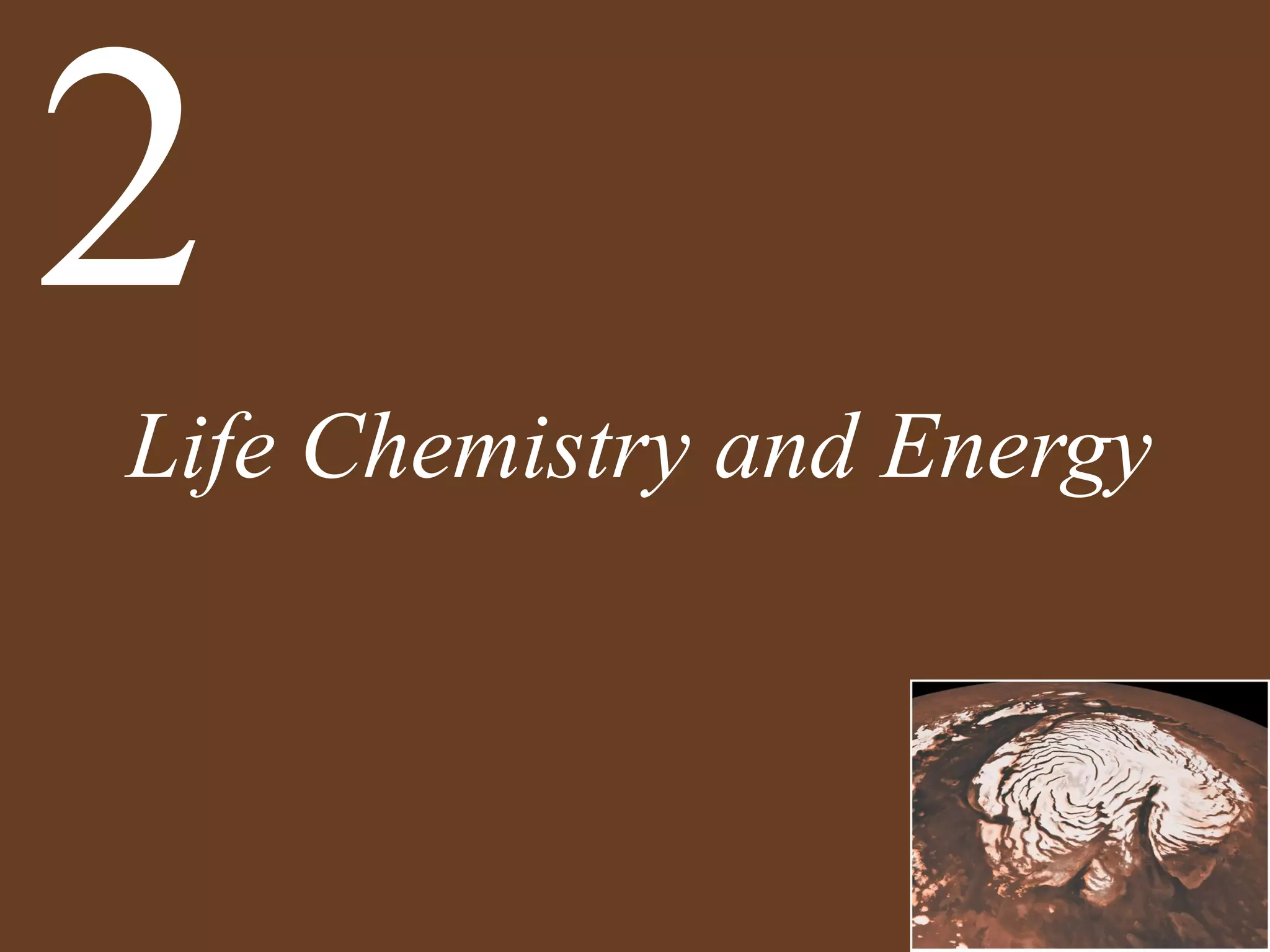
Why is the search for water important in
the search for life?
Concept 2.1 Atomic Structure Is the Basis for Life’s Chemistry
Living and nonliving matter is composed of
atoms.
Concept 2.1 Atomic Structure Is the Basis for Life’s Chemistry
Like charges repel; different charges attract.
Most atoms are neutral because the number of
electrons equals the number of protons.
Dalton—mass of one proton or neutron
(1.7 × 10⁻²⁴
grams)
Mass of electrons is so tiny, it is usually
ignored.
Concept 2.1 Atomic Structure Is the Basis for Life’s Chemistry
Element—pure substance that contains only
one kind of atom
Living things are mostly composed of 6
elements:
Carbon (C) Hydrogen (H) Nitrogen (N)
Oxygen (O) Phosphorus (P) Sulfur (S)
Concept 2.1 Atomic Structure Is the Basis for Life’s Chemistry
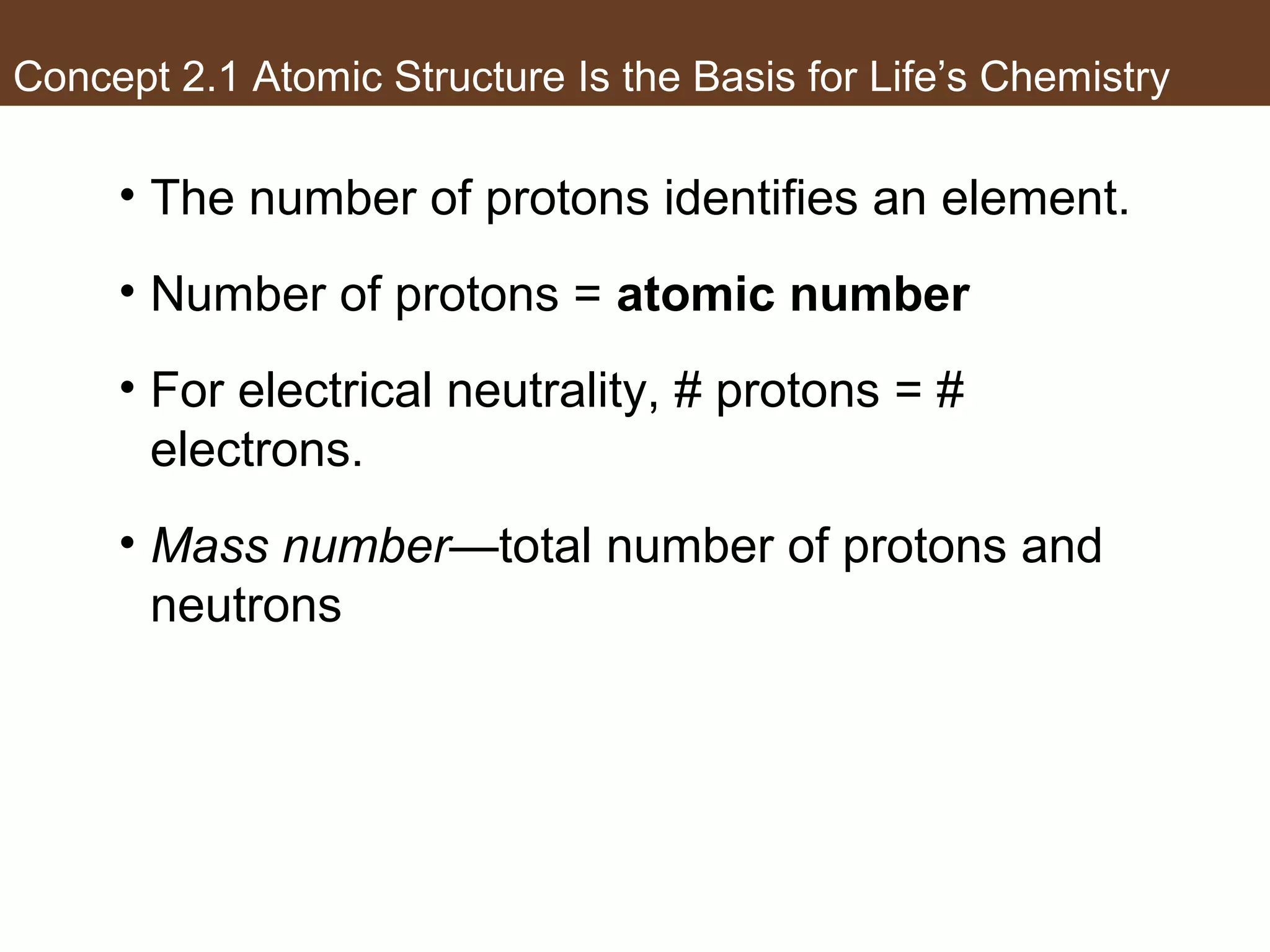
• The number of protons identifies an element.
• Number of protons = atomic number
• For electrical neutrality, # protons = #
electrons.
• Mass number—total number of protons and
neutrons
Concept 2.1 Atomic Structure Is the Basis for Life’s Chemistry
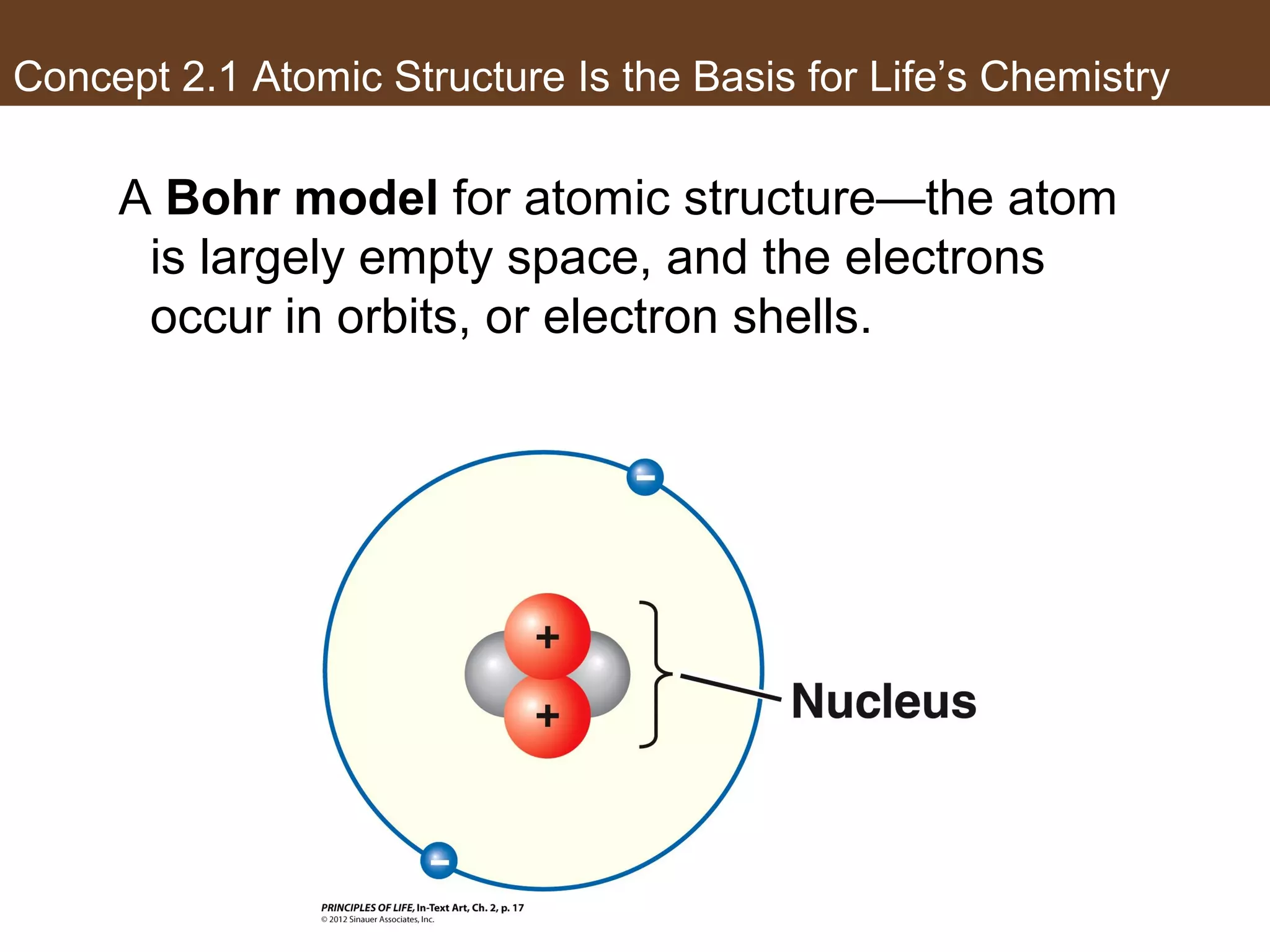
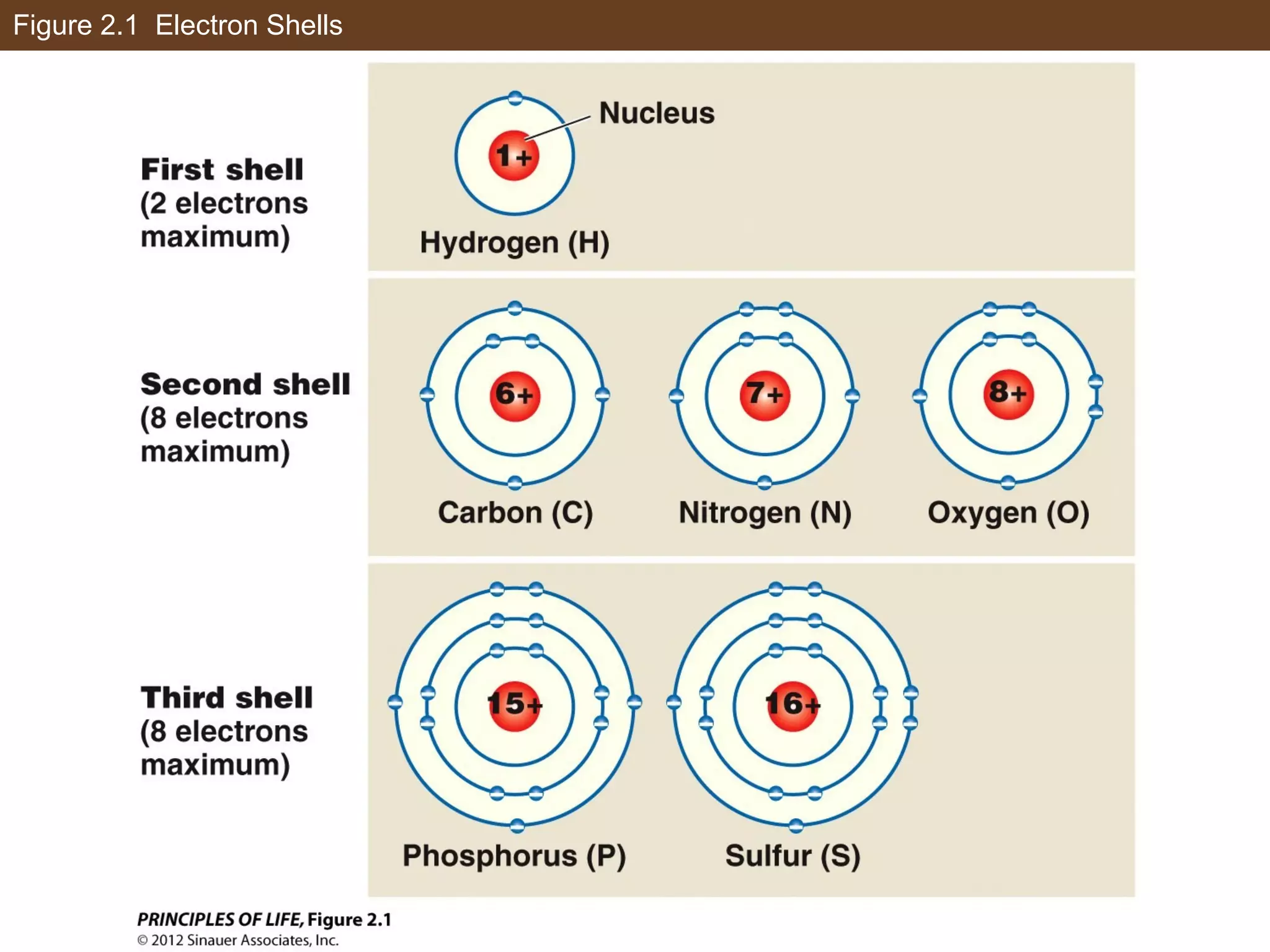
A Bohr model for atomic structure—the atom
is largely empty space, and the electrons
occur in orbits, or electron shells.
Concept 2.1 Atomic Structure Is the Basis for Life’s Chemistry
Behavior of electrons determines whether a
chemical bond will form and what shape the
bond will have.
Figure 2.1 Electron Shells
Concept 2.1 Atomic Structure Is the Basis for Life’s Chemistry
Atoms with unfilled outer shells tend to undergo
chemical reactions to fill their outer shells.
They can attain stability by sharing electrons
with other atoms or by losing or gaining
electrons.
The atoms are then bonded together into
molecules.
Concept 2.1 Atomic Structure Is the Basis for Life’s Chemistry
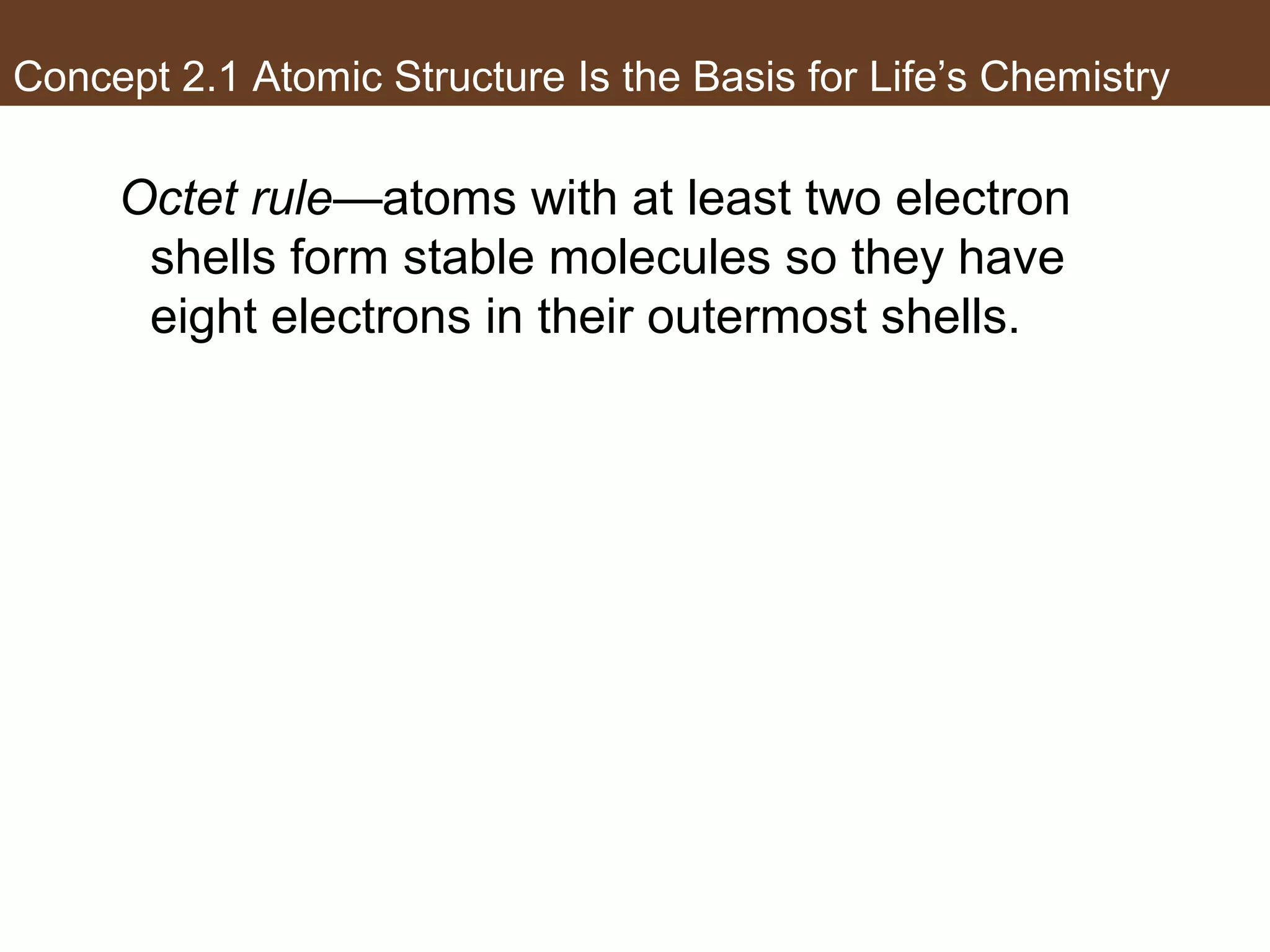
Octet rule—atoms with at least two electron
shells form stable molecules so they have
eight electrons in their outermost shells.
Concept 2.2 Atoms Interact and Form Molecules
Chemical bond is an attractive force that links
atoms together to form molecules.
There are several kinds of chemical bonds.
Table 2.1 Chemical Bonds and Interactions
Concept 2.2 Atoms Interact and Form Molecules
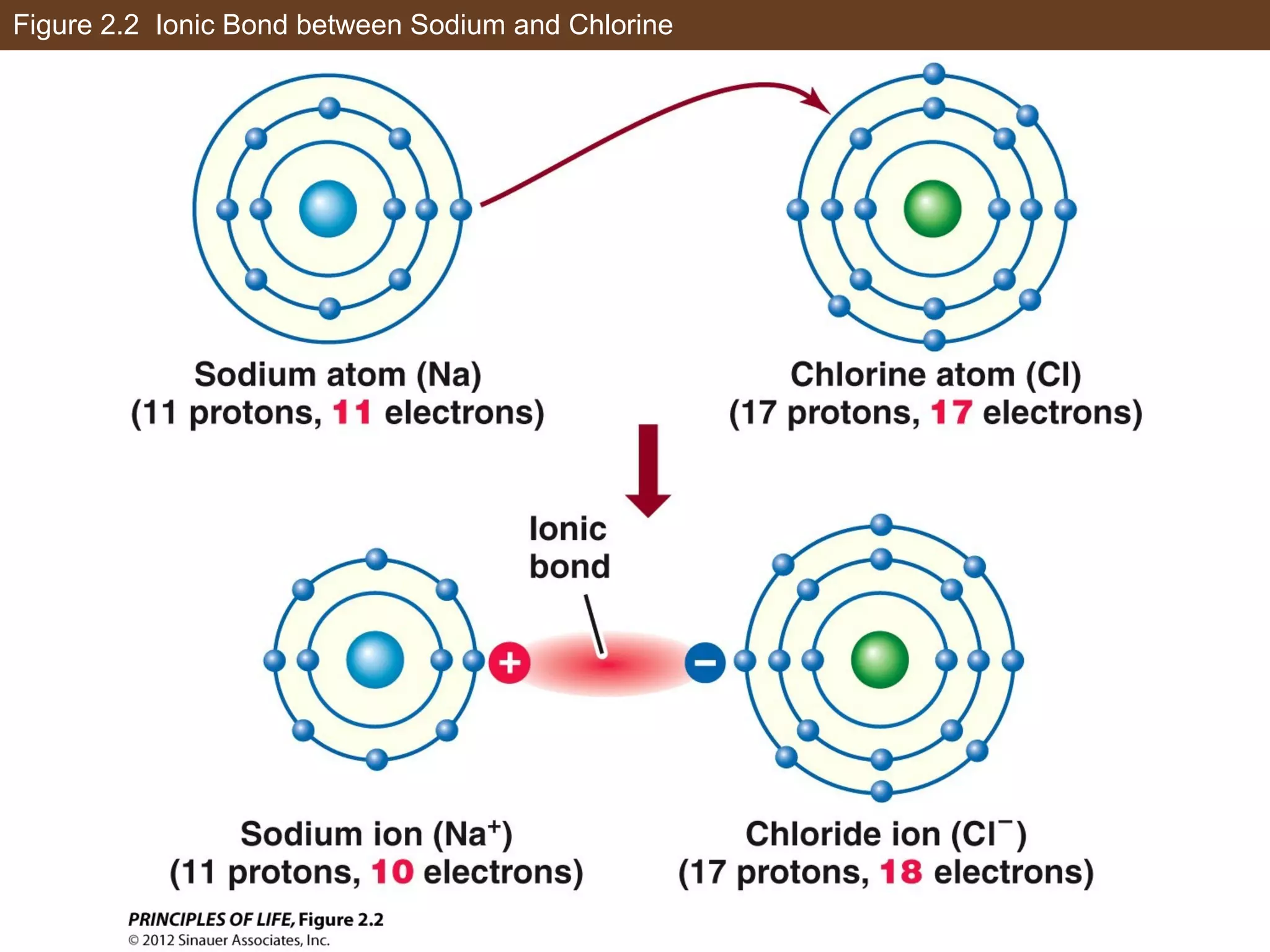
Ionic bonds
Ions are charged particle that form when an
atom gains or loses one or more electrons.
Cations—positively charged ions
Anions—negatively charged ions
Ionic bonds result from the electrical attraction
between ions with opposite charges.
The resulting molecules are called salts.
Figure 2.2 Ionic Bond between Sodium and Chlorine
Concept 2.2 Atoms Interact and Form Molecules
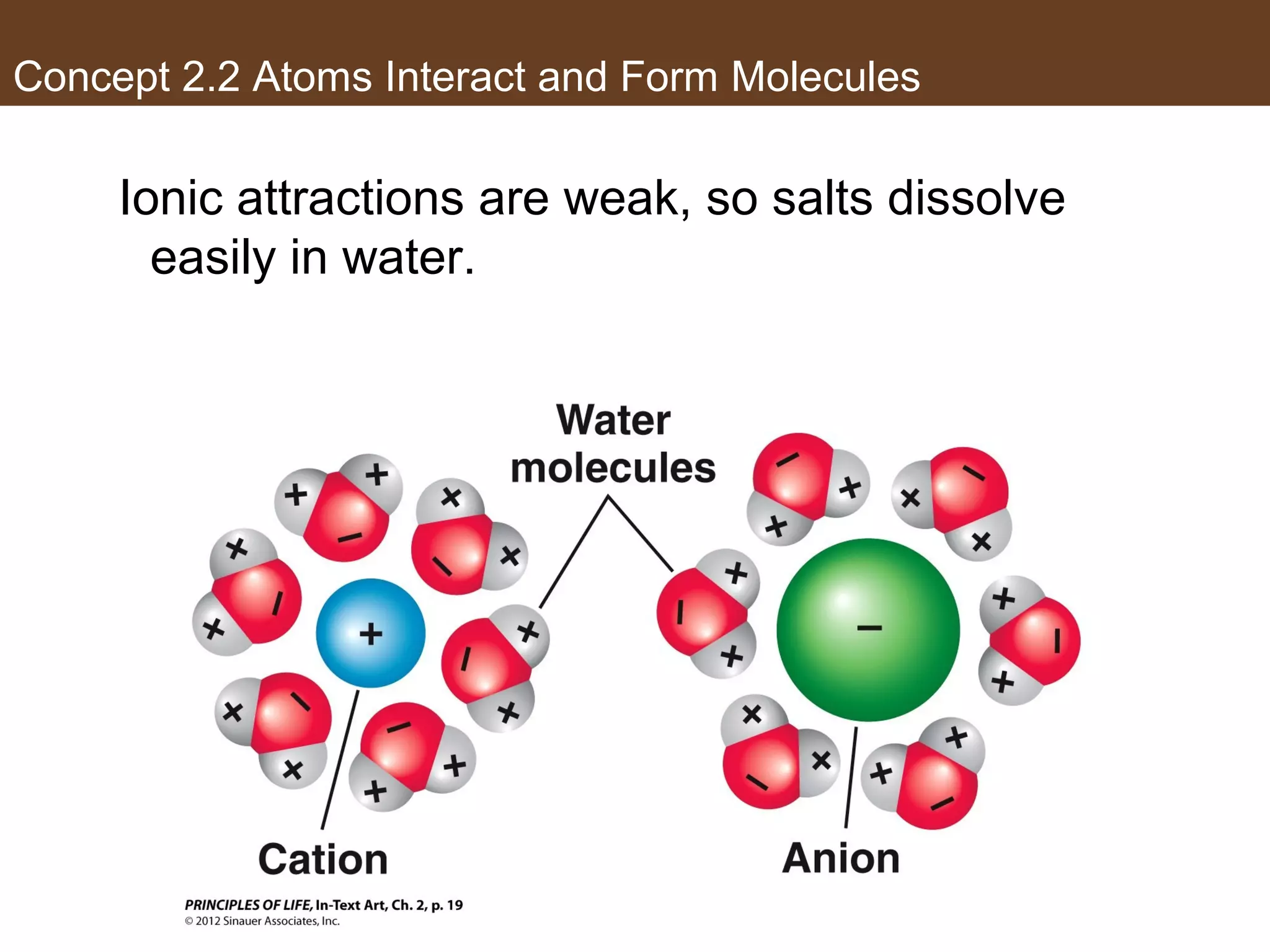
Ionic attractions are weak, so salts dissolve
easily in water.
Concept 2.2 Atoms Interact and Form Molecules
Covalent bonds
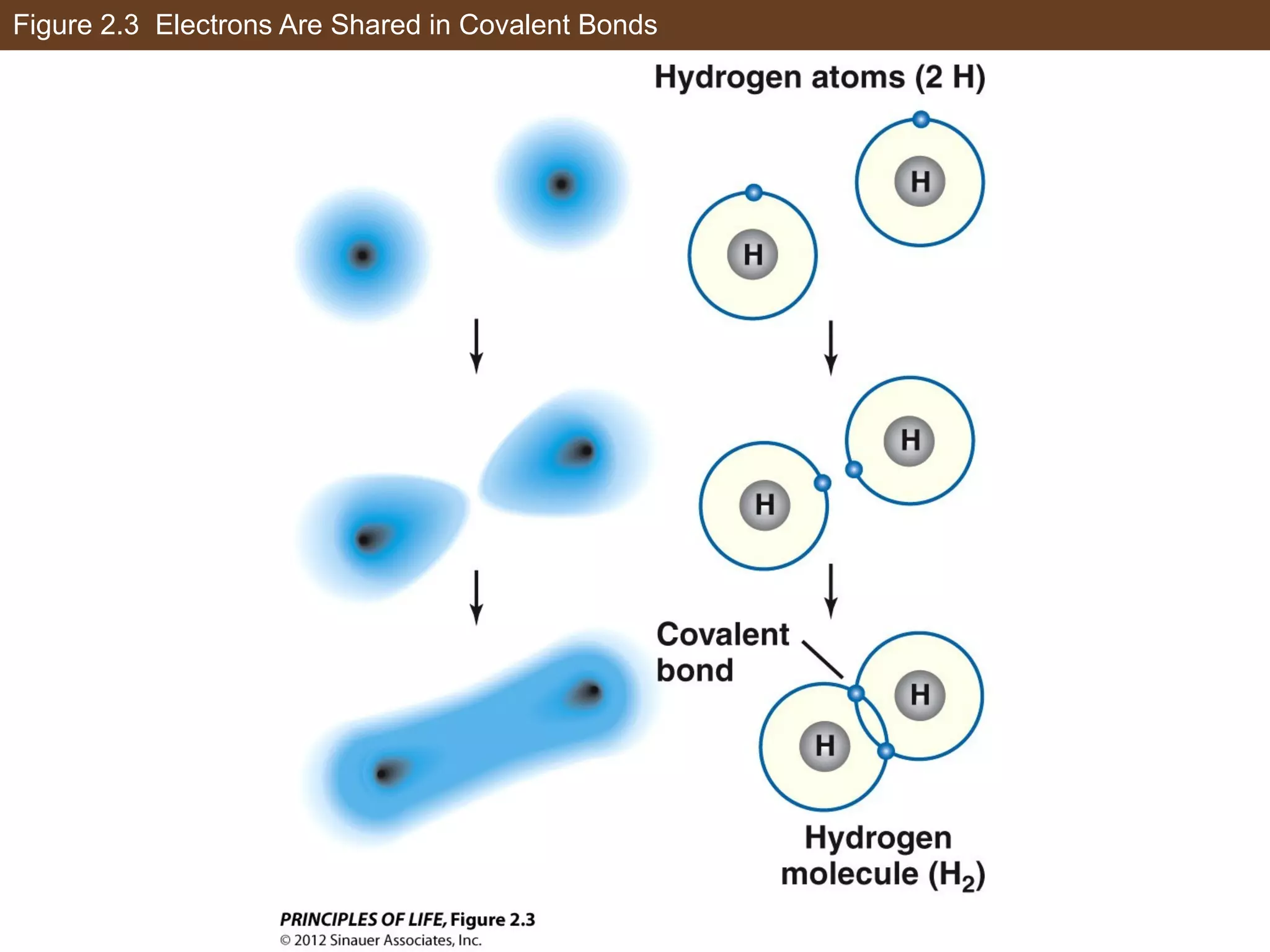
Covalent bonds form when two atoms share
pairs of electrons.
The atoms attain stability by having full outer
shells.
Each atom contributes one member of the
electron pair.
Figure 2.3 Electrons Are Shared in Covalent Bonds
Concept 2.2 Atoms Interact and Form Molecules
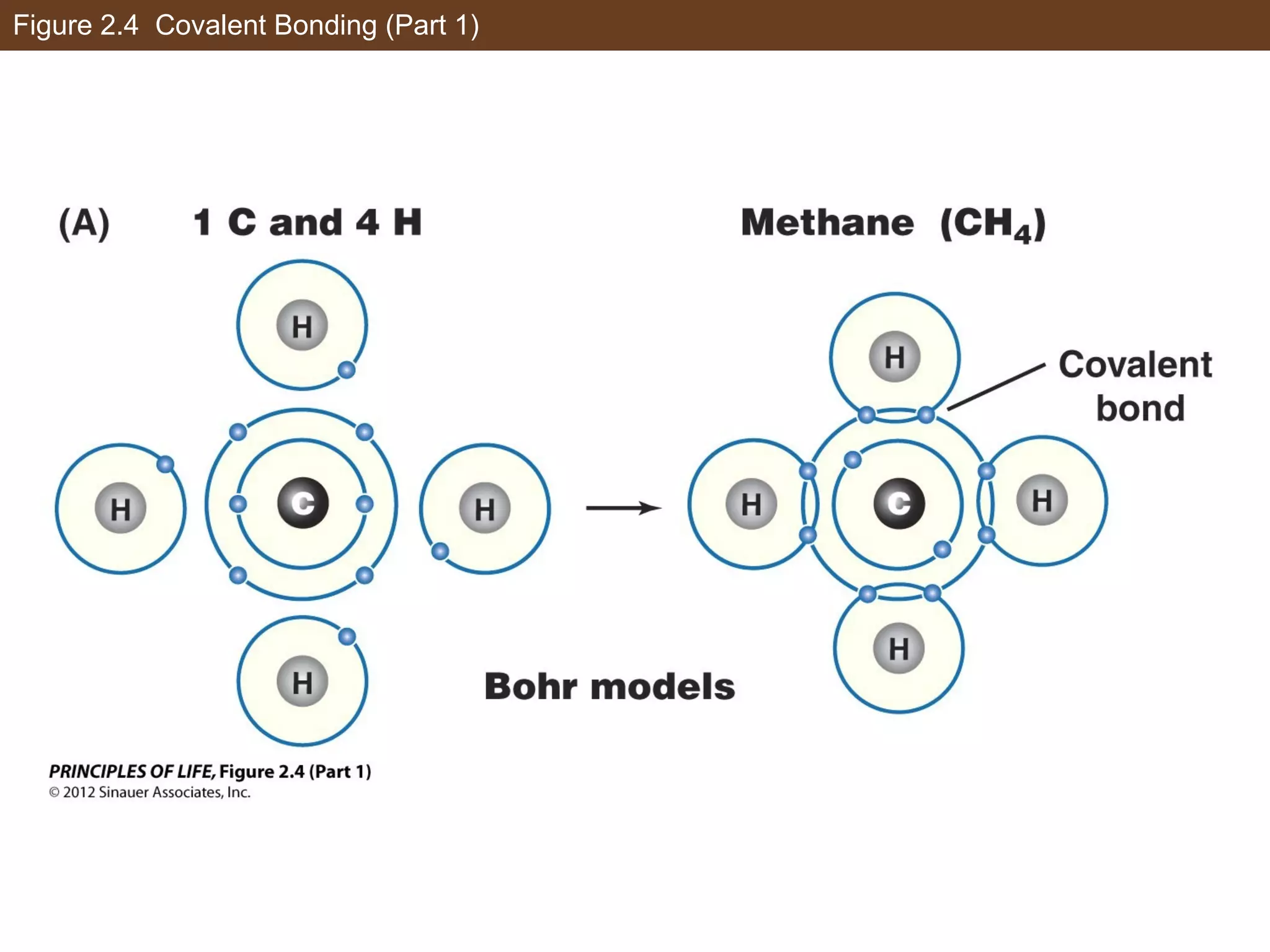
Carbon atoms have four electrons in the outer
shell—they can form covalent bonds with four
other atoms.
Figure 2.4 Covalent Bonding (Part 1)
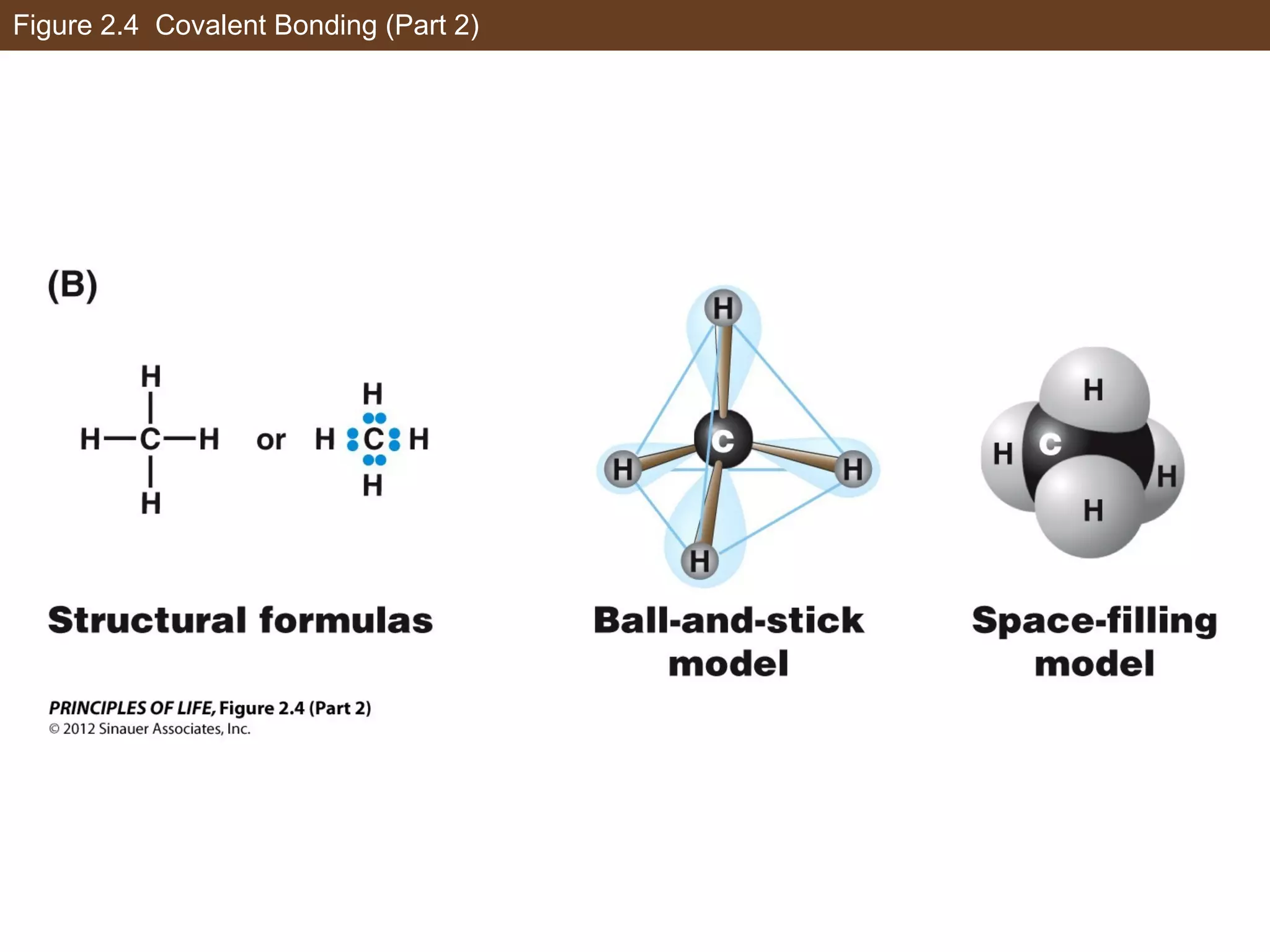
Figure 2.4 Covalent Bonding (Part 2)
Concept 2.2 Atoms Interact and Form Molecules
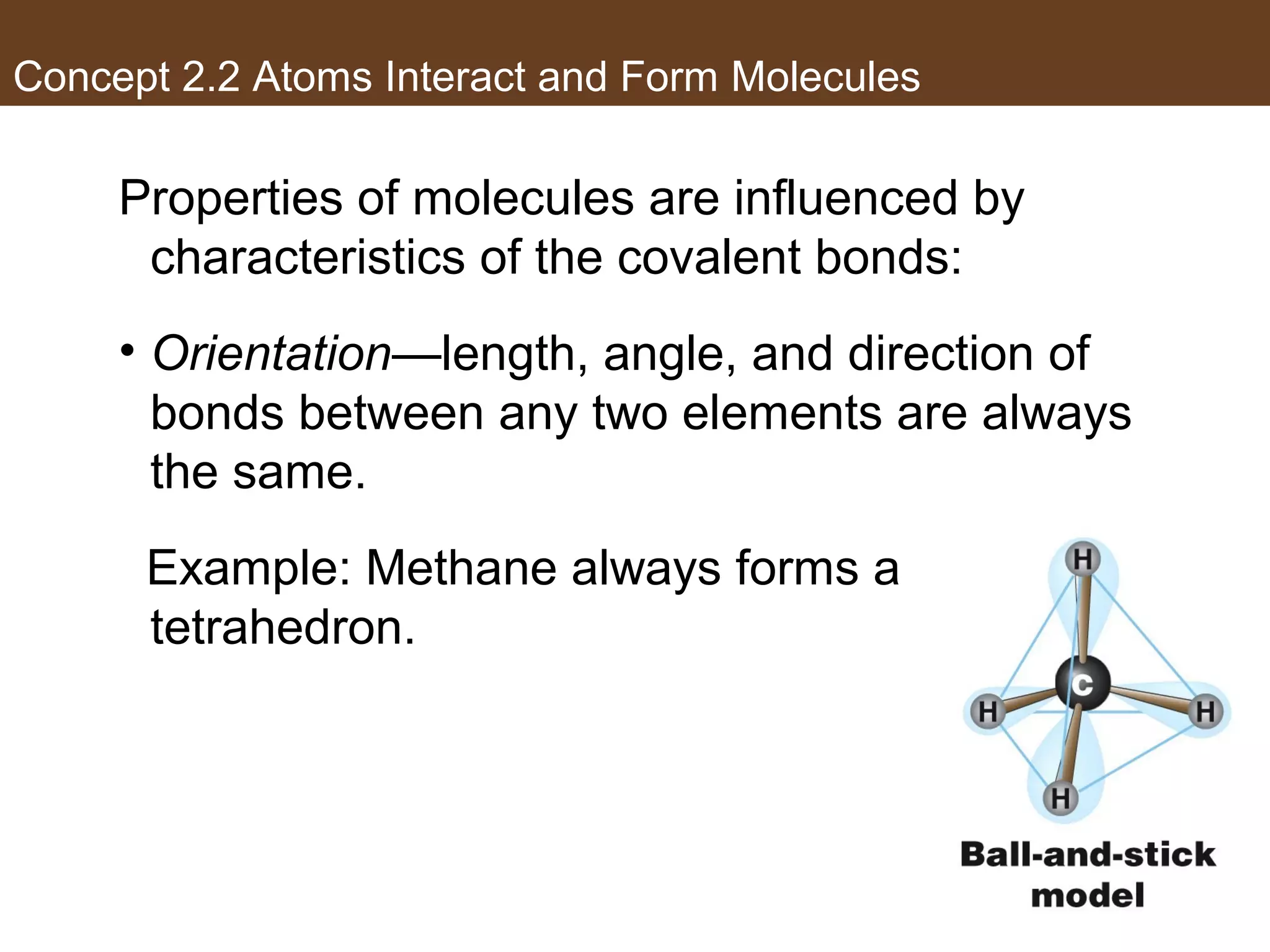
Properties of molecules are influenced by
characteristics of the covalent bonds:
• Orientation—length, angle, and direction of
bonds between any two elements are always
the same.
Example: Methane always forms a
tetrahedron.
Concept 2.2 Atoms Interact and Form Molecules
• Strength and stability—covalent bonds are
very strong; it takes a lot of energy to break
them.
• Multiple bonds
Single—sharing 1 pair of electrons
Double—sharing 2 pairs of electrons
Triple—sharing 3 pairs of electrons
C H
C C
N N
Concept 2.2 Atoms Interact and Form Molecules
• Degree of sharing electrons is not always
equal.
Electronegativity—the attractive force that an
atomic nucleus exerts on electrons
• It depends on the number of protons and the
distance between the nucleus and electrons.
Table 2.2 Some Electronegativities
Concept 2.2 Atoms Interact and Form Molecules
If two atoms have similar electronegativities,
they share electrons equally, in what is called
a nonpolar covalent bond.
If atoms have different electronegativities,
electrons tend to be near the most attractive
atom, in what is called a polar covalent bond
Concept 2.2 Atoms Interact and Form Molecules
Hydrogen bonds
Attraction between the δ–
end of one molecule
and the δ+
hydrogen end of another molecule
forms hydrogen bonds.
They form between water molecules.
They are important in the structure of DNA
and proteins.
Figure 2.5 Hydrogen Bonds Can Form between or within Molecules
Concept 2.2 Atoms Interact and Form Molecules
Water molecules form multiple hydrogen bonds
with each other—this contributes to high heat
capacity.
Concept 2.2 Atoms Interact and Form Molecules
A lot of heat is required to raise the
temperature of water—the heat energy breaks
the hydrogen bonds.
In organisms, presence of water shields them
from fluctuations in environmental
temperature.
Concept 2.2 Atoms Interact and Form Molecules
Water has a high heat of vaporization—a lot
of heat is required to change water from liquid
to gaseous state.
Thus, evaporation has a cooling effect on the
environment.
Sweating cools the body—as sweat evaporates
from the skin, it transforms some of the
adjacent body heat.
Concept 2.2 Atoms Interact and Form Molecules
Hydrogen bonds also give water cohesive
strength, or cohesion—water molecules
resist coming apart when placed under
tension.
• This permits narrow columns of water to
move from roots to leaves of plants.
Concept 2.2 Atoms Interact and Form Molecules
Any polar molecule can interact with any other
polar molecule through hydrogen bonds.
Hydrophilic (“water-loving”)—in aqueous
solutions, polar molecules become separated
and surrounded by water molecules
Nonpolar molecules are called hydrophobic
(“water-hating”); the interactions between
them are hydrophobic interactions.
Figure 2.6 Hydrophilic and Hydrophobic
Concept 2.2 Atoms Interact and Form Molecules
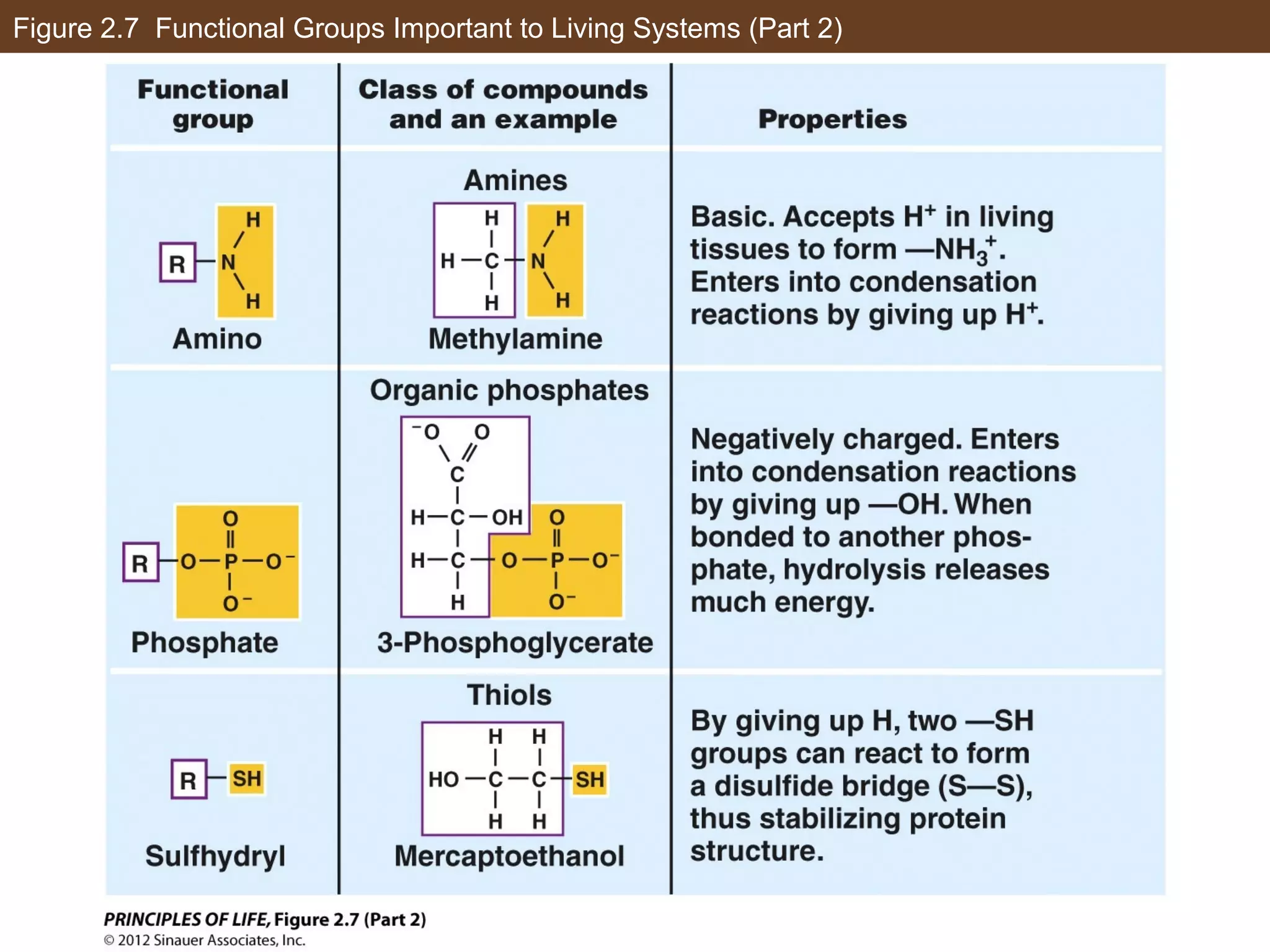
Functional groups—small groups of atoms
with specific chemical properties
Functional groups confer these properties to
larger molecules, e.g., polarity.
One biological molecule may contain many
functional groups.
Figure 2.7 Functional Groups Important to Living Systems (Part 1)
Figure 2.7 Functional Groups Important to Living Systems (Part 2)
Concept 2.2 Atoms Interact and Form Molecules
Macromolecules
• Most biological molecules are polymers
(poly, “many”; mer, “unit”), made by covalent
bonding of smaller molecules called
monomers.
Concept 2.2 Atoms Interact and Form Molecules
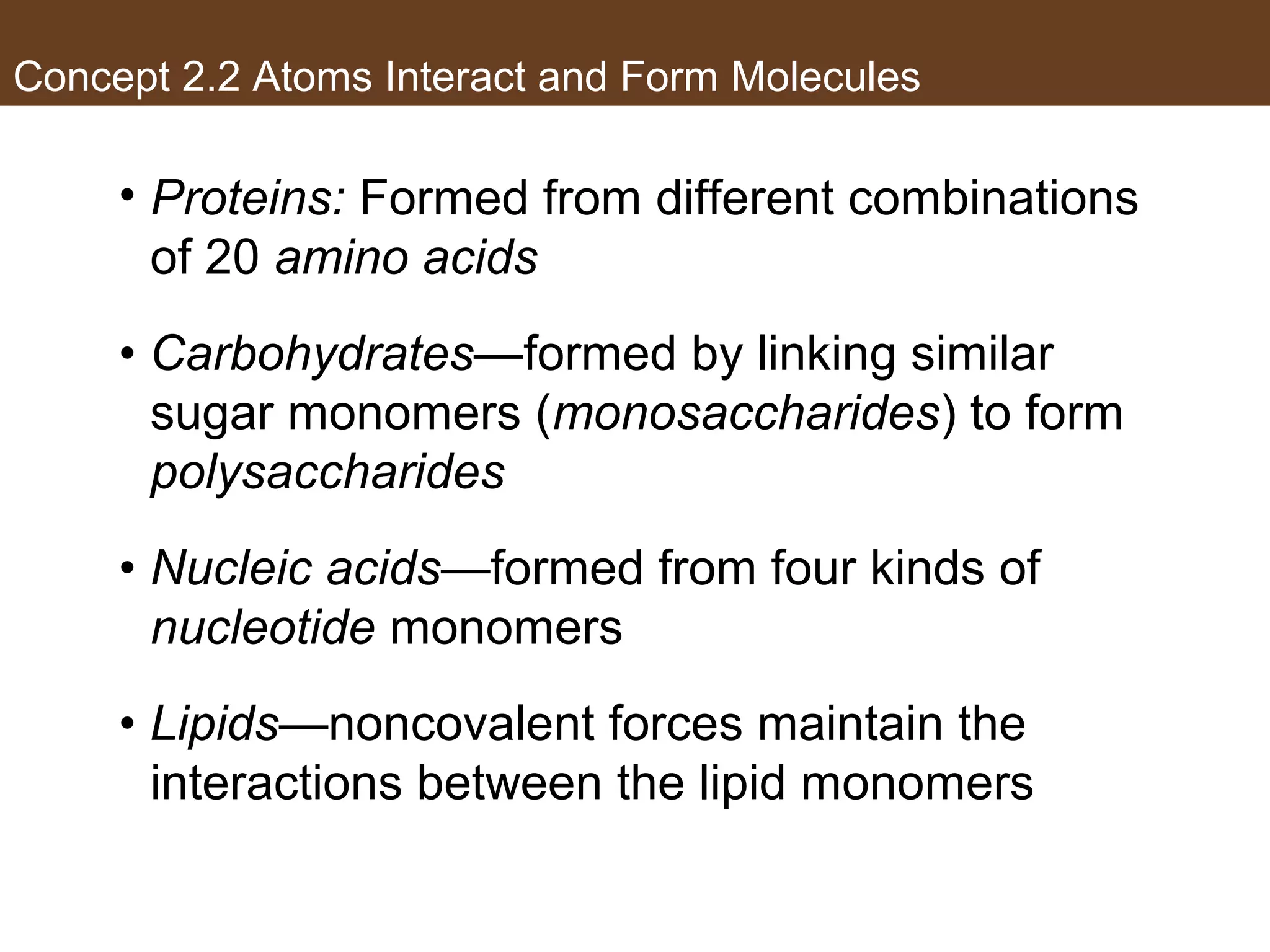
• Proteins: Formed from different combinations
of 20 amino acids
• Carbohydrates—formed by linking similar
sugar monomers (monosaccharides) to form
polysaccharides
• Nucleic acids—formed from four kinds of
nucleotide monomers
• Lipids—noncovalent forces maintain the
interactions between the lipid monomers
Concept 2.2 Atoms Interact and Form Molecules
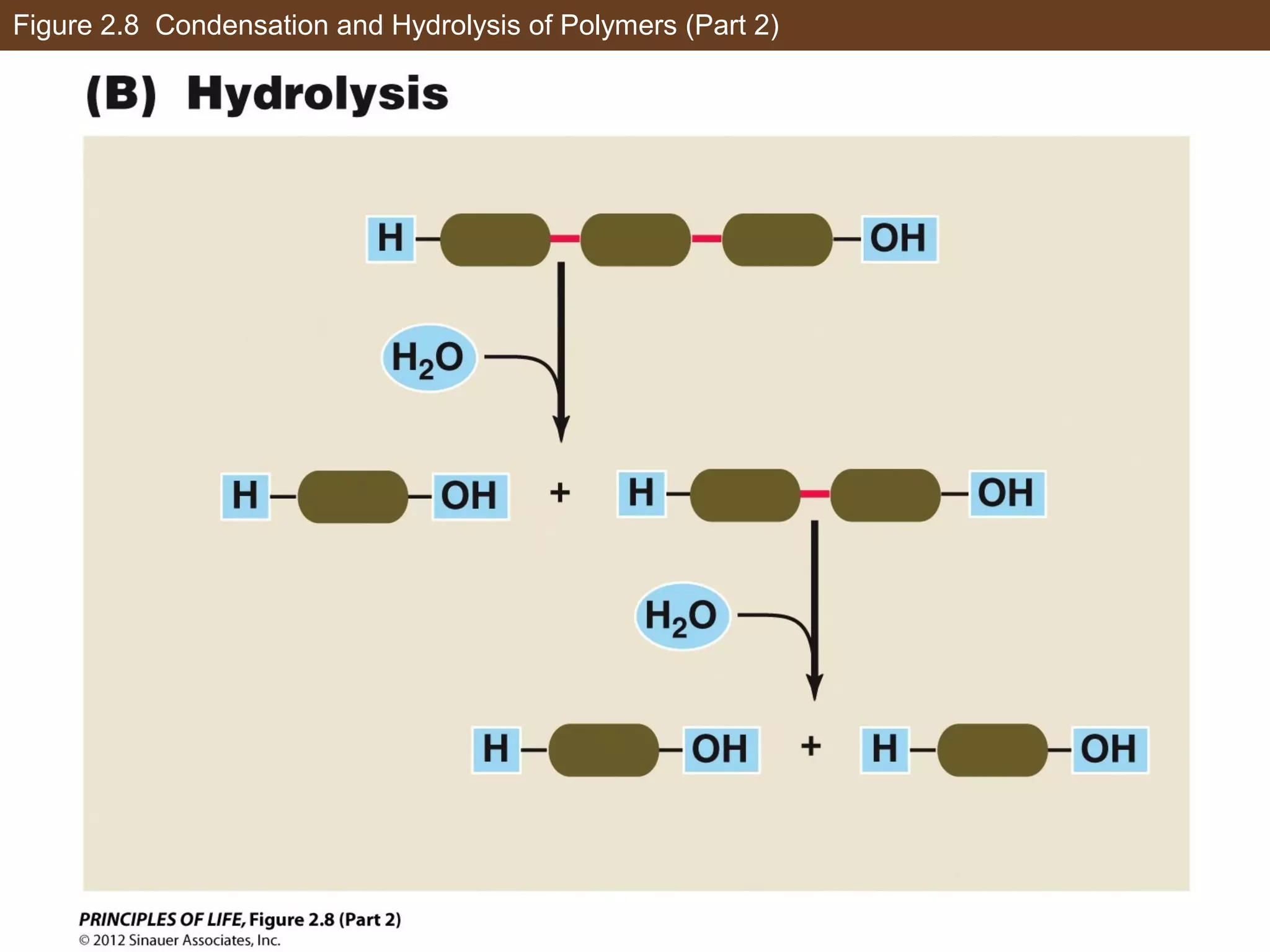
Polymers are formed and broken apart in
reactions involving water.
• Condensation—removal of water links
monomers together
• Hydrolysis—addition of water breaks a
polymer into monomers
Figure 2.8 Condensation and Hydrolysis of Polymers (Part 1)
Figure 2.8 Condensation and Hydrolysis of Polymers (Part 2)
Concept 2.3 Carbohydrates Consist of Sugar Molecules
Carbohydrates
• Source of stored energy
• Transport stored energy within complex
organisms
• Structural molecules that give many
organisms their shapes
• Recognition or signaling molecules that can
trigger specific biological responses
nn OHC ′)( 2
Concept 2.3 Carbohydrates Consist of Sugar Molecules
Monosaccharides are simple sugars.
Pentoses are 5-carbon sugars
Ribose and deoxyribose are the backbones of
RNA and DNA.
Hexoses (C6H12O6) include glucose, fructose,
mannose, and galactose.
Figure 2.9 Monosaccharides (Part 1)
Figure 2.9 Monosaccharides (Part 2)
Concept 2.3 Carbohydrates Consist of Sugar Molecules
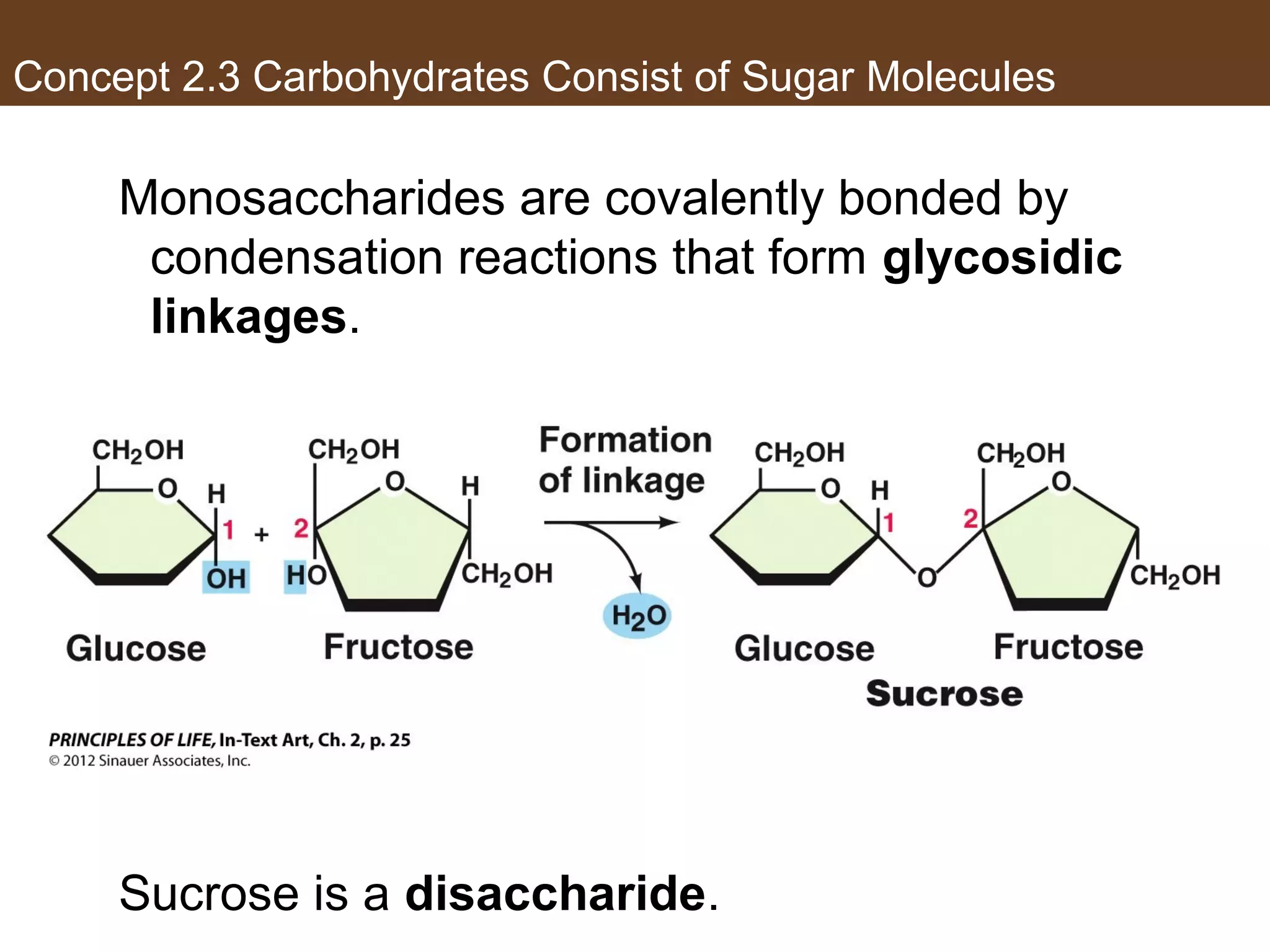
Monosaccharides are covalently bonded by
condensation reactions that form glycosidic
linkages.
Sucrose is a disaccharide.
Concept 2.3 Carbohydrates Consist of Sugar Molecules
Oligosaccharides contain several
monosaccharides.
Many have additional functional groups.
They are often bonded to proteins and lipids on
cell surfaces, where they serve as recognition
signals.
Concept 2.3 Carbohydrates Consist of Sugar Molecules
Polysaccharides are large polymers of
monosaccharides; the chains can be
branching.
Starches—a family of polysaccharides of
glucose
Glycogen—highly branched polymer of
glucose; main energy storage molecule in
mammals
Cellulose—the most abundant carbon-
containing (organic) biological compound on
Earth; stable; good structural material
Figure 2.10 Polysaccharides (Part 1)
Figure 2.10 Polysaccharides (Part 2)
Figure 2.10 Polysaccharides (Part 3)
Concept 2.4 Lipids Are Hydrophobic Molecules
Lipids are hydrocarbons (composed of C and
H atoms); they are insoluble in water because
of many nonpolar covalent bonds.
When close together, weak but additive van der
Waals interactions hold them together.
Concept 2.4 Lipids Are Hydrophobic Molecules
Lipids
• Store energy in C—C and C—H bonds
• Play structural role in cell membranes
• Fat in animal bodies serves as thermal
insulation
Concept 2.4 Lipids Are Hydrophobic Molecules
Triglycerides (simple lipids)
Fats—solid at room temperature
Oils—liquid at room temperature
They have very little polarity and are extremely
hydrophobic.
Concept 2.4 Lipids Are Hydrophobic Molecules
Triglycerides consist of:
• Three fatty acids—nonpolar hydrocarbon
chain attached to a polar carboxyl group
(—COOH) (carboxylic acid)
• One glycerol—an alcohol with 3 hydroxyl
(—OH) groups
Synthesis of a triglyceride involves three
condensation reactions.
Figure 2.11 Synthesis of a Triglyceride
Concept 2.4 Lipids Are Hydrophobic Molecules
Fatty acid chains can vary in length and
structure.
In saturated fatty acids, all bonds between
carbon atoms are single; they are saturated
with hydrogens.
In unsaturated fatty acids, hydrocarbon
chains contain one or more double bonds.
These acids cause kinks in the chain and
prevent molecules from packing together
tightly.
Figure 2.12 Saturated and Unsaturated Fatty Acids (Part 1)
Figure 2.12 Saturated and Unsaturated Fatty Acids (Part 2)
Concept 2.4 Lipids Are Hydrophobic Molecules
Fatty acids are amphipathic; they have a
hydrophilic end and a hydrophobic tail.
Phospholipid—two fatty acids and a
phosphate compound bound to glycerol
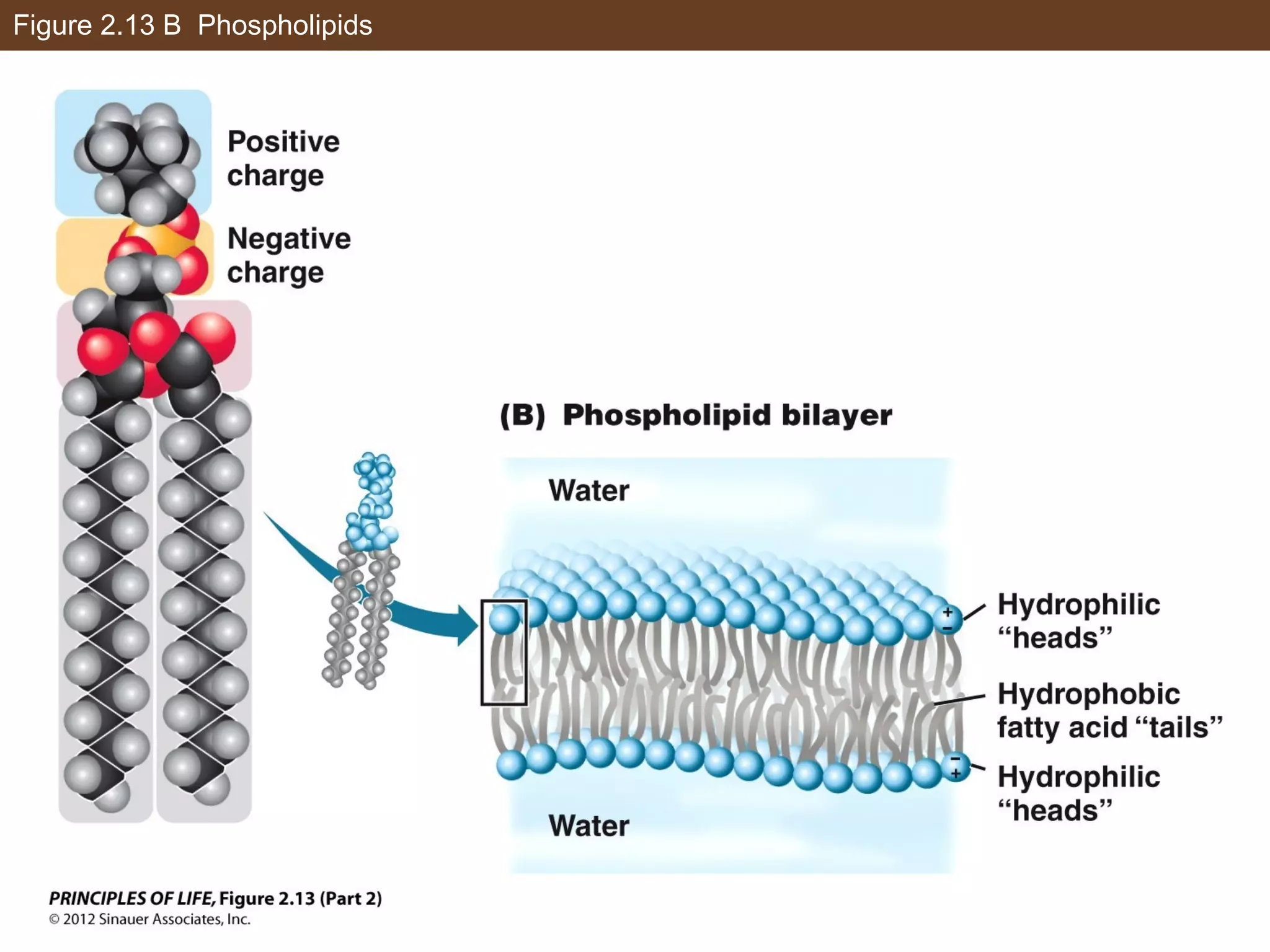
The phosphate group has a negative charge,
making that part of the molecule hydrophilic.
Figure 2.13 A Phospholipids
Concept 2.4 Lipids Are Hydrophobic Molecules
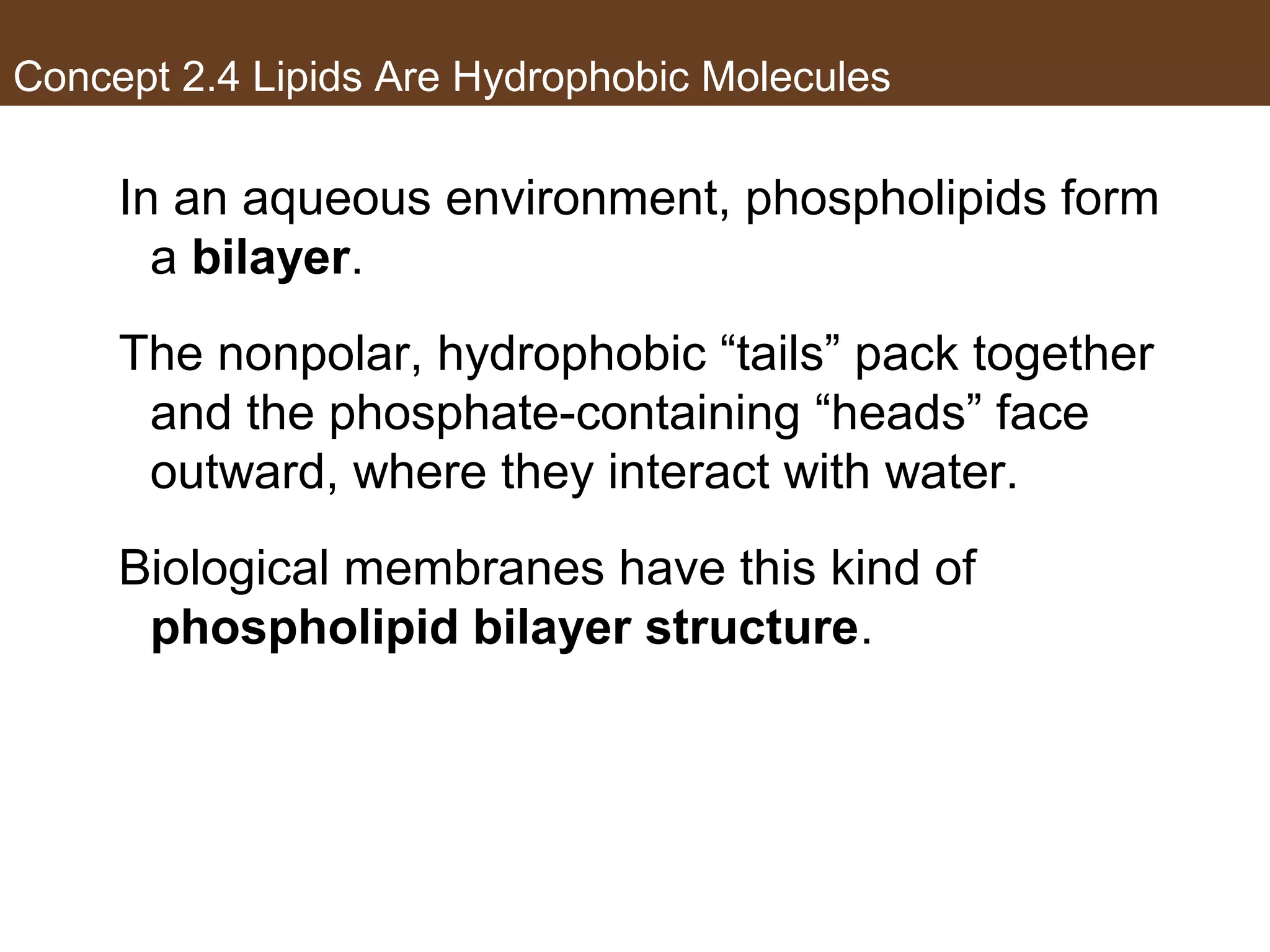
In an aqueous environment, phospholipids form
a bilayer.
The nonpolar, hydrophobic “tails” pack together
and the phosphate-containing “heads” face
outward, where they interact with water.
Biological membranes have this kind of
phospholipid bilayer structure.
Figure 2.13 B Phospholipids
Concept 2.5 Biochemical Changes Involve Energy
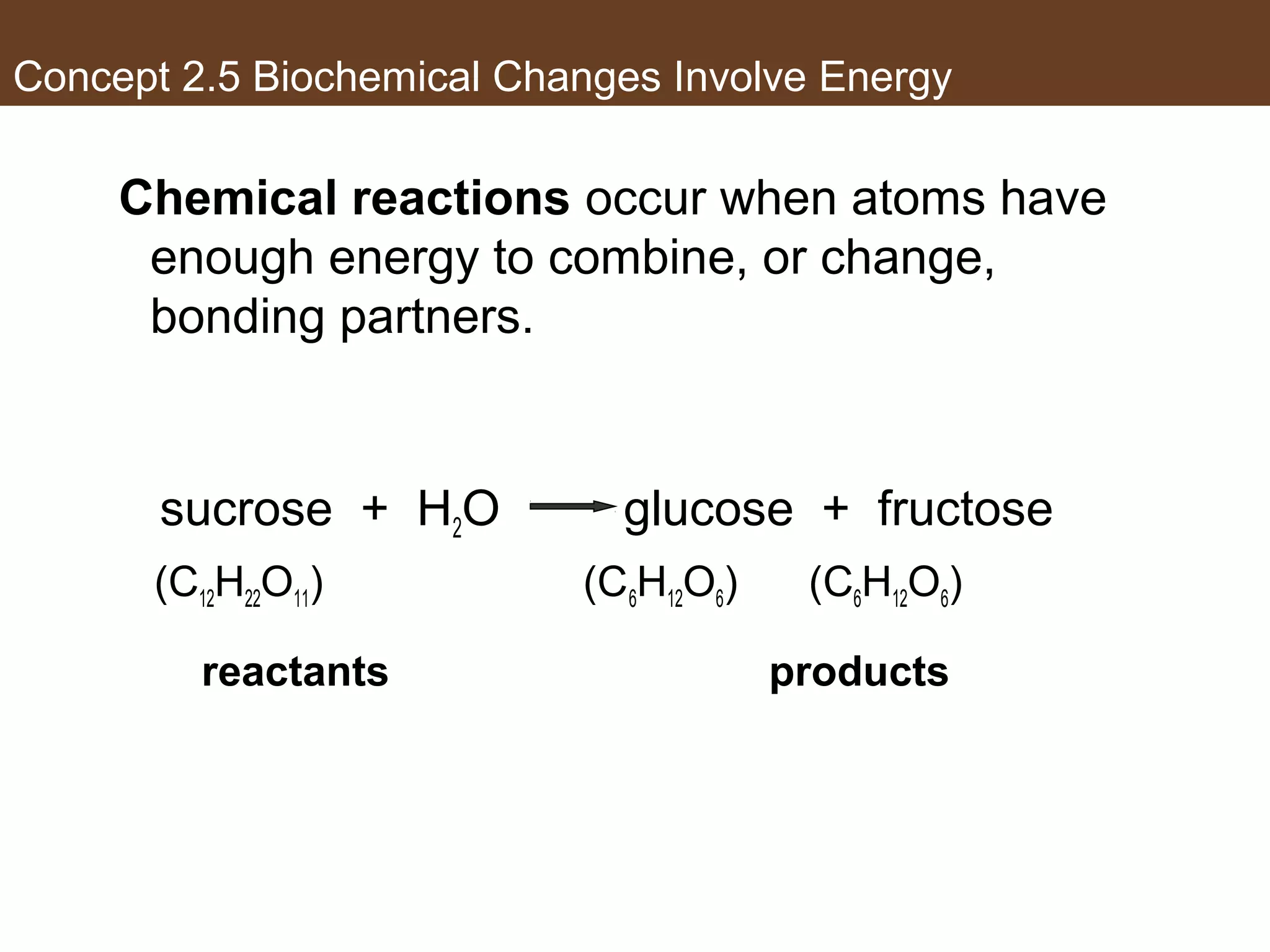
Chemical reactions occur when atoms have
enough energy to combine, or change,
bonding partners.
sucrose + H2O glucose + fructose
(C12H22O11) (C6H12O6) (C6H12O6)
reactants products
Concept 2.5 Biochemical Changes Involve Energy
Metabolism—the sum total of all chemical
reactions occurring in a biological system at a
given time
Metabolic reactions involve energy changes.
Concept 2.5 Biochemical Changes Involve Energy
All forms of energy can be considered as
either:
Potential—the energy of state or position, or
stored energy
Kinetic—the energy of movement (the type of
energy that does work) that makes things
change
Energy can be converted from one form to
another.
Concept 2.5 Biochemical Changes Involve Energy
Two basic types of metabolism:
Anabolic reactions link simple molecules to
form complex ones.
• They require energy inputs; energy is
captured in the chemical bonds that form.
Catabolic reactions break down complex
molecules into simpler ones.
• Energy stored in the chemical bonds is
released.
Figure 2.14 Energy Changes in Reactions (Part 1)
Figure 2.14 Energy Changes in Reactions (Part 2)
Concept 2.5 Biochemical Changes Involve Energy
The laws of thermodynamics apply to all
matter and energy transformations in the
universe.
First law: Energy is neither created nor
destroyed.
Second law: Disorder (entropy) tends to
increase.
When energy is converted from one form to
another, some of that energy becomes
unavailable for doing work.
Figure 2.15 The Laws of Thermodynamics (Part 1)
Figure 2.15 The Laws of Thermodynamics (Part 2)
Figure 2.15 The Laws of Thermodynamics (Part 3)
Concept 2.5 Biochemical Changes Involve Energy
If a chemical reaction increases entropy, its
products are more disordered or random than
its reactants.
If there are fewer products than reactants, the
disorder is reduced; this requires energy to
achieve.
Concept 2.5 Biochemical Changes Involve Energy
As a result of energy transformations, disorder
tends to increase.
• Some energy is always lost to random
thermal motion (entropy).
Concept 2.5 Biochemical Changes Involve Energy
Metabolism creates more disorder (more
energy is lost to entropy) than the amount of
order that is stored.
Example:
• The anabolic reactions needed to construct 1
kg of animal body require the catabolism of
about 10 kg of food.
Life requires a constant input of energy to
maintain order.
Answer to Opening Question
One way to investigate the possibility of life on
other planets is to study how life may have
originated on Earth.
An experiment in the 1950s combined gases
thought to be present in Earth’s early
atmosphere, including water vapor. An
electric spark provided energy.
Complex molecules were formed, such as
amino acids. Water was essential in this
experiment.
Figure 2.16 Synthesis of Prebiotic Molecules in an Experimental Atmosphere (Part 1)
Figure 2.16 Synthesis of Prebiotic Molecules in an Experimental Atmosphere (Part 2)

Ch02 lecture life chemistry and energy

  • 1.
  • 2.
    Chapter 2 LifeChemistry and Energy Key Concepts • 2.1 Atomic Structure Is the Basis for Life’s Chemistry • 2.2 Atoms Interact and Form Molecules • 2.3 Carbohydrates Consist of Sugar Molecules • 2.4 Lipids Are Hydrophobic Molecules • 2.5 Biochemical Changes Involve Energy
  • 3.
    Chapter 2 OpeningQuestion Why is the search for water important in the search for life?
  • 4.
    Concept 2.1 AtomicStructure Is the Basis for Life’s Chemistry Living and nonliving matter is composed of atoms.
  • 5.
    Concept 2.1 AtomicStructure Is the Basis for Life’s Chemistry Like charges repel; different charges attract. Most atoms are neutral because the number of electrons equals the number of protons. Dalton—mass of one proton or neutron (1.7 × 10⁻²⁴ grams) Mass of electrons is so tiny, it is usually ignored.
  • 6.
    Concept 2.1 AtomicStructure Is the Basis for Life’s Chemistry Element—pure substance that contains only one kind of atom Living things are mostly composed of 6 elements: Carbon (C) Hydrogen (H) Nitrogen (N) Oxygen (O) Phosphorus (P) Sulfur (S)
  • 7.
    Concept 2.1 AtomicStructure Is the Basis for Life’s Chemistry • The number of protons identifies an element. • Number of protons = atomic number • For electrical neutrality, # protons = # electrons. • Mass number—total number of protons and neutrons
  • 8.
    Concept 2.1 AtomicStructure Is the Basis for Life’s Chemistry A Bohr model for atomic structure—the atom is largely empty space, and the electrons occur in orbits, or electron shells.
  • 9.
    Concept 2.1 AtomicStructure Is the Basis for Life’s Chemistry Behavior of electrons determines whether a chemical bond will form and what shape the bond will have.
  • 10.
  • 11.
    Concept 2.1 AtomicStructure Is the Basis for Life’s Chemistry Atoms with unfilled outer shells tend to undergo chemical reactions to fill their outer shells. They can attain stability by sharing electrons with other atoms or by losing or gaining electrons. The atoms are then bonded together into molecules.
  • 12.
    Concept 2.1 AtomicStructure Is the Basis for Life’s Chemistry Octet rule—atoms with at least two electron shells form stable molecules so they have eight electrons in their outermost shells.
  • 13.
    Concept 2.2 AtomsInteract and Form Molecules Chemical bond is an attractive force that links atoms together to form molecules. There are several kinds of chemical bonds.
  • 14.
    Table 2.1 ChemicalBonds and Interactions
  • 15.
    Concept 2.2 AtomsInteract and Form Molecules Ionic bonds Ions are charged particle that form when an atom gains or loses one or more electrons. Cations—positively charged ions Anions—negatively charged ions Ionic bonds result from the electrical attraction between ions with opposite charges. The resulting molecules are called salts.
  • 16.
    Figure 2.2 IonicBond between Sodium and Chlorine
  • 17.
    Concept 2.2 AtomsInteract and Form Molecules Ionic attractions are weak, so salts dissolve easily in water.
  • 18.
    Concept 2.2 AtomsInteract and Form Molecules Covalent bonds Covalent bonds form when two atoms share pairs of electrons. The atoms attain stability by having full outer shells. Each atom contributes one member of the electron pair.
  • 19.
    Figure 2.3 ElectronsAre Shared in Covalent Bonds
  • 20.
    Concept 2.2 AtomsInteract and Form Molecules Carbon atoms have four electrons in the outer shell—they can form covalent bonds with four other atoms.
  • 21.
    Figure 2.4 CovalentBonding (Part 1)
  • 22.
    Figure 2.4 CovalentBonding (Part 2)
  • 23.
    Concept 2.2 AtomsInteract and Form Molecules Properties of molecules are influenced by characteristics of the covalent bonds: • Orientation—length, angle, and direction of bonds between any two elements are always the same. Example: Methane always forms a tetrahedron.
  • 24.
    Concept 2.2 AtomsInteract and Form Molecules • Strength and stability—covalent bonds are very strong; it takes a lot of energy to break them. • Multiple bonds Single—sharing 1 pair of electrons Double—sharing 2 pairs of electrons Triple—sharing 3 pairs of electrons C H C C N N
  • 25.
    Concept 2.2 AtomsInteract and Form Molecules • Degree of sharing electrons is not always equal. Electronegativity—the attractive force that an atomic nucleus exerts on electrons • It depends on the number of protons and the distance between the nucleus and electrons.
  • 26.
    Table 2.2 SomeElectronegativities
  • 27.
    Concept 2.2 AtomsInteract and Form Molecules If two atoms have similar electronegativities, they share electrons equally, in what is called a nonpolar covalent bond. If atoms have different electronegativities, electrons tend to be near the most attractive atom, in what is called a polar covalent bond
  • 28.
    Concept 2.2 AtomsInteract and Form Molecules Hydrogen bonds Attraction between the δ– end of one molecule and the δ+ hydrogen end of another molecule forms hydrogen bonds. They form between water molecules. They are important in the structure of DNA and proteins.
  • 29.
    Figure 2.5 HydrogenBonds Can Form between or within Molecules
  • 30.
    Concept 2.2 AtomsInteract and Form Molecules Water molecules form multiple hydrogen bonds with each other—this contributes to high heat capacity.
  • 31.
    Concept 2.2 AtomsInteract and Form Molecules A lot of heat is required to raise the temperature of water—the heat energy breaks the hydrogen bonds. In organisms, presence of water shields them from fluctuations in environmental temperature.
  • 32.
    Concept 2.2 AtomsInteract and Form Molecules Water has a high heat of vaporization—a lot of heat is required to change water from liquid to gaseous state. Thus, evaporation has a cooling effect on the environment. Sweating cools the body—as sweat evaporates from the skin, it transforms some of the adjacent body heat.
  • 33.
    Concept 2.2 AtomsInteract and Form Molecules Hydrogen bonds also give water cohesive strength, or cohesion—water molecules resist coming apart when placed under tension. • This permits narrow columns of water to move from roots to leaves of plants.
  • 34.
    Concept 2.2 AtomsInteract and Form Molecules Any polar molecule can interact with any other polar molecule through hydrogen bonds. Hydrophilic (“water-loving”)—in aqueous solutions, polar molecules become separated and surrounded by water molecules Nonpolar molecules are called hydrophobic (“water-hating”); the interactions between them are hydrophobic interactions.
  • 35.
    Figure 2.6 Hydrophilicand Hydrophobic
  • 36.
    Concept 2.2 AtomsInteract and Form Molecules Functional groups—small groups of atoms with specific chemical properties Functional groups confer these properties to larger molecules, e.g., polarity. One biological molecule may contain many functional groups.
  • 37.
    Figure 2.7 FunctionalGroups Important to Living Systems (Part 1)
  • 38.
    Figure 2.7 FunctionalGroups Important to Living Systems (Part 2)
  • 39.
    Concept 2.2 AtomsInteract and Form Molecules Macromolecules • Most biological molecules are polymers (poly, “many”; mer, “unit”), made by covalent bonding of smaller molecules called monomers.
  • 40.
    Concept 2.2 AtomsInteract and Form Molecules • Proteins: Formed from different combinations of 20 amino acids • Carbohydrates—formed by linking similar sugar monomers (monosaccharides) to form polysaccharides • Nucleic acids—formed from four kinds of nucleotide monomers • Lipids—noncovalent forces maintain the interactions between the lipid monomers
  • 41.
    Concept 2.2 AtomsInteract and Form Molecules Polymers are formed and broken apart in reactions involving water. • Condensation—removal of water links monomers together • Hydrolysis—addition of water breaks a polymer into monomers
  • 42.
    Figure 2.8 Condensationand Hydrolysis of Polymers (Part 1)
  • 43.
    Figure 2.8 Condensationand Hydrolysis of Polymers (Part 2)
  • 44.
    Concept 2.3 CarbohydratesConsist of Sugar Molecules Carbohydrates • Source of stored energy • Transport stored energy within complex organisms • Structural molecules that give many organisms their shapes • Recognition or signaling molecules that can trigger specific biological responses nn OHC ′)( 2
  • 45.
    Concept 2.3 CarbohydratesConsist of Sugar Molecules Monosaccharides are simple sugars. Pentoses are 5-carbon sugars Ribose and deoxyribose are the backbones of RNA and DNA. Hexoses (C6H12O6) include glucose, fructose, mannose, and galactose.
  • 46.
  • 47.
  • 48.
    Concept 2.3 CarbohydratesConsist of Sugar Molecules Monosaccharides are covalently bonded by condensation reactions that form glycosidic linkages. Sucrose is a disaccharide.
  • 49.
    Concept 2.3 CarbohydratesConsist of Sugar Molecules Oligosaccharides contain several monosaccharides. Many have additional functional groups. They are often bonded to proteins and lipids on cell surfaces, where they serve as recognition signals.
  • 50.
    Concept 2.3 CarbohydratesConsist of Sugar Molecules Polysaccharides are large polymers of monosaccharides; the chains can be branching. Starches—a family of polysaccharides of glucose Glycogen—highly branched polymer of glucose; main energy storage molecule in mammals Cellulose—the most abundant carbon- containing (organic) biological compound on Earth; stable; good structural material
  • 51.
  • 52.
  • 53.
  • 54.
    Concept 2.4 LipidsAre Hydrophobic Molecules Lipids are hydrocarbons (composed of C and H atoms); they are insoluble in water because of many nonpolar covalent bonds. When close together, weak but additive van der Waals interactions hold them together.
  • 55.
    Concept 2.4 LipidsAre Hydrophobic Molecules Lipids • Store energy in C—C and C—H bonds • Play structural role in cell membranes • Fat in animal bodies serves as thermal insulation
  • 56.
    Concept 2.4 LipidsAre Hydrophobic Molecules Triglycerides (simple lipids) Fats—solid at room temperature Oils—liquid at room temperature They have very little polarity and are extremely hydrophobic.
  • 57.
    Concept 2.4 LipidsAre Hydrophobic Molecules Triglycerides consist of: • Three fatty acids—nonpolar hydrocarbon chain attached to a polar carboxyl group (—COOH) (carboxylic acid) • One glycerol—an alcohol with 3 hydroxyl (—OH) groups Synthesis of a triglyceride involves three condensation reactions.
  • 58.
    Figure 2.11 Synthesisof a Triglyceride
  • 59.
    Concept 2.4 LipidsAre Hydrophobic Molecules Fatty acid chains can vary in length and structure. In saturated fatty acids, all bonds between carbon atoms are single; they are saturated with hydrogens. In unsaturated fatty acids, hydrocarbon chains contain one or more double bonds. These acids cause kinks in the chain and prevent molecules from packing together tightly.
  • 60.
    Figure 2.12 Saturatedand Unsaturated Fatty Acids (Part 1)
  • 61.
    Figure 2.12 Saturatedand Unsaturated Fatty Acids (Part 2)
  • 62.
    Concept 2.4 LipidsAre Hydrophobic Molecules Fatty acids are amphipathic; they have a hydrophilic end and a hydrophobic tail. Phospholipid—two fatty acids and a phosphate compound bound to glycerol The phosphate group has a negative charge, making that part of the molecule hydrophilic.
  • 63.
    Figure 2.13 APhospholipids
  • 64.
    Concept 2.4 LipidsAre Hydrophobic Molecules In an aqueous environment, phospholipids form a bilayer. The nonpolar, hydrophobic “tails” pack together and the phosphate-containing “heads” face outward, where they interact with water. Biological membranes have this kind of phospholipid bilayer structure.
  • 65.
    Figure 2.13 BPhospholipids
  • 66.
    Concept 2.5 BiochemicalChanges Involve Energy Chemical reactions occur when atoms have enough energy to combine, or change, bonding partners. sucrose + H2O glucose + fructose (C12H22O11) (C6H12O6) (C6H12O6) reactants products
  • 67.
    Concept 2.5 BiochemicalChanges Involve Energy Metabolism—the sum total of all chemical reactions occurring in a biological system at a given time Metabolic reactions involve energy changes.
  • 68.
    Concept 2.5 BiochemicalChanges Involve Energy All forms of energy can be considered as either: Potential—the energy of state or position, or stored energy Kinetic—the energy of movement (the type of energy that does work) that makes things change Energy can be converted from one form to another.
  • 69.
    Concept 2.5 BiochemicalChanges Involve Energy Two basic types of metabolism: Anabolic reactions link simple molecules to form complex ones. • They require energy inputs; energy is captured in the chemical bonds that form. Catabolic reactions break down complex molecules into simpler ones. • Energy stored in the chemical bonds is released.
  • 70.
    Figure 2.14 EnergyChanges in Reactions (Part 1)
  • 71.
    Figure 2.14 EnergyChanges in Reactions (Part 2)
  • 72.
    Concept 2.5 BiochemicalChanges Involve Energy The laws of thermodynamics apply to all matter and energy transformations in the universe. First law: Energy is neither created nor destroyed. Second law: Disorder (entropy) tends to increase. When energy is converted from one form to another, some of that energy becomes unavailable for doing work.
  • 73.
    Figure 2.15 TheLaws of Thermodynamics (Part 1)
  • 74.
    Figure 2.15 TheLaws of Thermodynamics (Part 2)
  • 75.
    Figure 2.15 TheLaws of Thermodynamics (Part 3)
  • 76.
    Concept 2.5 BiochemicalChanges Involve Energy If a chemical reaction increases entropy, its products are more disordered or random than its reactants. If there are fewer products than reactants, the disorder is reduced; this requires energy to achieve.
  • 77.
    Concept 2.5 BiochemicalChanges Involve Energy As a result of energy transformations, disorder tends to increase. • Some energy is always lost to random thermal motion (entropy).
  • 78.
    Concept 2.5 BiochemicalChanges Involve Energy Metabolism creates more disorder (more energy is lost to entropy) than the amount of order that is stored. Example: • The anabolic reactions needed to construct 1 kg of animal body require the catabolism of about 10 kg of food. Life requires a constant input of energy to maintain order.
  • 79.
    Answer to OpeningQuestion One way to investigate the possibility of life on other planets is to study how life may have originated on Earth. An experiment in the 1950s combined gases thought to be present in Earth’s early atmosphere, including water vapor. An electric spark provided energy. Complex molecules were formed, such as amino acids. Water was essential in this experiment.
  • 80.
    Figure 2.16 Synthesisof Prebiotic Molecules in an Experimental Atmosphere (Part 1)
  • 81.
    Figure 2.16 Synthesisof Prebiotic Molecules in an Experimental Atmosphere (Part 2)

Editor's Notes

  • #14 ANIMATED TUTORIAL 2.1 Chemical Bond Formation
  • #24 VIDEO 2.1 Methane: A three-dimensional model
  • #33 LINK Evaporation is important in the physiology of both plants and animals; see Concepts 25.3 and 29.4
  • #35 APPLY THE CONCEPT Atoms interact and form molecules
  • #42 ANIMATED TUTORIAL 2.2 Macromolecules: Carbohydrates and Lipids
  • #46 LINK For a description of the nucleic acids RNA and DNA see Concept 3.1
  • #51 VIDEO 2.2 Starch: A three-dimensional model VIDEO 2.3 Cellulose: A three-dimensional model
  • #60 VIDEO 2.4 Palmitic acid and linoleic acid: A three-dimensional model
  • #67 APPLY THE CONCEPT Biochemical changes involve energy
  • #80 ANIMATED TUTORIAL 2.3 Synthesis of Prebiotic Molecules