1
COLLEG OF ENGINEERING THECHNOLOGY
DEPARTMENT OF MECHANICAL ENGINEEERING
PROJECTREPORT
PROJECT TITLE……………………….. ONICENGINEAND RECIPROCATING MACHINE
COURS CODE MENG 4202
GRUPE MEMBERS…………………………………………………………………………..ID NO
1, SHUSHAYHAILU……………………………………………………………………….4142/07
2,MIKILEBERHE……………………………………………………………………………….
3,REDAETSEGAY………………………………………………………………………………
4
5
SUBMITED TO INSTRACTOR: REDAE
2
3
Acknowledgeme
We would like to acknowledge and appreciate the great guidance from my project
supervisor, instructor berihu
I would also like to thank my parents and classmates for their encouragement,
understanding and support throughout the entire project.
I would also like to thank the almighty God for bringing me this far and giving me the strength to
carry out the project.
I would also like to thank my friend’s zemical and toweled
Abstract— To start with, a study on the effect of turbocharger on a single cylinder is made. The design and
installation of turbocharger in a single cylinder is available in this literature. We have designed and fabricated a
prototype of the Turbochargerwas implemented in Two- wheeler, In which the efficiency of the Engine can be
increased . KEYWORDS: Gasoline Engine, Exhaust Manifold, Intake Manifold, Turbocharger, Nozzle, Flanges, K &
N Air Filter, Carburetor, Turbine, Compressor. Volumetric Efficiency of a S.I. or C.I. Engine is increased by
providing combustion chamber with maximum amount of air. This is achieved by installation of Turbocharger or
Supercharger. Supercharger uses engine power to run itself whereas a Turbocharger doesn’t utilize any engine
power it runs by Exhaust gases.In present work we’ll be increasing the volumetric efficiency of a 125cc single
cylinder bike by installation of turbocharger. To start with, a study on the effect of turbochargeron a single cylinder
is made. The design and installation of turbochargerin a single cylinder is available in this literature.
INTRODUCTION
In turbocharging, the turbocharger is being driven by a gas turbine using the energy in exhaust
gases. The major parts of turbocharger are turbine wheel, turbine housing, turbo shaft, comp.
wheel, comp. housing & bearing housing. A 4-stroke S.I. Engine is an engine that uses gasoline
as fuel. S.I.engine is a spark ignited engine that is the combustion is carried out by spark ignition,
it is achieved by installation of spark plug on cylinder head.
In this project we are using Honda Stunner CBF 125cc for the installation of turbocharger. The
CBF125 is a motorcycle manufactured by Honda's Indian subsidiary HMSI. The motorcycle is
knownas Stunner in the Indian market. In India, it has two variants, the carburetor version simply
called Stunner To increase the output efficiency of any engine we have to burn
more fuel and make bigger explosion in every cycle. We have two options for
this.
One way to add power is to build a bigger engine. But bigger engines, which
weigh more and cost more to build and maintain, are not always better.
4
Another way to add power is to make a normal-sized engine more efficient.
We can accomplish this by forcing more air into the combustion chamber.
More air means more fuel can be added, and more fuel means a bigger
explosion and greater horsepower. This can be done with the help of a
supercharger. A supercharger is basically an air compressor used for forced
induction of an internal combustion engine. It does the same work as that of a
compressor, i.e. it compresses the air being delivered to the combustion chamber
of an engine. The greater mass flow-rate provides more oxygen to support
combustion than would be available in a naturally-aspirated engine, which allows
more fuel to be provided and more work to be done per cycle, increasing the power
output of the engine.Thus a supercharger is extra equipment provided in an engine
so as to boost the capacity and the torque of an engine.
Definition
The most efficient method of increasing the power of an engine is by supercharging,
i.e. increasing the flow of air into the engine to enable more fuel to be burnt. A
Supercharger is run by the mechanical drive, powered by engine power . A
turbocharger uses the otherwise unused energy in the exhaust gases to drive a
turbine directly connected by a co-axial shaft to a rotary compressor in the air
intake system
Types of super charger:
Based on the use of compressor
• Centrifugal type
• Roots type
• Vane type
Components of turbocharger
• Air compressor
5
• Turbine
• Intercooler
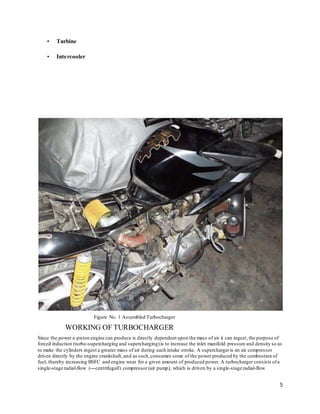
Figure No. 1 Assembled Turbocharger
WORKING OF TURBOCHARGER
Since the power a piston engine can produce is directly dependent upon the mass of air it can ingest, the purpose of
forced induction (turbo-supercharging and supercharging)is to increase the inlet manifold pressure and density so as
to make the cylinders ingest a greater mass of air during each intake stroke. A superchargeris an air compressor
driven directly by the engine crankshaft, and as such,consumes some of the power produced by the combustion of
fuel, thereby increasing BSFC and engine wear for a given amount of produced power. A turbocharger consists ofa
single-stage radial-flow (―centrifugal‖) compressor (air pump), which is driven by a single-stage radial-flow
6
turbine, instead of being driven directly by the crankshaft. The turbine extracts wasted kinetic and thermal energy
from the high-temperature exhaust gas flow and produces the power to drive the compressor, at the cost of a slight
increase in pumping losse
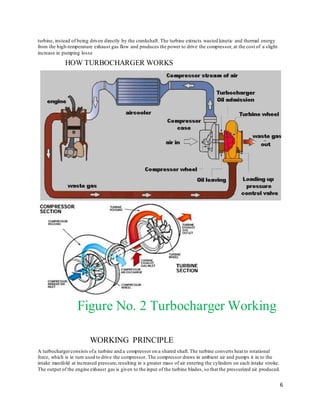
HOW TURBOCHARGER WORKS
Figure No. 2 Turbocharger Working
WORKING PRINCIPLE
A turbochargerconsists ofa turbine and a compressor on a shared shaft.The turbine converts heat to rotational
force, which is in turn used to drive the compressor. The compressor draws in ambient air and pumps it in to the
intake manifold at increased pressure,resulting in a greater mass of air entering the cylinders on each intake stroke.
The output of the engine exhaust gas is given to the input of the turbine blades, so that the pressurized air produced.
7
This power, the alternate power must be much more convenient in availability and usage.The next important reason
for the search of effective, unadulterated power are to save the surrounding environments including men, machine
and material of both the existing and the next fourth generation from pollution, the cause for many harmful
happenings and to reach the saturation point. We have designed and fabricated a prototype of the Turbocharger was
implemented in Two- wheeler, In which the efficiency of the Engine can be increased. Thus we have developed a
method to increase the efficiency of the engine and at the same time to control the Emissions from the engine. The
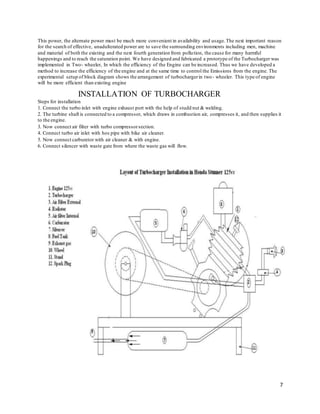
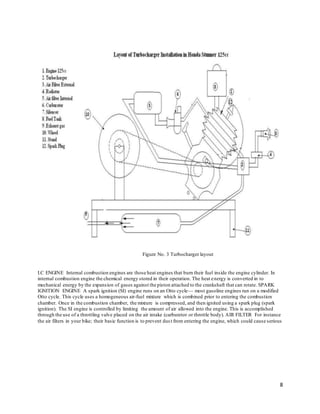
experimental setup of block diagram shows the arrangement of turbochargerin two- wheeler. This type of engine
will be more efficient than existing engine
INSTALLATION OF TURBOCHARGER
Steps for installation
1. Connect the turbo inlet with engine exhaust port with the help of studd nut & welding.
2. The turbine shaft is connected to a compressor, which draws in combustion air, compresses it, and then supplies it
to the engine.
3. Now connect air filter with turbo compressorsection.
4. Connect turbo air inlet with hos pipe with bike air cleaner.
5. Now connect carburetor with air cleaner & with engine.
6. Connect silencer with waste gate from where the waste gas will flow.
8
Figure No. 3 Turbocharger layout
I.C ENGINE Internal combustion engines are those heat engines that burn their fuel inside the engine cylinder. In
internal combustion engine the chemical energy stored in their operation. The heat energy is converted in to
mechanical energy by the expansion of gases against the piston attached to the crankshaft that can rotate. SPARK
IGNITION ENGINE A spark ignition (SI) engine runs on an Otto cycle— most gasoline engines run on a modified
Otto cycle. This cycle uses a homogeneous air-fuel mixture which is combined prior to entering the combustion
chamber. Once in the combustion chamber, the mixture is compressed, and then ignited using a spark plug (spark
ignition). The SI engine is controlled by limiting the amount of air allowed into the engine. This is accomplished
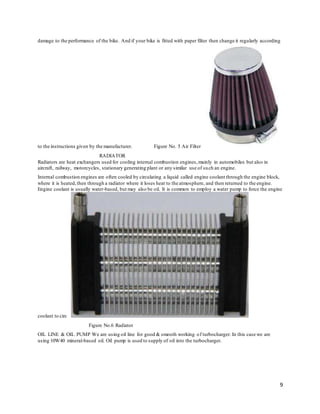
through the use of a throttling valve placed on the air intake (carburetor or throttle body). AIR FILTER For instance
the air filters in your bike; their basic function is to prevent dust from entering the engine, which could cause serious
9
damage to the performance of the bike. And if your bike is fitted with paper filter then change it regularly according
to the instructions given by the manufacturer. Figure No. 5 Air Filter
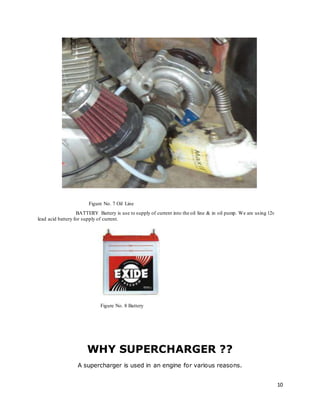
RADIATOR
Radiators are heat exchangers used for cooling internal combustion engines,mainly in automobiles but also in
aircraft, railway, motorcycles, stationary generating plant or any similar use of such an engine.
Internal combustion engines are often cooled by circulating a liquid called engine coolant through the engine block,
where it is heated,then through a radiator where it loses heat to the atmosphere, and then returned to the engine.
Engine coolant is usually water-based, but may also be oil. It is common to employ a water pump to force the engine
coolant to circ
Figure No.6 Radiator
OIL LINE & OIL PUMP We are using oil line for good & smooth working of turbocharger. In this case we are
using 10W40 mineral-based oil. Oil pump is used to supply of oil into the turbocharger.
10
Figure No. 7 Oil Line
BATTERY Battery is use to supply of current into the oil line & in oil pump. We are using 12v
lead acid battery for supply of current.
Figure No. 8 Battery
WHY SUPERCHARGER ??
A supercharger is used in an engine for various reasons.
11
Some of the advantages of superchargers are as follows:
 Increases the power of an engine.
 A supercharger spinning at 50,000 RPM translates to a boost of about
six to nine pounds per square inch (psi).
 Increases the torque produced.
 An efficiently working engine with supercharger can achieve the same
speed in one third of the time taken by the same engine without
supercharger.
 Necessary in airplanes and jets as they have less oxygen at high
altitudes. So they provide the sufficient amount of air by compressing
it to higher pressure. And ensures complete combustion.
 Higher amount of oxygen in compressed air from supercharger
ensures complete combustion of the fuel.
 Complete combustion reduces pollution to some extent.
PRINCIPLE OF WORKING
12
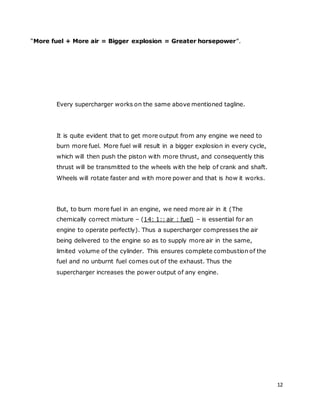
“More fuel + More air = Bigger explosion = Greater horsepower”.
Every supercharger works on the same above mentioned tagline.
It is quite evident that to get more output from any engine we need to
burn more fuel. More fuel will result in a bigger explosion in every cycle,
which will then push the piston with more thrust, and consequently this
thrust will be transmitted to the wheels with the help of crank and shaft.
Wheels will rotate faster and with more power and that is how it works.
But, to burn more fuel in an engine, we need more air in it (The
chemically correct mixture – (14: 1:: air : fuel) – is essential for an
engine to operate perfectly). Thus a supercharger compresses the air
being delivered to the engine so as to supply more air in the same,
limited volume of the cylinder. This ensures complete combustion of the
fuel and no unburnt fuel comes out of the exhaust. Thus the
supercharger increases the power output of any engine.
13
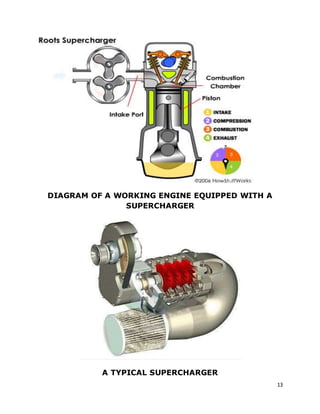
DIAGRAM OF A WORKING ENGINE EQUIPPED WITH A
SUPERCHARGER
A TYPICAL SUPERCHARGER
14
CLASSIFICATION OF
SUPERCHARGERS
Based on method of compression, Superchargers can be classified as:-
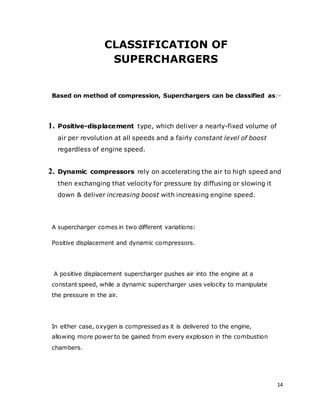
1. Positive-displacement type, which deliver a nearly-fixed volume of
air per revolution at all speeds and a fairly constant level of boost
regardless of engine speed.
2. Dynamic compressors rely on accelerating the air to high speed and
then exchanging that velocity for pressure by diffusing or slowing it
down & deliver increasing boost with increasing engine speed.
A supercharger comes in two different variations:
Positive displacement and dynamic compressors.
A positive displacement supercharger pushes air into the engine at a
constant speed, while a dynamic supercharger uses velocity to manipulate
the pressure in the air.
In either case, oxygen is compressed as it is delivered to the engine,
allowing more power to be gained from every explosion in the combustion
chambers.
15
COMMONLY USED SUPERCHARGERS
Nowadays, there are several types of superchargers used in the engines.
Following are some of the most commonly used superchargers in the
market.
o Roots Superchargers
o Twin-Screw Superchargers
o Centrifugal Superchargers
History of Superchargers
 The Roots supercharger is the oldest design of supercharger used in
any type of engine.
 Philander and Francis Roots, in 1860, introduced the concept of such
type of equipment. Though they patented the design as a machine
16
that would help ventilate mine shafts, later this turned out to be a
miraculous invention for automotive engineers.
 In 1900, Gottleib Daimler for the first time included a Roots
supercharger in a car engine which improved the output of the engine.
This was the first step towards its development.
ROOTS SUPERCHARGER
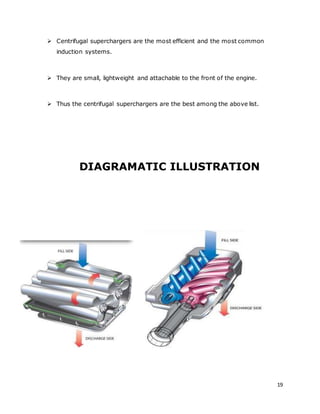
Constructional features: It consists of two meshing lobes that are fitted on
two parallel shafts. Those lobes resembles to a lobe gear that are in continuous
mesh. Both the lobes mesh in such a manner that the air pockets between these
lobes and the side walls goes on decreasing as air moves from the fill side to the
discharge side. Thus the passing air gets squeezed.
Working of Roots Supercharger: As the meshing lobes spin, air trapped in
the pockets between the lobes is carried between the fill side and the discharge
side & large quantities of air move into the intake manifold and "stack up" to
create positive pressure. This pressurized air is received at the discharge side.
 Roots superchargers are usually large and sit on top of the engine.
 Roots superchargers are the least efficient supercharger for two
reasons:-
17
1. They add more weight to the vehicle.
2. They provide air in discrete bursts instead of
Providing in a smooth and continuous manner.
TWIN-SCREW SUPERCHARGERS
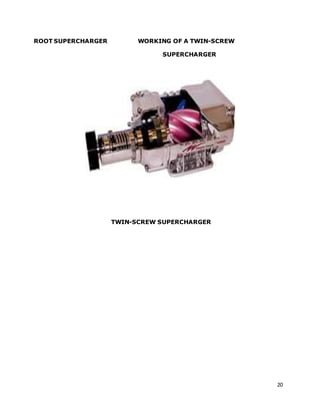
Constructional features: Twin-Screw Superchargers consist of two meshing
lobes that resemble a set of worm gear. The two gears meshes in such a way
that the air pockets between them goes on decreasing as air moves ahead.
Working of Twin Screw Superchargers: A twin-screw supercharger operates
by pulling air through a pair of meshing lobes that resemble a set of worm
gears.
The rotors have a conical taper, which means the air pockets decrease in size as
air moves from the fill side to the discharge side. Thus a twin-screw
supercharger compresses the air inside the rotor housing.
As the air pockets shrink, the air is squeezed into a smaller space.
 Thus twin-screw superchargers are more efficient compared to roots
supercharger.
 They cost more because the screw-type rotors require more precision in
the manufacturing process.
18
 They also make a lot of noise.
 The compressed air exiting the discharge outlet creates a whine or whistle
that must be checked with noise suppression techniques.
CENTRIFUGAL SUPERCHARGERS
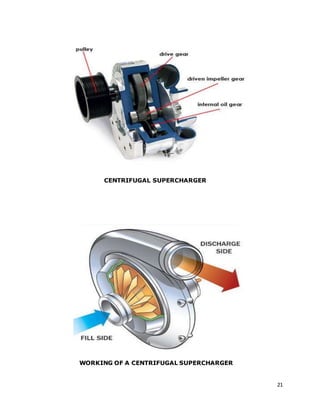
Constructional features: Centrifugal superchargers consist of an impeller with
several blades that rotate at a very high speed at around 50000 rpm. This
impeller throws the air outside due to centrifugal force. It also consists of a
diffuser which exchanges the speed for high pressure.
Working of Centrifugal Supercharger: As the air is drawn in the hub of the
impeller, centrifugal force causes it to radiate outward. The air leaves the
impeller at high speed, but low pressure.
A diffuser converts the high-speed, low-pressure air to low-speed, high-pressure
air.
Thus pressurized air is achieved.
 Impeller speeds can reach ‘50,000 to 60,000 RPM’.
19
 Centrifugal superchargers are the most efficient and the most common
induction systems.
 They are small, lightweight and attachable to the front of the engine.
 Thus the centrifugal superchargers are the best among the above list.
DIAGRAMATIC ILLUSTRATION
20
ROOT SUPERCHARGER WORKING OF A TWIN-SCREW
SUPERCHARGER
TWIN-SCREW SUPERCHARGER
21
CENTRIFUGAL SUPERCHARGER
WORKING OF A CENTRIFUGAL SUPERCHARGER
22
DRIVES USED IN SUPERCHARGERS
Drives are basically the equipments that are used to transfer power from one
shaft to another shaft. In a supercharger, drives are used to transfer part of
engine power to the superchargerThere are several types of drives used to
empower a supercharger. These drives are used according to there
requirements.Some of them are as under:
Mechanical:-
 Belt (V belt, toothed belt & Flat belt).
 Gear drive.
 Chain drive.
Exhaust gas turbines:-
 Axial turbine.
 Radial turbine.
Other:-
 Electric motor.
SUPERCHARGER
AN
EDGE OVER TURBOCHARGER
23
Superchargers do not suffer lag: - Superchargers have no lag time because
they are driven directly by the crankshaft, whereas Turbochargers suffers lag
because it takes a few moments before the exhaust gases reach a velocity that
is sufficient to drive the impeller/turbine.
Since the superchargers are directly empowered from the engine, so as the
engine starts, the superchargers can be activated. But in the case of
turbochargers they take some time for the accumulation of exhaust gases.
Modification of the exhaust system: - Installing a turbocharger requires
extensive modification of the exhaust system, but superchargers can be bolted
to the top or side of the engine, that makes them cheaper to install and easier
to service and maintain.
So this becomes a problem in the case of turbochargers. It becomes a tough
task to modify the exhaust system as well as it adds an extra cost in the vehicle.
Shutdown procedure: - No special shutdown procedure is required with
superchargers as they are not lubricated by engine oil. They can be shut down
normally. Whereas turbochargers must idle for about 30 seconds or so prior to
shutdown so the lubricating oil has a chance to cool down.
Thus it creates a problem during shutdown procedure as turbochargers can’t be
shutdown normally.
NOTHING IS PERFECT
24
 It derives power from the engine itself: Crankshaft drives superchargers
so they steal some of the engine's horsepower. A supercharger can consume
as much as 20 percent of an engine's total power output. So it can be
considered as a loss of engine power.
(But because a supercharger can generate as much as 46 percent
additional horsepower, I think the trade-off is worth it).
Whereas this is not the case in turbochargers, it empowers itself from the
exhaust gas of the engine, which is mainly a waste of the engine.
 An added strain on the engine: Supercharging puts an added strain
on the engine, which needs to be strong to handle the extra boost and bigger
explosions. Engine and the other connected mechanisms have to be made
robust enough to bear the extra pressure. So this makes the design engineer
task tougher.
 An extra expense: Heavy-duty components, design complexity &
maintenance add an extra burden on the expenses. And these expenses have
to be made for better performance without any compromise.
Though this seems too much, but when compared to its output, this seems a
good deal.
25
CONCLUSION
 Despite their disadvantages, superchargers are still the most cost-
effective way to increase horsepower.
 Superchargers can result in power increase of 50 to 100 percent,
making them great for racing, towing heavy loads or just adding
excitement to the typical driving experience.
 It is a must use component in an airplanes.
 As superchargers ensure complete combustion, it greatly reduces the
pollution problem.
 With the use of high octane premium-grade gas, I think it is a
miracle invention for speed junkies.
26
REFERENCES
 http://auto.howstuffworks.com/supercharger5.htm
 http://www.howstuffworks.com/search.php?terms=supercharger
 http://www.superchargerpros.com/
 http://en.wikipedia.org/wiki/Supercharger
27
 http://en.wikipedia.org/wiki/Supercharger#History
 http://www.magnusonproducts.com/

Sisc1

  • 1.
    1 COLLEG OF ENGINEERINGTHECHNOLOGY DEPARTMENT OF MECHANICAL ENGINEEERING PROJECTREPORT PROJECT TITLE……………………….. ONICENGINEAND RECIPROCATING MACHINE COURS CODE MENG 4202 GRUPE MEMBERS…………………………………………………………………………..ID NO 1, SHUSHAYHAILU……………………………………………………………………….4142/07 2,MIKILEBERHE………………………………………………………………………………. 3,REDAETSEGAY……………………………………………………………………………… 4 5 SUBMITED TO INSTRACTOR: REDAE
  • 2.
  • 3.
    3 Acknowledgeme We would liketo acknowledge and appreciate the great guidance from my project supervisor, instructor berihu I would also like to thank my parents and classmates for their encouragement, understanding and support throughout the entire project. I would also like to thank the almighty God for bringing me this far and giving me the strength to carry out the project. I would also like to thank my friend’s zemical and toweled Abstract— To start with, a study on the effect of turbocharger on a single cylinder is made. The design and installation of turbocharger in a single cylinder is available in this literature. We have designed and fabricated a prototype of the Turbochargerwas implemented in Two- wheeler, In which the efficiency of the Engine can be increased . KEYWORDS: Gasoline Engine, Exhaust Manifold, Intake Manifold, Turbocharger, Nozzle, Flanges, K & N Air Filter, Carburetor, Turbine, Compressor. Volumetric Efficiency of a S.I. or C.I. Engine is increased by providing combustion chamber with maximum amount of air. This is achieved by installation of Turbocharger or Supercharger. Supercharger uses engine power to run itself whereas a Turbocharger doesn’t utilize any engine power it runs by Exhaust gases.In present work we’ll be increasing the volumetric efficiency of a 125cc single cylinder bike by installation of turbocharger. To start with, a study on the effect of turbochargeron a single cylinder is made. The design and installation of turbochargerin a single cylinder is available in this literature. INTRODUCTION In turbocharging, the turbocharger is being driven by a gas turbine using the energy in exhaust gases. The major parts of turbocharger are turbine wheel, turbine housing, turbo shaft, comp. wheel, comp. housing & bearing housing. A 4-stroke S.I. Engine is an engine that uses gasoline as fuel. S.I.engine is a spark ignited engine that is the combustion is carried out by spark ignition, it is achieved by installation of spark plug on cylinder head. In this project we are using Honda Stunner CBF 125cc for the installation of turbocharger. The CBF125 is a motorcycle manufactured by Honda's Indian subsidiary HMSI. The motorcycle is knownas Stunner in the Indian market. In India, it has two variants, the carburetor version simply called Stunner To increase the output efficiency of any engine we have to burn more fuel and make bigger explosion in every cycle. We have two options for this. One way to add power is to build a bigger engine. But bigger engines, which weigh more and cost more to build and maintain, are not always better.
  • 4.
    4 Another way toadd power is to make a normal-sized engine more efficient. We can accomplish this by forcing more air into the combustion chamber. More air means more fuel can be added, and more fuel means a bigger explosion and greater horsepower. This can be done with the help of a supercharger. A supercharger is basically an air compressor used for forced induction of an internal combustion engine. It does the same work as that of a compressor, i.e. it compresses the air being delivered to the combustion chamber of an engine. The greater mass flow-rate provides more oxygen to support combustion than would be available in a naturally-aspirated engine, which allows more fuel to be provided and more work to be done per cycle, increasing the power output of the engine.Thus a supercharger is extra equipment provided in an engine so as to boost the capacity and the torque of an engine. Definition The most efficient method of increasing the power of an engine is by supercharging, i.e. increasing the flow of air into the engine to enable more fuel to be burnt. A Supercharger is run by the mechanical drive, powered by engine power . A turbocharger uses the otherwise unused energy in the exhaust gases to drive a turbine directly connected by a co-axial shaft to a rotary compressor in the air intake system Types of super charger: Based on the use of compressor • Centrifugal type • Roots type • Vane type Components of turbocharger • Air compressor
  • 5.
    5 • Turbine • Intercooler FigureNo. 1 Assembled Turbocharger WORKING OF TURBOCHARGER Since the power a piston engine can produce is directly dependent upon the mass of air it can ingest, the purpose of forced induction (turbo-supercharging and supercharging)is to increase the inlet manifold pressure and density so as to make the cylinders ingest a greater mass of air during each intake stroke. A superchargeris an air compressor driven directly by the engine crankshaft, and as such,consumes some of the power produced by the combustion of fuel, thereby increasing BSFC and engine wear for a given amount of produced power. A turbocharger consists ofa single-stage radial-flow (―centrifugal‖) compressor (air pump), which is driven by a single-stage radial-flow
  • 6.
    6 turbine, instead ofbeing driven directly by the crankshaft. The turbine extracts wasted kinetic and thermal energy from the high-temperature exhaust gas flow and produces the power to drive the compressor, at the cost of a slight increase in pumping losse HOW TURBOCHARGER WORKS Figure No. 2 Turbocharger Working WORKING PRINCIPLE A turbochargerconsists ofa turbine and a compressor on a shared shaft.The turbine converts heat to rotational force, which is in turn used to drive the compressor. The compressor draws in ambient air and pumps it in to the intake manifold at increased pressure,resulting in a greater mass of air entering the cylinders on each intake stroke. The output of the engine exhaust gas is given to the input of the turbine blades, so that the pressurized air produced.
  • 7.
    7 This power, thealternate power must be much more convenient in availability and usage.The next important reason for the search of effective, unadulterated power are to save the surrounding environments including men, machine and material of both the existing and the next fourth generation from pollution, the cause for many harmful happenings and to reach the saturation point. We have designed and fabricated a prototype of the Turbocharger was implemented in Two- wheeler, In which the efficiency of the Engine can be increased. Thus we have developed a method to increase the efficiency of the engine and at the same time to control the Emissions from the engine. The experimental setup of block diagram shows the arrangement of turbochargerin two- wheeler. This type of engine will be more efficient than existing engine INSTALLATION OF TURBOCHARGER Steps for installation 1. Connect the turbo inlet with engine exhaust port with the help of studd nut & welding. 2. The turbine shaft is connected to a compressor, which draws in combustion air, compresses it, and then supplies it to the engine. 3. Now connect air filter with turbo compressorsection. 4. Connect turbo air inlet with hos pipe with bike air cleaner. 5. Now connect carburetor with air cleaner & with engine. 6. Connect silencer with waste gate from where the waste gas will flow.
  • 8.
    8 Figure No. 3Turbocharger layout I.C ENGINE Internal combustion engines are those heat engines that burn their fuel inside the engine cylinder. In internal combustion engine the chemical energy stored in their operation. The heat energy is converted in to mechanical energy by the expansion of gases against the piston attached to the crankshaft that can rotate. SPARK IGNITION ENGINE A spark ignition (SI) engine runs on an Otto cycle— most gasoline engines run on a modified Otto cycle. This cycle uses a homogeneous air-fuel mixture which is combined prior to entering the combustion chamber. Once in the combustion chamber, the mixture is compressed, and then ignited using a spark plug (spark ignition). The SI engine is controlled by limiting the amount of air allowed into the engine. This is accomplished through the use of a throttling valve placed on the air intake (carburetor or throttle body). AIR FILTER For instance the air filters in your bike; their basic function is to prevent dust from entering the engine, which could cause serious
  • 9.
    9 damage to theperformance of the bike. And if your bike is fitted with paper filter then change it regularly according to the instructions given by the manufacturer. Figure No. 5 Air Filter RADIATOR Radiators are heat exchangers used for cooling internal combustion engines,mainly in automobiles but also in aircraft, railway, motorcycles, stationary generating plant or any similar use of such an engine. Internal combustion engines are often cooled by circulating a liquid called engine coolant through the engine block, where it is heated,then through a radiator where it loses heat to the atmosphere, and then returned to the engine. Engine coolant is usually water-based, but may also be oil. It is common to employ a water pump to force the engine coolant to circ Figure No.6 Radiator OIL LINE & OIL PUMP We are using oil line for good & smooth working of turbocharger. In this case we are using 10W40 mineral-based oil. Oil pump is used to supply of oil into the turbocharger.
  • 10.
    10 Figure No. 7Oil Line BATTERY Battery is use to supply of current into the oil line & in oil pump. We are using 12v lead acid battery for supply of current. Figure No. 8 Battery WHY SUPERCHARGER ?? A supercharger is used in an engine for various reasons.
  • 11.
    11 Some of theadvantages of superchargers are as follows:  Increases the power of an engine.  A supercharger spinning at 50,000 RPM translates to a boost of about six to nine pounds per square inch (psi).  Increases the torque produced.  An efficiently working engine with supercharger can achieve the same speed in one third of the time taken by the same engine without supercharger.  Necessary in airplanes and jets as they have less oxygen at high altitudes. So they provide the sufficient amount of air by compressing it to higher pressure. And ensures complete combustion.  Higher amount of oxygen in compressed air from supercharger ensures complete combustion of the fuel.  Complete combustion reduces pollution to some extent. PRINCIPLE OF WORKING
  • 12.
    12 “More fuel +More air = Bigger explosion = Greater horsepower”. Every supercharger works on the same above mentioned tagline. It is quite evident that to get more output from any engine we need to burn more fuel. More fuel will result in a bigger explosion in every cycle, which will then push the piston with more thrust, and consequently this thrust will be transmitted to the wheels with the help of crank and shaft. Wheels will rotate faster and with more power and that is how it works. But, to burn more fuel in an engine, we need more air in it (The chemically correct mixture – (14: 1:: air : fuel) – is essential for an engine to operate perfectly). Thus a supercharger compresses the air being delivered to the engine so as to supply more air in the same, limited volume of the cylinder. This ensures complete combustion of the fuel and no unburnt fuel comes out of the exhaust. Thus the supercharger increases the power output of any engine.
  • 13.
    13 DIAGRAM OF AWORKING ENGINE EQUIPPED WITH A SUPERCHARGER A TYPICAL SUPERCHARGER
  • 14.
    14 CLASSIFICATION OF SUPERCHARGERS Based onmethod of compression, Superchargers can be classified as:- 1. Positive-displacement type, which deliver a nearly-fixed volume of air per revolution at all speeds and a fairly constant level of boost regardless of engine speed. 2. Dynamic compressors rely on accelerating the air to high speed and then exchanging that velocity for pressure by diffusing or slowing it down & deliver increasing boost with increasing engine speed. A supercharger comes in two different variations: Positive displacement and dynamic compressors. A positive displacement supercharger pushes air into the engine at a constant speed, while a dynamic supercharger uses velocity to manipulate the pressure in the air. In either case, oxygen is compressed as it is delivered to the engine, allowing more power to be gained from every explosion in the combustion chambers.
  • 15.
    15 COMMONLY USED SUPERCHARGERS Nowadays,there are several types of superchargers used in the engines. Following are some of the most commonly used superchargers in the market. o Roots Superchargers o Twin-Screw Superchargers o Centrifugal Superchargers History of Superchargers  The Roots supercharger is the oldest design of supercharger used in any type of engine.  Philander and Francis Roots, in 1860, introduced the concept of such type of equipment. Though they patented the design as a machine
  • 16.
    16 that would helpventilate mine shafts, later this turned out to be a miraculous invention for automotive engineers.  In 1900, Gottleib Daimler for the first time included a Roots supercharger in a car engine which improved the output of the engine. This was the first step towards its development. ROOTS SUPERCHARGER Constructional features: It consists of two meshing lobes that are fitted on two parallel shafts. Those lobes resembles to a lobe gear that are in continuous mesh. Both the lobes mesh in such a manner that the air pockets between these lobes and the side walls goes on decreasing as air moves from the fill side to the discharge side. Thus the passing air gets squeezed. Working of Roots Supercharger: As the meshing lobes spin, air trapped in the pockets between the lobes is carried between the fill side and the discharge side & large quantities of air move into the intake manifold and "stack up" to create positive pressure. This pressurized air is received at the discharge side.  Roots superchargers are usually large and sit on top of the engine.  Roots superchargers are the least efficient supercharger for two reasons:-
  • 17.
    17 1. They addmore weight to the vehicle. 2. They provide air in discrete bursts instead of Providing in a smooth and continuous manner. TWIN-SCREW SUPERCHARGERS Constructional features: Twin-Screw Superchargers consist of two meshing lobes that resemble a set of worm gear. The two gears meshes in such a way that the air pockets between them goes on decreasing as air moves ahead. Working of Twin Screw Superchargers: A twin-screw supercharger operates by pulling air through a pair of meshing lobes that resemble a set of worm gears. The rotors have a conical taper, which means the air pockets decrease in size as air moves from the fill side to the discharge side. Thus a twin-screw supercharger compresses the air inside the rotor housing. As the air pockets shrink, the air is squeezed into a smaller space.  Thus twin-screw superchargers are more efficient compared to roots supercharger.  They cost more because the screw-type rotors require more precision in the manufacturing process.
  • 18.
    18  They alsomake a lot of noise.  The compressed air exiting the discharge outlet creates a whine or whistle that must be checked with noise suppression techniques. CENTRIFUGAL SUPERCHARGERS Constructional features: Centrifugal superchargers consist of an impeller with several blades that rotate at a very high speed at around 50000 rpm. This impeller throws the air outside due to centrifugal force. It also consists of a diffuser which exchanges the speed for high pressure. Working of Centrifugal Supercharger: As the air is drawn in the hub of the impeller, centrifugal force causes it to radiate outward. The air leaves the impeller at high speed, but low pressure. A diffuser converts the high-speed, low-pressure air to low-speed, high-pressure air. Thus pressurized air is achieved.  Impeller speeds can reach ‘50,000 to 60,000 RPM’.
  • 19.
    19  Centrifugal superchargersare the most efficient and the most common induction systems.  They are small, lightweight and attachable to the front of the engine.  Thus the centrifugal superchargers are the best among the above list. DIAGRAMATIC ILLUSTRATION
  • 20.
    20 ROOT SUPERCHARGER WORKINGOF A TWIN-SCREW SUPERCHARGER TWIN-SCREW SUPERCHARGER
  • 21.
    21 CENTRIFUGAL SUPERCHARGER WORKING OFA CENTRIFUGAL SUPERCHARGER
  • 22.
    22 DRIVES USED INSUPERCHARGERS Drives are basically the equipments that are used to transfer power from one shaft to another shaft. In a supercharger, drives are used to transfer part of engine power to the superchargerThere are several types of drives used to empower a supercharger. These drives are used according to there requirements.Some of them are as under: Mechanical:-  Belt (V belt, toothed belt & Flat belt).  Gear drive.  Chain drive. Exhaust gas turbines:-  Axial turbine.  Radial turbine. Other:-  Electric motor. SUPERCHARGER AN EDGE OVER TURBOCHARGER
  • 23.
    23 Superchargers do notsuffer lag: - Superchargers have no lag time because they are driven directly by the crankshaft, whereas Turbochargers suffers lag because it takes a few moments before the exhaust gases reach a velocity that is sufficient to drive the impeller/turbine. Since the superchargers are directly empowered from the engine, so as the engine starts, the superchargers can be activated. But in the case of turbochargers they take some time for the accumulation of exhaust gases. Modification of the exhaust system: - Installing a turbocharger requires extensive modification of the exhaust system, but superchargers can be bolted to the top or side of the engine, that makes them cheaper to install and easier to service and maintain. So this becomes a problem in the case of turbochargers. It becomes a tough task to modify the exhaust system as well as it adds an extra cost in the vehicle. Shutdown procedure: - No special shutdown procedure is required with superchargers as they are not lubricated by engine oil. They can be shut down normally. Whereas turbochargers must idle for about 30 seconds or so prior to shutdown so the lubricating oil has a chance to cool down. Thus it creates a problem during shutdown procedure as turbochargers can’t be shutdown normally. NOTHING IS PERFECT
  • 24.
    24  It derivespower from the engine itself: Crankshaft drives superchargers so they steal some of the engine's horsepower. A supercharger can consume as much as 20 percent of an engine's total power output. So it can be considered as a loss of engine power. (But because a supercharger can generate as much as 46 percent additional horsepower, I think the trade-off is worth it). Whereas this is not the case in turbochargers, it empowers itself from the exhaust gas of the engine, which is mainly a waste of the engine.  An added strain on the engine: Supercharging puts an added strain on the engine, which needs to be strong to handle the extra boost and bigger explosions. Engine and the other connected mechanisms have to be made robust enough to bear the extra pressure. So this makes the design engineer task tougher.  An extra expense: Heavy-duty components, design complexity & maintenance add an extra burden on the expenses. And these expenses have to be made for better performance without any compromise. Though this seems too much, but when compared to its output, this seems a good deal.
  • 25.
    25 CONCLUSION  Despite theirdisadvantages, superchargers are still the most cost- effective way to increase horsepower.  Superchargers can result in power increase of 50 to 100 percent, making them great for racing, towing heavy loads or just adding excitement to the typical driving experience.  It is a must use component in an airplanes.  As superchargers ensure complete combustion, it greatly reduces the pollution problem.  With the use of high octane premium-grade gas, I think it is a miracle invention for speed junkies.
  • 26.
  • 27.