Chapter 8 - 1
ISSUES TO ADDRESS...
• How do flaws in a material initiate failure?
• How is fracture resistance quantified; how do different
material classes compare?
• How do we estimate the stress to fracture?
• How do loading rate, loading history, and temperature
affect the failure stress?
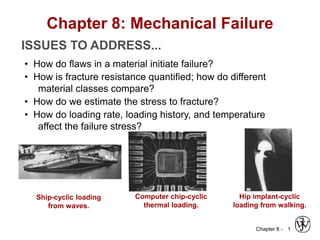
Ship-cyclic loading
from waves.
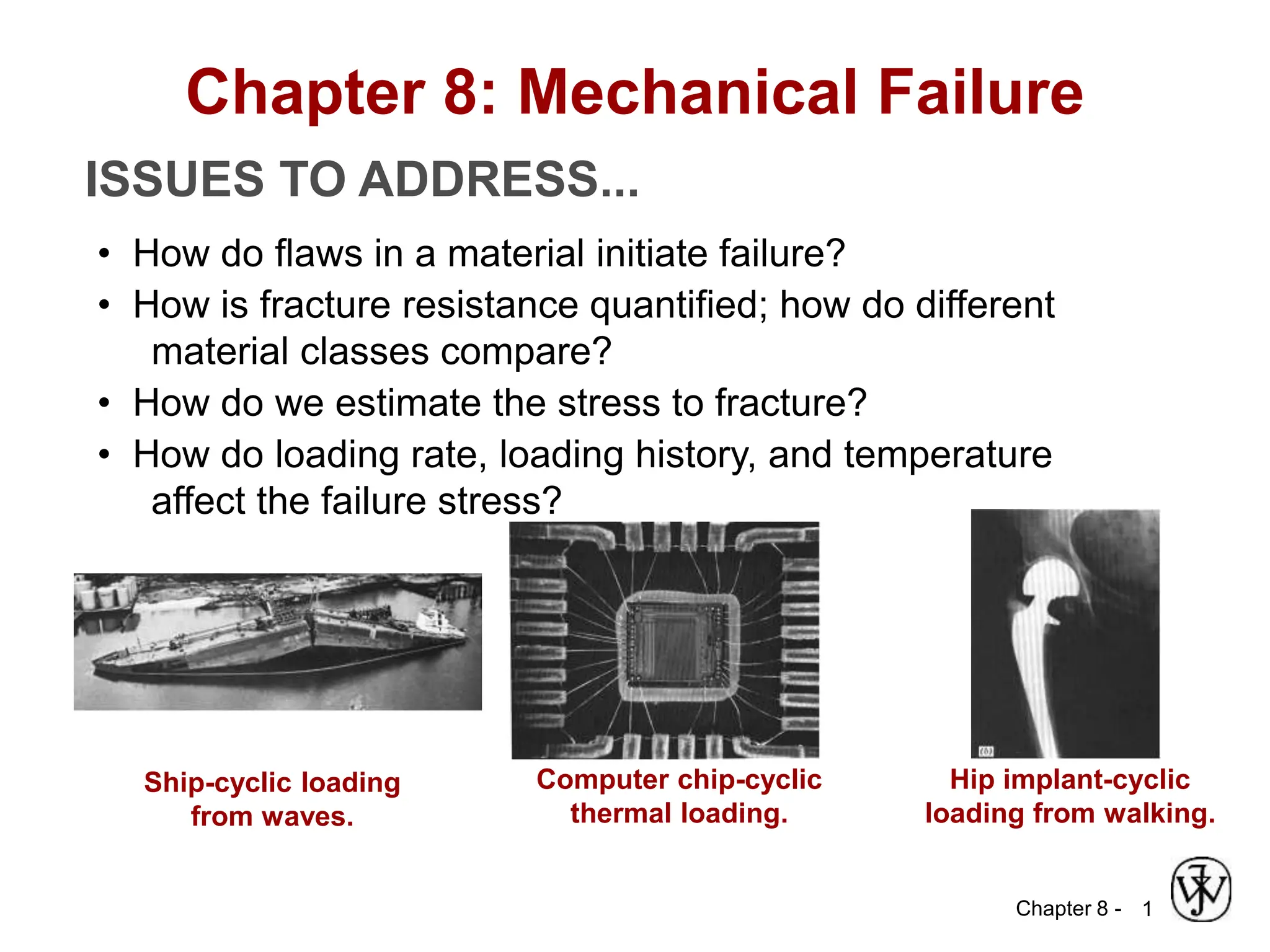
Computer chip-cyclic
thermal loading.
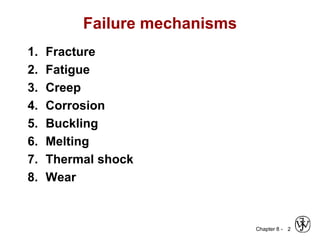
Hip implant-cyclic
loading from walking.
Chapter 8: Mechanical Failure
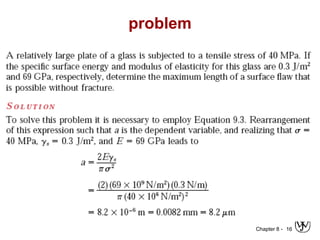
Chapter 8 -
Failure mechanisms
1. Fracture
2. Fatigue
3. Creep
4. Corrosion
5. Buckling
6. Melting
7. Thermal shock
8. Wear
2
Chapter 8 - 3
1. Fracture mechanisms
• Ductile fracture
– Occurs with plastic deformation
• Brittle fracture
– Little or no plastic deformation
– Suddenly and catastrophic
Fracture is the separation of a body into two or more pieces in
response to an imposed stress that is static (i.e., constant or slowly
changing with time) and at temperatures that are low relative to the
melting temperature of the material.
The applied stress may be tensile, compressive, shear, or torsional;
• Any fracture process involves two steps—crack formation and
propagation—in response to an imposed stress
Chapter 8 - 4
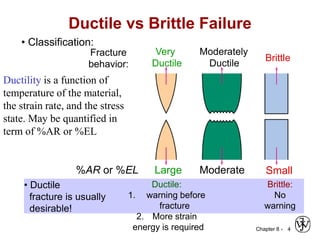
Ductile vs Brittle Failure
Very
Ductile
Moderately
Ductile
Brittle
Fracture
behavior:
Large Moderate
%AR or %EL Small
• Ductile
fracture is usually
desirable!
• Classification:
Ductile:
1. warning before
fracture
2. More strain
energy is required
Brittle:
No
warning
Ductility is a function of
temperature of the material,
the strain rate, and the stress
state. May be quantified in
term of %AR or %EL
Chapter 8 - 5
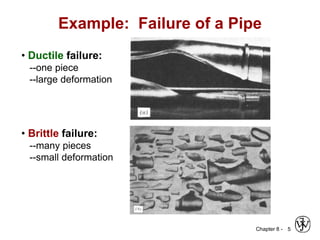
• Ductile failure:
--one piece
--large deformation
Example: Failure of a Pipe
• Brittle failure:
--many pieces
--small deformation
Chapter 8 - 6
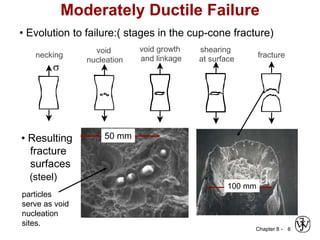
• Evolution to failure:( stages in the cup-cone fracture)
• Resulting
fracture
surfaces
(steel)
50 mm
particles
serve as void
nucleation
sites.
50 mm
100 mm
Moderately Ductile Failure
necking
s
void
nucleation
void growth
and linkage
shearing
at surface
fracture
Chapter 8 - 7
Ductile vs. Brittle Failure
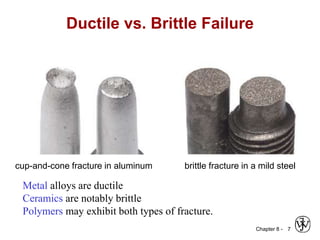
cup-and-cone fracture in aluminum brittle fracture in a mild steel
Metal alloys are ductile
Ceramics are notably brittle
Polymers may exhibit both types of fracture.
Chapter 8 - 8
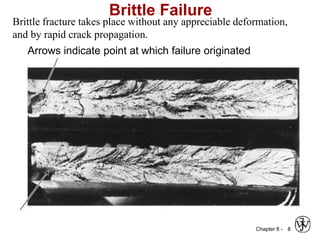
Brittle Failure
Arrows indicate point at which failure originated
Brittle fracture takes place without any appreciable deformation,
and by rapid crack propagation.
Chapter 8 - 9
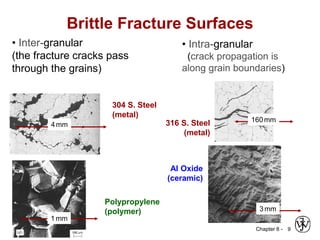
• Inter-granular
(the fracture cracks pass
through the grains)
• Intra-granular
(crack propagation is
along grain boundaries)
Al Oxide
(ceramic)
316 S. Steel
(metal)
304 S. Steel
(metal)
Polypropylene
(polymer) 3mm
4mm
160mm
1mm
Brittle Fracture Surfaces
Chapter 8 -
Principles of fracture mechanics
1. stress concentration
2. Fracture toughness
3. Design using fracture mechanics
4. Impact fracture testing
10
This subject allows quantification of the relationships between
material properties, stress level, the presence of crack-
producing flaws, and crack propagation mechanisms.
Chapter 8 - 11
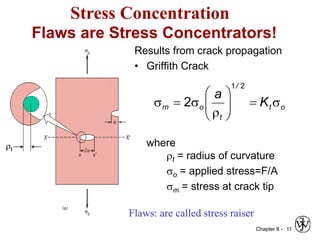
Flaws are Stress Concentrators!
Results from crack propagation
• Griffith Crack
where
t = radius of curvature
so = applied stress=F/A
sm = stress at crack tip
o
t
/
t
o
m K
a
s










s

s
2
1
2
t
Stress Concentration
Flaws: are called stress raiser
Chapter 8 - 12
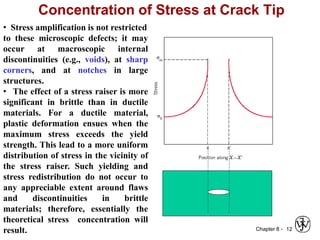
Concentration of Stress at Crack Tip
• Stress amplification is not restricted
to these microscopic defects; it may
occur at macroscopic internal
discontinuities (e.g., voids), at sharp
corners, and at notches in large
structures.
• The effect of a stress raiser is more
significant in brittle than in ductile
materials. For a ductile material,
plastic deformation ensues when the
maximum stress exceeds the yield
strength. This lead to a more uniform
distribution of stress in the vicinity of
the stress raiser. Such yielding and
stress redistribution do not occur to
any appreciable extent around flaws
and discontinuities in brittle
materials; therefore, essentially the
theoretical stress concentration will
result.
Chapter 8 - 13
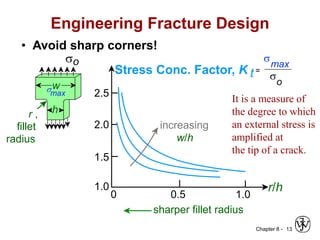
Engineering Fracture Design
r/h
sharper fillet radius
increasing
w/h
0 0.5 1.0
1.0
1.5
2.0
2.5
Stress Conc. Factor, K t
s
max
s
o
=
• Avoid sharp corners!
s
r ,
fillet
radius
w
h
o
smax
It is a measure of
the degree to which
an external stress is
amplified at
the tip of a crack.
Chapter 8 - 14
Crack Propagation
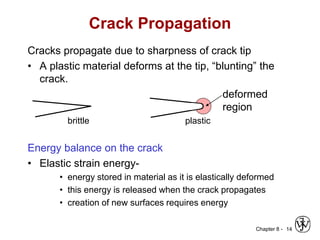
Cracks propagate due to sharpness of crack tip
• A plastic material deforms at the tip, “blunting” the
crack.
deformed
region
brittle
Energy balance on the crack
• Elastic strain energy-
• energy stored in material as it is elastically deformed
• this energy is released when the crack propagates
• creation of new surfaces requires energy
plastic
Chapter 8 - 15
When Does a Crack Propagate?
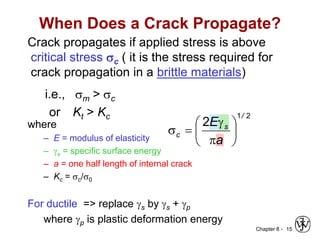
Crack propagates if applied stress is above
critical stress sc ( it is the stress required for
crack propagation in a brittle materials)
where
– E = modulus of elasticity
– s = specific surface energy
– a = one half length of internal crack
– Kc = sc/s0
For ductile => replace s by s + p
where p is plastic deformation energy
2
1
2
/
s
c
a
E









s
i.e., sm > sc
or Kt > Kc
Chapter 8 -
problem
16
Chapter 8 -
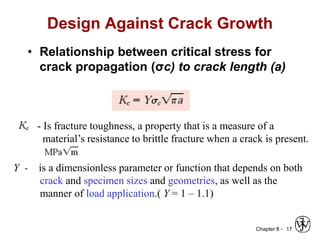
Design Against Crack Growth
• Relationship between critical stress for
crack propagation (σc) to crack length (a)
17
- Is fracture toughness, a property that is a measure of a
material’s resistance to brittle fracture when a crack is present.
Y - is a dimensionless parameter or function that depends on both
crack and specimen sizes and geometries, as well as the
manner of load application.( Y = 1 – 1.1)
Chapter 8 - 18
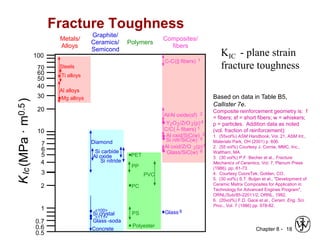
Fracture Toughness
Based on data in Table B5,
Callister 7e.
Composite reinforcement geometry is: f
= fibers; sf = short fibers; w = whiskers;
p = particles. Addition data as noted
(vol. fraction of reinforcement):
1. (55vol%) ASM Handbook, Vol. 21, ASM Int.,
Materials Park, OH (2001) p. 606.
2. (55 vol%) Courtesy J. Cornie, MMC, Inc.,
Waltham, MA.
3. (30 vol%) P.F. Becher et al., Fracture
Mechanics of Ceramics, Vol. 7, Plenum Press
(1986). pp. 61-73.
4. Courtesy CoorsTek, Golden, CO.
5. (30 vol%) S.T. Buljan et al., "Development of
Ceramic Matrix Composites for Application in
Technology for Advanced Engines Program",
ORNL/Sub/85-22011/2, ORNL, 1992.
6. (20vol%) F.D. Gace et al., Ceram. Eng. Sci.
Proc., Vol. 7 (1986) pp. 978-82.
Graphite/
Ceramics/
Semicond
Metals/
Alloys
Composites/
fibers
Polymers
5
K
Ic
(MPa
·
m
0.5
)
1
Mg alloys
Al alloys
Ti alloys
Steels
Si crystal
Glass -soda
Concrete
Si carbide
PC
Glass 6
0.5
0.7
2
4
3
10
20
30
<100>
<111>
Diamond
PVC
PP
Polyester
PS
PET
C-C(|| fibers) 1
0.6
6
7
40
50
60
70
100
Al oxide
Si nitride
C/C( fibers) 1
Al/Al oxide(sf) 2
Al oxid/SiC(w) 3
Al oxid/ZrO 2(p)4
Si nitr/SiC(w) 5
Glass/SiC(w) 6
Y2O3/ZrO 2(p)4
KIC - plane strain
fracture toughness
Chapter 8 -
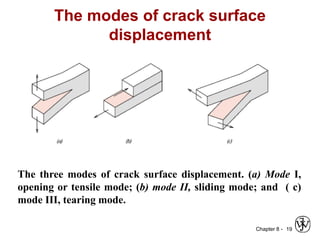
The modes of crack surface
displacement
19
The three modes of crack surface displacement. (a) Mode I,
opening or tensile mode; (b) mode II, sliding mode; and ( c)
mode III, tearing mode.
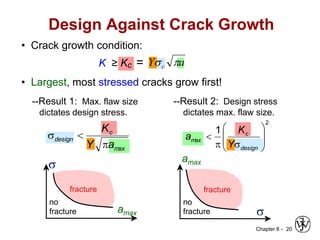
Chapter 8 - 20
• Crack growth condition:
• Largest, most stressed cracks grow first!
Design Against Crack Growth
K ≥ Kc = a
Y c 
s
--Result 1: Max. flaw size
dictates design stress.
m
ax
c
design
a
Y
K


s
s
amax
no
fracture
fracture
--Result 2: Design stress
dictates max. flaw size.
2
1








s


design
c
max
Y
K
a
amax
s
no
fracture
fracture
Chapter 8 - 21
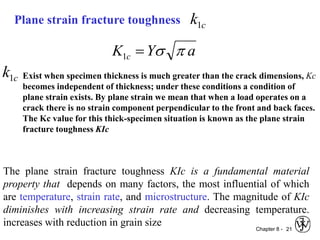
Plane strain fracture toughness c
k1
a
Y
K c 
s

1
c
k1 Exist when specimen thickness is much greater than the crack dimensions, Kc
becomes independent of thickness; under these conditions a condition of
plane strain exists. By plane strain we mean that when a load operates on a
crack there is no strain component perpendicular to the front and back faces.
The Kc value for this thick-specimen situation is known as the plane strain
fracture toughness KIc
The plane strain fracture toughness KIc is a fundamental material
property that depends on many factors, the most influential of which
are temperature, strain rate, and microstructure. The magnitude of KIc
diminishes with increasing strain rate and decreasing temperature.
increases with reduction in grain size
Chapter 8 - 22
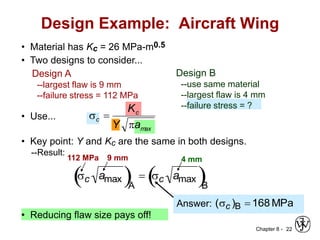
• Two designs to consider...
Design A
--largest flaw is 9 mm
--failure stress = 112 MPa
Design B
--use same material
--largest flaw is 4 mm
--failure stress = ?
• Key point: Y and Kc are the same in both designs.
Answer: MPa
168
)
( B 
sc
• Reducing flaw size pays off!
• Material has Kc = 26 MPa-m0.5
Design Example: Aircraft Wing
• Use...
max
c
c
a
Y
K


s

sc amax
 A
 sc amax
 B
9 mm
112 MPa 4 mm
--Result:
Chapter 8 - 23
Loading Rate
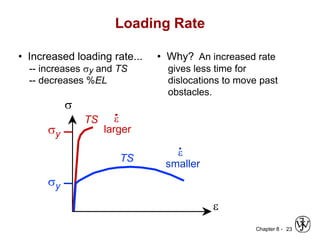
• Increased loading rate...
-- increases sy and TS
-- decreases %EL
• Why? An increased rate
gives less time for
dislocations to move past
obstacles.
s
e
sy
sy
TS
TS
larger
e
smaller
e
Chapter 8 - 24
Impact Testing
final height initial height
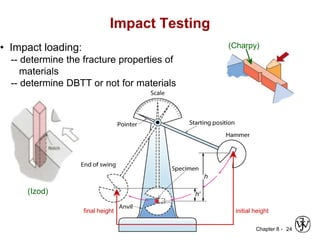
• Impact loading:
-- determine the fracture properties of
materials
-- determine DBTT or not for materials
(Charpy)
(Izod)
Chapter 8 - 25
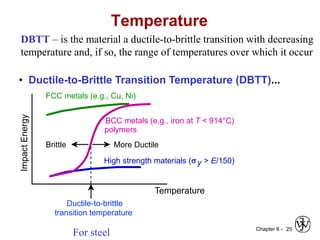
• Ductile-to-Brittle Transition Temperature (DBTT)...
Temperature
BCC metals (e.g., iron at T < 914°C)
Impact
Energy
Temperature
High strength materials (sy > E/150)
polymers
More Ductile
Brittle
Ductile-to-brittle
transition temperature
FCC metals (e.g., Cu, Ni)
DBTT – is the material a ductile-to-brittle transition with decreasing
temperature and, if so, the range of temperatures over which it occur
For steel
Chapter 8 - 26
Structures constructed from alloys that exhibit this ductile-to-
brittle behavior should be used only at temperatures above the
transition temperature, to avoid brittle and catastrophic
failure. Classic examples of this type of failure occurred, with
disastrous consequences, during World War II when a number
of welded transport ships, away from combat, suddenly and
precipitously split in half. The vessels were constructed of a
steel alloy that possessed adequate ductility according to room-
temperature tensile tests. The brittle fractures occurred at
relatively low ambient temperatures, at about 4C (40F), in the
vicinity of the transition temperature of the alloy. Each fracture
crack originated at some point of stress concentration, probably
a sharp corner or fabrication defect, and then propagated
around the entire girth of the ship
Chapter 8 - 27
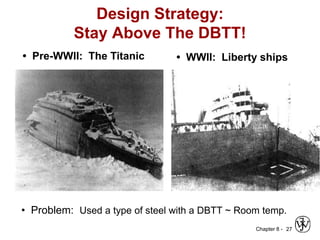
• Pre-WWII: The Titanic • WWII: Liberty ships
• Problem: Used a type of steel with a DBTT ~ Room temp.
Design Strategy:
Stay Above The DBTT!
Chapter 8 - 28
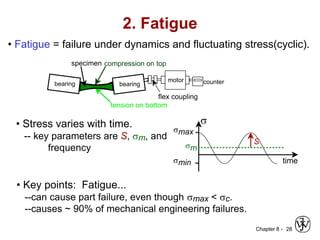
2. Fatigue
• Fatigue = failure under dynamics and fluctuating stress(cyclic).
• Stress varies with time.
-- key parameters are S, sm, and
frequency
smax
smin
s
time
sm
S
• Key points: Fatigue...
--can cause part failure, even though smax < sc.
--causes ~ 90% of mechanical engineering failures.
tension on bottom
compression on top
counter
motor
flex coupling
specimen
bearing bearing
Chapter 8 - 29
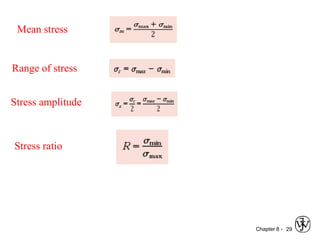
Mean stress
Range of stress
Stress amplitude
Stress ratio
Chapter 8 - 30
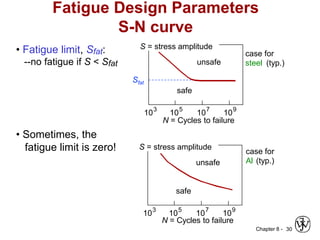
• Fatigue limit, Sfat:
--no fatigue if S < Sfat
Fatigue Design Parameters
S-N curve
Sfat
case for
steel (typ.)
N = Cycles to failure
103
105
107
109
unsafe
safe
S = stress amplitude
• Sometimes, the
fatigue limit is zero! case for
Al (typ.)
N = Cycles to failure
103
105
107
109
unsafe
safe
S = stress amplitude
Chapter 8 - 31
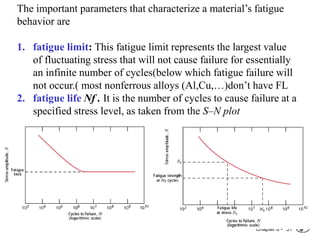
The important parameters that characterize a material’s fatigue
behavior are
1. fatigue limit: This fatigue limit represents the largest value
of fluctuating stress that will not cause failure for essentially
an infinite number of cycles(below which fatigue failure will
not occur.( most nonferrous alloys (Al,Cu,…)don’t have FL
2. fatigue life Nf . It is the number of cycles to cause failure at a
specified stress level, as taken from the S–N plot
Chapter 8 -
Fatigue Mechanism
• The process of fatigue failure is characterized by three
distinct steps: (1) crack initiation, wherein a small crack
forms at some point of high stress concentration;
(2) crack propagation, during which this crack advances
incrementally with each stress cycle; and (3) final failure,
which occurs very rapidly once the advancing crack has
reached a critical size.
• Cracks associated with fatigue failure almost always
initiate (or nucleate) on the surface of a component at some
point of stress concentration. Crack nucleation sites
include surface scratches, sharp fillets, keyways, threads,
dents, and the like. In addition, cyclic loading can produce
microscopic surface discontinuities resulting from
dislocation slip steps which may also act as stress raisers,
and therefore as crack initiation sites.
32
Chapter 8 - 33
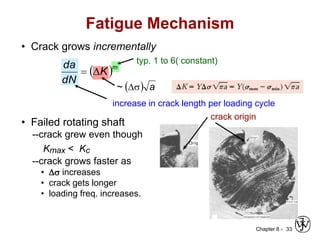
• Crack grows incrementally
typ. 1 to 6( constant)
  a
~ s

increase in crack length per loading cycle
• Failed rotating shaft
--crack grew even though
Kmax < Kc
--crack grows faster as
• s increases
• crack gets longer
• loading freq. increases.
crack origin
Fatigue Mechanism
 m
K
dN
da


Chapter 8 -
Factors that affect fatigue life
1. Mean stress
2. Surface effects
3. Environmental effects
34
Chapter 8 - 35
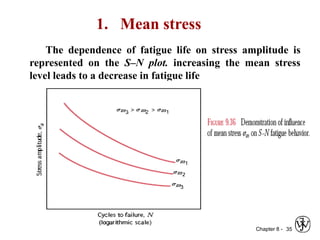
1. Mean stress
The dependence of fatigue life on stress amplitude is
represented on the S–N plot. increasing the mean stress
level leads to a decrease in fatigue life
Chapter 8 - 36
2. Surface effect
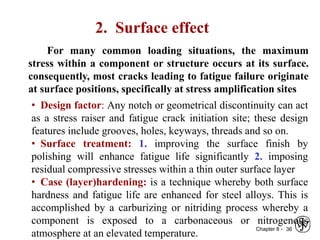
For many common loading situations, the maximum
stress within a component or structure occurs at its surface.
consequently, most cracks leading to fatigue failure originate
at surface positions, specifically at stress amplification sites
• Design factor: Any notch or geometrical discontinuity can act
as a stress raiser and fatigue crack initiation site; these design
features include grooves, holes, keyways, threads and so on.
• Surface treatment: 1. improving the surface finish by
polishing will enhance fatigue life significantly 2. imposing
residual compressive stresses within a thin outer surface layer
• Case (layer)hardening: is a technique whereby both surface
hardness and fatigue life are enhanced for steel alloys. This is
accomplished by a carburizing or nitriding process whereby a
component is exposed to a carbonaceous or nitrogenous
atmosphere at an elevated temperature.
Chapter 8 -
Environmental effects
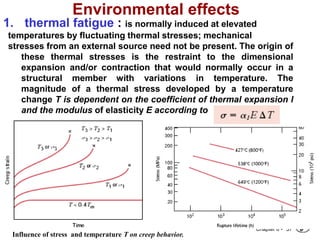
1. thermal fatigue : is normally induced at elevated
temperatures by fluctuating thermal stresses; mechanical
stresses from an external source need not be present. The origin of
these thermal stresses is the restraint to the dimensional
expansion and/or contraction that would normally occur in a
structural member with variations in temperature. The
magnitude of a thermal stress developed by a temperature
change T is dependent on the coefficient of thermal expansion l
and the modulus of elasticity E according to
•
37
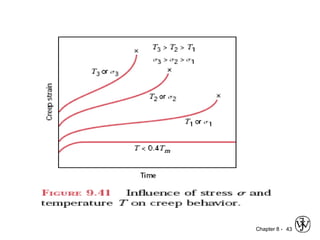
Influence of stress and temperature T on creep behavior.
Chapter 8 - 38
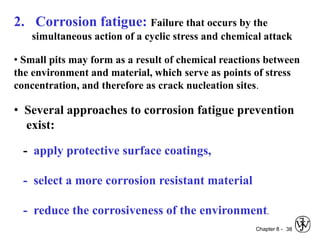
2. Corrosion fatigue: Failure that occurs by the
simultaneous action of a cyclic stress and chemical attack
• Small pits may form as a result of chemical reactions between
the environment and material, which serve as points of stress
concentration, and therefore as crack nucleation sites.
• Several approaches to corrosion fatigue prevention
exist:
- apply protective surface coatings,
- select a more corrosion resistant material
- reduce the corrosiveness of the environment.
Chapter 8 - 39
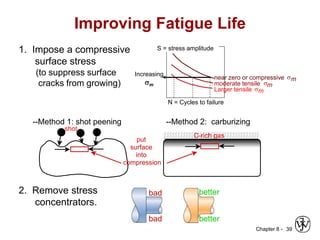
Improving Fatigue Life
1. Impose a compressive
surface stress
(to suppress surface
cracks from growing)
N = Cycles to failure
moderate tensile sm
Larger tensile sm
S = stress amplitude
near zero or compressive sm
Increasing
sm
--Method 1: shot peening
put
surface
into
compression
shot
--Method 2: carburizing
C-rich gas
2. Remove stress
concentrators.
bad
bad
better
better
Chapter 8 -
3. Creep
• The time-dependent permanent deformation
that occurs when material are subjected to a
constant load or stress; for most materials it
is important only at elevated temperatures.
• For metals it becomes important only for
temperatures greater than about 0.4Tm (Tm
absolute melting temperature).
40
Chapter 8 - 41
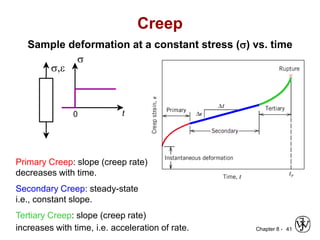
Creep
Sample deformation at a constant stress (s) vs. time
Primary Creep: slope (creep rate)
decreases with time.
Secondary Creep: steady-state
i.e., constant slope.
Tertiary Creep: slope (creep rate)
increases with time, i.e. acceleration of rate.
s
s,e
0 t
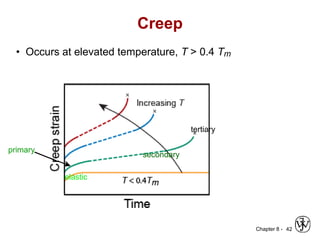
Chapter 8 - 42
• Occurs at elevated temperature, T > 0.4 Tm
Creep
elastic
primary
secondary
tertiary
Chapter 8 - 43
Chapter 8 - 44
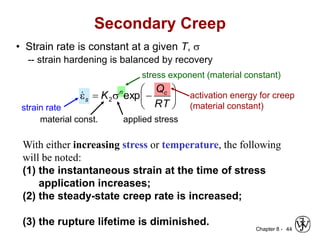
• Strain rate is constant at a given T, s
-- strain hardening is balanced by recovery
stress exponent (material constant)
strain rate
activation energy for creep
(material constant)
applied stress
material const.







s

e
RT
Q
K c
n
s exp
2

Secondary Creep
With either increasing stress or temperature, the following
will be noted:
(1) the instantaneous strain at the time of stress
application increases;
(2) the steady-state creep rate is increased;
(3) the rupture lifetime is diminished.
Chapter 8 - 45
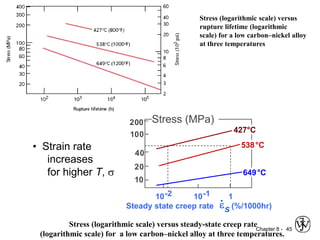
• Strain rate
increases
for higher T, s
10
20
40
100
200
10-2 10-1 1
Steady state creep rate (%/1000hr)
e
s
Stress (MPa)
427°C
538°C
649°C
Stress (logarithmic scale) versus steady-state creep rate
(logarithmic scale) for a low carbon–nickel alloy at three temperatures.
Stress (logarithmic scale) versus
rupture lifetime (logarithmic
scale) for a low carbon–nickel alloy
at three temperatures
Chapter 8 - 46
Creep Failure
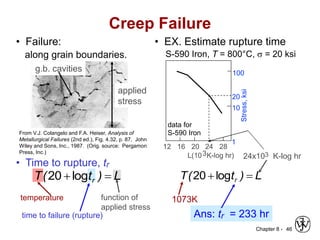
• EX. Estimate rupture time
S-590 Iron, T = 800°C, s = 20 ksi
• Failure:
along grain boundaries.
time to failure (rupture)
function of
applied stress
temperature
L
)
t
(
T r 
log
20
applied
stress
g.b. cavities
• Time to rupture, tr
From V.J. Colangelo and F.A. Heiser, Analysis of
Metallurgical Failures (2nd ed.), Fig. 4.32, p. 87, John
Wiley and Sons, Inc., 1987. (Orig. source: Pergamon
Press, Inc.)
L
)
t
(
T r 
log
20
1073K
Ans: tr = 233 hr
24x103 K-log hr
L(103K-log hr)
Stress,
ksi
100
10
1
12 20 24 28
16
data for
S-590 Iron
20
Chapter 8 -
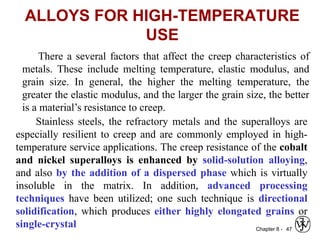
ALLOYS FOR HIGH-TEMPERATURE
USE
47
There a several factors that affect the creep characteristics of
metals. These include melting temperature, elastic modulus, and
grain size. In general, the higher the melting temperature, the
greater the elastic modulus, and the larger the grain size, the better
is a material’s resistance to creep.
Stainless steels, the refractory metals and the superalloys are
especially resilient to creep and are commonly employed in high-
temperature service applications. The creep resistance of the cobalt
and nickel superalloys is enhanced by solid-solution alloying,
and also by the addition of a dispersed phase which is virtually
insoluble in the matrix. In addition, advanced processing
techniques have been utilized; one such technique is directional
solidification, which produces either highly elongated grains or
single-crystal
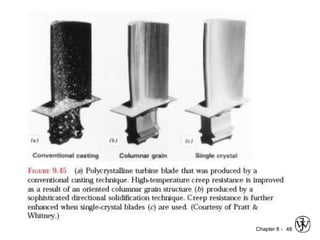
Chapter 8 - 48
Chapter 8 -
4. Corrosion
• Corrosion is breaking down! of essential
properties in a material due to reactions
with its surroundings. In the most
common use of the word, this means a
loss of an electron of metals reacting with
water and oxygen
• Weakening of iron due to oxidation of the
iron atoms is a well-known example of
electrochemical corrosion. This is
commonly known as rust This type of
damage usually affects metallic materials,
and typically produces oxide(s) and/or
salt(s) of the original metal 49
Chapter 8 - 50
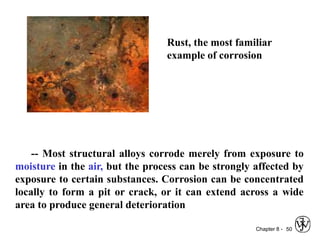
Rust, the most familiar
example of corrosion
-- Most structural alloys corrode merely from exposure to
moisture in the air, but the process can be strongly affected by
exposure to certain substances. Corrosion can be concentrated
locally to form a pit or crack, or it can extend across a wide
area to produce general deterioration
Chapter 8 -
Resistant to corrosion
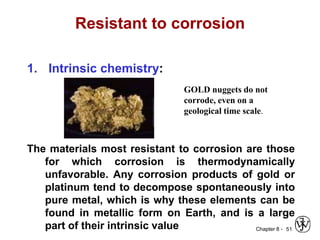
1. Intrinsic chemistry:
The materials most resistant to corrosion are those
for which corrosion is thermodynamically
unfavorable. Any corrosion products of gold or
platinum tend to decompose spontaneously into
pure metal, which is why these elements can be
found in metallic form on Earth, and is a large
part of their intrinsic value 51
GOLD nuggets do not
corrode, even on a
geological time scale.
Chapter 8 - 52
2. Passivation:
Given the right conditions, a thin film of corrosion products
can form on a metal's surface spontaneously, acting as a
barrier to further oxidation. When this layer stops growing
at less than a micrometre thick under the conditions that a
material will be used in, the phenomenon is known as
passivation
Passivation in air and water is seen in such materials as
aluminum, stainless steel, titanium, and silicon
Chapter 8 - 53
3. surface treatment ( coating ):
Plating, painting, and the application of enamel are the
most common anti-corrosion treatments. They work by
providing a barrier of corrosion-resistant material between
the damaging environment and the (often cheaper, tougher,
and/or easier-to-process) structural material
Example: chromium on steel
Chapter 8 -
5. Buckling
• In engineering, buckling is a failure mode
characterized by a sudden failure of a structural
member subjected to high compressive
stresses, where the actual compressive
stresses at failure are smaller than the ultimate
compressive stresses that the material is
capable of withstanding. This mode of failure is
also described as failure due to elastic
instability
54
Chapter 8 - 55
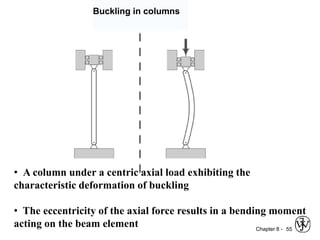
Buckling in columns
• A column under a centric axial load exhibiting the
characteristic deformation of buckling
• The eccentricity of the axial force results in a bending moment
acting on the beam element
Chapter 8 - 56
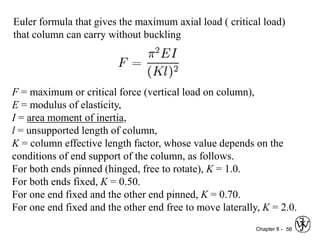
Euler formula that gives the maximum axial load ( critical load)
that column can carry without buckling
F = maximum or critical force (vertical load on column),
E = modulus of elasticity,
I = area moment of inertia,
l = unsupported length of column,
K = column effective length factor, whose value depends on the
conditions of end support of the column, as follows.
For both ends pinned (hinged, free to rotate), K = 1.0.
For both ends fixed, K = 0.50.
For one end fixed and the other end pinned, K = 0.70.
For one end fixed and the other end free to move laterally, K = 2.0.
Chapter 8 -
6. Melting
• Melting is a process that results in the
phase change of a substance from a solid
to a liquid. The internal energy of a solid
substance is increased (typically by the
application of heat) to a specific
temperature (called the melting point) at
which it changes to the liquid phase. An
object that has melted completely is molten
• The melting point of a substance is equal
to its freezing point
57
Chapter 8 - 58
• Molecular vibrations
When the internal energy of a solid is increased by the application
of an external energy source, the molecular vibrations of the substance
increases. As these vibrations increase, the substance becomes more
and more disordered
• Constant temperature
Substances melt at a constant temperature, the melting point.
Further increases in temperature (even with continued application of
energy) do not occur until the substance is molten
Chapter 8 -
7. Thermal chock
• Thermal shock is the name given to cracking as
a result of rapid temperature change. Glass and
ceramic objects are particularly vulnerable to this
form of failure, due to their low toughness, low
thermal conductivity, and high thermal expansion
coefficients
• Thermal shock occurs when a thermal gradient
causes different parts of an object to expand by
different amounts. This differential expansion can
be understood in terms of stress or of strain,
equivalently. At some point, this stress
overcomes the strength of the material, causing a
crack to form. If nothing stops this crack from
propagating through the material, it will cause the
object's structure to fail 59
Chapter 8 - 60
Thermal shock can be prevented by:
1. Reducing the thermal gradient seen by the object, by
a) changing its temperature more slowly
b) increasing the material's thermal conductivity
2. Reducing the material's coefficient of thermal expansion
3. Increasing its strength
4. Increasing its toughness, by
a) crack tip blunting, i.e., plasticity or phase transformation
b) crack deflection
Chapter 8 - 61
Example.
Borosilicate glass such as Pyrex is made to withstand
thermal shock better than most other glass through a
combination of reduced expansion coefficient and greater
strength, though fused quartz outperforms it in both these
respects. Some glass-ceramic materials include a controlled
proportion of material with a negative expansion
coefficient, so that the overall coefficient can be reduced to
almost exactly zero over a reasonably wide range of
temperatures
Chapter 8 -
8. wear
• Wear is the erosion of material from a solid
surface by the action of another solid, or
it is a process in which interaction of surface(s) or
bounding face(s) of a solid with the working
environment results in the dimensional loss of the
solid, with or without loss of material
• Wear environment includes loads(types include
unidirectional sliding, reciprocating, rolling,
impact),speed, temperatures, counter-bodies(solid,
liquid, gas), types of contact (single phase or
multiphase in which phases involved can be liquid
plus solid particles plus gas bubbles)
62
Chapter 8 -
principal wear processes
• There are four principal wear processes:
a.Adhesive wear
b.Abrasive wear
c.Corrosive wear
d.Surface fatigue
63
Chapter 8 - 64
a. Adhesive wear
Adhesive wear is also known as scoring, galling, or seizing. It
occurs when two solid surfaces slide over one another under
pressure. Surface projections, or asperities, are plastically
deformed and eventually welded together by the high local
pressure. As sliding continues, these bonds are broken,
producing cavities on the surface, projections on the second
surface, and frequently tiny, abrasive particles, all of which
contribute to future wear of surfaces
b. Abrasive wear
When material is removed by contact with hard particles,
abrasive wear occurs. The particles either may be present at the
surface of a second material or may exist as loose particles
between two surfaces
Chapter 8 - 65
c. Corrosive wear
Often referred to simply as “corrosion”, corrosive wear is
deterioration of useful properties in a material due to
reactions with its environment
d. Surface fatigue
Surface fatigue is a process by which the surface of a
material is weakened by cyclic loading, which is one type of
general material fatigue
Chapter 8 - 66
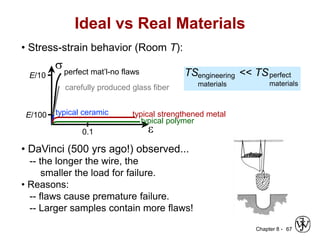
• Engineering materials don't reach theoretical strength.
• Flaws produce stress concentrations that cause
premature failure.
• Sharp corners produce large stress concentrations
and premature failure.
• Failure type depends on T and stress:
- for noncyclic s and T < 0.4Tm, failure stress decreases with:
- increased maximum flaw size,
- decreased T,
- increased rate of loading.
- for cyclic s:
- cycles to fail decreases as s increases.
- for higher T (T > 0.4Tm):
- time to fail decreases as s or T increases.
SUMMARY
Chapter 8 - 67
• Stress-strain behavior (Room T):
Ideal vs Real Materials
TS << TS
engineering
materials
perfect
materials
s
e
E/10
E/100
0.1
perfect mat’l-no flaws
carefully produced glass fiber
typical ceramic typical strengthened metal
typical polymer
• DaVinci (500 yrs ago!) observed...
-- the longer the wire, the
smaller the load for failure.
• Reasons:
-- flaws cause premature failure.
-- Larger samples contain more flaws!

Chapter 8. Mechanical Failure - Failure mechanisms

  • 1.
    Chapter 8 -1 ISSUES TO ADDRESS... • How do flaws in a material initiate failure? • How is fracture resistance quantified; how do different material classes compare? • How do we estimate the stress to fracture? • How do loading rate, loading history, and temperature affect the failure stress? Ship-cyclic loading from waves. Computer chip-cyclic thermal loading. Hip implant-cyclic loading from walking. Chapter 8: Mechanical Failure
  • 2.
    Chapter 8 - Failuremechanisms 1. Fracture 2. Fatigue 3. Creep 4. Corrosion 5. Buckling 6. Melting 7. Thermal shock 8. Wear 2
  • 3.
    Chapter 8 -3 1. Fracture mechanisms • Ductile fracture – Occurs with plastic deformation • Brittle fracture – Little or no plastic deformation – Suddenly and catastrophic Fracture is the separation of a body into two or more pieces in response to an imposed stress that is static (i.e., constant or slowly changing with time) and at temperatures that are low relative to the melting temperature of the material. The applied stress may be tensile, compressive, shear, or torsional; • Any fracture process involves two steps—crack formation and propagation—in response to an imposed stress
  • 4.
    Chapter 8 -4 Ductile vs Brittle Failure Very Ductile Moderately Ductile Brittle Fracture behavior: Large Moderate %AR or %EL Small • Ductile fracture is usually desirable! • Classification: Ductile: 1. warning before fracture 2. More strain energy is required Brittle: No warning Ductility is a function of temperature of the material, the strain rate, and the stress state. May be quantified in term of %AR or %EL
  • 5.
    Chapter 8 -5 • Ductile failure: --one piece --large deformation Example: Failure of a Pipe • Brittle failure: --many pieces --small deformation
  • 6.
    Chapter 8 -6 • Evolution to failure:( stages in the cup-cone fracture) • Resulting fracture surfaces (steel) 50 mm particles serve as void nucleation sites. 50 mm 100 mm Moderately Ductile Failure necking s void nucleation void growth and linkage shearing at surface fracture
  • 7.
    Chapter 8 -7 Ductile vs. Brittle Failure cup-and-cone fracture in aluminum brittle fracture in a mild steel Metal alloys are ductile Ceramics are notably brittle Polymers may exhibit both types of fracture.
  • 8.
    Chapter 8 -8 Brittle Failure Arrows indicate point at which failure originated Brittle fracture takes place without any appreciable deformation, and by rapid crack propagation.
  • 9.
    Chapter 8 -9 • Inter-granular (the fracture cracks pass through the grains) • Intra-granular (crack propagation is along grain boundaries) Al Oxide (ceramic) 316 S. Steel (metal) 304 S. Steel (metal) Polypropylene (polymer) 3mm 4mm 160mm 1mm Brittle Fracture Surfaces
  • 10.
    Chapter 8 - Principlesof fracture mechanics 1. stress concentration 2. Fracture toughness 3. Design using fracture mechanics 4. Impact fracture testing 10 This subject allows quantification of the relationships between material properties, stress level, the presence of crack- producing flaws, and crack propagation mechanisms.
  • 11.
    Chapter 8 -11 Flaws are Stress Concentrators! Results from crack propagation • Griffith Crack where t = radius of curvature so = applied stress=F/A sm = stress at crack tip o t / t o m K a s           s  s 2 1 2 t Stress Concentration Flaws: are called stress raiser
  • 12.
    Chapter 8 -12 Concentration of Stress at Crack Tip • Stress amplification is not restricted to these microscopic defects; it may occur at macroscopic internal discontinuities (e.g., voids), at sharp corners, and at notches in large structures. • The effect of a stress raiser is more significant in brittle than in ductile materials. For a ductile material, plastic deformation ensues when the maximum stress exceeds the yield strength. This lead to a more uniform distribution of stress in the vicinity of the stress raiser. Such yielding and stress redistribution do not occur to any appreciable extent around flaws and discontinuities in brittle materials; therefore, essentially the theoretical stress concentration will result.
  • 13.
    Chapter 8 -13 Engineering Fracture Design r/h sharper fillet radius increasing w/h 0 0.5 1.0 1.0 1.5 2.0 2.5 Stress Conc. Factor, K t s max s o = • Avoid sharp corners! s r , fillet radius w h o smax It is a measure of the degree to which an external stress is amplified at the tip of a crack.
  • 14.
    Chapter 8 -14 Crack Propagation Cracks propagate due to sharpness of crack tip • A plastic material deforms at the tip, “blunting” the crack. deformed region brittle Energy balance on the crack • Elastic strain energy- • energy stored in material as it is elastically deformed • this energy is released when the crack propagates • creation of new surfaces requires energy plastic
  • 15.
    Chapter 8 -15 When Does a Crack Propagate? Crack propagates if applied stress is above critical stress sc ( it is the stress required for crack propagation in a brittle materials) where – E = modulus of elasticity – s = specific surface energy – a = one half length of internal crack – Kc = sc/s0 For ductile => replace s by s + p where p is plastic deformation energy 2 1 2 / s c a E          s i.e., sm > sc or Kt > Kc
  • 16.
  • 17.
    Chapter 8 - DesignAgainst Crack Growth • Relationship between critical stress for crack propagation (σc) to crack length (a) 17 - Is fracture toughness, a property that is a measure of a material’s resistance to brittle fracture when a crack is present. Y - is a dimensionless parameter or function that depends on both crack and specimen sizes and geometries, as well as the manner of load application.( Y = 1 – 1.1)
  • 18.
    Chapter 8 -18 Fracture Toughness Based on data in Table B5, Callister 7e. Composite reinforcement geometry is: f = fibers; sf = short fibers; w = whiskers; p = particles. Addition data as noted (vol. fraction of reinforcement): 1. (55vol%) ASM Handbook, Vol. 21, ASM Int., Materials Park, OH (2001) p. 606. 2. (55 vol%) Courtesy J. Cornie, MMC, Inc., Waltham, MA. 3. (30 vol%) P.F. Becher et al., Fracture Mechanics of Ceramics, Vol. 7, Plenum Press (1986). pp. 61-73. 4. Courtesy CoorsTek, Golden, CO. 5. (30 vol%) S.T. Buljan et al., "Development of Ceramic Matrix Composites for Application in Technology for Advanced Engines Program", ORNL/Sub/85-22011/2, ORNL, 1992. 6. (20vol%) F.D. Gace et al., Ceram. Eng. Sci. Proc., Vol. 7 (1986) pp. 978-82. Graphite/ Ceramics/ Semicond Metals/ Alloys Composites/ fibers Polymers 5 K Ic (MPa · m 0.5 ) 1 Mg alloys Al alloys Ti alloys Steels Si crystal Glass -soda Concrete Si carbide PC Glass 6 0.5 0.7 2 4 3 10 20 30 <100> <111> Diamond PVC PP Polyester PS PET C-C(|| fibers) 1 0.6 6 7 40 50 60 70 100 Al oxide Si nitride C/C( fibers) 1 Al/Al oxide(sf) 2 Al oxid/SiC(w) 3 Al oxid/ZrO 2(p)4 Si nitr/SiC(w) 5 Glass/SiC(w) 6 Y2O3/ZrO 2(p)4 KIC - plane strain fracture toughness
  • 19.
    Chapter 8 - Themodes of crack surface displacement 19 The three modes of crack surface displacement. (a) Mode I, opening or tensile mode; (b) mode II, sliding mode; and ( c) mode III, tearing mode.
  • 20.
    Chapter 8 -20 • Crack growth condition: • Largest, most stressed cracks grow first! Design Against Crack Growth K ≥ Kc = a Y c  s --Result 1: Max. flaw size dictates design stress. m ax c design a Y K   s s amax no fracture fracture --Result 2: Design stress dictates max. flaw size. 2 1         s   design c max Y K a amax s no fracture fracture
  • 21.
    Chapter 8 -21 Plane strain fracture toughness c k1 a Y K c  s  1 c k1 Exist when specimen thickness is much greater than the crack dimensions, Kc becomes independent of thickness; under these conditions a condition of plane strain exists. By plane strain we mean that when a load operates on a crack there is no strain component perpendicular to the front and back faces. The Kc value for this thick-specimen situation is known as the plane strain fracture toughness KIc The plane strain fracture toughness KIc is a fundamental material property that depends on many factors, the most influential of which are temperature, strain rate, and microstructure. The magnitude of KIc diminishes with increasing strain rate and decreasing temperature. increases with reduction in grain size
  • 22.
    Chapter 8 -22 • Two designs to consider... Design A --largest flaw is 9 mm --failure stress = 112 MPa Design B --use same material --largest flaw is 4 mm --failure stress = ? • Key point: Y and Kc are the same in both designs. Answer: MPa 168 ) ( B  sc • Reducing flaw size pays off! • Material has Kc = 26 MPa-m0.5 Design Example: Aircraft Wing • Use... max c c a Y K   s  sc amax  A  sc amax  B 9 mm 112 MPa 4 mm --Result:
  • 23.
    Chapter 8 -23 Loading Rate • Increased loading rate... -- increases sy and TS -- decreases %EL • Why? An increased rate gives less time for dislocations to move past obstacles. s e sy sy TS TS larger e smaller e
  • 24.
    Chapter 8 -24 Impact Testing final height initial height • Impact loading: -- determine the fracture properties of materials -- determine DBTT or not for materials (Charpy) (Izod)
  • 25.
    Chapter 8 -25 • Ductile-to-Brittle Transition Temperature (DBTT)... Temperature BCC metals (e.g., iron at T < 914°C) Impact Energy Temperature High strength materials (sy > E/150) polymers More Ductile Brittle Ductile-to-brittle transition temperature FCC metals (e.g., Cu, Ni) DBTT – is the material a ductile-to-brittle transition with decreasing temperature and, if so, the range of temperatures over which it occur For steel
  • 26.
    Chapter 8 -26 Structures constructed from alloys that exhibit this ductile-to- brittle behavior should be used only at temperatures above the transition temperature, to avoid brittle and catastrophic failure. Classic examples of this type of failure occurred, with disastrous consequences, during World War II when a number of welded transport ships, away from combat, suddenly and precipitously split in half. The vessels were constructed of a steel alloy that possessed adequate ductility according to room- temperature tensile tests. The brittle fractures occurred at relatively low ambient temperatures, at about 4C (40F), in the vicinity of the transition temperature of the alloy. Each fracture crack originated at some point of stress concentration, probably a sharp corner or fabrication defect, and then propagated around the entire girth of the ship
  • 27.
    Chapter 8 -27 • Pre-WWII: The Titanic • WWII: Liberty ships • Problem: Used a type of steel with a DBTT ~ Room temp. Design Strategy: Stay Above The DBTT!
  • 28.
    Chapter 8 -28 2. Fatigue • Fatigue = failure under dynamics and fluctuating stress(cyclic). • Stress varies with time. -- key parameters are S, sm, and frequency smax smin s time sm S • Key points: Fatigue... --can cause part failure, even though smax < sc. --causes ~ 90% of mechanical engineering failures. tension on bottom compression on top counter motor flex coupling specimen bearing bearing
  • 29.
    Chapter 8 -29 Mean stress Range of stress Stress amplitude Stress ratio
  • 30.
    Chapter 8 -30 • Fatigue limit, Sfat: --no fatigue if S < Sfat Fatigue Design Parameters S-N curve Sfat case for steel (typ.) N = Cycles to failure 103 105 107 109 unsafe safe S = stress amplitude • Sometimes, the fatigue limit is zero! case for Al (typ.) N = Cycles to failure 103 105 107 109 unsafe safe S = stress amplitude
  • 31.
    Chapter 8 -31 The important parameters that characterize a material’s fatigue behavior are 1. fatigue limit: This fatigue limit represents the largest value of fluctuating stress that will not cause failure for essentially an infinite number of cycles(below which fatigue failure will not occur.( most nonferrous alloys (Al,Cu,…)don’t have FL 2. fatigue life Nf . It is the number of cycles to cause failure at a specified stress level, as taken from the S–N plot
  • 32.
    Chapter 8 - FatigueMechanism • The process of fatigue failure is characterized by three distinct steps: (1) crack initiation, wherein a small crack forms at some point of high stress concentration; (2) crack propagation, during which this crack advances incrementally with each stress cycle; and (3) final failure, which occurs very rapidly once the advancing crack has reached a critical size. • Cracks associated with fatigue failure almost always initiate (or nucleate) on the surface of a component at some point of stress concentration. Crack nucleation sites include surface scratches, sharp fillets, keyways, threads, dents, and the like. In addition, cyclic loading can produce microscopic surface discontinuities resulting from dislocation slip steps which may also act as stress raisers, and therefore as crack initiation sites. 32
  • 33.
    Chapter 8 -33 • Crack grows incrementally typ. 1 to 6( constant)   a ~ s  increase in crack length per loading cycle • Failed rotating shaft --crack grew even though Kmax < Kc --crack grows faster as • s increases • crack gets longer • loading freq. increases. crack origin Fatigue Mechanism  m K dN da  
  • 34.
    Chapter 8 - Factorsthat affect fatigue life 1. Mean stress 2. Surface effects 3. Environmental effects 34
  • 35.
    Chapter 8 -35 1. Mean stress The dependence of fatigue life on stress amplitude is represented on the S–N plot. increasing the mean stress level leads to a decrease in fatigue life
  • 36.
    Chapter 8 -36 2. Surface effect For many common loading situations, the maximum stress within a component or structure occurs at its surface. consequently, most cracks leading to fatigue failure originate at surface positions, specifically at stress amplification sites • Design factor: Any notch or geometrical discontinuity can act as a stress raiser and fatigue crack initiation site; these design features include grooves, holes, keyways, threads and so on. • Surface treatment: 1. improving the surface finish by polishing will enhance fatigue life significantly 2. imposing residual compressive stresses within a thin outer surface layer • Case (layer)hardening: is a technique whereby both surface hardness and fatigue life are enhanced for steel alloys. This is accomplished by a carburizing or nitriding process whereby a component is exposed to a carbonaceous or nitrogenous atmosphere at an elevated temperature.
  • 37.
    Chapter 8 - Environmentaleffects 1. thermal fatigue : is normally induced at elevated temperatures by fluctuating thermal stresses; mechanical stresses from an external source need not be present. The origin of these thermal stresses is the restraint to the dimensional expansion and/or contraction that would normally occur in a structural member with variations in temperature. The magnitude of a thermal stress developed by a temperature change T is dependent on the coefficient of thermal expansion l and the modulus of elasticity E according to • 37 Influence of stress and temperature T on creep behavior.
  • 38.
    Chapter 8 -38 2. Corrosion fatigue: Failure that occurs by the simultaneous action of a cyclic stress and chemical attack • Small pits may form as a result of chemical reactions between the environment and material, which serve as points of stress concentration, and therefore as crack nucleation sites. • Several approaches to corrosion fatigue prevention exist: - apply protective surface coatings, - select a more corrosion resistant material - reduce the corrosiveness of the environment.
  • 39.
    Chapter 8 -39 Improving Fatigue Life 1. Impose a compressive surface stress (to suppress surface cracks from growing) N = Cycles to failure moderate tensile sm Larger tensile sm S = stress amplitude near zero or compressive sm Increasing sm --Method 1: shot peening put surface into compression shot --Method 2: carburizing C-rich gas 2. Remove stress concentrators. bad bad better better
  • 40.
    Chapter 8 - 3.Creep • The time-dependent permanent deformation that occurs when material are subjected to a constant load or stress; for most materials it is important only at elevated temperatures. • For metals it becomes important only for temperatures greater than about 0.4Tm (Tm absolute melting temperature). 40
  • 41.
    Chapter 8 -41 Creep Sample deformation at a constant stress (s) vs. time Primary Creep: slope (creep rate) decreases with time. Secondary Creep: steady-state i.e., constant slope. Tertiary Creep: slope (creep rate) increases with time, i.e. acceleration of rate. s s,e 0 t
  • 42.
    Chapter 8 -42 • Occurs at elevated temperature, T > 0.4 Tm Creep elastic primary secondary tertiary
  • 43.
  • 44.
    Chapter 8 -44 • Strain rate is constant at a given T, s -- strain hardening is balanced by recovery stress exponent (material constant) strain rate activation energy for creep (material constant) applied stress material const.        s  e RT Q K c n s exp 2  Secondary Creep With either increasing stress or temperature, the following will be noted: (1) the instantaneous strain at the time of stress application increases; (2) the steady-state creep rate is increased; (3) the rupture lifetime is diminished.
  • 45.
    Chapter 8 -45 • Strain rate increases for higher T, s 10 20 40 100 200 10-2 10-1 1 Steady state creep rate (%/1000hr) e s Stress (MPa) 427°C 538°C 649°C Stress (logarithmic scale) versus steady-state creep rate (logarithmic scale) for a low carbon–nickel alloy at three temperatures. Stress (logarithmic scale) versus rupture lifetime (logarithmic scale) for a low carbon–nickel alloy at three temperatures
  • 46.
    Chapter 8 -46 Creep Failure • EX. Estimate rupture time S-590 Iron, T = 800°C, s = 20 ksi • Failure: along grain boundaries. time to failure (rupture) function of applied stress temperature L ) t ( T r  log 20 applied stress g.b. cavities • Time to rupture, tr From V.J. Colangelo and F.A. Heiser, Analysis of Metallurgical Failures (2nd ed.), Fig. 4.32, p. 87, John Wiley and Sons, Inc., 1987. (Orig. source: Pergamon Press, Inc.) L ) t ( T r  log 20 1073K Ans: tr = 233 hr 24x103 K-log hr L(103K-log hr) Stress, ksi 100 10 1 12 20 24 28 16 data for S-590 Iron 20
  • 47.
    Chapter 8 - ALLOYSFOR HIGH-TEMPERATURE USE 47 There a several factors that affect the creep characteristics of metals. These include melting temperature, elastic modulus, and grain size. In general, the higher the melting temperature, the greater the elastic modulus, and the larger the grain size, the better is a material’s resistance to creep. Stainless steels, the refractory metals and the superalloys are especially resilient to creep and are commonly employed in high- temperature service applications. The creep resistance of the cobalt and nickel superalloys is enhanced by solid-solution alloying, and also by the addition of a dispersed phase which is virtually insoluble in the matrix. In addition, advanced processing techniques have been utilized; one such technique is directional solidification, which produces either highly elongated grains or single-crystal
  • 48.
  • 49.
    Chapter 8 - 4.Corrosion • Corrosion is breaking down! of essential properties in a material due to reactions with its surroundings. In the most common use of the word, this means a loss of an electron of metals reacting with water and oxygen • Weakening of iron due to oxidation of the iron atoms is a well-known example of electrochemical corrosion. This is commonly known as rust This type of damage usually affects metallic materials, and typically produces oxide(s) and/or salt(s) of the original metal 49
  • 50.
    Chapter 8 -50 Rust, the most familiar example of corrosion -- Most structural alloys corrode merely from exposure to moisture in the air, but the process can be strongly affected by exposure to certain substances. Corrosion can be concentrated locally to form a pit or crack, or it can extend across a wide area to produce general deterioration
  • 51.
    Chapter 8 - Resistantto corrosion 1. Intrinsic chemistry: The materials most resistant to corrosion are those for which corrosion is thermodynamically unfavorable. Any corrosion products of gold or platinum tend to decompose spontaneously into pure metal, which is why these elements can be found in metallic form on Earth, and is a large part of their intrinsic value 51 GOLD nuggets do not corrode, even on a geological time scale.
  • 52.
    Chapter 8 -52 2. Passivation: Given the right conditions, a thin film of corrosion products can form on a metal's surface spontaneously, acting as a barrier to further oxidation. When this layer stops growing at less than a micrometre thick under the conditions that a material will be used in, the phenomenon is known as passivation Passivation in air and water is seen in such materials as aluminum, stainless steel, titanium, and silicon
  • 53.
    Chapter 8 -53 3. surface treatment ( coating ): Plating, painting, and the application of enamel are the most common anti-corrosion treatments. They work by providing a barrier of corrosion-resistant material between the damaging environment and the (often cheaper, tougher, and/or easier-to-process) structural material Example: chromium on steel
  • 54.
    Chapter 8 - 5.Buckling • In engineering, buckling is a failure mode characterized by a sudden failure of a structural member subjected to high compressive stresses, where the actual compressive stresses at failure are smaller than the ultimate compressive stresses that the material is capable of withstanding. This mode of failure is also described as failure due to elastic instability 54
  • 55.
    Chapter 8 -55 Buckling in columns • A column under a centric axial load exhibiting the characteristic deformation of buckling • The eccentricity of the axial force results in a bending moment acting on the beam element
  • 56.
    Chapter 8 -56 Euler formula that gives the maximum axial load ( critical load) that column can carry without buckling F = maximum or critical force (vertical load on column), E = modulus of elasticity, I = area moment of inertia, l = unsupported length of column, K = column effective length factor, whose value depends on the conditions of end support of the column, as follows. For both ends pinned (hinged, free to rotate), K = 1.0. For both ends fixed, K = 0.50. For one end fixed and the other end pinned, K = 0.70. For one end fixed and the other end free to move laterally, K = 2.0.
  • 57.
    Chapter 8 - 6.Melting • Melting is a process that results in the phase change of a substance from a solid to a liquid. The internal energy of a solid substance is increased (typically by the application of heat) to a specific temperature (called the melting point) at which it changes to the liquid phase. An object that has melted completely is molten • The melting point of a substance is equal to its freezing point 57
  • 58.
    Chapter 8 -58 • Molecular vibrations When the internal energy of a solid is increased by the application of an external energy source, the molecular vibrations of the substance increases. As these vibrations increase, the substance becomes more and more disordered • Constant temperature Substances melt at a constant temperature, the melting point. Further increases in temperature (even with continued application of energy) do not occur until the substance is molten
  • 59.
    Chapter 8 - 7.Thermal chock • Thermal shock is the name given to cracking as a result of rapid temperature change. Glass and ceramic objects are particularly vulnerable to this form of failure, due to their low toughness, low thermal conductivity, and high thermal expansion coefficients • Thermal shock occurs when a thermal gradient causes different parts of an object to expand by different amounts. This differential expansion can be understood in terms of stress or of strain, equivalently. At some point, this stress overcomes the strength of the material, causing a crack to form. If nothing stops this crack from propagating through the material, it will cause the object's structure to fail 59
  • 60.
    Chapter 8 -60 Thermal shock can be prevented by: 1. Reducing the thermal gradient seen by the object, by a) changing its temperature more slowly b) increasing the material's thermal conductivity 2. Reducing the material's coefficient of thermal expansion 3. Increasing its strength 4. Increasing its toughness, by a) crack tip blunting, i.e., plasticity or phase transformation b) crack deflection
  • 61.
    Chapter 8 -61 Example. Borosilicate glass such as Pyrex is made to withstand thermal shock better than most other glass through a combination of reduced expansion coefficient and greater strength, though fused quartz outperforms it in both these respects. Some glass-ceramic materials include a controlled proportion of material with a negative expansion coefficient, so that the overall coefficient can be reduced to almost exactly zero over a reasonably wide range of temperatures
  • 62.
    Chapter 8 - 8.wear • Wear is the erosion of material from a solid surface by the action of another solid, or it is a process in which interaction of surface(s) or bounding face(s) of a solid with the working environment results in the dimensional loss of the solid, with or without loss of material • Wear environment includes loads(types include unidirectional sliding, reciprocating, rolling, impact),speed, temperatures, counter-bodies(solid, liquid, gas), types of contact (single phase or multiphase in which phases involved can be liquid plus solid particles plus gas bubbles) 62
  • 63.
    Chapter 8 - principalwear processes • There are four principal wear processes: a.Adhesive wear b.Abrasive wear c.Corrosive wear d.Surface fatigue 63
  • 64.
    Chapter 8 -64 a. Adhesive wear Adhesive wear is also known as scoring, galling, or seizing. It occurs when two solid surfaces slide over one another under pressure. Surface projections, or asperities, are plastically deformed and eventually welded together by the high local pressure. As sliding continues, these bonds are broken, producing cavities on the surface, projections on the second surface, and frequently tiny, abrasive particles, all of which contribute to future wear of surfaces b. Abrasive wear When material is removed by contact with hard particles, abrasive wear occurs. The particles either may be present at the surface of a second material or may exist as loose particles between two surfaces
  • 65.
    Chapter 8 -65 c. Corrosive wear Often referred to simply as “corrosion”, corrosive wear is deterioration of useful properties in a material due to reactions with its environment d. Surface fatigue Surface fatigue is a process by which the surface of a material is weakened by cyclic loading, which is one type of general material fatigue
  • 66.
    Chapter 8 -66 • Engineering materials don't reach theoretical strength. • Flaws produce stress concentrations that cause premature failure. • Sharp corners produce large stress concentrations and premature failure. • Failure type depends on T and stress: - for noncyclic s and T < 0.4Tm, failure stress decreases with: - increased maximum flaw size, - decreased T, - increased rate of loading. - for cyclic s: - cycles to fail decreases as s increases. - for higher T (T > 0.4Tm): - time to fail decreases as s or T increases. SUMMARY
  • 67.
    Chapter 8 -67 • Stress-strain behavior (Room T): Ideal vs Real Materials TS << TS engineering materials perfect materials s e E/10 E/100 0.1 perfect mat’l-no flaws carefully produced glass fiber typical ceramic typical strengthened metal typical polymer • DaVinci (500 yrs ago!) observed... -- the longer the wire, the smaller the load for failure. • Reasons: -- flaws cause premature failure. -- Larger samples contain more flaws!