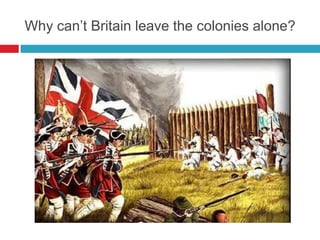
Why can‟t Britain leave the colonies alone?
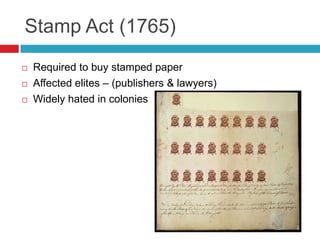
Stamp Act (1765)
 Required to buy stamped paper
 Affected elites – (publishers & lawyers)
 Widely hated in colonies
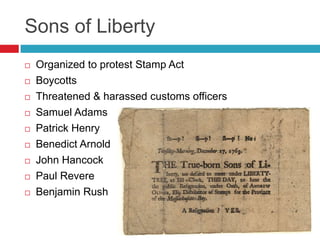
Sons of Liberty
 Organized to protest Stamp Act
 Boycotts
 Threatened & harassed customs officers
 Samuel Adams
 Patrick Henry
 Benedict Arnold
 John Hancock
 Paul Revere
 Benjamin Rush
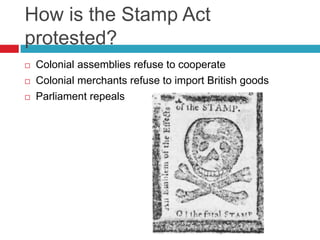
How is the Stamp Act
protested?
 Colonial assemblies refuse to cooperate
 Colonial merchants refuse to import British goods
 Parliament repeals
What are the effects of the Stamp Act?
- Colonies bound together against Britain
- Britain bends, but believes it can still assert
authority
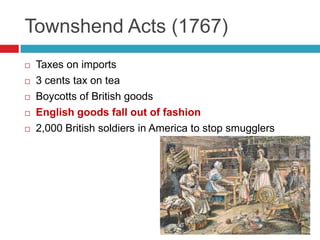
Townshend Acts (1767)
 Taxes on imports
 3 cents tax on tea
 Boycotts of British goods
 English goods fall out of fashion
 2,000 British soldiers in America to stop smugglers
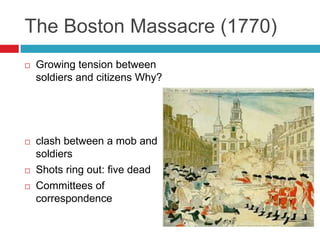
The Boston Massacre (1770)
 Growing tension between
soldiers and citizens Why?
 clash between a mob and
soldiers
 Shots ring out: five dead
 Committees of
correspondence
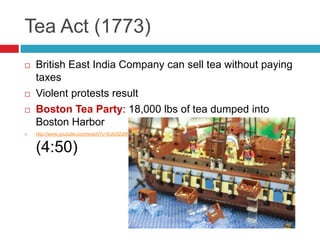
Tea Act (1773)
 British East India Company can sell tea without paying
taxes
 Violent protests result
 Boston Tea Party: 18,000 lbs of tea dumped into
Boston Harbor
 http://www.youtube.com/watch?v=Eytc9ZaNWyc&list=PL8dPuuaLjXtMwmepBjTSG593eG7ObzO7s&index=6
(4:50)
Intolerable Acts (1774)
 Boston Harbor shut down
 Quartering Act: British
soldiers housed in private
homes
 Martial law declared in
Boston
 First Continental Congress:
supports protests & asserts
colonial rights
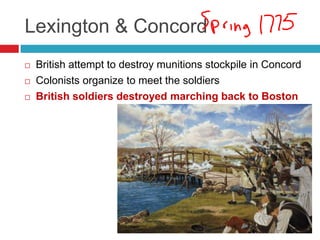
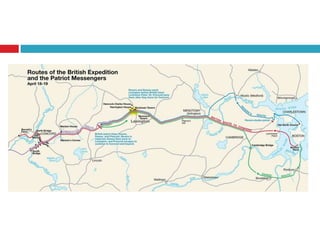
Lexington & Concord
 British attempt to destroy munitions stockpile in Concord
 Colonists organize to meet the soldiers
 British soldiers destroyed marching back to Boston
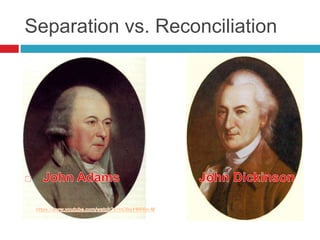
Separation vs. Reconciliation
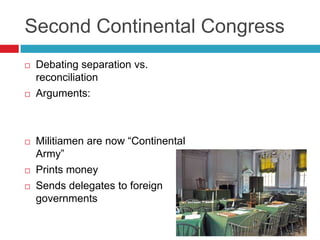
Second Continental Congress
 Debating separation vs.
reconciliation
 Arguments:
 Militiamen are now “Continental
Army”
 Prints money
 Sends delegates to foreign
governments
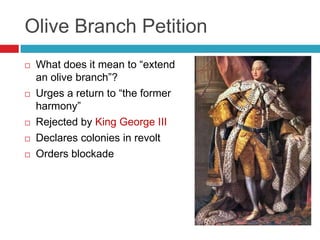
Olive Branch Petition
 What does it mean to “extend
an olive branch”?
 Urges a return to “the former
harmony”
 Rejected by King George III
 Declares colonies in revolt
 Orders blockade
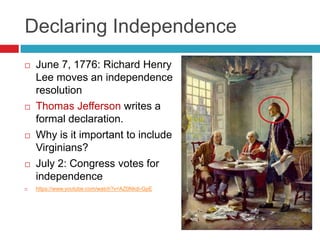
Declaring Independence
 June 7, 1776: Richard Henry
Lee moves an independence
resolution
 Thomas Jefferson writes a
formal declaration.
 Why is it important to include
Virginians?
 July 2: Congress votes for
independence
 https://www.youtube.com/watch?v=AZ0Nkdi-GpE
Declaration of Independence
 Draws from Locke‟s theory of “natural rights”
 Government‟s power comes from the people
 What did “all men are created equal” mean?
Declaration of Independence
 Intro: “We have a right to declare independence.”
 Preamble: “Revolution is just when natural rights are
harmed.”
 Indictment: “These are the „repeated injuries‟ of the king.”
 Conclusion: “Our case is made; the fault lies with Britain.”
 We hold these truths to be self-evident, that all men are
created equal, that they are endowed by their Creator
with certain unalienable Rights, that among these are
Life, Liberty and the pursuit of Happiness. — That to
secure these rights, Governments are instituted among
Men, deriving their just powers from the consent of the
governed, — That whenever any Form of Government
becomes destructive of these ends, it is the Right of the
People to alter or to abolish it, and to institute new
Government, laying its foundation on such principles and
organizing its powers in such form, as to them shall seem
most likely to effect their Safety and Happiness.
Taking Sides
Loyalists Patriots
Taking Sides
 Native-Americans:
 African-Americans:
Revolutionary War
Four Questions
 Who‟s fighting?
 Who won?
 Where is it fought?
 Why?
Advantages https://www.youtube.com/watch?v=3EiSymRrKI4 (3:13)
Continental Army British Army
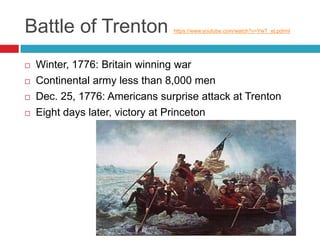
Battle of Trenton https://www.youtube.com/watch?v=YwT_eLpdrmI
 Winter, 1776: Britain winning war
 Continental army less than 8,000 men
 Dec. 25, 1776: Americans surprise attack at Trenton
 Eight days later, victory at Princeton
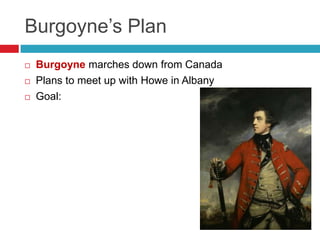
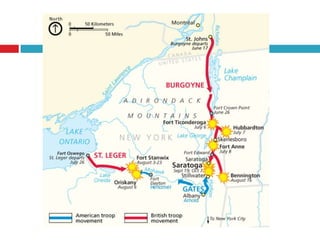
Burgoyne‟s Plan
 Burgoyne marches down from Canada
 Plans to meet up with Howe in Albany
 Goal:
Burgoyne‟s Plan (American Story of US)
 Why does Burgoyne‟s Plan fail?
 Aftermath of Saratoga
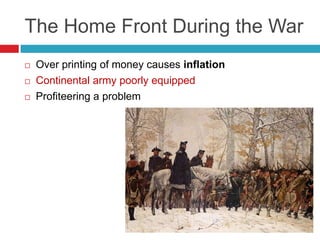
The Home Front During the War
 Over printing of money causes inflation
 Continental army poorly equipped
 Profiteering a problem
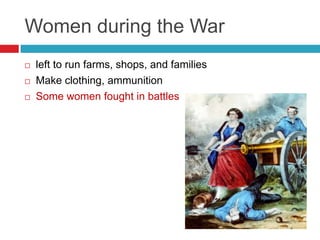
Women during the War
 left to run farms, shops, and families
 Make clothing, ammunition
 Some women fought in battles
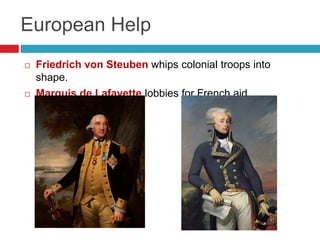
European Help
 Friedrich von Steuben whips colonial troops into
shape.
 Marquis de Lafayette lobbies for French aid
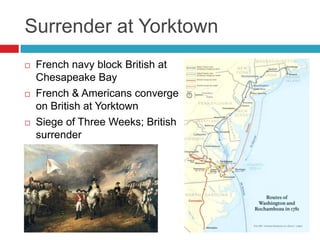
Surrender at Yorktown
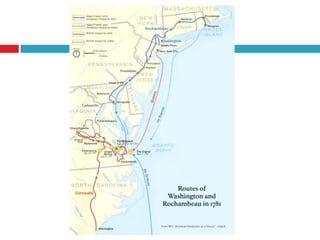
 French navy block British at
Chesapeake Bay
 French & Americans converge
on British at Yorktown
 Siege of Three Weeks; British
surrender
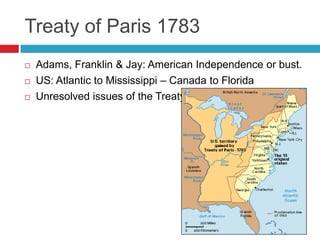
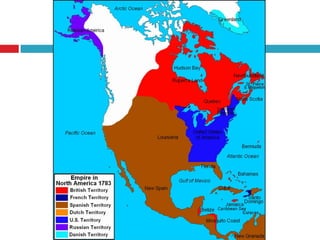
Treaty of Paris 1783
 Adams, Franklin & Jay: American Independence or bust.
 US: Atlantic to Mississippi – Canada to Florida
 Unresolved issues of the Treaty?
Aftermath of War
 Rise of egalitarianism…for some
 Now what…
How Revolutionary Was It?

Us history the war for independence

  • 2.
    Why can‟t Britainleave the colonies alone?
  • 3.
    Stamp Act (1765) Required to buy stamped paper  Affected elites – (publishers & lawyers)  Widely hated in colonies
  • 4.
    Sons of Liberty Organized to protest Stamp Act  Boycotts  Threatened & harassed customs officers  Samuel Adams  Patrick Henry  Benedict Arnold  John Hancock  Paul Revere  Benjamin Rush
  • 5.
    How is theStamp Act protested?  Colonial assemblies refuse to cooperate  Colonial merchants refuse to import British goods  Parliament repeals
  • 7.
    What are theeffects of the Stamp Act? - Colonies bound together against Britain - Britain bends, but believes it can still assert authority
  • 8.
    Townshend Acts (1767) Taxes on imports  3 cents tax on tea  Boycotts of British goods  English goods fall out of fashion  2,000 British soldiers in America to stop smugglers
  • 9.
    The Boston Massacre(1770)  Growing tension between soldiers and citizens Why?  clash between a mob and soldiers  Shots ring out: five dead  Committees of correspondence
  • 10.
    Tea Act (1773) British East India Company can sell tea without paying taxes  Violent protests result  Boston Tea Party: 18,000 lbs of tea dumped into Boston Harbor  http://www.youtube.com/watch?v=Eytc9ZaNWyc&list=PL8dPuuaLjXtMwmepBjTSG593eG7ObzO7s&index=6 (4:50)
  • 12.
    Intolerable Acts (1774) Boston Harbor shut down  Quartering Act: British soldiers housed in private homes  Martial law declared in Boston  First Continental Congress: supports protests & asserts colonial rights
  • 13.
    Lexington & Concord British attempt to destroy munitions stockpile in Concord  Colonists organize to meet the soldiers  British soldiers destroyed marching back to Boston
  • 15.
  • 16.
    Second Continental Congress Debating separation vs. reconciliation  Arguments:  Militiamen are now “Continental Army”  Prints money  Sends delegates to foreign governments
  • 17.
    Olive Branch Petition What does it mean to “extend an olive branch”?  Urges a return to “the former harmony”  Rejected by King George III  Declares colonies in revolt  Orders blockade
  • 18.
    Declaring Independence  June7, 1776: Richard Henry Lee moves an independence resolution  Thomas Jefferson writes a formal declaration.  Why is it important to include Virginians?  July 2: Congress votes for independence  https://www.youtube.com/watch?v=AZ0Nkdi-GpE
  • 19.
    Declaration of Independence Draws from Locke‟s theory of “natural rights”  Government‟s power comes from the people  What did “all men are created equal” mean?
  • 20.
    Declaration of Independence Intro: “We have a right to declare independence.”  Preamble: “Revolution is just when natural rights are harmed.”  Indictment: “These are the „repeated injuries‟ of the king.”  Conclusion: “Our case is made; the fault lies with Britain.”  We hold these truths to be self-evident, that all men are created equal, that they are endowed by their Creator with certain unalienable Rights, that among these are Life, Liberty and the pursuit of Happiness. — That to secure these rights, Governments are instituted among Men, deriving their just powers from the consent of the governed, — That whenever any Form of Government becomes destructive of these ends, it is the Right of the People to alter or to abolish it, and to institute new Government, laying its foundation on such principles and organizing its powers in such form, as to them shall seem most likely to effect their Safety and Happiness.
  • 21.
  • 22.
  • 23.
    Revolutionary War Four Questions Who‟s fighting?  Who won?  Where is it fought?  Why?
  • 24.
  • 25.
    Battle of Trentonhttps://www.youtube.com/watch?v=YwT_eLpdrmI  Winter, 1776: Britain winning war  Continental army less than 8,000 men  Dec. 25, 1776: Americans surprise attack at Trenton  Eight days later, victory at Princeton
  • 26.
    Burgoyne‟s Plan  Burgoynemarches down from Canada  Plans to meet up with Howe in Albany  Goal:
  • 28.
    Burgoyne‟s Plan (AmericanStory of US)  Why does Burgoyne‟s Plan fail?  Aftermath of Saratoga
  • 29.
    The Home FrontDuring the War  Over printing of money causes inflation  Continental army poorly equipped  Profiteering a problem
  • 30.
    Women during theWar  left to run farms, shops, and families  Make clothing, ammunition  Some women fought in battles
  • 31.
    European Help  Friedrichvon Steuben whips colonial troops into shape.  Marquis de Lafayette lobbies for French aid
  • 32.
    Surrender at Yorktown French navy block British at Chesapeake Bay  French & Americans converge on British at Yorktown  Siege of Three Weeks; British surrender
  • 34.
    Treaty of Paris1783  Adams, Franklin & Jay: American Independence or bust.  US: Atlantic to Mississippi – Canada to Florida  Unresolved issues of the Treaty?
  • 36.
    Aftermath of War Rise of egalitarianism…for some  Now what…
  • 37.

Editor's Notes

  • #8 - Colonies bound together against Britain- Britain bends, but believes it can still assert authority