Introduction
History 7 women in 1959 initiated a venture to earn additional income through better use of their idle time Household materials were used to make these products Low overheads and prices created demand for their product. Number rose 7 to 25 within 3 months and 300 member at the end of third year Equal profit sharing among group members irrespective of individual contribution.
Contd… Mode of Profit sharing decided at individual branch level Functioned first seven years( 1959 -1966 ) as an unregistered organization In 1966-67, Lijjat was registered as a public trust recognized by Khadi and Village Industries Commission(KVIC) as a unit belonging to “Processing  of Cereals and pulses industry group”  Tax breaks Interest subsidies
Standard Operating Procedure Prepared papads were delivered to branch office next morning while another batch of pre-mixed dough collected for next-day production Quality check was done by experienced members through Visual inspection  Payment for production was done the following day Accounts prepared every evening and vetted by a Sanchalika. If incomplete, the branch doesn’t open for next day operations Accounts – easily accessible to every member-sister for greater transparency
Contd… Identified commission agents and dealt only in cash. Credit only for outside supply of raw material 62 branches all over India 17 in Mumbai suburbs 11 in rest of Maharashtra 12 in Gujarat 23 branches spread across AP, Bihar, Karnataka etc.
Contd… Initially, Additional facilities were rented for rolling and drying papads as and when needed After third year, Decentralization of production from a centralized location to individual member homes Lijjat created a market niche through brand building over the years. Marketing was ensured through sales offices  Home fresh nature of the Product Word of Mouth publicity
Quality Check  Quality of Papads can vary according to the water used in various parts of India Final products are tested in the Lijjat's laboratory in Mumbai In the monthly meetings, the quality issue and modifications are tested Ingredients purchased and distributed by the Central Office to maintain the quality  Procurement of Ingredients Urad dal from Myanmar Asafetida from Iran Black Pepper from Kerala Surprise visits to various branches to ensure production conditions are hygienic
Contd… When a new branch of Lijjat opens, a neighboring Lijjat branch helps it by guiding and training new members. Successive failures of a branch to abide by the organization's philosophy of consistent quality and production of papads, the central committee reduces the daily wages of its members by 1 rupee Members also rewarded for extra effort  Rajkot members in 2002 received Rs. 4000 as bonus Several issues of Lijjat Patrika enumerate the names of the names/numbers of the  member-sisters
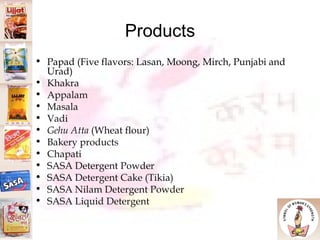
Products Papad (Five flavors: Lasan, Moong, Mirch, Punjabi and Urad)‏ Khakra Appalam Masala Vadi Gehu Atta  (Wheat flour)‏ Bakery products Chapati SASA Detergent Powder SASA Detergent Cake (Tikia)‏ SASA Nilam Detergent Powder SASA Liquid Detergent
Divisions Flour Division (Vashi)‏ Masala Division and Quality Control Laboratory (Cotton Green)‏ Printing Division (Cotton Green)‏ Advertising Division, Bandra Khakra Division, (Buhari, Valod district)‏ Chapati Divisions at Wadala, Borivali, Mulund and Kandivali Polypropylene set-up (Kashi-mira Road)‏ Vadi factory (Valod)‏ Bakery Division (Valod)‏ Detergent Powder and Cakes manufacturing unit (Dahisar) and office (Borivali)‏
Culture and Leadership
Founders Seven women with no special skills but a strong determination to earn dignity as individuals  Jaswantiben Jamnadas Popat Parvatiben Ramdas Thodani Ujamben Narandas Kundalia Banuben N. Tanna Laguben Amritlar Gokani  Jayaben V. Vithalani and One more whose name is not available
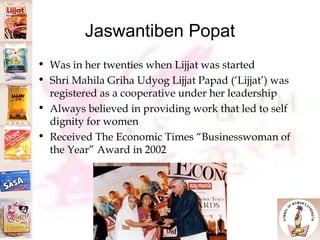
Jaswantiben Popat Was in her twenties when Lijjat was started Shri Mahila Griha Udyog Lijjat Papad (‘Lijjat’) was registered as a cooperative under her leadership Always believed in providing work that led to self dignity for women Received The Economic Times “Businesswoman of the Year” Award in 2002
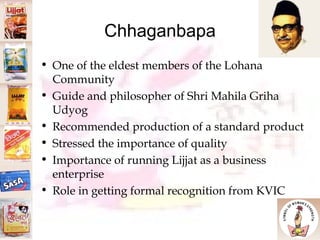
Chhaganbapa One of the eldest members of the Lohana Community Guide and philosopher of Shri Mahila Griha Udyog Recommended production of a standard product Stressed the importance of quality Importance of running Lijjat as a business enterprise Role in getting formal recognition from KVIC
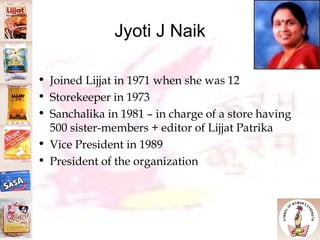
Jyoti J Naik Joined Lijjat in 1971 when she was 12 Storekeeper in 1973 Sanchalika in 1981 – in charge of a store having 500 sister-members + editor of Lijjat Patrika Vice President in 1989 President of the organization
Philosophy Follows Mahatma Gandhi’s principles of  sarvodaya  and trusteeship Basis of collective ownership Self employment, dignity of labour and earning capacity for women All members as owners Women’s empowerment Share profits Mobility of labour & access to going up the  ladder - seniority within the sisterhood
Core values An organization of the women, for the women and by the women Pledge to ensure that all get the fruits of labour, no harm is caused to the institution and  Synthesis of 3 different concepts The concept of Business Production of quality goods at reasonable prices The concept of family Mutual family affection, concern and trust The concept of Devotion  ‘ Work is worship’
Welfare schemes for members Literacy campaign ‘Akshardeep’ started in 1999 for its members in Bhubhaneshwar Literacy programmes in other states Guidance on further studies Educational and hobby centres for rural women  Free computer training to sisters’ children Loans and housing assistance
Opportunity Identification & Innovation
Innovative… coz It’s a WOMAN’s World Lijjat Papad is about women. It provides work - and work that gives self-dignity. Only women are eligible to join or, in the organization’s parlance, to become sister-members  Approximately 41,000 women work in 62 regional branches
Innovative coz it taps the fortune at the BOP The women employed are poor, and are often the sole earners in their households. If they do not earn here, they will not eat at home  Pro-poor bias is part of the institution’s genetic code
Innovative   coz its tech-free The company has intentionally not introduced any kind of technology in the production of papads, as this would lead to the loss of workplaces
Commendable coz its profitable Despite or maybe because of its approach, Lijjat is a profit-oriented company “ Without an income, our company’s existence would be at stake. A proficient corporate management is indispensable to achieve profits,” is a central message in the company guidelines.
Clean and Clear Lijjat makes it a principle not to grant credit or discounts – not even to dealers with whom the organization has successfully cooperated for decades Moreover, the company has never accepted charities or grants, in order to maintain its independence and thus protect the self-dignity of the associated women
Uniqueness It is primarily a cottage industry, urban in its origin.It has eventually spread to the rural areas and to the other cities and towns in several states of India Essence was to provide self employment, dignity of labor and earning capacity for women In contrast to other Indian women, the workers actually own Lijjat – collective ownership The company is a cooperative that implements Mahatma Gandhi’s principles of “self-help” and “trusteeship”
Spreading the Lijjat family Joining up is not at all difficult: Every woman, who with her signature pledges to adhere to the company’s basic tenets of mutual trust, devotion, and quality at reasonable prices, is accepted with no further formalities or preconditions It’s a self-propelling process of economic empowerment of women
Easy to start because No barriers to entry such as skills making papad is like a birthright to the Indian woman No education or vocational training needed to learn the business
Easy to spread because The model is scaleable unlike a crafts-based cottage industry Has followed strategy of replicating the standard operating structure and procedures of the original Mumbai model in other branches From an initial membership of 7 women in Mumbai, Lijjat today has over 42,000 women across the country. Has grown from one roof to 63 branches and 40 divisions spread across 17 states
Also spread because Expansion was caused by a ‘demand pull’ Word of mouth publicity Good quality, natural products Attractive pricing Regularity and reliability of supply Separate marketing, sales & advertising divisions
Diversification to spread further To use the positive brand image of Lijjat to promote other products Related Khakra Atta Masala Unrelated Leather Matches Detergent (Sasa)‏
In-home Growth Members who show leadership skills are given such as administrative issues and can gradually go on to becomes  sanchalikas  or branch heads
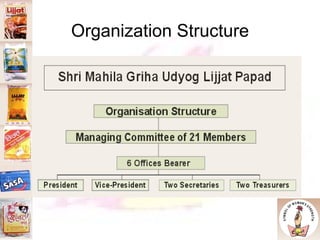
Organization Structure
Value Creation and Impact
Value Creation Women empowerment Uniting women under the co-operative for social welfare Making profit through a social venture Shown a way in which a cooperative can work as well as an MNC
Women empowerment Making 41,000 illiterate women as entrepreneurs Each women earns Rs 2,000 to Rs 3,000 every month for her roughly six hours of work everyday from home Re – enforces the  Gandhian principles of self-help and trusteeship Lijjat believes in the philosophy of sarvodaya and collective ownership. It accepts all its working members as the owners and an equal partaker in both profit and loss.
Key elements of empowerment All the decisions are based on consensus and any member-sister has the right to veto a decision Use of Technology is rejected as it would displace jobs Profits and losses are shared equally among the members of a given branch There is no fixed retirement age at Lijjat as the motive is emphasis obviously was on earning one's bread through daily work, all through one's life
Uniting women for social welfare Lijjat gives Chhaganbapa Smruti Scholarships to the daughters of the member-sisters  Lijjat has started an educational and hobby centre for the rural women Lijjat teamed up with UNICEF to organize a seminar in Mumbai on "Child Care and Mother Welfare Lijjat undertook the rehabilitation of Chincholi (Jogan), the earthquake affected village in the Latur district of Maharashtra.
Uniting women for social welfare Lijjat Patrika, the in-house magazine has emerged as a strong mode of communication for information related to significant events and initiatives at Lijjat, in addition to presenting articles on women The organization has undertaken various efforts to promote literacy and computer education for member-sisters and their families
Uniting women for social welfare Organization is based on the principle of sisterhood - pledge allegiance to common values of responsibility, equality, and rejection of charity Men can only be salaried employees (accountants, drivers or security guards), and not the members of the organization  When a new branch of Lijjat opens, a neighboring Lijjat branch helps it by guiding and training new members so that even these new women members can prosper
Profit Generation Profit generation is considered essential as that is what makes the organization self sustainable  Less number of administrative staff per centre to reduce expenses Own network of suppliers as the product range does not give credit to the retailers Today, Lijjat Papad is the generic reference for papads Each branch is responsible for all activities from production to packaging to collection and distribution of vanai and profit for its particular geographical region. This ensures that each branch works efficiently with profit as motive
Co-operative or an MNC? Identified a need and converted that it into a business using the basic skill that every women has i.e. cooking and now that business generates turnover of more than Rs. 3.1bn  Innovation has been a crucial driver for the co-operative.The co-operative has started a new venture for chappati which is based on the fact that in metror the pace of life is fast and people don’t have time to cook food so women form small groups and cater to the local demand for homemade chapatti or similar products. These chappatis are sold to hotels, office canteens, etc.
Co-operative or an MNC? Converted a loss-making papad making venture by one Laxmidasbhai into a profitable business  Focus on quality to make sure that the business works in long term Proper accounts and all labor laws followed Diversification into other products such as soaps, vadis etc. To maintain consistency of the product the central office purchases and distributes all ingredients to maintain the quality of the final product. For example, the urad dal is imported from Myanmar, asafetida is imported from Iran, and black pepper comes from Kerala
Co-operative or an MNC? There are separate divisions of advertising, marketing, sales promotion and exports To get publicity advertising was undertaken through the vernacular newspapers, television and radio to reach all segments of the society The organization’s structure is very efficient and transparent with each branch having a committee of eleven member-sisters, chosen by consensus.
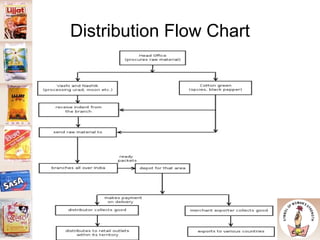
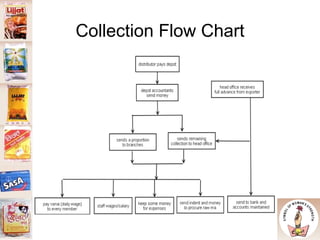
Co-operative or an MNC? Member-sisters are also rewarded for extra effort and penalized for bad quality as well Lijjat calculates an estimate of the quantity each distributor will take, and thus produce accordingly. This ensures that there is neither stock inventory  damages for storage The collection and the distribution flowchart for materials and finished products is as efficient as any MNC
Distribution Flow Chart
Collection Flow Chart
Measuring Impact Lijjat recevied the "Best Village Industries Institution" award from KVIC for the period 1998-99 to 2000-01. In 2002, the "Businesswoman of the Year" award was given to "The Women Behind Lijjat Papad" at The Economic Times Awards for Corporate Excellence Mumbai City felicitated Smt.Rukminiben B.Pawar, Lijjat President, as an outstanding woman in the field of social work After the 2001 Gujarat earthquake, all the branches of Lijjat gave a total donation of more than Rs 4.8 million, including Rs 1 million from the central office
Measuring Impact In many parts of Maharashtra and Gujarat, locally manufactured and marketed eatables are catching on.  There is hardly any NGO or voluntary organization nowadays which does not try to create employment and funds, small or big, along Lijjat’s line Confident with its success Lijjat has been trying to rewrite its own success with another products like khakhra, black pepper powder, detergent powder and cake, vadi, bakery products, wheat flour with varying degree of success
The Growth Membership has  expanded from an initial number of 7 sisters from one building to over 40,000 sisters throughout India.  The organisation is wide-spread, with it's Central Office at Mumbai and it's 67 Branches and 35 Divisions in different states all over India.  The venture started with Rs 80. Lijjat’s annual sales increased from Rs 6,196 in 1959 to more than Rs 3 billion in 2002, with exports itself exceeding Rs. 12 crores.
Sustainability
Key factors contributing to the sustainability Worker’s Cooperative Financials  Exports Quality Management Diversification Membership/Working Culture Self Perception as a business entity Approach to the business Transparency in operations Highly integrated  and flexible operational model
Registered as a Cooperative A   cooperative  owned and democratically controlled by its employees.  There are no outside or consumer owners in a worker cooperative Only the workers own shares of the business. Only one membership share may be issued to a member One membership share is the equivalent of one vote Membership is not compulsory for employees, but only employees can become members And of course the tax benefits
Financials The accumulated profits of the Lijjat enterprise stand at Rs. 48.32 crores The annual profit for the year are Rs. 6.54 crores. This was achieved on an annual turnover in 2003-04 of Rs. 310 crores. The average monthly income to each worker is Rs.3000/ All transactions are recorded on a daily basis P & L and Balance Sheet are prepared every month Branch doesn’t open for transaction in case the accounts are incomplete for the previous day
Financials Generation of resources and rotating working capital on a weekly/biweekly cycle Marketing is on a strictly cash-and-carry basis, allowing for funds to be continuously recycled  The Sisters Savings Fund is also available to the each of the Lijjat branches, to tide over short-term cash deficits, in case of necessity.  Loans of Rs. 8.94 lakhs under the Processing Cereals and Pulses Industry Scheme., for expansion of existing branches, establishment of new ones and for purchase of equipment for the masala unit  On the whole, labour charges work out to about 20-25 per cent of the total cost, with raw materials consuming 55-60 per cent and sales and other administrative expenses making up the remaining 20 per cent
Exports Lijjat’s exports alone account for Rs 10 crore (Rs 100 million)‏ Not directly involved in exporting, but recognised professional merchant exporters (who also export other food products) place an export order  Only on receiving the full advance through a cheque production is undertaken.  Because all exports are done from Mumbai, the supply also comes from here.  Export production is of the same quality as daily production. Again with exporters, responsibility ends with delivery At present, 30 per cent to 35 per cent of the production of Lijjat Papad is being exported, mainly to countries like the United States, the United Kingdom, the Middle East, Singapore, Hong Kong and Holland.
The Transaction Raw material (dough)-Mumbai Distributed to all the branches across India Branch Manager (Sanchalika) distributes it to members for rolling and drying Once through with it members return the dried papad (and the cycle is repeated)‏ Payment is made the next day of delivery after quality check Local demand is met through local fixed commission agents Advance payment is charged from these agents apart from a security deposit No retail sales is made
Sustaining Quality: The Core Competence Central purchasing and processing of raw material like dal etc into flour Training is given at the time of induction so as to ensure same process and recipe is followed at each and every member Quality check center at every branch Each and every packet has to pass quality assessment check Bad/Inferior quality products are destroyed 1kg dough must produce 800gms of final output failing which pay is cut
Diversification Related Diversification The Khakra division set up in 1974,  Flour mills in 1975, Masala division in 1976 It relied on the goodwill for the Lijjat brand and thus there was no focused marketing effort.  Recently, Lijjat has ventured into the supply of chapattis in Mumbai. Unrelated diversification There were failures such as leather and production of matches.  The most successful diversification was the production of detergent SASA SASA has 6 production units, a research and quality control division and a sales and purchase office. Occupying a niche in a highly price sensitive market without the advertising blitz associated with larger brands
Business is the Motto Run and perceived as a serious business, not a charity organisation.  There is no place for feelings of pity, sympathy or charity among members.  We also do not accept donation or charity of any kind, even if voluntarily offered.  This has helped the organisation retain independence and brought quick growth.  It has given clear vision of the path of progress. Maintaining proper accounts has always been on our agenda Every branch closes the account book every day
Membership Any woman who pledges to adopt the institution's values and who has respect for quality can become a member and co-owner of the organisation Another important fact about the institution is that no male can become a member and no male employee whether working or honorary or on salary basis has voting rights.  Women from any caste, religion and community can join the organization No place for prejudice on the basis of caste or religion, and democracy in its truest form is encouraged
We don’t solve management problems, but avoid them Production is carried out not in one central location but in hundreds and thousands of individual homes Each branch is responsible for all activities from production to packaging to collection and distribution of  vanai  and profit for its particular geographical region The branch system ensures that every activity happens within its own ambit. Testing for quality and packaging are done at every branch Avoids logistical nightmare Helps promoting the culture of: Performance = Profit  (A straight and direct relationship on a branch to branch basis)‏
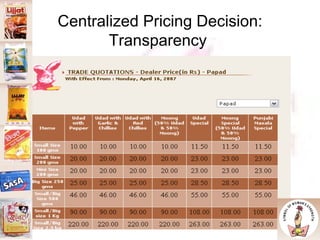
Contd… Certain activities, however, are centralised. For one, all raw materials are purchased in Mumbai and then distributed to the 62 branches to ensure consistent quality of Lijjat Papad.  Given the vastness of India, every region produces different quality of urad, rice, spices, et cetera. If procured locally, the final product would never be consistent in quality and Lijjat would have no USP (unique selling proposition) in the market.  The other centralised process is the grinding of flour. Lijjat owns two grinding mills, one in Vashi (Navi Mumbai) and one in Nashik (in Maharashtra). Since the raw material is purchased in Mumbai, grinding the flour at our own mills helps reduce costs.  Pricing of the products is also done at the head office Daily maintenance of accounts avoids monetary hassles
Business Transparency Each branch office is responsible for setting a target for monthly production and the marketing Each Lijjat centre has a clearly delineated marketing territory to avoid competition amongst centres Commission agents are attached to almost all Lijjat Centres and they account for a major part of the Lijjat sales Lijjat has a separate marketing, sales, and advertising divisions Same prices across the category
Centralized Pricing Decision: Transparency
Flexibility The decentralised production methodology has ensured that the women do not have to leave their homes for work  It allows them flexible working schedule enabling them to discharge other household responsibilities  This account for the easy acceptance of the work among such a large number of women since they feel their economic activity will not disrupt the family by their absence Men are also less hostile to women working at home for extra income than travelling to a workplace Self selection of work by the members
Summing it up Lijjat provides economic opportunities through a domestic activity The merging of ownership with membership has encouraged uniform and sustained organizational growth The consistent quality of the product has been a primary factor in establishing and maintaining Lijjat’s brand image in the market for the last four decades The Sarvodaya philosophy proved vital in forming Lijjat’s foundation Transparency in operations and a nonhierarchical structure has helped in establishing organizational accountability among member sisters
THANK YOU.

08 Lijjat

  • 1.
  • 2.
  • 3.
    History 7 womenin 1959 initiated a venture to earn additional income through better use of their idle time Household materials were used to make these products Low overheads and prices created demand for their product. Number rose 7 to 25 within 3 months and 300 member at the end of third year Equal profit sharing among group members irrespective of individual contribution.
  • 4.
    Contd… Mode ofProfit sharing decided at individual branch level Functioned first seven years( 1959 -1966 ) as an unregistered organization In 1966-67, Lijjat was registered as a public trust recognized by Khadi and Village Industries Commission(KVIC) as a unit belonging to “Processing of Cereals and pulses industry group” Tax breaks Interest subsidies
  • 5.
    Standard Operating ProcedurePrepared papads were delivered to branch office next morning while another batch of pre-mixed dough collected for next-day production Quality check was done by experienced members through Visual inspection Payment for production was done the following day Accounts prepared every evening and vetted by a Sanchalika. If incomplete, the branch doesn’t open for next day operations Accounts – easily accessible to every member-sister for greater transparency
  • 6.
    Contd… Identified commissionagents and dealt only in cash. Credit only for outside supply of raw material 62 branches all over India 17 in Mumbai suburbs 11 in rest of Maharashtra 12 in Gujarat 23 branches spread across AP, Bihar, Karnataka etc.
  • 7.
    Contd… Initially, Additionalfacilities were rented for rolling and drying papads as and when needed After third year, Decentralization of production from a centralized location to individual member homes Lijjat created a market niche through brand building over the years. Marketing was ensured through sales offices Home fresh nature of the Product Word of Mouth publicity
  • 8.
    Quality Check Quality of Papads can vary according to the water used in various parts of India Final products are tested in the Lijjat's laboratory in Mumbai In the monthly meetings, the quality issue and modifications are tested Ingredients purchased and distributed by the Central Office to maintain the quality Procurement of Ingredients Urad dal from Myanmar Asafetida from Iran Black Pepper from Kerala Surprise visits to various branches to ensure production conditions are hygienic
  • 9.
    Contd… When anew branch of Lijjat opens, a neighboring Lijjat branch helps it by guiding and training new members. Successive failures of a branch to abide by the organization's philosophy of consistent quality and production of papads, the central committee reduces the daily wages of its members by 1 rupee Members also rewarded for extra effort Rajkot members in 2002 received Rs. 4000 as bonus Several issues of Lijjat Patrika enumerate the names of the names/numbers of the member-sisters
  • 10.
    Products Papad (Fiveflavors: Lasan, Moong, Mirch, Punjabi and Urad)‏ Khakra Appalam Masala Vadi Gehu Atta (Wheat flour)‏ Bakery products Chapati SASA Detergent Powder SASA Detergent Cake (Tikia)‏ SASA Nilam Detergent Powder SASA Liquid Detergent
  • 11.
    Divisions Flour Division(Vashi)‏ Masala Division and Quality Control Laboratory (Cotton Green)‏ Printing Division (Cotton Green)‏ Advertising Division, Bandra Khakra Division, (Buhari, Valod district)‏ Chapati Divisions at Wadala, Borivali, Mulund and Kandivali Polypropylene set-up (Kashi-mira Road)‏ Vadi factory (Valod)‏ Bakery Division (Valod)‏ Detergent Powder and Cakes manufacturing unit (Dahisar) and office (Borivali)‏
  • 12.
  • 13.
    Founders Seven womenwith no special skills but a strong determination to earn dignity as individuals Jaswantiben Jamnadas Popat Parvatiben Ramdas Thodani Ujamben Narandas Kundalia Banuben N. Tanna Laguben Amritlar Gokani Jayaben V. Vithalani and One more whose name is not available
  • 14.
    Jaswantiben Popat Wasin her twenties when Lijjat was started Shri Mahila Griha Udyog Lijjat Papad (‘Lijjat’) was registered as a cooperative under her leadership Always believed in providing work that led to self dignity for women Received The Economic Times “Businesswoman of the Year” Award in 2002
  • 15.
    Chhaganbapa One ofthe eldest members of the Lohana Community Guide and philosopher of Shri Mahila Griha Udyog Recommended production of a standard product Stressed the importance of quality Importance of running Lijjat as a business enterprise Role in getting formal recognition from KVIC
  • 16.
    Jyoti J NaikJoined Lijjat in 1971 when she was 12 Storekeeper in 1973 Sanchalika in 1981 – in charge of a store having 500 sister-members + editor of Lijjat Patrika Vice President in 1989 President of the organization
  • 17.
    Philosophy Follows MahatmaGandhi’s principles of sarvodaya and trusteeship Basis of collective ownership Self employment, dignity of labour and earning capacity for women All members as owners Women’s empowerment Share profits Mobility of labour & access to going up the ladder - seniority within the sisterhood
  • 18.
    Core values Anorganization of the women, for the women and by the women Pledge to ensure that all get the fruits of labour, no harm is caused to the institution and Synthesis of 3 different concepts The concept of Business Production of quality goods at reasonable prices The concept of family Mutual family affection, concern and trust The concept of Devotion ‘ Work is worship’
  • 19.
    Welfare schemes formembers Literacy campaign ‘Akshardeep’ started in 1999 for its members in Bhubhaneshwar Literacy programmes in other states Guidance on further studies Educational and hobby centres for rural women Free computer training to sisters’ children Loans and housing assistance
  • 20.
  • 21.
    Innovative… coz It’sa WOMAN’s World Lijjat Papad is about women. It provides work - and work that gives self-dignity. Only women are eligible to join or, in the organization’s parlance, to become sister-members Approximately 41,000 women work in 62 regional branches
  • 22.
    Innovative coz ittaps the fortune at the BOP The women employed are poor, and are often the sole earners in their households. If they do not earn here, they will not eat at home Pro-poor bias is part of the institution’s genetic code
  • 23.
    Innovative coz its tech-free The company has intentionally not introduced any kind of technology in the production of papads, as this would lead to the loss of workplaces
  • 24.
    Commendable coz itsprofitable Despite or maybe because of its approach, Lijjat is a profit-oriented company “ Without an income, our company’s existence would be at stake. A proficient corporate management is indispensable to achieve profits,” is a central message in the company guidelines.
  • 25.
    Clean and ClearLijjat makes it a principle not to grant credit or discounts – not even to dealers with whom the organization has successfully cooperated for decades Moreover, the company has never accepted charities or grants, in order to maintain its independence and thus protect the self-dignity of the associated women
  • 26.
    Uniqueness It isprimarily a cottage industry, urban in its origin.It has eventually spread to the rural areas and to the other cities and towns in several states of India Essence was to provide self employment, dignity of labor and earning capacity for women In contrast to other Indian women, the workers actually own Lijjat – collective ownership The company is a cooperative that implements Mahatma Gandhi’s principles of “self-help” and “trusteeship”
  • 27.
    Spreading the Lijjatfamily Joining up is not at all difficult: Every woman, who with her signature pledges to adhere to the company’s basic tenets of mutual trust, devotion, and quality at reasonable prices, is accepted with no further formalities or preconditions It’s a self-propelling process of economic empowerment of women
  • 28.
    Easy to startbecause No barriers to entry such as skills making papad is like a birthright to the Indian woman No education or vocational training needed to learn the business
  • 29.
    Easy to spreadbecause The model is scaleable unlike a crafts-based cottage industry Has followed strategy of replicating the standard operating structure and procedures of the original Mumbai model in other branches From an initial membership of 7 women in Mumbai, Lijjat today has over 42,000 women across the country. Has grown from one roof to 63 branches and 40 divisions spread across 17 states
  • 30.
    Also spread becauseExpansion was caused by a ‘demand pull’ Word of mouth publicity Good quality, natural products Attractive pricing Regularity and reliability of supply Separate marketing, sales & advertising divisions
  • 31.
    Diversification to spreadfurther To use the positive brand image of Lijjat to promote other products Related Khakra Atta Masala Unrelated Leather Matches Detergent (Sasa)‏
  • 32.
    In-home Growth Memberswho show leadership skills are given such as administrative issues and can gradually go on to becomes sanchalikas or branch heads
  • 33.
  • 34.
  • 35.
    Value Creation Womenempowerment Uniting women under the co-operative for social welfare Making profit through a social venture Shown a way in which a cooperative can work as well as an MNC
  • 36.
    Women empowerment Making41,000 illiterate women as entrepreneurs Each women earns Rs 2,000 to Rs 3,000 every month for her roughly six hours of work everyday from home Re – enforces the Gandhian principles of self-help and trusteeship Lijjat believes in the philosophy of sarvodaya and collective ownership. It accepts all its working members as the owners and an equal partaker in both profit and loss.
  • 37.
    Key elements ofempowerment All the decisions are based on consensus and any member-sister has the right to veto a decision Use of Technology is rejected as it would displace jobs Profits and losses are shared equally among the members of a given branch There is no fixed retirement age at Lijjat as the motive is emphasis obviously was on earning one's bread through daily work, all through one's life
  • 38.
    Uniting women forsocial welfare Lijjat gives Chhaganbapa Smruti Scholarships to the daughters of the member-sisters Lijjat has started an educational and hobby centre for the rural women Lijjat teamed up with UNICEF to organize a seminar in Mumbai on "Child Care and Mother Welfare Lijjat undertook the rehabilitation of Chincholi (Jogan), the earthquake affected village in the Latur district of Maharashtra.
  • 39.
    Uniting women forsocial welfare Lijjat Patrika, the in-house magazine has emerged as a strong mode of communication for information related to significant events and initiatives at Lijjat, in addition to presenting articles on women The organization has undertaken various efforts to promote literacy and computer education for member-sisters and their families
  • 40.
    Uniting women forsocial welfare Organization is based on the principle of sisterhood - pledge allegiance to common values of responsibility, equality, and rejection of charity Men can only be salaried employees (accountants, drivers or security guards), and not the members of the organization When a new branch of Lijjat opens, a neighboring Lijjat branch helps it by guiding and training new members so that even these new women members can prosper
  • 41.
    Profit Generation Profitgeneration is considered essential as that is what makes the organization self sustainable Less number of administrative staff per centre to reduce expenses Own network of suppliers as the product range does not give credit to the retailers Today, Lijjat Papad is the generic reference for papads Each branch is responsible for all activities from production to packaging to collection and distribution of vanai and profit for its particular geographical region. This ensures that each branch works efficiently with profit as motive
  • 42.
    Co-operative or anMNC? Identified a need and converted that it into a business using the basic skill that every women has i.e. cooking and now that business generates turnover of more than Rs. 3.1bn Innovation has been a crucial driver for the co-operative.The co-operative has started a new venture for chappati which is based on the fact that in metror the pace of life is fast and people don’t have time to cook food so women form small groups and cater to the local demand for homemade chapatti or similar products. These chappatis are sold to hotels, office canteens, etc.
  • 43.
    Co-operative or anMNC? Converted a loss-making papad making venture by one Laxmidasbhai into a profitable business Focus on quality to make sure that the business works in long term Proper accounts and all labor laws followed Diversification into other products such as soaps, vadis etc. To maintain consistency of the product the central office purchases and distributes all ingredients to maintain the quality of the final product. For example, the urad dal is imported from Myanmar, asafetida is imported from Iran, and black pepper comes from Kerala
  • 44.
    Co-operative or anMNC? There are separate divisions of advertising, marketing, sales promotion and exports To get publicity advertising was undertaken through the vernacular newspapers, television and radio to reach all segments of the society The organization’s structure is very efficient and transparent with each branch having a committee of eleven member-sisters, chosen by consensus.
  • 45.
    Co-operative or anMNC? Member-sisters are also rewarded for extra effort and penalized for bad quality as well Lijjat calculates an estimate of the quantity each distributor will take, and thus produce accordingly. This ensures that there is neither stock inventory damages for storage The collection and the distribution flowchart for materials and finished products is as efficient as any MNC
  • 46.
  • 47.
  • 48.
    Measuring Impact Lijjatrecevied the "Best Village Industries Institution" award from KVIC for the period 1998-99 to 2000-01. In 2002, the "Businesswoman of the Year" award was given to "The Women Behind Lijjat Papad" at The Economic Times Awards for Corporate Excellence Mumbai City felicitated Smt.Rukminiben B.Pawar, Lijjat President, as an outstanding woman in the field of social work After the 2001 Gujarat earthquake, all the branches of Lijjat gave a total donation of more than Rs 4.8 million, including Rs 1 million from the central office
  • 49.
    Measuring Impact Inmany parts of Maharashtra and Gujarat, locally manufactured and marketed eatables are catching on. There is hardly any NGO or voluntary organization nowadays which does not try to create employment and funds, small or big, along Lijjat’s line Confident with its success Lijjat has been trying to rewrite its own success with another products like khakhra, black pepper powder, detergent powder and cake, vadi, bakery products, wheat flour with varying degree of success
  • 50.
    The Growth Membershiphas expanded from an initial number of 7 sisters from one building to over 40,000 sisters throughout India. The organisation is wide-spread, with it's Central Office at Mumbai and it's 67 Branches and 35 Divisions in different states all over India. The venture started with Rs 80. Lijjat’s annual sales increased from Rs 6,196 in 1959 to more than Rs 3 billion in 2002, with exports itself exceeding Rs. 12 crores.
  • 51.
  • 52.
    Key factors contributingto the sustainability Worker’s Cooperative Financials Exports Quality Management Diversification Membership/Working Culture Self Perception as a business entity Approach to the business Transparency in operations Highly integrated and flexible operational model
  • 53.
    Registered as aCooperative A cooperative owned and democratically controlled by its employees. There are no outside or consumer owners in a worker cooperative Only the workers own shares of the business. Only one membership share may be issued to a member One membership share is the equivalent of one vote Membership is not compulsory for employees, but only employees can become members And of course the tax benefits
  • 54.
    Financials The accumulatedprofits of the Lijjat enterprise stand at Rs. 48.32 crores The annual profit for the year are Rs. 6.54 crores. This was achieved on an annual turnover in 2003-04 of Rs. 310 crores. The average monthly income to each worker is Rs.3000/ All transactions are recorded on a daily basis P & L and Balance Sheet are prepared every month Branch doesn’t open for transaction in case the accounts are incomplete for the previous day
  • 55.
    Financials Generation ofresources and rotating working capital on a weekly/biweekly cycle Marketing is on a strictly cash-and-carry basis, allowing for funds to be continuously recycled The Sisters Savings Fund is also available to the each of the Lijjat branches, to tide over short-term cash deficits, in case of necessity. Loans of Rs. 8.94 lakhs under the Processing Cereals and Pulses Industry Scheme., for expansion of existing branches, establishment of new ones and for purchase of equipment for the masala unit On the whole, labour charges work out to about 20-25 per cent of the total cost, with raw materials consuming 55-60 per cent and sales and other administrative expenses making up the remaining 20 per cent
  • 56.
    Exports Lijjat’s exportsalone account for Rs 10 crore (Rs 100 million)‏ Not directly involved in exporting, but recognised professional merchant exporters (who also export other food products) place an export order Only on receiving the full advance through a cheque production is undertaken. Because all exports are done from Mumbai, the supply also comes from here. Export production is of the same quality as daily production. Again with exporters, responsibility ends with delivery At present, 30 per cent to 35 per cent of the production of Lijjat Papad is being exported, mainly to countries like the United States, the United Kingdom, the Middle East, Singapore, Hong Kong and Holland.
  • 57.
    The Transaction Rawmaterial (dough)-Mumbai Distributed to all the branches across India Branch Manager (Sanchalika) distributes it to members for rolling and drying Once through with it members return the dried papad (and the cycle is repeated)‏ Payment is made the next day of delivery after quality check Local demand is met through local fixed commission agents Advance payment is charged from these agents apart from a security deposit No retail sales is made
  • 58.
    Sustaining Quality: TheCore Competence Central purchasing and processing of raw material like dal etc into flour Training is given at the time of induction so as to ensure same process and recipe is followed at each and every member Quality check center at every branch Each and every packet has to pass quality assessment check Bad/Inferior quality products are destroyed 1kg dough must produce 800gms of final output failing which pay is cut
  • 59.
    Diversification Related DiversificationThe Khakra division set up in 1974, Flour mills in 1975, Masala division in 1976 It relied on the goodwill for the Lijjat brand and thus there was no focused marketing effort. Recently, Lijjat has ventured into the supply of chapattis in Mumbai. Unrelated diversification There were failures such as leather and production of matches. The most successful diversification was the production of detergent SASA SASA has 6 production units, a research and quality control division and a sales and purchase office. Occupying a niche in a highly price sensitive market without the advertising blitz associated with larger brands
  • 60.
    Business is theMotto Run and perceived as a serious business, not a charity organisation. There is no place for feelings of pity, sympathy or charity among members. We also do not accept donation or charity of any kind, even if voluntarily offered. This has helped the organisation retain independence and brought quick growth. It has given clear vision of the path of progress. Maintaining proper accounts has always been on our agenda Every branch closes the account book every day
  • 61.
    Membership Any womanwho pledges to adopt the institution's values and who has respect for quality can become a member and co-owner of the organisation Another important fact about the institution is that no male can become a member and no male employee whether working or honorary or on salary basis has voting rights. Women from any caste, religion and community can join the organization No place for prejudice on the basis of caste or religion, and democracy in its truest form is encouraged
  • 62.
    We don’t solvemanagement problems, but avoid them Production is carried out not in one central location but in hundreds and thousands of individual homes Each branch is responsible for all activities from production to packaging to collection and distribution of vanai and profit for its particular geographical region The branch system ensures that every activity happens within its own ambit. Testing for quality and packaging are done at every branch Avoids logistical nightmare Helps promoting the culture of: Performance = Profit (A straight and direct relationship on a branch to branch basis)‏
  • 63.
    Contd… Certain activities,however, are centralised. For one, all raw materials are purchased in Mumbai and then distributed to the 62 branches to ensure consistent quality of Lijjat Papad. Given the vastness of India, every region produces different quality of urad, rice, spices, et cetera. If procured locally, the final product would never be consistent in quality and Lijjat would have no USP (unique selling proposition) in the market. The other centralised process is the grinding of flour. Lijjat owns two grinding mills, one in Vashi (Navi Mumbai) and one in Nashik (in Maharashtra). Since the raw material is purchased in Mumbai, grinding the flour at our own mills helps reduce costs. Pricing of the products is also done at the head office Daily maintenance of accounts avoids monetary hassles
  • 64.
    Business Transparency Eachbranch office is responsible for setting a target for monthly production and the marketing Each Lijjat centre has a clearly delineated marketing territory to avoid competition amongst centres Commission agents are attached to almost all Lijjat Centres and they account for a major part of the Lijjat sales Lijjat has a separate marketing, sales, and advertising divisions Same prices across the category
  • 65.
  • 66.
    Flexibility The decentralisedproduction methodology has ensured that the women do not have to leave their homes for work It allows them flexible working schedule enabling them to discharge other household responsibilities This account for the easy acceptance of the work among such a large number of women since they feel their economic activity will not disrupt the family by their absence Men are also less hostile to women working at home for extra income than travelling to a workplace Self selection of work by the members
  • 67.
    Summing it upLijjat provides economic opportunities through a domestic activity The merging of ownership with membership has encouraged uniform and sustained organizational growth The consistent quality of the product has been a primary factor in establishing and maintaining Lijjat’s brand image in the market for the last four decades The Sarvodaya philosophy proved vital in forming Lijjat’s foundation Transparency in operations and a nonhierarchical structure has helped in establishing organizational accountability among member sisters
  • 68.