Managing and Caring for
Self
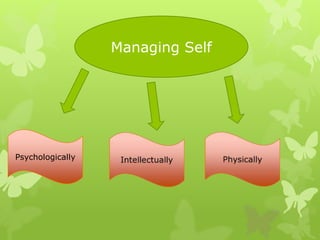
Managing Self
Psychologically
Managing Self includes:
 Knowing for Self for Self Development
• Self Concept, Personality, Traits, Multiple Intelligence
 Managing Self – Physical
• Personal grooming, Health, Hygiene, Time Management
 Managing Self- Intellectual Development
• Information Search, Reading, Note Taking, Writing
 Managing Self – Psychological
• Stress, Emotions, Anxiety and techniques to manage
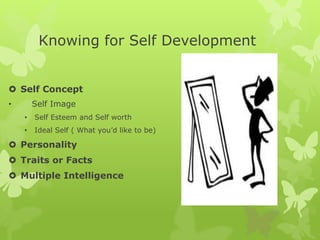
Knowing for Self Development
 Self Concept
• Self Image
• Self Esteem and Self worth
• Ideal Self ( What you’d like to be)
 Personality
 Traits or Facts
 Multiple Intelligence
SELF - CONCEPT
 The Self Concept is how we think about and evaluate ourselves.
 Self concept is made up of
 How we assess ourselves
 How we see our personality
 How we rate our skills and abilities
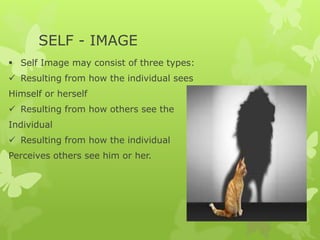
SELF - IMAGE
 Self Image may consist of three types:
 Resulting from how the individual sees
Himself or herself
 Resulting from how others see the
Individual
 Resulting from how the individual
Perceives others see him or her.
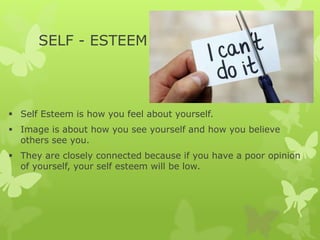
SELF - ESTEEM
 Self Esteem is how you feel about yourself.
 Image is about how you see yourself and how you believe
others see you.
 They are closely connected because if you have a poor opinion
of yourself, your self esteem will be low.
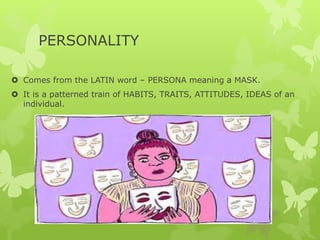
PERSONALITY
 Comes from the LATIN word – PERSONA meaning a MASK.
 It is a patterned train of HABITS, TRAITS, ATTITUDES, IDEAS of an
individual.
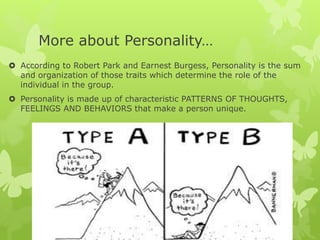
More about Personality…
 According to Robert Park and Earnest Burgess, Personality is the sum
and organization of those traits which determine the role of the
individual in the group.
 Personality is made up of characteristic PATTERNS OF THOUGHTS,
FEELINGS AND BEHAVIORS that make a person unique.
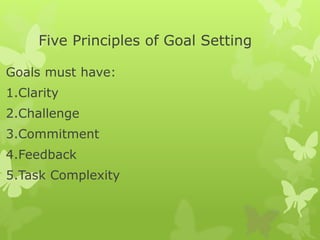
Five Principles of Goal Setting
Goals must have:
1.Clarity
2.Challenge
3.Commitment
4.Feedback
5.Task Complexity
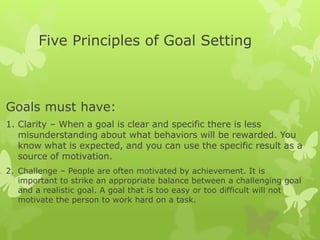
Five Principles of Goal Setting
Goals must have:
1. Clarity – When a goal is clear and specific there is less
misunderstanding about what behaviors will be rewarded. You
know what is expected, and you can use the specific result as a
source of motivation.
2. Challenge – People are often motivated by achievement. It is
important to strike an appropriate balance between a challenging goal
and a realistic goal. A goal that is too easy or too difficult will not
motivate the person to work hard on a task.
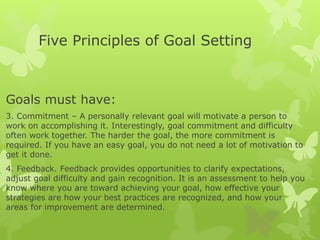
Five Principles of Goal Setting
Goals must have:
3. Commitment – A personally relevant goal will motivate a person to
work on accomplishing it. Interestingly, goal commitment and difficulty
often work together. The harder the goal, the more commitment is
required. If you have an easy goal, you do not need a lot of motivation to
get it done.
4. Feedback. Feedback provides opportunities to clarify expectations,
adjust goal difficulty and gain recognition. It is an assessment to help you
know where you are toward achieving your goal, how effective your
strategies are how your best practices are recognized, and how your
areas for improvement are determined.
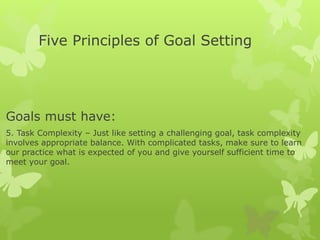
Five Principles of Goal Setting
Goals must have:
5. Task Complexity – Just like setting a challenging goal, task complexity
involves appropriate balance. With complicated tasks, make sure to learn
our practice what is expected of you and give yourself sufficient time to
meet your goal.
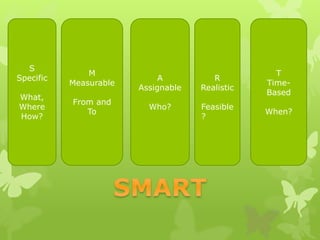
S
Specific
What,
Where
How?
M
Measurable
From and
To
A
Assignable
Who?
R
Realistic
Feasible
?
T
Time-
Based
When?
Specific…
 For you to be motivated to perform, you need
to have a specific goal. “Increase my grade” is
too vague. A specific goal would be” “Get a
grade of 95 in GEC Self.”
Measurable…
 A measurable goal is important so that you can
monitor your progress and receive feedback.
Thus, a specific and measurable goal would be,
“ Increase my grade in GEC Self from 2.0 to
1.0”
Assignable…
 You should be able to relate to your own goal.
Make your goal a personal commitment. For
example, “I will increase my grade in GEC Self
from 2.0 to 1.0.”
Realistic…
 You cannot just say, “I will increase my grade
in GEC Self from 2.0 to 1.0.” Likewise, you
should not set very low goals, such as “I will
increase my grade from 2.0 to 1.0” Goals that
are too difficult or too easy to achieve will not
positively motivate your performance. Set
goals that are difficult enough to be realistically
attained.
Time-related…
 A “habit” implies something that happens
regularly. Since “habits” are occur regularly,
these are also relatively quick to develop-
provided you stick to them! Setting a time
frame for your goal will require you to develop
a habit or routine.
 Once you have established your routine,
working toward your goal will come naturally
Managing and Caring for Self.pptx

Managing and Caring for Self.pptx

  • 1.
  • 2.
  • 3.
    Managing Self includes: Knowing for Self for Self Development • Self Concept, Personality, Traits, Multiple Intelligence  Managing Self – Physical • Personal grooming, Health, Hygiene, Time Management  Managing Self- Intellectual Development • Information Search, Reading, Note Taking, Writing  Managing Self – Psychological • Stress, Emotions, Anxiety and techniques to manage
  • 4.
    Knowing for SelfDevelopment  Self Concept • Self Image • Self Esteem and Self worth • Ideal Self ( What you’d like to be)  Personality  Traits or Facts  Multiple Intelligence
  • 5.
    SELF - CONCEPT The Self Concept is how we think about and evaluate ourselves.  Self concept is made up of  How we assess ourselves  How we see our personality  How we rate our skills and abilities
  • 6.
    SELF - IMAGE Self Image may consist of three types:  Resulting from how the individual sees Himself or herself  Resulting from how others see the Individual  Resulting from how the individual Perceives others see him or her.
  • 7.
    SELF - ESTEEM Self Esteem is how you feel about yourself.  Image is about how you see yourself and how you believe others see you.  They are closely connected because if you have a poor opinion of yourself, your self esteem will be low.
  • 8.
    PERSONALITY  Comes fromthe LATIN word – PERSONA meaning a MASK.  It is a patterned train of HABITS, TRAITS, ATTITUDES, IDEAS of an individual.
  • 9.
    More about Personality… According to Robert Park and Earnest Burgess, Personality is the sum and organization of those traits which determine the role of the individual in the group.  Personality is made up of characteristic PATTERNS OF THOUGHTS, FEELINGS AND BEHAVIORS that make a person unique.
  • 10.
    Five Principles ofGoal Setting Goals must have: 1.Clarity 2.Challenge 3.Commitment 4.Feedback 5.Task Complexity
  • 11.
    Five Principles ofGoal Setting Goals must have: 1. Clarity – When a goal is clear and specific there is less misunderstanding about what behaviors will be rewarded. You know what is expected, and you can use the specific result as a source of motivation. 2. Challenge – People are often motivated by achievement. It is important to strike an appropriate balance between a challenging goal and a realistic goal. A goal that is too easy or too difficult will not motivate the person to work hard on a task.
  • 12.
    Five Principles ofGoal Setting Goals must have: 3. Commitment – A personally relevant goal will motivate a person to work on accomplishing it. Interestingly, goal commitment and difficulty often work together. The harder the goal, the more commitment is required. If you have an easy goal, you do not need a lot of motivation to get it done. 4. Feedback. Feedback provides opportunities to clarify expectations, adjust goal difficulty and gain recognition. It is an assessment to help you know where you are toward achieving your goal, how effective your strategies are how your best practices are recognized, and how your areas for improvement are determined.
  • 13.
    Five Principles ofGoal Setting Goals must have: 5. Task Complexity – Just like setting a challenging goal, task complexity involves appropriate balance. With complicated tasks, make sure to learn our practice what is expected of you and give yourself sufficient time to meet your goal.
  • 14.
  • 15.
    Specific…  For youto be motivated to perform, you need to have a specific goal. “Increase my grade” is too vague. A specific goal would be” “Get a grade of 95 in GEC Self.”
  • 16.
    Measurable…  A measurablegoal is important so that you can monitor your progress and receive feedback. Thus, a specific and measurable goal would be, “ Increase my grade in GEC Self from 2.0 to 1.0”
  • 17.
    Assignable…  You shouldbe able to relate to your own goal. Make your goal a personal commitment. For example, “I will increase my grade in GEC Self from 2.0 to 1.0.”
  • 18.
    Realistic…  You cannotjust say, “I will increase my grade in GEC Self from 2.0 to 1.0.” Likewise, you should not set very low goals, such as “I will increase my grade from 2.0 to 1.0” Goals that are too difficult or too easy to achieve will not positively motivate your performance. Set goals that are difficult enough to be realistically attained.
  • 19.
    Time-related…  A “habit”implies something that happens regularly. Since “habits” are occur regularly, these are also relatively quick to develop- provided you stick to them! Setting a time frame for your goal will require you to develop a habit or routine.  Once you have established your routine, working toward your goal will come naturally