Business Associations:  Briefed by Tiffani L Hume (3L)Agency ,Partnership & Limited Liability CompaniesSources: * ALL SLIDES IN THIS PRESENTATION ARE REFERENCED FROM THE BELOW SOURCES: Conviser, R.J (2003) Gilbert Law Summaries: Agency, Partnership & Limited Liability Companies		BAR/BRI, Chicago, ILKaufman, M.J (2006) Gilbert Law Summaries: Agency and Partnership 				Loyola University of Chicago School of Law CD Series
What is an “Agency”?Definition:  “An agency is a fiduciary relationship arising from the mutual manifestation of consent that an agent shall act on behalf of and subject to the control of the principal” [Conviser, R.J (2003)].
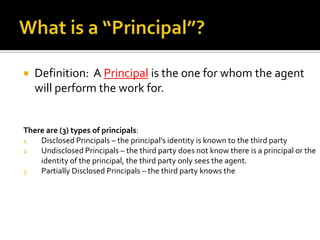
What is a “Principal”?Definition: A Principal is the one for whom the agent will perform the work for.  There are (3) types of principals:Disclosed Principals – the principal’s identity is known to the third partyUndisclosed Principals – the third party does not know there is a principal or the identity of the principal, the third party only sees the agent.Partially Disclosed Principals – the third party knows the
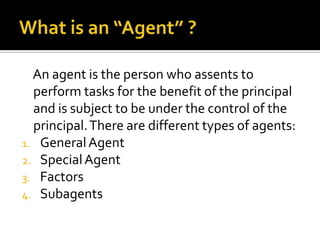
What is an “Agent” ?    An agent is the person who assents to perform tasks for the benefit of the principal and is subject to be under the control of the principal. There are different types of agents:General AgentSpecial AgentFactorsSubagents
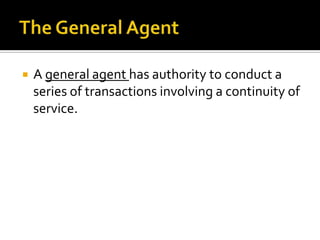
The General AgentA general agent has authority to conduct a series of transactions involving a continuity of service.
The Special AgentA special Agent has authority for only a single transaction or a series of transactions  not involving continuity of service.
FACTORSDefinition:  A Factor is a commercial agent employed to sell consigned merchandise in the agents own name for the principal
The SubagentWhen an agent has the authority to appoint another to assist in performing tasks for the principal – this person is considered a subagentIf the agent is authorized to appoint a subagent, the subagent will perform tasks for the principal just as the agent does.The Agent is responsible for the subagent primarily (pay, torts, etc)The Principal is liable for the “authorized” subagent “Secondarily”
The Subagent – part 2UNAUTHORIZED SUBAGENTSThese people are not considered subagentsThey are considered “agents of the agent”The principal is not responsible for the unauthorized agent – the agent who appointed the unauthorized agent is liable for the torts, contracts, payment of the agent and actions therein.
Working into Agency Law LiabilityThe most common question is:  Is the principal liable for the torts of his agent?The second part of this is:  “When, how and why?”To get to the answer, we must first find out IF there is an agency relationship in existence.
Requirements For An AgencyTo find out if there is a “Principal – Agent” relationship established three things must exist:ASSENTBENEFITCONTROL“ABC”  “ABC”  “ABC” “ABC” “ABC” “ABC” “ABC”
AgencyASSENT   Assent is an informal agreement between a principal with capacity and an agent
AgencyBENEFIT   The agent’s conduct must be for the principals benefit only
AgencyCONTROL   The principal must have the right to control the agent by having the power to supervise the manner of the agents performanceSubagents & Borrowed Agents – There can be no vicarious liability for a subagents or borrowed agents tort unless there is assent, benefit and the right to control the subagent or borrowed agent.
Agency Independent Contractors:  there is no power to control an independent contractor because there is no power to supervise the manner of an independent contractors performanceGENERALLY – there can be no liability for an independent contractors tortsEXCEPTION:   If the independent contractor is engaged in ULTRA HAZARDOUS activities or Estoppel is raised by a third party based on the principal holding out the I.C as one of his agents.
Determining the LiabilityOnce the relationship has been established and you can clearly state that there is a principal – agent relationship, we can then ask the question: “When is a principal liable for the torts of his agent (s)?”
Agency: Determining Liability1. There must be an agency relationship that exists2. The agents must be working within the scope of their duties when the tort occurred.3. See the next slide
Agency: Determining Liability 2RE:  SCOPE OF PRINCIPAL- AGENT RELATIONSHIPThe questions that need to be answered1.  Was the conduct of the kind that this agent is hired to perform?2.   Did the tort occur on the job or was it in some other place?       a. Frolic =  a new and independent journey (not liable)       b. Detour = a mere departure from an assigned task (liable)       c.  Did the agent intend to benefit the principal? (if Yes, Liable)
Agency: Determining Liability 3Regarding Intentional Torts:a. Intentional torts are generally outside of the scope of agencyb. Exceptions:      1. If the act of the agent was authorized by the principal      2. If the intentional tort was natural from the nature of the employment      3. If the conduct was motivated by a desire to serve the principal
BREAK TIME 15 minutesWhen we come back we will talk about the “Liability of a principal to third parties for contracts entered into by an agent”
Agency: Principal liability for the contracts entered into by his agentRULE:   The principal is liable for contracts entered into by its agent if the principal authorized the agent to enter the contract
Agency: Contract LiabilityWays in which the principal can authorize the agent to enter into a contract:1.  By actual express authority2.  By actual  Implied Authority3.  By Apparent Authority4.  By Ratification
Agency:  Contract LiabilityActual Express Authority:  The principal has used words to express authority to an agent to enter a contract on the principals behalf.Can be oralCan be privateNarrowly construedEXCEPTION:  Equal Dignity Doctrine:  “if the contract must be in writing, then so to equally must the expressed authority to enter that contract be in writing” [Conviser, R.J (2003)]
Agency: Contract LiabilityExpress Authority will be revoked by:    Unilateral act of either party
    Death or incapacity of the principalEXCEPTION:  Express authority cannot be revoked if the principal gives the agent a durable power of attorney: “ A power of attorney is a written expression of authority to enter a transaction”
Agency: Contract LiabilityActual Implied Authority Necessity – There is implied authority to do all tasks that are necessary to accomplish an expressed taskCustom:  There is implied authority to do all tasks customarily performed by persons with the agents title or positionPrior Dealings:  There is implied authority to do all tasks that the agent believes to have been authorized from prior acquiescence by the principal
Agency:  Contract LiabilityApparent AuthorityThis is what the principal “holds out to the third party or the public” by indicating he has an agent or that a certain person “is” his agentTwo prong test:  (1) the principal has cloaked the agent with the appearance of authority & (2) the third party reasonably relies on the appearance of authority
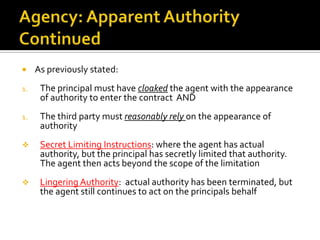
Agency: Apparent Authority Continued As previously stated:The principal must have cloaked the agent with the appearance of authority to enter the contract  ANDThe third party must reasonably rely on the appearance of authoritySecret Limiting Instructions: where the agent has actual authority, but the principal has secretly limited that authority. The agent then acts beyond the scope of the limitation
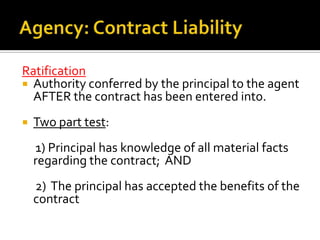
Lingering Authority:  actual authority has been terminated, but the agent still continues to act on the principals behalfAgency: Contract LiabilityRatificationAuthority conferred by the principal to the agent AFTER the contract has been entered into.Two part test:    1) Principal has knowledge of all material facts regarding the contract;  AND    2)  The principal has accepted the benefits of the contract
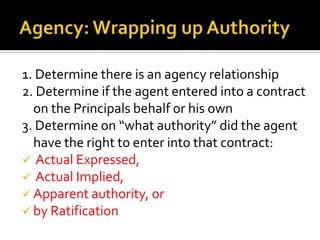
Agency: Wrapping up Authority1. Determine there is an agency relationship2. Determine if the agent entered into a contract on the Principals behalf or his own3. Determine on “what authority” did the agent have the right to enter into that contract:Actual Expressed,
 Actual Implied,
Apparent authority, or
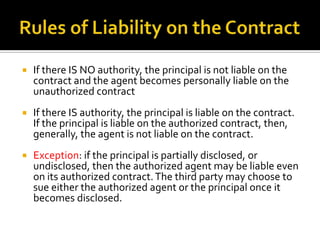
by RatificationRules of Liability on the ContractIf there IS NO authority, the principal is not liable on the contract and the agent becomes personally liable on the unauthorized contractIf there IS authority, the principal is liable on the contract.  If the principal is liable on the authorized contract, then, generally, the agent is not liable on the contract.Exception: if the principal is partially disclosed, or undisclosed, then the authorized agent may be liable even on its authorized contract. The third party may choose to sue either the authorized agent or the principal once it becomes disclosed.
Duties between Agents and PrincipalsDuty to exercise reasonable careDuty to obey reasonable instructionsDuty of loyaltyNo self dealing – the agent may never receive a benefit to herself to the detriment of the principal
No usurping the principals opportunity
No secret profitsEND OF AGENCY LAWNEXT:  GENERAL PARTNERSHIP,LLP &  RLLC LAW
GENERAL PARTNERSHIP FORMATION General partnership formations do not require any formalities to form or become a general partnershipDefinition:  a general partnership is an association of two or more people, carrying on as co-owners  of a business for a profitThe contribution of money or services in return for a share of the profits creates a presumption that a general partnership exists
General Partners: Liabilities of Partners to Third PartiesAgency principles applyPartners are agents of the partnership for carrying on usual partnership dutiesThe partnership is bound by torts committed by partners in the scope of partnership businessThe partnership is bound by contracts entered into by partners with partnership authority
General Partners are personally liable for debts and obligations of the partnershipIncoming partners liability for pre existing debt:  there is no direct personal liability for prior debtsDissociating partners liability for subsequent debts -  dissociating partners  retain liability on future debts until actual notice of dissociation is given to creditors, or until 90 days after filing of dissociation with the state
General Partnership Liability by Estoppel A person who represents to a third party that he is a partner in a partnership will be liable to that third party as if he was a partner in the partnership even if he is not
Comparing and Contrasting PartnershipsNow that we have covered “general partnerships”  lets discuss some other types of partnerships:Limited PartnershipsRegistered Limited Partnerships
Limited PartnershipsDefinition:  a limited partnership is a partnership with at least one general partner and one limited partnerFormation:  must file a limited partnership certificate that includes the names of all general partnersLimited Liability Control:  General Partners are liable for all debts and obligations. General partners have substantial managerial control; Limited Partners  are not liable for debts and obligations. Must pay full consideration for their interests. Generally, they have limited control.
Registered Limited Liability Company [RLLC] Formation – must register with the state by filing a statement of qualificationMust file annual reportsLiabilities:  No partner is liable for debts and obligations of the partnershipExample:  A, B, C and D are partners in an RLLC.  A wracks up a $10 million dollar trial through the law firm,  A has to cover all of the expenses, debts and obligations of that case, not B,C and D.  Each person is responsible for their own partnership debts and obligations. The partnership is not going to be sued for the debt, Person A will be individually sued as an agent of the company. Each person pays into their own interest within the company.
Rights and Duties of Partners General Partners are fiduciaries of each other and the partnership:Duty of loyalty
No usurping partnership opportunities
Partners may never make as secret, undisclosed profit at the expense of the partnership
Action for accounting: the only form of action that can be brought by a partnership against one of its own disloyal, breaching  partnersRights in Partnership PropertySpecific partnership assets: Land Leases and equipment that are owned by the partnership – are not transferable by any individual partner unless ALL partners agreeShare of profits and Surplus- this is a partners individual profit and surplus, they can transfer as they wishShare in management – not transferableTrouble figuring out who owns what? Find out who paid for the property and with whose money
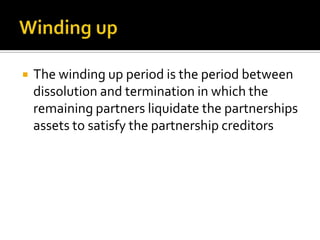
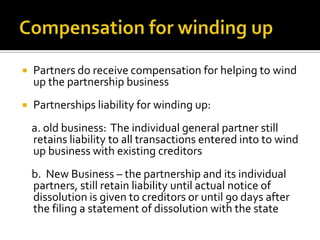
Rights continuedManagement:  absent an agreement, all partners are entitled to equal controlSalary- absent an agreement, no partner gets a salaryWinding up – partners do get compensated for winding up a partnershipPartners share of profits and losses – absent an agreement profits are shared equally.  Regarding losses -  absent an agreement, losses are shared like profits

Agency And Partnership

  • 1.
    Business Associations: Briefed by Tiffani L Hume (3L)Agency ,Partnership & Limited Liability CompaniesSources: * ALL SLIDES IN THIS PRESENTATION ARE REFERENCED FROM THE BELOW SOURCES: Conviser, R.J (2003) Gilbert Law Summaries: Agency, Partnership & Limited Liability Companies BAR/BRI, Chicago, ILKaufman, M.J (2006) Gilbert Law Summaries: Agency and Partnership Loyola University of Chicago School of Law CD Series
  • 2.
    What is an“Agency”?Definition: “An agency is a fiduciary relationship arising from the mutual manifestation of consent that an agent shall act on behalf of and subject to the control of the principal” [Conviser, R.J (2003)].
  • 3.
    What is a“Principal”?Definition: A Principal is the one for whom the agent will perform the work for. There are (3) types of principals:Disclosed Principals – the principal’s identity is known to the third partyUndisclosed Principals – the third party does not know there is a principal or the identity of the principal, the third party only sees the agent.Partially Disclosed Principals – the third party knows the
  • 4.
    What is an“Agent” ? An agent is the person who assents to perform tasks for the benefit of the principal and is subject to be under the control of the principal. There are different types of agents:General AgentSpecial AgentFactorsSubagents
  • 5.
    The General AgentAgeneral agent has authority to conduct a series of transactions involving a continuity of service.
  • 6.
    The Special AgentAspecial Agent has authority for only a single transaction or a series of transactions not involving continuity of service.
  • 7.
    FACTORSDefinition: AFactor is a commercial agent employed to sell consigned merchandise in the agents own name for the principal
  • 8.
    The SubagentWhen anagent has the authority to appoint another to assist in performing tasks for the principal – this person is considered a subagentIf the agent is authorized to appoint a subagent, the subagent will perform tasks for the principal just as the agent does.The Agent is responsible for the subagent primarily (pay, torts, etc)The Principal is liable for the “authorized” subagent “Secondarily”
  • 9.
    The Subagent –part 2UNAUTHORIZED SUBAGENTSThese people are not considered subagentsThey are considered “agents of the agent”The principal is not responsible for the unauthorized agent – the agent who appointed the unauthorized agent is liable for the torts, contracts, payment of the agent and actions therein.
  • 10.
    Working into AgencyLaw LiabilityThe most common question is: Is the principal liable for the torts of his agent?The second part of this is: “When, how and why?”To get to the answer, we must first find out IF there is an agency relationship in existence.
  • 11.
    Requirements For AnAgencyTo find out if there is a “Principal – Agent” relationship established three things must exist:ASSENTBENEFITCONTROL“ABC” “ABC” “ABC” “ABC” “ABC” “ABC” “ABC”
  • 12.
    AgencyASSENT Assent is an informal agreement between a principal with capacity and an agent
  • 13.
    AgencyBENEFIT The agent’s conduct must be for the principals benefit only
  • 14.
    AgencyCONTROL The principal must have the right to control the agent by having the power to supervise the manner of the agents performanceSubagents & Borrowed Agents – There can be no vicarious liability for a subagents or borrowed agents tort unless there is assent, benefit and the right to control the subagent or borrowed agent.
  • 15.
    Agency Independent Contractors: there is no power to control an independent contractor because there is no power to supervise the manner of an independent contractors performanceGENERALLY – there can be no liability for an independent contractors tortsEXCEPTION: If the independent contractor is engaged in ULTRA HAZARDOUS activities or Estoppel is raised by a third party based on the principal holding out the I.C as one of his agents.
  • 16.
    Determining the LiabilityOncethe relationship has been established and you can clearly state that there is a principal – agent relationship, we can then ask the question: “When is a principal liable for the torts of his agent (s)?”
  • 17.
    Agency: Determining Liability1.There must be an agency relationship that exists2. The agents must be working within the scope of their duties when the tort occurred.3. See the next slide
  • 18.
    Agency: Determining Liability2RE: SCOPE OF PRINCIPAL- AGENT RELATIONSHIPThe questions that need to be answered1. Was the conduct of the kind that this agent is hired to perform?2. Did the tort occur on the job or was it in some other place? a. Frolic = a new and independent journey (not liable) b. Detour = a mere departure from an assigned task (liable) c. Did the agent intend to benefit the principal? (if Yes, Liable)
  • 19.
    Agency: Determining Liability3Regarding Intentional Torts:a. Intentional torts are generally outside of the scope of agencyb. Exceptions: 1. If the act of the agent was authorized by the principal 2. If the intentional tort was natural from the nature of the employment 3. If the conduct was motivated by a desire to serve the principal
  • 20.
    BREAK TIME 15minutesWhen we come back we will talk about the “Liability of a principal to third parties for contracts entered into by an agent”
  • 21.
    Agency: Principal liabilityfor the contracts entered into by his agentRULE: The principal is liable for contracts entered into by its agent if the principal authorized the agent to enter the contract
  • 22.
    Agency: Contract LiabilityWaysin which the principal can authorize the agent to enter into a contract:1. By actual express authority2. By actual Implied Authority3. By Apparent Authority4. By Ratification
  • 23.
    Agency: ContractLiabilityActual Express Authority: The principal has used words to express authority to an agent to enter a contract on the principals behalf.Can be oralCan be privateNarrowly construedEXCEPTION: Equal Dignity Doctrine: “if the contract must be in writing, then so to equally must the expressed authority to enter that contract be in writing” [Conviser, R.J (2003)]
  • 24.
    Agency: Contract LiabilityExpressAuthority will be revoked by: Unilateral act of either party
  • 25.
    Death or incapacity of the principalEXCEPTION: Express authority cannot be revoked if the principal gives the agent a durable power of attorney: “ A power of attorney is a written expression of authority to enter a transaction”
  • 26.
    Agency: Contract LiabilityActualImplied Authority Necessity – There is implied authority to do all tasks that are necessary to accomplish an expressed taskCustom: There is implied authority to do all tasks customarily performed by persons with the agents title or positionPrior Dealings: There is implied authority to do all tasks that the agent believes to have been authorized from prior acquiescence by the principal
  • 27.
    Agency: ContractLiabilityApparent AuthorityThis is what the principal “holds out to the third party or the public” by indicating he has an agent or that a certain person “is” his agentTwo prong test: (1) the principal has cloaked the agent with the appearance of authority & (2) the third party reasonably relies on the appearance of authority
  • 28.
    Agency: Apparent AuthorityContinued As previously stated:The principal must have cloaked the agent with the appearance of authority to enter the contract ANDThe third party must reasonably rely on the appearance of authoritySecret Limiting Instructions: where the agent has actual authority, but the principal has secretly limited that authority. The agent then acts beyond the scope of the limitation
  • 29.
    Lingering Authority: actual authority has been terminated, but the agent still continues to act on the principals behalfAgency: Contract LiabilityRatificationAuthority conferred by the principal to the agent AFTER the contract has been entered into.Two part test: 1) Principal has knowledge of all material facts regarding the contract; AND 2) The principal has accepted the benefits of the contract
  • 30.
    Agency: Wrapping upAuthority1. Determine there is an agency relationship2. Determine if the agent entered into a contract on the Principals behalf or his own3. Determine on “what authority” did the agent have the right to enter into that contract:Actual Expressed,
  • 31.
  • 32.
  • 33.
    by RatificationRules ofLiability on the ContractIf there IS NO authority, the principal is not liable on the contract and the agent becomes personally liable on the unauthorized contractIf there IS authority, the principal is liable on the contract. If the principal is liable on the authorized contract, then, generally, the agent is not liable on the contract.Exception: if the principal is partially disclosed, or undisclosed, then the authorized agent may be liable even on its authorized contract. The third party may choose to sue either the authorized agent or the principal once it becomes disclosed.
  • 34.
    Duties between Agentsand PrincipalsDuty to exercise reasonable careDuty to obey reasonable instructionsDuty of loyaltyNo self dealing – the agent may never receive a benefit to herself to the detriment of the principal
  • 35.
    No usurping theprincipals opportunity
  • 36.
    No secret profitsENDOF AGENCY LAWNEXT: GENERAL PARTNERSHIP,LLP & RLLC LAW
  • 37.
    GENERAL PARTNERSHIP FORMATIONGeneral partnership formations do not require any formalities to form or become a general partnershipDefinition: a general partnership is an association of two or more people, carrying on as co-owners of a business for a profitThe contribution of money or services in return for a share of the profits creates a presumption that a general partnership exists
  • 38.
    General Partners: Liabilitiesof Partners to Third PartiesAgency principles applyPartners are agents of the partnership for carrying on usual partnership dutiesThe partnership is bound by torts committed by partners in the scope of partnership businessThe partnership is bound by contracts entered into by partners with partnership authority
  • 39.
    General Partners arepersonally liable for debts and obligations of the partnershipIncoming partners liability for pre existing debt: there is no direct personal liability for prior debtsDissociating partners liability for subsequent debts - dissociating partners retain liability on future debts until actual notice of dissociation is given to creditors, or until 90 days after filing of dissociation with the state
  • 40.
    General Partnership Liabilityby Estoppel A person who represents to a third party that he is a partner in a partnership will be liable to that third party as if he was a partner in the partnership even if he is not
  • 41.
    Comparing and ContrastingPartnershipsNow that we have covered “general partnerships” lets discuss some other types of partnerships:Limited PartnershipsRegistered Limited Partnerships
  • 42.
    Limited PartnershipsDefinition: a limited partnership is a partnership with at least one general partner and one limited partnerFormation: must file a limited partnership certificate that includes the names of all general partnersLimited Liability Control: General Partners are liable for all debts and obligations. General partners have substantial managerial control; Limited Partners are not liable for debts and obligations. Must pay full consideration for their interests. Generally, they have limited control.
  • 43.
    Registered Limited LiabilityCompany [RLLC] Formation – must register with the state by filing a statement of qualificationMust file annual reportsLiabilities: No partner is liable for debts and obligations of the partnershipExample: A, B, C and D are partners in an RLLC. A wracks up a $10 million dollar trial through the law firm, A has to cover all of the expenses, debts and obligations of that case, not B,C and D. Each person is responsible for their own partnership debts and obligations. The partnership is not going to be sued for the debt, Person A will be individually sued as an agent of the company. Each person pays into their own interest within the company.
  • 44.
    Rights and Dutiesof Partners General Partners are fiduciaries of each other and the partnership:Duty of loyalty
  • 45.
  • 46.
    Partners may nevermake as secret, undisclosed profit at the expense of the partnership
  • 47.
    Action for accounting:the only form of action that can be brought by a partnership against one of its own disloyal, breaching partnersRights in Partnership PropertySpecific partnership assets: Land Leases and equipment that are owned by the partnership – are not transferable by any individual partner unless ALL partners agreeShare of profits and Surplus- this is a partners individual profit and surplus, they can transfer as they wishShare in management – not transferableTrouble figuring out who owns what? Find out who paid for the property and with whose money
  • 48.
    Rights continuedManagement: absent an agreement, all partners are entitled to equal controlSalary- absent an agreement, no partner gets a salaryWinding up – partners do get compensated for winding up a partnershipPartners share of profits and losses – absent an agreement profits are shared equally. Regarding losses - absent an agreement, losses are shared like profits