
Financial management
for NGOs
Financial planning
“Failing to plan is planning to fail“
www.mango.org.uk
www.mango.org.uk
Did you know that there are
4 essential building blocks
in a strong financial management
system?
www.mango.org.uk
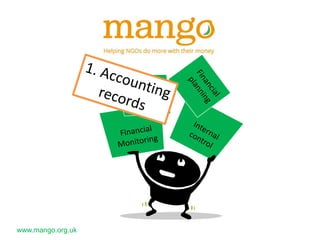
This is about keeping an accurate
and complete record of all financial
transactions – for accountability
and transparency.
www.mango.org.uk
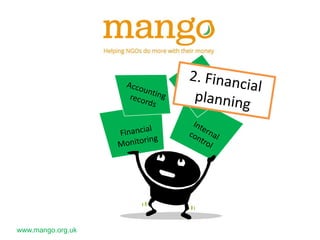
We have to plan ahead to make
sure we have the money we need
to achieve our objectives, now and
in the future.
www.mango.org.uk
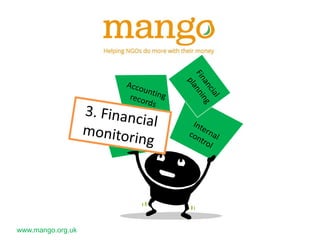
This is about keeping track of
progress against our plans and
sharing how we are doing with key
stakeholders.
www.mango.org.uk
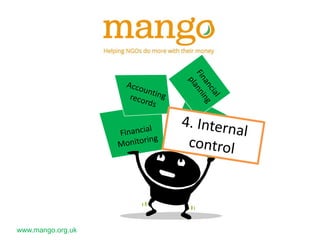
We have a duty to protect our
financial resources and staff from
internal risks such as accidents,
theft and fraud.
We do this by implementing a
series of commonsense
controls and checks.
www.mango.org.uk
 This slideshow
looks at the
financial planning
process.
www.mango.org.uk
So what does the
financial planning
process involve?
www.mango.org.uk
Take a moment to write
down 3 things that financial
planning involves before
moving to the next
slide to see our ideas ...
Go on
when
ready
www.mango.org.uk
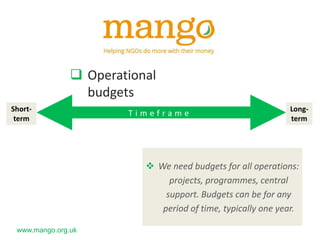
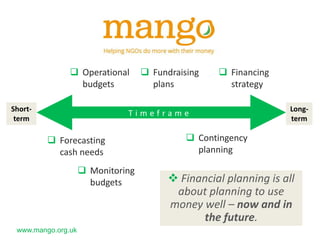
 Operational
budgets
Long-
term
Short-
term
T i m e f r a m e
 We need budgets for all operations:
projects, programmes, central
support. Budgets can be for any
period of time, typically one year.
www.mango.org.uk
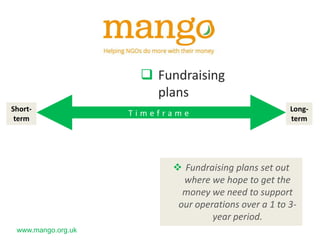
 Fundraising
plans
Long-
term
Short-
term
T i m e f r a m e
 Fundraising plans set out
where we hope to get the
money we need to support
our operations over a 1 to 3-
year period.
www.mango.org.uk
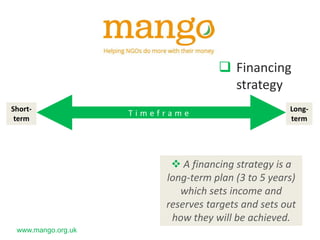
 Financing
strategy
Long-
term
Short-
term
T i m e f r a m e
 A financing strategy is a
long-term plan (3 to 5 years)
which sets income and
reserves targets and sets out
how they will be achieved.
www.mango.org.uk
 Monitoring
budgets
 Forecasting
cash needs
Long-
term
Short-
term
T i m e f r a m e
 Contingency
planning
During programme
implementation, financial planning
continues, eg with monthly cash
forecasts, budget monitoring and risk
management.
www.mango.org.uk
T i m e f r a m e
 Financial planning is all
about planning to use
money well – now and in
the future.
 Operational
budgets
 Financing
strategy
 Fundraising
plans
 Forecasting
cash needs
Long-
term
Short-
term
 Monitoring
budgets
 Contingency
planning
www.mango.org.uk
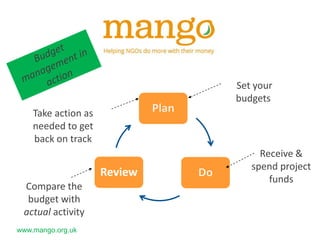
Review
Receive &
spend project
funds
Set your
budgets
Compare the
budget with
actual activity
Take action as
needed to get
back on track
www.mango.org.uk
 In your experience, what
makes a great budget?
Make some notes and then
see if you agree with our
ideas ...
Go on
when
ready
www.mango.org.uk
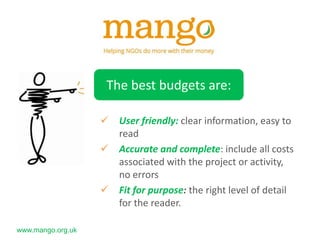
 User friendly: clear information, easy to
read
 Accurate and complete: include all costs
associated with the project or activity,
no errors
 Fit for purpose: the right level of detail
for the reader.
The best budgets are:
www.mango.org.uk
Top tips on how to
create great
budgets
www.mango.org.uk
 Get all the information you need
ready in advance, eg activity plans,
quantities and prices
 Start early and allow time for
reviews and revisions.
1. Be organised
www.mango.org.uk
2. Work as a team
 Don’t leave the budget-setting to
the finance folk!
 The best budgets are written with
the help of those who will use
them.
www.mango.org.uk
 Write down your budgeting
assumptions, eg inflation and
exchange rates used
 Attach price quotations
 Ask yourself: would other people
be able to understand my budget?
3. Keep clear notes
www.mango.org.uk
4. Clear and justified
calculations
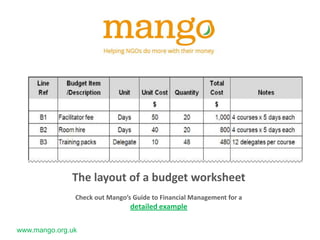
 Use a budget worksheet (see next
slide) to create a clear and detailed
budget, showing all calculations
 Research prices, don’t make them
up!
www.mango.org.uk
The layout of a budget worksheet
Check out Mango’s Guide to Financial Management for a
detailed example
www.mango.org.uk
5. Include all costs
 Make sure you include all costs
associated with the project, both
direct and shared costs:
• Eg Staff recruitment & training,
employer’s taxes, Board expenses,
maintenance, central support
contribution ...
www.mango.org.uk
6. Find a ‘budget
buddy’
 Get someone to check your budget
before you send it off – it is too
easy to make a calculation error or
to leave out something important.
www.mango.org.uk
Want to lean more about budgeting?
Then join us on one of our practical and fun
courses soon.
Budgeting essentials eWorkshop now available!
http://www.mango.org.uk/training
training@mango.org.uk
www.mango.org.uk
Find out more about Mango
and free resources for NGOs
http://www.mango.org.uk/Guide

Mango: Financial planning for NGOs