The Impact of Cultural Differences on Global Business
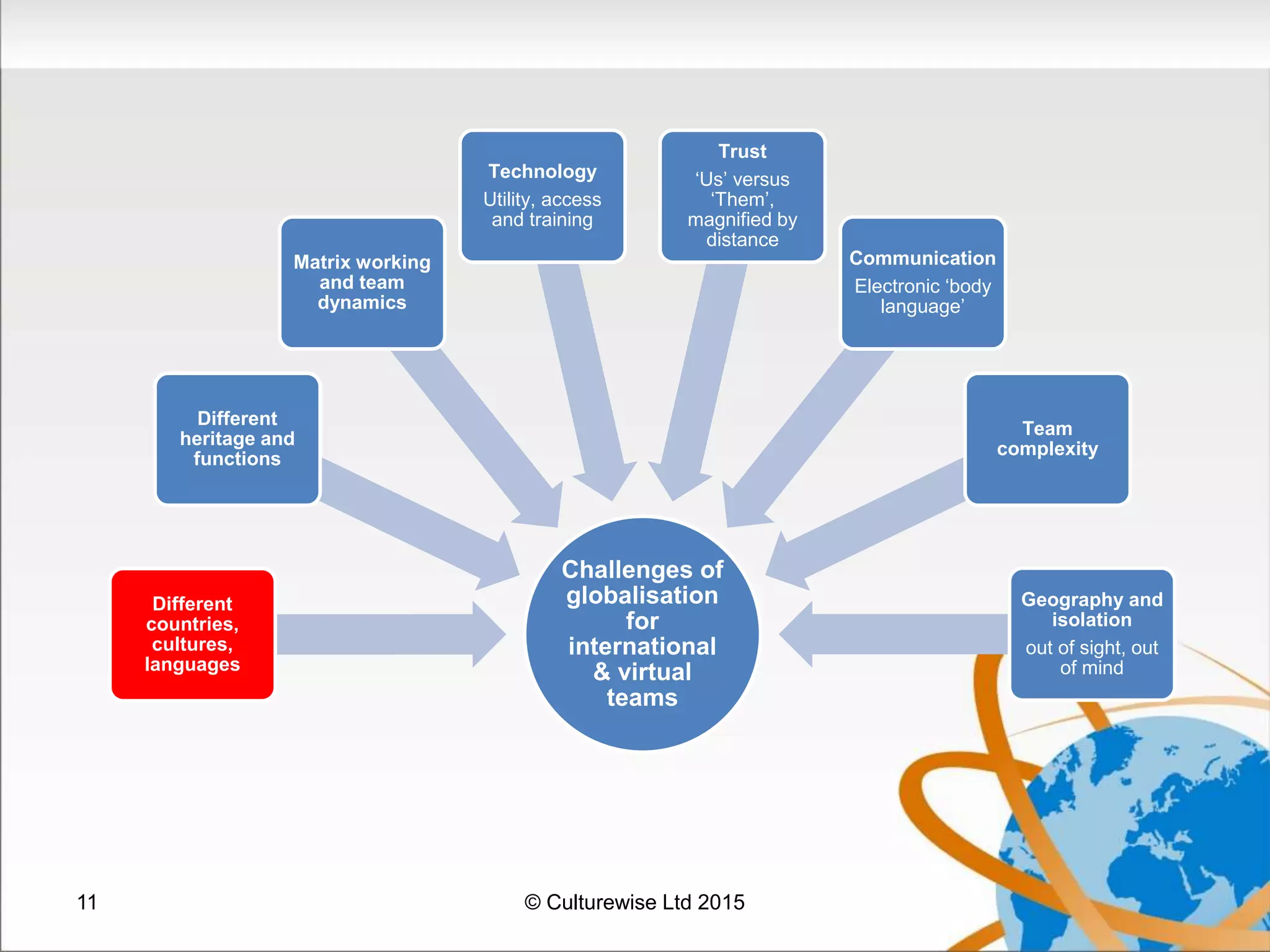
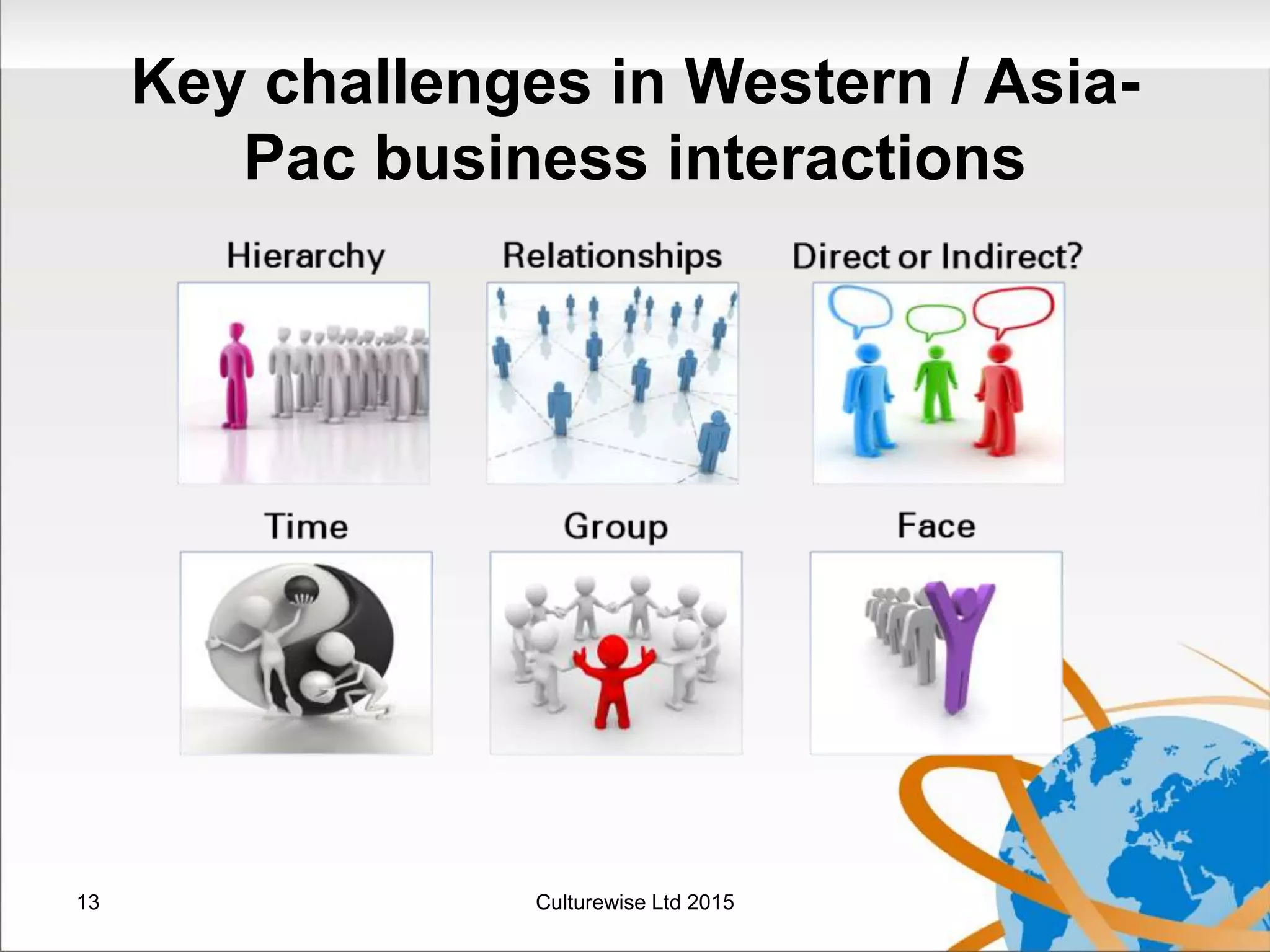
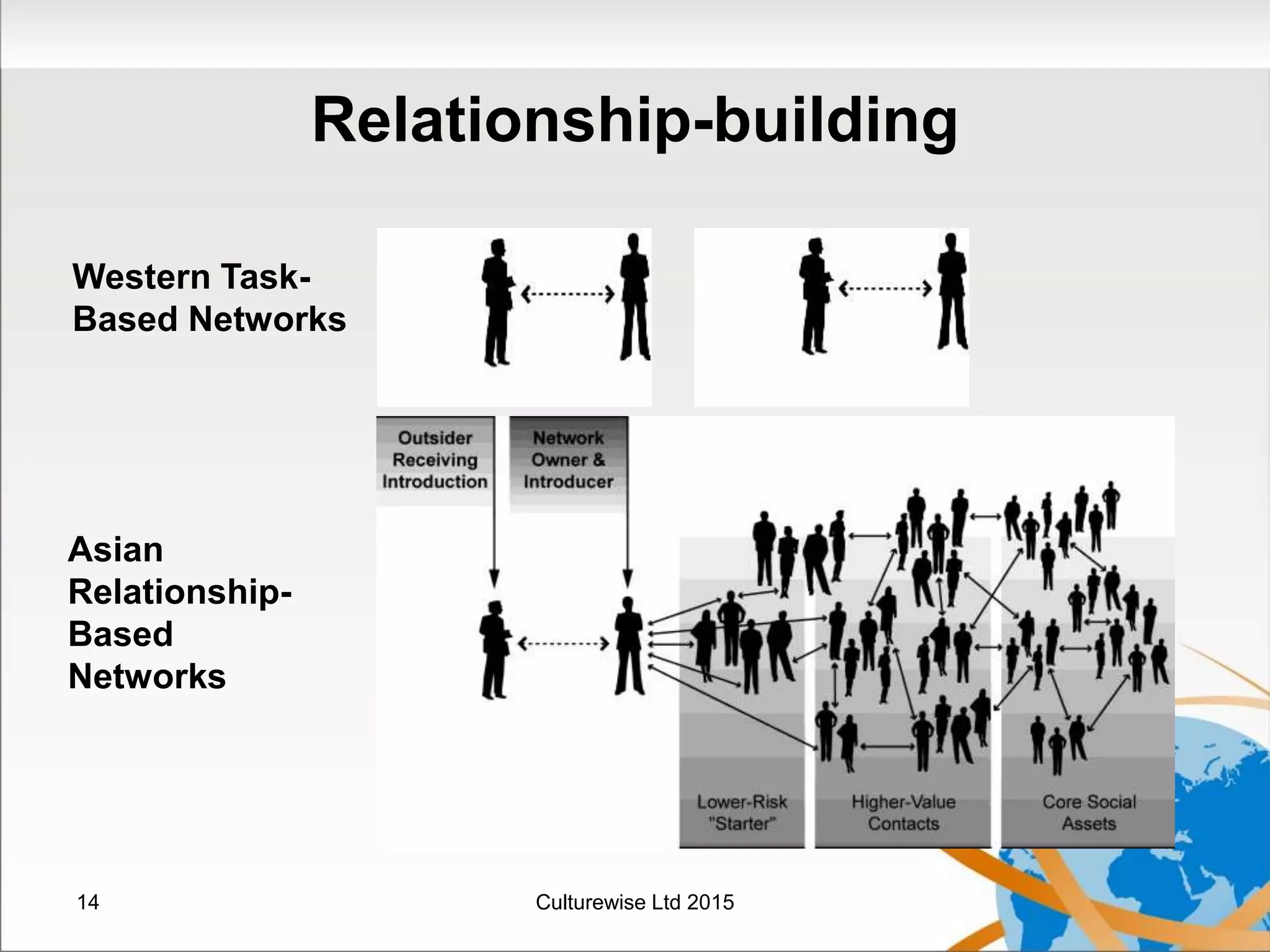
This document discusses the impact of cultural differences on global business. It begins by outlining the objectives of raising awareness of how culture and cultural differences affect international business. It then defines culture as the ideas, values and assumptions that guide behaviors. The document emphasizes that most cultural differences lie below the surface and are not immediately visible. It highlights some key below-surface differences that can impact work, such as communication styles and decision-making processes. The document also notes several areas of business that are affected by cultural differences, such as relationship building, communication styles, and working in international teams. It concludes by offering six practical steps for working more effectively across cultures, such as being flexible, understanding deep and surface culture, and choosing the best communication
The Impact of Cultural Differences on Global Business
1.
The Impact ofCultural Differences
on Global Business
Culturewise Limited
1 Culturewise Ltd 2015
2.
Objectives and agenda
•To raise awareness of the
impact of culture and
cultural differences on
international business
• To reflect on practical on
strategies for working more
effectively with colleagues
from different cultural
backgrounds
• About Culturewise
• Four key questions…
1. What is culture?
2. Why is culture important in
business?
3. Where does culture impact on
business?
4. How can we work more
effectively across cultures?
2 Culturewise Ltd 2015
3.
About Culturewise
• Culturewiseprovides cultural awareness training and
coaching for clients from every major business sector
• Context is ‘Globalisation’ – just like every of aspect of global
business, cross-cultural issues need to be managed
effectively
• Three key training areas
– Country-specific (i.e. China, India, Middle East, etc.)
– Role-specific (i.e. Global Team Leaders, International Assignees, etc.)
– Sector-specific (i.e. Retail, Financial Services, Law, etc.)
3 Culturewise Ltd 2015
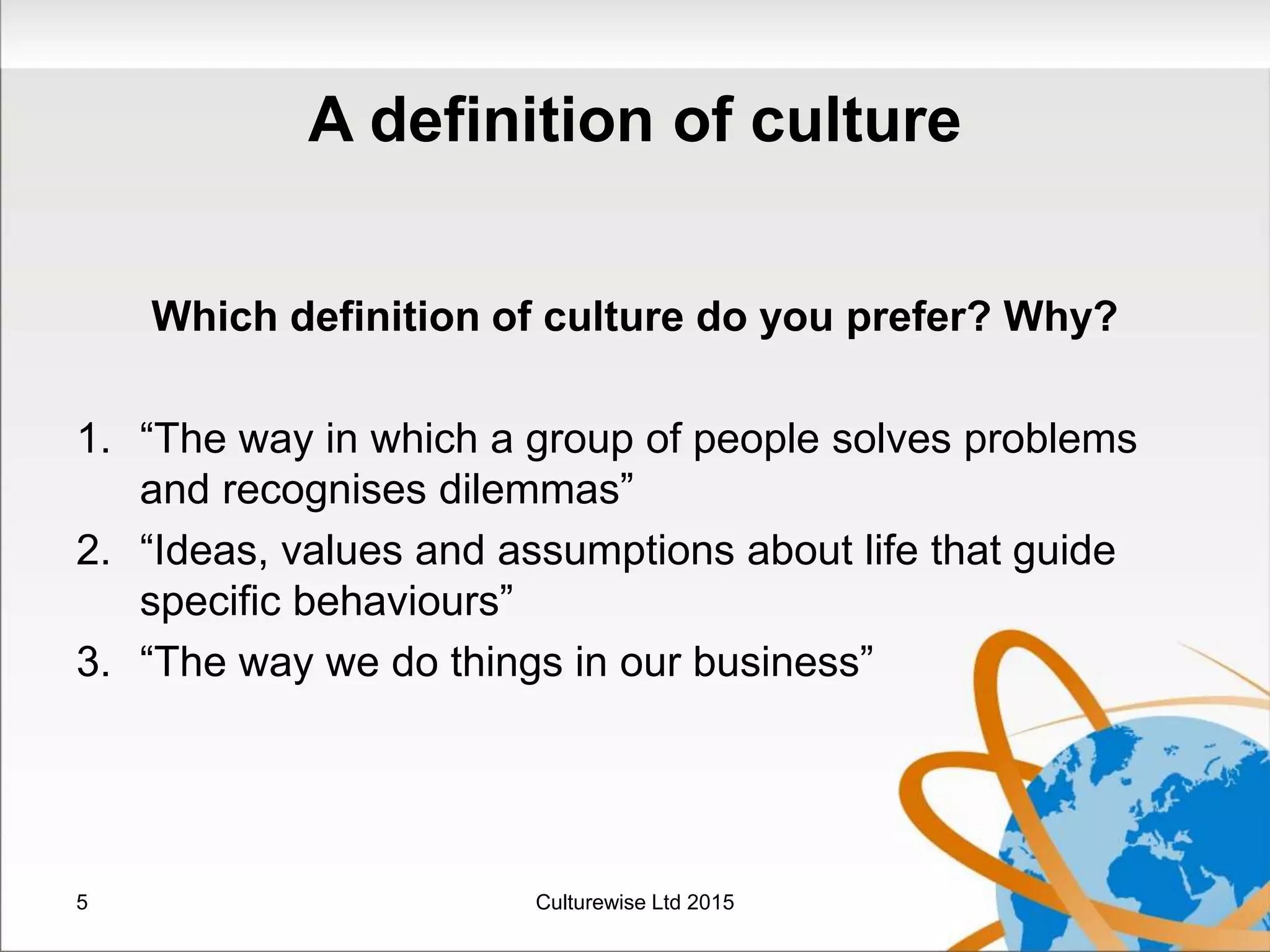
A definition ofculture
Which definition of culture do you prefer? Why?
1. “The way in which a group of people solves problems
and recognises dilemmas”
2. “Ideas, values and assumptions about life that guide
specific behaviours”
3. “The way we do things in our business”
5 Culturewise Ltd 2015
6.
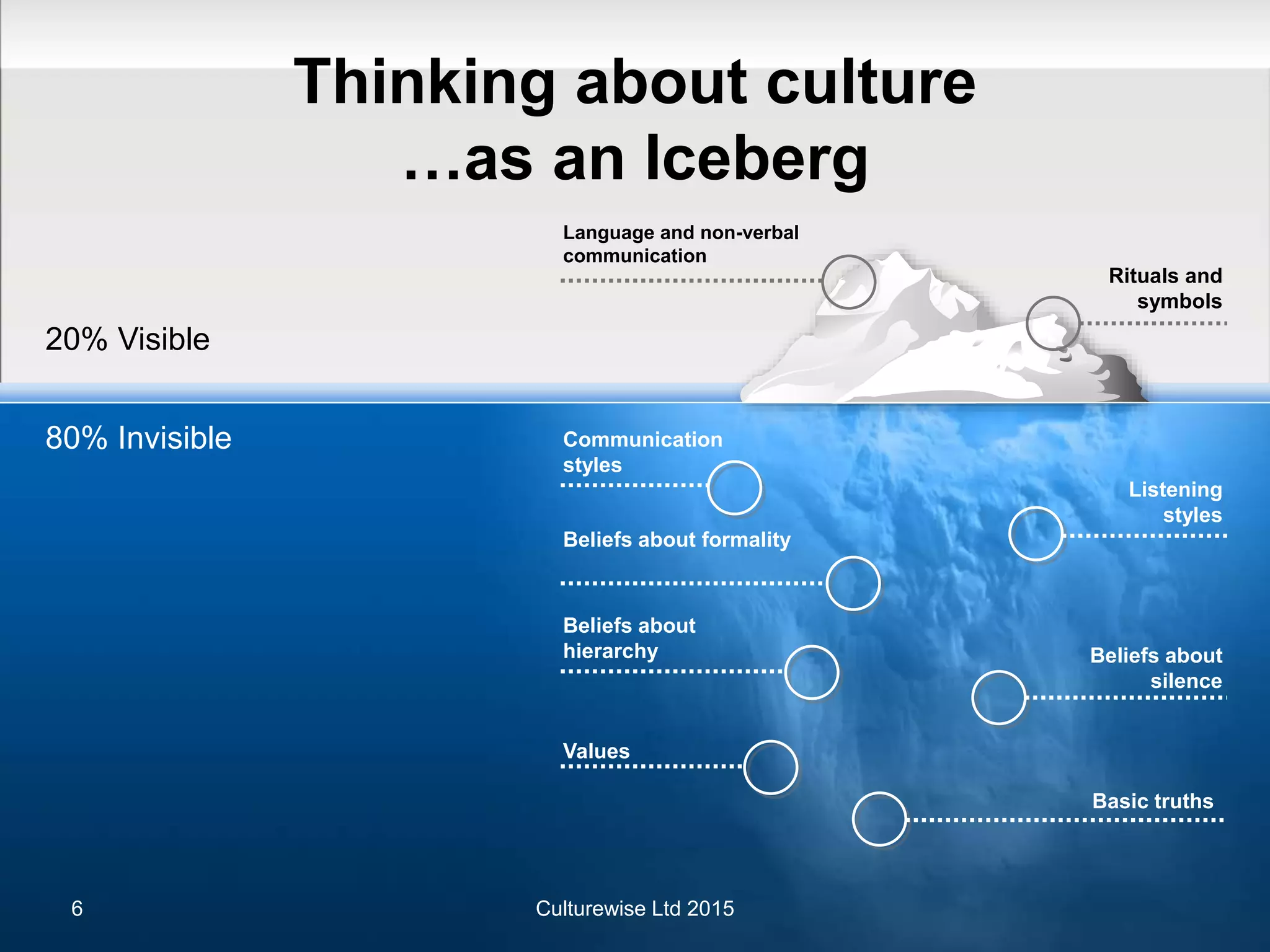
Thinking about culture
…asan Iceberg
20% Visible
80% Invisible
Listening
styles
Beliefs about
silence
Basic truths
Communication
styles
Beliefs about formality
Values
Beliefs about
hierarchy
Language and non-verbal
communication
Rituals and
symbols
Culturewise Ltd 20156
7.
...many of thechallenges in working
with people from different cultures
are below the cultural surface
Culturewise Ltd 20157
8.
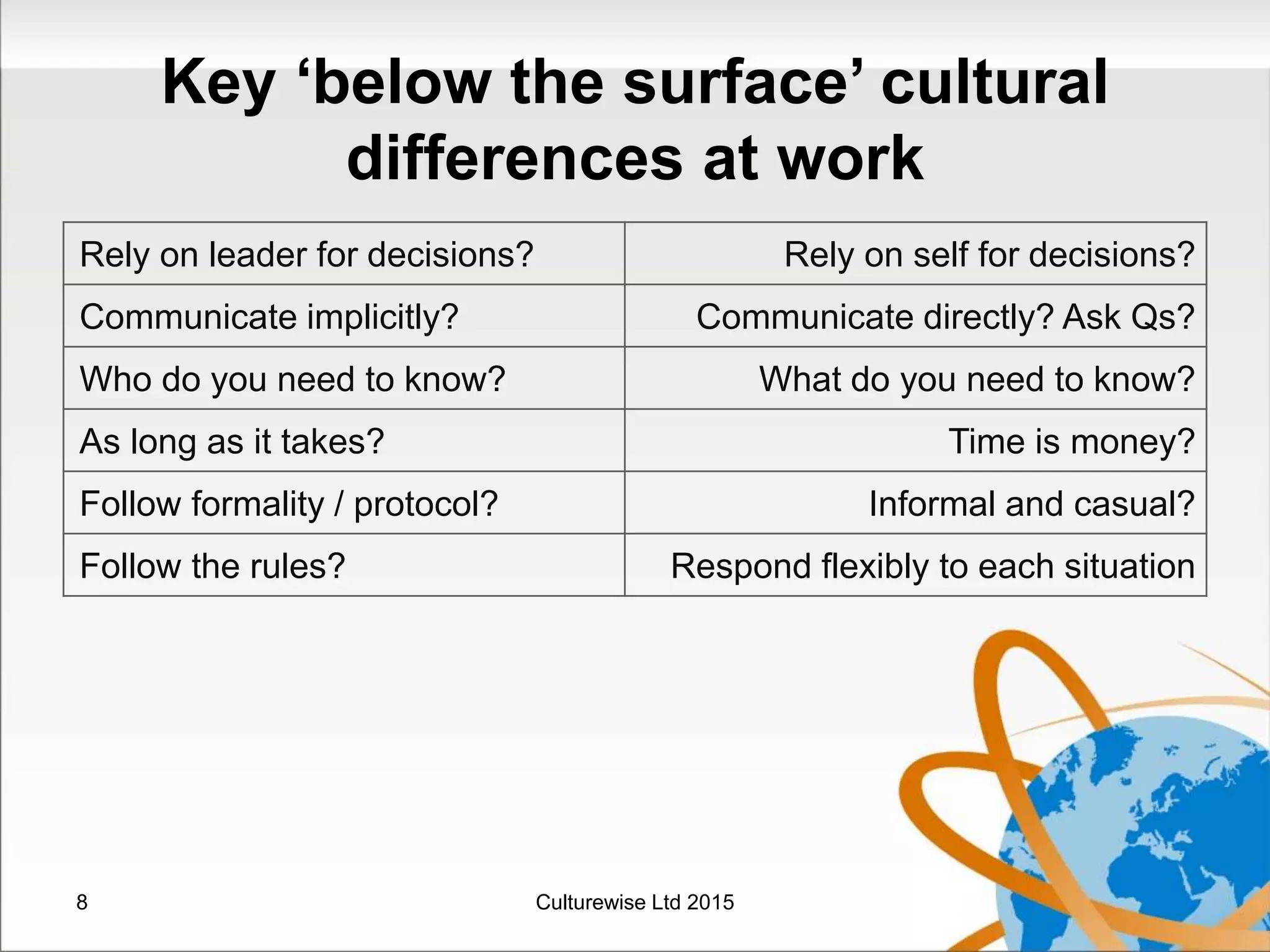
Key ‘below thesurface’ cultural
differences at work
Rely on leader for decisions? Rely on self for decisions?
Communicate implicitly? Communicate directly? Ask Qs?
Who do you need to know? What do you need to know?
As long as it takes? Time is money?
Follow formality / protocol? Informal and casual?
Follow the rules? Respond flexibly to each situation
8 Culturewise Ltd 2015
9.
Why is cultureimportant in
business?
9 Culturewise Ltd 2015
10.
The importance ofculture for
individuals and organisations
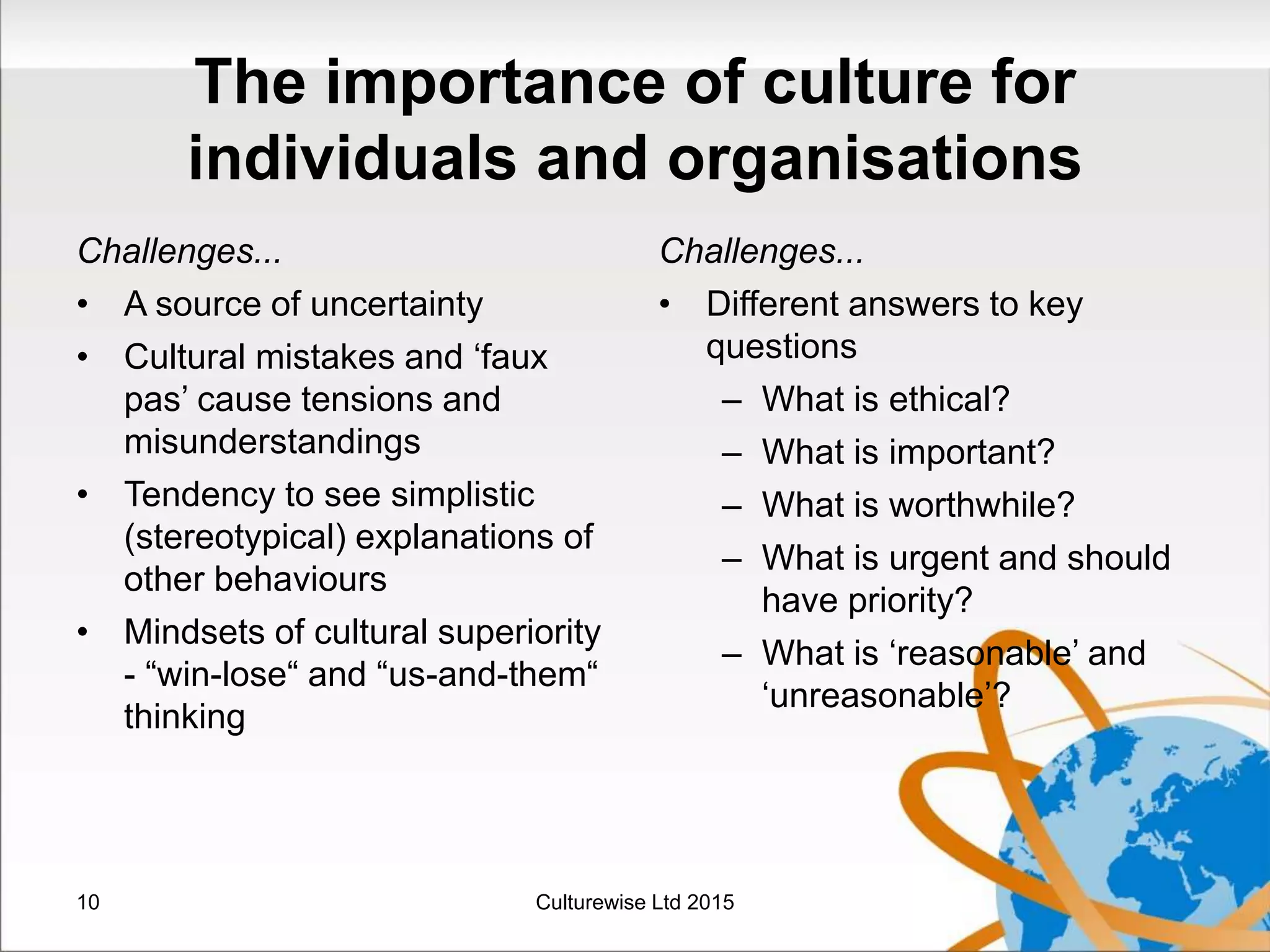
Challenges...
• A source of uncertainty
• Cultural mistakes and ‘faux
pas’ cause tensions and
misunderstandings
• Tendency to see simplistic
(stereotypical) explanations of
other behaviours
• Mindsets of cultural superiority
- “win-lose“ and “us-and-them“
thinking
Challenges...
• Different answers to key
questions
– What is ethical?
– What is important?
– What is worthwhile?
– What is urgent and should
have priority?
– What is ‘reasonable’ and
‘unreasonable’?
10 Culturewise Ltd 2015
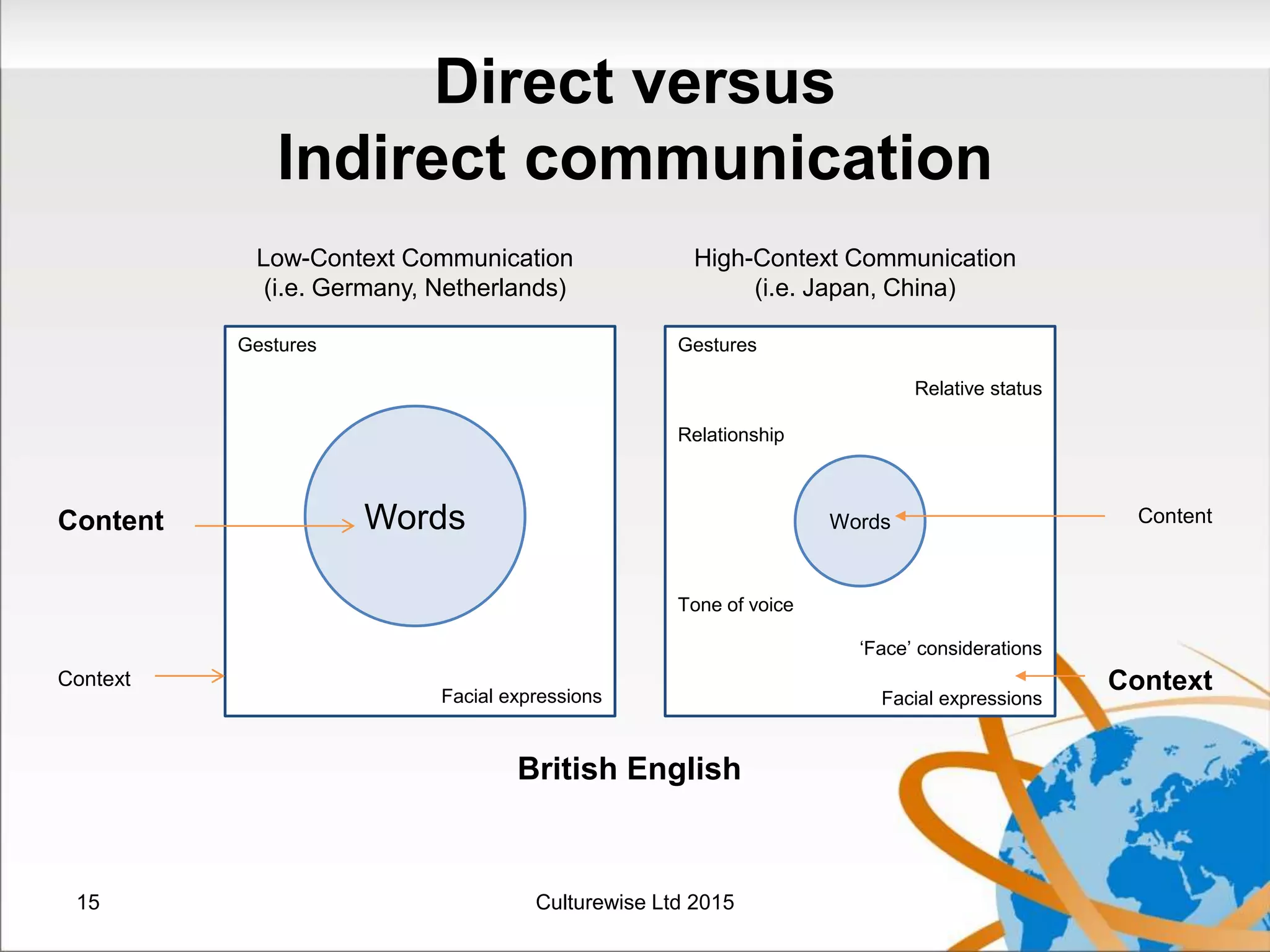
Low-Context Communication
(i.e. Germany,Netherlands)
High-Context Communication
(i.e. Japan, China)
Words WordsContent
Context
Facial expressions
Gestures
Facial expressions
Gestures
Relative status
Relationship
Tone of voice
‘Face’ considerations
Content
Context
British English
Direct versus
Indirect communication
15 Culturewise Ltd 2015
16.
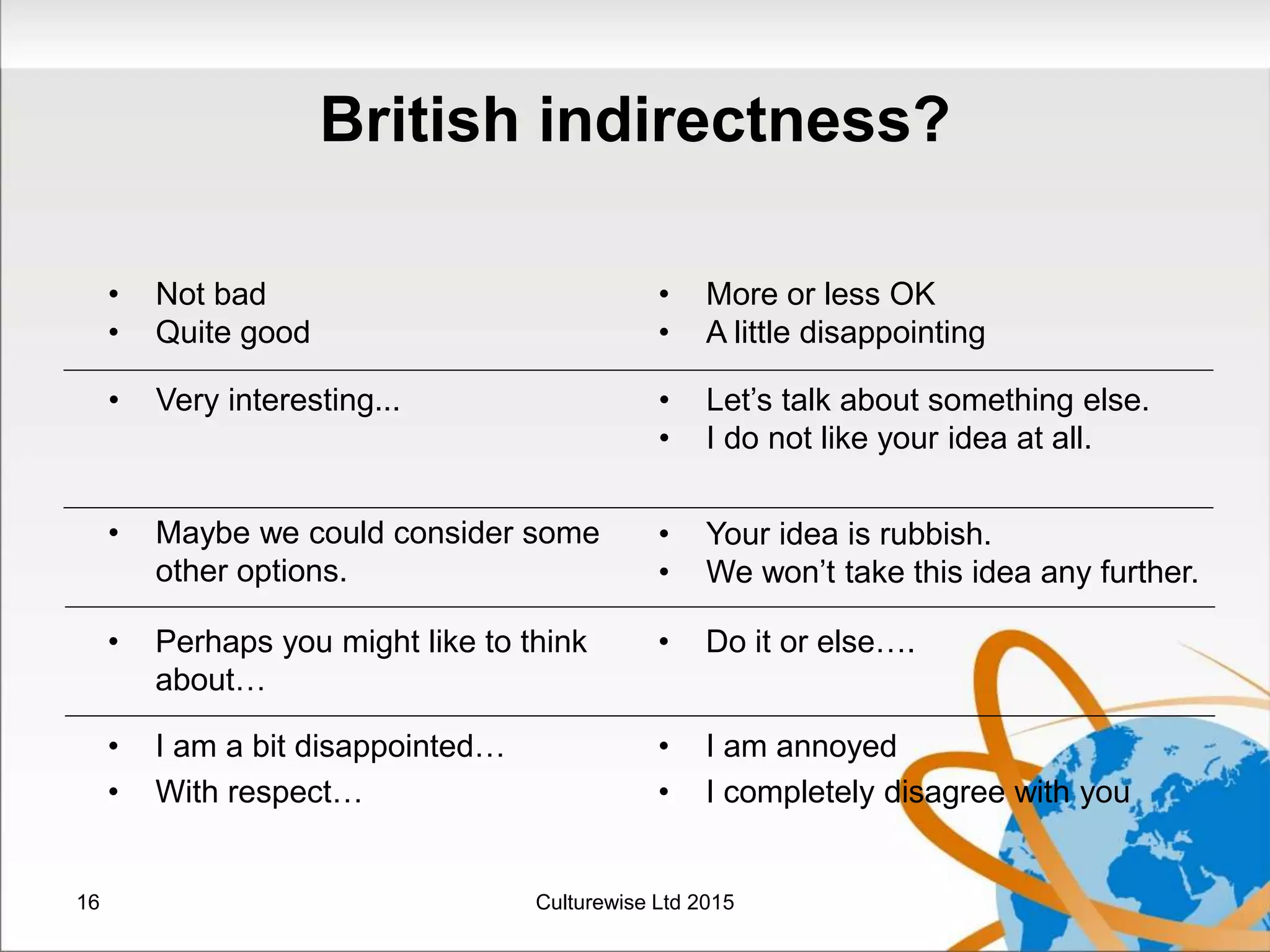
• More orless OK
• A little disappointing
• Let’s talk about something else.
• I do not like your idea at all.
• Very interesting...
• Your idea is rubbish.
• We won’t take this idea any further.
• Maybe we could consider some
other options.
• Do it or else….• Perhaps you might like to think
about…
• I am annoyed
• I completely disagree with you
• I am a bit disappointed…
• With respect…
• Not bad
• Quite good
British indirectness?
16 Culturewise Ltd 2015
17.
How can wework more effectively
across cultures?
17 Culturewise Ltd 2015
18.
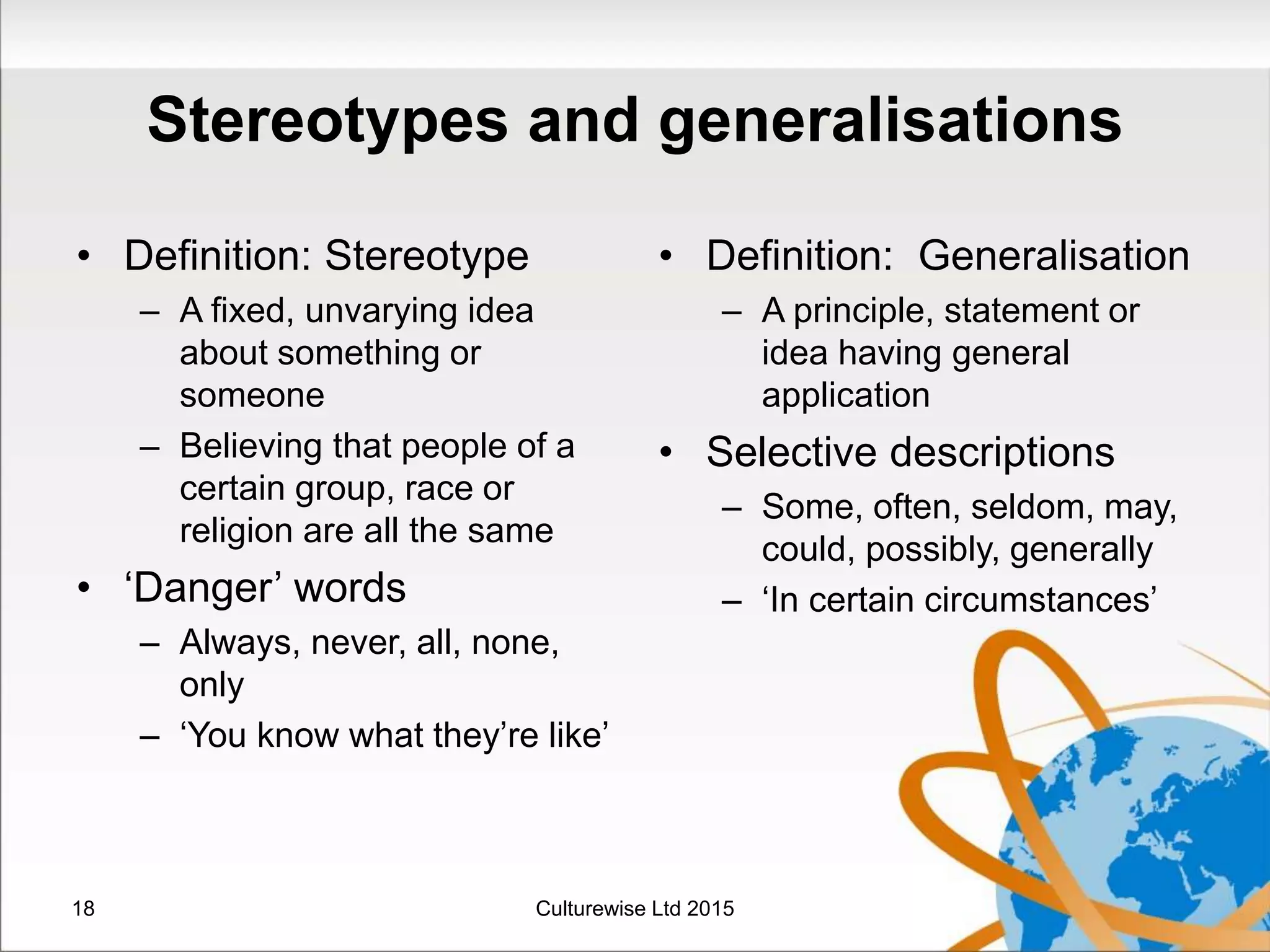
Stereotypes and generalisations
•Definition: Stereotype
– A fixed, unvarying idea
about something or
someone
– Believing that people of a
certain group, race or
religion are all the same
• ‘Danger’ words
– Always, never, all, none,
only
– ‘You know what they’re like’
• Definition: Generalisation
– A principle, statement or
idea having general
application
• Selective descriptions
– Some, often, seldom, may,
could, possibly, generally
– ‘In certain circumstances’
Culturewise Ltd 201518
19.
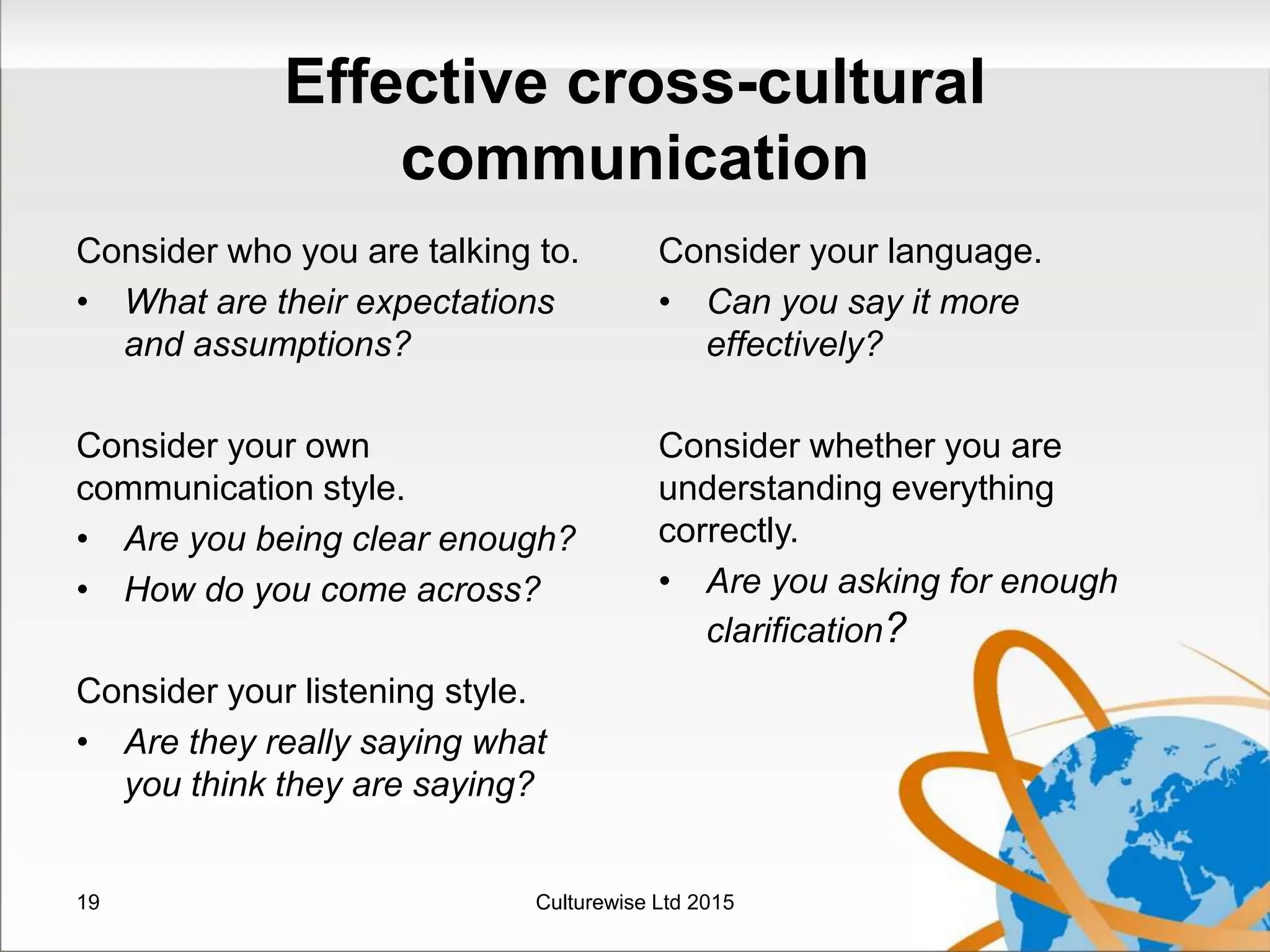
Effective cross-cultural
communication
Consider whoyou are talking to.
• What are their expectations
and assumptions?
Consider your own
communication style.
• Are you being clear enough?
• How do you come across?
Consider your listening style.
• Are they really saying what
you think they are saying?
Consider your language.
• Can you say it more
effectively?
Consider whether you are
understanding everything
correctly.
• Are you asking for enough
clarification?
19 Culturewise Ltd 2015
20.
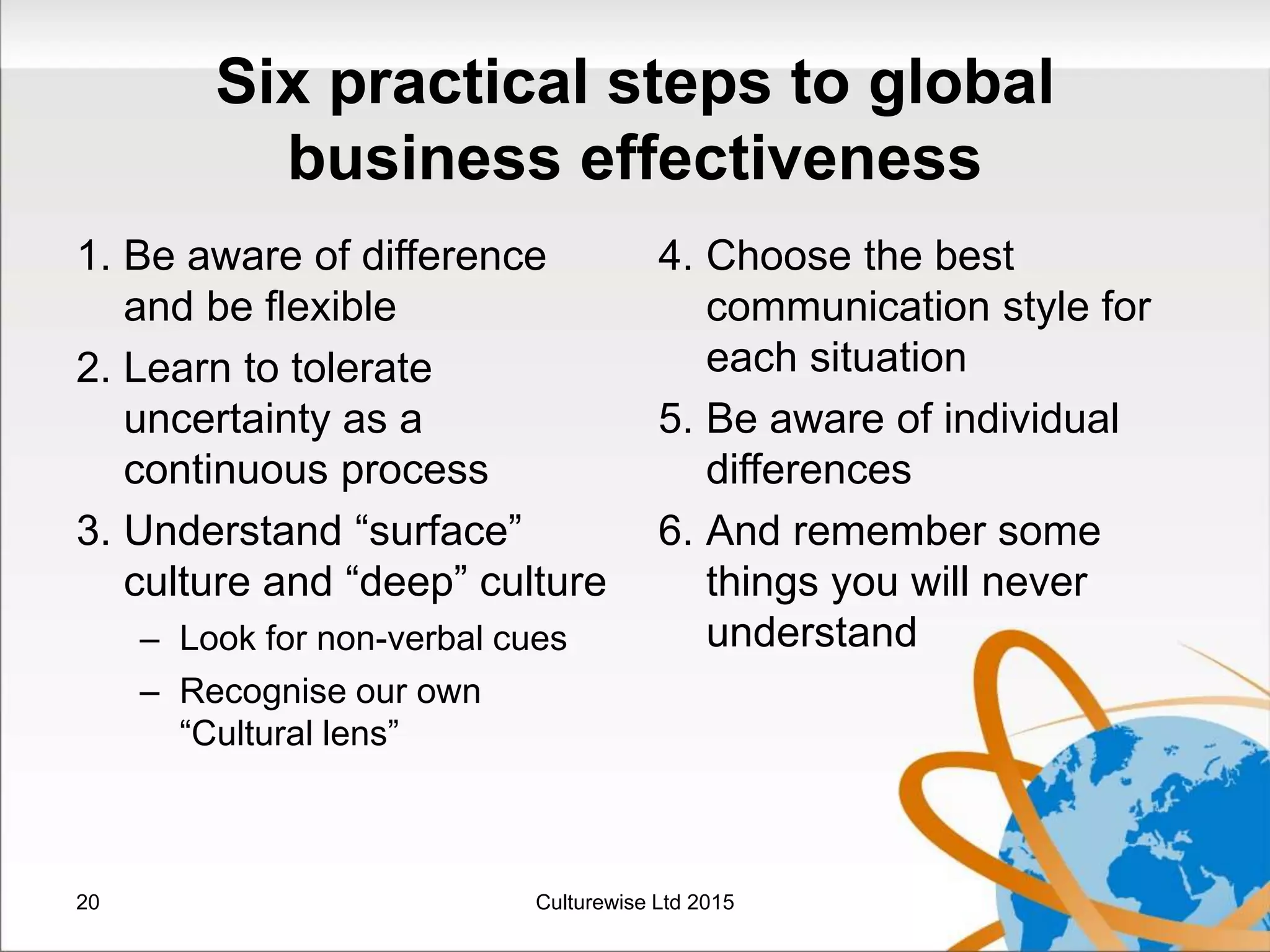
Six practical stepsto global
business effectiveness
1. Be aware of difference
and be flexible
2. Learn to tolerate
uncertainty as a
continuous process
3. Understand “surface”
culture and “deep” culture
– Look for non-verbal cues
– Recognise our own
“Cultural lens”
4. Choose the best
communication style for
each situation
5. Be aware of individual
differences
6. And remember some
things you will never
understand
20 Culturewise Ltd 2015