INFORMATION,
CONTROL, AND
PRIVACY
Created by: Norwin C. Adriatico
Who first defined ethics?
Socrates
- was the first to recognized the need to define ethical
concepts and attempt to establish a universal standard.
booksite.elsevier.com
Aristotle
- “One can become virtuous by imitating the acts of
virtuous individuals for we are what we repeatedly do”.
booksite.elsevier.com
Computer Ethics
What are the importance of ethics?
- Ethics is what guides us to tell the truth, keep our
promises, or help someone in need.
- It helps us make decisions that create positive impacts.
- It is responsible for analyzing the moral duties of
computer users and professionals and ethical issues in
public policy. www.scu.edu
Computer Ethics
Computer Ethics
What is computer/technology ethics?
- is a field of applied ethics that addresses ethical issues in
the use, design and management of information
technology and in the formulation of ethical policies for its
regulation in society. www.sciencedirect.com
Let us check our thoughts…
Ethical or not?
1. An organization requires employees to wear
badges that track their whereabouts while at
work.
2. A supervisor reads an employee’s email
message.
3. An employee uses his computer at work to
send email messages to a friend.
Let us check our thoughts…
Ethical or not?
4. An employee sends an email message to
several co-workers and blind copies his
supervisor.
5. An employee sends an email message to a
third party without permission from the sender.
6. An employee uses her computer at work to
complete a homework assignment for school.
Let us check our thoughts…
Ethical or not?
7. The vice president of your student government
organization downloads photo from the web
and uses it in a flyer recruiting members.
8. A student copies text from the web and uses it
in a research paper for his English composition
class.
9. An employee sends political campaign material
to individuals on her employer’s mailing list.
Let us check our thoughts…
Ethical or not?
10. A company requires employees to keep personal
mobile phones in a secure locker and does not permit
employees to view these devices during their shifts.
11. An employee makes a copy of software and installs it
on her home computer. No one uses her home
computer while she is at work, and she uses her home
computer only to finish projects from work.
Let us check our thoughts…
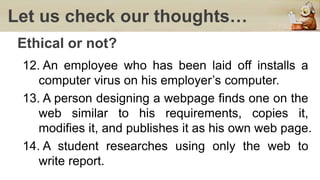
Ethical or not?
12. An employee who has been laid off installs a
computer virus on his employer’s computer.
13. A person designing a webpage finds one on the
web similar to his requirements, copies it,
modifies it, and publishes it as his own web page.
14. A student researches using only the web to
write report.
Let us check our thoughts…
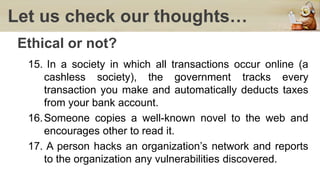
Ethical or not?
15. In a society in which all transactions occur online (a
cashless society), the government tracks every
transaction you make and automatically deducts taxes
from your bank account.
16.Someone copies a well-known novel to the web and
encourages other to read it.
17. A person hacks an organization’s network and reports
to the organization any vulnerabilities discovered.
Let us check our thoughts…
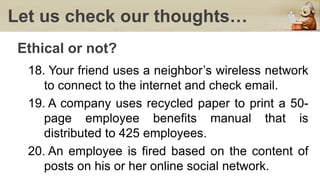
Ethical or not?
18. Your friend uses a neighbor’s wireless network
to connect to the internet and check email.
19. A company uses recycled paper to print a 50-
page employee benefits manual that is
distributed to 425 employees.
20. An employee is fired based on the content of
posts on his or her online social network.
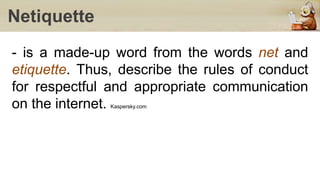
Netiquette
- is a made-up word from the words net and
etiquette. Thus, describe the rules of conduct
for respectful and appropriate communication
on the internet. Kaspersky.com
Netiquette
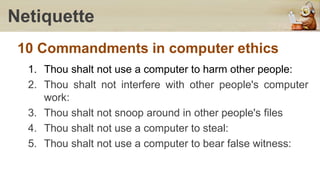
10 Commandments in computer ethics
1. Thou shalt not use a computer to harm other people:
2. Thou shalt not interfere with other people's computer
work:
3. Thou shalt not snoop around in other people's files
4. Thou shalt not use a computer to steal:
5. Thou shalt not use a computer to bear false witness:
Netiquette
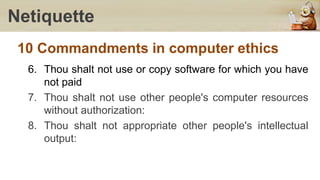
10 Commandments in computer ethics
6. Thou shalt not use or copy software for which you have
not paid
7. Thou shalt not use other people's computer resources
without authorization:
8. Thou shalt not appropriate other people's intellectual
output:
Netiquette
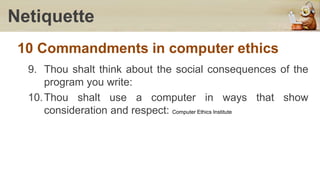
10 Commandments in computer ethics
9. Thou shalt think about the social consequences of the
program you write:
10.Thou shalt use a computer in ways that show
consideration and respect: Computer Ethics Institute
Cybercrime Law
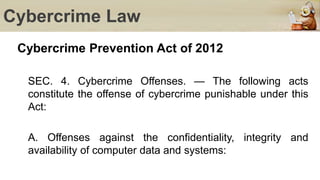
Cybercrime Prevention Act of 2012
SEC. 4. Cybercrime Offenses. — The following acts
constitute the offense of cybercrime punishable under this
Act:
A. Offenses against the confidentiality, integrity and
availability of computer data and systems:
Cybercrime Law
Cybercrime Prevention Act of 2012
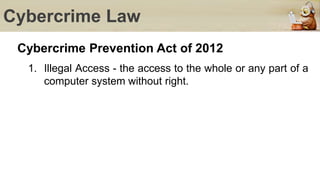
1. Illegal Access - the access to the whole or any part of a
computer system without right.
Cybercrime Law
Cybercrime Prevention Act of 2012
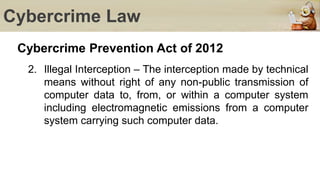
2. Illegal Interception – The interception made by technical
means without right of any non-public transmission of
computer data to, from, or within a computer system
including electromagnetic emissions from a computer
system carrying such computer data.
Cybercrime Law
Cybercrime Prevention Act of 2012
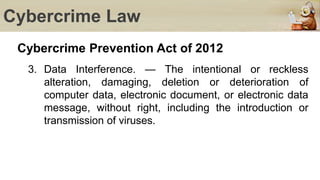
3. Data Interference. — The intentional or reckless
alteration, damaging, deletion or deterioration of
computer data, electronic document, or electronic data
message, without right, including the introduction or
transmission of viruses.
Cybercrime Law
Cybercrime Prevention Act of 2012
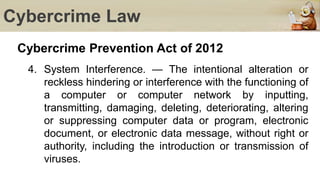
4. System Interference. — The intentional alteration or
reckless hindering or interference with the functioning of
a computer or computer network by inputting,
transmitting, damaging, deleting, deteriorating, altering
or suppressing computer data or program, electronic
document, or electronic data message, without right or
authority, including the introduction or transmission of
viruses.
Cybercrime Law
Cybercrime Prevention Act of 2012
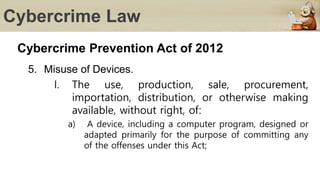
5. Misuse of Devices.
I. The use, production, sale, procurement,
importation, distribution, or otherwise making
available, without right, of:
a) A device, including a computer program, designed or
adapted primarily for the purpose of committing any
of the offenses under this Act;
Cybercrime Law
Cybercrime Prevention Act of 2012
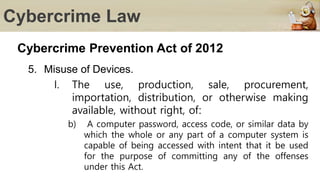
5. Misuse of Devices.
I. The use, production, sale, procurement,
importation, distribution, or otherwise making
available, without right, of:
b) A computer password, access code, or similar data by
which the whole or any part of a computer system is
capable of being accessed with intent that it be used
for the purpose of committing any of the offenses
under this Act.
Cybercrime Law
Cybercrime Prevention Act of 2012
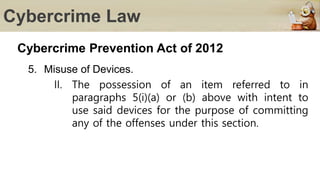
5. Misuse of Devices.
II. The possession of an item referred to in
paragraphs 5(i)(a) or (b) above with intent to
use said devices for the purpose of committing
any of the offenses under this section.
Cybercrime Law
Cybercrime Prevention Act of 2012
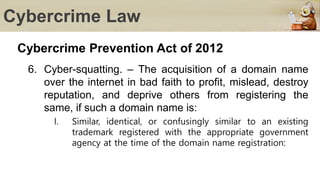
6. Cyber-squatting. – The acquisition of a domain name
over the internet in bad faith to profit, mislead, destroy
reputation, and deprive others from registering the
same, if such a domain name is:
I. Similar, identical, or confusingly similar to an existing
trademark registered with the appropriate government
agency at the time of the domain name registration:
Cybercrime Law
Cybercrime Prevention Act of 2012
6. Cyber-squatting. – The acquisition of a domain name
over the internet in bad faith to profit, mislead, destroy
reputation, and deprive others from registering the
same, if such a domain name is:
II. Identical or in any way similar with the name of a person
other than the registrant, in case of a personal name;
Cybercrime Law
Cybercrime Prevention Act of 2012
6. Cyber-squatting. – The acquisition of a domain name
over the internet in bad faith to profit, mislead, destroy
reputation, and deprive others from registering the
same, if such a domain name is:
III. Acquired without right or with intellectual property
interests in it.;
Cybercrime Law
Cybercrime Prevention Act of 2012
B. Computer-related Offenses:
1. Computer-related Forgery.
I. The input, alteration, or deletion of any computer data
without right resulting in inauthentic data with the intent
that it be considered or acted upon for legal purposes as
if it were authentic, regardless whether or not the data is
directly readable and intelligible;
Cybercrime Law
Cybercrime Prevention Act of 2012
B. Computer-related Offenses:
1. Computer-related Forgery.
II. The act of knowingly using computer data which is the
product of computer-related forgery as defined herein,
for the purpose of perpetuating a fraudulent or dishonest
design.
Cybercrime Law
Cybercrime Prevention Act of 2012
B. Computer-related Offenses:
2. Computer-related Fraud - The unauthorized input, alteration,
or deletion of computer data or program or interference in the
functioning of a computer system, causing damage thereby with
fraudulent intent: Provided, that if no damage has yet been caused,
the penalty imposable shall be one (1) degree lower.
Cybercrime Law
Cybercrime Prevention Act of 2012
B. Computer-related Offenses:
3. Computer-related Identity theft - The intentional acquisition,
use, misuse, transfer, possession, alteration or deletion of
identifying information belonging to another, whether natural or
juridical, without right: Provided, That if no damage has yet been
caused, the penalty imposable shall be one (1) degree lower.
Cybercrime Law
Cybercrime Prevention Act of 2012
C. Content-related Offenses:
1. Cybersex. — The willful engagement, maintenance,
control, or operation, directly or indirectly, of any
lascivious exhibition of sexual organs or sexual activity,
with the aid of a computer system, for favor or
consideration.
Cybercrime Law
Cybercrime Prevention Act of 2012
C. Content-related Offenses:
2. Child Pornography. — The unlawful or prohibited acts
defined and punishable by Republic Act No. 9775 or
the Anti-Child Pornography Act of 2009, committed
through a computer system: Provided, That the penalty
to be imposed shall be (1) one degree higher than that
provided for in Republic Act No. 9775.
Cybercrime Law
Cybercrime Prevention Act of 2012
C. Content-related Offenses:
3. Unsolicited Commercial Communications. — The
transmission of commercial electronic communication
with the use of computer system which seek to
advertise, sell, or offer for sale products and services.
Cybercrime Law
Cybercrime Prevention Act of 2012
C. Content-related Offenses:
4. Libel. — The unlawful or prohibited acts of libel as
defined in Article 355 of the Revised Penal Code, as
amended, committed through a computer system or
any other similar means which may be devised in the
future.
References
- Discovering Computers 2018, Misty E. Vermaat et. al.
- Cybernetics Morality and Law in Cyberspace, 2021, Richard A. Spinello
- Cybercrime Prevention Act of 2012, Sept 12, 2012, Officialgazette.gov.ph

Chapter 4_Information, Control, and Privacy.pptx

  • 1.
  • 2.
    Who first definedethics? Socrates - was the first to recognized the need to define ethical concepts and attempt to establish a universal standard. booksite.elsevier.com Aristotle - “One can become virtuous by imitating the acts of virtuous individuals for we are what we repeatedly do”. booksite.elsevier.com Computer Ethics
  • 3.
    What are theimportance of ethics? - Ethics is what guides us to tell the truth, keep our promises, or help someone in need. - It helps us make decisions that create positive impacts. - It is responsible for analyzing the moral duties of computer users and professionals and ethical issues in public policy. www.scu.edu Computer Ethics
  • 4.
    Computer Ethics What iscomputer/technology ethics? - is a field of applied ethics that addresses ethical issues in the use, design and management of information technology and in the formulation of ethical policies for its regulation in society. www.sciencedirect.com
  • 5.
    Let us checkour thoughts… Ethical or not? 1. An organization requires employees to wear badges that track their whereabouts while at work. 2. A supervisor reads an employee’s email message. 3. An employee uses his computer at work to send email messages to a friend.
  • 6.
    Let us checkour thoughts… Ethical or not? 4. An employee sends an email message to several co-workers and blind copies his supervisor. 5. An employee sends an email message to a third party without permission from the sender. 6. An employee uses her computer at work to complete a homework assignment for school.
  • 7.
    Let us checkour thoughts… Ethical or not? 7. The vice president of your student government organization downloads photo from the web and uses it in a flyer recruiting members. 8. A student copies text from the web and uses it in a research paper for his English composition class. 9. An employee sends political campaign material to individuals on her employer’s mailing list.
  • 8.
    Let us checkour thoughts… Ethical or not? 10. A company requires employees to keep personal mobile phones in a secure locker and does not permit employees to view these devices during their shifts. 11. An employee makes a copy of software and installs it on her home computer. No one uses her home computer while she is at work, and she uses her home computer only to finish projects from work.
  • 9.
    Let us checkour thoughts… Ethical or not? 12. An employee who has been laid off installs a computer virus on his employer’s computer. 13. A person designing a webpage finds one on the web similar to his requirements, copies it, modifies it, and publishes it as his own web page. 14. A student researches using only the web to write report.
  • 10.
    Let us checkour thoughts… Ethical or not? 15. In a society in which all transactions occur online (a cashless society), the government tracks every transaction you make and automatically deducts taxes from your bank account. 16.Someone copies a well-known novel to the web and encourages other to read it. 17. A person hacks an organization’s network and reports to the organization any vulnerabilities discovered.
  • 11.
    Let us checkour thoughts… Ethical or not? 18. Your friend uses a neighbor’s wireless network to connect to the internet and check email. 19. A company uses recycled paper to print a 50- page employee benefits manual that is distributed to 425 employees. 20. An employee is fired based on the content of posts on his or her online social network.
  • 12.
    Netiquette - is amade-up word from the words net and etiquette. Thus, describe the rules of conduct for respectful and appropriate communication on the internet. Kaspersky.com
  • 13.
    Netiquette 10 Commandments incomputer ethics 1. Thou shalt not use a computer to harm other people: 2. Thou shalt not interfere with other people's computer work: 3. Thou shalt not snoop around in other people's files 4. Thou shalt not use a computer to steal: 5. Thou shalt not use a computer to bear false witness:
  • 14.
    Netiquette 10 Commandments incomputer ethics 6. Thou shalt not use or copy software for which you have not paid 7. Thou shalt not use other people's computer resources without authorization: 8. Thou shalt not appropriate other people's intellectual output:
  • 15.
    Netiquette 10 Commandments incomputer ethics 9. Thou shalt think about the social consequences of the program you write: 10.Thou shalt use a computer in ways that show consideration and respect: Computer Ethics Institute
  • 16.
    Cybercrime Law Cybercrime PreventionAct of 2012 SEC. 4. Cybercrime Offenses. — The following acts constitute the offense of cybercrime punishable under this Act: A. Offenses against the confidentiality, integrity and availability of computer data and systems:
  • 17.
    Cybercrime Law Cybercrime PreventionAct of 2012 1. Illegal Access - the access to the whole or any part of a computer system without right.
  • 18.
    Cybercrime Law Cybercrime PreventionAct of 2012 2. Illegal Interception – The interception made by technical means without right of any non-public transmission of computer data to, from, or within a computer system including electromagnetic emissions from a computer system carrying such computer data.
  • 19.
    Cybercrime Law Cybercrime PreventionAct of 2012 3. Data Interference. — The intentional or reckless alteration, damaging, deletion or deterioration of computer data, electronic document, or electronic data message, without right, including the introduction or transmission of viruses.
  • 20.
    Cybercrime Law Cybercrime PreventionAct of 2012 4. System Interference. — The intentional alteration or reckless hindering or interference with the functioning of a computer or computer network by inputting, transmitting, damaging, deleting, deteriorating, altering or suppressing computer data or program, electronic document, or electronic data message, without right or authority, including the introduction or transmission of viruses.
  • 21.
    Cybercrime Law Cybercrime PreventionAct of 2012 5. Misuse of Devices. I. The use, production, sale, procurement, importation, distribution, or otherwise making available, without right, of: a) A device, including a computer program, designed or adapted primarily for the purpose of committing any of the offenses under this Act;
  • 22.
    Cybercrime Law Cybercrime PreventionAct of 2012 5. Misuse of Devices. I. The use, production, sale, procurement, importation, distribution, or otherwise making available, without right, of: b) A computer password, access code, or similar data by which the whole or any part of a computer system is capable of being accessed with intent that it be used for the purpose of committing any of the offenses under this Act.
  • 23.
    Cybercrime Law Cybercrime PreventionAct of 2012 5. Misuse of Devices. II. The possession of an item referred to in paragraphs 5(i)(a) or (b) above with intent to use said devices for the purpose of committing any of the offenses under this section.
  • 24.
    Cybercrime Law Cybercrime PreventionAct of 2012 6. Cyber-squatting. – The acquisition of a domain name over the internet in bad faith to profit, mislead, destroy reputation, and deprive others from registering the same, if such a domain name is: I. Similar, identical, or confusingly similar to an existing trademark registered with the appropriate government agency at the time of the domain name registration:
  • 25.
    Cybercrime Law Cybercrime PreventionAct of 2012 6. Cyber-squatting. – The acquisition of a domain name over the internet in bad faith to profit, mislead, destroy reputation, and deprive others from registering the same, if such a domain name is: II. Identical or in any way similar with the name of a person other than the registrant, in case of a personal name;
  • 26.
    Cybercrime Law Cybercrime PreventionAct of 2012 6. Cyber-squatting. – The acquisition of a domain name over the internet in bad faith to profit, mislead, destroy reputation, and deprive others from registering the same, if such a domain name is: III. Acquired without right or with intellectual property interests in it.;
  • 27.
    Cybercrime Law Cybercrime PreventionAct of 2012 B. Computer-related Offenses: 1. Computer-related Forgery. I. The input, alteration, or deletion of any computer data without right resulting in inauthentic data with the intent that it be considered or acted upon for legal purposes as if it were authentic, regardless whether or not the data is directly readable and intelligible;
  • 28.
    Cybercrime Law Cybercrime PreventionAct of 2012 B. Computer-related Offenses: 1. Computer-related Forgery. II. The act of knowingly using computer data which is the product of computer-related forgery as defined herein, for the purpose of perpetuating a fraudulent or dishonest design.
  • 29.
    Cybercrime Law Cybercrime PreventionAct of 2012 B. Computer-related Offenses: 2. Computer-related Fraud - The unauthorized input, alteration, or deletion of computer data or program or interference in the functioning of a computer system, causing damage thereby with fraudulent intent: Provided, that if no damage has yet been caused, the penalty imposable shall be one (1) degree lower.
  • 30.
    Cybercrime Law Cybercrime PreventionAct of 2012 B. Computer-related Offenses: 3. Computer-related Identity theft - The intentional acquisition, use, misuse, transfer, possession, alteration or deletion of identifying information belonging to another, whether natural or juridical, without right: Provided, That if no damage has yet been caused, the penalty imposable shall be one (1) degree lower.
  • 31.
    Cybercrime Law Cybercrime PreventionAct of 2012 C. Content-related Offenses: 1. Cybersex. — The willful engagement, maintenance, control, or operation, directly or indirectly, of any lascivious exhibition of sexual organs or sexual activity, with the aid of a computer system, for favor or consideration.
  • 32.
    Cybercrime Law Cybercrime PreventionAct of 2012 C. Content-related Offenses: 2. Child Pornography. — The unlawful or prohibited acts defined and punishable by Republic Act No. 9775 or the Anti-Child Pornography Act of 2009, committed through a computer system: Provided, That the penalty to be imposed shall be (1) one degree higher than that provided for in Republic Act No. 9775.
  • 33.
    Cybercrime Law Cybercrime PreventionAct of 2012 C. Content-related Offenses: 3. Unsolicited Commercial Communications. — The transmission of commercial electronic communication with the use of computer system which seek to advertise, sell, or offer for sale products and services.
  • 34.
    Cybercrime Law Cybercrime PreventionAct of 2012 C. Content-related Offenses: 4. Libel. — The unlawful or prohibited acts of libel as defined in Article 355 of the Revised Penal Code, as amended, committed through a computer system or any other similar means which may be devised in the future.
  • 35.
    References - Discovering Computers2018, Misty E. Vermaat et. al. - Cybernetics Morality and Law in Cyberspace, 2021, Richard A. Spinello - Cybercrime Prevention Act of 2012, Sept 12, 2012, Officialgazette.gov.ph

Editor's Notes

  • #28 Forgery - the action of forging or producing a copy of a document, signature, banknote, or work of art.
  • #29 Forgery - the action of forging or producing a copy of a document, signature, banknote, or work of art.
  • #30 Forgery - the action of forging or producing a copy of a document, signature, banknote, or work of art.
  • #31 Forgery - the action of forging or producing a copy of a document, signature, banknote, or work of art.
  • #32 Forgery - the action of forging or producing a copy of a document, signature, banknote, or work of art.
  • #33 Forgery - the action of forging or producing a copy of a document, signature, banknote, or work of art.
  • #34 Forgery - the action of forging or producing a copy of a document, signature, banknote, or work of art.
  • #35 Forgery - the action of forging or producing a copy of a document, signature, banknote, or work of art.