EMPOWERMENT TECHNOLOGIES
PROJECTTIMELINE
March 16, 2023
Online Safety and Security
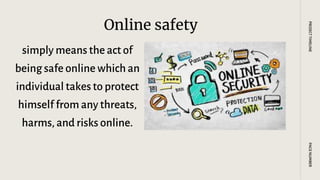
Online safety
simply means the act of
being safe online which an
individual takes to protect
himself from any threats,
harms, and risks online.
PAGE
NUMBER
PROJECT
TIMELINE
How important are online safety and security?
How about ethics and etiquette?
Republic Act 10175 and
its salient features.
CYBER CRIME LAW
PAGE
NUMBER
PROJECT
TIMELINE
The Cybercrime Prevention Act of 2012, officially recorded as Republic
Act No. 10175, is a law in the Philippines approved on September 12,
2012. It aims to address the legal issues concerning online interactions
and the Internet in the Philippines. Among the Cybercrime
Prevention Act of 2012, officially recorded as Republic Act No. 10175,
the cybercrime offenses included in the bill are cybersquatting,
cybersex, child pornography, identity theft, illegal; access to data, and
libel.
Republic Act No. 10175:
The Cybercrime Prevention Act of 2012
PAGE
NUMBER
PROJECT
TIMELINE
PAGE
NUMBER
PROJECT
TIMELINE
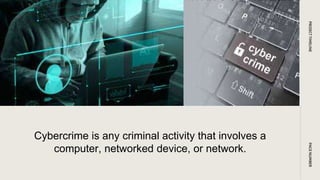
Cybercrime is any criminal activity that involves a
computer, networked device, or network.
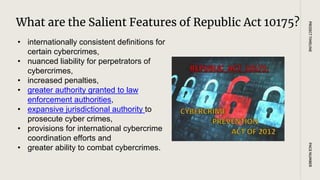
What are the Salient Features of Republic Act 10175?
PAGE
NUMBER
PROJECT
TIMELINE
• internationally consistent definitions for
certain cybercrimes,
• nuanced liability for perpetrators of
cybercrimes,
• increased penalties,
• greater authority granted to law
enforcement authorities,
• expansive jurisdictional authority to
prosecute cyber crimes,
• provisions for international cybercrime
coordination efforts and
• greater ability to combat cybercrimes.
Law Enforcement Authorities. — The National Bureau of
Investigation (NBI) and the Philippine National Police (PNP)
shall be responsible for the efficient and effective law
enforcement of the provisions of this Act.
Supreme Court Designates Cybercrime Courts
Accordingly, Cybercrime cases shall now be filed with the Office
of the Clerk of Court in the official station of the proper
cybercrime court.
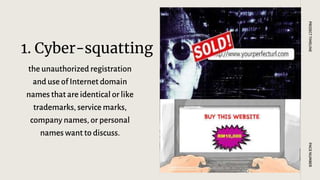
1. Cyber-squatting
the unauthorized registration
and use of Internet domain
names that are identical or like
trademarks, service marks,
company names, or personal
names want to discuss.
PAGE
NUMBER
PROJECT
TIMELINE
The term is derived from “squatting“,
which is the act of occupying an
abandoned or unoccupied space or
building that the squatter does not
own, rent, or otherwise have
permission to use.
Cybersquatting
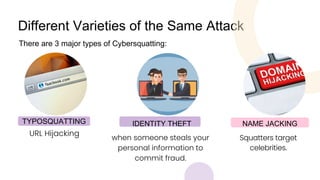
Different Varieties of the Same Attack
There are 3 major types of Cybersquatting:
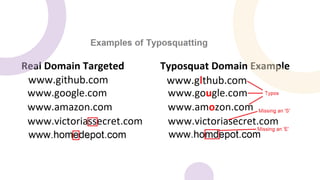
URL Hijacking
TYPOSQUATTING NAME JACKING
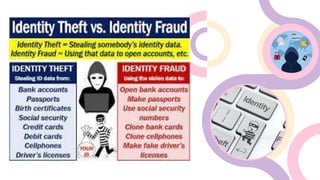
IDENTITY THEFT
when someone steals your
personal information to
commit fraud.
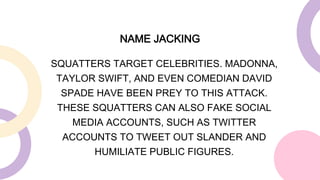
Squatters target
celebrities.
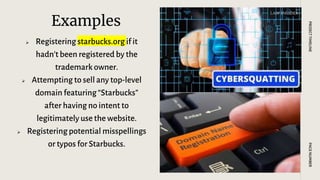
Examples
 Registering starbucks.org if it
hadn't been registered by the
trademark owner.
 Attempting to sell any top-level
domain featuring “Starbucks”
after having no intent to
legitimately use the website.
 Registering potential misspellings
or typos for Starbucks.
PAGE
NUMBER
PROJECT
TIMELINE
SQUATTERS TARGET CELEBRITIES. MADONNA,
TAYLOR SWIFT, AND EVEN COMEDIAN DAVID
SPADE HAVE BEEN PREY TO THIS ATTACK.
THESE SQUATTERS CAN ALSO FAKE SOCIAL
MEDIA ACCOUNTS, SUCH AS TWITTER
ACCOUNTS TO TWEET OUT SLANDER AND
HUMILIATE PUBLIC FIGURES.
NAME JACKING
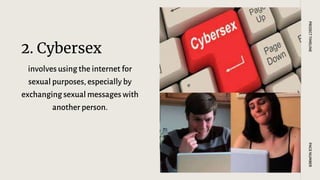
2. Cybersex
involves using the internet for
sexual purposes, especially by
exchanging sexual messages with
another person.
PAGE
NUMBER
PROJECT
TIMELINE
2. Cybersex
“the willful engagement, maintenance,
control, or operation, directly or
indirectly, of any lascivious exhibition
of sexual organs or sexualactivity, with
the aid of a computer system, for favor
or consideration”, is considered a
cybercrime with penalties involving
imprisonment and fines of up to one
million pesos.
PAGE
NUMBER
PROJECT
TIMELINE
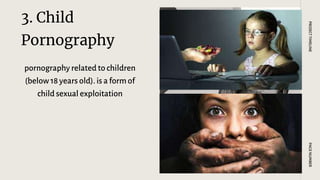
3. Child
Pornography
pornography related to children
(below 18 years old). is a form of
child sexual exploitation
PAGE
NUMBER
PROJECT
TIMELINE
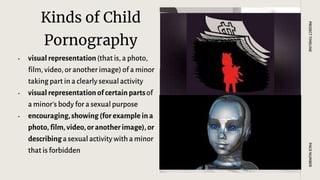
Kinds of Child
Pornography
• visual representation(that is, a photo,
film, video, or another image) of a minor
taking part in a clearly sexual activity
• visual representation of certain partsof
a minor’s body for a sexual purpose
• encouraging,showing (for example ina
photo, film, video,or another image), or
describinga sexual activity with a minor
that is forbidden
PAGE
NUMBER
PROJECT
TIMELINE
Possible Crimes That Deal With Child Pornography
PAGE
NUMBER
PROJECT
TIMELINE
• make child pornography
• print child pornography
• publish child pornography
• distribute child pornography
• transmit (send) child pornography
• make child pornography available
• sell child pornography
• import child pornography
• export child pornography
• possess (have) child pornography
• access (look up or get hold of) child pornography
• advertise child pornography
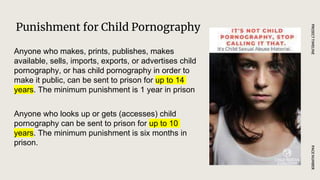
Punishment for Child Pornography
PAGE
NUMBER
PROJECT
TIMELINE
Anyone who makes, prints, publishes, makes
available, sells, imports, exports, or advertises child
pornography, or has child pornography in order to
make it public, can be sent to prison for up to 14
years. The minimum punishment is 1 year in prison
Anyone who looks up or gets (accesses) child
pornography can be sent to prison for up to 10
years. The minimum punishment is six months in
prison.
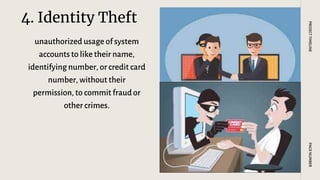
4. Identity Theft
unauthorized usage of system
accounts to like their name,
identifying number, or credit card
number, without their
permission, to commit fraud or
other crimes.
PAGE
NUMBER
PROJECT
TIMELINE
Types of Identity Theft
PAGE
NUMBER
PROJECT
TIMELINE
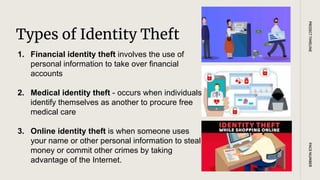
1. Financial identity theft involves the use of
personal information to take over financial
accounts
2. Medical identity theft - occurs when individuals
identify themselves as another to procure free
medical care
3. Online identity theft is when someone uses
your name or other personal information to steal
money or commit other crimes by taking
advantage of the Internet.
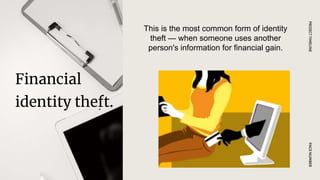
Financial
identity theft.
PAGE
NUMBER
PROJECT
TIMELINE
This is the most common form of identity
theft — when someone uses another
person's information for financial gain.
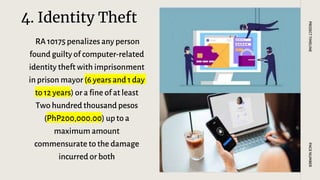
4. Identity Theft
RA 10175 penalizes any person
found guilty of computer-related
identity theft with imprisonment
in prison mayor (6 years and 1 day
to 12 years) or a fine of at least
Two hundred thousand pesos
(PhP200,000.00) up to a
maximum amount
commensurate to the damage
incurred or both
PAGE
NUMBER
PROJECT
TIMELINE
5. Illegal access to
data and libel.
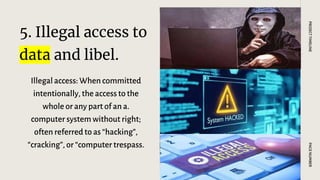
Illegal access: When committed
intentionally, the access to the
whole or any part of an a.
computer system without right;
often referred to as “hacking”,
“cracking”, or “computer trespass.
PAGE
NUMBER
PROJECT
TIMELINE
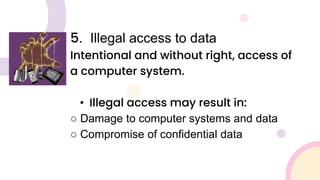
5. Illegal access to data
Intentional and without right, access of
a computer system.
• Illegal access may result in:
○ Damage to computer systems and data
○ Compromise of confidential data
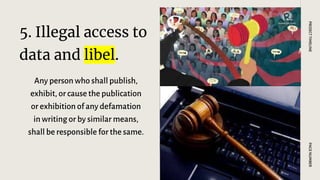
5. Illegal access to
data and libel.
Any person who shall publish,
exhibit, or cause the publication
or exhibition of any defamation
in writing or by similar means,
shall be responsible for the same.
PAGE
NUMBER
PROJECT
TIMELINE
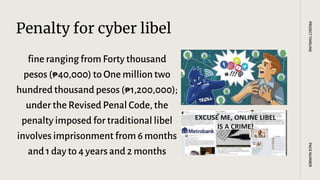
fine ranging from Forty thousand
pesos (₱40,000) to One million two
hundred thousand pesos (₱1,200,000);
under the Revised Penal Code, the
penalty imposed for traditional libel
involves imprisonment from 6 months
and 1 day to 4 years and 2 months
Penalty for cyber libel
PAGE
NUMBER
PROJECT
TIMELINE
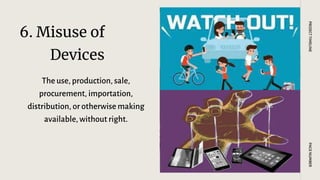
6. Misuse of
Devices
The use, production, sale,
procurement, importation,
distribution, or otherwise making
available, without right.
PAGE
NUMBER
PROJECT
TIMELINE
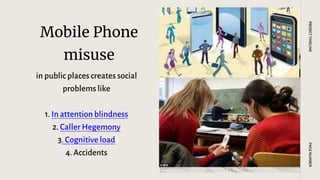
Mobile Phone
misuse
in public places creates social
problems like
1. In attention blindness
2. Caller Hegemony
3. Cognitive load
4. Accidents
PAGE
NUMBER
PROJECT
TIMELINE
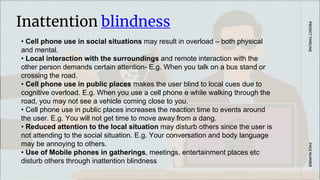
Inattention blindness
PAGE
NUMBER
PROJECT
TIMELINE
• Cell phone use in social situations may result in overload – both physical
and mental.
• Local interaction with the surroundings and remote interaction with the
other person demands certain attention- E.g. When you talk on a bus stand or
crossing the road.
• Cell phone use in public places makes the user blind to local cues due to
cognitive overload. E.g. When you use a cell phone e while walking through the
road, you may not see a vehicle coming close to you.
• Cell phone use in public places increases the reaction time to events around
the user. E.g. You will not get time to move away from a dang.
• Reduced attention to the local situation may disturb others since the user is
not attending to the social situation. E.g. Your conversation and body language
may be annoying to others.
• Use of Mobile phones in gatherings, meetings, entertainment places etc
disturb others through inattention blindness
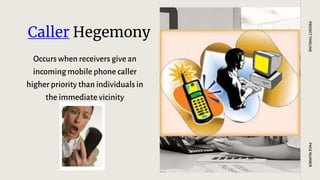
Caller Hegemony
Occurs when receivers give an
incoming mobile phone caller
higher priority than individuals in
the immediate vicinity
PAGE
NUMBER
PROJECT
TIMELINE
Cognitive Load
relates to the amount of
information that working
memory can hold at one time
For example, when you hear two
people trying to explain
something to you at the same
time.
PAGE
NUMBER
PROJECT
TIMELINE
Accidents
PAGE
NUMBER
PROJECT
TIMELINE
What is a
Cyber Citizen?
What makes a
good Cyber
Citizen?
Cyber Citizenship
is a term that refers to
being responsible when
using the Internet.
PAGE
NUMBER
PROJECT
TIMELINE
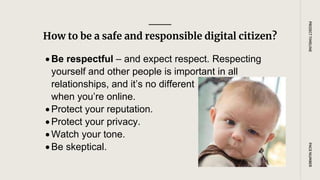
How to be a safe and responsible digital citizen?
PAGE
NUMBER
PROJECT
TIMELINE
 Be respectful – and expect respect. Respecting
yourself and other people is important in all
relationships, and it’s no different
when you’re online.
 Protect your reputation.
 Protect your privacy.
 Watch your tone.
 Be skeptical.
Thank you!
For listening.. Seeyou nextmeeting.Goodbye.
PAGE
NUMBER
PROJECT
TIMELINE

Online Safety and Security.pptx

  • 1.
  • 2.
    Online safety simply meansthe act of being safe online which an individual takes to protect himself from any threats, harms, and risks online. PAGE NUMBER PROJECT TIMELINE
  • 3.
    How important areonline safety and security? How about ethics and etiquette?
  • 4.
    Republic Act 10175and its salient features. CYBER CRIME LAW PAGE NUMBER PROJECT TIMELINE
  • 5.
    The Cybercrime PreventionAct of 2012, officially recorded as Republic Act No. 10175, is a law in the Philippines approved on September 12, 2012. It aims to address the legal issues concerning online interactions and the Internet in the Philippines. Among the Cybercrime Prevention Act of 2012, officially recorded as Republic Act No. 10175, the cybercrime offenses included in the bill are cybersquatting, cybersex, child pornography, identity theft, illegal; access to data, and libel. Republic Act No. 10175: The Cybercrime Prevention Act of 2012 PAGE NUMBER PROJECT TIMELINE
  • 6.
    PAGE NUMBER PROJECT TIMELINE Cybercrime is anycriminal activity that involves a computer, networked device, or network.
  • 7.
    What are theSalient Features of Republic Act 10175? PAGE NUMBER PROJECT TIMELINE • internationally consistent definitions for certain cybercrimes, • nuanced liability for perpetrators of cybercrimes, • increased penalties, • greater authority granted to law enforcement authorities, • expansive jurisdictional authority to prosecute cyber crimes, • provisions for international cybercrime coordination efforts and • greater ability to combat cybercrimes.
  • 8.
    Law Enforcement Authorities.— The National Bureau of Investigation (NBI) and the Philippine National Police (PNP) shall be responsible for the efficient and effective law enforcement of the provisions of this Act.
  • 9.
    Supreme Court DesignatesCybercrime Courts Accordingly, Cybercrime cases shall now be filed with the Office of the Clerk of Court in the official station of the proper cybercrime court.
  • 10.
    1. Cyber-squatting the unauthorizedregistration and use of Internet domain names that are identical or like trademarks, service marks, company names, or personal names want to discuss. PAGE NUMBER PROJECT TIMELINE
  • 11.
    The term isderived from “squatting“, which is the act of occupying an abandoned or unoccupied space or building that the squatter does not own, rent, or otherwise have permission to use. Cybersquatting
  • 12.
    Different Varieties ofthe Same Attack There are 3 major types of Cybersquatting: URL Hijacking TYPOSQUATTING NAME JACKING IDENTITY THEFT when someone steals your personal information to commit fraud. Squatters target celebrities.
  • 13.
    Examples  Registering starbucks.orgif it hadn't been registered by the trademark owner.  Attempting to sell any top-level domain featuring “Starbucks” after having no intent to legitimately use the website.  Registering potential misspellings or typos for Starbucks. PAGE NUMBER PROJECT TIMELINE
  • 17.
    SQUATTERS TARGET CELEBRITIES.MADONNA, TAYLOR SWIFT, AND EVEN COMEDIAN DAVID SPADE HAVE BEEN PREY TO THIS ATTACK. THESE SQUATTERS CAN ALSO FAKE SOCIAL MEDIA ACCOUNTS, SUCH AS TWITTER ACCOUNTS TO TWEET OUT SLANDER AND HUMILIATE PUBLIC FIGURES. NAME JACKING
  • 18.
    2. Cybersex involves usingthe internet for sexual purposes, especially by exchanging sexual messages with another person. PAGE NUMBER PROJECT TIMELINE
  • 19.
    2. Cybersex “the willfulengagement, maintenance, control, or operation, directly or indirectly, of any lascivious exhibition of sexual organs or sexualactivity, with the aid of a computer system, for favor or consideration”, is considered a cybercrime with penalties involving imprisonment and fines of up to one million pesos. PAGE NUMBER PROJECT TIMELINE
  • 20.
    3. Child Pornography pornography relatedto children (below 18 years old). is a form of child sexual exploitation PAGE NUMBER PROJECT TIMELINE
  • 21.
    Kinds of Child Pornography •visual representation(that is, a photo, film, video, or another image) of a minor taking part in a clearly sexual activity • visual representation of certain partsof a minor’s body for a sexual purpose • encouraging,showing (for example ina photo, film, video,or another image), or describinga sexual activity with a minor that is forbidden PAGE NUMBER PROJECT TIMELINE
  • 22.
    Possible Crimes ThatDeal With Child Pornography PAGE NUMBER PROJECT TIMELINE • make child pornography • print child pornography • publish child pornography • distribute child pornography • transmit (send) child pornography • make child pornography available • sell child pornography • import child pornography • export child pornography • possess (have) child pornography • access (look up or get hold of) child pornography • advertise child pornography
  • 23.
    Punishment for ChildPornography PAGE NUMBER PROJECT TIMELINE Anyone who makes, prints, publishes, makes available, sells, imports, exports, or advertises child pornography, or has child pornography in order to make it public, can be sent to prison for up to 14 years. The minimum punishment is 1 year in prison Anyone who looks up or gets (accesses) child pornography can be sent to prison for up to 10 years. The minimum punishment is six months in prison.
  • 24.
    4. Identity Theft unauthorizedusage of system accounts to like their name, identifying number, or credit card number, without their permission, to commit fraud or other crimes. PAGE NUMBER PROJECT TIMELINE
  • 25.
    Types of IdentityTheft PAGE NUMBER PROJECT TIMELINE 1. Financial identity theft involves the use of personal information to take over financial accounts 2. Medical identity theft - occurs when individuals identify themselves as another to procure free medical care 3. Online identity theft is when someone uses your name or other personal information to steal money or commit other crimes by taking advantage of the Internet.
  • 26.
    Financial identity theft. PAGE NUMBER PROJECT TIMELINE This isthe most common form of identity theft — when someone uses another person's information for financial gain.
  • 27.
    4. Identity Theft RA10175 penalizes any person found guilty of computer-related identity theft with imprisonment in prison mayor (6 years and 1 day to 12 years) or a fine of at least Two hundred thousand pesos (PhP200,000.00) up to a maximum amount commensurate to the damage incurred or both PAGE NUMBER PROJECT TIMELINE
  • 28.
    5. Illegal accessto data and libel. Illegal access: When committed intentionally, the access to the whole or any part of an a. computer system without right; often referred to as “hacking”, “cracking”, or “computer trespass. PAGE NUMBER PROJECT TIMELINE
  • 29.
    5. Illegal accessto data Intentional and without right, access of a computer system. • Illegal access may result in: ○ Damage to computer systems and data ○ Compromise of confidential data
  • 30.
    5. Illegal accessto data and libel. Any person who shall publish, exhibit, or cause the publication or exhibition of any defamation in writing or by similar means, shall be responsible for the same. PAGE NUMBER PROJECT TIMELINE
  • 31.
    fine ranging fromForty thousand pesos (₱40,000) to One million two hundred thousand pesos (₱1,200,000); under the Revised Penal Code, the penalty imposed for traditional libel involves imprisonment from 6 months and 1 day to 4 years and 2 months Penalty for cyber libel PAGE NUMBER PROJECT TIMELINE
  • 32.
    6. Misuse of Devices Theuse, production, sale, procurement, importation, distribution, or otherwise making available, without right. PAGE NUMBER PROJECT TIMELINE
  • 33.
    Mobile Phone misuse in publicplaces creates social problems like 1. In attention blindness 2. Caller Hegemony 3. Cognitive load 4. Accidents PAGE NUMBER PROJECT TIMELINE
  • 34.
    Inattention blindness PAGE NUMBER PROJECT TIMELINE • Cellphone use in social situations may result in overload – both physical and mental. • Local interaction with the surroundings and remote interaction with the other person demands certain attention- E.g. When you talk on a bus stand or crossing the road. • Cell phone use in public places makes the user blind to local cues due to cognitive overload. E.g. When you use a cell phone e while walking through the road, you may not see a vehicle coming close to you. • Cell phone use in public places increases the reaction time to events around the user. E.g. You will not get time to move away from a dang. • Reduced attention to the local situation may disturb others since the user is not attending to the social situation. E.g. Your conversation and body language may be annoying to others. • Use of Mobile phones in gatherings, meetings, entertainment places etc disturb others through inattention blindness
  • 35.
    Caller Hegemony Occurs whenreceivers give an incoming mobile phone caller higher priority than individuals in the immediate vicinity PAGE NUMBER PROJECT TIMELINE
  • 36.
    Cognitive Load relates tothe amount of information that working memory can hold at one time For example, when you hear two people trying to explain something to you at the same time. PAGE NUMBER PROJECT TIMELINE
  • 37.
  • 38.
    What is a CyberCitizen? What makes a good Cyber Citizen? Cyber Citizenship is a term that refers to being responsible when using the Internet. PAGE NUMBER PROJECT TIMELINE
  • 39.
    How to bea safe and responsible digital citizen? PAGE NUMBER PROJECT TIMELINE  Be respectful – and expect respect. Respecting yourself and other people is important in all relationships, and it’s no different when you’re online.  Protect your reputation.  Protect your privacy.  Watch your tone.  Be skeptical.

  • 40.
    Thank you! For listening..Seeyou nextmeeting.Goodbye. PAGE NUMBER PROJECT TIMELINE