THE NETIQUETTE
and the
COMPUTER ETHICS
1 DEFINITION OF
NETIQUETTE
*
WHAT DOES NETIQUETTE MEAN?
Netiquette is a made-up word from the words "net" and "etiquette."
Netiquette describes the rules of conduct for respectful and
appropriate communication on the internet. In general, netiquette is
the set of professional and social etiquettes practiced and advocated
in electronic communication over any computer network. Common
guidelines include being courteous and precise and avoiding
cyberbullying. Netiquette also dictates that users should obey
copyright laws and avoid overusing emoticons.
2
BASIC RULES
OF NETIQUETTE
*
1. Make Real
People a
Priority
Nothing is more irritating than trying to
have a conversation with someone
who is engrossed in their phone, tablet,
or another electronic device. This is
especially important if the other
person is your date, partner, or child. If
you are expecting an important call,
email, or text, let the person you are
with know upfront and apologize for
the interruption.
*
2. Use
Respectful
Language
If you don’t respect people,
then people won’t respect
you. So, it is very important to
use respectful language in the
real world as well as in the
virtual social world.
*
3. Share With
Discretion
Don’t upload naked pictures or post drunk
pictures, drug use pictures, or other
statements about your private life online
by mistake, or normally, never make this
mistake in your life. If you do so,
oversharing can lead to identity theft.Your
social media posts can be used by
scammers to steal your identity and
private information. Be discreet with any
information that can be used as an answer
to security questions on your private
accounts.
*
4. Don’t
Exclude
Others
When you are in public with lots
of people and you feel left out,
that feeling can lead to lots of
negative emotions and a sense of
lost control. So, never act like
this with others; try to socialize
and communicate with everyone.
*
5. Choose
Friends
Wisely
Nowadays, it is very different to
find a real, true friend, especially
in this era of social media. And it
can be intimidating for both if
you delete someone from your
friend list on social media. So
choose your friends wisely.
*
6. Respect
People's
Privacy
Don’t share people’s information
without their permission. If you are
forwarding an email message, use BCC
(blind carbon copy) rather than CC
(carbon copy) when sending it to more
than one person. This helps protect
the privacy of all the other email
recipients. You should always respect
people’s privacy.
*
7. Fact Check
Before
Reposting
This rule is the most crucial
one. You should always check
your post before posting it.
Don’t spread rumors or fake
messages over social media; it
can lead to various serious
problems.
*
8. Don’t
Spam
The term “spam” refers to the receipt of any
unwanted message. In the online world,
spamming can refer to an unwanted email,
text, or social media message. At times, these
messages contain viruses that might harm
digital devices. Never open messages, click on
links, or download attachments from
unfamiliar sources. If the message you receive
looks suspicious, contact the sender by other
means to ensure it’s them and not a
cybercriminal.
*
9. Respond to
Emails and
Texts
Promptly
By all means, ignore and delete spam,
unsolicited messages, and crazy stuff.
You don't owe anyone a response if they
are sending you something you didn't ask
for in advance. Otherwise, have the
courtesy to reply to a message within a
few days, especially if that message is
from family or friends. If it’s going to take
longer, that's okay. Just tell them that so
they know and aren't waiting for your
reply.
*
10. Update
Online
Information
Don't leave inaccurate information online
just because you can't be bothered to
update your social media profile or, if you
own a business, your company's website.
Following this netiquette guideline is even
more important if you're actively looking for
a job online. If prospective employers find
outdated information on your professional
networking page, they might assume that
you don't care enough about getting work.
3 TYPES OF
NETIQUETTE
* NETIQUETTE
BASICS
• Help the newbies
• Research before asking
• Remember emotion
* NETIQUETTE OF
REPLYING
• Be brief
• Use descriptive lines
• Stay on-topic
* NETIQUETTE OF
SENDING
• Acknowledge important
communications
• Summarize for the group
• Check current information before
replying
* NETIQUETTE OF
CONFIDENTIALLY
• Don’t publicize other’s email address
• Respect Copyright
4
IMPORTANCE OF
NETIQUETTE
• Keep it short
• Avoid using ALL CAPS
• P-r-o-o-f-r-e-a-d
• Be careful what you say
• Pay attention to formatting
5
CYBERCRIMES
*
What is Cybercrime?
Cybercrime is defined as unlawful activity that involves
or involves the use of a computer, a computer network,
or a networked device. The majority of cybercrime is
conducted by cybercriminals or hackers looking to
profit. However, cybercrime may occasionally try to
hary systems or networks for motives other than profit.
These could be political or personal in nature.
Phishing and Scam:
Phishing is a deceptive technique used by
cybercriminals to trick individuals into sharing sensitive
details, like passwords or credit card numbers, often
through fake emails or messages. The end goal is to
exploit this information for malicious purposes.
Identity Theft:
This is when a cybercriminal steals
someone's personal information, like
credit card details or personal photos,
and uses it to commit fraud or other
crimes without the person's consent.
Ransomware Attack:
A prevalent type of cybercrime where
malware is used to encrypt a user's personal
data, preventing them from accessing it. The
attacker then demands a ransom in
exchange for the decryption key.
Hacking:
This involves unauthorized access to
private computers or networks with
the intent to misuse them. This could
involve data theft, system shutdown,
or other harmful actions.
Internet Fraud:
This is a broad term for any crime
committed over the internet, such as spam,
banking fraud, or service theft. It involves
deceiving users or exploiting internet
services for illegal gain.
*
WHAT PROTECTS US
FROM CYBERCRIME?
*
HOW TO AVOID AND PREVENT CYBERCRIME?
It is true that there is a law that can protect us from
online criminal activities but as an individual, you
can do some things in your daily life that will help
you avoid and prevent being a victim of
Cybercrime.
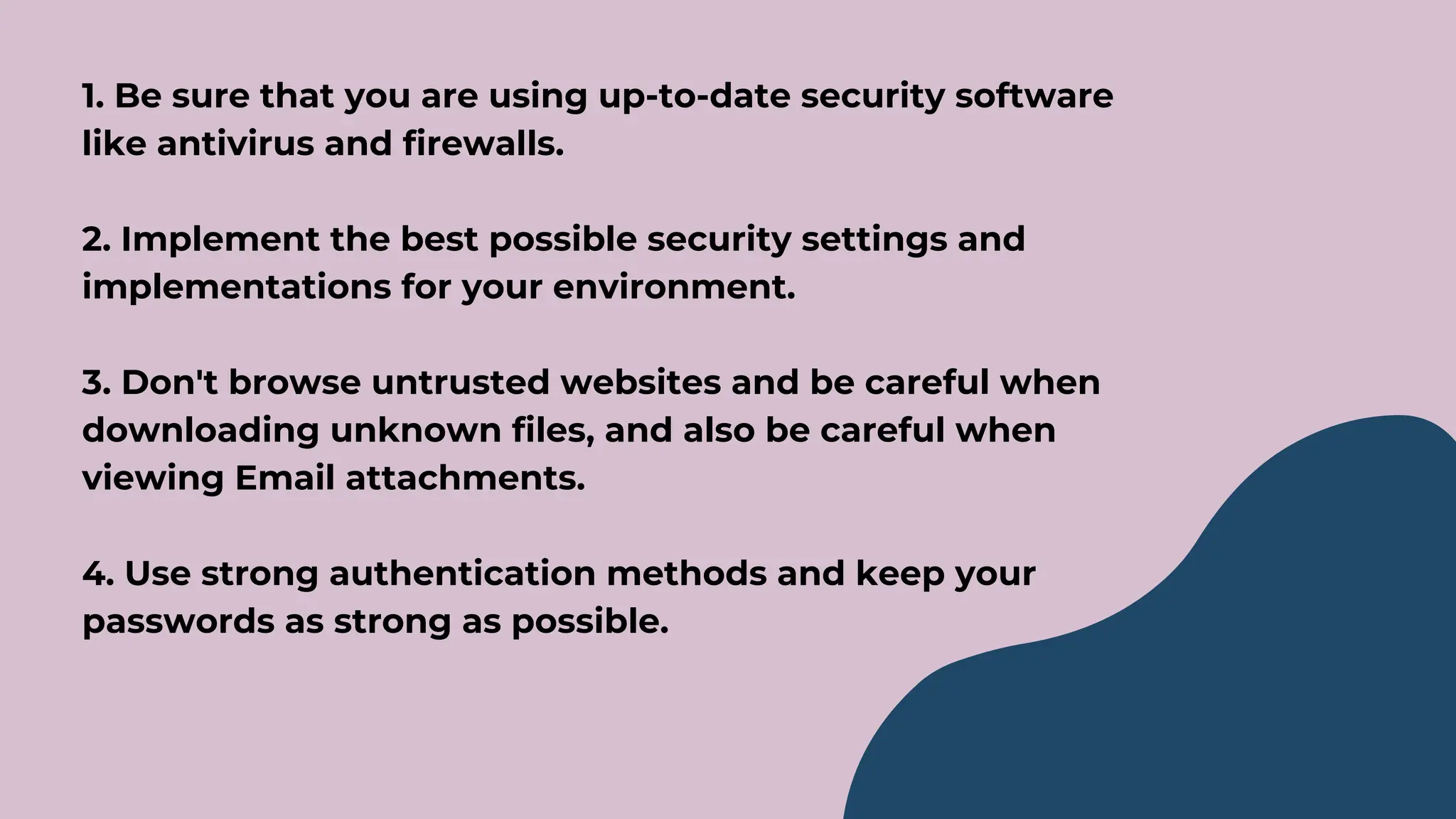
1. Be sure that you are using up-to-date security software
like antivirus and firewalls.
2. Implement the best possible security settings and
implementations for your environment.
3. Don't browse untrusted websites and be careful when
downloading unknown files, and also be careful when
viewing Email attachments.
4. Use strong authentication methods and keep your
passwords as strong as possible.
5. Don't share sensitive information online or on your
social media. accounts.
6. Educate your children about the risks of internet
usage and keep monitoring their activities.
7. Always be ready to make an immediate reaction
when falling victim to cybercrimes by referring to
the police.
6
INTERNET
THREATS
6
Cyberbullying sending hurtful messages, spreading rumors
online, sharing embarrassing photos or videos without
consent of the people, creating fake profiles to impersonate
others, and more. It can also have serious emotional,
psychological, and even physical consequences to the
victim, including depression, anxiety, low self-esteem, and in
extreme cases, self-harm or suicide. Here are the ways to
avoid it:
1. Check your Privacy Settings: always check your privacy settings to
check what the attacker can see to your profile and also to protect you
for future attacks
2. Be aware for what you post: always think before you post or share
anything online. Avoid sharing personal information or engaging in
conversations that could potentially lead to conflict.
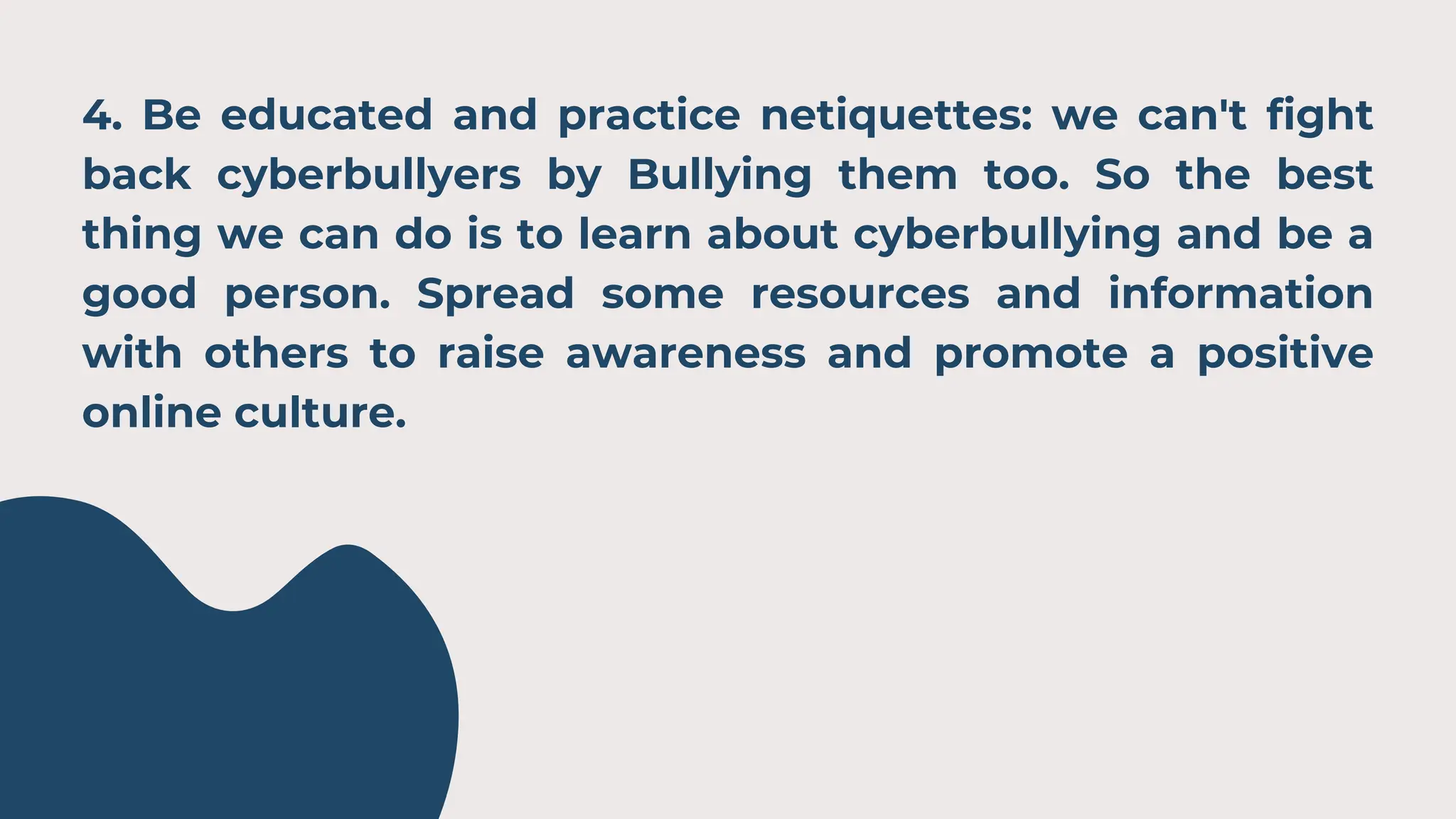
4. Be educated and practice netiquettes: we can't fight
back cyberbullyers by Bullying them too. So the best
thing we can do is to learn about cyberbullying and be a
good person. Spread some resources and information
with others to raise awareness and promote a positive
online culture.
3. Don't forget to talk to someone: since cyberbullying can
affect your mental health, we should have ourselves
someone to talk to. Try talking to a trusted friend, family
member, teacher, or counselor for support and guidance.
Don't keep the problem to yourself
THANK YOU
FOR LISTENING!

The-Netiquette-and-the-Computer-Ethics.pdf

  • 1.
  • 2.
  • 3.
    * WHAT DOES NETIQUETTEMEAN? Netiquette is a made-up word from the words "net" and "etiquette." Netiquette describes the rules of conduct for respectful and appropriate communication on the internet. In general, netiquette is the set of professional and social etiquettes practiced and advocated in electronic communication over any computer network. Common guidelines include being courteous and precise and avoiding cyberbullying. Netiquette also dictates that users should obey copyright laws and avoid overusing emoticons.
  • 4.
  • 5.
    * 1. Make Real Peoplea Priority Nothing is more irritating than trying to have a conversation with someone who is engrossed in their phone, tablet, or another electronic device. This is especially important if the other person is your date, partner, or child. If you are expecting an important call, email, or text, let the person you are with know upfront and apologize for the interruption.
  • 6.
    * 2. Use Respectful Language If youdon’t respect people, then people won’t respect you. So, it is very important to use respectful language in the real world as well as in the virtual social world.
  • 7.
    * 3. Share With Discretion Don’tupload naked pictures or post drunk pictures, drug use pictures, or other statements about your private life online by mistake, or normally, never make this mistake in your life. If you do so, oversharing can lead to identity theft.Your social media posts can be used by scammers to steal your identity and private information. Be discreet with any information that can be used as an answer to security questions on your private accounts.
  • 8.
    * 4. Don’t Exclude Others When youare in public with lots of people and you feel left out, that feeling can lead to lots of negative emotions and a sense of lost control. So, never act like this with others; try to socialize and communicate with everyone.
  • 9.
    * 5. Choose Friends Wisely Nowadays, itis very different to find a real, true friend, especially in this era of social media. And it can be intimidating for both if you delete someone from your friend list on social media. So choose your friends wisely.
  • 10.
    * 6. Respect People's Privacy Don’t sharepeople’s information without their permission. If you are forwarding an email message, use BCC (blind carbon copy) rather than CC (carbon copy) when sending it to more than one person. This helps protect the privacy of all the other email recipients. You should always respect people’s privacy.
  • 11.
    * 7. Fact Check Before Reposting Thisrule is the most crucial one. You should always check your post before posting it. Don’t spread rumors or fake messages over social media; it can lead to various serious problems.
  • 12.
    * 8. Don’t Spam The term“spam” refers to the receipt of any unwanted message. In the online world, spamming can refer to an unwanted email, text, or social media message. At times, these messages contain viruses that might harm digital devices. Never open messages, click on links, or download attachments from unfamiliar sources. If the message you receive looks suspicious, contact the sender by other means to ensure it’s them and not a cybercriminal.
  • 13.
    * 9. Respond to Emailsand Texts Promptly By all means, ignore and delete spam, unsolicited messages, and crazy stuff. You don't owe anyone a response if they are sending you something you didn't ask for in advance. Otherwise, have the courtesy to reply to a message within a few days, especially if that message is from family or friends. If it’s going to take longer, that's okay. Just tell them that so they know and aren't waiting for your reply.
  • 14.
    * 10. Update Online Information Don't leaveinaccurate information online just because you can't be bothered to update your social media profile or, if you own a business, your company's website. Following this netiquette guideline is even more important if you're actively looking for a job online. If prospective employers find outdated information on your professional networking page, they might assume that you don't care enough about getting work.
  • 15.
  • 16.
  • 17.
    • Help thenewbies • Research before asking • Remember emotion
  • 18.
  • 19.
    • Be brief •Use descriptive lines • Stay on-topic
  • 20.
  • 21.
    • Acknowledge important communications •Summarize for the group • Check current information before replying
  • 22.
  • 23.
    • Don’t publicizeother’s email address • Respect Copyright
  • 24.
  • 25.
    • Keep itshort • Avoid using ALL CAPS • P-r-o-o-f-r-e-a-d • Be careful what you say • Pay attention to formatting
  • 26.
  • 27.
    * What is Cybercrime? Cybercrimeis defined as unlawful activity that involves or involves the use of a computer, a computer network, or a networked device. The majority of cybercrime is conducted by cybercriminals or hackers looking to profit. However, cybercrime may occasionally try to hary systems or networks for motives other than profit. These could be political or personal in nature.
  • 28.
    Phishing and Scam: Phishingis a deceptive technique used by cybercriminals to trick individuals into sharing sensitive details, like passwords or credit card numbers, often through fake emails or messages. The end goal is to exploit this information for malicious purposes.
  • 29.
    Identity Theft: This iswhen a cybercriminal steals someone's personal information, like credit card details or personal photos, and uses it to commit fraud or other crimes without the person's consent.
  • 30.
    Ransomware Attack: A prevalenttype of cybercrime where malware is used to encrypt a user's personal data, preventing them from accessing it. The attacker then demands a ransom in exchange for the decryption key.
  • 31.
    Hacking: This involves unauthorizedaccess to private computers or networks with the intent to misuse them. This could involve data theft, system shutdown, or other harmful actions.
  • 32.
    Internet Fraud: This isa broad term for any crime committed over the internet, such as spam, banking fraud, or service theft. It involves deceiving users or exploiting internet services for illegal gain.
  • 33.
  • 34.
    * HOW TO AVOIDAND PREVENT CYBERCRIME? It is true that there is a law that can protect us from online criminal activities but as an individual, you can do some things in your daily life that will help you avoid and prevent being a victim of Cybercrime.
  • 35.
    1. Be surethat you are using up-to-date security software like antivirus and firewalls. 2. Implement the best possible security settings and implementations for your environment. 3. Don't browse untrusted websites and be careful when downloading unknown files, and also be careful when viewing Email attachments. 4. Use strong authentication methods and keep your passwords as strong as possible.
  • 36.
    5. Don't sharesensitive information online or on your social media. accounts. 6. Educate your children about the risks of internet usage and keep monitoring their activities. 7. Always be ready to make an immediate reaction when falling victim to cybercrimes by referring to the police.
  • 37.
  • 38.
    6 Cyberbullying sending hurtfulmessages, spreading rumors online, sharing embarrassing photos or videos without consent of the people, creating fake profiles to impersonate others, and more. It can also have serious emotional, psychological, and even physical consequences to the victim, including depression, anxiety, low self-esteem, and in extreme cases, self-harm or suicide. Here are the ways to avoid it:
  • 39.
    1. Check yourPrivacy Settings: always check your privacy settings to check what the attacker can see to your profile and also to protect you for future attacks 2. Be aware for what you post: always think before you post or share anything online. Avoid sharing personal information or engaging in conversations that could potentially lead to conflict.
  • 40.
    4. Be educatedand practice netiquettes: we can't fight back cyberbullyers by Bullying them too. So the best thing we can do is to learn about cyberbullying and be a good person. Spread some resources and information with others to raise awareness and promote a positive online culture.
  • 41.
    3. Don't forgetto talk to someone: since cyberbullying can affect your mental health, we should have ourselves someone to talk to. Try talking to a trusted friend, family member, teacher, or counselor for support and guidance. Don't keep the problem to yourself
  • 42.