Chapter 4
Internet of Things(IoTs)
By Arba A.
Wolaita Sodo University 1
Chapter 4: Objectives
At the end of this chapters students should understand:
 Describe IOT
 Overview and History of IoT
 Pros and Cons of IOT
 How IoT works ( Architectures, IoT Trends, Devices and Networks,
Examples of IoT Applications, Management Platform for the Internet
of Things)
 Explain the architecture of IoT
 Describe IoT tools and platforms
 Describe some of the application areas of IoT
Wolaita Sodo University 2
Overview of IoT
 The most important features of IoT include:
 AI − IoT essentially makes virtually anything “smart”, meaning it enhances every aspect of life
with the power of data collection, artificial intelligence algorithms, and networks.
 Connectivity − New enabling technologies for networking and specifically IoT networking,
mean networks are no longer exclusively tied to major providers.
 Sensors − They act as defining instruments that transform IoT from a standard passive
network of devices into an active system capable of real-world integration. IoT loses its
distinction without sensors.
Wolaita Sodo University 3
Overview of IoT
 Active Engagement − Much of today's interaction with connected
technology happens through passive engagement.
 IoT introduces a new paradigm for active content, product, or service
engagement.
 Small Devices − Devices, as predicted, have become smaller, cheaper, and
more powerful over time. IoT exploits purpose-built small devices to deliver
its precision, scalability, and versatility.
Wolaita Sodo University 4
But what is IoT Exactly? Definitions?
 Definitions from,
 Internet Architecture Board’s (IAB): The networking of smart objects,
meaning a huge number of devices intelligently communicating in the
presence of internet protocol that cannot be directly operated by human
beings but exist as components in buildings, vehicles or the environment
 Internet Engineering Task Force (IETF): The networking of smart
objects in which smart objects have some constraints such as limited
bandwidth, power, and processing accessibility for achieving
interoperability among smart objects.
Wolaita Sodo University 5
But what is IoT Exactly? Definitions? Cont’d…
 Definitions from….
 IEEE Communications: A framework of all things that have a representation
in the presence of the internet in such a way that new applications and
services enable the interaction in the physical and virtual world in the form of
Machine-to-Machine (M2M) communication in the cloud.
 Oxford dictionary: The interaction of everyday object’s computing devices
through the Internet that enables the sending and receiving of useful data
Wolaita Sodo University 6
But what is IoT Exactly? Definitions? Cont’d…
 Simple formula IoT= Services+ Data+ Networks + Sensors
 Generally, The Internet of Things (IoT) is the network of physical objects or "things" embedded with
electronics, software, sensors, and network connectivity, which enables these objects to collect and
exchange data.
 IoT is a system of interrelated computing devices, mechanical and digital machines, objects, animals or
people that are provided with unique identifiers (UIDs) and the ability to transfer data over a network
without requiring human-to-human or human-to-computer interaction (without any human
intervention).
 A thing in the internet of things can be a person with a heart monitor implant, a farm animal with a
biochip transponder, an automobile that has built-in sensors to alert the driver when tire pressure is low
or any other natural or man-made object that can be assigned an IP address and is able to transfer
data over a network
Wolaita Sodo University 7
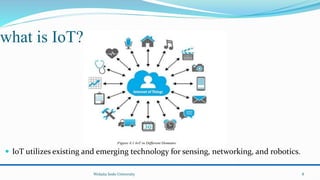
what is IoT?
 IoT utilizes existing and emerging technology for sensing, networking, and robotics.
Wolaita Sodo University 8
Advantage and Disadvantages of IoT
 Advantages of IoT
 Improved(active) Customer Engagement: It avoids blind-spots and significant flaws inaccuracy;
and as noted, engagement remains passive.
 Technology Optimization: Improve device use, and aid in more potent improvements to
technology. IOT unlocks a world of critical functional and field data.
 Reduced Waste: Current analytics give us superficial insight, but IoT provides real-world
information leading to the more effective management of resources
 Enhanced Data Collection(sensors do that): IoT breaks the current limitations of data collection
of passive usage out of those spaces and places it exactly where humans really want to go to
analyze our world. It allows an accurate picture of everything.
Wolaita Sodo University 12
Advantage and Disadvantages of IoT
 Disadvantages of IoT
 Increased Security Concern more devices and more info created
and shared therefore ,hacker could steal confidential information
also increases.
 Big Data Management challenging for enterprises handling
massive number of IoT devices and collecting and managing the
data
 The higher chance of system corruption if there is a bug in any
part of the system
 Device Interoperability Since there’s no international standard of
compatibility for IoT, it’s difficult for devices from different
manufacturers (or vendors ) to communicate with each other.
Wolaita Sodo University 13
Key IoT Challenges
 There are key challenges and implications today that need to be addressed
before the mass adoption of IoT can occur that include:
 Privacy and Security ( refer to the security issues at different
Layers of IOT)
 Constantly connected devices communicating over networks. The system offers little
control despite any security measures.
 This leaves users exposed to various kinds of attackers.
 The sophistication of IoT provides substantial personal data in extreme detail without
the user's active participation.
Wolaita Sodo University 14
Key IoT Challenges – Cont’d…
 Complexity − IoT is complicated in terms of design, deployment, and
maintenance given their use of multiple technologies and a large set of
new enabling technologies.
 Flexibility and Interoperability − Many are concerned about the
flexibility of an IoT system to integrate easily with another. They worry
about finding themselves with several conflicting or locking systems
 Compliance − IoT, like any other technology in the realm of business,
must comply with regulations.
Wolaita Sodo University 15
How Does IoT Works ?
 An IoT ecosystem consists of web-enabled smart devices
that use
 embedded processors
 sensors and
 communication hardware
to collect, send and act on data they acquire from their
environments.
Wolaita Sodo University 16
How IoT Works Cont’d…
Wolaita Sodo University 20
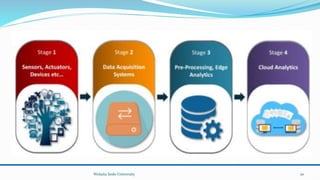
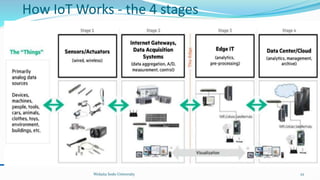
How IoT Works - the 4 stages
 Stage 1 (Sensors/Actuators)
 A thing in the context of “Internet of Things”, should be equipped with sensors
and actuators thus giving the ability to emit, accept and process signals
 Stage 2 (Data Acquisition Systems):
 The data from the sensors starts in analogue form which needs to be aggregated
and converted into digital streams for further processing.
 This stage performs these data aggregation and conversion functions
 Stage 3 (Edge Analytics)
 Once IoT data has been digitized and aggregated, it may require further
processing before it enters the data center, this is where Edge Analytics comes in
 Stage 4 (Cloud Analytics)
 Data that needs more in-depth processing gets forwarded to physical data
centers or cloud-based systems.
Wolaita Sodo University 21
How IoT Works - the 4 stages
Wolaita Sodo University 22
IoT Architecture
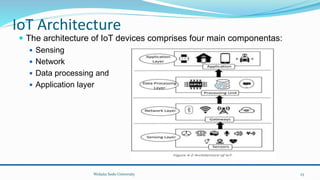
 The architecture of IoT devices comprises four main componentas:
 Sensing
 Network
 Data processing and
 Application layer
Wolaita Sodo University 23
IoT Architecture
1. Sensing layer:
The main purpose of the sensing layer is to identify any phenomena in the
devices’ peripheral and obtain data from the real world.
 Using multiple sensors for applications is one of the primary features of IoT
devices. Sensors in IoT devices are usually integrated through sensor hubs.
 A sensor hub is a common connection point for multiple sensors that
accumulate and forward sensor data to the processing unit of a device.
 Actuators can also intervene to change the physical conditions that generate
the data. It might, for example, shut off a power supply, adjust an airflow
valve, or move a robotic gripper in an assembly process.
Wolaita Sodo University 24
IoT- Architecture : Smart device / sensor layer
 accelerometers
 temperature sensors
 magnetometers
 proximity sensors
 gyroscopes
 image sensors
 acoustic sensors
 light sensors
 pressure sensors
 gas RFID sensors
 humidity sensors
 microflow sensors
Wolaita Sodo University
Here is a list of some of the measurement devices used in IoT:
25
 Sensors in IoT devices can be classified into three broad categories as
described below
 A. Motion Sensors: Motion sensors measure the change in motion as
well as the orientation of the devices.
 There are two types of motions one can observe in a device: linear and
angular motions.
 The linear motion refers to the linear displacement of an IoT device while
the angular motion refers to the rotational displacement of the device.
Wolaita Sodo University
IoT Architecture
26
Sensors in IoT devices
 B. Environmental Sensors: Sensors such as Light sensors, Pressure
sensors, etc. are embedded in IoT devices to sense the change in
environmental parameters in the device’s peripheral.
 The primary purpose of using environmental sensors in IoT devices is
to help the devices to take autonomous decisions according to the
changes of a device’s peripheral. (e.g., home automation systems,
smart locks, smart lights, etc.)
Wolaita Sodo University
IoT Architecture
27
 Sensors in IoT devices
 C. Position sensors: Position sensors of IoT devices deal with the
physical position and location of the device. The most common position
sensors used in IoT devices are magnetic sensors and Global Positioning
System (GPS) sensors.
Wolaita Sodo University
IoT Architecture
28
2. Network Layer – It acts as a communication channel to transfer data,
collected in the sensing layer, to other connected devices.
It is implemented using diverse communication technologies (e.g., Wi-Fi,
Bluetooth, Zigbee, ZWave, LoRa, cellular network, etc.) to allow data flow
between other devices.
3. Data Processing Layer - The data processing layer consists of the main
data processing unit of IoT devices. The data processing layer takes data
collected in the sensing layer and analyses the data to make decisions based
on the result.
4. Application Layer - The application layer implements and presents the
results of the data processing layer to accomplish disparate applications of
IoT devices.
Wolaita Sodo University
IoT Architecture
29
IoT- Devices
 Connected devices are part of a scenario in which every device talks to other
related devices in an environment to automate home and industrial tasks, and to
communicate usable sensor data to users, businesses and other interested parties.
As such, the devices can be categorized into three main groups:
 Consumer
 Consumer connected devices include smart TVs, smart speakers, toys,
wearables, and smart appliances. smart meters, commercial security systems
and smart city technologies such as those used to monitor traffic and weather
conditions are examples of industrial and enterprise IoT devices.
Wolaita Sodo University 31
IoT- Devices
 Smart sensors located in a conference room can help an employee locate
and schedule an available room for a meeting, ensuring the proper room
type, size and features are available.
 IoT network typically includes a number of devices with constrained
resources (power, processing, memory, among others) and some of those
devices may be massively deployed over large areas
 IoT landscape is depicted by an increasing number of connected devices
characterized by their heterogeneity and the presence of resources
constrained networks.
Wolaita Sodo University 32
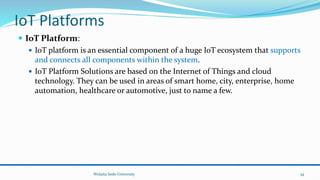
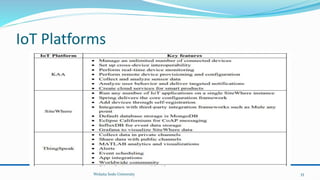
IoT Platforms
 IoT Platform:
 IoT platform is an essential component of a huge IoT ecosystem that supports
and connects all components within the system.
 IoT Platform Solutions are based on the Internet of Things and cloud
technology. They can be used in areas of smart home, city, enterprise, home
automation, healthcare or automotive, just to name a few.
Wolaita Sodo University 34
IoT Platforms
Wolaita Sodo University 35
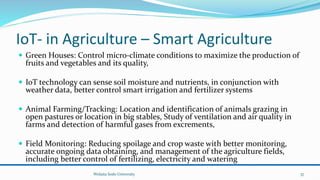
IoT- in Agriculture – Smart Agriculture
 Green Houses: Control micro-climate conditions to maximize the production of
fruits and vegetables and its quality,
 IoT technology can sense soil moisture and nutrients, in conjunction with
weather data, better control smart irrigation and fertilizer systems
 Animal Farming/Tracking: Location and identification of animals grazing in
open pastures or location in big stables, Study of ventilation and air quality in
farms and detection of harmful gases from excrements,
 Field Monitoring: Reducing spoilage and crop waste with better monitoring,
accurate ongoing data obtaining, and management of the agriculture fields,
including better control of fertilizing, electricity and watering
Wolaita Sodo University 37
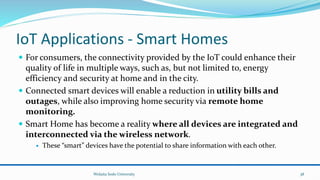
IoT Applications - Smart Homes
 For consumers, the connectivity provided by the IoT could enhance their
quality of life in multiple ways, such as, but not limited to, energy
efficiency and security at home and in the city.
 Connected smart devices will enable a reduction in utility bills and
outages, while also improving home security via remote home
monitoring.
 Smart Home has become a reality where all devices are integrated and
interconnected via the wireless network.
 These “smart” devices have the potential to share information with each other.
Wolaita Sodo University 38
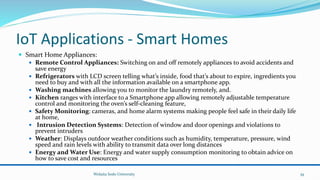
IoT Applications - Smart Homes
 Smart Home Appliances:
 Remote Control Appliances: Switching on and off remotely appliances to avoid accidents and
save energy
 Refrigerators with LCD screen telling what’s inside, food that’s about to expire, ingredients you
need to buy and with all the information available on a smartphone app.
 Washing machines allowing you to monitor the laundry remotely, and.
 Kitchen ranges with interface to a Smartphone app allowing remotely adjustable temperature
control and monitoring the oven’s self-cleaning feature,
 Safety Monitoring: cameras, and home alarm systems making people feel safe in their daily life
at home,
 Intrusion Detection Systems: Detection of window and door openings and violations to
prevent intruders
 Weather: Displays outdoor weather conditions such as humidity, temperature, pressure, wind
speed and rain levels with ability to transmit data over long distances
 Energy and Water Use: Energy and water supply consumption monitoring to obtain advice on
how to save cost and resources
Wolaita Sodo University 39
IoT Across Application - Smart City
Applications
 Lighting : intelligent and weather adaptive lighting in street lights.
 Smart Roads and Intelligent High-ways with warning messages and
diversions according to climate conditions and unexpected events like
accidents or traffic jams
 Smart Parking: Real-time monitoring of parking spaces availability in
the city making residents able to identify and reserve the closest
available spaces
 Waste Management: Detection of rubbish levels in containers to
optimize the trash collection routes.
 Garbage cans and recycle bins with RFID tags allow the sanitation staff to
see when garbage has been put out
Wolaita Sodo University 42
IoT Across Application - Smart City
Applications
 In Smart Cities, the development of smart grids, data analytics, and
autonomous vehicles will provide an intelligent platform to deliver
innovations in
 Energy management,
 Traffic management, and
 Security,
by sharing the benefits of this technology throughout society
Wolaita Sodo University 43
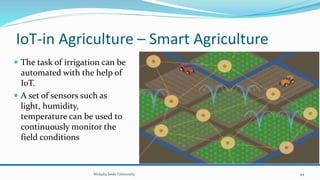
IoT-in Agriculture – Smart Agriculture
 The task of irrigation can be
automated with the help of
IoT.
 A set of sensors such as
light, humidity,
temperature can be used to
continuously monitor the
field conditions
Wolaita Sodo University 44
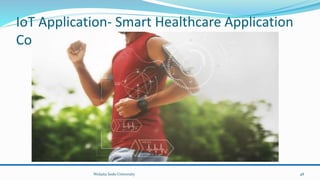
IoT Application- Smart Healthcare Application
 Smartwatches and fitness devices have changed the frequency of health
monitoring.
 People can monitor their own health at regular intervals.
 Not only this, now if a patient is coming to the hospital by ambulance, by
the time he or she reaches the hospital his health report is diagnosed by
doctors and the hospital quickly starts the treatment.
 The data gathered from multiple healthcare applications are now
collected and used to analyze different disease and find its cure.
 Hospitals often use IoT systems to complete tasks such as inventory
management, for both pharmaceuticals and medical instruments
Wolaita Sodo University 45
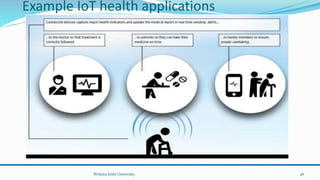
Example IoT health applications
Wolaita Sodo University 46
IoT Application- Smart Healthcare Application
Cont’d…
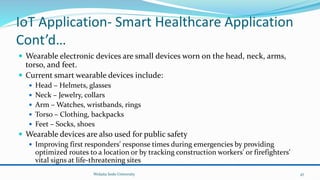
 Wearable electronic devices are small devices worn on the head, neck, arms,
torso, and feet.
 Current smart wearable devices include:
 Head – Helmets, glasses
 Neck – Jewelry, collars
 Arm – Watches, wristbands, rings
 Torso – Clothing, backpacks
 Feet – Socks, shoes
 Wearable devices are also used for public safety
 Improving first responders' response times during emergencies by providing
optimized routes to a location or by tracking construction workers' or firefighters'
vital signs at life-threatening sites
Wolaita Sodo University 47
IoT Application- Smart Healthcare Application
Cont’d…
Wolaita Sodo University 48
IoT Application- Smart Education Application
 IoT provides education aids which help in filling the gaps in the education
industry.
 It not only improves the quality of education but also optimizes the cost
and improves the management by taking into consideration students
response and performance.
Wolaita Sodo University 49
IoT Application- Air and Water Pollution,
Hazards etc.
 Through various sensors, we can detect the pollution in the air and water
by frequent sampling.
 This helps in preventing substantial contamination and related disasters
 The Internet of Things platform can be used to accumulate data related to
a specific geographic location using remote monitoring tools and perform
analytics so that early warnings of a disaster can be found out.
Wolaita Sodo University 50
End of the chapter
Wolaita Sodo University 52

Chapter 4about internet of things IoT.pptx

  • 1.
    Chapter 4 Internet ofThings(IoTs) By Arba A. Wolaita Sodo University 1
  • 2.
    Chapter 4: Objectives Atthe end of this chapters students should understand:  Describe IOT  Overview and History of IoT  Pros and Cons of IOT  How IoT works ( Architectures, IoT Trends, Devices and Networks, Examples of IoT Applications, Management Platform for the Internet of Things)  Explain the architecture of IoT  Describe IoT tools and platforms  Describe some of the application areas of IoT Wolaita Sodo University 2
  • 3.
    Overview of IoT The most important features of IoT include:  AI − IoT essentially makes virtually anything “smart”, meaning it enhances every aspect of life with the power of data collection, artificial intelligence algorithms, and networks.  Connectivity − New enabling technologies for networking and specifically IoT networking, mean networks are no longer exclusively tied to major providers.  Sensors − They act as defining instruments that transform IoT from a standard passive network of devices into an active system capable of real-world integration. IoT loses its distinction without sensors. Wolaita Sodo University 3
  • 4.
    Overview of IoT Active Engagement − Much of today's interaction with connected technology happens through passive engagement.  IoT introduces a new paradigm for active content, product, or service engagement.  Small Devices − Devices, as predicted, have become smaller, cheaper, and more powerful over time. IoT exploits purpose-built small devices to deliver its precision, scalability, and versatility. Wolaita Sodo University 4
  • 5.
    But what isIoT Exactly? Definitions?  Definitions from,  Internet Architecture Board’s (IAB): The networking of smart objects, meaning a huge number of devices intelligently communicating in the presence of internet protocol that cannot be directly operated by human beings but exist as components in buildings, vehicles or the environment  Internet Engineering Task Force (IETF): The networking of smart objects in which smart objects have some constraints such as limited bandwidth, power, and processing accessibility for achieving interoperability among smart objects. Wolaita Sodo University 5
  • 6.
    But what isIoT Exactly? Definitions? Cont’d…  Definitions from….  IEEE Communications: A framework of all things that have a representation in the presence of the internet in such a way that new applications and services enable the interaction in the physical and virtual world in the form of Machine-to-Machine (M2M) communication in the cloud.  Oxford dictionary: The interaction of everyday object’s computing devices through the Internet that enables the sending and receiving of useful data Wolaita Sodo University 6
  • 7.
    But what isIoT Exactly? Definitions? Cont’d…  Simple formula IoT= Services+ Data+ Networks + Sensors  Generally, The Internet of Things (IoT) is the network of physical objects or "things" embedded with electronics, software, sensors, and network connectivity, which enables these objects to collect and exchange data.  IoT is a system of interrelated computing devices, mechanical and digital machines, objects, animals or people that are provided with unique identifiers (UIDs) and the ability to transfer data over a network without requiring human-to-human or human-to-computer interaction (without any human intervention).  A thing in the internet of things can be a person with a heart monitor implant, a farm animal with a biochip transponder, an automobile that has built-in sensors to alert the driver when tire pressure is low or any other natural or man-made object that can be assigned an IP address and is able to transfer data over a network Wolaita Sodo University 7
  • 8.
    what is IoT? IoT utilizes existing and emerging technology for sensing, networking, and robotics. Wolaita Sodo University 8
  • 9.
    Advantage and Disadvantagesof IoT  Advantages of IoT  Improved(active) Customer Engagement: It avoids blind-spots and significant flaws inaccuracy; and as noted, engagement remains passive.  Technology Optimization: Improve device use, and aid in more potent improvements to technology. IOT unlocks a world of critical functional and field data.  Reduced Waste: Current analytics give us superficial insight, but IoT provides real-world information leading to the more effective management of resources  Enhanced Data Collection(sensors do that): IoT breaks the current limitations of data collection of passive usage out of those spaces and places it exactly where humans really want to go to analyze our world. It allows an accurate picture of everything. Wolaita Sodo University 12
  • 10.
    Advantage and Disadvantagesof IoT  Disadvantages of IoT  Increased Security Concern more devices and more info created and shared therefore ,hacker could steal confidential information also increases.  Big Data Management challenging for enterprises handling massive number of IoT devices and collecting and managing the data  The higher chance of system corruption if there is a bug in any part of the system  Device Interoperability Since there’s no international standard of compatibility for IoT, it’s difficult for devices from different manufacturers (or vendors ) to communicate with each other. Wolaita Sodo University 13
  • 11.
    Key IoT Challenges There are key challenges and implications today that need to be addressed before the mass adoption of IoT can occur that include:  Privacy and Security ( refer to the security issues at different Layers of IOT)  Constantly connected devices communicating over networks. The system offers little control despite any security measures.  This leaves users exposed to various kinds of attackers.  The sophistication of IoT provides substantial personal data in extreme detail without the user's active participation. Wolaita Sodo University 14
  • 12.
    Key IoT Challenges– Cont’d…  Complexity − IoT is complicated in terms of design, deployment, and maintenance given their use of multiple technologies and a large set of new enabling technologies.  Flexibility and Interoperability − Many are concerned about the flexibility of an IoT system to integrate easily with another. They worry about finding themselves with several conflicting or locking systems  Compliance − IoT, like any other technology in the realm of business, must comply with regulations. Wolaita Sodo University 15
  • 13.
    How Does IoTWorks ?  An IoT ecosystem consists of web-enabled smart devices that use  embedded processors  sensors and  communication hardware to collect, send and act on data they acquire from their environments. Wolaita Sodo University 16
  • 14.
    How IoT WorksCont’d… Wolaita Sodo University 20
  • 15.
    How IoT Works- the 4 stages  Stage 1 (Sensors/Actuators)  A thing in the context of “Internet of Things”, should be equipped with sensors and actuators thus giving the ability to emit, accept and process signals  Stage 2 (Data Acquisition Systems):  The data from the sensors starts in analogue form which needs to be aggregated and converted into digital streams for further processing.  This stage performs these data aggregation and conversion functions  Stage 3 (Edge Analytics)  Once IoT data has been digitized and aggregated, it may require further processing before it enters the data center, this is where Edge Analytics comes in  Stage 4 (Cloud Analytics)  Data that needs more in-depth processing gets forwarded to physical data centers or cloud-based systems. Wolaita Sodo University 21
  • 16.
    How IoT Works- the 4 stages Wolaita Sodo University 22
  • 17.
    IoT Architecture  Thearchitecture of IoT devices comprises four main componentas:  Sensing  Network  Data processing and  Application layer Wolaita Sodo University 23
  • 18.
    IoT Architecture 1. Sensinglayer: The main purpose of the sensing layer is to identify any phenomena in the devices’ peripheral and obtain data from the real world.  Using multiple sensors for applications is one of the primary features of IoT devices. Sensors in IoT devices are usually integrated through sensor hubs.  A sensor hub is a common connection point for multiple sensors that accumulate and forward sensor data to the processing unit of a device.  Actuators can also intervene to change the physical conditions that generate the data. It might, for example, shut off a power supply, adjust an airflow valve, or move a robotic gripper in an assembly process. Wolaita Sodo University 24
  • 19.
    IoT- Architecture :Smart device / sensor layer  accelerometers  temperature sensors  magnetometers  proximity sensors  gyroscopes  image sensors  acoustic sensors  light sensors  pressure sensors  gas RFID sensors  humidity sensors  microflow sensors Wolaita Sodo University Here is a list of some of the measurement devices used in IoT: 25
  • 20.
     Sensors inIoT devices can be classified into three broad categories as described below  A. Motion Sensors: Motion sensors measure the change in motion as well as the orientation of the devices.  There are two types of motions one can observe in a device: linear and angular motions.  The linear motion refers to the linear displacement of an IoT device while the angular motion refers to the rotational displacement of the device. Wolaita Sodo University IoT Architecture 26
  • 21.
    Sensors in IoTdevices  B. Environmental Sensors: Sensors such as Light sensors, Pressure sensors, etc. are embedded in IoT devices to sense the change in environmental parameters in the device’s peripheral.  The primary purpose of using environmental sensors in IoT devices is to help the devices to take autonomous decisions according to the changes of a device’s peripheral. (e.g., home automation systems, smart locks, smart lights, etc.) Wolaita Sodo University IoT Architecture 27
  • 22.
     Sensors inIoT devices  C. Position sensors: Position sensors of IoT devices deal with the physical position and location of the device. The most common position sensors used in IoT devices are magnetic sensors and Global Positioning System (GPS) sensors. Wolaita Sodo University IoT Architecture 28
  • 23.
    2. Network Layer– It acts as a communication channel to transfer data, collected in the sensing layer, to other connected devices. It is implemented using diverse communication technologies (e.g., Wi-Fi, Bluetooth, Zigbee, ZWave, LoRa, cellular network, etc.) to allow data flow between other devices. 3. Data Processing Layer - The data processing layer consists of the main data processing unit of IoT devices. The data processing layer takes data collected in the sensing layer and analyses the data to make decisions based on the result. 4. Application Layer - The application layer implements and presents the results of the data processing layer to accomplish disparate applications of IoT devices. Wolaita Sodo University IoT Architecture 29
  • 24.
    IoT- Devices  Connecteddevices are part of a scenario in which every device talks to other related devices in an environment to automate home and industrial tasks, and to communicate usable sensor data to users, businesses and other interested parties. As such, the devices can be categorized into three main groups:  Consumer  Consumer connected devices include smart TVs, smart speakers, toys, wearables, and smart appliances. smart meters, commercial security systems and smart city technologies such as those used to monitor traffic and weather conditions are examples of industrial and enterprise IoT devices. Wolaita Sodo University 31
  • 25.
    IoT- Devices  Smartsensors located in a conference room can help an employee locate and schedule an available room for a meeting, ensuring the proper room type, size and features are available.  IoT network typically includes a number of devices with constrained resources (power, processing, memory, among others) and some of those devices may be massively deployed over large areas  IoT landscape is depicted by an increasing number of connected devices characterized by their heterogeneity and the presence of resources constrained networks. Wolaita Sodo University 32
  • 26.
    IoT Platforms  IoTPlatform:  IoT platform is an essential component of a huge IoT ecosystem that supports and connects all components within the system.  IoT Platform Solutions are based on the Internet of Things and cloud technology. They can be used in areas of smart home, city, enterprise, home automation, healthcare or automotive, just to name a few. Wolaita Sodo University 34
  • 27.
  • 28.
    IoT- in Agriculture– Smart Agriculture  Green Houses: Control micro-climate conditions to maximize the production of fruits and vegetables and its quality,  IoT technology can sense soil moisture and nutrients, in conjunction with weather data, better control smart irrigation and fertilizer systems  Animal Farming/Tracking: Location and identification of animals grazing in open pastures or location in big stables, Study of ventilation and air quality in farms and detection of harmful gases from excrements,  Field Monitoring: Reducing spoilage and crop waste with better monitoring, accurate ongoing data obtaining, and management of the agriculture fields, including better control of fertilizing, electricity and watering Wolaita Sodo University 37
  • 29.
    IoT Applications -Smart Homes  For consumers, the connectivity provided by the IoT could enhance their quality of life in multiple ways, such as, but not limited to, energy efficiency and security at home and in the city.  Connected smart devices will enable a reduction in utility bills and outages, while also improving home security via remote home monitoring.  Smart Home has become a reality where all devices are integrated and interconnected via the wireless network.  These “smart” devices have the potential to share information with each other. Wolaita Sodo University 38
  • 30.
    IoT Applications -Smart Homes  Smart Home Appliances:  Remote Control Appliances: Switching on and off remotely appliances to avoid accidents and save energy  Refrigerators with LCD screen telling what’s inside, food that’s about to expire, ingredients you need to buy and with all the information available on a smartphone app.  Washing machines allowing you to monitor the laundry remotely, and.  Kitchen ranges with interface to a Smartphone app allowing remotely adjustable temperature control and monitoring the oven’s self-cleaning feature,  Safety Monitoring: cameras, and home alarm systems making people feel safe in their daily life at home,  Intrusion Detection Systems: Detection of window and door openings and violations to prevent intruders  Weather: Displays outdoor weather conditions such as humidity, temperature, pressure, wind speed and rain levels with ability to transmit data over long distances  Energy and Water Use: Energy and water supply consumption monitoring to obtain advice on how to save cost and resources Wolaita Sodo University 39
  • 31.
    IoT Across Application- Smart City Applications  Lighting : intelligent and weather adaptive lighting in street lights.  Smart Roads and Intelligent High-ways with warning messages and diversions according to climate conditions and unexpected events like accidents or traffic jams  Smart Parking: Real-time monitoring of parking spaces availability in the city making residents able to identify and reserve the closest available spaces  Waste Management: Detection of rubbish levels in containers to optimize the trash collection routes.  Garbage cans and recycle bins with RFID tags allow the sanitation staff to see when garbage has been put out Wolaita Sodo University 42
  • 32.
    IoT Across Application- Smart City Applications  In Smart Cities, the development of smart grids, data analytics, and autonomous vehicles will provide an intelligent platform to deliver innovations in  Energy management,  Traffic management, and  Security, by sharing the benefits of this technology throughout society Wolaita Sodo University 43
  • 33.
    IoT-in Agriculture –Smart Agriculture  The task of irrigation can be automated with the help of IoT.  A set of sensors such as light, humidity, temperature can be used to continuously monitor the field conditions Wolaita Sodo University 44
  • 34.
    IoT Application- SmartHealthcare Application  Smartwatches and fitness devices have changed the frequency of health monitoring.  People can monitor their own health at regular intervals.  Not only this, now if a patient is coming to the hospital by ambulance, by the time he or she reaches the hospital his health report is diagnosed by doctors and the hospital quickly starts the treatment.  The data gathered from multiple healthcare applications are now collected and used to analyze different disease and find its cure.  Hospitals often use IoT systems to complete tasks such as inventory management, for both pharmaceuticals and medical instruments Wolaita Sodo University 45
  • 35.
    Example IoT healthapplications Wolaita Sodo University 46
  • 36.
    IoT Application- SmartHealthcare Application Cont’d…  Wearable electronic devices are small devices worn on the head, neck, arms, torso, and feet.  Current smart wearable devices include:  Head – Helmets, glasses  Neck – Jewelry, collars  Arm – Watches, wristbands, rings  Torso – Clothing, backpacks  Feet – Socks, shoes  Wearable devices are also used for public safety  Improving first responders' response times during emergencies by providing optimized routes to a location or by tracking construction workers' or firefighters' vital signs at life-threatening sites Wolaita Sodo University 47
  • 37.
    IoT Application- SmartHealthcare Application Cont’d… Wolaita Sodo University 48
  • 38.
    IoT Application- SmartEducation Application  IoT provides education aids which help in filling the gaps in the education industry.  It not only improves the quality of education but also optimizes the cost and improves the management by taking into consideration students response and performance. Wolaita Sodo University 49
  • 39.
    IoT Application- Airand Water Pollution, Hazards etc.  Through various sensors, we can detect the pollution in the air and water by frequent sampling.  This helps in preventing substantial contamination and related disasters  The Internet of Things platform can be used to accumulate data related to a specific geographic location using remote monitoring tools and perform analytics so that early warnings of a disaster can be found out. Wolaita Sodo University 50
  • 40.
    End of thechapter Wolaita Sodo University 52

Editor's Notes

  • #25 Sensors also called transducers.Transducer converts some physical phenome
  • #27 Sensors also called transducers. Transducers converts physical phenomenon into electrical impulse that determines the reading.
  • #28 Sensors also called transducers. Transducers converts physical phenomenon into electrical impulse that determines the reading.
  • #29 Sensors also called transducers. Transducers converts physical phenomenon into electrical impulse that determines the reading.
  • #30 Sensors also called transducers. Transducers converts physical phenomenon into electrical impulse that determines the reading.