Chapter 4:Internets of Things (IoT)
7-Jun-24 HU - IOT - Informatics
1
4.1. Overview of IoT
 IoT features includes:-
1. Artificial Intelligence
 Makes virtually anything “smart”.
2. Connectivity:
 IoT creates small but practical networks that no longer tied to major providers between its
system devices.
3. Sensors :
 IoT loses its distinction without sensors
 makes IoT an active system capable of real-world integration
4. Active engagement
 IoT introduces a new paradigm for active content, product, or service engagement.
5. Small device use
 IoT exploits purpose-built small devices to deliver its precision, scalability, and versatility
2
7-Jun-24 HU - IOT - Informatics
4.1.1. What is IoT?
1) IoT is the networking of smart objects --Internet Architecture Board’s (IAB)
2) IoT is the networking of smart objects in which smart objects have some
constraints such as limited bandwidth, power, and processing accessibility
for achieving interoperability among smart objects. -- Internet Engineering Task Force
3) IoT is a framework of all things that have a representation in the presence of
the internet in such a way that new applications and services enable the
interaction in the physical and virtual world in the form of Machine-to-Machine
(M2M) communication in the cloud. --Institute of Electrical and Electronics Engineers (IEEE)
3
7-Jun-24 HU - IOT - Informatics
Cont’d…
4) IoT is the interaction of everyday object’s computing devices
through the Internet that enables the sending and receiving of useful
data. ----Oxford dictionary’s definition
5) IoT is expressed through a simple formula such as:
IoT= Services+ Data+ Networks + Sensors
-------IoT in 2020
4
7-Jun-24 HU - IOT - Informatics
Cont’d…
 Generally IoT is the network of physical objects or "things"
embedded with electronics, software, sensors, and network
connectivity, which enables objects to collect and exchange
data.
 It is a network of devices that can sense, accumulate and
transfer data over the internet without any human intervention.
 It consists of any device with an on/off switch connected to the
Internet
5
7-Jun-24 HU - IOT - Informatics
Cont’d…
 Applications:
 smart-city,
smart-home,
smart-energy,
connected car,
smart agriculture,
health care,
logistics,
connected campus, building & industry etc.
6
7-Jun-24 HU - IOT - Informatics
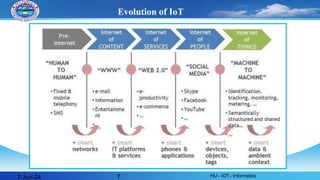
Evolution of IoT
7-Jun-24 HU - IOT - Informatics
7
IoT domains
7-Jun-24 HU - IOT - Informatics
8
4.1.3. IoT − Advantages
 Improved Customer
Engagement
 Technology Optimization
 Reduced Waste
 Enhanced Data Collection
 Lack of Security.
 A bug in the system, could affect all connected
device
 No international standard of compatibility for IoT,
 Heterogeneous devices couldn’t make
communication.
 Collecting and managing the data from millions
of IoT devices will be challenging for a given
Enterprise.
7-Jun-24 HU - IOT - Informatics
9
4.1.4. IoT – Disadvantages
4.1.5. Challenges of IoT
 Security
 Privacy
 Complexity
 Flexibility
 Compliance
10
7-Jun-24 HU - IOT - Informatics
4.2. How does it work?
is a
back bone
of IoT
IPV6
Help user to
control &
command
their devices
ranging from
room
thermostat to
jet engines &
assembly lines
End-User
Mobile apps
Data is
stored and
processed
securely
using Big
data analytics
Cloud/server
Gateway
to Internet
Bridge
internal
Network to
external
network
IoT
Gateway
Collecting,
sending,
acting on the
data they
acquire
Share the
data through
gateway or
cloud to be
analyzed
locally
Sensors
11
7-Jun-24 HU - IOT - Informatics
4.2.1. Architecture of IoT
 Sensing Layer
 Network Layer
 Data Processing Layer
 Application Layer
12
7-Jun-24 HU - IOT - Informatics
4.2.2. Devices and Networks
 Devices can be categorized
into three main groups:
1) Consumer
2) Enterprise
3) Industrial
13
7-Jun-24 HU - IOT - Informatics
Cont’d…
 IoT network devices has constrained resources (power, processing,
memory, etc.)
 The IoT network devices must be managed, configured and
monitored remotely to ensure their correct functioning.
 IoT network and device management solution should consider
several elements
14
7-Jun-24 HU - IOT - Informatics
KAA
Key Features:
• Manage an unlimited number of connected devices
• Set up cross-device interoperability
• Perform real-time device monitoring
• Perform remote device provisioning & configuration
• Collect and analyze sensor data
• Analyze user behavior and deliver targeted
notifications
• Create cloud services for smart products
4.3. IoT Tools and Platforms
7-Jun-24 HU - IOT - Informatics
15
Site
Where
Key Features:
• Run any number of IoT applications on a single
SiteWhere instance
• Spring delivers the core configuration framework
• Add devices through self-registration
• Integrates with third-party integration frameworks
such as Mule any point
• Default database storage is MongoDB
• Eclipse Californium for CoAP messaging
• InfluxDB for event data storage
• Grafana to visualize SiteWhere data
7-Jun-24 HU - IOT - Informatics
16
Thing
Speak
Key Features:
• Collect data in private channels
• Share data with public channels
• MATLAB analytics and visualizations
• Alerts
• Event scheduling
• App integrations
• Worldwide community
7-Jun-24 HU - IOT - Informatics
17
Device
Hive
Key Features:
• Directly integrate with Alexa
• Visualization dashboard of your choice
• It supports Big data solutions such as Elastic Search,
Apache Spark, Cassandra and Kafka for real-time
and batch processing.
• Connect any device
• It comes with Apache Spark and Spark Streaming
support.
• Supports libraries written in various programming
languages, including Android and iOS libraries
• It allows running batch analytics and machine
learning on top of your device data
7-Jun-24 HU - IOT - Informatics
18
Zetta
Things
Board
Key Features:
• Supports a wide range of hacker boards
• Zetta allows you to assemble smartphone apps, device
apps, and cloud apps
Key Features:
• Real-time data visualization and remote device control
• Customizable rules, plugins, widgets and transport
implementations 76
• Allows monitoring client-side and provision server-
side device attributes.
• Support multi-tenant installations out-of-the-box.
• Supports transport encryption for both MQTT &
HTTP(s) protocols.
7-Jun-24
HU - IOT - Informatics
19
4.4. Applications of IoT
IoT is applicable in sectors :
 Agriculture
 Consumer Use
 Healthcare
 Insurance
20
 Manufacturing
 Retail
 Transportation
 Utilities
7-Jun-24 HU - IOT - Informatics
4.3.1. IoT Based Smart Home
 Remote Control
Appliances
 Weather Controlling
 Smart Home
Appliances
 Energy and Water
Use
 Intrusion Detection
Systems
 Safety Monitoring
21
7-Jun-24 HU - IOT - Informatics
4.3.2. IoT Based Smart City
 Structural Health
 Lightning
 Safety
 Transportation
 Waste Management
 Smart Parking
22
Img src: Google image
7-Jun-24 HU - IOT - Informatics
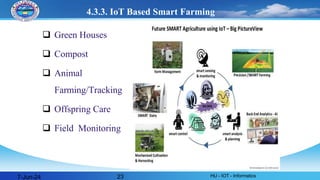
4.3.3. IoT Based Smart Farming
 Green Houses
 Compost
 Animal
Farming/Tracking
 Offspring Care
 Field Monitoring
23
7-Jun-24 HU - IOT - Informatics
Chapter 5: Augmented Reality(AR)
7-Jun-24 HU - IOT - Informatics
24
Augmented Reality(AR)
 The fundamental idea of AR is to combine , or mix, the view of the real
environment with additional, virtual content that is presented through
computer graphics.
 It is achieved by ensuring that the virtual content is aligned and
registered with the real objects.
 As a person moves in an environment and their perspective view of real
objects changes, the virtual content should also be presented from the
same perspective.
7-Jun-24 HU - IOT - Informatics
25
What is Augmented reality(AR)?
Definition
 Augmented reality (AR) is a form of emerging
technology that allows users to overlay computer
generated content in the real world.
 AR refers to a live view of a physical real-world
environment whose elements are merged with augmented
computer-generated images creating a mixed reality.
7-Jun-24 HU - IOT - Informatics
26
 Augmented Reality (AR) is a real-time direct or indirect view of a
physical real-world environment that has been enhanced
/augmented by adding virtual computer-generated information to it.
 The inputs for the computer are captured by sensory devices,
these includes sound, video, graphics or GPS data.
 Augmented reality is the integration of digital information with the
user's environment in real time.
7-Jun-24 HU - IOT - Informatics
27
What is Augmented reality(AR)?
Virtual Reality (VR)
Virtual Reality (VR) is fully immersive, which tricks your senses
into thinking you’re in a different environment or world apart from
the real world.
Using a head-mounted display (HMD) or headset, you’ll experience
a computer-generated world of imagery and sounds. You can
manipulate objects and move around using haptic controllers while
tethered to a console or PC.
 It is also called a computer-simulated reality.
7-Jun-24 HU - IOT - Informatics
28
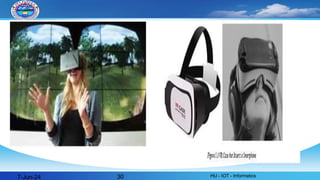
 It refers to computer technologies using reality headsets to generate
realistic sounds, images and other sensations that replicate a real
environment or create an imaginary world.
 Advanced VR environment will engage all five senses (taste, sight,
smell, touch, sound) .
 Using VR devices such as HTC Vive, Oculus Rift or Google
Cardboard, users can be transported into a number of real-world and
imagined environments.
7-Jun-24 HU - IOT - Informatics
29
Virtual Reality (VR)
7-Jun-24 HU - IOT - Informatics
30
Virtual Reality (VR)
 Most VR headsets are connected to a computer (Oculus
Rift) or a gaming console (PlayStation VR)
 There are standalone devices (Google Cardboard is among
the most popular) as well.
 Most standalone VR headsets work in combination with
smartphones – you insert a smartphone, wear a
headset, and immerse in the virtual reality
7-Jun-24 HU - IOT - Informatics
31
Augmented Reality (AR)
 In augmented reality, users see and interact with the real world while
digital content is added to it.
 There’s a different way to experience augmented reality, though –
with special AR headsets, such as
• Google Glass, where digital content is displayed on a tiny screen in
front of a user’s eye.
 AR adds digital elements to a live view by using the camera on a
smartphone.
• Examples: Snapchat lenses and
the game Pokémon Go.
7-Jun-24 HU - IOT - Informatics
32
Mixed Reality (MR)
 Mixed Reality (MR) sometimes referred to as hybrid reality.
 It is the merging of real and virtual worlds to produce new
environments and visualizations where physical and digital objects co-
exist and interact in real-time.
For example, with MR, you can play a
virtual video game,
grab your real-world water bottle, and
smack an imaginary character from the game with the bottle.
7-Jun-24 HU - IOT - Informatics
33
 In mixed reality, you interact with
and manipulate both physical and
virtual items and environments,
using next-generation sensing and
imaging technologies.
7-Jun-24 HU - IOT - Informatics
34
Mixed Reality (MR)
VR Vs. AR Vs. MR
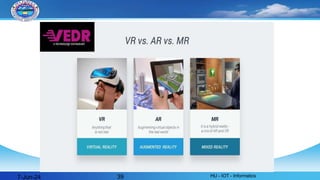
 VR content is 100% digital
 AR overlays digital content on top of the real-world.
 MR is a digital overlay that allows interactive virtual elements to
integrate and interact with the real-world environment.
7-Jun-24 HU - IOT - Informatics
35
7-Jun-24 HU - IOT - Informatics
36
VR Vs. AR Vs. MR
Characteristic VR AR MR
Is user aware about real world No Yes Yes
Can user interact with real and virtual
world in real time No Yes Yes
Can real & virtual contents interact with
each other in real time No No Yes
 Numerous augmented reality apps and games can run on almost
every smartphone on the market.
 Virtual reality programs requires:
• specialized VR headsets,
• noise-canceling headphones,
• cameras to track room space and boundaries, and
• sometimes even motion capture technology.
 Some of the biggest names in VR tech today are the Oculus
Rift, HTC Vive, and PlayStation VR.
7-Jun-24 HU - IOT - Informatics
37
VR Vs. AR Vs. MR
 Mixed reality hardware is still emerging and hasn’t quite broken into
the mainstream consumer market, most likely due to the price.
 The consumer releases of the Microsoft HoloLens and Magic Leap
One retail for over $2000 USD .
 However, mixed reality applications sometimes require exponentially
more processing power and thus require more powerful hardware.
7-Jun-24 HU - IOT - Informatics
38
VR Vs. AR Vs. MR
7-Jun-24 HU - IOT - Informatics
39
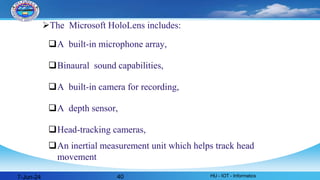
The Microsoft HoloLens includes:
A built-in microphone array,
Binaural sound capabilities,
A built-in camera for recording,
A depth sensor,
Head-tracking cameras,
An inertial measurement unit which helps track head
movement
7-Jun-24 HU - IOT - Informatics
40
The first Augmented Reality Systems (ARS) were usually designed with a basis on
three main blocks
The Infrastructure Tracker Unit
 It is responsible for collecting data from the real world, sending them to the
Processing Unit,
Processing Unit
 Which mixed the virtual content with the real content and sent the result to the
Video Out module of the Visual Unit
Visual Unit
 Used to display
7-Jun-24 HU - IOT - Informatics
41
The architecture of AR Systems
 Some designs used a
Video In, to acquire
required data for the
Infrastructure Tracker
Unit .
7-Jun-24 HU - IOT - Informatics
42
The architecture of AR Systems
 The Visual Unit can be classified into two types of system,
depending on the followed visualization technology:
1. Video see-through
 It uses a Head-Mounted Display (HMD) that employs a
video-mixing and displays the merged images on a closed-
view HMD.
2. Optical see-through:
 It uses an HMD that employs optical combiners to merge
the images within an open-view HMD.
7-Jun-24 HU - IOT - Informatics
43
The architecture of AR Systems
HMDs shortcomings
 HMDs are currently the dominant display technology in the AR
field.
 However, they lack in several aspects, such as ergonomics, high
prices and relatively low mobility due to their sizes and connectivity
features.
 An additional problem involving HMD is the interaction with the
real environment, which places virtual interactive zones to the user,
making the collision with these zones hard due to the difficulty to
interact with multiple points in different depths.
7-Jun-24 HU - IOT - Informatics
44
Applications of AR Systems
 One of the newest developing technologies is augmented reality (AR),
which can be applied to many different disciplines such as:
Education.
Medicine.
Entertainment.
Military, etc.
7-Jun-24 HU - IOT - Informatics
45
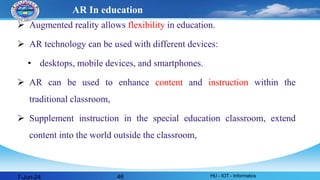
AR In education
 Augmented reality allows flexibility in education.
 AR technology can be used with different devices:
• desktops, mobile devices, and smartphones.
 AR can be used to enhance content and instruction within the
traditional classroom,
 Supplement instruction in the special education classroom, extend
content into the world outside the classroom,
7-Jun-24 HU - IOT - Informatics
46
 More importantly, the following reasons for using
augmented reality in education:
 Affordable learning materials
 Interactive lessons
 Higher engagement
 Higher retention
 Boost intellectual curiosity
7-Jun-24 HU - IOT - Informatics
47
AR In education
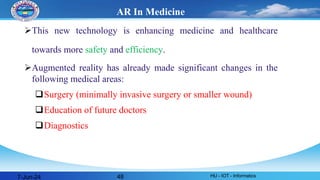
AR In Medicine
This new technology is enhancing medicine and healthcare
towards more safety and efficiency.
Augmented reality has already made significant changes in the
following medical areas:
Surgery (minimally invasive surgery or smaller wound)
Education of future doctors
Diagnostics
7-Jun-24 HU - IOT - Informatics
48
AR in health care
7-Jun-24 HU - IOT - Informatics
49
 AR tools aid to detect signs of depression and other
mental illnesses by reading from:
Facial expressions.
Voice tones.
Physical gestures
7-Jun-24 HU - IOT - Informatics
50
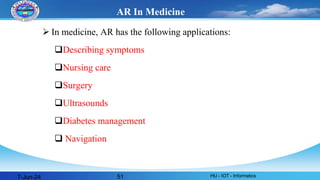
AR In Medicine
 In medicine, AR has the following applications:
Describing symptoms
Nursing care
Surgery
Ultrasounds
Diabetes management
 Navigation
7-Jun-24 HU - IOT - Informatics
51
AR In Medicine
 Generally, AR provides the following benefits to patients and healthcare
workers:
 Reduce the risks associated with minimally invasive surgery.
 Better informed decisions about the right treatment and illness
prevention.;
 Make procedures more tolerable.
 Better aftercare
 Medical training and education.
 Assistance in medical procedures and routine tasks.
7-Jun-24 HU - IOT - Informatics
52
AR In Medicine
AR In Entertainment
 AR in games :- such as Pokémon Go
 AR in music
 AR on TV
 AR in eSports
 AR in the theater
7-Jun-24 HU - IOT - Informatics
53
Thank you
7-Jun-24 HU - IOT - Informatics
54

Chapter 4 & 5 Emerging Technology Writeup.pptx

  • 1.
    Chapter 4:Internets ofThings (IoT) 7-Jun-24 HU - IOT - Informatics 1
  • 2.
    4.1. Overview ofIoT  IoT features includes:- 1. Artificial Intelligence  Makes virtually anything “smart”. 2. Connectivity:  IoT creates small but practical networks that no longer tied to major providers between its system devices. 3. Sensors :  IoT loses its distinction without sensors  makes IoT an active system capable of real-world integration 4. Active engagement  IoT introduces a new paradigm for active content, product, or service engagement. 5. Small device use  IoT exploits purpose-built small devices to deliver its precision, scalability, and versatility 2 7-Jun-24 HU - IOT - Informatics
  • 3.
    4.1.1. What isIoT? 1) IoT is the networking of smart objects --Internet Architecture Board’s (IAB) 2) IoT is the networking of smart objects in which smart objects have some constraints such as limited bandwidth, power, and processing accessibility for achieving interoperability among smart objects. -- Internet Engineering Task Force 3) IoT is a framework of all things that have a representation in the presence of the internet in such a way that new applications and services enable the interaction in the physical and virtual world in the form of Machine-to-Machine (M2M) communication in the cloud. --Institute of Electrical and Electronics Engineers (IEEE) 3 7-Jun-24 HU - IOT - Informatics
  • 4.
    Cont’d… 4) IoT isthe interaction of everyday object’s computing devices through the Internet that enables the sending and receiving of useful data. ----Oxford dictionary’s definition 5) IoT is expressed through a simple formula such as: IoT= Services+ Data+ Networks + Sensors -------IoT in 2020 4 7-Jun-24 HU - IOT - Informatics
  • 5.
    Cont’d…  Generally IoTis the network of physical objects or "things" embedded with electronics, software, sensors, and network connectivity, which enables objects to collect and exchange data.  It is a network of devices that can sense, accumulate and transfer data over the internet without any human intervention.  It consists of any device with an on/off switch connected to the Internet 5 7-Jun-24 HU - IOT - Informatics
  • 6.
    Cont’d…  Applications:  smart-city, smart-home, smart-energy, connectedcar, smart agriculture, health care, logistics, connected campus, building & industry etc. 6 7-Jun-24 HU - IOT - Informatics
  • 7.
    Evolution of IoT 7-Jun-24HU - IOT - Informatics 7
  • 8.
    IoT domains 7-Jun-24 HU- IOT - Informatics 8
  • 9.
    4.1.3. IoT −Advantages  Improved Customer Engagement  Technology Optimization  Reduced Waste  Enhanced Data Collection  Lack of Security.  A bug in the system, could affect all connected device  No international standard of compatibility for IoT,  Heterogeneous devices couldn’t make communication.  Collecting and managing the data from millions of IoT devices will be challenging for a given Enterprise. 7-Jun-24 HU - IOT - Informatics 9 4.1.4. IoT – Disadvantages
  • 10.
    4.1.5. Challenges ofIoT  Security  Privacy  Complexity  Flexibility  Compliance 10 7-Jun-24 HU - IOT - Informatics
  • 11.
    4.2. How doesit work? is a back bone of IoT IPV6 Help user to control & command their devices ranging from room thermostat to jet engines & assembly lines End-User Mobile apps Data is stored and processed securely using Big data analytics Cloud/server Gateway to Internet Bridge internal Network to external network IoT Gateway Collecting, sending, acting on the data they acquire Share the data through gateway or cloud to be analyzed locally Sensors 11 7-Jun-24 HU - IOT - Informatics
  • 12.
    4.2.1. Architecture ofIoT  Sensing Layer  Network Layer  Data Processing Layer  Application Layer 12 7-Jun-24 HU - IOT - Informatics
  • 13.
    4.2.2. Devices andNetworks  Devices can be categorized into three main groups: 1) Consumer 2) Enterprise 3) Industrial 13 7-Jun-24 HU - IOT - Informatics
  • 14.
    Cont’d…  IoT networkdevices has constrained resources (power, processing, memory, etc.)  The IoT network devices must be managed, configured and monitored remotely to ensure their correct functioning.  IoT network and device management solution should consider several elements 14 7-Jun-24 HU - IOT - Informatics
  • 15.
    KAA Key Features: • Managean unlimited number of connected devices • Set up cross-device interoperability • Perform real-time device monitoring • Perform remote device provisioning & configuration • Collect and analyze sensor data • Analyze user behavior and deliver targeted notifications • Create cloud services for smart products 4.3. IoT Tools and Platforms 7-Jun-24 HU - IOT - Informatics 15
  • 16.
    Site Where Key Features: • Runany number of IoT applications on a single SiteWhere instance • Spring delivers the core configuration framework • Add devices through self-registration • Integrates with third-party integration frameworks such as Mule any point • Default database storage is MongoDB • Eclipse Californium for CoAP messaging • InfluxDB for event data storage • Grafana to visualize SiteWhere data 7-Jun-24 HU - IOT - Informatics 16
  • 17.
    Thing Speak Key Features: • Collectdata in private channels • Share data with public channels • MATLAB analytics and visualizations • Alerts • Event scheduling • App integrations • Worldwide community 7-Jun-24 HU - IOT - Informatics 17
  • 18.
    Device Hive Key Features: • Directlyintegrate with Alexa • Visualization dashboard of your choice • It supports Big data solutions such as Elastic Search, Apache Spark, Cassandra and Kafka for real-time and batch processing. • Connect any device • It comes with Apache Spark and Spark Streaming support. • Supports libraries written in various programming languages, including Android and iOS libraries • It allows running batch analytics and machine learning on top of your device data 7-Jun-24 HU - IOT - Informatics 18
  • 19.
    Zetta Things Board Key Features: • Supportsa wide range of hacker boards • Zetta allows you to assemble smartphone apps, device apps, and cloud apps Key Features: • Real-time data visualization and remote device control • Customizable rules, plugins, widgets and transport implementations 76 • Allows monitoring client-side and provision server- side device attributes. • Support multi-tenant installations out-of-the-box. • Supports transport encryption for both MQTT & HTTP(s) protocols. 7-Jun-24 HU - IOT - Informatics 19
  • 20.
    4.4. Applications ofIoT IoT is applicable in sectors :  Agriculture  Consumer Use  Healthcare  Insurance 20  Manufacturing  Retail  Transportation  Utilities 7-Jun-24 HU - IOT - Informatics
  • 21.
    4.3.1. IoT BasedSmart Home  Remote Control Appliances  Weather Controlling  Smart Home Appliances  Energy and Water Use  Intrusion Detection Systems  Safety Monitoring 21 7-Jun-24 HU - IOT - Informatics
  • 22.
    4.3.2. IoT BasedSmart City  Structural Health  Lightning  Safety  Transportation  Waste Management  Smart Parking 22 Img src: Google image 7-Jun-24 HU - IOT - Informatics
  • 23.
    4.3.3. IoT BasedSmart Farming  Green Houses  Compost  Animal Farming/Tracking  Offspring Care  Field Monitoring 23 7-Jun-24 HU - IOT - Informatics
  • 24.
    Chapter 5: AugmentedReality(AR) 7-Jun-24 HU - IOT - Informatics 24
  • 25.
    Augmented Reality(AR)  Thefundamental idea of AR is to combine , or mix, the view of the real environment with additional, virtual content that is presented through computer graphics.  It is achieved by ensuring that the virtual content is aligned and registered with the real objects.  As a person moves in an environment and their perspective view of real objects changes, the virtual content should also be presented from the same perspective. 7-Jun-24 HU - IOT - Informatics 25
  • 26.
    What is Augmentedreality(AR)? Definition  Augmented reality (AR) is a form of emerging technology that allows users to overlay computer generated content in the real world.  AR refers to a live view of a physical real-world environment whose elements are merged with augmented computer-generated images creating a mixed reality. 7-Jun-24 HU - IOT - Informatics 26
  • 27.
     Augmented Reality(AR) is a real-time direct or indirect view of a physical real-world environment that has been enhanced /augmented by adding virtual computer-generated information to it.  The inputs for the computer are captured by sensory devices, these includes sound, video, graphics or GPS data.  Augmented reality is the integration of digital information with the user's environment in real time. 7-Jun-24 HU - IOT - Informatics 27 What is Augmented reality(AR)?
  • 28.
    Virtual Reality (VR) VirtualReality (VR) is fully immersive, which tricks your senses into thinking you’re in a different environment or world apart from the real world. Using a head-mounted display (HMD) or headset, you’ll experience a computer-generated world of imagery and sounds. You can manipulate objects and move around using haptic controllers while tethered to a console or PC.  It is also called a computer-simulated reality. 7-Jun-24 HU - IOT - Informatics 28
  • 29.
     It refersto computer technologies using reality headsets to generate realistic sounds, images and other sensations that replicate a real environment or create an imaginary world.  Advanced VR environment will engage all five senses (taste, sight, smell, touch, sound) .  Using VR devices such as HTC Vive, Oculus Rift or Google Cardboard, users can be transported into a number of real-world and imagined environments. 7-Jun-24 HU - IOT - Informatics 29 Virtual Reality (VR)
  • 30.
    7-Jun-24 HU -IOT - Informatics 30
  • 31.
    Virtual Reality (VR) Most VR headsets are connected to a computer (Oculus Rift) or a gaming console (PlayStation VR)  There are standalone devices (Google Cardboard is among the most popular) as well.  Most standalone VR headsets work in combination with smartphones – you insert a smartphone, wear a headset, and immerse in the virtual reality 7-Jun-24 HU - IOT - Informatics 31
  • 32.
    Augmented Reality (AR) In augmented reality, users see and interact with the real world while digital content is added to it.  There’s a different way to experience augmented reality, though – with special AR headsets, such as • Google Glass, where digital content is displayed on a tiny screen in front of a user’s eye.  AR adds digital elements to a live view by using the camera on a smartphone. • Examples: Snapchat lenses and the game Pokémon Go. 7-Jun-24 HU - IOT - Informatics 32
  • 33.
    Mixed Reality (MR) Mixed Reality (MR) sometimes referred to as hybrid reality.  It is the merging of real and virtual worlds to produce new environments and visualizations where physical and digital objects co- exist and interact in real-time. For example, with MR, you can play a virtual video game, grab your real-world water bottle, and smack an imaginary character from the game with the bottle. 7-Jun-24 HU - IOT - Informatics 33
  • 34.
     In mixedreality, you interact with and manipulate both physical and virtual items and environments, using next-generation sensing and imaging technologies. 7-Jun-24 HU - IOT - Informatics 34 Mixed Reality (MR)
  • 35.
    VR Vs. ARVs. MR  VR content is 100% digital  AR overlays digital content on top of the real-world.  MR is a digital overlay that allows interactive virtual elements to integrate and interact with the real-world environment. 7-Jun-24 HU - IOT - Informatics 35
  • 36.
    7-Jun-24 HU -IOT - Informatics 36 VR Vs. AR Vs. MR Characteristic VR AR MR Is user aware about real world No Yes Yes Can user interact with real and virtual world in real time No Yes Yes Can real & virtual contents interact with each other in real time No No Yes
  • 37.
     Numerous augmentedreality apps and games can run on almost every smartphone on the market.  Virtual reality programs requires: • specialized VR headsets, • noise-canceling headphones, • cameras to track room space and boundaries, and • sometimes even motion capture technology.  Some of the biggest names in VR tech today are the Oculus Rift, HTC Vive, and PlayStation VR. 7-Jun-24 HU - IOT - Informatics 37 VR Vs. AR Vs. MR
  • 38.
     Mixed realityhardware is still emerging and hasn’t quite broken into the mainstream consumer market, most likely due to the price.  The consumer releases of the Microsoft HoloLens and Magic Leap One retail for over $2000 USD .  However, mixed reality applications sometimes require exponentially more processing power and thus require more powerful hardware. 7-Jun-24 HU - IOT - Informatics 38 VR Vs. AR Vs. MR
  • 39.
    7-Jun-24 HU -IOT - Informatics 39
  • 40.
    The Microsoft HoloLensincludes: A built-in microphone array, Binaural sound capabilities, A built-in camera for recording, A depth sensor, Head-tracking cameras, An inertial measurement unit which helps track head movement 7-Jun-24 HU - IOT - Informatics 40
  • 41.
    The first AugmentedReality Systems (ARS) were usually designed with a basis on three main blocks The Infrastructure Tracker Unit  It is responsible for collecting data from the real world, sending them to the Processing Unit, Processing Unit  Which mixed the virtual content with the real content and sent the result to the Video Out module of the Visual Unit Visual Unit  Used to display 7-Jun-24 HU - IOT - Informatics 41 The architecture of AR Systems
  • 42.
     Some designsused a Video In, to acquire required data for the Infrastructure Tracker Unit . 7-Jun-24 HU - IOT - Informatics 42 The architecture of AR Systems
  • 43.
     The VisualUnit can be classified into two types of system, depending on the followed visualization technology: 1. Video see-through  It uses a Head-Mounted Display (HMD) that employs a video-mixing and displays the merged images on a closed- view HMD. 2. Optical see-through:  It uses an HMD that employs optical combiners to merge the images within an open-view HMD. 7-Jun-24 HU - IOT - Informatics 43 The architecture of AR Systems
  • 44.
    HMDs shortcomings  HMDsare currently the dominant display technology in the AR field.  However, they lack in several aspects, such as ergonomics, high prices and relatively low mobility due to their sizes and connectivity features.  An additional problem involving HMD is the interaction with the real environment, which places virtual interactive zones to the user, making the collision with these zones hard due to the difficulty to interact with multiple points in different depths. 7-Jun-24 HU - IOT - Informatics 44
  • 45.
    Applications of ARSystems  One of the newest developing technologies is augmented reality (AR), which can be applied to many different disciplines such as: Education. Medicine. Entertainment. Military, etc. 7-Jun-24 HU - IOT - Informatics 45
  • 46.
    AR In education Augmented reality allows flexibility in education.  AR technology can be used with different devices: • desktops, mobile devices, and smartphones.  AR can be used to enhance content and instruction within the traditional classroom,  Supplement instruction in the special education classroom, extend content into the world outside the classroom, 7-Jun-24 HU - IOT - Informatics 46
  • 47.
     More importantly,the following reasons for using augmented reality in education:  Affordable learning materials  Interactive lessons  Higher engagement  Higher retention  Boost intellectual curiosity 7-Jun-24 HU - IOT - Informatics 47 AR In education
  • 48.
    AR In Medicine Thisnew technology is enhancing medicine and healthcare towards more safety and efficiency. Augmented reality has already made significant changes in the following medical areas: Surgery (minimally invasive surgery or smaller wound) Education of future doctors Diagnostics 7-Jun-24 HU - IOT - Informatics 48
  • 49.
    AR in healthcare 7-Jun-24 HU - IOT - Informatics 49
  • 50.
     AR toolsaid to detect signs of depression and other mental illnesses by reading from: Facial expressions. Voice tones. Physical gestures 7-Jun-24 HU - IOT - Informatics 50 AR In Medicine
  • 51.
     In medicine,AR has the following applications: Describing symptoms Nursing care Surgery Ultrasounds Diabetes management  Navigation 7-Jun-24 HU - IOT - Informatics 51 AR In Medicine
  • 52.
     Generally, ARprovides the following benefits to patients and healthcare workers:  Reduce the risks associated with minimally invasive surgery.  Better informed decisions about the right treatment and illness prevention.;  Make procedures more tolerable.  Better aftercare  Medical training and education.  Assistance in medical procedures and routine tasks. 7-Jun-24 HU - IOT - Informatics 52 AR In Medicine
  • 53.
    AR In Entertainment AR in games :- such as Pokémon Go  AR in music  AR on TV  AR in eSports  AR in the theater 7-Jun-24 HU - IOT - Informatics 53
  • 54.
    Thank you 7-Jun-24 HU- IOT - Informatics 54

Editor's Notes

  • #6 IoT systems allow users to achieve deeper automation, analysis, and integration within a system. They improve the reach of these areas and their accuracy.
  • #7 IoT systems allow users to achieve deeper automation, analysis, and integration within a system. They improve the reach of these areas and their accuracy.
  • #13 For instance, environment sensors are used in many applications to improve user experience (e.g., home automation systems, smart locks, smart lights, etc.).
  • #14 In the enterprise, smart sensors located in a conference room can help an employee locate and schedule an available ro om for a meeting, ensuring the proper room type, size and features are available When meeting attendees enter the room, the temperature will adjust according to the occupancy, and the lights will dim as the appropriate PowerPoint loads on the screen and the speaker begins his presentation.
  • #21 "The Ultimate Goal of IOT is to Automate Human Life."