





Big
Change
Revolution
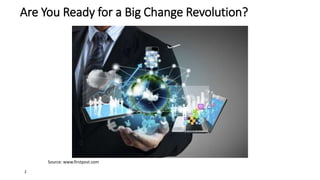
Are You Ready for a Big Change Revolution?
2
Source: www.firstpost.com
• By 2018, digital business will require 50% fewer
business process workers and 500% more key
digital business jobs, compared with traditional
models
• By 2018, the total cost of ownership for business
operations will be reduced by 30% through smart
machines and industrialized services
• By 2020, developed world life expectancy will
increase by a half-year due to the widespread
adoption of wireless health monitoring technology
3
Source: Gartner – Top 10 Strategic Predictions for 2015 and Beyond: Digital Business Is Driving 'Big Change‘, Oct 2014
A Changing Landscape 2018 - 2020
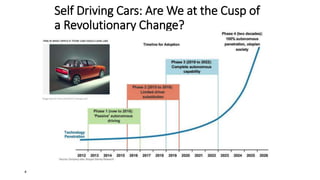
Self Driving Cars: Are We at the Cusp of
a Revolutionary Change?
4
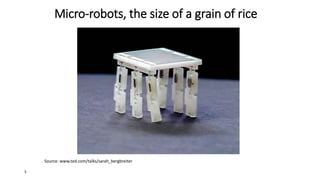
Micro-robots, the size of a grain of rice
5
Source: www.ted.com/talks/sarah_bergbreiter
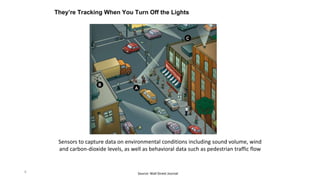
They’re Tracking When You Turn Off the Lights
6 Source: Wall Street Journal
Sensors to capture data on environmental conditions including sound volume, wind
and carbon-dioxide levels, as well as behavioral data such as pedestrian traffic flow
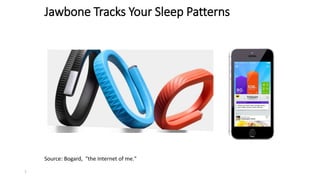
Jawbone Tracks Your Sleep Patterns
7
Source: Bogard, "the Internet of me."
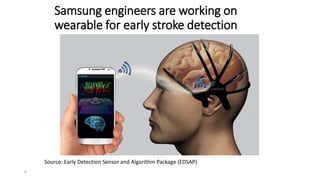
Samsung engineers are working on
wearable for early stroke detection
8
Source: Early Detection Sensor and Algorithm Package (EDSAP)
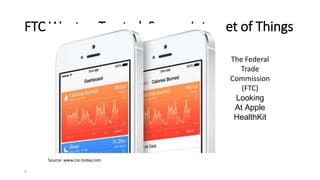
FTC Wants a Trusted, Secure Internet of Things
9
The Federal
Trade
Commission
(FTC)
Looking
At Apple
HealthKit
Source: www.cio-today.com
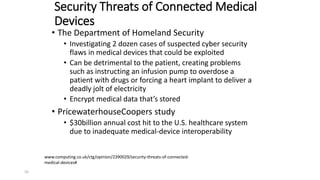
• The Department of Homeland Security
• Investigating 2 dozen cases of suspected cyber security
flaws in medical devices that could be exploited
• Can be detrimental to the patient, creating problems
such as instructing an infusion pump to overdose a
patient with drugs or forcing a heart implant to deliver a
deadly jolt of electricity
• Encrypt medical data that’s stored
• PricewaterhouseCoopers study
• $30billion annual cost hit to the U.S. healthcare system
due to inadequate medical-device interoperability
Security Threats of Connected Medical
Devices
10
www.computing.co.uk/ctg/opinion/2390029/security-threats-of-connected-
medical-devices#
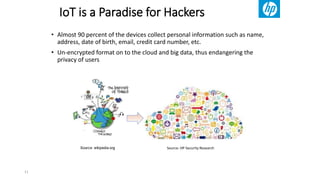
IoT is a Paradise for Hackers
11
Source: HP Security Research
• Almost 90 percent of the devices collect personal information such as name,
address, date of birth, email, credit card number, etc.
• Un-encrypted format on to the cloud and big data, thus endangering the
privacy of users
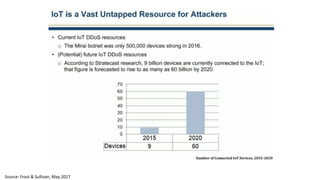
• 26 billion devices on the Internet of Things by 2020
(Gartner)
• 15 Billion existing devices connected
to the internet (Intel)
• Not adequately protected at the device level
• Cannot wait for a new generation of secure devices to be
developed
• Require robust and layered security controls
90% of world's data generated over last two
years
12
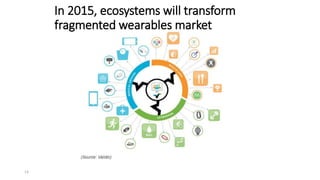
In 2015, ecosystems will transform
fragmented wearables market
13
A New
World
THE INTERNET OF THINGS
New
Security
Threats
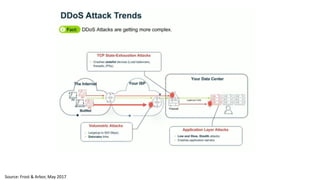
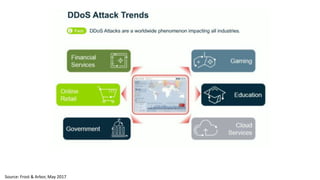
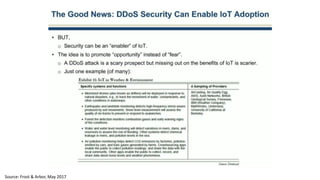
Source: Frost & Sullivan, May 2017
Examples
of New
Attacks
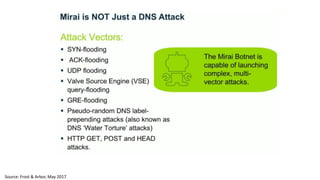
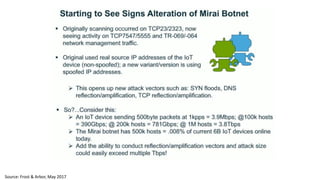
Source: Frost & Sullivan, May 2017
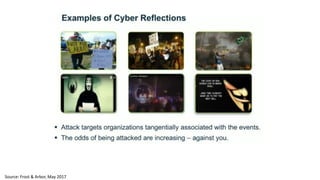
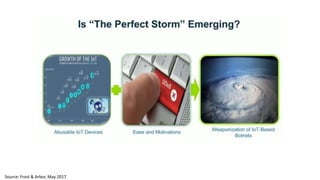
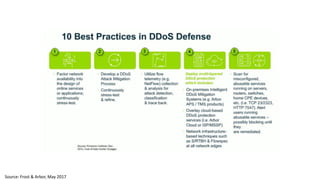
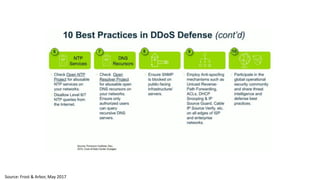
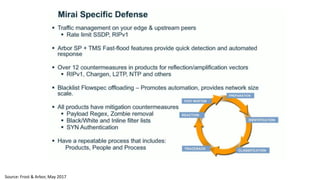
Source: Frost & Arbor, May 2017
Some
Solutions
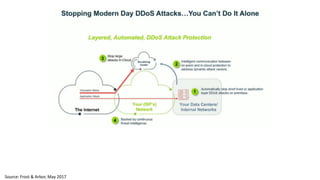
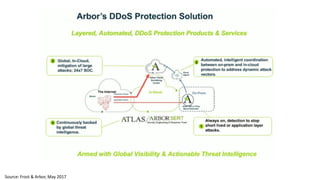
Source: Frost & Arbor, May 2017
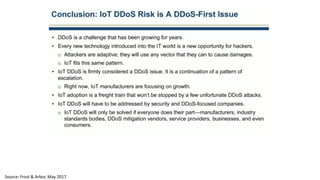
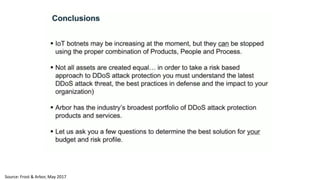
Summary
Source: Frost & Arbor, May 2017

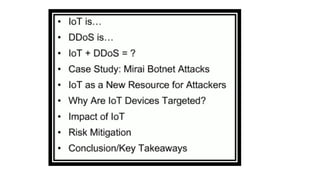
IoT - Attacks and Solutions

Editor's Notes

  • #3 Business: Are you ready for a big change revolution? The consumer need to get faster, less expensive and better products and services in a mode that supports any time, any place, any channel is fueling the digital business revolution. Digitalization and the digital business are catalysts of change that are affecting the human-machine relationship and driving better customer outcomes. New business models fueled by Big Data, Cloud & the Internet of Things ·         Machines Are Taking a More-Active Role in Enhancing Human Endeavors. ·         Digitalized Things Are Making Assisted Economic Decisions. http://www.firstpost.com/business/digital-business-ready-big-change-revolution-2059461.htm
  • #4 Gartner: A Changing Landscape 2018 – 2020 By 2017, U.S. customers' mobile engagement behavior will drive mobile commerce revenue in the U.S. to 50% of U.S. digital commerce revenue. By 2017, 50% of consumer product investments will be redirected to customer experience innovations. By 2017, nearly 20% of durable goods "e-tailers" will use 3D printing to create personalized product offerings. By 2018, digital business will require 50% fewer business process workers and 500% more key digital business jobs, compared with traditional models. By 2018, the total cost of ownership for business operations will be reduced by 30% through smart machines and industrialized services. By 2020, developed world life expectancy will increase by a half-year, due to the widespread adoption of wireless health monitoring technology.
  • #5 Around 2020 According to Morgan Stanley, completely autonomous vehicles, will start rolling out to the masses. Even though they’re hardly seen on the road, self-driving cars have been the talk of the town for so long that they already seem like  a technology of the past. Google has been working on one for years. Apple is supposedly working on one too. And then there is speculation that everyone from Uber to Tesla could join this prodigal race. Piloting now: Volvo’s Cloud Connected Cars Help Remedy Road Conditions Volvo’s exhibit at the Mobile World Congress shows us the power of the cloud connected car. Volvo is an innovator in vehicle safety and the Swedish automaker is piloting a new cloud connected system that is designed to report weather conditions on dangerous roads. Let’s say you’re driving down a road that contains a patch of ice. Once your car detects the loss in traction, an alert is immediately beamed into the cloud. Other drivers who have this cloud system will receive real time alerts about the condition. Local emergency services workers could theoretically get access the same on-demand information. This would enable localities to rapidly deploy salt trucks and snow plows on dangerous roads which could potentially save someone’s life. Using GPS and cloud, Volvo could even pinpoint the exact stretch of road that harbors the dangerous conditions. http://www.iamwire.com/2015/03/driving-cars-cusp-revolutionary-change/111248   http://www.cloudwedge.com/volvos-cloud-connected-cars-help-remedy-road-conditions-4389/
  • #6 By studying the movement and bodies of insects such as ants, Sarah Bergbreiter and her team build incredibly robust, super teeny, mechanical versions of creepy crawlies … and then they add rockets. See their jaw-dropping developments in micro-robotics, and hear about three ways we might use these little helpers in the future.
  • #7 I will avoid to discuss TV, webcam, refrigerators, ovens, thermostats, and some other smart devices. Let’s look at some other examples. University of Chicago installed dozens of sensor packs on street lamps in the city’s central business district and elsewhere. Each pack, roughly the size of a thick laptop, contains 65 sensors intended to capture data on environmental conditions including sound volume, wind and carbon-dioxide levels, as well as behavioral data such as pedestrian traffic flow as revealed by Wi-Fi-enabled smartphones. Infrared camera peers at windows of thousands of buildings in NYC. The camera software determine what time households turn in, what kind of light bulbs they use, and even what pollutants their buildings emit. Four percent of NYC go to bed before 7:30 p.m. on weeknights. Only 6% turn off the lights after midnight.
  • #8 your Smartphone will now start to collect your activity data passively in the background, enabling Jawbone to provide instant feedback automatically. "When I wake up, my first question is, How did I sleep? Now, right there on my [Smartphone] home screen is the summary of last night's sleep. Imagine gradually waking from a long slumber to discover that, without even removing your blankets, the bedroom lights have begun turning on and the coffee maker in the kitchen has started brewing a fresh blend. It might sound futuristic but according to Jawbone product VP Travis Bogard the technology is already here. Because UP24 tracks your sleep patterns and REM cycles, it knows the perfect time for you to wake up feeling the most refreshed. What if the lights dimmed on to help you rise from sleep? With the UP platform, and with apps like IFTTT (If This Then That), it's now possible. Once the UP24 triggers its sleep alarm, it can tell another app on your iPhone to turn on the lights.
  • #9 Samsung engineers are working on wearable for early stroke detection Samsung has quite the diverse family of products, and for the last two years, a team of engineers have been working on yet another. Folks from its smartphone and washing machine teams are building a wearable sensor that monitors brainwaves to detect the early stages of a stroke. The result is a prototype known as the Early Detection Sensor and Algorithm Package (EDSAP): a device that keeps tabs on the electric impulses of the brain with the help of a smartphone or tablet. In theory, the sensor-packed headset will alert folks who are at risk for a stroke early on, so they can get to a doctor to prevent potentially serious and permanent effects.
  • #10 http://www.cio-today.com/article/index.php?story_id=131004IP17JU The Federal Trade Commission (FTC) is in talks with Apple over their new Apple HealthKit which was launched with iOS 8, and the FTC is looking for assurances from Apple that the data from HealthKit will be protected. According to a recent report by Reuters, Apple and the FTC have met on a number of occasions over the last few months to discuss how users data will be protected. The FTC are obviously looking to ensure that data in Apple’s Health kit is secure, and Apple have said that they designed ‘HealthKit with privacy in mind‘. Source Reuters FTC Wants a Trusted, Secure Internet of Things The Federal Trade Commission is voicing its concerns about the Internet of Things (IoT), suggesting several steps businesses should take to protect consumer privacy and security . The FTC acknowledged that IoT, which connects devices to the Internet so they can send and receive data , is already making an impact on millions of American consumers via health and fitness monitors, connected cars, home security devices and household appliances. The agency is concerned that privacy and security concerns could undermine consumer confidence in this booming industry. http://www.technewsworld.com/story/81670.html I think that we need the benefits of having large volumes of data to analyze and for a long time. The data is already out there and we urgently need to protect this data that we load into Big Data and Cloud.  
  • #11 Let’s talk about medical devices. Remote monitoring patients opening up a whole new era of predictive and more effective healthcare. PricewaterhouseCoopers study highlighted a $30bn annual cost hit to the US healthcare system due to inadequate medical-device interoperability. The Department of Homeland Security is also investigating two dozen cases of suspected cyber security flaws in medical devices that officials fear could be exploited by hackers. The ability to control these medical devices can be detrimental to the patient, creating problems such as instructing an infusion pump to overdose a patient with drugs, or forcing a heart implant to deliver a deadly jolt of electricity. Need to protect data and other vulnerabilities that hackers can use to expose confidential data. This begins with the data centre and keeping medical data stored there secure and encrypted.
  • #12 HP New Report Says Internet of Things is a Paradise for Hackers But at the same time, TV, webcam, refrigerators, ovens, thermostats, and a host of other smart devices will become an easy prey for hackers. One study, conducted by the Division of HP Fortify unit has revealed the presence of a large number of vulnerabilities in 10 Internet of Things (IoT) devices. HP did not release the names of the producers, specifying only that the majority of them uses cloud services and all include a mobile app for remote control. HP Security Research reviewed 10 of the most popular devices and found that most of the devices have high average number of vulnerabilities per device including Heartbleed, denial of service, weak password or cross site scripting. Specifically, it was confirmed that the presence of vulnerabilities included in the top 10 device is part of the Open Web Application Security Project (OWASP). The results are quite alarming, since a single bug may facilitate chain attacks, whereas in a smart home, there may be dozens of devices interconnected. Almost 90 percent of the devices examined in the report collect personal information such as name, address, date of birth, email, credit card number, etc. that are transmitted in un-encrypted format over the local network and on the cloud, thus endangering the privacy of users.
  • #13 Exponential growth of data generation and collection stemming from new business models According to forecasts by Gartner, by 2020 there will be in circulation of more than 26 billion connected devices. EMC Corporation forecasts the digital universe of Internet of Things has doubled every two years and may be increased 10-fold between 2013 and 2020 from 4.4 trillion to 44 trillion gigabytes. It’s unrealistic to believe that billions of existing devices connected to the internet can be adequately protected at the device level.  Likewise, we cannot wait for a new generation of secure devices to be developed.  Instead, it’s incumbent upon the companies that send and collect sensitive information about the users of these devices to be better custodians of that data.  That will require implementing robust and layered risk management controls as well as encrypting or tokenizing that data while it’s stored on the company’s servers, being used for analytics in Big Data environments, or shared with other cloud-based services
  • #14 http://medcitynews.com/2015/01/wearable-ecosystems-seek-transform-fragmented-wearables-market/ e widespread availability of fitness wearables coupled with marginal use has created a relatively new trend in the market — ecosystems. After all, no one can afford to depend on the business of just a few devices and it opens up access to a bigger share of wearables users. Its also a way to add more value and ensure the longer term survival of the sector. For those who use more than one wearable, these ecosystems are helping to organize their data into useful visualization tools.