Chapter 3 Immigrants and their role in developing Singapore
Who were the immigrants? People of different races from different parts of the world who came immediately after Raffles founded Singapore. Population swelled: 1819 – a few hundreds of pirates and Orang Laut 1824 – 10,683 1891 – 181, 602 By 1840, the Chinese outnumbered the Malays. The first people who came were the Malays and the Chinese from Malacca.
Why did they come Push factors Lack of jobs in homeland. Natural disasters. Unrest in home country. Famine Poverty Pull factors Absence of restriction on immigrants. Availability of jobs. Business opportunities. Free port  Security provided by the British government.
Where did they come from? Arabia – the Arabs who were mainly traders. Europe – mainly the British, Dutch and the Portugese. India – Tamils, Malayalees, Gujaratis, Sindhees and Parsees. Some were labourers and convicts, others were laundrymen, milkmen, moneylenders and money changers. Sri Lanka – Tamil and Sinhalese. China – Mainly from Fujian, Guangdong and Hainan Island. Malacca and Penang – Peranakans (Straits-born Chinese). Malay Archipelago – Malays, Javanese, Boyanese and Bugis.
Factors that led to growth of trade Political future assured by Anglo-Dutch Treaty which recognised Singapore as a British possession. Free port – No import and export charges and port duties. Its strategic location meant that it could attract traders from the east and west. Private enterprise was encouraged and there were no monopolies.
How trade was carried out? Europeans established trading companies and agency houses. They bought and sold goods through Chinese middlemen, usually Straits-born Chinese who were conversant in English and the local languages. Goods sold include: Cotton, woolen cotton, steel and glassware (from Europe) Tea, silk, preserved foodstuff and household ware (China) Elephant tusks, sugar, rice, rhinceros horns and buffalo skin ( SEAsia, Thailand and Indochina) Pepper, bird’s nests, sago and camphor (Malay Archipelago)
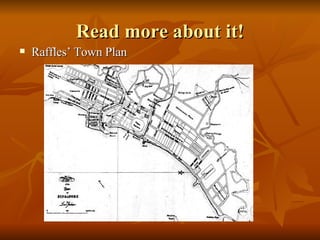
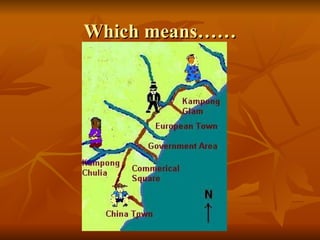
Read more about it! Raffles’ Town Plan
Which means……
Point to ponder ‘ To a large extent, Raffles was racist when he came up with the Raffles’ Town Plan.’ Do you agree? Explain your answer.
The End

Chapter 3

  • 1.
    Chapter 3 Immigrantsand their role in developing Singapore
  • 2.
    Who were theimmigrants? People of different races from different parts of the world who came immediately after Raffles founded Singapore. Population swelled: 1819 – a few hundreds of pirates and Orang Laut 1824 – 10,683 1891 – 181, 602 By 1840, the Chinese outnumbered the Malays. The first people who came were the Malays and the Chinese from Malacca.
  • 3.
    Why did theycome Push factors Lack of jobs in homeland. Natural disasters. Unrest in home country. Famine Poverty Pull factors Absence of restriction on immigrants. Availability of jobs. Business opportunities. Free port Security provided by the British government.
  • 4.
    Where did theycome from? Arabia – the Arabs who were mainly traders. Europe – mainly the British, Dutch and the Portugese. India – Tamils, Malayalees, Gujaratis, Sindhees and Parsees. Some were labourers and convicts, others were laundrymen, milkmen, moneylenders and money changers. Sri Lanka – Tamil and Sinhalese. China – Mainly from Fujian, Guangdong and Hainan Island. Malacca and Penang – Peranakans (Straits-born Chinese). Malay Archipelago – Malays, Javanese, Boyanese and Bugis.
  • 5.
    Factors that ledto growth of trade Political future assured by Anglo-Dutch Treaty which recognised Singapore as a British possession. Free port – No import and export charges and port duties. Its strategic location meant that it could attract traders from the east and west. Private enterprise was encouraged and there were no monopolies.
  • 6.
    How trade wascarried out? Europeans established trading companies and agency houses. They bought and sold goods through Chinese middlemen, usually Straits-born Chinese who were conversant in English and the local languages. Goods sold include: Cotton, woolen cotton, steel and glassware (from Europe) Tea, silk, preserved foodstuff and household ware (China) Elephant tusks, sugar, rice, rhinceros horns and buffalo skin ( SEAsia, Thailand and Indochina) Pepper, bird’s nests, sago and camphor (Malay Archipelago)
  • 7.
    Read more aboutit! Raffles’ Town Plan
  • 8.
  • 9.
    Point to ponder‘ To a large extent, Raffles was racist when he came up with the Raffles’ Town Plan.’ Do you agree? Explain your answer.
  • 10.