4.1 History of Singapore!
!
Early Names!
!
Across the history of the Southeast Asian region, Singapore has been referred to by a variety of
names, such as "Puluozhong", "Temasek" and "Singapura". The last of these is the Malay origins
for the modern name of Singapore.!
!
Puluozhong!
!
A Chinese historical account of Singapore in the third century refers to the island as Puluozhong. It
is derived from the Malay words "pulau ujong", which means "island at the end of the peninsula".!
!
Temasek!
!
In 1365, Singapore was called Temasek in the epic poem "Javanese Nagarakretagama". Temasek
means "sea town" in Malay. The poem is recognised today as the most important piece of literature
ever written during the Majapahit era. Chinese trader Wang Dayuan, who visited Singapore around
1330, wrote the earliest first-hand account of the island's history, referring to Singapore as
"Danmaxi", a Mandarin version of”Temasek”.!
!
!
!
4 Investigate and data
collection : Present city
ENBE	 |	 Final	 Project	 |	 Part	 A	 -	 Report	 |	 The	 Future	 City	 Representation
Singapura!
!
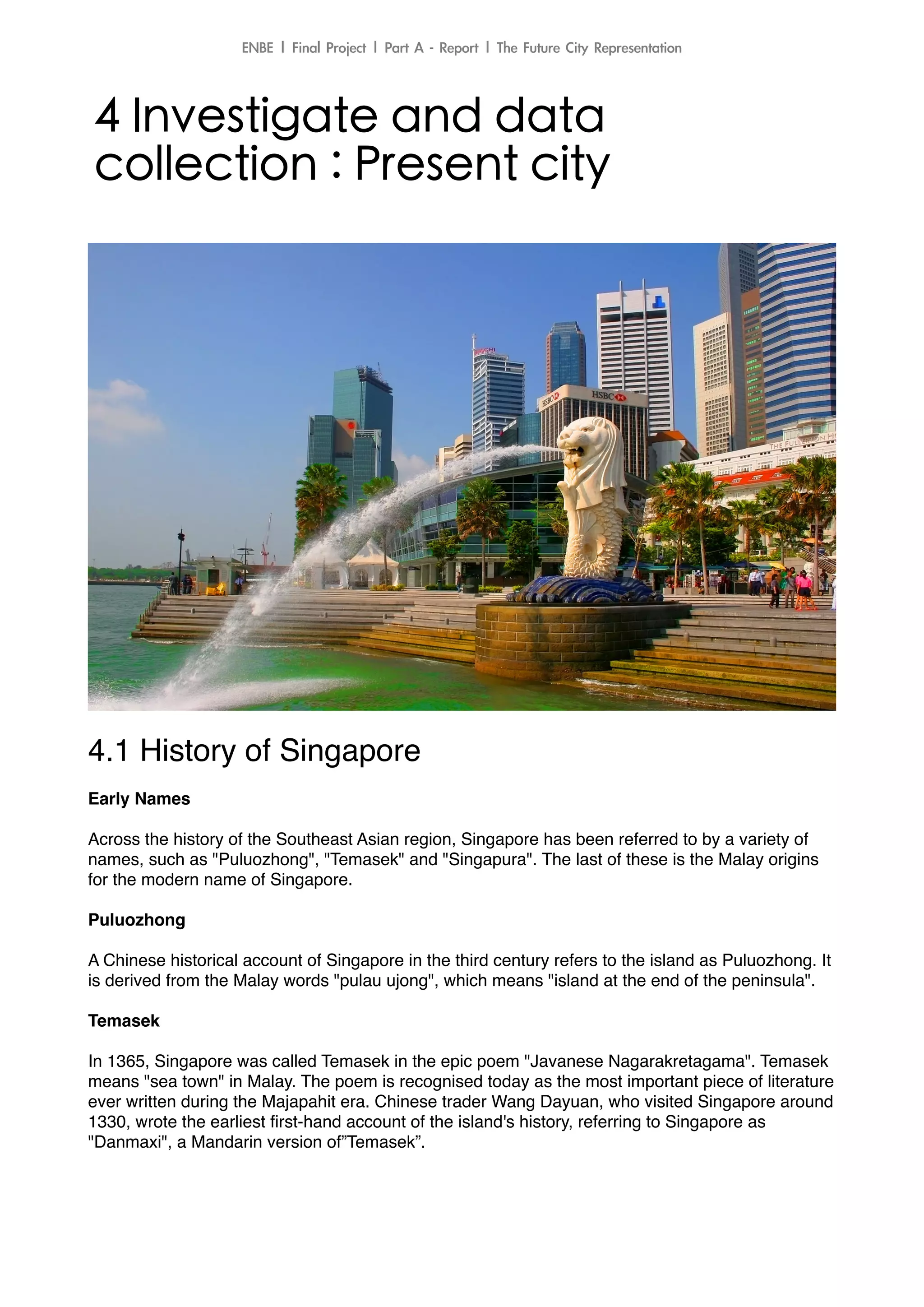
Of all the historical accounts, the "Sejarah Melayu" or "Malay Annals" paints the most captivating
picture of how Singapore came to have its present name. Legend has it that Sang Nila Utama,
then ruler of Palembang (the capital city of the ancient kingdom of Srivijaya), made an unexpected
landing in Temasek. While seeking shelter from the storm, he sighted an animal on the island that
appeared to be a lion. He declared the island's new name to be "Singa Pura", which means "Lion
City" in Malay. It replaced Temasek as the common name for the island by the end of the 14th
century. It was because of this ruler’s keen foresight that Singapore was later established as a
trading post and settlement, due to its naturally strategic location along the Malacca Straits.!
!
Pre-Colonial History!
!
Singapore's early history centred on several struggles for power in the region.!
During the 14th century, the kingdoms of Siam (now Thailand) and the Java-based Majapahit
empire jostled for control over the Malay Peninsula, including Singapore. One account in the
Sejarah Melayu (Malay Annals) cited Singapore as having been lost in a Majapahit attack. Later, a
prince of Palembang, Parameswara (also known as Iskandar Shah), killed the local chief and
made himself the new ruler. However, his reign was short-lived. Parameswara then fled north to
Muar in the Malay Peninsula, and later founded the Malacca Sultanate. Singapore was to become
an important part of the Sultanate, important enough to be the fief of the admirals (laksamanas),
including the famous Hang Tuah.!
By the early 19th century, Singapore had come under the rule of the Sultan of Johor, who
was based in the Riau-Lingga archipelago. One of the Sultan's senior ministers, the Temenggong,
was put in charge of the administration of Johor and Singapore.!
Following that, Singapore faced a major historical transformation. In early 1819, the British
East India Company founded modern Singapore through an agreement with Sultan Hussein Shah
and the Temenggong. At that time, Singapore's population stood at around 1,000 indigenous
people, comprising mainly the Malays and Orang Laut (sea nomads) who clustered around the
Singapore River, Kallang River, Telok Blangah and along the Johor Straits. There were also some
Chinese traders and gambier planters.!
ENBE	 |	 Final	 Project	 |	 Part	 A	 -	 Report	 |	 The	 Future	 City	 Representation

Zelos 4.1

  • 1.
    4.1 History ofSingapore! ! Early Names! ! Across the history of the Southeast Asian region, Singapore has been referred to by a variety of names, such as "Puluozhong", "Temasek" and "Singapura". The last of these is the Malay origins for the modern name of Singapore.! ! Puluozhong! ! A Chinese historical account of Singapore in the third century refers to the island as Puluozhong. It is derived from the Malay words "pulau ujong", which means "island at the end of the peninsula".! ! Temasek! ! In 1365, Singapore was called Temasek in the epic poem "Javanese Nagarakretagama". Temasek means "sea town" in Malay. The poem is recognised today as the most important piece of literature ever written during the Majapahit era. Chinese trader Wang Dayuan, who visited Singapore around 1330, wrote the earliest first-hand account of the island's history, referring to Singapore as "Danmaxi", a Mandarin version of”Temasek”.! ! ! ! 4 Investigate and data collection : Present city ENBE | Final Project | Part A - Report | The Future City Representation
  • 2.
    Singapura! ! Of all thehistorical accounts, the "Sejarah Melayu" or "Malay Annals" paints the most captivating picture of how Singapore came to have its present name. Legend has it that Sang Nila Utama, then ruler of Palembang (the capital city of the ancient kingdom of Srivijaya), made an unexpected landing in Temasek. While seeking shelter from the storm, he sighted an animal on the island that appeared to be a lion. He declared the island's new name to be "Singa Pura", which means "Lion City" in Malay. It replaced Temasek as the common name for the island by the end of the 14th century. It was because of this ruler’s keen foresight that Singapore was later established as a trading post and settlement, due to its naturally strategic location along the Malacca Straits.! ! Pre-Colonial History! ! Singapore's early history centred on several struggles for power in the region.! During the 14th century, the kingdoms of Siam (now Thailand) and the Java-based Majapahit empire jostled for control over the Malay Peninsula, including Singapore. One account in the Sejarah Melayu (Malay Annals) cited Singapore as having been lost in a Majapahit attack. Later, a prince of Palembang, Parameswara (also known as Iskandar Shah), killed the local chief and made himself the new ruler. However, his reign was short-lived. Parameswara then fled north to Muar in the Malay Peninsula, and later founded the Malacca Sultanate. Singapore was to become an important part of the Sultanate, important enough to be the fief of the admirals (laksamanas), including the famous Hang Tuah.! By the early 19th century, Singapore had come under the rule of the Sultan of Johor, who was based in the Riau-Lingga archipelago. One of the Sultan's senior ministers, the Temenggong, was put in charge of the administration of Johor and Singapore.! Following that, Singapore faced a major historical transformation. In early 1819, the British East India Company founded modern Singapore through an agreement with Sultan Hussein Shah and the Temenggong. At that time, Singapore's population stood at around 1,000 indigenous people, comprising mainly the Malays and Orang Laut (sea nomads) who clustered around the Singapore River, Kallang River, Telok Blangah and along the Johor Straits. There were also some Chinese traders and gambier planters.! ENBE | Final Project | Part A - Report | The Future City Representation