Do you know that ….? Dolphins sleep with one eye open. Soap Operas are so called because advertisements in the past during the show were centred around soap powder. It is impossible to keep your eyes open when you sneeze. Leonardo Da Vinci invented the scissors. It is physically impossible for pigs to look at the sky. Bookkeeper is the only English word that has three consecutive double letters.
Your ears and nose continue to grow throughout your life. Mosquitoes are attracted to people who have recently eaten bananas. An ostrich’s eye is bigger than its brain. There are no clocks in Las Vegas gambling casino. You use an average of 43 muscles for a frown. You use an average of 17 muscles for a smile. Every 2000 frowns creates a wrinkle. The list of ingredients that make a lipstick include fish scales. Almost half of the bones in your body are in your hands and feet. Donald Duck comics are banned from Finland because it does not wear pants.
Introduction Can you think of any events or inventions in the 21 st  century that had significant impact on our lives? Examples:  Internet  Transnational Terrorism Mobile phone
How did External Events before WW II affect Singapore?
Industrial Revolution (1750 – 1850) Invention of new machines & discovery of new sources of power to drive these machines. It transformed the way people lived and worked. Example: Making cloth, invention of spinning wheel & steam engine. New modes of traveling: railway train and steamships.
Implications of the new inventions Goods could be produced in large quantities cheaply and swiftly. Raw materials were needed outside Europe. They began to seek new markets outside Europe as well. People could travel longer distances in shorter period of time.
How was Singapore affected? More ships visited Singapore as more Europeans sailed to the East to obtain raw matrials and find markets to sell their goods. Steamships stopped at Singapore to refuel and obtain food supplies from 1880s. Communications improved. A letter which took 5 months to arrive from Europe now took only 5 weeks with the arrival of steamships. Singapore came into closer contact with Britain and the rest of the world.
Suez Canal 1859 – 1869 Ships travelling between Europe and Asia had to sail around the southern tip of Africa, Cape of Good Hope. This long and dangerous journey took 120 days from London in Britain to Singapore. Traders sought to find a shorter route to Asia with the new need to find raw materials and new markets.
Suez Canal (2) French engineer, Ferdinand de Lesseps drew plan to build the canal. Took 10 years, $200 million and 120 000 lives were sacrificed to complete the project.
Effect of the opening of the Canal on Singapore (Text p. 81) Journey from London to Singapore was shorten to 50 days compared to 120 days previously. People, cargoes and mail took a shorter time to reach Singapore. Cost of shipping was reduced as more frequent trips could be made and shorter time was needed. Expansion of trade – volume of imports rose from 25 millions to 55 millions, exports rose from 15 millions to 43 millions. (1859 vs. 1869) –text p.82
Effects of Opening of Canal on S’pore 1852 – New harbour was built in S’pore. (known as Keppel harbour from 1900). Deep waters allowing bigger ships to sail right up to the harbour Islands of Pulau Ubin and Sentosa sheltered the harbour from strong winds and big waves. (text p.83) 1912 – Improvements made to the harbour provided better and faster services at the port. Singapore became one of the busiest ports in Asia.
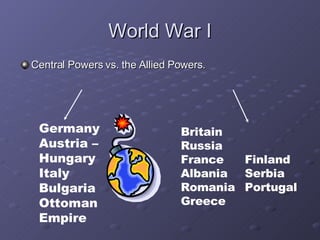
World War I Central Powers vs. the Allied Powers. Germany Austria – Hungary Italy Bulgaria Ottoman Empire Britain Russia France Finland Albania Serbia Romania Portugal Greece
Effects of WW I on S’pore Frantic rush for food supply. Prices soared as a result. Govt forbade export of large quantities of food, increased rice imports and assured people. Things went back to normal after a few weeks. Sept 1914 - Arrival of German warship, Emden threatened trade and shipping in Singapore. Emden destroyed by Sydney in Nov 1914 off Cocos Islands.
Sepoy Mutiny 1915 Sepoys heard rumours that they would be sent to Europe or Turkey to fight against the Muslims. They rebelled and went around killing Europeans in Singapore. Put down after 10 days. 56 Sepoys, 3 Chinese and 2 Malay, and more than 40 Europeans (18 civilians) were killed. 41 Mutineers shot to death and 126 sentenced to jail.
Effect on Local Population No support from the locals. Singaporean Indians did not take part in the mutiny. Sikh police remained loyal to Britain. Large number of Sepoys in the regiment did not take part. British realised they cannot be careless about defence of S’pore, threat could come from within or outside Singapore.
Local help to Britain during WW I European volunteers Many sailed to Europe to fight the war and never came back. Donation of fighter planes Tan Jiak Kim presented Malayan No. 21 to Britain. Altogether 53 planes donated by Singaporeans and Malayans to fight WW I.
Local Help (2) Tan Jiak Kim contributed $18,000 to war funds. Donations were collected, activities were carried out to raise funds. Volunteers signed up to defend important places in Singapore.
Happenings in China 1906 - Dr Sun Yat Sen started Tong Meng Hui in Singapore. 1911 – Fall of Qing Dynasty in China. Dr Sun stopped by Singapore when he returned to China to become the provisional President. Many Chinese donated money and signed up to join his revolutionary army to unite China.
The Great Depression 1920s Depression – great decrease in business activities, with widespread unemployment. Singapore was greatly affected as demand for tin and rubber dropped sharply. Companies suffered losses and retrenched workers. Businessmen became bankrupt. Widespread unemployment and hardship.
Great Depression (2) 1930 – Govt passed law to restrict and reduce number of unskilled labourers coming into S’pore. Numbers unemployed were arranged to be sent back to China and India. By 1934 – business improved and trade started to pick up again.
Conclusions As Singapore depend largely on its human resources and trade, external events will affect us to a large extent. We need to stay receptive to change and be creative in order to survive and strive.

Chapter 5 - How external events affect Singapore?

  • 1.
    Do you knowthat ….? Dolphins sleep with one eye open. Soap Operas are so called because advertisements in the past during the show were centred around soap powder. It is impossible to keep your eyes open when you sneeze. Leonardo Da Vinci invented the scissors. It is physically impossible for pigs to look at the sky. Bookkeeper is the only English word that has three consecutive double letters.
  • 2.
    Your ears andnose continue to grow throughout your life. Mosquitoes are attracted to people who have recently eaten bananas. An ostrich’s eye is bigger than its brain. There are no clocks in Las Vegas gambling casino. You use an average of 43 muscles for a frown. You use an average of 17 muscles for a smile. Every 2000 frowns creates a wrinkle. The list of ingredients that make a lipstick include fish scales. Almost half of the bones in your body are in your hands and feet. Donald Duck comics are banned from Finland because it does not wear pants.
  • 3.
    Introduction Can youthink of any events or inventions in the 21 st century that had significant impact on our lives? Examples: Internet Transnational Terrorism Mobile phone
  • 4.
    How did ExternalEvents before WW II affect Singapore?
  • 5.
    Industrial Revolution (1750– 1850) Invention of new machines & discovery of new sources of power to drive these machines. It transformed the way people lived and worked. Example: Making cloth, invention of spinning wheel & steam engine. New modes of traveling: railway train and steamships.
  • 6.
    Implications of thenew inventions Goods could be produced in large quantities cheaply and swiftly. Raw materials were needed outside Europe. They began to seek new markets outside Europe as well. People could travel longer distances in shorter period of time.
  • 7.
    How was Singaporeaffected? More ships visited Singapore as more Europeans sailed to the East to obtain raw matrials and find markets to sell their goods. Steamships stopped at Singapore to refuel and obtain food supplies from 1880s. Communications improved. A letter which took 5 months to arrive from Europe now took only 5 weeks with the arrival of steamships. Singapore came into closer contact with Britain and the rest of the world.
  • 8.
    Suez Canal 1859– 1869 Ships travelling between Europe and Asia had to sail around the southern tip of Africa, Cape of Good Hope. This long and dangerous journey took 120 days from London in Britain to Singapore. Traders sought to find a shorter route to Asia with the new need to find raw materials and new markets.
  • 9.
    Suez Canal (2)French engineer, Ferdinand de Lesseps drew plan to build the canal. Took 10 years, $200 million and 120 000 lives were sacrificed to complete the project.
  • 10.
    Effect of theopening of the Canal on Singapore (Text p. 81) Journey from London to Singapore was shorten to 50 days compared to 120 days previously. People, cargoes and mail took a shorter time to reach Singapore. Cost of shipping was reduced as more frequent trips could be made and shorter time was needed. Expansion of trade – volume of imports rose from 25 millions to 55 millions, exports rose from 15 millions to 43 millions. (1859 vs. 1869) –text p.82
  • 11.
    Effects of Openingof Canal on S’pore 1852 – New harbour was built in S’pore. (known as Keppel harbour from 1900). Deep waters allowing bigger ships to sail right up to the harbour Islands of Pulau Ubin and Sentosa sheltered the harbour from strong winds and big waves. (text p.83) 1912 – Improvements made to the harbour provided better and faster services at the port. Singapore became one of the busiest ports in Asia.
  • 12.
    World War ICentral Powers vs. the Allied Powers. Germany Austria – Hungary Italy Bulgaria Ottoman Empire Britain Russia France Finland Albania Serbia Romania Portugal Greece
  • 13.
    Effects of WWI on S’pore Frantic rush for food supply. Prices soared as a result. Govt forbade export of large quantities of food, increased rice imports and assured people. Things went back to normal after a few weeks. Sept 1914 - Arrival of German warship, Emden threatened trade and shipping in Singapore. Emden destroyed by Sydney in Nov 1914 off Cocos Islands.
  • 14.
    Sepoy Mutiny 1915Sepoys heard rumours that they would be sent to Europe or Turkey to fight against the Muslims. They rebelled and went around killing Europeans in Singapore. Put down after 10 days. 56 Sepoys, 3 Chinese and 2 Malay, and more than 40 Europeans (18 civilians) were killed. 41 Mutineers shot to death and 126 sentenced to jail.
  • 15.
    Effect on LocalPopulation No support from the locals. Singaporean Indians did not take part in the mutiny. Sikh police remained loyal to Britain. Large number of Sepoys in the regiment did not take part. British realised they cannot be careless about defence of S’pore, threat could come from within or outside Singapore.
  • 16.
    Local help toBritain during WW I European volunteers Many sailed to Europe to fight the war and never came back. Donation of fighter planes Tan Jiak Kim presented Malayan No. 21 to Britain. Altogether 53 planes donated by Singaporeans and Malayans to fight WW I.
  • 17.
    Local Help (2)Tan Jiak Kim contributed $18,000 to war funds. Donations were collected, activities were carried out to raise funds. Volunteers signed up to defend important places in Singapore.
  • 18.
    Happenings in China1906 - Dr Sun Yat Sen started Tong Meng Hui in Singapore. 1911 – Fall of Qing Dynasty in China. Dr Sun stopped by Singapore when he returned to China to become the provisional President. Many Chinese donated money and signed up to join his revolutionary army to unite China.
  • 19.
    The Great Depression1920s Depression – great decrease in business activities, with widespread unemployment. Singapore was greatly affected as demand for tin and rubber dropped sharply. Companies suffered losses and retrenched workers. Businessmen became bankrupt. Widespread unemployment and hardship.
  • 20.
    Great Depression (2)1930 – Govt passed law to restrict and reduce number of unskilled labourers coming into S’pore. Numbers unemployed were arranged to be sent back to China and India. By 1934 – business improved and trade started to pick up again.
  • 21.
    Conclusions As Singaporedepend largely on its human resources and trade, external events will affect us to a large extent. We need to stay receptive to change and be creative in order to survive and strive.