Main subject- English Literature
Unit -3 : Fiction
The Great Gatsby by F. Scott. Fitzgerald
Resource Person
Dipali Nayee
GSET Qualified
F. Scott. Fitzgerald ( 1896-1940)
 American novelist, essayist, screenwriter and short-story writer.
 Fitzgerald consider to be a Lost Generation writer.
 His works deals with Jazz music, elements of Roaring Twenties and Flapper culture.
 At the age of 13, his first work published, a detective story in the school newspaper.
 He served in US Army as a second lieutenant.
 He fell in love with Ginevra king, Daisy’s (heroine of the novel) character based on
her.
 He married with Zelda Sayre.
 He wrote 4 novels, 4 collections of short stories, 164 short stories.
 He died at the age of 44.
His works
 This Side of Paradise (1920)
 The Beautiful and Dammed (1922)
 The Great Gatsby (1925)
 Tender Is the Night (1934)
 The Last Tycoon (1941) – unfinished novel, posthumously published after
prepared by his friend.
The Great Gatsby (1925)
About the Novel:
 Fitzgerald inspired by the parties he had attended while visiting Long Island’s
North Shore, began planning the novel in 1923, desiring to produce, in his
words, “something new- something extraordinary and beautiful and simple
and intricately patterned”.
 The Great Gatsby published in 1925, received mixed reviews, and sold poorly.
 Fitzgerald died in 1940, believing himself to be failure and his work forgotten.
 However, the novel experienced a revival during World War II, and became a
part of American high school curricula and numerous stage adaptation in the
following decades.
 The Great Gatsby widely consider to be a literary classic and achieved title of
the “Great American Novel”.
The Great Gatsby (1925)
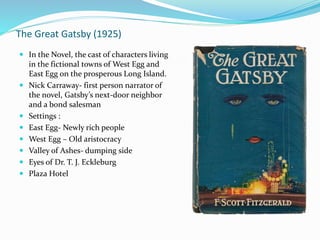
 In the Novel, the cast of characters living
in the fictional towns of West Egg and
East Egg on the prosperous Long Island.
 Nick Carraway- first person narrator of
the novel, Gatsby’s next-door neighbor
and a bond salesman
 Settings :
 East Egg- Newly rich people
 West Egg – Old aristocracy
 Valley of Ashes- dumping side
 Eyes of Dr. T. J. Eckleburg
 Plaza Hotel
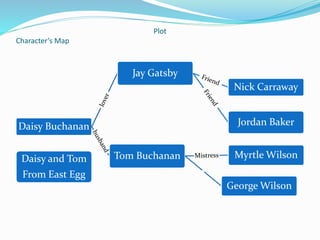
Plot
Character’s Map
Daisy Buchanan
Jay Gatsby
Nick Carraway
Jordan Baker
Tom Buchanan Myrtle Wilson
George Wilson
Daisy and Tom
From East Egg
Themes of the Novel
American Dream
 "The American Dream is a national ethos of the United States, the set of ideals
that include liberty, opportunity and equality". Liberty includes prosperity and
success for all people. The American Dream is not only a dream of an
individual but a dream of a nation and a whole age. On the contrary to it,
Gatsby’s dream revolves around an individual motif, to be loved by Daisy. He
accumulated wealth after knowing Daisy’s affection for affluent people. So,
here one can easily notice how Fitzgerald uses the symbol of the fall of
American dream in the life of Gatsby.
 The American Dream asserts that wealth can be gained through hard work.
Though we can learn from the novel Gatsby's money comes from crime and
illegal activities like bootlegging. Gatsby buys a luxurious mansion in the West
Egg but he remains strange from the world of the East Egg that is a world for
old money. That's why the novel ends with Nick's sad contemplation of the
American Dream.
Jazz Age
 The Jazz Age is a term coined by F. Scott Fitzgerald to illustrate the condition of
America in 1920. It occurred between the First World War and the Great
Depression. The 1920s is considered the Jazz Age because this is the time when
jazz music blossomed and became tremendously popular. It is a crazy and
difficult time, and full of wealth, frivolity and carelessness. The young man in
that period began to rebel against the traditional culture and morality of
previous generations, as Gatsby plays a palpable example of it, who had
contempt for life and engaged themselves in pursuing money and enjoying the
carefree hedonism. People like Tom and Daisy are driving fast cars, drinking
hard whisky, and taking an immense delight in it. This age owns the most
expensive carnival like Gatsby’s extravagant parties. People’s spirit became
decadence gradually until its corruption as Gatsby’s illegal business of
bootlegging, as alcohol was banned in the entire US.
Flapper period and Roaring Twenties
 Jazz Age is also called the Flapper Period and Roaring Twenties. As a result of
the financial explosion, people changed their perspectives towards women, by
the consequences they obtained more rights and freedom in their work and
life, in this way it became a revolt against so-called male chauvinism, which was
established through the ages. For example, they wore short skirts and short
hair; they smoked, drank and danced wildly. In this novel Daisy and Jordan
Baker represent that type of woman, they wore short skirts with short hair, they
always seemed to be smoking, drinking and attending parties, Jazz music and
wild dance going on.
 It is also called the Roaring Twenties because of moral decay and the loss of
faith, which makes people feel that life is dislocated, chaotic and fragmented as
Gatsby always suffers from it. His chaos reflected concretely in the lavish
parties, cocktail, jazz, wild dance, violence as well as the conflict between the
traditional ethic and the modern values.
Money and Immorality
 F. Scott Fitzgerald’s novel THE GREAT GATSBY, which deals with major
issues American society was facing in that period. Different characters
like Jay Gatsby, Tom, Daisy, Myrtle Wilson and Wolfsheim are all
embodiment of this materialistic society, money creates a big illusion
in their mind. They want to accomplish their dream, hope, love,
happiness by money but their way is not convenient, so it leads to
immorality.
 The creation of Jay Gatsby’s money comes from bootlegging, and he
attempts to cover it by saying that his wealth comes from a wealthy
Midwestern family. Money creates an illusion of Gatsby’s mind because
he follows the dream to win his love Daisy again. His illegal activities
leads to immorality. At the end none of his relatives or friends attend
his funeral except 5 people.
Symbols
 Valley of Ashes:
It is set between West Egg and New York. The ashes are made by industry that
helps others to be rich and it compels to the poor to live in this condition. The
poor people who live on this dumping side are endured by the rich people.
They used them as Tom used to Myrtle.
 Eyes of Dr. T. J Eckleburg
His eyes symbolize God’s eyes, judging and looking at people who lost their
morality and look down upon humanity and human condition. Fitzgerald uses
a remarkable place for these eyes, along the road from West Egg to Manhattan,
near George Wilson's garage.
THANK YOU

Net coaching & remedial classes

  • 1.
    Main subject- EnglishLiterature Unit -3 : Fiction The Great Gatsby by F. Scott. Fitzgerald Resource Person Dipali Nayee GSET Qualified
  • 2.
    F. Scott. Fitzgerald( 1896-1940)  American novelist, essayist, screenwriter and short-story writer.  Fitzgerald consider to be a Lost Generation writer.  His works deals with Jazz music, elements of Roaring Twenties and Flapper culture.  At the age of 13, his first work published, a detective story in the school newspaper.  He served in US Army as a second lieutenant.  He fell in love with Ginevra king, Daisy’s (heroine of the novel) character based on her.  He married with Zelda Sayre.  He wrote 4 novels, 4 collections of short stories, 164 short stories.  He died at the age of 44.
  • 3.
    His works  ThisSide of Paradise (1920)  The Beautiful and Dammed (1922)  The Great Gatsby (1925)  Tender Is the Night (1934)  The Last Tycoon (1941) – unfinished novel, posthumously published after prepared by his friend.
  • 4.
    The Great Gatsby(1925) About the Novel:  Fitzgerald inspired by the parties he had attended while visiting Long Island’s North Shore, began planning the novel in 1923, desiring to produce, in his words, “something new- something extraordinary and beautiful and simple and intricately patterned”.  The Great Gatsby published in 1925, received mixed reviews, and sold poorly.  Fitzgerald died in 1940, believing himself to be failure and his work forgotten.  However, the novel experienced a revival during World War II, and became a part of American high school curricula and numerous stage adaptation in the following decades.  The Great Gatsby widely consider to be a literary classic and achieved title of the “Great American Novel”.
  • 5.
    The Great Gatsby(1925)  In the Novel, the cast of characters living in the fictional towns of West Egg and East Egg on the prosperous Long Island.  Nick Carraway- first person narrator of the novel, Gatsby’s next-door neighbor and a bond salesman  Settings :  East Egg- Newly rich people  West Egg – Old aristocracy  Valley of Ashes- dumping side  Eyes of Dr. T. J. Eckleburg  Plaza Hotel
  • 6.
    Plot Character’s Map Daisy Buchanan JayGatsby Nick Carraway Jordan Baker Tom Buchanan Myrtle Wilson George Wilson Daisy and Tom From East Egg
  • 7.
    Themes of theNovel American Dream  "The American Dream is a national ethos of the United States, the set of ideals that include liberty, opportunity and equality". Liberty includes prosperity and success for all people. The American Dream is not only a dream of an individual but a dream of a nation and a whole age. On the contrary to it, Gatsby’s dream revolves around an individual motif, to be loved by Daisy. He accumulated wealth after knowing Daisy’s affection for affluent people. So, here one can easily notice how Fitzgerald uses the symbol of the fall of American dream in the life of Gatsby.  The American Dream asserts that wealth can be gained through hard work. Though we can learn from the novel Gatsby's money comes from crime and illegal activities like bootlegging. Gatsby buys a luxurious mansion in the West Egg but he remains strange from the world of the East Egg that is a world for old money. That's why the novel ends with Nick's sad contemplation of the American Dream.
  • 8.
    Jazz Age  TheJazz Age is a term coined by F. Scott Fitzgerald to illustrate the condition of America in 1920. It occurred between the First World War and the Great Depression. The 1920s is considered the Jazz Age because this is the time when jazz music blossomed and became tremendously popular. It is a crazy and difficult time, and full of wealth, frivolity and carelessness. The young man in that period began to rebel against the traditional culture and morality of previous generations, as Gatsby plays a palpable example of it, who had contempt for life and engaged themselves in pursuing money and enjoying the carefree hedonism. People like Tom and Daisy are driving fast cars, drinking hard whisky, and taking an immense delight in it. This age owns the most expensive carnival like Gatsby’s extravagant parties. People’s spirit became decadence gradually until its corruption as Gatsby’s illegal business of bootlegging, as alcohol was banned in the entire US.
  • 9.
    Flapper period andRoaring Twenties  Jazz Age is also called the Flapper Period and Roaring Twenties. As a result of the financial explosion, people changed their perspectives towards women, by the consequences they obtained more rights and freedom in their work and life, in this way it became a revolt against so-called male chauvinism, which was established through the ages. For example, they wore short skirts and short hair; they smoked, drank and danced wildly. In this novel Daisy and Jordan Baker represent that type of woman, they wore short skirts with short hair, they always seemed to be smoking, drinking and attending parties, Jazz music and wild dance going on.  It is also called the Roaring Twenties because of moral decay and the loss of faith, which makes people feel that life is dislocated, chaotic and fragmented as Gatsby always suffers from it. His chaos reflected concretely in the lavish parties, cocktail, jazz, wild dance, violence as well as the conflict between the traditional ethic and the modern values.
  • 10.
    Money and Immorality F. Scott Fitzgerald’s novel THE GREAT GATSBY, which deals with major issues American society was facing in that period. Different characters like Jay Gatsby, Tom, Daisy, Myrtle Wilson and Wolfsheim are all embodiment of this materialistic society, money creates a big illusion in their mind. They want to accomplish their dream, hope, love, happiness by money but their way is not convenient, so it leads to immorality.  The creation of Jay Gatsby’s money comes from bootlegging, and he attempts to cover it by saying that his wealth comes from a wealthy Midwestern family. Money creates an illusion of Gatsby’s mind because he follows the dream to win his love Daisy again. His illegal activities leads to immorality. At the end none of his relatives or friends attend his funeral except 5 people.
  • 11.
    Symbols  Valley ofAshes: It is set between West Egg and New York. The ashes are made by industry that helps others to be rich and it compels to the poor to live in this condition. The poor people who live on this dumping side are endured by the rich people. They used them as Tom used to Myrtle.  Eyes of Dr. T. J Eckleburg His eyes symbolize God’s eyes, judging and looking at people who lost their morality and look down upon humanity and human condition. Fitzgerald uses a remarkable place for these eyes, along the road from West Egg to Manhattan, near George Wilson's garage.
  • 12.